1. Introduction
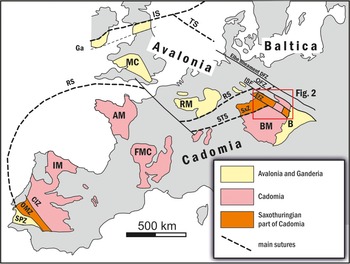
Several crustal fragments of the Bohemian Massif comprise Neoproterozoic-Early Ordovician volcano-sedimentary successions formed at the northern Gondwana margin. In the Neoproterozoic and early Cambrian, northern part of Gondwana was a long volcano-magmatic arc formed in response to subduction of oceanic domains identified in the literature as the Iapetus and Tornquist Oceans (e.g. Linnemann et al. Reference Linnemann, Gerdes, Drost and Buschmann2007; Nance et al. Reference Nance, Gutiérrez-Alonso, Keppie, Linnemann, Murphy, Quesada, Strachan and Woodcock2012; Domeier, Reference Domeier2016; Boris, Domeier & Jakob, Reference Boris, Domeier and Jakob2021; Oriolo et al. Reference Oriolo, Schulz, Geuna, González, Otamendi, Sláma, Druguet and Siegesmund2021) or the Paleo-Pacific Ocean (Merdith et al. Reference Merdith, Williams, Collins, Tetley, Mulder, Blades, Young, Armistead, Cannon, Zahirovic and Müller2021). During the late Cambrian and Early Ordovician, the arc was split into two parts called Avalonia and Cadomia, and separated by the newly opened Rheic Ocean (e.g. Linnemann et al. Reference Linnemann, McNaughton, Romer, Gehmlich, Drost and Tonk2004; Linnemann et al. Reference Linnemann, Pereira, Jeffries, Drost and Gerdes2008; Nance & Linnemann, Reference Nance and Linnemann2008; Oriolo et al. Reference Oriolo, Schulz, Geuna, González, Otamendi, Sláma, Druguet and Siegesmund2021). This resulted in the late Cambrian-Early Ordovician times in transformation of the Gondwana active margin into a passive margin, although the mechanism responsible for this transformation is still debated (e.g. Winchester et al. Reference Winchester, Pharaoh, Verniers, Ioane and Seghedi2006; Linnemann et al. Reference Linnemann, Pereira, Jeffries, Drost and Gerdes2008; Sláma et al. Reference Sláma, Dunkley, Kachlík and Kusiak2008b; Nance et al. Reference Nance, Gutiérrez-Alonso, Keppie, Linnemann, Murphy, Quesada, Strachan and Woodcock2010; Díez Fernández et al. Reference Díez Fernández, Castiñeiras and Gómez Barreiro2012; Hajná et al. Reference Hajná, Žák, Dörr, Kachlík and Sláma2018). Subsequently, during the closure of the Rheic Ocean, remnants of the Neoproterozoic basement were trapped between the colliding continents of Gondwana and Laurussia and recycled in the Variscan belt of Europe. Subsequently, remnants of the Avalonian and Cadomian basement were dispersed throughout the Variscan belt of Europe and juxtaposed along the Rheic suture (Fig. 1). The suture is relatively well documented in the western and central sectors of the Variscan belt of Europe (e.g. Linnemann et al. Reference Linnemann, Gerdes, Drost and Buschmann2007; Pérez-Cáceres et al. Reference Pérez-Cáceres, Martínez Poyatos, Simancas and Azor2015; Kirchner & Albert, Reference Kirchner and Albert2020). However, in its eastern part, that is, in the Sudetes, the location of the suture is still poorly recognized. Some authors discussed the presence of the Rheic suture between the Central and East Sudetes (e.g. Mazur et al. Reference Mazur, Szczepański, Turniak and McNaughton2012; Jastrzębski et al. Reference Jastrzębski, Żelaźniewicz, Majka, Murtezi, Bazarnik and Kapitonov2013; Jastrzębski et al. Reference Jastrzębski, Żelaźniewicz, Murtezi, Larionov and Sergeev2015; Oberc-Dziedzic et al. Reference Oberc-Dziedzic, Kryza, Madej and Pin2018; Jastrzębski et al. Reference Jastrzębski, Żelaźniewicz, Budzyń, Sláma and Konečny2020; Śliwiński et al. Reference Śliwiński, Jastrzębski and Sláma2022), while others questioned its existence in this fragment of the Variscan belt of Europe (Soejono et al. Reference Soejono, Žáčková, Janoušek, Machek and Košler2010; Collett et al. Reference Collett, Štípská, Schulmann, Míková and Kröner2021, Reference Collett, Schulmann, Deiller, Štípská, Peřestý, Ulrich, Jiang, de Hoÿm de Marien and Míková2022). Unfortunately, this fragment of the Variscan orogen is partly located on the Fore-Sudetic Block, where the metamorphic basement is mostly covered by Cenozoic sediments. Therefore, unravelling the location of the suture in this portion of the Sudetes and the nature of the exposed basement is disputable, and every new piece of evidence becomes important.
Peri-Gondwanan terranes of Southern and Central Europe (modified from Franke, Reference Franke1989; Linnemann et al. Reference Linnemann, Gerdes, Drost and Buschmann2007; Nance et al. Reference Nance, Murphy, Strachan, Keppie, Gutierrez Alonso, Fernandez Suarez, Quesada, Linnemann, d’Lemos and Pisarevsky2008). AM – Armorican Massif, IM – Iberian Massif, FMC – French Massif Central, BM – Bohemian Massif, RM – Rhenish Massif, MC – Midland Craton, B – Brunovistulicum, Ga- Ganderia, SPZ – South Portuguese Zone, OMZ – Ossa-Morena Zone, CIZ- Central Iberian Zone, SxZ – Saxothuringian Zone, EFZ – Elbe Fault Zone, ISF – Intra Sudetic Fault, DFZ – Dolsk Fault Zone, OFZ – Odra Fault Zone, IS – Iapetus Suture, RS – Rheic Suture STS – Saxothuringian Suture, TS – Thor Suture.

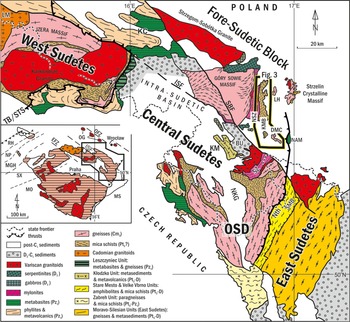
In this paper, we present new LA–ICP–MS U–Pb data on zircons and bulk chemical composition of the volcano-sedimentary successions from the Kamieniec Metamorphic Belt (KMB) and the Doboszowice Metamorphic Complex (DMC) exposed in the eastern part of the Fore-Sudetic Block (Fig. 2). The data are used to describe the provenance of the detrital material, the time of deposition and the tectonic setting of the formation of the volcano-sedimentary successions in the eastern part of the Fore-Sudetic Block. This allows us to propose a new model for the development of the Cambro-Ordovician rocks cropping out in the eastern part of the Fore-Sudetic Block from the early Palaeozoic to the Carboniferous. The model is generally consistent with those proposed for other Late Neoproterozoic and Cambro-Ordovician sequences exposed in the Bohemian Massif (Jastrzębski et al. Reference Jastrzębski, Budzyń and Stawikowski2017; Hajná et al. Reference Hajná, Žák, Dörr, Kachlík and Sláma2018; Collett et al. Reference Collett, Schulmann, Štípská and Míková2020; Soejono et al. Reference Soejono, Machek, Sláma, Janoušek and Kohút2020; Collett et al. Reference Collett, Schulmann, Deiller, Štípská, Peřestý, Ulrich, Jiang, de Hoÿm de Marien and Míková2022; Soejono et al. Reference Soejono, Schulmann, Sláma, Hrdličková, Hanžl, Konopásek, Collett and Míková2022). Our data combined with already published results shed new light on the development of the passive Gondwana margin and the nature of the tectonic suture separating the Central and East Sudetes. Furthermore, the presented data provide important time limitations on the Variscan tectonothermal event responsible for recycling of the Cadomian crust.
Geological sketch map of the Sudetes after Mazur et al. (Reference Mazur, Aleksandrowski, Kryza and Oberc-Dziedzic2006). Abbreviations: BU – Bardo Sedimentary unit; OSD – Orlica-Śnieżnik Dome, ISF – Intra-Sudetic fault; KM – Kłodzko massif; KMB – Kamieniec Metamorphic Belt; DMC – Doboszowice Metamorphic Complex; LM – Lusatian massif; NKG – Nysa Kłodzka Graben, NAM – Niedźwiedź amphibolite massif; LH – Lipowe Hills Massif; SBF – Sudetic boundary fault; SMB – Staré Město Belt; TB/STS – Teplá-Barrandian/Saxothuringian suture; Nth – Nyznerov thrust. Abbreviations inset: EFZ – Elbe Fault Zone, MGH – Mid-German Crystalline High; MO – Moldanubian zone; MS – Moravo-Silesian zone; NP – Northern Phyllite zone; OG – Odra granitoids, OFZ – Odra Fault Zone, RH – Rhenohercynian zone; SX – Saxothuringian zone. Age assignments: Pt – Proterozoic; Pz – Palaeozoic; Cm – Cambrian; Or – Ordovician; D – Devonian; C – Carboniferous; 1 – Early; 2 – Middle.

2. Geological setting
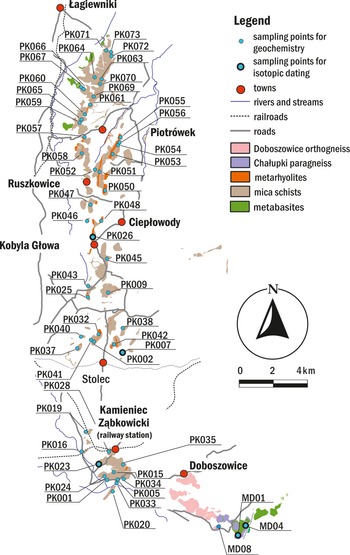
The KMB and the DMC are fragments of the crystalline basement, emerging from below the younger Cenozoic cover of the Fore-Sudetic Block (Fig. 2). The KMB forms c. 25 km long and 5 km wide longitudinal belt between the Góry Sowie Massif and the Niemcza Shear Zone in the west and the Strzelin Crystalline Massif (including the Lipowe Hills) in the east (Fig. 2). A volcano-sedimentary succession exposed in the KMB is dominated by mica schists intercalated with scarce paragneisses, marbles, quartz-graphite schists, eclogites, and felsic volcanics (Fig. 3). The latter are interpreted as tuffs or lava flows (Dziedzicowa, Reference Dziedzicowa1966). On the contrary, the DMC is a c. 6 km long exposure of crystalline basement located south-east of the KMB and directly west of the Niedźwiedź Amphibolite Massif (NAM, Fig. 2). The DMC may be divided into a western and an eastern parts. The western part exposes the Doboszowice orthogneiss with protolith age dated on zircons using U–Pb SHRIMP at 488 ± 6 Ma (Mazur et al. Reference Mazur, Kröner, Szczepański, Turniak, Hanžl, Melichar, Rodionov, Paderin and Sergeev2010) or at 494 ± 5 Ma using U–Pb ICP–MS (Jastrzębski et al. Reference Jastrzębski, Żelaźniewicz, Stawikowski, Budzyń, Krzemińska, Machowiak, Madej, Białek, Sláma, Czupyt and Jaźwa2023). The eastern part is mainly composed of the migmatic Chałupki paragneiss interleaved with scarce mica schists and metabasalts of unknown age (Fig. 3). The protolith age of the volcano-sedimentary successions exposed in the KMB and DMC is poorly known. Available data suggest that the maximum depositional age (MDA) of the KMB and the adjacent Lipowe Hills mica schists is in the range of c. 560–570 Ma (Oberc-Dziedzic et al. Reference Oberc-Dziedzic, Kryza, Madej and Pin2018; Jastrzębski et al. Reference Jastrzębski, Żelaźniewicz, Budzyń, Sláma and Konečny2020), while the Chałupki paragneiss from the DMC has a late Cambrian MDA (Jastrzębski et al. Reference Jastrzębski, Żelaźniewicz, Stawikowski, Budzyń, Krzemińska, Machowiak, Madej, Białek, Sláma, Czupyt and Jaźwa2023).
Geological sketch map of the Kamieniec Metamorphic Belt and the Doboszowice Metamorphic Complex.

The volcano-sedimentary successions comprised in the KMB and DMC suffered a Variscan metamorphism. According to several authors, it was related to continental collision between two Gondwana-derived crustal domains represented by the Saxothuringian and Brunovistulian (e.g. Schulmann et al. Reference Schulmann, Konopásek, Janousek, Lexa, Lardeaux, Edel, Stípská and Ulrich2009; Chopin et al. Reference Chopin, Schulmann, Skrzypek, Lehmann, Dujardin, Martelat, Lexa, Corsini, Edel, Štípská and Pitra2012; Jastrzębski et al. Reference Jastrzębski, Żelaźniewicz, Budzyń, Sláma and Konečny2020; Szczepański et al. Reference Szczepański, Zhong, Dąbrowski, Wang and Goleń2022; Szczepański & Goleń, Reference Szczepański and Goleń2022). However, the metamorphic records preserved in the KMB and DMC are strikingly different. The mica schists of the KMB underwent HP-LT metamorphism at c. 490oC and 18 kbar which was overprinted by LP-HT episode at c. 530–580oC and 3–7 kbar (Szczepański et al. Reference Szczepański, Zhong, Dąbrowski, Wang and Goleń2022; Szczepański & Goleń, Reference Szczepański and Goleń2022). On the other hand, the migmatized Chałupki paragneiss bears record of HT metamorphism at max. 670oC and 8 kbar (Puziewicz et al. Reference Puziewicz, Mazur and Papiewska1999; Szczepański & Marciniak, Reference Szczepański and Marciniak2018). The age of the tectonothermal event recorded in the KMB has recently been estimated at c. 330 Ma (Jastrzębski et al. Reference Jastrzębski, Żelaźniewicz, Budzyń, Sláma and Konečny2020) and in the DMC at c. 346–341 Ma based on ICP–MS U–Th–Pb dating of monazite (Jastrzębski et al. Reference Jastrzębski, Żelaźniewicz, Stawikowski, Budzyń, Krzemińska, Machowiak, Madej, Białek, Sláma, Czupyt and Jaźwa2023). This is in agreement with Lu-–Hf and Sm–Nd garnet dating of the Chałupki paragneiss, which shows that these rocks were metamorphosed between 347 ± 3.6 Ma and 337.3 ± 6.6 Ma (Szczepanski et al. Reference Szczepanski, Anczkiewicz and Marciniak2022).
3. Analytical methods
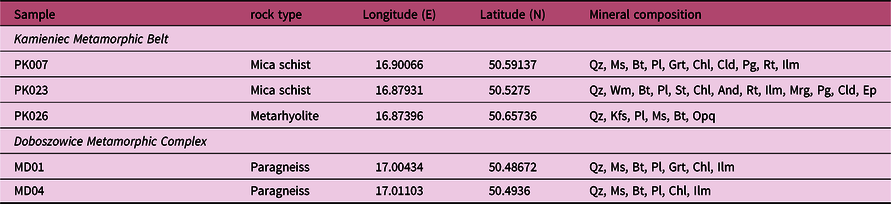
Bulk rock chemical analyses of 53 mica schists, 10 paragneisses and 17 quartz-feldspathic rocks (interpreted as metarhyolites, see below) were performed at Acme Analytical Laboratories Ltd. (Vancouver, Canada) and are summarized in Supplementary Table 1. The location of all the samples used in this study is shown in Fig. 3. The location and a brief petrological description of the geochronological samples from the studied units are given in Table 1. Major and trace element abundances were determined using ICP-MS following lithium metaborate fusion and nitric acid digestion of 0.2 g of representative whole-rock powder. Loss on ignition (LOI) was measured by weight difference after ignition at 1000oC. The detection limits are within 0.01% for major elements, between 0.05 and 0.5 ppm for most trace elements. The detection limits for all analysed elements are given in Supplementary Table 1. Geochemical diagrams were designed using the R software environment (R Core Team, 2021).
Location and brief petrological description of geochronological samples from the studied area. The abbreviations of mineral names are after Whitney and Evans (Reference Whitney and Evans2010)

Mineral separation was carried out at the Kraków Research Centre, Institute of Geological Sciences, Polish Academy of Sciences following conventional techniques involving crushing, sieving, heavy liquids and Frantz magnetic separator. Zircon grains were hand-picked under a binocular so that representative population was achieved. Cathodoluminescent images of zircons were obtained using a JEOL electron microscope (15 kV and 1 nA) at the Institute of Geological Sciences, University of Wroclaw, Poland.
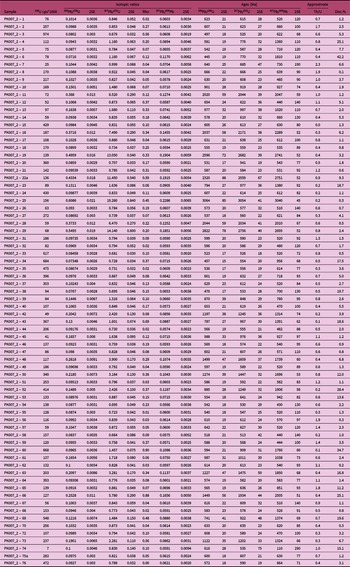
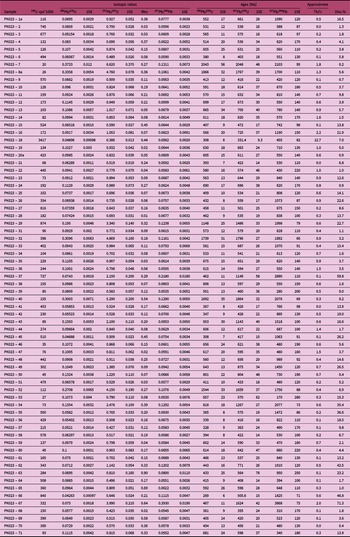
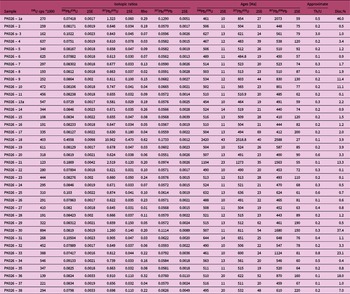
In situ U-Pb detrital zircon dating of five samples by laser ablation inductively coupled plasma mass spectrometry (LA ICP-MS) was conducted at the Kraków Research Centre, Institute of Geological Sciences, Polish Academy of Sciences. The analyses were carried out using an excimer laser (ArF) RESOlution by Resonetics (now Applied Spectra) equipped with S155 dual-volume, large format sample cell. Laser ablation was coupled with ICP-MS XseriesII by ThermoFisher Scientific. Ablation took place in He which was mixed downstream with Ar and small amount of nitrogen to enhance sensitivity of ICP-MS. Before reaching the plasma, the carrier gas passes through a signal smoothing manifold. We applied a 32 µm diameter laser spot of about 3 J/cm2 energy fired with 5 Hz frequency (analytical parameters are summarized in Supplementary Table 2). The main ablation is preceded by two surface cleaning shots and gas blank measurement. Zircon Z91500 (Wiedenbeck et al. Reference Wiedenbeck, Allé, Corfu, Griffin, Meier, Oberli, Quadt, Roddick and Spiegel1995) was used as a primary standard, and zircons GJ-1 (Jackson et al. Reference Jackson, Pearson, Griffin and Belousova2004) and/or Plešovice (Sláma et al. Reference Sláma, Košler, Condon, Crowley, Gerdes, Hanchar, Horstwood, Morris, Nasdala, Norberg, Schaltegger, Schoene, Tubrett and Whitehouse2008a) were frequently measured for quality control. Typically, two primary standards were measured every six or seven unknowns (Supplementary Table 3). For each analytical session, the secondary standards yielded Concordia ages accurate within ≤ 1% precision (two relative standard deviations).
The data were reduced using Iolite 3 software (Paton et al. Reference Paton, Hellstrom, Paul, Woodhead and Hergt2011). The data treatment along with the error propagation method are presented in Paton et al. (Reference Paton, Woodhead, Hellstrom, Hergt, Greig and Maas2010). No common Pb correction was applied. All analyses are presented on the Concordia plots using Isoplot/Ex 4.15 (Ludwig, Reference Ludwig2008), whereas the KDE diagrams contain only zircons with ≤ 10% discordance (% discordance = [1 – (206Pb/238U age)/(207Pb/235U age)] × 100%). For KDE, we used 206Pb/238U ages except for zircons older than 1 Ga, for which we used 207Pb/206Pb ages. The diagrams were constructed using the R software environment (R Core Team, 2021). The MDA of the sedimentary protolith was defined according to Dickinson and Gehrels (Reference Dickinson and Gehrels2009) using the youngest graphical detrital zircon age peak on an age probability plot and the mean age of the youngest two or more grains that overlap in age at 1σ. In our interpretation of MDA, we ignored single-grain age peaks. All mineral abbreviations are after Whitney and Evans (Reference Whitney and Evans2010).
3.a. Petrography of geochronological samples
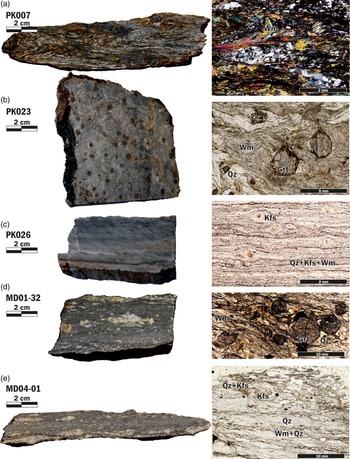
Two mica schist samples (PK007and PK023) and quartz-feldspathic schist (metarhyolite PK026) from the KMB, and two samples of migmatitic paragneiss from the DMC (MD01-32 and MD04-01) were subjected to LA ICP-MS U-Pb zircon dating (Fig. 4, Tables 2–6). Petrography, mineral assemblages and the P-T history of mica schists from the KMB were described in detail by Szczepański et al. (Reference Szczepański, Zhong, Dąbrowski, Wang and Goleń2022) and Szczepański and Goleń (Reference Szczepański and Goleń2022). In this study, we used the same set of samples, and therefore here only a brief description of the mica schist from the KMB used for the geochronological study is given. The mica schist PK007 (Fig. 4a) is a fine-grained rock that contains two mineral assemblages. The M1 assemblage consists of the first generation of garnet – Grt1 forming the cores of the garnet grains and Cld + Ph + Pg + Chl + Rt + Qz forming inclusions predominantly in Grt1. Quartz, phengitic white mica, chlorite and rutile are also present in the rock matrix of the examined sample. The M2 assemblage is represented by the second garnet generation – Grt2, which defines narrow rims growing on the first garnet generation (Grt1) and Ms + Bt + Pl + Chl + Ilm + Qz. The mineral assemblage M2 is observed as inclusions in the Grt2 as well as in the rock matrix. Sample PK023 (Fig. 4b) is a medium- to coarse-grained mica schist that contains two mineral assemblages. The M1 assemblage represented by Cld + Ph + Pg + Ep + Chl + Rt + Qz is mostly observed as inclusions in garnet porpyroblasts. The M2 assemblage represented by Ms + Bt + Mrg + Pl + St + Ilm + And + Qz is partly observed as inclusions in garnet grains and also occurs in the rock matrix.
Macro- and microphotographs of representative lithologies from the Kamieniec Metamorphic Belt and the Doboszowice Metamorphic Complex: (a) fine-grained mica schist sPK007, (b) coarse-grained mica schist PK023, (c) fine-grained metarhyolite PK026, (c) medium-grained migmatic Chałupki paragneiss MD01 and (d) medium-grained migmatic Chałupki paragneiss MD04.

Laser ablation ICP-MS U–Pb isotopic data of detrital zircons from sample PK007

Laser ablation ICP-MS U–Pb isotopic data of detrital zircons from sample PK023

Laser ablation ICP-MS U–Pb isotopic data of detrital zircons from sample PK026

Laser ablation ICP-MS U–Pb isotopic data of detrital zircons from sample MD01-32

Laser ablation ICP-MS U–Pb isotopic data of detrital zircons from sample MD04-01

Quartz-feldspathic (metarhyolite) PK026 sample (Fig. 4c) is a fine-grained rock containing a mineral assemblage composed of Qz + Kfs + Ms + Bt + Opq. The sample contains K-feldspar porphyroblasts reaching up to 2 mm in diameter that are dispersed in a very fine-grained matrix consisting mainly of a mixture of recrystallized K-feldspar, quartz and rare white mica flakes. Due to this petrographic and mineral evidence coupled with geochemical features (see section 3.c.), we identify sample PK026 (together with the whole group of quartz-feldspathic rocks) as a metarhyolite.
A detailed description of the paragneisses from the DMC has already been published (Puziewicz et al. Reference Puziewicz, Mazur and Papiewska1999), and therefore only a brief petrographic description of the analysed samples is presented here. Sample MD01-32 (Fig. 4d) is a medium-grained garnet-bearing paragneiss containing two mineral assemblages. The M1 assemblage consists of rare high Si white mica grains (Ms1) together with rutile needles, and the M2 assemblage consists of Grt and low Si white mica (Ms2) accompanied by Pl + Bt + Ilm. Sample MD04-01 (Fig. 4e) is a medium-grained paragneiss that contains one mineral assemblage comprising low Si white mica (Ms2) and Pl + Bt + Rt + Ilm. Both paragneiss samples show elongated quartz-feldspathic patches of variable size (up to 2–3 cm in length) that are aligned parallel to the penetrative foliation (Fig. 4d, e).
3.b. Whole-rock geochemistry of metasedimentary rocks
Fifty-three mica schist samples and ten paragneiss samples from the KMB and the DMC were analysed for major and trace element composition (Fig. 3, Supplementary Table 1). The two rock suites differ in the chemical composition of the major elements. This is expressed by a higher average SiO2 value (72.5 wt%) in the analysed paragneisses compared to mica schists (64.4 wt%). On the contrary, the mica schists have a higher Al2O3 content (17.15 wt%) compared to the paragneisses (14.25 wt%). Similarly, the average sum of MgO and FeO (7.8 in the mica schists and 4.0 in the paragneisses) and the average sum of Na2O, K2O and CaO (4.3 in the mica schists and 1.7 in the paragneisses) are different.
Major element data can be used to distinguish carbonates and soils from more clastic sediments and to classify greywacke along with arkose and quartz-rich sandstones using binary plots. A ternary plot utilizing SiO2, Al2O3+Fe2O3 and CaO+MgO (Hasterok et al. Reference Hasterok, Gard and Webb2018) shows that all the samples fall into the pelite field close to the psammite field (Fig. 5a). On the classification diagram of Wimmenauer (Reference Wimmenauer1984), the studied samples show a rather limited range of SiO2/Al2O3 ratio and are scattered between the greywacke and pelite fields, while a minority of samples show a composition typical of pelitic greywacke and arkoses (Fig. 5b). The diagram proposed by Herron (Reference Herron1988) shows that in terms of chemical composition the analysed rocks resemble mostly shales and wackes, while minority of samples are chemically similar to arkoses (Fig. 5c). On the other hand, the diagram proposed by Pettijohn et al. (Reference Pettijohn, Potter and Siever1987) shows that inspected rocks are scattered in the fields of greywacke, litharenite and arkose (Fig. 5d). In terms of trace element abundances when normalized to the composition of the upper continental crust, the studied mica schist and paragneiss samples show quite consistent patterns (Fig. 5e, f). All samples studied display strong Sr-negative anomaly and, in the case of the mica schists, variously developed U-negative and Nb-positive anomalies. In addition, the paragneiss samples show variously developed Zr and Hf negative anomalies and variously developed Sc negative anomalies. The DMC paragneisses also exhibit variable Cs content.
Geochemical characteristics of the studied metasedimentary rocks from the Kamieniec Metamorphic Belt and the Doboszowice Metamorphic Complex. (a–d) Classification diagrams after (a) Hasterok et al. (Reference Hasterok, Gard and Webb2018), (b) Wimmenauer (Reference Wimmenauer1984), (c) Herron (Reference Herron1988) and (d) Pettijohn et al. (Reference Pettijohn, Potter and Siever1987). (c, d) Upper continental crust (UCC)-normalized major element pattern for investigated samples from the Kamieniec Metamorphic Belt and the Doboszowice Metamorphic Complex. Normalization factors after Taylor and McLennan (Reference Taylor and McLennan1995). MS – mica schists, PG – paragneisses.

3.c. Whole-rock geochemistry of metarhyolites from the KMB
Metarhyolites were analysed for major and trace element composition (Fig. 3, Supplementary Table 1). They have 73.3–81.8 wt% of SiO2, 9.8–14.9 wt% of Al2O3, 0.39–2.73 wt% of Fe2O3 tot, 0.08–1.53 wt% of MgO and 5.11–9.89 wt% Na2O+K2O.
The total alkali versus SiO2 plot (TAS diagram, not shown) reveals that these rocks are rhyolites of subalkaline affinity, which is consistent with petrographic evidence (Fig. 4c). Diagrams based on immobile trace element ratios confirm that these rocks have the composition corresponding to that of rhyolites (Fig. 6b), while on the Co versus Th plot (Hastie et al. Reference Hastie, Kerr, Pearce and Mitchell2007) they fall in the field of high-K calc-alkaline and shoshonitic series but near the borderline with calc-alkaline series (Fig. 6c). The A/CNK (molar Al2O3/(CaO + Na2O + K2O)) and A/NK (molar Al2O3/(Na2O + K2O)) values (both 1.1–2.3) indicate that they are peraluminous (Fig. 6a), whilst in terms of CIPW norms are corundum-normative (1.1–7.6%).
Geochemical data for the meta-rhyolites of the Kamieniec Metamorphic Belt. (a) Aluminousity diagram of Shand (Reference Shand1943) with divisions after Maniar and Piccoli (Reference Maniar and Piccoli1989). (b) Zr/Ti–Nb/Y classification diagram of Winchester and Floyd (Reference Winchester and Floyd1977). (c) Th–Co classification diagram of Hastie et al. (Reference Hastie, Kerr, Pearce and Mitchell2007). (d) Nb–Y discrimination diagram of Pearce et al. (Reference Pearce, Harris and Tindle1984). ORG – orogenic granites, syn-COLG – syn-collisional granites, VAG – volcanic arc granites, WPG – within-plate granites. (e) Meta-rhyolites plotted against fields for granitic liquids experimentally derived from pelites, greywackes and amphibolites (data from Patiño Douce (Reference Patiño Douce1999) compiled by Jung et al. Reference Jung, Masberg, Mihm and Hoernes2009). (f) Th/Yb–Ta/Yb geotectonic classification diagram of Gorton and Schandl (Reference Gorton and Schandl2000). OA – oceanic arcs, ACM – active continental margins, WPVZ – within-plate volcanic zones, WPB – within-plate basalts, MORB – mid-ocean ridge basalts. See text.

The investigated rocks show negative correlations of SiO2: well defined with Al2O3 and Fe2O3 tot, and less distinct with TiO2, MgO and CaO (Fig. S01), which may indicate a fractionation and removal of plagioclase, biotite, apatite, and ilmenite. Given the peraluminous composition, it could be conjectured that the negative correlations of Al2O3, FeOtot and MgO against SiO2 imply cordierite-crystallizing magmas.
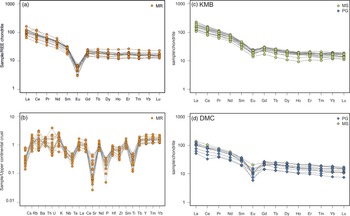
The concentrations of compatible trace elements are low, for example, Co (0.3–2.2 ppm), V (8–20 ppm) Sc (2–11 ppm) or below detection limit (Cr, Ni). The rocks have variable concentrations of incompatible trace elements (e.g. Zr: 57–160 ppm, Ba: 353–1707 ppm, Y: 24–50 ppm, Th: 9.6–20 ppm and ΣREE: 99–212 ppm), and among them only a few show but weak trend with increasing SiO2 (Zr and Nb negative, Th positive; Fig. S02). In the case of large ion lithophile elements (LILE), this lack of correlation most probably indicates element mobility under metamorphic conditions. The rare earth elements (REE) chondrite-normalized (CN, Sun & McDonough, Reference Sun and McDonough1989) profiles show enrichment of light rare earth elements (LREE) over mid rare earth elements (MREE) and heavy rare earth elements (HREE) ([La/Sm]CN = 2.81–5.47, [La/Yb]CN = 3.80–13.6). The resulting REE patterns have a negative slope for LREE and are flat for MREE–HREE (Fig. 7a). The fractionation of MREE from HREE is weak as [Gd/Yb]CN ranges from 1.0 to 1.5. The rocks show a pronounced Eu anomaly (Eu/Eu* = 0.11–0.36, Fig. 7a), and assuming a divalent oxidation state of Eu, it may indicate either fractional crystallization of plagioclase or that during partial melting this mineral was present in the source. On upper continental crust-normalized variation diagrams (Fig. 7b), meta-rhyolites show variable enrichment in LILE and Th but strong depletion in high-field-strength elements (HFSE, i.e. Nb, Ta, Ti, P, Zr, Hf) and in Sr; the latter negative anomaly is probably related to the Eu anomaly. These significant and negative anomalies support the fractionation of the Pl + Bt + Ap + Ilm mineral assemblage, presumably joined by some zircon and perhaps monazite, as shown by negative trends of Zr versus SiO2 (Fig. S02) and [La/Yb]CN versus CeCN (not shown). However, these anomalies may also characterize the melt source, as upper and/or middle crust have developed depletion in high-field-strength elements (Taylor & McLennan, Reference Taylor and McLennan1985).
Trace element diagrams for the studied samples of meta-rhyolite and metasediments from the Kamieniec Metamorphic Belt: (a) REE patterns normalized to chondrite, (b) immobile incompatible elements normalized to primitive mantle. Normalization factor after Sun and McDonough (Reference Sun and McDonough1989). Dark shaded area is for mica schists form the KMB, while light shaded area is for the Doboszowice paragneiss for the DMC, (c) chondrite-normalized REE patterns for investigated samples from (c) the Kamieniec Metamorphic Belt and (d) the Doboszowice Metamorphic Complex. Normalization factors after Sun and McDonough (Reference Sun and McDonough1989). Symbols for metasedimentary rocks as in Fig. 5.

3.d. Internal structure of analysed zircon grains
3.d.1. Sample PK007
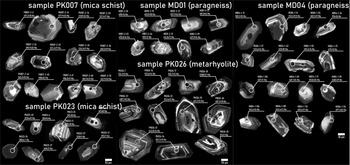
The zircon population of sample PK007 ranges from 40 to 152 μm with a mean length of 80 μm. It is dominated by grains with an elongation of less than 2 (84%), while zircons with an elongation in the range of 2 to 3 are much less frequent (16%). The zircon grains examined are often ovoid (32%) to well-rounded (38%). However, euhedral crystals are an important group (30%). Most of the grains in the examined sample are homogeneous (60%), while 40% of them show inherited cores. The very small group of grains (4%) have dark, thin rims.
3.d.2. Sample PK023
Sample PK023 contains grains ranging in length from 51 to 149 μm with a mean length of 83 μm. Most of the zircons analysed have an elongation of less than 2 (64%), while grains with an elongation greater than 2 form a much smaller group (36%). A large group of zircons are rounded to euhedral crystals (66%), while ovoid to well-rounded grains are less common (34%). Most grains are homogeneous (74%), and only a small group of zircons (18%) show inherited cores. Examined zircons often show dark, thin rims (44%) or represent dark, homogeneous grains (8%).
3.d.3. Sample MD01-31
The zircons in sample MD01-32 range in length from 56 to 121 μm with a mean length of 85 μm. Half of the grains analysed have an elongation of less than 2. The sample is dominated by euhedral crystals (55% of the population). However, well-rounded grains are also common (45%). Most zircon crystals are homogeneous (75%), while grains with inherited cores are much less frequent (25%). Zircons with dark, thin rims make up 40% of the population.
3.d.4. MD04-01
Zircon grains in sample MD04-01 range in length from 57 to 166 μm with a mean length of 92 μm and an elongation mostly below 2 (73%). Most grains are euhedral (78%), while rounded and well-rounded zircons are common (22% of the population). A relatively large group of grains have dark and thin rims (57%).
3.d.5. Sample PK026
The zircon population of sample PK026 ranges from 54 to 164 μm with a mean length of 121 μm. The population of grains with elongation greater than 2 is relatively abundant (40%). The zircon grains examined are predominantly euhedral (95%) and homogenous (83%) crystals. A small group of zircons (17%) show inherited cores.
In summary, cathodoluminescence images of the investigated zircon population show that within the metasedimentary samples most of the investigated grains show similar characteristics in terms of brightness, internal texture and elongation. Most of the grains are euhedral with locally corroded faces and show moderate cathodoluminescence and fine oscillatory zoning of clearly magmatic origin (e.g. PK007-2-36, Fig. 8) of which some are well rounded (e.g. PK023-40, Fig. 8). Some zircons have textures indicative of metasomatic alterations (e.g. MD04-1-12, Fig. 8). Some zircons from both groups contain xenocrystic cores (e.g. PK026-26, Fig. 8). Interestingly, especially in samples PK023, MD01-32 and MD04-01, a number of grains show thin and dark rims (e.g. PK023-21, MD04-1-91, MD04-1-116, Fig. 8 and S03) or represent dark, homogeneous grains with patchy or no internal zoning pattern (PK023-18. Fig. 8) probably related to metamorphic growth. It is worth noting that the population of zircon grains documented in the sample PK026 differs slightly from the remaining samples. The majority of grains in this sample are characterized by long euhedral grains with high elongation of greater than 2 and with oscillatory zoning of clearly magmatic origin supporting our interpretation that this sample represents metarhyolite (Fig. 8).

3.e. U-Pb zircon dating
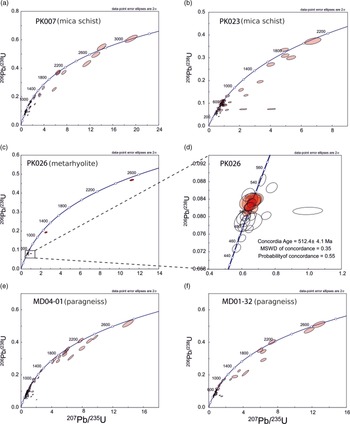
Laser ablation ICP–MS U–Pb dating identified more than 80 % of zircons as younger than 1 Ga (Figs. 9 and 10, Tables 2–6). Although the samples show significant differences in their KDE age spectra, they all share the presence of the prominent 590–600 Ma peak (Fig. 10). In the case of sample PK007, this peak dominates the entire spectrum but is additionally accompanied by a significant small group of zircons of about 1.0 Ga (Fig. 10a). Sample PK023 contains, in addition to the common Ediacaran peak mentioned above, a prominent younger peak of 400 Ma tailing to about 320 Ma representing the youngest age component in the latter sample (Fig. 10b). The paragneisses contain a very pronounced peak of 480–510 Ma, which is dominant in sample MD01-32 (Fig. 10c, d). The two paragneisses also contain several smaller peaks ranging from about 770 to 1000 Ma (Fig. 10c, d). All samples contain several minor groups of grains of Proterozoic and Archean age (Fig. 10).
U–Pb Concordia diagrams for samples from the DMC and KMB. Concordia plots were done using the Isoplot/Ex 4.15 Excel add-in (Ludwig, Reference Ludwig2008). (a) micaschist PK007, (b) micaschist PK023, (c, d) metarhyolite PK026, (e) paragneiss MD04-01 and (f) paragneiss MD01-32.

Binned frequency-density plots of detrital zircons from: (a–d) analysed samples (N = number of analyses). For zircons older than, 1 Ga 207</sup>Pb/206</sup>Pb ages were taken for interpretation and the 206Pb/238U ages for younger grains. Frequency-density plots were designed via the R software environment (R Core Team, 2021). KDE bandwidth is 30 Ma.

Except for the four metamorphosed sedimentary rocks presented above, we additionally analysed the quartz-feldspathic schist PK026, which we interpreted on account of its mineral composition, zircon morphology and bulk geochemical features as a metarhyolite (see sections 3a, 3c and 3d). The vast majority of analyses plot between 450 and 550 Ma (206Pb/238U ages). The most common group of analyses defines a clear cluster around 510 Ma, which we interpret as the time of rhyolite emplacement (Fig. 9c, d). Some younger ages we interpret as the result of Pb loss due to a Variscan event. A group of three concordant analyses reflects inherited domains of 630–645 Ma, and 207Pb/206Pb ages define the minimum zircon crystallization ages of the two oldest domains defined by single analyses as 2593 ± 21 and 1536 ± 76 Ma (Fig. 9c, d).
4. Discussion
4.a. Potential influence of metamorphism on whole-rock geochemistry
Both metasediments and metaryolites have undergone a medium- to high-temperature metamorphism, which could have mobilized the large-ion lithophile elements (e.g. Na, K, Ba, Rb and Cs). However, any large-scale remobilization of REEs, Th, Zr, Sc, Cr and Co seems unlikely as the patterns observed on the spider plots are quite uniform in the examined samples suite (Figs. 5 and 7). Furthermore, these elements are thought to be largely transferred to clastic sediments during weathering and transport, thus reflecting the signature of the parent material (Bhatia & Crook, Reference Bhatia and Crook1986; McLennan, Reference McLennan1989).
4.b. Provenance signature based on chemical composition of metasediments
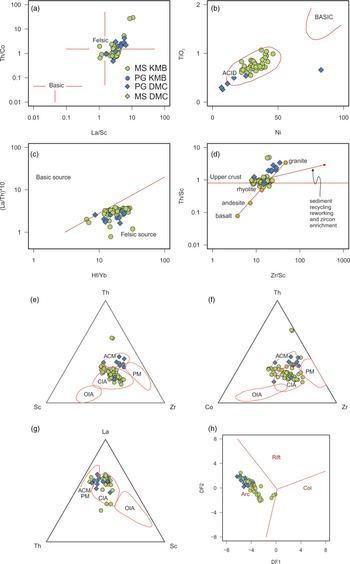
The La/Sc and Th/Co ratios are commonly considered useful provenance indicators (Cullers, Reference Cullers2002). The samples used in this study show La/Sc (1.02 to 10.57) and Th/Co (0.48 to 30.7) ratios typical of felsic rocks (Fig. 11a). Similarly, TiO2 (0.04 to 1.08) and Ni (2 to 82.8) concentrations, as well as Hf/Yb and La/Th ratios, are mostly characteristic of the felsic source in the examined samples (Floyd et al. Reference Floyd, Leveridge, Franke, Shail and Doerr1990; Fig. 11b, c). These conclusions are confirmed by the Th/Sc versus Zr/Sc diagram (Fig. 11d). Since these elements are transferred quantitatively from source to sink sediment, their ratio can be used to infer the composition of the source rock and the sedimentary processes it suffered (McLennan et al. Reference McLennan, Hemming, McDaniel and Hanson1993). Zirconium is mainly retained in zircon, and thus the Zr/Sc ratio is a useful index of zircon enrichment in sedimentary rocks. However, the Th/Sc ratio is a good index of igneous differentiation processes because Th is typically an incompatible element, whereas Sc is compatible in igneous rocks. Therefore, the Zr/Sc ratio is considered a proxy for the degree of recycling, whereas the Th/Sc ratio reflects the average composition of the source rocks (McLennan et al. Reference McLennan, Hemming, McDaniel and Hanson1993). Consequently, igneous differentiation results in a positive linear correlation of the Th/Sc versus Zr/Sc ratios. Interestingly, the analysed samples show Zr/Sc (7.8 to 53.4) and Th/Sc (0.6 to 7.0) ratios intermediate between rhyolite and granite source rocks (Fig. 11d). Furthermore, relatively low values of the Zr/Sc ratio and low Zr concentration (0.47 to 0.78) suggest that sediment recycling and reworking did not influence the final composition of the studied metasediments (Floyd et al. Reference Floyd, Leveridge, Franke, Shail and Doerr1990; McLennan et al. Reference McLennan, Hemming, McDaniel and Hanson1993).
Diagrams illustrating lithology of the source area after (a) Cullers (Reference Cullers2002), (b) Floyd et al. (Reference Floyd, Winchester and Park1989), (c) Hladil et al. (Reference Hladil, Patocka, Kachlik, Melichar and Hubacik2003) and (d) the influence of sediment recycling and zircon enrichment on chemical composition of the investigated quartzites after McLennan et al. (Reference McLennan, Hemming, McDaniel and Hanson1993). (e, f) Discrimination diagrams showing tectonic setting of deposition of the protolith to the mica schists and paragneisses of the Kamieniec Metamorphic Belt and the Doboszowice Metamorphic Complex. (after Bhatia & Crook, Reference Bhatia and Crook1986). Abbreviations: PM – passive margin, CIA – continental island arc, ACM – Active continental margin, OIA – oceanic island arc. d) Discriminant-function multi-dimensional diagram after Verma and Armstrong-Altrin (Reference Verma and Armstrong-Altrin2013). Samples fall in the field typical of arc-related sediments. Symbols as in Fig. 5.

The REE pattern of the source rocks is preserved in clastic sediments and can therefore be used to distinguish between a felsic and a mafic dominated source of clastic sediments (Taylor & McLennan, Reference Taylor and McLennan1985). Felsic rocks are characterized by higher LREE/HREE ratios and negative Eu anomalies, whereas mafic rocks generally have lower LREE/HREE ratios accompanied by little or no Eu anomalies (Cullers, Reference Cullers1994). The samples examined generally show high (LREE/HREE)CN ratios (0.8 to 14.5 with the mean value of 8.7) and moderate to strong negative EuCN anomalies (1.34 to 18.94 with the mean value of 2.46, Fig. 7c, d).
In summary, the ratios of La/Sc, Th/Sc, Th/Co, Zr concentration and the REE distribution patterns of the studied sedimentary successions from the KMB and DMC indicate that they were generally derived from a felsic source and, as shown by the Eu anomaly, the Zr/Sc ratio and Zr concentration, they were not significantly affected by alteration during transport (Cullers, Reference Cullers1994; Cullers, Reference Cullers2000).
4.c. Tectonic setting of deposition
Several diagrams allow for the identification of the tectonic setting of a source region (e.g. Bhatia, Reference Bhatia1983; Roser &Korsch, Reference Roser and Korsch1986). However, unravelling the tectonic setting of the deposition of metamorphosed sedimentary sequences should rely on immobile trace elements. Therefore, we first applied the ternary plots Sc-Th-Zr, Th-Co-Zr and Th-La-Sc of Bhatia and Crook (Reference Bhatia and Crook1986). These plots show that the samples analysed have a typical trace element composition of sediments derived from erosion of the continental arc or active continental margin (Fig. 11e–g). However, as shown by Verma and Armstrong-Altrin (Reference Verma and Armstrong-Altrin2013), major elements can also provide reliable information on the tectonic setting of the sedimentary basin. They proposed two new discriminant functions based on major elements for the tectonic discrimination of siliciclastic sediments and suggested that the functions are insensitive to element mobility. Indeed, the studied metasedimentary rocks have the chemical composition of the major element typical of arc-related sandstones demonstrating the usefulness of this technique even for metamorphosed rock suites (Fig. 11h).
In summary, the chemical composition of the mica schists and paragneisses from the KMB and DMC, in terms of main and trace elements, is typical of sediments derived from erosion of suprasubduction complexes.
4.d. Age of deposition of the KMB and DMC volcano-sedimentary succession
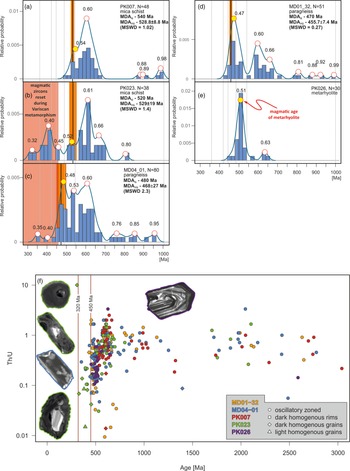
The youngest prominent density peaks defined by detrital zircon grains in the mica schists of the KMB (samples PK007 and PK023) range from 610 to 600 Ma (Fig. 12a, b). However, both samples reveal less prominent density peaks at 540 (sample PK007) and 520 Ma (sample PK023) (Fig. 12a, b). On the other hand, paragneiss samples from the DMC (samples MD01-32 and MD04-01) have the youngest prominent density peaks at 480–470 Ma (Fig. 12c, d). Consequently, these peaks represent the youngest graphical age peaks controlled by more than one grain and could therefore be interpreted as MDAs for these samples (Dickinson & Gehrels, Reference Dickinson and Gehrels2009) (Fig. 12a–d). However, we additionally calculated MDA using the mean age of the youngest two or more grains that overlap in age at 1σ (Dickinson & Gehrels, Reference Dickinson and Gehrels2009). Using this approach, the MDA for sample PK007 is 528.8 ± 8.8 Ma (MSWD = 1.02), 529 ± 19 Ma (MSWD = 1.4) for sample PK023, 468 ± 27 (MSWD 2.3) for sample MD04 and 455.7 ± 7.4 (MSWD = 0.27) for sample MD01. The only prominent peak documented in the metarhyolite sample from the KMB has an age of 510 Ma and is interpreted as a magmatic age (Fig. 12e). Considering the differences between the MDAs calculated by the two methods, we finally decided to use the ages calculated using the mean age of the youngest two or more grains that overlap in age at 1σ. Consequently, the results presented suggest that the studied volcano-sedimentary successions exposed in the eastern part of the Fore-Sudetic Block may represent two different rock sequences in terms of MDA. The mica schists exposed in the KMB show an early Cambrian MDA at c. 529 Ma, whereas the paragneiss of the DMC represent an Upper Ordovician sequence with a MDA of c. 456 Ma. In addition, an early Cambrian sequence of the KMB was injected by several rhyolitic sills at c. 510 Ma. Our interpretation of the studied metarhyolites as sills is supported by their very consistent chemical composition and consistent textural features, with no evidence of, for example, degassing. This allows us to reject the suggestion that the metarhyolites represent tuffs or lava flows as suggested by Dziedzicowa (Reference Dziedzicowa1966). Moreover, it should be emphasized that younger age peaks documented for samples PK023 and MD04 are mostly defined by dark grains or thin dark rims formed due to metamorphism (Fig. 12b, c, see section 4.h.).
(a–e) Histograms with kernel density estimates of the Phanerozoic and Neoproterozoic zircon age populations from the dated mica schists and paragneisses of the Kamieniec Metamorphic Belt and the Doboszowice Metamorphic Complex. Bin width for histogram is 20 Ma, and bandwidth for KDE is 15 Ma. Orange rectangles and black lines are for MDA calculated using the mean age of the youngest two or more grains that overlap in age at 1σ (MDAG). Yellow dots are for MDA calculated using the youngest graphical age peaks controlled by more than one grain (MDAYG). Vertical axis is relative age probability. (f) Diagram showing Th/U zircon ratios versus the age showing the chemical variation of magmatic and metamorphic zircon domains for the studied samples. The colour code refers to the investigated samples, while the different dot shapes refer to the different types of zircons.

Our estimate of MDA of the mica schists from the KMB and Chałupki paragneiss form the DMC is c. 30 Ma younger compared to previously published maximum depositional ages (Oberc-Dziedzic et al. Reference Oberc-Dziedzic, Kryza, Madej and Pin2018; Jastrzębski et al. Reference Jastrzębski, Żelaźniewicz, Budzyń, Sláma and Konečny2020; Jastrzębski et al. Reference Jastrzębski, Żelaźniewicz, Stawikowski, Budzyń, Krzemińska, Machowiak, Madej, Białek, Sláma, Czupyt and Jaźwa2023). Consequently, in terms of a MDA, we interpret the volcano-sedimentary successions exposed in the KMB equivalent to the early Cambrian sedimentary sequences exposed in other parts of the Variscan belt of Europe. The early Cambrian succession exposed in the Central Sudetes is represented by metamorphosed pelites with supra-subduction geochemical signature (e.g. Szczepański & Ilnicki, Reference Szczepański and Ilnicki2014). On the other hand, the Upper Ordovician sequence exposed in the DMC has no equivalent in the Sudetes, but it was documented in the Teplá-Barrandian Unit (Drost et al. Reference Drost, Gerdes, Jeffries, Linnemann and Storey2011). The only Ordovician sequence known from the Sudetes is of Early Ordovician in age and is often represented by metamorphosed quartzarenites showing geochemical signature typical of sediments deposited on a passive continental margin (e.g. Žáčková et al. Reference Žáčková, Konopásek, Košler and Jeřábek2010; Mazur et al. Reference Mazur, Szczepański, Turniak and McNaughton2012; Szczepański & Ilnicki, Reference Szczepański and Ilnicki2014; Szczepański et al. Reference Szczepański, Turniak, Anczkiewicz and Gleichner2020). However, similar to described from the DMC Ordovician paragneiss and mica schist lithologies with geochemical signature indicating erosion of supra-subduction rock complexes have recently been documented from the Teplá-Barrandian of the Bohemian Massif (Hajná et al. Reference Hajná, Žák and Dörr2017; Soejono et al. Reference Soejono, Machek, Sláma, Janoušek and Kohút2020).
In conclusion, we suggest that the volcano-sedimentary successions of the KMB and DMC represent fragment of the early Palaeozoic siliciclastic cover deposited on the Gondwana margin.
4.e. Provenance constraints
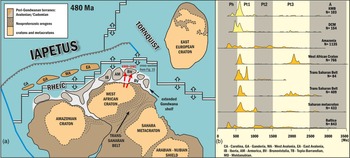
Figure 13 compares the age spectra from the KMB and DMC with those from various cratonic areas of Gondwana.
(a) Tentative simplified reconstruction of Western Gondwana extended passive margin during the Early Ordovician, modified after Domeier (Reference Domeier2016) and Torsvik (Reference Torsvik2017). Abbreviations: CA – Carolina, GA – Ganderia, WA – West Avalonia, EA – East Avalonia, IB – Iberia, AM – Armorica, BV – Brunovistulia, BH – Saxothuringia, Tepla-Barrandian and – Moldanubia, KMB – Kamieniec Metamorphic Belt, DMC – Doboszowice Metamorphic Complex. Red arrows indicate the main directon of sedimentary transport. Types of lithospheric boundaries: black-white – spreading ridge, grey – subduction, blue – transform. (b) Kernel density plots for detrital zircons from: Kamieniec Metamorphic Belt (this study), Doboszowice Metamorphic Complex (this study), Amazonian Craton (Gaucher et al. Reference Gaucher, Finney, Poire, Valencia, Grove, Blanco, Pamoukaghlian and Peral2008; Geraldes et al. Reference Geraldes, Nogueira, Vargas-Mattos, Matos, Teixeira, Valencia and Ruiz2014; Pankhurst et al. Reference Pankhurst, Hervé, Fanning, Calderón, Niemeyer, Griem-Klee and Soto2016), West African Craton (Abati et al. Reference Abati, Aghzer, Gerdes and Ennih2010), Trans-Saharan Belt – Tuareg Shield (Henry et al. Reference Henry, Liégeois, Nouar, Derder, Bayou, Bruguier, Ouabadi, Belhai, Amenna, Hemmi and Ayache2009), Trans-Saharan Belt (Peucat et al. Reference Peucat, Drareni, Latouche, Deloule and Vidal2003; Abdallah et al. Reference Abdallah, Liégeois, De Waele, Fezaa and Ouabadi2007; Bendaoud et al. Reference Bendaoud, Ouzegane, Godard, Liégeois, Kienast, Bruguier and Drareni2008; Bosch et al. Reference Bosch, Bruguier, Caby, Buscail and Hammor2016), Saharan Metacraton (Meinhold et al. Reference Meinhold, Morton, Fanning, Frei, Howard, Phillips, Strogen and Whitham2011) and Baltica (Valverde-Vaquero et al. Reference Valverde-Vaquero, Dörr, Belka, Franke, Wiszniewska and Schastok2000; Kristoffersen et al. Reference Kristoffersen, Andersen and Andresen2014; Kuznetsov et al. Reference Kuznetsov, Meert and Romanyuk2014). Kernel density plots were designed via the R software environment (R Core Team, 2021). Abreviations: Ph – Phanerozoic, Pt1 – Neoproterozoic, Pt2 – Mesoproterozoic, Pt2 – Paleoproterozoic, A – Archean.

The youngest age spectra defined by detrital grains recognized in the investigated rocks are typical of the Cambro-Ordovician sedimentary cover of the Cadomian crust exposed in the Sudetes and other parts of the Variscan belt of Europe (Figs. 12–14; e.g. Fernández-Suárez et al. Reference Fernández-Suárez, Alonso, Cox and Jenner2002; Linnemann, Reference Linnemann2007; Linnemann et al. Reference Linnemann, Pereira, Jeffries, Drost and Gerdes2008; Žáčková et al. Reference Žáčková, Konopásek, Košler and Jeřábek2010; Drost et al. Reference Drost, Gerdes, Jeffries, Linnemann and Storey2011; Mazur et al. Reference Mazur, Szczepański, Turniak and McNaughton2012; Košler et al. Reference Košler, Konopásek, Sláma and Vrána2014; Strachan et al. Reference Strachan, Linnemann, Jeffries, Drost and Ulrich2014; Soejono et al. Reference Soejono, Machek, Sláma, Janoušek and Kohút2020). The youngest population of zircon grains recognized in the metasedimentary succession analysed from the DMC was probably derived from the erosion of Cambro-Ordovician granites widely exposed in the Saxothuringian (Zieger et al. Reference Zieger, Linnemann, Hofmann, Gärtner, Marko and Gerdes2018 and references therein), Teplá-Barradian (e.g. Žák et al. Reference Žák, Kraft and Hajná2013) and Moldanubian zones (Žák et al. Reference Žák, Sláma, Syahputra and Nance2023). An example of such intrusion is the Doboszowice orthogneiss dated at 488 ± 6 Ma, which is exposed in the DMC (Mazur et al. Reference Mazur, Kröner, Szczepański, Turniak, Hanžl, Melichar, Rodionov, Paderin and Sergeev2010). Furthermore, zircon grains ranging in age from ca. 490 to 520 Ma were most likely supplied by Cambrian granites known from the Sudetes exemplified by, for example, Śnieżnik or Izera orthogneiss (e.g. Turniak et al. Reference Turniak, Mazur and Wysoczański2000; Lange et al. Reference Lange, Bröcker, Armstrong, Żelaźniewicz, Trapp and Mezger2005; Mazur et al. Reference Mazur, Kröner, Szczepański, Turniak, Hanžl, Melichar, Rodionov, Paderin and Sergeev2010; Zieger et al. Reference Zieger, Linnemann, Hofmann, Gärtner, Marko and Gerdes2018). Neoproterozoic grains could have been derived from granitoid intrusions dated at c. 540 Ma that were reported from several fragments of Cadomian basement exposed in the Bohemian Massif (Linnemann & Heuse, Reference Linnemann and Heuse2001; Tichomirowa et al. Reference Tichomirowa, Berger, Koch, Belyatski, Götze, Kempe, Nasdala and Schaltegger2001; Mingram et al. Reference Mingram, Kröner, Hegner and Krentz2004; Żelaźniewicz et al. Reference Żelaźniewicz, Dörr, Bylina, Franke, Haack, Heinisch, Schastok, Grandmontagne and Kulicki2004; Jastrzębski et al. Reference Jastrzębski, Żelaźniewcz, Sláma, Machowiak, Śliwiński, Jaźwa and Kocjan2021; Tabaud et al. Reference Tabaud, Štípská, Mazur, Schulmann, Míková, Wong and Sun2021; Śliwiński et al.et al. Reference Śliwiński, Jastrzębski and Sláma2022; Soejono et al. Reference Soejono, Schulmann, Sláma, Hrdličková, Hanžl, Konopásek, Collett and Míková2022). However, several detrital zircons were most probably supplied by volcano-sedimentary successions represented by, for example, the Stronie and Młynowiec formations in the Orlica-Śnieżnik dome (Jastrzębski et al. Reference Jastrzębski, Żelaźniewicz, Nowak, Murtezi and Larionov2010; Mazur et al. Reference Mazur, Szczepański, Turniak and McNaughton2012; Mazur et al. Reference Mazur, Turniak, Szczepański and McNaughton2015), the Zwethau and the Rothstein formations in the Saxohuringian zone (e.g. Elicki, Reference Elicki1997; Linnemann, Reference Linnemann2007) or from glaciomarine sedimentary rocks documented in the Elbe zone and the North Saxon antiform in the southeastern part of the Saxothuringian zone (Linnemann et al. Reference Linnemann, Pidal, Hofmann, Drost, Quesada, Gerdes, Marko, Gärtner, Zieger, Ulrich, Krause, Vickers-Rich and Horak2018). Consequently, the anhedral Neoproterozoic zircons documented in the studied rocks may represent recycled material supplied by local sedimentary successions. This may explain the low abundance of the oldest, Paleoproterozoic or Archean zircons, in the studied samples.
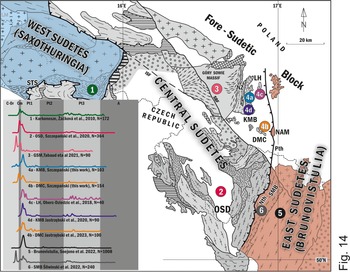
Comparison of zircon age spectra obtained for various crustal domains from the Sudetes shown on the geological sketch map of the Sudetes after Mazur et al. (Reference Mazur, Aleksandrowski, Kryza and Oberc-Dziedzic2006). Kernel density plots for detrital zircons from: 1. Karkonosze (Žáčková et al. Reference Žáčková, Konopásek, Košler and Jeřábek2010), 2. Orlica-Śnieżnik Dome (Szczepański et al. Reference Szczepański, Turniak, Anczkiewicz and Gleichner2020); 3. Góry Sowie Massif (Tabaud et al. Reference Tabaud, Štípská, Mazur, Schulmann, Míková, Wong and Sun2021); 4a. Kamieniec Metamorphic Belt (this work), 4b. Doboszowice Crystalline Massif (this work and Jastrzębski et al. Reference Jastrzębski, Żelaźniewicz, Stawikowski, Budzyń, Krzemińska, Machowiak, Madej, Białek, Sláma, Czupyt and Jaźwa2023), 4c – Lipowe Hills (Oberc-Dziedzic et al. Reference Oberc-Dziedzic, Kryza, Madej and Pin2018); 4d. Kamieniec Metamorphic Belt (Jastrzębski et al. Reference Jastrzębski, Żelaźniewicz, Budzyń, Sláma and Konečny2020); 5. Brunovistulia (Friedl et al. Reference Friedl, Finger, Paquette, von Quadt, McNaughton and Fletcher2004; Mazur et al. Reference Mazur, Kröner, Szczepański, Turniak, Hanžl, Melichar, Rodionov, Paderin and Sergeev2010), 6. Staré Město Belt (Śliwiński et al. Reference Śliwiński, Jastrzębski and Sláma2022). Abbreviations: STS – Saxothuringian suture, OSD – Orlica-Śnieżnik Dome, DMC – Doboszowice Crystalline Massif, KMB – Kamieniec Metamorphic Belt, NZ – Niemcza Zone, LH – Lipowe Hills, NAM – Niedźwiedź amphibolite Massif, Pth – Paczków thrust, Nth – Nyznerov thrust, SMB – Staré Město Belt. Abbreviations in inset: C-Or – Carboniferous-Ordovician, Cm – Cambrian, Pt1 – Neoproterozoic, Pt2 – Mesoproterozoic, Pt2 – Paleoproterozoic, A – Archean.

The detrital zircon age spectra clearly show the paucity of Mesoproterozic zircons pointing to a period of magmatic and volcanic inactivity in the source area, as there are only a few zircon grains of this age documented in the investigated rocks (Figs. 10 and 13). This Mesoproterozoic age gap in zircon age spectra is commonly reported from the West African Craton and from the Trans-Saharan Belt (e.g. Tuareg Shield) (Fig. 13). Interestingly, the Saharan Metacraton, Amazonia and Baltica can be excluded as a potential source of detritus, since these cratonic areas are characterized by the presence of Mesoproterozoic zircons (Fig. 13).
In summary, we suggest that the data presented here advocate for the West African provenance for the studied volcano-sedimentary succession. Available detrital zircon ages from Cambro-Ordovician sedimentary successions covering the Saxothuringian, Teplá-Barrandian and Moldanubian zones as well as the Armorican Massif clearly indicate that all these Neoproterozoic crustal fragments were derived from the same cratonic areas and Cadomian arc-related basement located at the northern periphery of Gondwana (Figs. 13 and 14; corresponding references are given in Fig. 14). Consequently, we support suggestions that during the Cambro-Ordovician time, Cadomian crustal fragments were dispersed along the northern periphery of Gondwana, most probably forming an extended shelf that developed on a passive continental margin (e.g. Drost et al. Reference Drost, Gerdes, Jeffries, Linnemann and Storey2011; Žák & Sláma Reference Žák and Sláma2018; Soejono et al. Reference Soejono, Machek, Sláma, Janoušek and Kohút2020; Collett et al. Reference Collett, Štípská, Schulmann, Míková and Kröner2021; Tabaud et al. Reference Tabaud, Štípská, Mazur, Schulmann, Míková, Wong and Sun2021; Tabaud et al. Reference Tabaud, Štípská, Mazur, Schulmann, Míková, Wong and Sun2021; Collett et al. Reference Collett, Schulmann, Deiller, Štípská, Peřestý, Ulrich, Jiang, de Hoÿm de Marien and Míková2022).
4.f. Petrogenetic interpretation of the KMB volcanism
The zircons from metarhyolite sample are dominated by an age peak of 510 Ma that we correlate with the time of magmatic emplacement (Figs. 9c, d and 12e). Rare Neoproterozoic and Archaean inheritance points to the involvement of an older crustal component in magma genesis (Fig. 9c, d).
The derivation of metarhyolites protolith from continental crust material is implied by the peraluminous and corundum-normative composition, depletion in HFSE (Figs. 6 and 7) and by low Zr/Nb (8.2–23) and Nb/Th (0.23–0.69) (Supplementary Table 1). Depletion in HFSE together with enrichment in LREE, a flat MREE-HREE profile, elevated Th content and high Th/Nb are also consistent with a subduction-related environment of magma origin (e.g. Pearce et al. Reference Pearce, Harris and Tindle1984; Pearce & Peate, Reference Pearce and Peate1995, Schandl & Gorton, Reference Schandl and Gorton2002).
Jung et al. (Reference Jung, Masberg, Mihm and Hoernes2009) through compilation of experimentally derived liquids devised a diagram for discrimination of granitoid sources (Fig. 6e). The plot shows that the KMB metarhyolites are related to a greywacke precursor (with no input from mantle-derived sources). This inference is consistent with their peraluminous affinity, whilst the plagioclase-bearing residue in the source possibly explains the negative Eu and Sr anomalies. Furthermore, immature, quartz-feldspathic-rich sources (e.g. psammites, paragneisses, etc.) that are able to supply peraluminous, cordierite-crystallizing liquids, require higher melting temperatures (>850–875°C; Sylvester, Reference Sylvester1998, Moyen et al. Reference Moyen, Laurent, Chelle-Michou, Couzinié, Vanderhaeghe, Zeh, Villaros and Gardien2017). Sylvester (Reference Sylvester1998) showed that low to moderate values of Al2O3/TiO2 in strongly peraluminous granitic rocks may serve as a proxy of hot, melt-forming conditions. Moderate values of Al2O3/TiO2 (52–228, av. 108 ± 48) of the studied metarhyolites seem to confirm these premises.
Although some of the discrimination diagrams support an active continental margin as a possible tectonic environment (Fig. 6f), we interpret this as a signature of inherited geochemical features pertinent to the tectonic setting of sedimentary precursor to the KMB meta-rhyolites. Additionally, collisional or post-collisional affinity is suggested (Fig. 6d and S04a). Furthermore, the discrimination diagram of Verma et al. (Reference Verma, Pandarinath, Verma and Agrawal2013) with probability of 65% points to the collisional setting of the KMB meta-rhyolites. However, within-plate environment is also apparent (probability of 34%; Fig. S04b). Given no affinity to alkaline, A-type granitoid magmas, the latter indication possibly echoes the progression of tectonic setting from post-collisional towards anorogenic, presumably extensional regime (Fig. S04c and d).
The Cambrian age (ca. 510 Ma) and geochemical features of the KMB meta-rhyolites (S-type, peraluminous magmas from post-collisional, transitional setting) emphasize their similarities to post-orogenic (meta-)granites from the Saxothuringian domain in the West Sudetes, notably, ca. 504 Ma Rumburk granites and ca. 500–511 Ma Izera-Kowary gneisses (Oberc-Dziedzic et al. Reference Oberc-Dziedzic, Pin and Kryza2005, Pin et al. Reference Pin, Kryza, Oberc-Dziedzic, Mazur, Turniak and Waldhausrová2007, Oberc-Dziedzic et al. Reference Oberc-Dziedzic, Kryza, Pin, Mochnacka and Larionov2009) and those from the Moldanubian and Tepla-Barandian domains (e.g. Žák, Kraft & Hajná, Reference Žák, Kraft and Hajná2013; Žák et al. Reference Žák, Sláma, Syahputra and Nance2023), but not the Brunovistulian domain. Thus, we consider the origin of the meta-rhyolites as another facet of magmatic pulses concurrent with the gradual change of tectonic environment marking the end of the Cadomian orogeny (arc-Gondwana continent collision) and the onset of Cambro-Ordovician rifting. These genetic links are highlighted by sparse inherited zircon ages of meta-rhyolites (ca. 560, 630 and 2590 Ma, Fig. 9c, d). They are close to the age peaks reported from the Rumburk granites and Izera-Kowary gneisses, and resemble those of Lusatian greywackes (1.1–2.6 Ma and 540–730 Ma; Kröner et al. Reference Kröner, Jaeckel and Opletal1994, Linnemann et al. Reference Linnemann, McNaughton, Romer, Gehmlich, Drost and Tonk2004) considered as their sedimentary precursors formed in the Cadomian arc.
The lack of HP conditions during Cadomian arc-continent collision and limited crustal thickening (e.g. Dörr et al. Reference Dörr, Zulauf, Fiala, Franke and Vejnar2002) are consistent with the inferred hot conditions of the KMB rhyolitic magma generation and correlate with intrusions into transitional crust at the peripheries of Gondwana that were postulated by tectonic model of Linnemann (Reference Linnemann2007) for the late Cambrian in the Saxothuringia (e.g. Zieger et al. Reference Zieger, Linnemann, Hofmann, Gärtner, Marko and Gerdes2018).
4.g. Is the Rheic suture exposed on the Fore-Sudetic Block?
The presented zircon age spectra demonstrate that the volcano-sedimentary successions of the KMB and DMC are typical of the Gondwana-derived terranes now exposed in the Bohemian Massif and exemplified by the Saxothuringian, Teplá-Barrandian and Moldanubian zones (see Žák & Sláma, Reference Žák and Sláma2018). It is worth noting that some volcano-sedimentary successions exposed in the Brunovistulian zone also show similar detrital zircon signature (Soejono et al. Reference Soejono, Schulmann, Sláma, Hrdličková, Hanžl, Konopásek, Collett and Míková2022). However, this domain is characterized by a paucity of magmatic and volcanic rocks of c. 500 Ma that are commonly exposed in the KMB and DMC. Furthermore, the existence of extensive Ordovician cover seems to be rather typical for such Gondwana-derived terranes like Saxothuringia, Moldanubia or Teplá-Barrandia. The only Ordovician strata documented in the Brunovistulian domain includes light green clay-rich siliceous rocks, interbedded with fine-grained quartz sandstones that has only been encountered in a restricted area in the northern part of Upper Silesia (see Kalvoda et al. Reference Kalvoda, Babek, Fatka, Leichmann, Melichar, Nehyba and Spacek2008). It is worth noting that an affinity to the Saxothuringian domain was previously suggested by Jastrzębski et al. (Reference Jastrzębski, Żelaźniewicz, Budzyń, Sláma and Konečny2020, Reference Jastrzębski, Żelaźniewicz, Stawikowski, Budzyń, Krzemińska, Machowiak, Madej, Białek, Sláma, Czupyt and Jaźwa2023) and Oberc-Dziedzic et al. (Reference Oberc-Dziedzic, Kryza, Madej and Pin2018) for rocks of the DMC, Lipowe Hills and KMB (sites 4b, 4c and 4d in Fig. 14, respectively). Furthermore, similar age spectra were also reported by Tabaud et al. (Reference Tabaud, Štípská, Mazur, Schulmann, Míková, Wong and Sun2021) for the Góry Sowie Massif (site 3 in Fig. 14). On the other hand, Tabaud et al. (Reference Tabaud, Štípská, Mazur, Schulmann, Míková, Wong and Sun2021) suggested that the rocks exposed to the east of the Góry Sowie Massif and to the west of the Strzelin Massif represent the Moldanubian zone. However, it is worth noting that Chopin et al. (Reference Chopin, Schulmann, Skrzypek, Lehmann, Dujardin, Martelat, Lexa, Corsini, Edel, Štípská and Pitra2012) defined the Moldanubian zone as a recycled passive margin of the Saxothuringian zone. Therefore, the results of our study combined with existing data allow us to identify the volcano-sedimentary successions now exposed in the longitudinal belt between the Góry Sowie massif in the west and the Lipowe Hills in the east as part of the Gondwana-derived terranes now exposed in the Bohemian Massif including Saxothuringia, its recycled part described as Moldanubia or Teplá-Barrandia (Fig. 14). Furthermore, similar detrital zircon age spectra of the late Neoproterozoic (Ediacaran) and Cambro-Ordovician volcano-sedimentary sequences were recently documented from the Stare Město Belt and the Bunovistulian terrane (sites 6 and 5 on Fig. 14, respectively, Collett et al. Reference Collett, Štípská, Schulmann, Míková and Kröner2021; Śliwiński et al. Reference Śliwiński, Jastrzębski and Sláma2022; Soejono et al. Reference Soejono, Schulmann, Sláma, Hrdličková, Hanžl, Konopásek, Collett and Míková2022). This implies that mentioned Gondwana-derived terranes and Brunovistulia were located within the extended Gondwana shelf at that time and were sourced from the same cratonic area (e.g. Collett et al. Reference Collett, Štípská, Schulmann, Míková and Kröner2021; Śliwiński et al. Reference Śliwiński, Jastrzębski and Sláma2022; Soejono et al. Reference Soejono, Schulmann, Sláma, Hrdličková, Hanžl, Konopásek, Collett and Míková2022). Furthermore, early Cambrian–Early Ordovician metabasalts of the Staré Město Belt and the Letovice ophiolite as well as the NAM (considered as the northern continuation of the Staré Město Belt on the Fore-Sudetic Block at the western tectonic boundary of the Brunovistulia; Fig. 14) all show intra-continental geochemical signatures (Awdankiewicz, Reference Awdankiewicz2008; Soejono et al. Reference Soejono, Žáčková, Janoušek, Machek and Košler2010; Collett et al. Reference Collett, Štípská, Schulmann, Míková and Kröner2021). Therefore, by combining the geochemical signal of the aforementioned metaigneous complexes with the provenance signature of the associated metasedimentary successions, we support the previous assumptions that the Saxoturingia–Brunovistulia boundary is a remnant of the initial intracontinental rift that developed on the extended Gondwana shelf that was later closed during the Variscan orogeny (see, e.g. Collett et al. Reference Collett, Štípská, Schulmann, Míková and Kröner2021; Soejono et al. Reference Soejono, Schulmann, Sláma, Hrdličková, Hanžl, Konopásek, Collett and Míková2022). Consequently, we are inclined to support the hypothesis that the Rheic suture is not exposed in the eastern part of the Bohemian Massif (e.g. Mazur et al. Reference Mazur, Aleksandrowski, Gągała, Krzywiec, Żaba, Gaidzik and Sikora2020; Collett et al. Reference Collett, Štípská, Schulmann, Míková and Kröner2021; Soejono et al. Reference Soejono, Schulmann, Sláma, Hrdličková, Hanžl, Konopásek, Collett and Míková2022).
4.h. Variscan thermal event recorded by the volcano-sedimentary succession
The youngest zircons documented in the studied metasedimentary samples (PK023 and MD04-01, Fig. 12b, c) reach ages of c. 330–320 Ma. We interpret all ages in the range between 450 and 320 Ma as reflecting lead loss due to the Variscan metamorphism. Several such young grains have been documented in samples PK023, MD04-01 and MD01-32 and are characterized by the appearance of thin dark rims or patchy zonation (Fig. 8). These features are characteristic of crystals that have experienced fluid interaction, for example, as a result of metamorphism (e.g. Spandler et al. Reference Spandler, Hermann and Rubatto2004). Furthermore, dark zircon rims or dark homogeneous grains are mostly characterized by a low Th/U ratio, which is typical for metamorphic zircons (Fig. 12f). We would like to emphasize that many such dark and thin zircon rims were documented in the samples examined but could not be dated due to their small dimensions. (Fig. S03). We suggest that the youngest zircons in our collection, with ages ranging between 330 and 320 Ma, most likely represent the age of the Variscan thermal overprint that caused Pb loss in some of the examined zircon grains.
4.i. From the Gondwana active margin to the Variscan collision of Cadomian terranes
Several early-middle Cambrian to Lower Ordovician sedimentary successions have been documented in the Variscan basement of the Bohemian Massif including the Münchberg Massif as well as the Teplá-Barrandian, the Saxothurignian and the Moldanubian domains (e.g. Linnemann et al. Reference Linnemann, Gehmlich, Tichomirowa, Buschmann, Nasdala, Jonas, Luetzner and Bombach2000; Drost et al. Reference Drost, Gerdes, Jeffries, Linnemann and Storey2011; Košler et al. Reference Košler, Konopásek, Sláma and Vrána2014; Hajná et al. Reference Hajná, Žák, Dörr, Kachlík and Sláma2018; Koglin et al. Reference Koglin, Zeh, Franz, Schüssler, Glodny, Gerdes and Brätz2018; Tabaud et al. Reference Tabaud, Štípská, Mazur, Schulmann, Míková, Wong and Sun2021). These volcano-sedimentary successions are mainly characterized by immature graywacke protoliths with chemical composition indicating deposition in a supra-subduction environment (Drost et al. Reference Drost, Gerdes, Jeffries, Linnemann and Storey2011; Koglin et al. Reference Koglin, Zeh, Franz, Schüssler, Glodny, Gerdes and Brätz2018; Tabaud et al. Reference Tabaud, Štípská, Mazur, Schulmann, Míková, Wong and Sun2021).
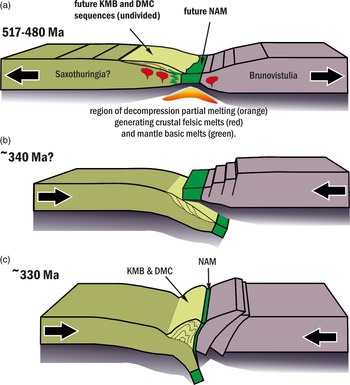
The data presented here indicate that the early-middle Cambrian and Ordovician sediments exposed in the KMB and DMC were deposited in a sedimentary basin sourced by a Cadomian orogen and their geochemical signal point to detritus derivation from a magmatic arc system. Therefore, in terms of provenance signature, it was the same or very similar detritus that fed the volcano-sedimentary successions exposed in the Saxoturingian domain including the neighbouring Orlica-Śnieżnik dome, the south-eastern part of the Karkonosze-Izera Block, the Góry Sowie massif, the Staré Město Belt and also the Brunovistulia in the East Sudetes (Fig. 14, and references therein). The most interesting is that in some of these areas the Early Ordovician rock successions represent light quartzites interpreted as mature quartzitic sandstones deposited on a passive continental margin (e.g. the Goszów Quartzites from the Orlica-Śnieżnik dome, Mazur et al. Reference Mazur, Szczepański, Turniak and McNaughton2012; Szczepański et al. Reference Szczepański, Turniak, Anczkiewicz and Gleichner2020). This suggests that the sedimentary basin that developed along the northern margin of Gondwana was active during the whole Ordovician and was fed by detritus characterized by varying proportions of mature cratonic material and immature arc detritus. Therefore, we support the idea that the Cambro-Ordovician basin at the northern margin of Gondwana developed above a retreating subducting oceanic slab represented by the Iapetus Ocean (e.g. Arenas et al. Reference Arenas, Martínez Catalán, Sánchez Martínez, Fernández-Suárez, Andonaegui, Pearce and Corfu2007; Díez Fernández et al. Reference Díez Fernández, Castiñeiras and Gómez Barreiro2012; Hajná et al. Reference Hajná, Žák, Dörr, Kachlík and Sláma2018; Soejono et al. Reference Soejono, Machek, Sláma, Janoušek and Kohút2020). The retreat of a subducting oceanic slab was responsible for the continental extension and the formation of a passive Gondwana margin. This process led to lithospheric thinning and astenospheric mantle upwelling responsible for crustal anatexis and the formation of granitoid intrusions at c. 520–480 Ma as proposed earlier by, for example, Soejono et al. (Reference Soejono, Machek, Sláma, Janoušek and Kohút2020). Postulated lithospheric thinning and extension was also responsible for the separation of Cadomian crustal fragments that formed the extended Gondwana shelf and the development of local intracontinental rifts, remnants of which are now exemplified by the NAM metabasalts on the Fore-Sudetic Block (Fig. 15a).
Simplified tectonic model for early Palaeozoic–Carboniferous evolution of the KMB and DMC. See text for explanation.

The Cambro-Ordovician extension is well documented in the post-Cadomian successions within the Variscan belt of Europe due to the occurrence of 517–480 Ma granitoid intrusions exposed, for example, throughout the Saxothuringian zone (e.g. the Izera-Karkonosze Massif), but also widely exposed in the Teplá-Barrandian and Moldanubian zones. Although metagranitoids from the Izera-Karkonosze Massif have a chemical composition typical of volcanic arc granites (e.g. Turniak et al. Reference Turniak, Mazur and Wysoczański2000; Zieger et al. Reference Zieger, Linnemann, Hofmann, Gärtner, Marko and Gerdes2018), Oberc-Dziedzic et al. (Reference Oberc-Dziedzic, Pin and Kryza2005) and Pin et al. (Reference Pin, Kryza, Oberc-Dziedzic, Mazur, Turniak and Waldhausrová2007) interpreted them on the basis of Sm-Nd isotopic data and bulk rock geochemistry as either typical S-type post-collisional or anorogenic and related to continental break-up. The latter idea and the relationship of the metagranitoids to continental break-up was recently supported by Jastrzębski et al. (Reference Jastrzębski, Budzyń and Stawikowski2017).
The final stage in the evolution of the rock successions exposed in the KMB and DMC was the closure of the intracontinental rift, remnants of which are found in the NAM on the Fore-Sudetic Block, followed by subduction of fragments of Gondwana continental shelf below Brunovistulia during the Variscan Orogeny (Fig. 15b). The results of classical geothermobarometry, thermodynamic calculations and quartz in garnet elastobarometry point to burial of the KMB volcano-sedimentary succession to depths of ∼65–70 km, which was followed by its imbrication, exhumation and folding (Szczepański et al. Reference Szczepański, Zhong, Dąbrowski, Wang and Goleń2022; Szczepański & Goleń, Reference Szczepański and Goleń2022; Fig. 15b, c). The age of maximum burial of the rock complexes within the postulated subduction zone is unknown and requires further investigation. The data presented in this study and previously published isotopic dating of monazite grains suggest that the last stages of exhumation occurred c. 320–330 Ma (Jastrzębski et al. Reference Jastrzębski, Żelaźniewicz, Budzyń, Sláma and Konečny2020). However, more recently published U-Th-Pb monazite data indicate that DMC experienced metamorphic episode at ca. 346–340 Ma (Jastrzębski et al. Reference Jastrzębski, Żelaźniewicz, Stawikowski, Budzyń, Krzemińska, Machowiak, Madej, Białek, Sláma, Czupyt and Jaźwa2023). This is confirmed by Lu-Hf and Sm-Nd garnet dating of the Chałupki paragneiss, which shows that these rocks were metamorphosed between 347 ± 3.6 Ma and 337.3 ± 6.6 Ma (Szczepański et al. Reference Szczepański, Zhong, Dąbrowski, Wang and Goleń2022). A scenario proposed here involving Cambro-Ordovician rifting followed by Variscan collision of terranes is consistent with previously proposed models for the development of the Cadomian and Cambro-Ordovician successions exposed in the Bohemian Massif (Martínez Catalán et al. Reference Martínez Catalán, Collett, Schulmann, Aleksandrowski and Mazur2020; Collett et al. Reference Collett, Štípská, Schulmann, Míková and Kröner2021; Martínez Catalán et al. Reference Martínez Catalán, Schulmann and Ghienne2021; Tabaud et al. Reference Tabaud, Štípská, Mazur, Schulmann, Míková, Wong and Sun2021; Soejono et al. Reference Soejono, Schulmann, Sláma, Hrdličková, Hanžl, Konopásek, Collett and Míková2022).
5. Conclusions
The volcano-sedimentary successions from the eastern part of the Fore-Sudetic Block (the KMB and the DMC) provide new input to understand the pre-Variscan and Varciscan history of the Cambro-Ordovician rocks outcropping in the eastern part of the Central Sudetes. Bulk rock chemistry and detrital zircon age spectra obtained using LA–ICP–MS U–Pb show that the mica schists of the KMB represent a succession equivalent to the Stronie Formation of the Orlica-Śnieżnik dome, while there is no exact time equivalent in the Sudetes for the Chałupki paragneisses now exposed in the DMC. The only Ordovician rock succession exposed in the Sudetes is represented by the Goszów quartzites of the Orlica-Śnieżnik dome. The data presented indicate that the volcano-sedimentary successions exposed in the eastern part of the Fore-Sudetic Block were sourced from the West African Craton or, more probably, from part of the Trans-Saharan Belt of Gondwana. Bulk rock geochemistry suggests that the studied volcano-sedimentary successions were deposited on the Gondwana margin during their transformation from an active to a passive setting within the back-arc environment. The youngest single zircon grains documented in the metasediment samples show ages of c. 330–320 Ma that we interpret as reflecting lead loss owing to the Variscan thermal overprint. Our data, combined with published results, suggest that the suture separating the Brunovistulian and Saxothuringian terranes is an intracontinental rift closed during the Variscan Orogeny, rather than a continuation of the Rheic suture.
Supplementary material
To view supplementary material for this article, please visit https://doi.org/10.1017/S0016756823000523
Acknowledgements
We thank Ulf Linnemann, Stanislaw Mazur, José R. Martínez Catalán and four anonymous reviewers for their constructive comments that led to substantial improvement of the manuscript, as well as Laura Bracciali and Peter Clift for editorial handling. The study was supported from NCN research grant UMO-2015/17/B/ST10/02212. Dariusz Marciniak and Marcin Goleń are thanked for help during preparation of zircon concentrates.
Competing interests
The author(s) declare none.