1 Introduction
This paper argues for an expanded IPA symbol set, to include available symbolization for central approximants. There are, of course, precedents in the phonetics community for revising and enlarging symbol sets, and it is this ongoing critical self-reflexivity which has enabled discussion of potential revisions at various IPA meetings. Barry & Trouvain (Reference Barry and Trouvain2008), too, have encouraged consultation regarding the need for a possible symbol for a central open vowel, with their case resting on what they refer to as ‘strong reasons, both theoretical and practical’ (p. 356) for their proposition. In the present paper we highlight a further deficit which might, arguably, be filled with revised and approved IPA symbols, and which also has far-reaching theoretical and practical significance, particularly in clinical speech contexts. The current paper contributes to and complements recent work on classifying subcategories of approximants undertaken by Martínez-Celdrán (Reference Martínez-Celdrán2004) and Martínez-Celdrán & Regueira (Reference Martínez-Celdrán and Regueira2008). When considering possible new symbols, we bear in mind the criteria discussed in Ball (Reference Ball2008): these include preserving a resemblance to existing symbols which share key elements of articulation, avoiding diacritics which shift the target symbol to a different perceptual category, and the requirement that symbols can be efficiently rendered by computer software.
Our present focus on central approximants underscores the fact that there are currently no dedicated symbols for many central approximants found in natural language, especially those that are considered to be weaker versions of voiced fricatives.Footnote 1 The use of ‘weaker’ here invokes gradations of occlusion, rather than of air-flow rate, a distinction which is carefully considered by Martínez-Celdrán (Reference Martínez-Celdrán2004). The central approximants have traditionally been divided into two groups, those which are related to vowel articulations (which we shall term semi-vowels) and those related to fricative articulations (called here frictionless continuants). While the former group is relatively well equipped with IPA symbols, the latter is not and the comparative lack of symbols for frictionless continuants does not seem to reflect IPA-external factors such as frequency of occurrence in natural language.
1.1 Prolongable versus non-prolongable approximants
The traditional division of central approximants into semi-vowels and frictionless continuants has often been justified in terms of prolongability. For example, Catford (Reference Catford1977: 131) states that semi-vowels are ‘an essentially momentary type of articulation’, and Laver (Reference Laver1994: 297) notes that what he terms ‘non-syllabic approximants’ are ‘of short relative duration and act as very brief transitional onsets to the vocoid at the nucleus of the syllable’. Indeed, the term ‘glide’ has often been applied to these sounds, as it is assumed that they involve a rapid glide from an initial articulatory gesture to that of the following vowel (Crystal Reference Crystal1997: 169).
Catford (Reference Catford1977: 134) assigns the term prolongable to approximants that are not semi-vowels, amongst which he includes the lateral approximants, the rhotic approximants, and the labio-dental approximant.
Ladefoged & Maddieson (Reference Ladefoged and Maddieson1996: 322) disagree with this division. They state that ‘these sounds have also been termed “glides”, based on the idea that they involve a quick movement from a high vowel position to a lower vowel. This term, and this characterization of these sounds is inappropriate; as with other consonants they can occur geminated’. Whether the feature of prolongability is vital to the division of central approximants noted above is clearly still open to question. Nevertheless, Maddieson's (Reference Maddieson1984) characterization of approximants and their associated vowels, and approximants with their associated consonants, still seems an appropriate context for a division into semi-vowels and frictionless continuants.
1.2 Symbols for semi-vowels and frictionless continuants
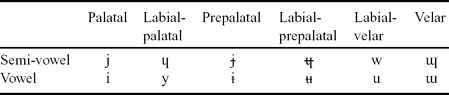
The IPA currently provides symbols for four semi-vowels, with another two possible to construct using IPA conventions. We can compare these to their associated high vowels in table form (see Table 1).
Symbols for semi-vowels and their associated vowels.

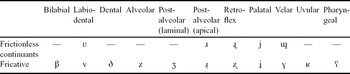
Table 2 shows the IPA provision for frictionless continuants. Where there are blanks in Table 2, these need to be transcribed with the symbol for the voiced fricative together with the lowering diacritic.
Symbols for frictionless continuants and their associated fricatives.
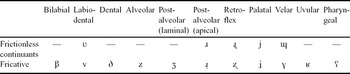
Table 2 demonstrates that for frictionless continuants there are very few unitary symbols provided and, of these, two are for the rhotic approximants which are often classed separately along with other rhotics (such as trills and taps), and two also fall into the category of semi-vowels.Footnote 2 (Interestingly, Table 2 also demonstrates one of the few examples where a fricative symbol is formed by adding a diacritic – in this case, the raising diacritic – onto a symbol for an approximant: [ ].) It is acknowledged here that, in spite of the clear articulatory distinctions indicated in Tables 1 and 2, there is some ambiguity regarding [j] and [ɰ]. These symbols indicate, on the one hand, the palatal and velar semivowel respectively and, on the other, the palatal and velar frictionless continuants, respectively. This ambiguity prompted Martínez-Celdrán (Reference Martínez-Celdrán2004) to argue for a revision to the IPA's approximant category. He suggests that the term semi-vowel ‘should be kept for the segments that are closely related to vowels’ (p. 208) and recommends that the IPA ‘should revise the concept of approximant . . . and eliminat[e] from the pulmonic consonants chart the row that currently appears with the label “approximants” since that row contains segments belonging to very different subcategories’ (p. 208). We see our present paper as a further attempt to advance discussion on the appropriate representation of varying approximant articulations.
We noted in Ball & Rahilly (Reference Ball and Rahilly1999) this ambiguity between the palatal and velar semi-vowel and frictionless continuant symbols. Martínez-Celdrán (Reference Martínez-Celdrán2004) suggests that this be resolved by adding the opening diacritic to the symbols for palatal and velar fricatives to denote the frictionless continuant. As the thrust of our argument here is against this practice, we suggest alternative symbolizations below.
Our particular focus in this paper is to address the gaps noted in Table 2 in provision of IPA symbols for frictionless continuants; our suggestions being collected in Table 3 below.
Proposed symbols for frictionless continuant approximants.

2 The bilabial frictionless continuants
There is no approved symbol for a bilabial frictionless continuant, that is an approximant with a bilabial place of articulation and no concomitant back or front tongue raising. Currently, if one wishes to transcribe such a sound, the symbol for the voiced bilabial fricative together with a lowering diacritic has to be used: [ ]. Graphically, this is less than ideal, as the lowering diacritic is difficult to see in any case (due to its size) and more so with the descender of the symbol in the same print space as the diacritic. However, provision of new symbols does not, naturally, rely on graphic considerations (though these should not be totally ignored) but on a need for the symbol. We argue here that the bilabial frictionless continuant occurs sufficiently often in natural language and in disordered speech to warrant its own symbol.
2.1 Bilabial frictionless continuants in natural language
Maddieson (Reference Maddieson1984) notes that there were six languages in the UPSID (UCLA Phonological Segment Inventory Database) that had phonemic bilabial frictionless continuants (the same number that had the labiodental frictionless continuant [ʋ]). These he lists as Hindi-Urdu, Lappish, Lakkia, Kunimaipa, Karok and Telugu (p. 244). Ladefoged & Maddieson (Reference Ladefoged and Maddieson1996: 324) point out that the Hindi labial approximant sometimes transcribed as [ʋ] is most usually realized as a bilabial, as in  [nɔʌ˜] ‘ninth’. These authors also refer to the fact that the bilabial approximant contrasts with [ɰ] in Axininca (Ladefoged & Maddieson Reference Ladefoged and Maddieson1996: 322).
2.2 Realizations of /r/ in British English
Recent research on young persons’ realizations of /r/ in British English indicates that a sound change is in progress. In particular, a bilabial frictionless continuant [] is increasingly common for /r/ in many varieties of English (see Foulkes & Docherty Reference Foulkes and Docherty2000: 5; Docherty & Foulkes Reference Docherty and Foulkes2001; Foulkes & Docherty Reference Foulkes and Docherty2001). In Foulkes & Docherty (Reference Foulkes and Docherty2000), the authors employ the visually simpler symbol [ʋ] for the labial variety of /r/, though they note that ‘[t]he patterns we have seen may just as likely result from bilabial constriction, suggesting the transcription [] may be an equally viable candidate’ (p. 54), and again, ‘there is no clear evidence for lower lip retraction, and therefore [] would be equally suitable’ (p. 54).
2.3 Disordered speech
This sound has regularly been reported in disordered speech of clients whose target language is English. For example, Ball, Lowry & McInnis (Reference Ball, Lowry and McInnis2006) and Müller, Ball & Rutter (Reference Müller, Ball and Rutter2008) describe a boy of 9 years and 8 months who had six different realizations of target English /r/ which varied by phonological context and by style of speech event. These variants included [ w ʋ ɰ]. Müller, Ball & Rutter (Reference Müller, Ball and Rutter2006) report on a highly unintelligible boy of 7;0 who for several target sounds and clusters regularly used [ ]; a bilabial approximant with simultaneous rhoticization (tongue tip raising) but no noticeable lip rounding.
2.4 Symbolizing the bilabial frictionless continuant
We assume that the reason only [ʋ] has a dedicated IPA symbol among the frictionless continuants despite it occurring in natural language about as often as [] (see Maddieson Reference Maddieson1984, as referred to earlier) is that a known contrast exists for [ʋ] and [v] in some languages (e.g. Urhobo, Ladefoged & Maddieson Reference Ladefoged and Maddieson1996: 324; and Dutch, Hamann & Sennema Reference Hamann and Sennema2005). On the other hand, we can find no evidence that [] and [β] contrast. Of course, contrastivity is not the sole criterion for provision of IPA symbols, as seen even in the case of [ɹ] and [ɻ], where we can find no languages that contrast these sounds phonemically.
Mindful of the criteria proposed by Ball (Reference Ball2008) for developing new symbols noted above, we would suggest that the following might be considered contenders for a bilabial approximant symbol: [ ] (both derived from Cyrillic). A further option is the superscript [ᵀ] to indicate a more open articulation, and avoiding the sometimes visually problematic subscript version of the ‘tiny T’ diacritic. One might also consider the ‘tiny T’ diacritic placed to the right of the symbol in question ([˕], e.g. Kelly & Local Reference Kelly and Local1986), although a potential problem with such a sequential arrangement is that it may not easily capture the simultaneity of the articulation. Perhaps the present discussion might contribute to a more widespread re-evaluation of the design and placement of diacritics. It is worth noting, in passing, for instance, that not all IPA diacritics are clear indicators of the articulatory properties intended. One particularly odd example is the velar fricative symbol [ˠ] as the diacritic of choice to signal velarization (in the case of dark [l], for instance) instead of [ɰ], to match the other such superscript symbols derived from those for approximants.
3 The dental and alveolar frictionless continuants
Dental and alveolar frictionless continuants are not common in natural language. Maddieson (Reference Maddieson1984: 244) reports that Andamanese has a dental/alveolar approximant (though the implication is that this is probably a rhotic). Laver (Reference Laver1994: 302–303) notes that Spanish and Danish use an approximant rather than a fricative allophonically in examples such as Spanish abogado [aoƔ˕a o] ‘lawyer’ (see also Martínez-Celdrán Reference Martínez-Celdrán2004), and Danish gade [ɡæ
 ˕ə] ‘street’.Footnote 3 In Icelandic, too, the voiced dental is also usually an approximant (IPA 1949: 28).
These approximants also occur in disordered speech. For example, speakers with dysarthria are often unable to make closures or close approximations, such that plosives and fricatives may be realized as frictionless continuant approximants. Theodoros & Murdoch (Reference Theodoros, Murdoch and Murdoch1998: 280), referring to hypokinetic dysarthria, state that, ‘consonant articulation has been found to be characterized by errors in the manner of production involving incomplete closure for stops and partial constriction of the vocal tract for fricatives, resulting in the abnormal production of stop-plosives, affricates and fricatives’.
The absence of turbulent airflow in these approximants means the main distinction between [ð], [z] and [ʒ] (i.e. the nature of the frication) is lost. Nevertheless, there is a perceptible difference between these sounds carried by the different tongue positions.
Possible symbols for a dental approximant include [Δ Ƌ] and, should a separate symbol be considered for an alveolar approximant, this could be [] or [ƨ]; and for the laminal postalveolar, [ƹ].
4 The uvular and pharyngeal frictionless continuants
Maddieson (Reference Maddieson1984: 246) reports Eastern Armenian as having a voiced uvular approximant, and Ladefoged & Maddieson (Reference Ladefoged and Maddieson1996: 168) note that Arabic pharyngeal are often approximant rather than fricative (and indeed may be better described as epiglottal rather than pharyngeal).
In disordered speech, cleft palate clients may use uvular and pharyngeal articulations (see Howard Reference Howard1993, Harding & Grunwell Reference Harding and Grunwell1996). These may be either fricatives or frictionless continuant approximants.
Possible symbols for uvular and pharyngeal frictionless continuants include [я ᴚ] (uvular) and [ʖ] (pharyngeal).
5 Palatal and velar frictionless continuants
As noted above, Martínez-Celdrán (Reference Martínez-Celdrán2004) points out that palatal and velar approximants in Spanish, Catalan and Galician do not match the descriptions given for semi-vowel [j] and [ɰ]. The solution offered is to add the lowering diacritic to [ʝ] and [ɣ], respectively. In our opinion, this adds two more symbol–diacritic combinations that are almost impossible to read if the diacritic is placed beneath the symbol. We suggest new symbols, therefore, for these two sounds: [ɿ] for the palatal (an inverted J), and [г] (small capital gamma) for the velar.
6 Conclusion
The frictionless continuant manner of articulation is the only section of the IPA chart currently lacking symbols for several examples known to occur in natural language. Presumably, this is mainly because few of them contrast phonemically with the equivalent lenis fricatives. The labiodental frictionless continuant has a symbol, despite the small number of languages where it contrasts with [v]. As we have seen, however, several others of this class of approximant occur relatively frequently as allophonic variants of fricatives, and as realizations of other target sounds in disordered speech. For language varieties worldwide, it is also known that the approximant category varies enormously in realization (see Canepari Reference Canepari2007). It must also be borne in mind that other sounds for which the IPA provides symbols have limited contrastive function as well (as noted earlier) and, so, contrastivity must be only one criterion to be considered. Table 3 summarizes the proposals for new symbols discussed above.
An alternative to the suggested symbols included above might be to devise some new symbol addition (such as the curved top of implosives) or more user friendly diacritic (such as the apostrophe used with ejectives) that would be attached to the voiced fricative symbol and mark them as frictionless continuants and be clearly legible and allow the addition of other diacritics as needed.