Implications
Because of the large cattle population in the world, and the large amount of resources consumed during the rearing process, improvements in growth efficiency have tremendous benefit for the whole cattle industry and for the consumers. This study confirmed the beneficial effect of ractopamine in improving muscle deposition and in providing more efficient use of resources for meat production, even in leaner Bos indicus cattle. In addition, this study demonstrated that these beneficial effects of ractopamine are not dependable on a higher protein diet and did not produced a tougher meat.
Introduction
Efficient use of nutrients is vital for profitability and sustainability of beef cattle production. β-adrenergic agonists (β-AA) are additives commonly used to improve the efficiency of gain in the USA beef industry. In December 2011 the use of ractopamine in feedlot cattle was approved in Brazil. The efficacy of β-AA has been demonstrated in several studies with mostly young, castrated, Bos taurus breeds, with a high degree of fat thickness, and marbling (Gruber et al., Reference Gruber, Tatum, Engle, Mitchell, Laudert, Schroeder and Platter2007; Quinn et al., Reference Quinn, Reinhardt, Loe, Depenbusch, Corrigan, May and Drouillard2008; Scramlin et al., Reference Scramlin, Platter, Gomez, Choat, Mckeith and Killefer2010). However, the efficacy of β-AA has yet to be demonstrated in Bos indicus intact bulls, with reduced fat thickness (slaughter at 20% carcass fat), a common situation in Brazilian herds.
Ractopamine is a β1-AA that promotes the repartition of nutrient flow away from lipogenesis, and towards protein accretion (Yang and McElligott, Reference Yang and McElligott1989). In general, feeding ractopamine increases average daily gain, improves feed efficiency and increases both live and hot carcass weight (HCW) (Schroeder, Reference Schroeder2004; Dunshea et al., Reference Dunshea, D’souza, Pethic, Harper and Warner2005; Avendaño et al., Reference Avendaño, Rodriguez, Murilo, Linres, Saavedra and Robinson2006). This increase in muscle mass is attributed to an increase in muscle protein synthesis, a reduction in protein degradation or some combination of both (Scramlin et al., Reference Scramlin, Platter, Gomez, Choat, Mckeith and Killefer2010). In addition, other β-AA increase the transcriptional activity of calpastatin (Rathmann et al., Reference Rathmann, Mehaffey, Baxa, Nichols, Yates, Hutcheson, Brooks, Johnson and Miller2009), which could be the reason for the reduction in tenderness that has been reported in some studies (Leheska et al., Reference Leheska, Montgomery, Krehbiel, Yates, Hutcheso, Nichols, Streeter, Blanton and Miller2008; Kellermeier et al., Reference Kellermeier, Tittor, Brooks, Galyean, Yates, Hutcheson, Nichols, Streeter, Johnson and Miller2009).
Based on studies with other species, rapid increase in fractional rate of muscle protein synthesis occurs with oral administration of ractopamine, without reduction of fractional protein degradation rates (Beerman, Reference Beerman2002). Because of the increase on muscle accretion, protein requirements may also be enhanced in ractopamine treated animals. There are few data reporting the effect of dietary CP on cattle or swine fed with ractopamine hydrochloride (RH) (Mitchell et al., Reference Mitchell, Solomon and Steele1991; Walker et al., Reference Walker, Titgemeyer, Drouillard, Loe, Depenbusch and Webb2006), and these reported no benefit in improving dietary CP in RH fed animals.
Therefore, the objective of this study was to evaluate effects of ractopamine and dietary CP content on feedlot performance, blood metabolites, carcass characteristics and meat quality of Nellore bulls.
Material and methods
All animal procedures used in this study were conducted in accordance with the Institutional Animal Care and Use Committee Guidelines of the University of São Paulo, and approved by the FMVZ animal ethics committee (Protocol Number 2474-2011).
Experimental site
The study was conducted at the Ouro Fino Experimental Station, located at the city of Guatapará, state of São Paulo, in southeast Brazil (21°29'48'' S, 48°02'16'' W, and 512 m above sea level) from September 2012 to January 2013. The animals were in the feedlot for a total of 112 days, with the first 15 days for acclimatization of the animals to the facility and diets. Pen dimensions were 5×10 m with 2 m of concrete floor, and shade in the east–west orientation. Automatic water troughs, with float-activated water supplies, were located at the end of each pen. The concrete feed bunk in each pen was 3 m long, and pens were situated in one line.
Animals management and diets
A total of 48 Nellore bulls, 24 to 26 months old, with average initial BW of 397±15 kg, were randomly allotted to 16 pens, each containing three bulls. Four treatments were randomly assigned to the pens, in a 2×2 factorial arrangement of treatments. The factors were two levels of CP in the diet (100% and 120% of the metabolizable protein (MP) requirement, defined as CP100 and CP120, respectively), and two levels (0 and 300 mg/animal·per day) of RH (Ouro Fino Animal Health, Cravinhos, SP, Brazil). The animals were kept on the experimental diets for a total of 97 days, and treated animals received RH for the final 35 days before slaughter.
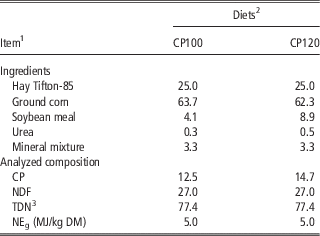
Animals were fed twice daily a diet with 25 : 75 forage : concentrate ratio on a dry matter (DM) basis to provide 27% of NDF on the diet (Table 1). Chopped Tifton-85 hay was used as the roughage source. Ractopamine was added to the mineral supplements that were mixed daily into the total diet to provide a daily intake of 300 mg of RH to each animal. Diets were offered ad libitum, dry matter intake (DMI) was measured daily by weighing of offered feed and orts weighing, and amount offered was adjusted daily allowing for a minimum of 5% orts during the experiment. In addition, ingredients and orts were sampled weekly and pooled to determine chemical composition. The animals remained in the feedlot system during 63 days, all fed the same diet, before the ractopamine supplementation period.
Composition and analyzed nutrient content (DM basis) of the finishing bulls diets

DM=dry matter.
1 The trace mineral mixture contained (per kg): zinc, 728 mg; iron, 221 mg; CP (minimum), 109%; fluorine (maximum), 106 mg; calcium, 116 g; selenium, 3 mg; phosphorus, 14 g; manganese, 226 mg; copper, 221 mg; cobalt, 29 mg; iodine, 21 mg; sodium, 44 g; sulphur, 43 g; potassium, 47 g; NNP – equivalent protein (maximum), 109%; monensin sodium, 1.000 mg/kg.
2 Levels of CP in the diet (100% and 120% of the metabolizable protein requirement).
3 Total digestible nutrients. Estimated according to National Research Council (2000).
To measure the performance, the animals were weighed at the beginning of the ractopamine supplementation (day 0), after 18 days of supplementation (day 18) and before slaughter (day 34). Animals were weighed after 18 h of feed and water restriction. Average daily gain was calculated for the two periods: from day 0 to day 18 and from day 18 to day 34. Feed efficiency was calculated from average dairy gain (ADG) and DMI during the RH supplementation period (from day 0 to day 34).
Feed samples and chemical analysis
Feed samples were taken during the morning feeding, and frozen for subsequent analysis of DM, organic matter, ash, ether extract (EE) and CP, according to the methods described by the Association of Official Analytical Chemists (2000). NDF was determined as in procedure B of Van Soest et al. (Reference Van Soest, Robertson and Lewis1991) using 8 M urea and heat stable α-amylase (Sigma Chemical Co., St. Louis, MO, USA), with no addition of sodium sulphite to avoid undesirable solubilization of fibrous compounds, such as lignin, in an ANKOM A200 Fibre Analyser (ANKOM® Technology, Fairpoint, NY, USA). ADL and ADF were analyzed according to Van Soest and Robertson (Reference Van Soest and Robertson1985).
Blood sample collection and analysis
Blood was collected by venipuncture or puncture of the coccygeal artery, before the morning feeding, at the beginning and at the end of RH supplementation. Blood samples (10 ml) were collected into 10 ml BD Vacutainers® (BD Vacutainer, São Paulo, SP, Brazil), without anticoagulant, for the measurement of serum glucose, total protein, albumin, plasma urea nitrogen, aspartate aminotransferase (AST), γ-glutamyl transferase (GGT) and alkaline phosphatase (ALP). Blood parameters were assayed colorimetrically according to standard procedures using commercially available diagnostic kits (Laborlab®, São Paulo, SP, Brazil and CELM, São Paulo, SP, Brazil) in an ABS-200 Automatic Biochemistry Analyzer (CELM®, São Caetano do Sul, SP, Brazil).
Carcass data
On day 113, bulls were transported ~50 km to a commercial slaughter house and humanely slaughtered. HCWs were recorded at slaughter. After 24 h of chilling, longissimus muscle area (LMA) and fat thickness were measured between the 12th and 13th ribs, across the longissimus dorsi, at the left half-carcasses. All remaining meat quality measurements were carried out on cross-sectional samples of longissimus muscle. Instrumental colour readings were collected using a CR 200b Minolta colorimeter (Minolta Camera Co., Ltd, Osaka, OSA, Japan). Three scans were taken at the time of carcass fabrication, during 5 s each, and averaged to determine instrumental colour values. Longissimus samples were allowed to oxygenate for 30 min before scanning. Results were expressed as L* (lightness), a* (redness) and b* (yellowness) in the CIELAB system, with the D65 light source. The a* value is a measure of a colour continuum from red to green, and b* value is a measure of a colour continuum from yellow to blue. Greater L* value denotes lighter meat and greater a* and b* values indicate a more red and yellow colour, respectively.
For determination of Warner–Bratzler shear force analysis (WBSF), the four most anterior longissimus dorsi steaks were randomly assigned to each animal of four postmortem aging periods (0, 7, 14 and 21 days). Steaks were vacuum packaged and stored at 3°C. After completion of the appropriate aging time, steaks were frozen and stored at −20°C for subsequent WBSF measurements.
9–11th rib composition
The procedure developed by Hankins and Howe (Reference Hankins and Howe1946) was used to mark the 9–11th rib section (HH section) on the left side of each carcass. At 24 h postmortem, carcasses were fabricated and the 9–11th rib section was removed from the primal rib. The samples were frozen, cut with chainsaw and ground in a large grinder (Frigmann Herman, Itupeva, SP, Brazil). Grounded samples were freeze-dried to constant weight with a lyophilizer (Itasul Import and Instrumental Technical Ltda, Porto Alegre, RS, Brazil), thus obtaining the water content of the HH samples.
Chemical composition of HH section was estimated according to Lanna et al. (Reference Lanna, Boin and Alleoni1995). The water content of the 9–11th rib section was used to estimate the water and EE in the empty body weighed (EBW) using the following equations:
 $$\eqalignno{ & \,\%\,\,{\rm water}\,{\rm EBW}={\rm 24}.{\rm 1936}{\plus}(0.{\rm 6574}{\times}\,\%\,\,{\rm water}\,{\rm 9} \cr \qquad\qquad\qquad -{\rm 11th}\,{\rm rib}\,{\rm section}) \, \cr\%\,\,{\rm EE}\,{\rm EBW}={\rm 6}0.{\rm 815} -{\rm (}0.{\rm 7968}{\times}\,\%\,\,{\rm water}\,{\rm 9}\cr\qquad\qquad\quad-{\rm 11th}\,{\rm rib}\,{\rm section)} $$
The protein and ash contents of EBW were estimated using 0.3009 as the protein : water ratio, and 0.0747 as the ash : water ratio (Leme et al., Reference Leme, Boin and Alleoni1994).
Shear force (SF) and cooking loss (CL) analysis
SF and CL were determined at the Laboratory of Meat Quality of the University of São Paulo, using the methodology proposed by Wheeler et al. (Reference Wheeler, Shackelford and Koohmaraie2001) and previously described by Cônsolo et al. (Reference Cônsolo, Gardinal, Gandra, Freitas Junior, Renno, Santana, Pflanzer and Pereira2015). The steaks were thawed for 24 h at 4°C, weighed and roasted in an oven equipped with a thermostat adjusted to 170°C (Flexa de Ouro Industry, São Paulo, SP, Brazil). The steaks internal temperature was monitored using individual thermometers (Globo Industry, Americana, SP, Brazil) inserted at the centre of the steak, until it reached 71°C. The steaks were cooled to 28°C and weighed again, thus obtaining the value for CL. Steaks were cooled at 4°C for 24 h before shearing. For WBSF evaluation, six cores with 1.3 cm of diameter were taken from each steak, parallel to the orientation of the muscle fibres (Ferrari furadeira, São Paulo, SP, Brazil). Each core was sheared perpendicular to the muscle fibre using a WBSF instrument (Warner–Bratzler meat Shear; G-R Manufacturing, Collins, KS, USA), according to standard procedures (American Meat Science Association, 1995). The WBSF values of the six subsamples were averaged for statistical analysis.
Statistical analysis
All statistical analyses were conducted using SAS version 9.1.2 for Windows (SAS Institute Inc., Cary, NC, USA). Data were analyzed as a completely randomized design with a 2×2 factorial arrangement of treatments, using the MIXED procedure. The model included the fixed effects of CP level (100% or 120% of requirements), the RH level (0 or 300 mg/animal·per day) and their interaction. Pens were considered as the experimental units (random effect). Data for ADG was analyzed as a repeated measure for periods (two periods: from day 0 to day 18 and from day 18 to day 34). The model included the fixed effects of CP, RH and their interaction, as well as the random effect of pen. Denominator degrees of freedom were calculated using the Kenward–Roger approximation. Meat quality data was also analyzed as repeated measure for aging time, and the fixed effects of aging time and the interaction of aging time with treatments were included in the model.
Various error covariance structures were investigated and the one that best fit the data, according to the Bayesian information criterion, was selected. When there was a significant interaction, the effects of treatments were compared using the SLICE option of the MIXED procedure. Significance was declared at P⩽0.05, and trends were considered at P>0.05 and P⩽0.10 for all analyses.
Results
Performance
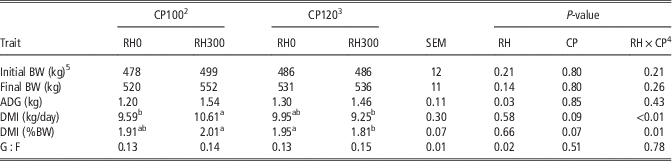
BW at the beginning of ractopamine supplementation (day 0) was similar for all treatments (P>0.10), demonstrating homogeneity at the initial allocation (Table 2). There was no RH×CP interaction on final BW (P=0.26), ADG (P=0.43) or on gain : feed ratio (G : F; P=0.78). Despite the numerical difference, there was no effect of RH supplementation on final body BW (P=0.14). On the other hand, animals supplemented with RH had 20% greater ADG than control animals (1.50 v. 1.25 kg/day, P=0.03). Increasing dietary CP content above requirements had no effect on final BW, ADG or G : F ratio (P>0.05).
Effects of RHFootnote 1 and dietary protein content on live performance

DMI=dry matter intake.
1 RH=ractopamine hydrochloride (Ouro Fino Saúde Animal, Cravinhos, SP, Brazil) fed at 0 or 300 mg/animal·per day during 35 days before slaughter.
2 Diet formulated to meet 100% of metabolizable protein requirements.
3 Diet formulated to meet 120% of metabolizable protein requirements.
4 Decomposition of the RH×CP interaction: within a row, means without a common superscript differ (P<0.05).
5 Corresponds to the beginning of RH supplementation.
For DMI, the RH×CP interaction was significant (P<0.01). The decomposition of the interaction demonstrated that for DMI expressed as a percentage of BW, RH supplementation had no effect on DMI at CP100 (P=0.12), yet it reduced DMI at CP120 (1.95% v. 1.81% BW for RH0 and RH300, respectively; P=0.03). Addition of RH to the diet considerably improved G : F ratio, independently of the CP concentration of the diet (0.15 v. 0.13, P=0.02).
Blood samples
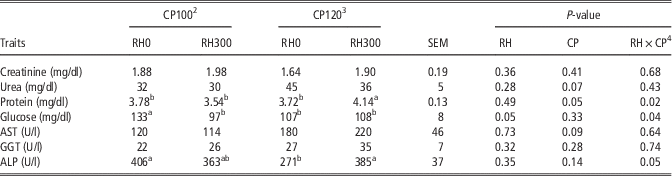
There was no RH×CP interaction on plasma creatinine (P=0.68) or urea concentration (P=0.43). There was also no effect of RH or dietary CP on plasma creatinine concentration (P>0.10, Table 3). Dietary CP level tended to increase blood urea (31.2 v. 40.8 mg/dl for CP100 and CP120, respectively, P=0.07), with no effect of RH (P=0.28). There was an RH×CP interaction for plasma total protein concentration (P=0.02). Ractopamine supplementation increased plasma total protein at CP120 (P=0.03) and had no effect at CP100 (P=0.17). There was also a significant RH×CP interaction for plasma glucose (P=0.04). Ractopamine supplementation decreased plasma glucose concentration at CP100 (P=0.05), and had no effect at CP120 (P=0.87). Regarding the plasma activity of the liver enzymes, there was no effect of RH×CP interaction for AST (P=0.64) or GGT (P=0.74). There was also no effect of RH on the activities of these two liver enzymes (P>0.30). There was a tendency for greater AST activity at CP120 than at CP100 (200 v. 116 U/l, P=0.09), with no effect of CP on GGT activity (P=0.28). The RH×CP interaction was significant for ALP activity (P=0.05), as ractopamine supplementation increased ALP activity at CP120 (P=0.05), and had no effect at CP100 (P=0.42).
Effects of RHFootnote 1 and dietary protein content on plasma composition

AST=aspartate aminotransferase; GGT=γ-glutamyl transferase; ALP=alkaline phosphatase.
1 RH=ractopamine hydrochloride (Ouro Fino Saúde Animal, Cravinhos, SP, Brazil) fed at 0 or 300 mg/animal·per day during 35 days before slaughter.
2 Diet formulated to meet 100% of metabolizable protein requirements.
3 Diet formulated to meet 120% of metabolizable protein requirements.
4 Decomposition of the RH×CP interaction: within a row, means without a common superscript differ (P<0.05).
Carcass traits and meat quality
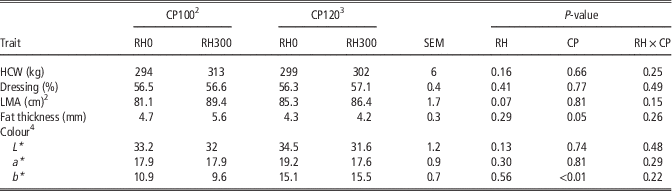
There were no RH×CP interaction effects on carcass traits or on longissimus colour (P>0.10). There was also no effect of RH or of CP on HCW or dressing percentage of the carcass (P>0.10, Table 4). There was a tendency for RH supplementation to increase LMA (83.2 v. 87.9 cm2, P=0.07), with no effect of dietary CP (P=0.81). Ractopamine did not alter fat thickness (P=0.29); however, increasing dietary CP above requirements (CP120) decreased fat thickness (5.1 v. 4.3 mm for CP100 and CP120, respectively, P=0.05).
Effects of RHFootnote 1 and dietary protein content on carcass traits and meat quality

HCW=hot carcass weight; LMA=longissimus muscle area.
1 RH=ractopamine hydrochloride (Ouro Fino Saúde Animal, Cravinhos, SP, Brazil) fed at 0 or 300 mg/animal·per day during 35 days before slaughter.
2 Diet formulated to meet 100% of metabolizable protein requirements.
3 Diet formulated to meet 120% of metabolizable protein requirements.
4 L*=lightness, from 0 (black) to 100 (white); a*=redness, from −120 (green) to 120 (red); b*=yellowness, from −120 (blue) to 120 (yellow).
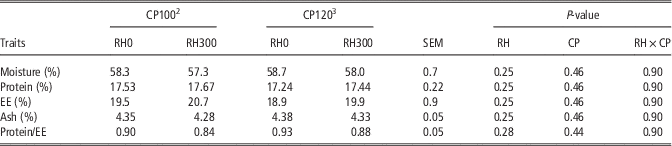
Meat colour scores were not affected by RH supplementation, and values were within the accepted normal range (Muchenje et al., Reference Muchenje, Dzama, Chimonyo, Raats and Strydom2009). Dietary CP altered the b* value (P<0.01), being greater for CP120 than CP100 (15.3 v. 10.2 for CP120 and CP100, respectively). When analyzing the chemical composition of the carcasses, as estimated by the Hankins and Howe’s (Reference Hankins and Howe1946) method, treatments had no effect on the protein, fat or ash content (Table 5).
Effects of RHFootnote 1 and dietary protein content on carcass composition

EE=ether extract.
1 RH=ractopamine hydrochloride (Ouro Fino Saúde Animal, Cravinhos, SP, Brazil) fed at 0 or 300 mg/animal·per day during 35 days before slaughter.
2 Diet formulated to meet 100% of metabolizable protein requirements.
3 Diet formulated to meet 120% of metabolizable protein requirements.
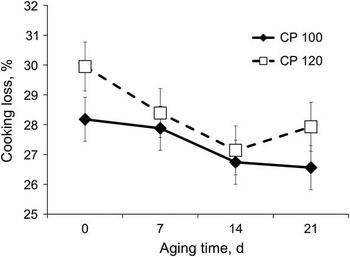
Regarding meat quality, there was no effect of RH×CP interaction (P=0.26), or of RH supplementation (P=0.66) on CL. There was a tendency (P=0.07) for greater CL at CP120 than at CP100 (28.4% v. 27.3% for CP120 and CP100, respectively, Figure 1), and this effect was not dependent on the postmortem aging time (P=0.77 for CP×time interaction). Postmortem aging time altered CL (P=0.04), as CL decreased with aging time. After 14 and 21 days of aging, CLs were lower than at day 0 (P<0.05, Figure 1).
Effect of dietary protein content and aging on cooking loss. Diets were formulated to provide either 100% (CP100) or 120% (CP120) of the metabolizable protein requirement of the animals. There were no effects of RH×CP interaction (P=0.26) or CP×aging interaction (P=0.77). Cooking losses tended to differ by dietary CP content (P=0.07). RH=ractopamine hydrochloride.

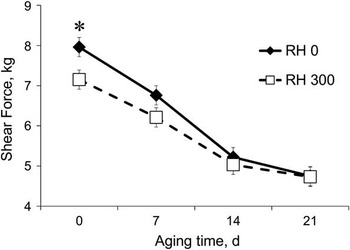
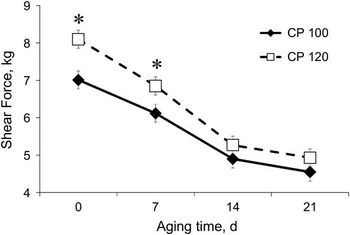
There was no RH×CP interaction for meat WBSF (P=0.13). There was a significant RH×time interaction for meat WBSF (P<0.01, Figure 2). Decomposition of the time×RH interaction demonstrated that RH supplementation decreased meat WBSF only at day 0 of aging (P=0.03), having no effect on WBSF after 7, 14 or 21 days of aging. There was also a CP×time interaction for meat WBSF (P<0.01), with CP120 increasing WBSF after 0 and 7 days of aging (P<0.05), with no effect of dietary CP on meat WBSF after 14 or 21 days of aging (Figure 3).
Effects of ractopamine hydrochloride (RH) and aging time on meat shear force. Animals received either 0 (RH 0) or 300 mg (RH 300) of RH per day (Ouro Fino Saúde Animal, Cravinhos, SP, Brazil). *=P<0.05. There was no RH×CP interaction (P=0.13); however, there was a significant RH×aging interaction (P<0.01) on meat shear force. Meat shear force was reduced with the advancing aging time in both treatments (P<0.01), and RH supplementation decreased shear force only at day 0 (P=0.03), with no effect after 7, 14 or 21 days of aging (P>0.10).

Effects of dietary protein content and aging time on meat shear force. Diets were formulated to provide either 100% (CP100) or 120% (CP120) of the metabolizable protein requirement of the animals. *=P<0.05. There was no RH×CP interaction (P=0.13); however, there was a significant CP×aging interaction (P<0.01) on meat shear force. Meat shear force was reduced with the advancing aging time in both dietary protein contents (P<0.01), and feeding excess protein (CP120) increased meat shear force at day 0 (P<0.01) and at day 7 (P=0.05) of aging, with no effect after 14 or 21 days of aging (P>0.10). RH=ractopamine hydrochloride.

Discussion
In feedlot systems, DMI, ADG and G : F are crucial cost-effective traits that affect the time that animals spend on feed and total profitability. Previous studies have clearly demonstrated the efficacy of adding β-AA to diets thereby improving cattle performance (Vestergaard et al., Reference Vestergaard, Sejrsen and Klastrup1994; Dunshea et al., Reference Dunshea, D’souza, Pethic, Harper and Warner2005; Avendaño et al., Reference Avendaño, Rodriguez, Murilo, Linres, Saavedra and Robinson2006). Schroeder (Reference Schroeder2004) summarized results from 10 experiments completed in different regions of the United States, using RH at the same dietary level as in the current study during the finishing phase, and found that ADG, total BW gain and the efficiency of gain were improved significantly by 26%, 20% and 20.5%, respectively, compared with non-supplemented controls. Nevertheless, these results were mostly conducted with B. taurus breeds, with a high percentage of fat in the carcass during the RH supplementation period. There are very few data with the effect of RH supplementation in B. indicus breeds with lower percentage of fat in the carcass.
In the present study with Nellore intact males, RH supplementation was also effective in increasing ADG and G : F ratio, but there was no effect on final BW. Avendaño et al. (Reference Avendaño, Rodriguez, Murilo, Linres, Saavedra and Robinson2006) reported an increase of 24% in ADG, and 34% in the G : F in crossbred steers consuming 300 mg/day of RH. More recently, Bryant et al. (Reference Bryant, Engle, Galyean, Wagner, Tatum, Anthony and Laudert2012) found no difference in final BW of RH supplemented steer, but addition of RH improved ADG by 25%, and G : F ratio in steers consuming 200 mg/day of RH. Similarly, Schroeder (Reference Schroeder2004) has shown 12.4% to 23.4% improvements in feed efficiency in steers fed 200 mg/day of RH for the final 28 days of the finishing period.
Because of the greater protein synthesis in ractopamine fed animals, a concomitant increase in protein requirement could be expected. According to the National Research Council (2000), increasing ADG from 1.4 to 1.6 kg/day results in ~12% increase in the MP requirement for growth; therefore, animal response to ractopamine could benefit from extra dietary protein. Contrary to our hypothesis, increasing dietary CP above standard requirement had no effect on body gain or feed efficiency in the present study. Our results corroborate with that of Walker et al. (Reference Walker, Titgemeyer, Drouillard, Loe, Depenbusch and Webb2006), who suggested that feeding β-agonists could enhance the efficiency with which cattle use MP, thereby leading to no change in protein requirements.
Ractopamine supplementation has been shown to decrease feed intake (Avendaño et al., Reference Avendaño, Rodriguez, Murilo, Linres, Saavedra and Robinson2006; McEvers et al., Reference McEvers, Nichols, Hutcheson, Edmonds and Lawrence2012). In the present study, RH also reduced feed intake, but only when associated with a diet with excess CP. Because RH supplementation can reduce protein degradation, the increased amino acid (AA) supply to the liver could explain the reduction in feed intake. The greater oxidation of AA in the liver could generate excess ATP leading to reduced intake (Allen et al., Reference Allen, Bradford and Oba2009).
The effects of RH supplementation on blood metabolites were also dependent of dietary CP levels. Glucose plasma concentration can be reduced when there is an increase in production demand, such as the increase in muscle synthesis in RH supplemented animals. The fact that RH reduced plasma glucose only at the CP100 diet probably reflects the excess of gluconeogenic AA available at the liver in the CP120 diet. The increase in the efficiency of AA metabolism by RH supplementation can also explain the increase in plasma total protein associated with the CP120 diet. A lower muscle degradation rate, because of RH supplementation, can lead to reduced plasma urea concentration (Walker et al., Reference Walker, Titgemeyer, Drouillard, Loe, Depenbusch and Webb2006; Bryant et al., Reference Bryant, Engle, Galyean, Wagner, Tatum, Anthony and Laudert2012), but this was not the case in the present study. Plasma activities of the liver enzymes AST, GGT and ALP are used as possible indicators of hepatic disturbances. Activities of AST, GGT and ALP in the present study were within the range of normal values for cattle (Radostitis et al., 2007), suggesting that RH supplementation had no negative effect on liver health status.
Increased muscle mass in mammals is recognized as an important effect of β-AA oral administration, by increasing the synthesis of muscle protein, reducing the degradation of muscle protein or a combination of both. This β-AA induced muscle hypertrophy is accredited to an increased rate of muscle α-actin synthesis, as well as to the inhibitory activity of calpastatin (Smith et al., Reference Smith, Gracia and Anderson1989; Yang and McElligott, Reference Yang and McElligott1989). Fat deposition in several organs can also be usually affected by β-AA supplementation. Avendaño et al. (Reference Avendaño, Rodriguez, Murilo, Linres, Saavedra and Robinson2006) reported 6% and 18% decrease in fat thickness of steers fed RH and zilpaterol hydrochloride (ZH), respectively. In the present study, RH supplementation tended to increase LMA, but did not alter carcass fat thickness. Bryant et al. (Reference Bryant, Engle, Galyean, Wagner, Tatum, Anthony and Laudert2012) also reported no change in fat thickness when steers were supplemented with 200 mg/day of RH.
Contrary to the present study, carcass fat thickness is usually not affected by dietary protein concentrations, if there is no change in the total amount of energy in the diet (Fluharty et al., Reference Fluharty, Loerch, Turner, Moeller and Lowe2000). The main substrate for lipogenesis in cattle is acetate from rumen fermentation of carbohydrates; therefore, excess protein in the diet could be producing less acetate in the rumen and reducing fat synthesis in the adipose tissue. Associated with the reduced acetate, diets with excess protein can also decrease energy availability for fat synthesis due to the higher energy expenditure for urea synthesis in the liver (Agnew and Yan, Reference Agnew and Yan2000). The changes in fat thickness with excess protein in the diet were not enough to promote changes in total carcass chemical composition, as estimated by the 9–11th rib composition.
Because of the effects of β-AA supplementation on protein metabolism, such as reduced protein degradation and decreased proteolytic activity in the muscle tissue, in general, studies have shown a negative impact on meat tenderness (Geesink et al., Reference Geesink, Smulders, Van Laack, Van der Kolk, Wensing and Breukink1993; Vestergaard et al., Reference Vestergaard, Sejrsen and Klastrup1994). Avendaño et al. (Reference Avendaño, Rodriguez, Murilo, Linres, Saavedra and Robinson2006) reported an increase of 16% in WBSF in meat from steers fed ZH, and 9% increase in meat WBSF from bulls fed RH. In the present study, there was no negative effect of RH supplementation on meat tenderness, measured by WBSF. In fact, contrary to expected, RH supplementation reduced meat WBSF at the day of slaughter, with no effect after some postmortem aging time. Analyzing WBSF of steaks after 14 days of aging, Arp et al. (Reference Arp, Howard, Woerner, Scanga, McKenna, Kolath, Chapman, Tatum and Belk2013) reported a dose response of RH, with no difference in WBSF values for meat from steers treated with 200 mg/animal·per day compared with non-treated control. Steaks from steers fed ZH or higher doses of RH (300 or 400 mg/animal·per d) had greater WBSF values and were rated lower for overall tenderness than controls (Arp et al., Reference Arp, Howard, Woerner, Scanga, McKenna, Kolath, Chapman, Tatum and Belk2013).
Miller et al. (Reference Miller, Carr, Ramsey, Crockett and Hoover2001) suggested a categorization of meat tenderness based on WBSF values, with intermediate meat having between 3.92 and 4.5 kg, and tough meat between 5.42 to 7.2 kg. According to this categorization, the meat from the bulls fed RH in the current study would still be classified as tough meat at day 0, likely reflecting the breed differences in meat tenderness. Brooks et al. (Reference Brooks, Claus, Dikeman, Shook, Hilton, Lawrence, Mehaffey, Johnson and Allen2009) reported that the longer the period of supplementation with ZH the lower the percentage of meat with WBSF values below 4.5 kg.
Meat tenderness at day 0, and after 7 days of postmortem aging, was also affected by dietary CP levels in the present study. Few studies have focused on the effects of dietary protein content on beef tenderness. Berge et al. (Reference Berge, Culioli, Renerre, Touraille, Micol and Geay1993) observed reduced meat tenderness with increased amounts of muscle production, because of greater dietary protein content. Marino et al. (Reference Marino, Albenzio, Caroprese, Napolitano, Santillo and Braghieri2011) also reported increased meat hardness with greater protein supplementation. Bulls fed RH had no change in meat colour; however, dietary CP promoted a strong increase in the b* variable, which measures the intensity of yellowness in the meat. According to Sirtori et al. (Reference Sirtori, Crovetti, Acciaioli, Pugliese, Bozzi, Campodoni and Franci2014), changes on meat colour generated by altering the CP content of the diet might be partially owing to the fat content. This statement agrees with the report of Latorre et al. (Reference Latorre, Làzaro, Gracia, Nieto and Mateos2003), who demonstrated that the increase in fat content was associated with a more intense colour of meat.
In summary, our results have demonstrated for the first time the efficacy of ractopamine supplementation to increase gain, improve feed efficiency and increase loin muscle area in intact Nellore young bulls, with relatively low carcass fat content. These effects were not further improved by increasing dietary protein content above requirements, and there was no negative effect of ractopamine on meat tenderness.
Acknowledgement
The authors would like to thank Ouro Fino Animal Health for the financial support.