INTRODUCTION
The large waves of migration in recent years have led to growth in the number of children being raised in multilingual societies. While the majority of these children are typically developing sequential bilinguals (or even multilinguals), their language production at the onset of bilingualism shows superficial similarity to the language of monolingual children with Specific Language Impairment (SLI). This similarity led Crago and Paradis (Reference Crago, Paradis, Levy and Schaeffer2003) to investigate whether bilingualism and SLI were ‘two of a kind’, concluding in later work (cf. Paradis, Reference Paradis2010a) that they were not. Their major argument was that the similarity is only in the locus of errors but not in the type of errors. Moreover, Hamann and Belletti (Reference Hamann and Belletti2008) showed that this initial similarity disappeared once bilingual children became more proficient. While the above-mentioned studies focused on verb morphosyntax in French–English bilinguals, the present study expands the domain of research beyond French–English bilinguals to bilingual populations which acquire typologically distinct pairs of languages: English–Hebrew and Russian–Hebrew, focusing on verb inflections and prepositions. The linguistic performance of these bilingual children is compared to the performance of Hebrew monolingual speaking children with SLI to provide further evidence for the similar and yet distinct linguistic abilities of the two populations.
Heterogeneity characterizes the population which is diagnosed with Specific Language Impairment. SLI is first and foremost a neurological disorder leading to a significant deficit in linguistic abilities, a ‘primary language disorder’ (Bishop, Bright, James, Bishop & van der Lely, Reference Bishop, Bright, James, Bishop and van der Lely2000; Leonard, Reference Leonard1998). There are a number of exclusionary criteria for SLI (Leonard, Reference Leonard1998) including: no hearing loss (no history of otitis media), no emotional and behavioral problems, no below average non-verbal IQ (> = 85), no acquired neurological problems, and no severe articulation/phonological deficit. Thus, SLI includes language abilities below age expectation for children with similar exposure and IQ, with no general communication difficulties; a language deficit more severe than an articulatory disorder; and language deficits for both receptive and expressive skills (Leonard, Reference Leonard1998). That is, SLI is a primary language disorder rather than a secondary language disorder which is the consequence of other disorders (Paradis, Reference Paradis2010a). Very often, the linguistic production of children with SLI resembles the linguistic production of children with typical language development at earlier stages of acquisition (Rice, Reference Rice, Rice and Warren2004). For the present study, children with SLI were defined as those with normal performance IQ who meet the exclusionary criteria for SLI and are below the norms set for typical development on standardized language tests.
This paper compares English–Hebrew and Russian–Hebrew bilingual preschool children with typical language development (TLD) in regular Hebrew-speaking preschool and monolingual children with SLI (MoSLI) attending language preschools in the same neighborhood. The comparisons with children with SLI are enhanced by a comparison with the results of Dromi, Leonard, and Adam (Reference Dromi, Leonard and Adam1997) and Dromi, Leonard, Adam, and Zadunaisky-Ehrlich (Reference Dromi, Leonard, Adam and Zadunaisky-Ehrlich1999), whose tasks and testing protocol were used as part of this study.
Monolingual SLI: verbal morphology and prepositions
SLI is manifested at different levels of representation. Delayed or impaired morphophonological and prosodic processes (Leonard, Reference Leonard1998), delays in acquisition of words and word retrieval (cf. Leonard, Reference Leonard1998), difficulties with morphosyntactic representations (e.g., Rice & Wexler, Reference Rice and Wexler1996), syntactic structures (e.g., van der Lely, Reference van der Lely1998; Novogrodsky & Friedmann, Reference Novogrodsky and Friedmann2006) as well as deficits in certain narrative, discourse, and pragmatic skills (e.g., Washington & Craig, Reference Washington and Craig2004) have been found to differ across languages, reflecting typological differences. The present review of manifestations of SLI focuses on aspects of morphosyntactic representation which are relevant for the present study.
Morphological and syntactic features are primary linguistic indicators of SLI (Leonard, Reference Leonard1998). Native English-speaking children with SLI show impaired production of verbal inflections, omitting them in obligatory contexts (Bishop, Reference Bishop1994; Rice & Wexler, Reference Rice and Wexler1996), thus generating root infinitives (also referred to as ‘optional infinitives’). For example, children with SLI use infinitival forms for matrix verbs, e.g., *He eat for He eats (Rice & Wexler, Reference Rice and Wexler1996). They also omit auxiliary verbs (Hadley & Rice, Reference Hadley and Rice1996), e.g., auxiliaries in negation, as in *He not want (Leonard, Reference Leonard1998). Leonard (Reference Leonard1998) concludes that the most consistent differences in English between children with SLI and language-matched peers are for finite verb inflections, copular forms, and auxiliaries which require agreement. Rice and Wexler (Reference Rice and Wexler1996) attribute these properties of the language of English-speaking children with SLI to a less mature representation in an Extended Optional Infinitive stage.
However, omissions and deviations in argument structure (Leonard, Reference Leonard1998), as well as adjunct omissions, e.g., of temporal adverbs (Fletcher & Garman, Reference Fletcher and Garman1988), have been reported as well. Children with SLI use simplified noun phrases and sentence structure (the small dog → small dog, or bare NPs, e.g., dog), and avoid complex PPs, such as on the rock, preferring bare nouns (van der Lely, Reference van der Lely1998). Johnston and Kamhi (Reference Johnston and Kamhi1984) as well as Grela, Rashiti, and Soares (Reference Grela, Rashiti and Soares2004) report that children with SLI use fewer prepositions than typically developing children, avoiding complex PPs and preferring bare nouns. Watkins and Rice (Reference Watkins and Rice1991) further show that the use of verb particles is particularly challenging for children with SLI. Furthermore, Roeper, Ramos, Seymour, and Abdul-Karim (Reference Roeper, Ramos, Seymour and Abdul-Karim2001) show that prepositions which are omitted are those predicted by the verb (e.g., ‘looking him shoe’ (look for); p. 396), while those which are retained are those which are not selected by the verb.
Studies of Russian SLI are rather scarce and no study deals directly with verb inflections and prepositions. Some of these studies do mention weakness of agreement inflections and omission of preposition and cases, but the focus of the studies currently available are on complex syntax on the one hand (Babyonyshev, Hart & Grigorenko, Reference Babyonyshev, Hart and Grigorenko2005) and phonology on the other.
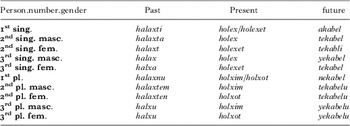
Studies of Hebrew SLI, conducted by Dromi, Leonard, and colleagues (e.g., Dromi et al., Reference Dromi, Leonard, Adam and Zadunaisky-Ehrlich1999; Dromi, Leonard & Shteiman, Reference Dromi, Leonard and Shteiman1993) focus on the use of finite verb morphology. Dromi et al. (Reference Dromi, Leonard, Adam and Zadunaisky-Ehrlich1999) investigated the use of verbal morphology in Hebrew-speaking children with SLI, aged four to six, using a sentence completion task. With verbal morphology being an inseparable part of every verb form in Hebrew, a Semitic language (see Table 1), it was suggested that very few inflections, if any, would pose a problem for children with SLI. Nonetheless, it was predicted that inflections which carry more features (e.g., the past tense, singular, second person, masculine verbal form rakadta ‘you danced’) would be more difficult than those which carry fewer features (e.g., the genderless past tense, singular, first person verbal form rakadti ‘I danced’ or the personless present tense, singular, masculine verbal form roked ‘(you) dance’), predicting errors that show feature reduction and a simpler feature complex (e.g., substituting rakadta, which has three agreement features, by rakadti or roked, which have only two agreement features).
Verb inflections in Hebrew past and present tenses

Dromi et al. (Reference Dromi, Leonard, Adam and Zadunaisky-Ehrlich1999) used a sentence completion task to target present tense morphemes, which are marked in Hebrew for gender (fem.), number (pl.) or both (fem. pl.). They reported that while monolingual children with TLD scored at ceiling on all three morphemes, children with SLI showed 80% success when one feature is involved, but hardly ever produced the target morphemes which represent two features (fem. pl.). Using an enactment task which targeted past tense morphemes (marked in Hebrew for person (1st, 2nd, 3rd), gender (masc. or fem.), number (sing. or pl.), or a combination of these features, they again found that while children with TLD scored at ceiling on all morphemes, children with SLI were at ceiling when fewer features were involved (e.g., 1st sing. or 1st pl.), but produced the target morpheme only around 80% of the time when it represented three features (e.g., 2nd sing. fem.). While studies of SLI in English find mostly omission errors, in Hebrew most errors are substitutions in which a morpheme which carries fewer features is used instead of a morpheme which carries more features. Dromi et al. (Reference Dromi, Leonard, Adam and Zadunaisky-Ehrlich1999) argued that their findings from Hebrew support a limited processing capacity position, since more complex structures, which place more demands on the system, seem to be more impaired.
Nominal morphosyntax in Hebrew is typologically very different from English, not lending itself easily to comparison. Unlike English, in Hebrew some nominal function words, such as determiners and even some prepositions, are prefixes (bound morphemes), e.g., ha-yeled ‘the boy’, ba-gan' ‘in the playground’; agreement inflectional features (gender and number) are inherent features of each noun and are often morphologically overt, e.g., yeled ‘boy’, yalda ‘girl’, yeladim ‘boys’, yeladot ‘girls’; and derivational morphology is both non-concatinative, e.g., yeled ‘boy’, mey al ed et ‘midwife’, and linear, e.g., yaldut ‘childhood’, yaldi ‘childish’, at the same time. In English, difficulties are more pronounced at the functional level (van der Lely, Reference van der Lely1998) whereas in Hebrew they are found at the word-formation level, due to the derivational complexity of Hebrew words (Ravid, Levie & Avivi-Ben-Zvi, Reference Ravid, Levie, Avivi-Ben Zvi, Verhoeven and van Balkom2003). There are no studies of preposition use by monolingual Hebrew-speaking children with SLI, but Dromi et al. (Reference Dromi, Leonard and Shteiman1993) found that the use of the prenominal accusative case marker (et), which is a free morpheme, was delayed among children with SLI, though their performance was similar to their language-matched controls.
To conclude, for children with SLI, both languages show a reduction in the use of verbal inflectional morphology. In English, children with SLI use root infinitives. In Hebrew, however, due to the salience of the inflectional system, simplification is more constrained and many aspects of inflectional morphology are retained. However, no previous study has looked at the use of prepositions in monolingual Hebrew speakers with SLI.
Child bilingualism and SLI: ‘two of a kind’?
One of the major challenges in diagnosing SLI among bilingual children is the parallel found between the language of sequential bilingual children and the language of children with SLI. Sequential bilingual children, unlike monolinguals, rely on knowledge transferred from their first language (L1) in acquiring their second language (L2) and at the same time often follow what looks like a typical language developmental trajectory. Thus, the bilinguals' linguistic performance and the errors in their production reflect both (partial) transfer from their L1 (Eubank, Reference Eubank, Hoekstra and Schwartz1994; Schwartz, Reference Schwartz, Van Kampen and Baauw2004; Vainikka & Young-Scholten, Reference Vainikka, Young-Scholten, Karimi, Samiian and Wilkins2007)) and grammatical development (Dulay & Burt, Reference Dulay and Burt1974), as well as a competition between two representations, one of the L1 and one of the L2 (Walters, Reference Walters2005). Nicoladis (Reference Nicoladis2006) suggested that when bilingual children were correct more often than incorrect, this pattern supported knowledge of the L2 syntactic structure, and attributed the errors to the influence of processing in a bilingual situation, viewing them as ‘an epiphenomenon of speech production’ (p. 26).
In the study of SLI, the domain of errors is associated either with a particular set of linguistic features or relations (Clahsen, Bartke & Göllner, Reference Clahsen, Bartke and Göllner1997; van der Lely, Reference van der Lely, Levy and Schaeffer2003) or with the degree of saliency and the processing effort which are associated with that particular domain in a particular language (Leonard, Reference Leonard, Levy and Schaeffer2003). The domain of errors, in both populations, is within the general scope of functional categories. These functional categories are the locus of difficulty for both populations.
Paradis (Reference Paradis1999) addressed the superficial resemblance between the language of sequential bilingual children and the language of children with SLI, and reported ‘significant similarities’ between monolingual French SLI and French L2 learners, especially regarding tense marking. In a following study, Paradis and Crago (Reference Paradis and Crago2000) concluded that tense marking might not be an effective clinical marker of SLI for second language learners. Yet Hamann and Belletti (Reference Hamann and Belletti2008) argued that this similarity is only found at the onset of bilingualism, disappearing in later years. Moreover, Crago and Paradis (Reference Crago, Paradis, Levy and Schaeffer2003) further addressed this issue, concluding that bilingualism and SLI are not ‘two of a kind’. They found profile differences in English between the two populations in terms of error type and pace of acquisition measured by changes in the percentage of correct use in the relevant contexts. More specifically, they argued that while children with SLI tended to omit the auxiliary in past or future periphrastic verb constructions, bilingual children substituted the auxiliary with the base or present tense form (Paradis & Crago, Reference Paradis and Crago2000). With such findings in mind, Paradis (Reference Paradis, Gavruseva and Haznedar2008) argued that bilingual children with TLD use substitutions in order to fill a gap between their limited knowledge of L2 and the communicative demands with a morphosyntactic expression. She argued that both the high proportions of commission errors for inflections and the overgeneralization of tense-carrying morphemes such as BE, for example, distinguished L2 children for whom tense is obligatory from children with SLI who might assume that tense is optional.
Several approaches to child second language acquisition tap into these difficulties with the verbal morphosyntax, suggesting partial transfer of the lexical tree only (Vainikka & Young-Scholten, Reference Vainikka, Young-Scholten, Karimi, Samiian and Wilkins2007) or transfer of lexical but not syntactic information (Eubank, Reference Eubank, Hoekstra and Schwartz1994). Vainikka (Reference Vainikka2010) addresses this similarity in the domain of errors within verb projections, arguing that it can be explained if agreed that all acquisition (L1, L2, TLD, SLI) begins with a bare VP and functional projections develop one by one both in L1 and L2 acquisition. Within such a model, the similarity between bilingualism and SLI stems from a similar process of acquisition in L1 and L2, while the differences between bilingualism and SLI can be attributed to impairment.
In the study of SLI, difficulty is associated with feature omission (Bishop, Reference Bishop1994; Gopnik, Reference Gopnik1990), impaired tense or agreement (Clahsen et al., Reference Clahsen, Bartke and Göllner1977; Rice, Reference Rice, Rice and Warren2004) or impairment in the checking mechanism (Wexler, Reference Wexler1998). All of these models ascribe the difficulty to impaired representation and locate it within the functional system, but do not offer an explanation as to the similarity in the locus of errors found in the two populations. Yet they might be able to explain the difference between bilinguals with TLD and monolinguals with SLI in the same way they explain the difference between monolinguals with TLD and monolinguals with SLI. More processing-oriented approaches attribute the difficulty observed in children with SLI to saliency of particular features within the target language or linguistic system and limitations in input-processing over time (Leonard, Reference Leonard, Levy and Schaeffer2003). Yet the limitations in input-processing associated with SLI which seem to cause a delay and even deviance in the acquisition of different modules of the linguistic system are not necessarily similar to the increased processing demands which, in bilinguals, take the form of longer reaction times in lexical access tasks (Sandoval, Gollan, Ferreira & Salmon, Reference Sandoval, Gollan, Ferreira and Salmon2010; Yan & Nicoladis, Reference Yan and Nicoladis2009).
This reported similarity with its possible different roots drives the present study. The present study addresses this issue in bilingual populations which acquire typologically distinct pairs of languages: English–Hebrew and Russian–Hebrew. The linguistic performance of these bilingual children is compared to the performance of monolingual Hebrew-speaking children with SLI to provide further evidence for the similar and yet distinct linguistic abilities of the two populations. Moreover, since in Hebrew verb inflection is less sensitive to omissions, the focus of this paper is extended to a second linguistic measure – prepositions. Errors are expected in both domains.
The present study explores two types of errors – omissions and substitutions – for both bilingual children with TLD and monolingual children with SLI. We return here to the same distinction between representation and processing raised above. In research on bilingualism, reference is often made to a processing load due to a dual task effect (Rohrer, Wixted, Salmon & Butters, Reference Rohrer, Wixted, Salmon and Butters1995) that manifests itself in verbal fluency tasks (Sandoval et al., Reference Sandoval, Gollan, Ferreira and Salmon2010). Bilingual adults show lower scores on verbal fluency tasks (Portocarrero, Burright & Donovick, Reference Portocarrero, Burright and Donovick2007). Additionally, Bialystok (Reference Bialystok2009), in a study of monolinguals and bilinguals using a verbal fluency task, showed that the bilinguals at both ages obtained lower scores than their monolingual peers. She further showed that when bilingual children participated in verbal fluency tasks, they were significantly slower than monolingual children. Processing demands are also viewed as a possible reason for code-switching (Walters, Reference Walters2005) and tip-of-the-tongue phenomena, which are more frequent among bilinguals (Pyers, Gollan & Emmorey, Reference Pyers, Gollan and Emmorey2009). Gauthier, Genesee, and Kasparian (Reference Gauthier, Genesee and Kasparian2012), for example, suggested that the occurrence of substitutions rather than omissions of object clitics in the French of international adoptees indicated that they had acquired the underlying syntactic representations but were limited in their ability to use them appropriately. Similar argumentation is employed by Grüter and Crago (Reference Grüter and Crago2011) to explain a production–comprehension asymmetry among L2 French speakers.
In light of the research findings discussed above we hypothesized that substitutions would be characteristic of bilingual acquisition, while omissions would characterize children with SLI. This further predicted the use of erroneous prepositions in bilingual children with TLD, while monolingual children with SLI were expected to omit prepositions. In terms of the use of Hebrew verb morphology, our prediction was that bilinguals with TLD would show feature substitution, while monolinguals with SLI would show feature reduction. That is, substitutions made by bilinguals with TLD would be into morphemes which carry the same number of features, while children with SLI would substitute morphemes which carry a higher number of features by morphemes with fewer features, omitting a feature or two, as proposed by Dromi et al. (Reference Dromi, Leonard, Adam and Zadunaisky-Ehrlich1999). This was tested for two linguistic measures: verb inflections and prepositions.
Linguistic measures
Inflections
While English inflects its verbs for past tense and for third person singular in the present, Hebrew uses a wide array of verb inflections. In addition to tense, verbs are inflected for gender and number in the present tense and for gender, number, and person in the past and future tenses. This is presented in Table 1 for the verb holex ‘walk’ in the past and present and the for the verb mekabel ‘get’ in the future.
As seen in Table 1, tense differences are marked by changes in the interdigited vowels, e.g., halax ‘walked’ –holex ‘walks’, as well as by a change to the prefix in the present tense of some conjugations. Gender, number, and person are marked by suffixation, e.g., halax-ti (1st sing.), halax-t (2nd sing. fem.), halx-u (3rd pl.), in the past tense, prefixation in the future, e.g., akabel (1st sing.), tekabel (2nd sing. masc.), yekabel (3rd sing. fem.),nekabel (1st pl.), and a combination of prefixation and suffixation, e.g., tekabli (2nd sing. fem.), yekablu (3rd pl.). This variety of inflections yields over twenty different inflected forms for each lexeme.
The present study focused on past and present tenses only. We looked at the use of the four present tense forms (masculine singular, which has no overt inflection, singular feminine, plural masculine, and plural feminine), as well as three past tense forms (1st singular, 2nd masculine singular, and 2nd feminine singular).
Prepositions
Prepositions are a heterogeneous category. Some prepositions contribute to the meaning of the sentence (e.g., locatives, directionals, temporals), as in (1), while others serve mainly a grammatical function of case assignment, as in (2).
(1) ani yoshev leyadha-xatul
I sit near the-cat
‘I sit near the cat.’
(2) ani coxek alha-yalda
I laugh on the-girl
‘I laugh at the girl.’
Yet, more often than not, the same preposition has both functions depending on its relation to the verb. Thus, for example, ‘to’ in (3) is semantically colored, being directional, and is not selected by the verb, while ‘to’ in (4) is semantically weak and obligatory, being selected by the verb.
(3) ani holex le-beyt^ha-sefer
I go to school
‘I am going to school.’
(4) ten et ze le-Miria
give ACC this to-Miriam
‘Give it to Miriam!’
This division is sufficient for describing the heterogeneity of prepositions in Hebrew, while English, a verb satellite language (Talmy, Reference Talmy2000), makes a further distinction between phrasal verbs and verb particle constructions. More specifically, English has a distinction between functional prepositions, as in (2) and (4) above, and particles. This distinction plays no role in the present paper, since Hebrew, a verb framed language, does not have particle verbs.
The present study employs the Hebrew distinction between free use, as in (1) and (3), and restricted use, as in (2) and (4), reflecting the relation between the verb and the preposition. Free prepositions are not restricted by the verb, while restricted prepositions are. Free prepositions (F-preps) introduce an adverbial prepositional phrase (locative, directional, temporal), e.g., at school, to school, in the morning, while restricted prepositions (R-preps) are restricted by the verb (dative, oblique), e.g., laugh at, chase after. In Hebrew, R-preps may or may not form a PP with the NP which follows, but this PP is not the argument of the verb, i.e., the theta-role is assigned to the NP which follows the preposition (cf. Botwinik-Rotem, Reference Botwinik-Rotem2004). R-preps primarily serve a grammatical function in case assignment and often do not contribute to the meaning of the sentence, while F-preps form a PP with the subsequent NP and contribute to the meaning of the sentence.
While in English all prepositions are free morphemes, i.e., independent words, in Hebrew some are free morphemes (as in (1) and (2)) and some are bound morphemes (as in (3) and (4)). The distinction between free and bound prepositions has no semantic or syntactic implications. Both types can be restricted by the verb which precedes them, or free.
METHOD
Participants
Following Kohnert (Reference Kohnert2008), a child is considered functionally bilingual when she comes from a bilingual background (either bilingual home or monolingual home in a society which speaks a language different from the home language) and needs to function in both languages on a daily basis. This definition was applied in selecting the participants for the present study. Most bilingual children in Israel are children of first-generation immigrants. This population is highly heterogeneous, and this variability is strongly influenced by the order and ages in which the two languages have been acquired (simultaneous/sequential), as well as by acquisition context (one parent – one language vs. home language – school language), family size, and birth order. The heterogeneity which the functional definition yields was addressed while analyzing the data.
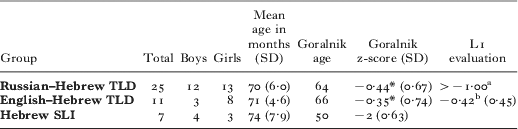
Forty-three children participated in this study: 25 Russian–Hebrew bilingual children with TLD, 11 English–Hebrew bilingual children with TLD and 7 Hebrew monolingual children with SLI. The participants were classified based on linguistic performance and parental reports:
• Twenty-five Russian–Hebrew bilingual children with TLD (13 girls, 12 boys), aged five to seven, with at least two years of exposure to L2 Hebrew all scored within monolingual norms for Hebrew. For their L1 they met two criteria:
• They had no reported history of language impairment in L1-Russian (based on parental lack of concern and scoring of various aspects of Russian development as reported in an adaptation of the ALDEQ parental questionnaires (Paradis, Emmerzael & Duncan, Reference Paradis, Emmerzael and Duncan2010)).
• They had a z-score higher than −1·00 (based on the scores of 80 Russian–Hebrew bilinguals) on a battery of tasks which consisted of a non-word repetition with Russian-like items, complex syntax sentence imitation in Russian, and MLU in narratives in Russian. Non-word repetition and complex sentence repetition were selected for this screening battery due to their combined reliability as psycholinguistic measures of SLI (Conti-Ramsden, Botting & Faragher, Reference Conti-Ramsden, Botting and Faragher2001).
• Eleven English–Hebrew bilingual children with TLD (8 girls, 3 boys), aged five to seven, with more than two years of exposure to L2 all scored within monolingual norms in both languages: CELF-II Preschool (Wiig, Secord & Semel, Reference Wiig, Secord and Semel2004) for English and Goralnik Screening Test for Hebrew (Goralnik, Reference Goralnik1995).
• Seven monolingual Hebrew-speaking children with SLI, aged five to seven (3 girls, 4 boys) all conformed to exclusionary criteria for SLI (Leonard, Reference Leonard1998, Reference Leonard, Levy and Schaeffer2003; Tallal and Stark, Reference Tallal and Stark1981). In addition, all scored more than 1·5 SD below the monolingual norm for their age group and SES on the Goralnik Screening Test for Hebrew (Goralnik, Reference Goralnik1995).
• For evaluation, results are also compared with those of some of the participants in the Dromi et al. (Reference Dromi, Leonard, Adam and Zadunaisky-Ehrlich1999) study: 15 children with SLI attending language preschool, aged 4;2–6;1 (Mean 5;2), 8 girls and 7 boys. Each of the children scored more than 1·25 SD below the norm for their age group and SES on the Goralnik Screening Test for Hebrew (Goralnik, Reference Goralnik1995).
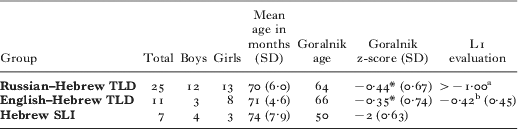
Details of the participants are presented in Table 2. Since the Goralnik is normed for children up to the age of six, but is widely used with children up to the age of seven or even eight, its interpretation is based on the linguistic age which is assigned to the child on the basis of the raw score. The z-scores presented here for the Goralnik reflect this manner of calculation, indicating the gap between the chronological age and the linguistic age in years. The CELF z-scores were calculated using the Standardized Score (SS) with 100 as the Mean and 15 as one SD.
Background information about the participants
a Russian non-standardized battery.
b CELF2 preschool z-score.
* p < .01.
As seen in Table 2, a significant difference, (F(2,40) = 10·81, p < .001, χ2 = 0·35), was found between the bilingual children and the impaired children in their performance on the Hebrew standardized screening test. The bilinguals' mean was 3–4 months below the monolingual norm, while the mean score of the children with SLI was two years below the monolingual norm (p < .01 on Tukey HSD post-hoc tests). The difference on raw scores and normed scores was as significant. While the impaired children were a few months older, no significant difference was found between the groups using a one-way ANOVA (F(2,40) = 1·36, p = .27). Parental consent was received for all children and the study was approved by the university review board for studies involving human subjects as well as by the Israeli Ministry of Education.
Tasks and procedures
Data were collected using three tasks: a sentence completion task within a story context (based on Dromi et al., Reference Dromi, Leonard, Adam and Zadunaisky-Ehrlich1999) and a sentence repetition task, to examine verb morphology, and a sentence repetition task to investigate preposition use. This variety of tasks made it possible to capture a comprehensive picture of the child's knowledge.
Sentence completion within a story context
This task (based on Dromi et al., Reference Dromi, Leonard, Adam and Zadunaisky-Ehrlich1999) serves to elicit production of 3rd person singular and plural, in the present and past tense, and to examine children's ability to mark agreement. Three of Dromi et al.'s five storybooks were recreated with colorful pictures to be used in Hebrew. Each book contains a sequence of pictures, which the experimenter uses to tell the story, pausing at preplanned points to allow the child to complete a sentence with the target verb form. To facilitate use of the target forms, the sentence prior to the one the child was expected to produce contains the target verb in a different, often infinitival, form. The stories tested the use of gender and number in third person past tense as in (5), yielding four past tense verb forms, and the use of gender and number in the present tense as in (6), yielding three present tense forms:
(5) ha-yeled raca likfoc; az hu _______ (kafac)
the-boy wanted to-jump; so he _______ (jumped)
(6) kan ha-kelev mexapes oxel, ve-kan ha-xatulot_____
here the-dog looks-for [masc. sing.] food, and-here the-cats [fem. pl.] (mexapsot) oxel
_____(look-for [fem. pl.]) food
A variety of the five Hebrew conjugations [binyanim] was used in the stories.
Sentence repetition: inflections
This task tested the use of person inflections in the past tense in Hebrew, in order to tap children's knowledge of agreement. Twenty-four sentences were used in Hebrew to test three inflections – 1st singular, 2nd masculine singular, 2nd feminine singular – with eight stimulus sentences for each form. Different conjugations were used in the Hebrew sentences. Each sentence contained four to eight words. The full set of stimulus sentences is listed in Appendix A. The child was asked to repeat sentences presented by the experimenter and was rewarded with blocks to build a tower for every sentence produced, regardless of whether it contained the correct form.
Sentence repetition: prepositions
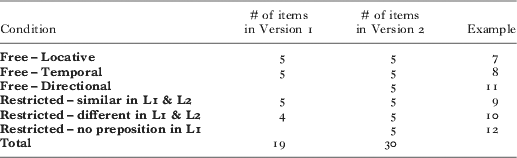
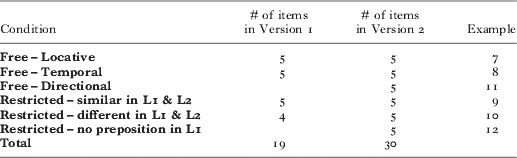
This task elicited free and restricted prepositions. Two versions were developed for the bilingual children, taking into consideration the L1 of the bilingual children, in order to accommodate cross-linguistic influences of the different L1s. Each language pair yielded a different set of contrastive categories, with some overlap across the two versions where possible. Each contrastive category (but one) had five items. The different conditions with number of items per conditions are presented in Table 3:
Number of items per condition in the prepositions task
Version 1 for English–Hebrew bilinguals
19 stimulus sentences were used. Ten stimulus sentences contained free prepositions: 5 contained locatives, as in (7), and 5 temporals, as in (8); and nine stimulus sentences contained a verb which requires a restricted preposition: 5 were the same in English and Hebrew (9), and 4 were different, as in (10):
(7) ha-yeled hexbi oxel leyadha-ec
the-boy hid food near the-tree
‘The boy hid the food near the tree.’
(8) ha-yeled shata xalav be-aruxat^cohorayim
the-boy drank milk in-lunch
‘The boy drank milk at lunch.’
(9) Axi ha-gadol makshiv le muzika ro'eshet
brother-poss.-1st-sg. the-big listens to music loud
‘My big brother listens to loud music.’
(10) ha-yeled caxak al ha-leycan
the-boy laughed on the-clown
‘The boy laughed at the clown.’
Only 9 R-prep sentences were used, since it was not possible to find 10 restricted prepositions which are familiar to preschool children in Hebrew. Notably, all the verbs used in the 9 sentences required a preposition in both languages of the bilingual children. All sentences were simple sentences containing high-frequency concrete nouns, verbs, adjectives, and prepositions. In all but three sentences, the preposition introduced a sentence-final PP. In order to target cross-linguistic differences and to generate appropriate contexts to examine code interference, some of the prepositions had translation equivalents in the L1 of the participants, while others were rendered with a different preposition. The full set of stimulus sentences is listed in Appendix B.
Version 2 for Russian–Hebrew bilinguals
30 stimulus sentences were used. The difference in the number of sentences reflects the number of contrastive categories observed in this language combination. Fifteen contained free prepositions: 5 locatives, 5 temporals, and 5 directionals, as in (11); and 15 stimulus sentences contained a verb which requires a restricted preposition: 5 were the same in Russian and Hebrew, 5 were different and 5 did not have a preposition in Russian ((12) demonstrates this category for the Hebrew–English contrast). In all sentences, the preposition introduced a sentence-final PP.
(11) ha-yalda hevi'a tapuax la-kita
the-girl brought apple to-the-classroom
‘The girl brought an apple to class.’
(12) ha-yeled ba'at ba-kadur
the-boy kicked in-the-ball
‘The boy kicked the ball.’
This version contained more items in order to introduce all possible cross-linguistic comparison. The full set of stimulus sentences is listed in Appendix C.
The monolingual children with SLI were tested with the version developed for the English–Hebrew bilinguals, since it contained fewer stimulus sentences. The child was asked to repeat sentences presented by the experimenter and was rewarded with blocks to build a tower for every sentence produced, regardless of whether it contained the correct form. The order of the sentences for inflections and prepositions were semi-randomly mixed to counterbalance each other.
Analysis
Data were analyzed separately for the two linguistic measures and the three different tasks, since they were tapping different aspects of the child's knowledge. Due to the nature of the findings (near ceiling effect for the children with TLD and relatively high scores for the children with SLI which did not lend themselves to normal distribution) non-parametric tests were used. Between-group comparisons were performed using Kruskal–Wallis non-parametric test followed by Friedman tests and Wilcoxon signed rank tests for within -group comparisons.
RESULTS
Verb inflections
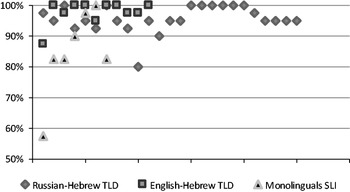
Findings in this section are presented first for the sentence repetition task, comparing the three groups on the use of past tense inflections. Figure 1 presents the total score (in percentages) for each child.
Total score for each child on use of past tense infections (by group).

As seen in Figure 1, all bilingual children with TLD but two used the target inflections in over 90% of the instances, while four of the seven children with SLI had lower than 90% success, with one outlier scoring below 60%. Since all children in all groups performed at ceiling for 3rd person as well as 1st person, findings are presented only for 1st and compared with 2nd person singular inflections. Next, these results for sentence repetition are compared with Dromi et al.'s (Reference Dromi, Leonard, Adam and Zadunaisky-Ehrlich1999) results on the enactment task, which tests the same past tense morphemes. The results of the imitation and enactment tasks for the past tense are complemented by a comparison between Dromi et al.'s monolingual children with SLI and the two bilingual groups using the sentence completion task evaluating the use of present tense morphology.
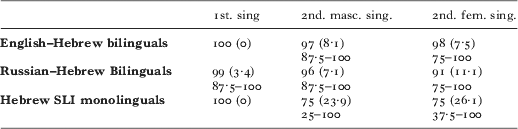
Table 4 presents the level of successful use of 1st and 2nd person singular past tense morphology in the sentence repetition task by the three groups of participants.
Percentage of correct usage of three past tense morphemes with SD and range
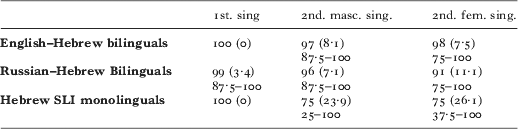
Given the ceiling effect for the bilingual children with TLD and the abnormal distribution, a Kruskal–Wallis non-parametric test was used to compare the three groups on each morpheme separately. It showed a significant group effect for 2nd masc. sing. (H(2) = 8·61, p = .014) and 2nd fem. sing. (H(2) = 7·31, p = .026) due to the relatively low scores of the group of children with SLI. Within-group analyses of the difference between the three morphemes using Friedman tests showed a significant difference only for the group of children with SLI (χ2(2) = 8, p = .018). No significant differences were found among the different morphemes for the bilingual groups.
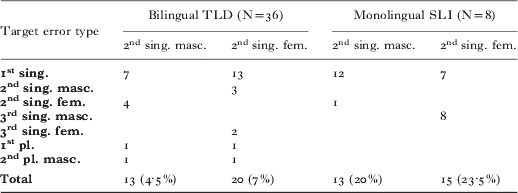
The quantitative analysis was followed by an error analysis, in order to see whether this approach could distinguish the two populations as well. Error analysis focused on 2nd person singular masculine and feminine, since all the children showed a ceiling effect in the use of 1st person morphology. Data were collapsed for the two bilingual groups with typical language development, since the type of errors were the same for both groups. Table 5 presents the number of different errors found in the use of past tense morphology, focusing on the use of the erroneous person/number/gender morpheme. Number of participants per group and percentage of errors in each morpheme is presented for both populations.
Frequency of the different error types in Hebrew past tense 2nd person morphemes
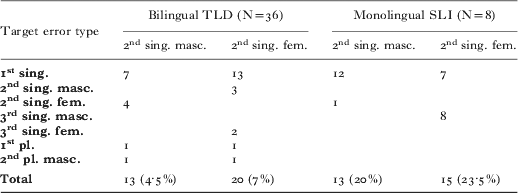
Table 5 shows that most of the errors produced by monolingual children with SLI involve the use of 1st person singular morphology rather than 2nd person morphology, and some involve cluster reduction of 2nd person feminine morphology, which results in the 3rd person base form. All these errors are characterized by the use of a less complex morpheme to replace a more complex morpheme. Both bilingual groups used erroneous 1st person forms as well. Yet, while for children with SLI 1st person singular forms were by far the most frequent error, followed by the 3rd person base form, the bilingual children made errors in gender and number as well. These other errors often resulted in verb forms which bear more features, i.e., a more complex morpheme.
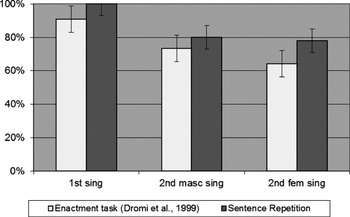
The results of the sentence repetition task could have been interpreted as evidence for lack of full understanding of the task by the children with SLI, or even a tendency to respond interactively to a second person sentence with a first person form rather than simply repeating the sentence (e.g., Experimenter: ‘Say: you opened the door’. Child: ‘I opened the door’). To verify that the source of the person errors is not an artifact of the task, the results of the sentence repetition were evaluated by comparing them to the results reported by Dromi et al. (Reference Dromi, Leonard, Adam and Zadunaisky-Ehrlich1999), who used an enactment task in which the child was asked to describe what she and other experimenters were doing. Since a pilot study showed that bilinguals with TLD scored at ceiling on this enactment task, like monolinguals with TLD, data for children with TLD are not presented here. Figure 2 provides a comparison between the percentage of success on the three morphemes tested in the sentence repetition task used in the present study and the same three morphemes in the enactment task used by Dromi et al. (Reference Dromi, Leonard, Adam and Zadunaisky-Ehrlich1999).
A comparison between the sentence repetition task and Dromi et al.'s (Reference Dromi, Leonard, Adam and Zadunaisky-Ehrlich1999) enactment task (in percentages).

Figure 2 shows that the results of both experiments reveal a similar response pattern, with the use of 1st person morphology significantly better than the use of 2nd person morphology. Moreover, sentence repetition seems to be somewhat easier than the enactment task (perhaps reflecting the older age of the participants in the present study as well), suggesting that our findings are not an artifact of the task used, but represent genuine difficulty with verb forms which bear more features. Thus, our findings so far show a clear distinction between the children with SLI and the bilingual children with TLD, in both the quantity and the nature of the errors.
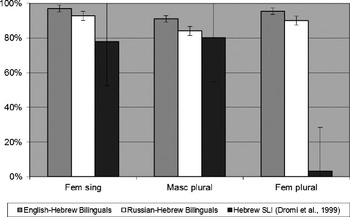
These findings are further supported by a comparison of the results of the sentence completion task from Dromi et al. (Reference Dromi, Leonard, Adam and Zadunaisky-Ehrlich1999) with the performance of our bilingual groups on that same task. Figure 3 presents the level of success on the sentence completion task, using 3rd person feminine singular and 3rd person masculine and feminine plural present tense morphology for the two bilingual groups and for the subjects in Dromi et al.'s paper. The results for the 3rd person masculine singular form are not presented, since it is marked by a zero morpheme and serves as the base form, thus yielding a ceiling effect for all children tested.
Percentage of correct usage of present tense morphology.

The major finding was that speakers of L2/Hebrew whose L1 is English performed almost at ceiling for all three morphemes tested by the sentence completion task after two years of exposure to Hebrew, while speakers whose L1 is Russian with a similar length of exposure to Hebrew performed at ceiling for two of the three morphemes, but scored like monolingual children with SLI on the masculine plural morpheme. An error analysis of the bilingual data, focusing on the errors made by the Russian–Hebrew group where the masculine plural form was expected, showed that they consistently chose the feminine plural form for verbs which describe the activity of a group of monkeys in one of the stories. This kind of error involves the use of a more complex morpheme (e.g., using kofcot ‘jump, fem. pl.’ for kofcim ‘jump, masc. pl.’) rather than the less complex morphemes (e.g., kofec ‘jump, masc. sing.’) which are responsible for the score of the group with SLI (cf. Dromi et al., Reference Dromi, Leonard, Adam and Zadunaisky-Ehrlich1999). This seems to be an influence of the L1 Russian since the word for ‘monkeys’ in Russian is feminine. That is, the similarity between the performance of the Russian–Hebrew bilingual group and the results for monolingual children with SLI was only superficial. The few remaining errors documented in the Hebrew L2 data were erroneous choice of tense, which did not involve a smaller number of features.
To conclude, the first major finding for the use of inflections is that bilingual children who are speakers of L2/Hebrew perform almost at ceiling on morphemes which are difficult for monolingual children with SLI. That is, the discrepancy between morphemes which carry more features and those which carry fewer features, noted in Dromi et al. (Reference Dromi, Leonard, Adam and Zadunaisky-Ehrlich1999), is found only for monolingual children with SLI. The second major finding relates to the nature of the errors. While in English and French the error pattern of monolingual children with SLI is characterized by omissions, and bilingual children show substitutions (Paradis, Reference Paradis2010a), in Hebrew the error pattern for both populations is characterized mostly by substitutions, but monolingual children with SLI opt for a reduced set of features, while bilingual children show a more varied pattern in their errors, and even use a more complex set of features under L1 influence.
Prepositions
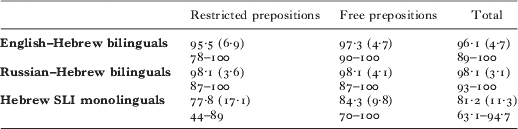
Further support for this conclusion comes from the use of prepositions by the three groups (see also Armon-Lotem, Reference Armon-Lotem2010; Armon-Lotem, Danon & Walters, Reference Armon-Lotem, Danon and Walters2008). Table 6 presents the level of success in repeating the two different types of prepositions by children in the three groups.
Percentage of correct usage of the different preposition types
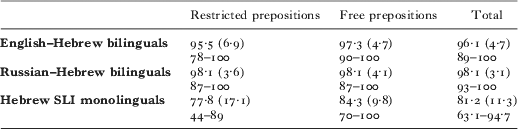
The data in Table 6 show a response pattern similar to that found for complex inflections (see Table 4), where the bilingual groups performed almost at ceiling, while the monolingual children with SLI successfully repeated the target prepositions around 80% of the time, regardless of preposition type. Given the ceiling effect for the bilingual children with TLD and the abnormal distribution, a Kruskal–Wallis non-parametric test was used to compare the three groups on each preposition separately. It showed a significant group effect for restricted prepositions (H(2) = 15·7, p < .001) and free prepositions (H(2) = 10·32, p = .006) due to the relatively low scores of the group of children with SLI. Within-group analyses of the difference between the two prepositions using a Wilcoxon signed rank test showed no significant difference between the two preposition types for any of the groups.
An error analysis was conducted in order to see whether it would also distinguish the two populations. Since no significant difference in the type of errors was found between the two preposition types, the data were collapsed. For the bilingual groups, the comparison was not applied to errors which were due to code interference from the L1, as in (13):
(13) *ima ko'eset ba-kelev
mother angry at/in-the-dog
‘Mom is angry at the dog.’
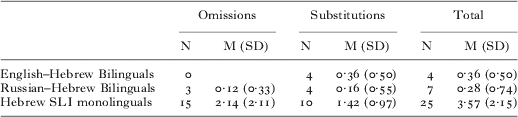
Example (13) reflects the interference of the English preposition at which leads to a substitution of Hebrew al ‘on’, which is selected in Hebrew by the verb ka'as ‘furious’, by ba ‘at/in’. Table 7 presents the ratio of errors per child per error type, comparing omissions vs. substitutions of prepositions in the monolingual SLI group to omissions vs. substitutions of prepositions which are not due to code interference in the bilingual groups.
Frequency of errors per child by type of error (substitutions vs. omissions)
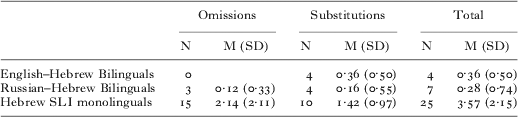
The distribution of errors in Table 7 shows that monolingual children with SLI have more errors of both types than bilingual children. This is particularly striking for omission errors, which never occurred in the English–Hebrew bilingual sample and occurred only three times (out of 750 trials) in the Russian–Hebrew sample. A Kruskal–Wallis non-parametric test was used to compare the three groups on each error type separately. It showed a significant group effect for substitutions (H(2) = 10·15, p = .006) and omissions (H(2) = 8·18, p = .017) due to the relatively high number of errors produced by the group of children with SLI. Using Wilcoxon signed rank tests within each group, no significant difference was found between the two error types for either of the groups, though monolingual children with SLI had more omissions than substitution errors, while the English–Hebrew bilingual children had more substitution errors and the Russian–Hebrew children had an equal number of both types. Finally, substitution errors of the monolingual children with SLI were often into simpler prepositions (e.g., substituting Hebrew lifney ‘before’ by be ‘in’), while the substitution errors of the bilingual children were often made by using a preposition as complex and semantically related (e.g., substituting Hebrew lifney ‘before’ by axarey ‘after’).
In summary, the major finding of the preposition study was that both substitution and omission errors were prevalent among Hebrew-speaking monolingual children with SLI, with significantly more omission errors on restricted prepositions. Such omissions were rarely found in the L2 Hebrew data from bilingual children with TLD.
DISCUSSION
The present study supported the claim that SLI and L2 were not ‘two of a kind’, but rather two different populations, despite the superficial similarity in the domain of errors (e.g., inflections, prepositions). Both inflection errors and preposition errors were found in both populations. The two populations were clearly distinguished both by the quantity of errors and by the type of errors (e.g., omission for SLI vs. substitution for TLD). A significant quantitative difference was found between the two populations for both types of morphemes, no matter whether bound or free. Moreover, the types of errors documented were of different natures. Inflection errors among children with SLI were characterized by feature reduction, which led to the use of less complex inflections, while inflection errors among bilingual children were characterized by the use of an erroneous, but not necessarily reduced, feature complex (and was sometimes even more complex). Preposition errors among monolingual children with SLI consisted of omissions, mostly for restricted prepositions, and to a lesser extent use of a less complex preposition, while bilingual children rarely omitted a preposition, and their substitutions were either due to code interference from the L1 or were semantically related but not necessarily simpler.
These findings, though emerging from two rather different functional categories, inflections and prepositions, in a language which is typologically different from English and French, resemble those described by Paradis and Crago (Reference Crago, Paradis, Levy and Schaeffer2003). They reported that children with SLI tended to omit the auxiliary in past or future periphrastic verb constructions in French and English, while bilingual children substituted the auxiliary with the base or present tense form. Similarly, Paradis (Reference Paradis, Gavruseva and Haznedar2008) showed that only L2 children generalize the use of BE, while children with SLI omit it. That is, the findings of this paper, like previous findings, point to sensitivity in the same linguistic domains in both bilingual and SLI groups, and at the same time to differences in the nature of the errors. This difference suggests a possible difference in the nature of their difficulty. In the next sections we address these two issues: the similarity in the domain of errors, and the nature of the difficulty.
Domain of errors
The present study looked at two domains of errors, verb inflections and prepositions, for both bilingual children who acquire Hebrew as L2 and monolingual Hebrew-speaking children with SLI. The locus of errors in the functional system for both bilingual children and monolingual children with SLI suggests that the functional system is more susceptible to any deviation from typical first language acquisition. However, as Vainikka (Reference Vainikka2010) points out, the functional system is also more fragile in typical L1 acquisition, as is evident in the ample research on monolingual acquisition. So, the similarity between some phases of L2 acquisition and SLI acquisition is anticipated since it reflects similar acquisition paths.
Nature of errors
A further exploration of the nature of the errors shows that this similarity in the domain of errors is superficial. The errors reported for the bilingual children in the present study are of the type reported for bilinguals in other linguistic domains, e.g., production of clitics and naming. Such errors can be attributed to bilingual processing demands, where a person is constantly making choices between two options emerging from very different systems (Nicoladis, Reference Nicoladis2006). Weighing the options from two systems can lead to erroneous, but not necessarily less complex, choices. Francis (Reference Francis2011: 78) points out that several studies currently indicate that ‘for preschool age bilinguals, control mechanisms that regulate the use of the two grammatical subsystems might respond to even slight imbalances, more so than in the case of mature bilingual speakers’. That is, more proficient bilinguals are better at regulation and control, while emergent bilinguals like our participants still show the influence of bilingual processing (Iluz-Cohen, Reference Iluz-Cohen2008).
Children with SLI, in contrast, are not in a position to weigh the options from two systems. Rather, they have difficulties using even one system. Paradis (Reference Paradis2010b) points out that ‘deficits in control and working memory processes could be a source of deficits in representations, and in turn, representational deficits could impact how control and working memory processes function, reducing the ability to completely disassociate their impact as development progresses’ (p. 346). The present study indicates that the morphemes' complexity as well as their syntactic role have an impact on the type of errors. When the system is typically developing, as is the case for emergent bilingual children, processing load does not yield a reduced structure, since the typically developed representation does not support it. But for children with SLI, the option of reduced structure is not blocked by their linguistic representations.
Quantity of errors
Similarly, although the quantity of errors distinguishes the two populations investigated here, the difference does not seem to support a complete absence of knowledge in either group. Rice and Wexler (Reference Rice and Wexler1996) attributed a less mature representation (the Extended Optional Infinitive stage) to English-speaking children with SLI who used tense in only 30–50% of obligatory contexts. These numbers are very different from the performance of the monolingual children with SLI in the present study, who used the target morphemes correctly around 80% of the time (while bilinguals with TLD performed at ceiling).
Nicoladis (Reference Nicoladis2006) suggested that when bilingual children were correct more often than incorrect, this pattern supports knowledge at the syntactic level, and errors can be attributed to the influence of the other language. This approach can explain the errors made by the Russian–Hebrew bilinguals on 20% of the plural present tense morpheme where they had to process two competing representations. For bilingual children it was argued above that the effects of knowing another language lead to increased processing demands. Thordardottir (Reference Thordardottir2008) suggests that the less frequent errors in children with SLI are processing-based errors influenced by the task difficulties. It is crucial to remember, however, that for children with SLI, unlike bilinguals with TLD, more complex inflections were more challenging than simpler ones, and, in at least one case, in the plural feminine in the present tense, monolingual children with SLI were unable to produce the form altogether. That is, while task-related processing might contribute to the emergence of errors, it seems that the linguistic representation of children with SLI does not block errors which result in violation of some syntactic principles, the way the bilingual linguistic representation does.
CONCLUSION
To conclude, the present study offers further evidence to show that despite the similarity in the domain of errors in the functional system, TLD in bilinguals and SLI in monolinguals are distinguished by the type and quantity of errors. Bilinguals' substitution errors resemble errors recorded in previous studies in tasks which involve lexical access. The type of errors found in the functional system of monolingual children with SLI includes omissions, that is, optional manifestation of the functional category, which can be explained only by impaired representation. These errors cannot, however, determine whether the impaired representation is the outcome of limitations in input-processing over time or the source of it. Furthermore, the number of errors produced by the monolingual children with SLI is not always enough to indicate absence of knowledge. That is, it seems safe to argue that Hebrew-speaking children with SLI in most cases know which inflection should be used and which preposition is obligatory and where. The nature of their errors suggests, however, that despite their knowledge of the target language, their linguistic representation does not block errors which violate syntactic principles. Further research as well as a coherent theory of the relation between processing and representation in children with SLI is necessary in order to explain why they occasionally use a reduced inflection or omit a preposition.
Appendix A: sentence repetition – inflections

Appendix B: sentence repetition – preposition (version I – for bilinguals with L1 English)

Appendix C: sentence repetition – preposition (version II – for bilinguals with L1 Russian)