Introduction
Following the publication of the National Health Service (NHS) Audit Commission report on low clinical value treatments in 2011,1 many primary care trusts (PCTs) in England have limited the funding for tonsillectomy procedures. Only those children who suffer from tonsillitis more than seven times a year, five times a year over two years or three times a year over three years, based on the Scottish Intercollegiate Guidelines Network (SIGN) criteria, are eligible for surgery.2
The SIGN adopted this criterion from a study by Paradise et al., published in 1984.Reference Paradise, Bluestone, Bachman, Colborn, Bernard and Taylor3 This was a clinical trial in which young children with severe tonsillitis were randomised to either a tonsillectomy group or a ‘watchful waiting’ group. The study found that surgery significantly reduced the number of infections in the first two years post-operation; however, the benefit of surgery plateaued by year three. Drawbacks of this historical trial were that number of infections per year was the sole outcome measure used, many children were lost to follow up by the third year and parents of those in the watchful waiting arm were able to freely switch their children to the surgical arm if they wished. Also of interest is the fact that the Paradise et al. research group exclusively studied children,Reference Paradise, Bluestone, Bachman, Colborn, Bernard and Taylor3 but SIGN, and subsequently many PCTs, also apply these criteria to an adult population.
Qualitative work published in recent years has shown that the quality of life (QoL) of children who suffer with severe tonsillitis, as quantified by Paradise et al.,Reference Paradise, Bluestone, Bachman, Colborn, Bernard and Taylor3 is comparable with that of children who suffer with other chronic diseases such as juvenile arthritis,Reference Goldstein, Stewart, Witsell, Hannley, Weaver and Yueh4 and performing a surgical tonsillectomy produces a significant improvement in their QoL.Reference Soni-Jaiswal, Parry and Kumar5
Children who suffer with mild to moderate tonsillitis may improve over time if managed conservatively, with most children being free of symptoms by 52 months of age.Reference Forsovell, Kristofersen and Oymar6 In this subgroup of patients, tonsillectomy produces a small improvement in the number of attacks of infection per year versus those children who are managed conservatively.Reference Burton and Glasziou7 It is believed that this small benefit is offset by the increased morbidity associated with surgery and the higher cost of treatment.Reference van Staaij, van der Akker, Rovers, Hordijk, Hoes and Schilder8, Reference van Staaij, van den Akker, van der Heijden, Schilder and Hoes9 Hence, the current practice in England is that of watchful waiting.
This study aimed to quantify the QoL impact that mild to moderate adenotonsillar disease has on children and to compare it with that of children with severe disease. To our knowledge, this is the first study to do this using a disease-specific patient-reported outcome measure.
Materials and methods
We performed a prospective study, comparing the QoL in children suffering with mild to moderate tonsillitis with the QoL in children with severe tonsillitis. The SIGN criteria were used to distinguish mild to moderate tonsillitis from severe tonsillitis. Severe tonsillitis was defined as: seven episodes of tonsillitis per year, five episodes per year for two consecutive years or three episodes per year for three years. Those children with a disease burden lower than this were classified as having mild to moderate disease.
All children, aged between 0 and 16 years, who were referred by their general practitioner or paediatrician to an ENT clinic at Wigan, Wrightington and Leigh NHS Trust between August 2012 and July 2013 were suitable for inclusion in this study.
The Tonsil and Adenoid Health Status Instrument is a patient-reported outcome measure, specifically designed for children with adenotonsillar disease living in America.Reference Goldstein, Stewart, Witsell, Hannley, Weaver and Yueh4 In this 15-item scale, each question is scored from 0 to 4, wherein 0 = no problem, 1 = very mild problem, 2 = moderate problems, 3 = fairly bad problems and 4 = severe problems. The Clinical Audit and Practice Advisory Group of ENT-UK modified the Tonsil and Adenoid Health Status Instrument, and published the 14-item Paediatric Throat Disorders Outcome Test for use in a UK population.Reference Hopkins, Fairley, Yung, Hore, Balasubramaniam and Haggard10 Three of the original questions, which addressed the presence of streptococcal sore throats, the cost of medical care and prescriptions, and poor weight gain, were replaced by questions on daytime sleepiness and the frequency of ear infections. The modified Paediatric Throat Disorders Outcome Test scores each question from 0 to 5, wherein 0 = no problems, 1 = very mild problem, 2 = mild or slight problems, 3 = moderate problems, 4 = severe problems and 5 = problems as severe as they can be.
The parents of all children referred with tonsillitis or recurrent upper respiratory tract infections were approached by the clinic receptionist and asked if they would mind completing the Paediatric Throat Disorders Outcome Test questionnaire based on their child's symptoms. Participation was purely voluntary. A second form was attached to the front of each participating patient's notes, which was to be completed by the ENT doctor assessing the patient on the day. A copy of this form may be found in Appendix 1. This form was included to determine the child's suitability for surgery and record the final treatment offered to them.
At our institute, children suffering with severe tonsillitis are routinely offered surgical tonsillectomy (a funding application form is completed and faxed to Ashton, Leigh and Wigan PCT). Those with mild to moderate tonsillitis are managed conservatively, and a watch and wait policy is adopted.
We contacted our regional Research and Ethics Committee (National Research Ethics Service) in August 2012 and were advised that formal ethical approval was not necessary as we were auditing our current practice. The Central Manchester Foundation Trust statistics department were consulted during the design of the study.
The Kolmogorov–Smirnov test was used to determine the normality of data. The comparison between means was conducted using an independent t-test (5 per cent significance level). SPSS® software, version 20, was employed for the analysis.
Results
A hundred children were recruited into this study. Fifty-eight children (58 per cent) were found to suffer with severe tonsillitis and were offered surgery. Of these, 48 underwent tonsillectomy and 10 underwent adenotonsillectomy. The remaining 42 children (42 per cent) suffered with mild to moderate tonsillitis and were managed conservatively.
The children were aged between 2 and 16 years. Forty-six of the children were male and 54 were female. Of the 46 males, 27 had severe tonsillitis and 19 had mild to moderate tonsillitis. Of the 54 females, 31 had severe tonsillitis and 23 had mild to moderate tonsillitis.
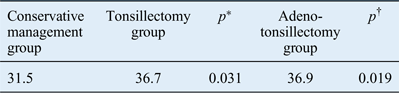
The mean Paediatric Throat Disorders Outcome Test score was 36.7 (standard deviation (SD) = 10.9) in those children undergoing a tonsillectomy alone and was 36.9 (SD = 10.6) in those undergoing an adenotonsillectomy. The mean score for children with mild to moderate tonsillitis being managed conservatively was 31.5 (SD = 11.4) (Table I).
Mean paediatric throat disorders outcome test scores

*For comparison between conservative management (mild to moderate tonsillitis) group and tonsillectomy (severe tonsillitis) group. †For comparison between conservative management (mild to moderate tonsillitis) group and adenotonsillectomy (severe tonsillitis) group.
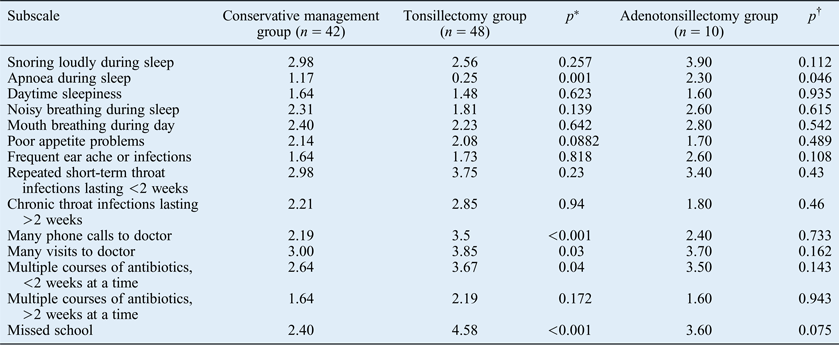
The mean scores for the Paediatric Throat Disorders Outcome Test subscales are provided in Table II.
Mean paediatric throat disorders outcome test subscale scores
*For comparison between conservative management (mild to moderate tonsillitis) group and tonsillectomy (severe tonsillitis) group. †For comparison between conservative management (mild to moderate tonsillitis) group and adenotonsillectomy (severe tonsillitis) group.
Discussion
In this prospective study, the QoL scores for children with mild to moderate tonsillitis who did not fit the criteria for surgery in our PCT were compared to those of children that did. The results revealed that children with mild to moderate disease had significantly better QoL scores than those with severe disease (p = 0.031 for tonsillectomy vs watch and wait, and p = 0.019 for adenotonsillectomy vs watch and wait). This comparison has not been made before; previous work has focused more on quantitative outcome measures, mainly the number of infections per year.Reference Paradise, Bluestone, Bachman, Colborn, Bernard and Taylor3, Reference Paradise, Bluestone, Colborn, Bernard, Rockette and Kurs-Larsky11, Reference Mawson, Adlington and Evans12 The study also revealed that the number of phone calls to doctors and attendances at general practitioner clinics were higher for children with severe disease, compared with the mild to moderate group. In addition, the severe disease group had an increased number of antibiotic courses throughout the year and more time off school.
The patient-reported outcome measure used in this study (the Paediatric Throat Disorders Outcome Test) includes a number of parameters specific to children with obstructive sleep apnoea (OSA), such as snoring, apnoea, daytime sleepiness, noisy breathing and mouth breathing. It was designed for use in recurrent tonsillitis cases and for OSA monitoring. The results of this study show a significant difference between the severe and mild to moderate tonsillitis groups in terms of parent-reported nocturnal apnoea (p = 0.001), but there was no difference for the other OSA subscales analysed. This indicates that the severity of tonsillitis does not influence the severity or presence of OSA.
Obstructive sleep apnoea and tonsillitis can coexist. Hopkins et al. showed that children who have both recurrent tonsillitis and OSA have poorer outcome scores than children with just one disease entity.Reference Hopkins, Fairley, Yung, Hore, Balasubramaniam and Haggard10 If left untreated, OSA may affect behaviour, cognitive development and intelligence, and may rarely result in failure to thrive, poor growth and cardiorespiratory sequelae.Reference Marcus, Brooks, Draper, Halbower, Jones and Schechter13 The primary management for these children constitutes an adenotonsillectomy and, in more severe cases, nasal continuous positive airway pressure treatment.Reference Fitzgerald and Fitzgerald14 A randomised, controlled trial published by Marcus et al. 2013 shows significant improvement in children with OSA treated by surgery as opposed to watchful waiting, in terms of their behaviour, QoL and polysomnography scores.Reference Marcus, Moore, Rosen, Giordani, Garetz and Taylor15
The majority of children with recurrent tonsillitis (regardless of severity) who are managed conservatively will eventually improve over an average period of four to five years.Reference Forsovell, Kristofersen and Oymar6 In those with severe disease, this improvement is expedited by surgery, with significant improvement seen both in the number of infections per year, which can decrease by an average of eight over a two-year period, and in QoL scores.Reference Paradise, Bluestone, Bachman, Colborn, Bernard and Taylor3, Reference Goldstein, Stewart, Witsell, Hannley, Weaver and Yueh4, Reference Burton and Glasziou7, Reference van Staaij, van den Akker, van der Heijden, Schilder and Hoes9 The evidence strongly suggests that surgery be offered to those children with severe disease, preferably within 10 weeks of their first consultation with their family practitioner.Reference Lock, Wilson, Steen, Eccles, Mason and Carrie16
Children with mild to moderate disease show a short-term improvement in their general QoL scores after surgery, which disappears in the medium term; at two-years’ follow up their QoL scores are similar to those who have been managed conservatively. This transient improvement in QoL, coupled with less than one-years’ improvement in the number of infections post-operation, needs to be balanced against the increased morbidity associated with surgery and the cost burden to the NHS.Reference van Staaij, van der Akker, Rovers, Hordijk, Hoes and Schilder8, Reference Paradise, Bluestone, Colborn, Bernard, Rockette and Kurs-Larsky11, Reference Lock, Wilson, Steen, Eccles, Mason and Carrie16, Reference Buskens, van Staaij, van Der Akker, Hoes and Schilder17
A limitation of this study is the lack of comparison between children with mild to moderate tonsillitis and healthy, randomly selected controls. However, the original paper describing the Paediatric Throat Disorders Outcome Test examined unmatched control subjects and reported low (i.e. good) QoL scores for these individuals (average score of 0.78).Reference Hopkins, Fairley, Yung, Hore, Balasubramaniam and Haggard10 Hence, although the outcome scores of children with mild to moderate disease are better than those of children with severe disease, and these are only marginally improved by surgery, patients with mild to moderate disease still have a comparative disease burden in the years that they are unwell. Another limitation concerns the fact that a few parents or carers may have declined participation in the study when approached in the out-patient department, thereby introducing further selection bias. The number of individuals that declined to participate (very few according to anecdotal reports from clinic reception staff) and the clinical severity of the tonsillitis in those non-participating children were not recorded.
• The quality of life (QoL) scores of children with severe tonsillitis are comparable to those of children with juvenile arthritis and severe asthma
• Performing surgery on children with severe tonsillitis provides significant qualitative and quantitative benefit post-operatively
• Children with mild to moderate tonsillitis show moderate improvements in qualitative and quantitative outcome measures after a tonsillectomy, but benefit may not be cost effective long-term
• Children with mild to moderate tonsillitis have significantly better QoL scores than children with severe tonsillitis
• Children with mild to moderate tonsillitis have decreased general practitioner attendance, fewer antibiotic courses and less time off school
• The results of this study support the historical cut-off between severe and mild to moderate disease, reinforcing the national drive to limit funding of surgery to children with severe tonsillitis
The results of this study support the national drive towards limiting tonsillectomy to children with either severe tonsillitis or OSA. Colleagues in primary care may be reassured that each child is assessed based on their disease burden, and only those who fit the criteria and will gain maximal benefit are offered surgery. Mild tonsillitis does not increase a young child's disease burden and it is a disease most of them will outgrow. Furthermore, performing surgery has very little benefit over conservative management. However, limiting funding or withdrawing the option of surgery completely from children with severe tonsillitis will only serve to increase the emergency admission rate and acute tonsillitis complication rate.Reference Al-Hussaini, Owens and Tomkinson18
Conclusion
Recurrent tonsillitis, regardless of the severity, has a negative impact on a child's QoL. Performing surgery can improve QoL to levels comparable with healthy children. However, the cost benefit to society and the inherent risk to the child make surgery a viable option only for children with severe tonsillitis and not for those with mild to moderate disease.
Appendix 1. Mandatory proforma completed by reviewing ENT surgeon
For completion by Doctor:
1. Does this child fit the EUR policy for tonsillectomy (six episodes of infective tonsillitis/year)?
□ Yes □ No
If no, please answer questions 2–6
If yes, please proceed to question 7
2. Does the child suffer with recurrent tonsillitis?
□ Yes □ No
3. How many episodes of tonsillitis/year?
4. For how many years have these symptoms been ongoing?
5. Does the child suffer with other associated symptoms?
□ Obstructive sleep apnoea □ Recurrent AOM □ Snoring □ Other
6. Is the child being discharged back to their GP?
□ Yes □ No
7. Is the child being listed for a tonsillectomy?
8. Does the child require an adenotonsillectomy instead of a tonsillectomy?
9. If yes, is the indication for an adenotonsillectomy one of the following?
□ Recurrent tonsillitis □ Obstructive sleep apnoea □ Recurrent glue ear □ Snoring
10. If yes to obstructive sleep apnoea, has this been confirmed using an overnight sleep study?
11. If yes, will this child require any of the following?
□ Further investigation □ HDU bed □ Referral to a specialist paediatric ENT unit
12. Has an application for funding been sent off?
□ Yes □ No