Introduction
Vocabulary acquisition has gained considerable attention in the past decades, both in the context of first language (L1) and second language (L2) learning. Numerous studies have shown that a significant proportion of L2 vocabulary is acquired incidentally, i.e. as a by-product of reading and listening activities which are not geared explicitly to vocabulary learning (Brown, Waring & Donkaewbua, Reference Brown, Waring and Donkaewbua2008; Huckin & Coady, Reference Huckin and Coady1999; Laufer, Reference Laufer2001; Paribakht & Wesche, Reference Paribakht, Wesche, Coady and Huckin1997; see Grabe (Reference Grabe2009) for an overview). One of the central questions addressed in the present study concerns the factors contributing to the increase (or decrease) of vocabulary gains during reading in L2.
So far, much of the research in this area has employed introspection-based methods and/or pencil and paper tasks such as the Vocabulary Knowledge Scale (VKS, Paribakht & Wesche, Reference Paribakht and Wesche1993; Wesche & Paribakht, Reference Wesche and Paribakht1996), multiple choice tests requiring identification of the target word's meaning (e.g. Vocabulary Levels Test, Nation, Reference Nation1983, Reference Nation2001), or generating a definition. According to Borovsky, Elman and Kutas (Reference Borovsky, Elman and Kutas2012, p. 280) and other authors “these are useful measures of word learning in its final stages but are relatively reticent about earlier stages of learning, when the learner's knowledge is not stable and/or robust enough to drive such overt behaviours”. Moreover, they typically tap only into the knowledge defined by Leach and Samuel (Reference Leach and Samuel2007, p. 307) as “lexical configuration” which refers to factual information about a word, such as its phonological and orthographical form, its meaning, its syntactic properties, etc. These measures do not allow the exploration of “lexical engagement”, i.e. of the dynamic interaction of a newly learned word with other lexical or sublexical units or of processes and stages that did not reach the level of consciousness.
On the other hand, there is a rapidly growing body of research on the acquisition of new words by adult native speakers (less so by L2 learners) (for an overview see Lindsay & Gaskell, Reference Lindsay and Gaskell2010; Tamminen, Reference Tamminen2010) that focuses on the initial stages of word acquisition and uses online methods that allow the examination of both lexical configuration and engagement of new words. In addition, they also provide insights into the development of lexical representations in memory.
Although these studies address topical questions, most of them have shown emergence of lexical representations under rather simple circumstances asking the participants to learn lists of individually presented new words during intensive training sessions. As criticized also by e.g. Qiao, Forster and Witzel (Reference Qiao, Forster and Witzel2009), such laboratory conditions that do not match real conditions under which adults typically acquire new vocabulary may result in representations of new words that differ qualitatively from lexical representations that emerge under more natural conditions.
The present study benefits from the strengths of both L1 and L2 approaches to vocabulary acquisition in that it combines a study on incidental acquisition with a study of lexical engagement using offline and online experimental methods (self-paced reading, lexical decision, semantic priming) in combination with other tasks (e.g. VKS). It explores the very first stages of incidental vocabulary acquisition (IVA), which do not result from extensive intentional vocabulary training. In particular, we investigate the establishment of new L2 meaning representations under different acquisition conditions and their integration in the semantic network.
The aim of the first, self-paced reading task, is to explore how text complexity on syntactic level affects IVA of advanced L2 learners. Text simplification has been believed to be an effective means for facilitating both L1 and L2 reading comprehension, thus playing a crucial role in reading material sequencing and gradation (Urano, Reference Urano2000). So far, however, no study has explored whether, or how, text complexity on syntactic level affects L2 IVA.
The aim of the second, semantic priming, task is to examine whether the newly acquired semantic representations are integrated in the L2 mental lexicon and interact with semantically related representations.
The following section, “Previous work”, starts with an overview of studies related to the questions we address in the first task (the role of syntactic complexity in IVA) and continues with a summary of previous research related to the second task (the integration of new representations in the L2 lexicon).
Previous work
The prerequisite for establishing a semantic representation of a new word during reading is the inference of its meaning from the surrounding context. This process takes place as a component of a larger process of building a mental model of the text meaning based on information contained in the text and in the reader's world knowledge (Johnson-Laird, Reference Johnson-Laird1983; van Dijk & Kintch, Reference van Dijk and Kintsch1983). An unknown word represents a discontinuity in the textual basis that the reader might attempt to bridge to achieve textual coherence.
Rieder (Reference Rieder2002a, Reference Riederb) emphasizes the distinction between building up a mental model of the text meaning, during which readers usually attempt to specify the meaning of unknown words only in order to complete the model, and “true vocabulary learning” which is induced by a learner's active shift of attention from the text level to the word level to focus on the word form followed by integration of its meaning into existing knowledge structures, consolidation of the form-meaning connection, etc. This shift can be triggered by various factors, e.g. by the prominence of the word form, the frequency of its occurrence, its centrality for the text meaning, context properties, or learner-specific factors (Rieder, Reference Rieder2002a, pp. 33–34).
After a period of focusing predominantly on quantitative aspects of IVA, the attention now has turned to the qualitative properties of the context in which the new word appears and which might trigger such a shift to the word level: “The quality of the context provides an answer to why gains in knowledge of meaning have varied from word to word (Saragi, [Nation & Meister], Reference Saragi, Nation and Meister1978; Horst, [Cobb & Meara], Reference Horst, Cobb and Meara1998) and study to study (Horst et al., Reference Horst, Cobb and Meara1998; Rott, Reference Rott1999; Saragi et al., Reference Saragi, Nation and Meister1978; Waring & Takaki, Reference Waring and Takaki2003)” (Webb, Reference Webb2008, p. 238) .
Since the 1980s, a number of studies has explored the effect of different types of text modification on early L1 and L2 comprehension (for reviews, see Chung, Reference Chung1995; Parker & Chaudron, Reference Parker and Chaudron1987). For these purposes, readability formulas have been developed and applied that typically are based on lexical and syntactic complexity, such as word length and frequency, or sentence length (Baker, Atwood & Duffy, Reference Baker, Atwood, Duffy, Davison and Green1988; Rezaee & Norouzi, Reference Rezaee and Norouzi2011). Texts using controlled vocabularies and short, simple sentences have been widely applied in many commercially published L2 reading materials (Urano, Reference Urano2000) to achieve the general aim of matching materials to learners with the appropriate level of proficiency. Studies testing the assumption that text simplifications improve comprehension and learning have, however, not yet reached conclusive results. One of the reasons is that they differ in which simplifications they include (the simplifications according to the readability formulas confound several factors) and which populations they test. A study by Shokouhi and Maniati (Reference Shokouhi and Maniati2009) shows that while lexical simplification does facilitate L2 comprehension, it hinders acquisition of new words (as opposed to lexical elaboration). On the other hand, in a study with L1 primary and secondary school students at 3rd, 5th and 7th grade levels, Nagy, Anderson and Herman (Reference Nagy, Anderson and Herman1987) observed a negative relationship between learning from context and text difficulty as measured by readability formulas: the more difficult the text was, the fewer unknown words were learned.
The results of previous research thus suggest that text readability/difficulty affects IVA, but it is not yet clear whether, how and to what degree the text properties that contribute to text comprehensibility also affect IVA. Thus, the present study focuses on one particular factor, namely syntactic complexity, and aims to identify its influence on both the process of inference as well as the incidental acquisition of words.
The research on emergence of new semantic representation has not yet explored how and under which modalities semantic representations of incidentally acquired words are established and incorporated into the semantic network of the L2 lexicon. More recent opinions claim that naturalist usage-based learning is not sufficient to acquire L2 vocabulary (Cobb & Horst, Reference Cobb, Horst, Harley and Hulstijn2004; Ellis, Reference Ellis2008; Laufer, Reference Laufer2005) and needs to be supported by deliberate form-focused learning (Elgort & Nation, Reference Elgort, Nation, Seedhouse, Walsh and Jenks2010; Hulstijn, Reference Hulstijn, Doughty and Long2003; Nation, Reference Nation2007) as well as by metalinguistic teaching approaches (Jiang, Reference Jiang2004). Thus, deeper and broader knowledge of how new L2 lexical representations are established and incorporated in the L2 lexicon is necessary to evaluate and understand the benefits or shortcomings of IVA. In the present study, we examine the emergence of implicitly learned semantic representations directly after they have been inferred (i.e. without a consolidation period) while taking into account the different conditions under which they were inferred (i.e. from syntactically simple and complex contexts).
In order to explore lexical–semantic representations and their integration within the lexical–semantic network, various versions of priming experiments have typically been used. In the field of L2 research, cross-language priming has primarily been used to reveal whether bilinguals organize words in their two languages in shared or separate stores and for an investigation of the nature of the connections between lexemes and concepts in the two language systems (for reviews see Altarriba & Basnight-Brown, Reference Altarriba and Basnight-Brown2007; McDonough & Trofimovich, Reference McDonough and Trofimovich2008; Williams & Cheung, Reference Williams, Cheung, Trofimovich and McDonough2011). Fewer L2 studies have examined the relationships between semantic representations within the L2 semantic system as compared to the L1 system. Their results (Altarriba & Canary, Reference Altarriba and Canary2004; Favreau & Segalowitz, Reference Favreau and Segalowitz1983; Frenck-Mestre & Prince, Reference Frenck-Mestre and Prince1997; Kotz & Elston-Güttler, Reference Kotz and Elston-Güttler2004) highlight the importance of language experience in shaping L2 lexical–semantic networks: whereas semantic facilitation effects of similar strength as in L1 are typically observed with very proficient L2 learners (but for a differing account compare Devitto & Burges, Reference Devitto and Burgess2004), less proficient learners show either smaller or no semantic priming effects in their L2. These results indicate differences in the strength and richness of semantic relationships in the L1 and L2 networks (e.g. Keatley, Spinks & de Gelder, Reference Keatley, Spinks and de Gelder1994).
Several recent studies have addressed the nature of memory representation of L2 words. Jiang and Forster (Reference Jiang and Forster2001) proposed an Episodic L2 Hypothesis that was recently supported by work of Witzel and Forster (Reference Witzel and Forster2012). According to this hypothesis, L2 words are represented in episodic rather than semantic memory. Unfortunately, the tasks employed by Witzel and Forster (Reference Witzel and Forster2012) (repetition and translation priming in episodic recognition and lexical decision) do not contribute to the research of semantic engagement within the L2 lexicon.
The studies from the above mentioned areas of the L2 research are concerned with the semantic integration or representation of familiar L2 words only. To our knowledge, there is no study exploring lexical engagement of newly learned words in L2 (with the exception of Elgort (Reference Elgort2011), who investigated intentional/deliberate vocabulary acquisition).
In the area of L1 adult word learning, an account related to the Episodic L2 Hypothesis was proposed by Davis and Gaskell (Reference Davis and Gaskell2009) that addresses the question of memory representation of newly learned words. The account is based on the principles of complementary learning systems (CLS) theories of memory (e.g. McClelland, McNaughton & O’Reilly, Reference McClelland, McNaughton and O’Reilly1995) and assumes that newly learned words are initially stored as episodic representations in the rapidly learning hippocampal system, isolated from long-term lexical representations of the mental lexicon in the neocortex. Only after memory consolidation during sleep or spaced learning (Lindsay & Gaskell, Reference Lindsay and Gaskell2013), do stable cortical representations emerge that are fully integrated in the mental lexicon (Lindsay & Gaskell, Reference Lindsay and Gaskell2010; Tamminen & Gaskell, Reference Tamminen and Gaskell2012).
Studies in adult L1 acquisition examining the semantic integration of newly learned words show different patterns depending on the task employed (Tamminen, Reference Tamminen2010). Facilitative semantic priming effects for newly learned words in L1 have been observed in studies employing a semantic decision task where participants consciously evaluate the semantic relatedness between primes and targets (Breitenstein, Zwitserlood, de Vries, Feldhues, Knecht & Dobel, Reference Breitenstein, Zwitserlood, de Vries, Feldhues, Knecht and Dobel2007; Perfetti, Landi & Oakhill, Reference Perfetti, Landi, Oakhill, Snowling and Hulme2005; see Mestres-Misse, Rodriguez-Fornells & Münte, Reference Mestres-Misse, Rodriguez-Fornells and Münte2007, for less straightforward results). Only one recent study, by Tamminen and Gaskell (Reference Tamminen and Gaskell2012), shows small (around 7 ms) semantic and masked semantic priming effects when new words learned in intensive training sessions were used as primes in a lexical decision task. On the other hand, a picture-word interference study by Clay, Bowers, Davis and Hanley (Reference Clay, Bowers, Davis and Hanley2007) shows that presenting a novel wordFootnote 1 (trained for meaning) simultaneously with a semantically related picture slowed down picture naming times relative to presenting an unrelated novel word. The effects reflecting semantic engagement of newly learned words, however, typically either do not appear directly after learning or are weaker when compared with the effects that appear after a period of consolidation, usually involving sleep. To the contrary, recent studies using event-related potentials (ERPs) (Borovsky et al., Reference Borovsky, Elman and Kutas2012; Borovsky, Kutas & Elman, Reference Borovsky, Kutas and Elman2010; Mestres-Misse et al., Reference Mestres-Misse, Rodriguez-Fornells and Münte2007; Shtyrov, Nikulin & Pulvermüller, Reference Shtyrov, Nikulin and Pulvermüller2010) indicate that new words can be integrated into existing semantic networks very fast, i.e. within minutes of their first being encountered.
In the present study, we use semantically primed lexical decision to explore lexical engagement of newly learned words in L2 German inferred from texts with different degrees of syntactic complexity. In contrast to previous approaches used in L1, we examine the integration of new semantic representations that have been acquired unintentionally during reading, i.e. in the same way in which both L1 and L2 speakers presumably acquire a large part of their vocabularies.
The present study
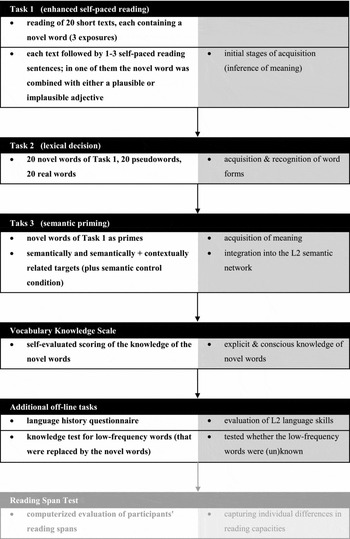
The testing session in the present study consisted of three experimental tasks with reaction-time measurements, a reading span test and several shorter pen-and-paper tasks including VKS (see Figure 1 for an overview). In the main text, we present only the results of the (i) text reading and self-paced reading and (ii) semantic priming experiments. A summary of all tasks in the experimental session as well as the results of the tasks not reported here can be found in Online Supplementary Materials, alongside the online version of the present paper, at journals.cambridge.org/bil.
An overview of tasks in the experimental session.

Participants
Sixty-eight advanced second language learners of German, mostly exchange students at the University of Leipzig, participated in the tasks. Their native languages were mostly of Slavic or Romance origin and their L2 German proficiency corresponded to the levels B2 and C1 of the Common European Framework of Reference for Languages (CEFR),Footnote 2 i.e. they have not yet reached native-like proficiency. The average age of the participants was 22.1 years, their first contact with the German language was at 15.3 years (min 12 years, max 18 years) and they had been learning German for 9.2 years (min 7 years, max 15 years; most participants had learned German for between 7 and 12 years, some experienced periods when they were not using German) on average.
Text reading and self-paced reading
In this task we explored the inference and initial acquisition stages of meaning of novel words in syntactically simple and complex texts.
Earlier research has shown that syntactically complex texts require more cognitive and processing resources (Bentin, Deutsch & Liberman, Reference Bentin, Deutsch and Liberman1990; Deutsch & Bentin, Reference Deutsch and Bentin1996; Tunmer & Hoover, Reference Tunmer, Hoover, Gough, Ehri and Treiman1992) and are thus more difficult to comprehend. It is, however, not clear, what exactly the increased demands on the resources mean for IVA.
We posit two hypotheses. The first is that when all or most resources are necessary for decoding the global text structure, not enough resources remain for the acquisition of unknown words and syntactic complexity would thus hinder IVA. According to Pulido (Reference Pulido2004), reading simple texts may help to free up cognitive resources which are needed to engage in successful inference to resolve the meaning of unknown words. Thus, additional resources are available during the processing of simple texts which enable the forging of stronger form−meaning connections, so that the target lexical items may be more easily retrievable later, or better organized.
Conversely, we could hypothesize that syntactically complex texts create conditions in which the meaning of every single word may be important for constructing a coherent text representation (Shokouhi & Maniati, Reference Shokouhi and Maniati2009) and which could thus lead to more successful IVA. Moreover, IVA may benefit from the additional attention devoted to the processing of complex structures when compared to less complex texts: when comprehension of a text passage proceeds smoothly, new words may be skipped, because the textual model may be easily constructed without them.
Determining syntactic complexity is a controversial topic that has been vividly debated both in the area of reading comprehension and measuring of oral and written proficiency (see Pallotti, Reference Pallotti2009, for an overview).
Based on the discussions of complexity in the previous studies (especially Arya, Hiebert & Pearson, Reference Arya, Hiebert and Pearson2011; Leikin & Assayag-Bouskila, Reference Leikin and Assayag-Bouskila2004), we extracted and manipulated syntactic/structural properties that have been shown to affect text complexity and consequently its comprehensibility due to their demands on the cognitive capacity (Britton, Glynn, Meyer & Penland, Reference Britton, Glynn, Meyer and Penland1982, p. 59).
Factors affecting text complexity and comprehensibility
Sentence length, number of clauses per sentence
Sentence length (counted in words) provides a quite accurate approximation to more sophisticated methods measuring complexity (Szmrecsányi, Reference Szmrecsányi, Purnelle, Fairon and Dister2004) and it has been included in all common readability formulas. However, it has often been stated that syntactic complexity is a complex text property which is not determined solely by sentence length (Baker, Atwood & Duffy, Reference Baker, Atwood, Duffy, Davison and Green1988; Rezaee & Norouzi, Reference Rezaee and Norouzi2011). Complex versions of texts used in our study do not differ from their simple counterparts in number of words or propositions, but in that several clauses were combined into one sentence in the complex version (for a similar complexity manipulation, see e.g. Iwashita Reference Iwashita2006).
Subordination
Subordination (vs. coordination) is another established factor determining syntactic text complexity, with sentences including more subordinate clauses being more complex (Ellis & Barkhuizen, Reference Ellis and Barkhuizen2005; Wigglesworth, Reference Wigglesworth1997). The type of clause is especially important for languages like German where word order systematically varies between main and subordinate clauses (with main clauses exhibiting V-second and subordinate clauses V-final order, respectively). In addition, Weyerts, Penke, Münte, Heinze and Clahsen (Reference Weyerts, Penke, Münte, Heinze and Clahsen2002) (using self-paced reading and event-related brain potentials) showed that native speakers of German process finite verbs in second position more easily than in the sentence final position.
Number of reduced clauses embedded in one syntactic structure
Sentences containing several reduced clauses, such as participle attributes, nominalizations and infinitive constructions, are more complex than structures with only one proposition. As already noticed by Wang (Reference Wang1970), linguistic depth and number of self-embedded structures also affect the comprehensibility of texts.
Voice
Passive voice contributes to syntactic complexity because of the non-canonical assignment of thematic roles to its constituents and elicits longer reading times (see, e.g. among many others Ferreira, Reference Ferreira2003). In addition, the analytical passive verb forms in German also affect word order: in main clauses, the finite auxiliary is in the V2 position, while the lexical part of the verb in the infinitive is found in sentence final position.
Based on the above mentioned criteria for syntactic complexity, the syntactically complex texts in the present study contained longer sentences with a larger number of clauses per sentence with more subordination, more participle attributes, deverbal nominalizations, infinitive constructions and passive voice. In other aspects, the two versions of the texts were kept as constant as possible.Footnote 3
However, it should be stressed that the manipulation of syntactic complexity in the present study was aimed at yielding texts that would still be accounted as both native-like and relatively unmarked. Thus, we did not try to exhaust extreme positions on the complexity scale for both versions of a particular text at the expense of readability and relative unmarkedness. Instead, the texts were designed to exhibit a noticeable, as well as quantifiable, difference in syntactic complexity between both versions that would reflect the syntactic differences between original texts and adapted graded readers (Crossley, Louwerse, McCarthy & McNamara, Reference Crossley, Louwerse, McCarthy and McNamara2007; Simensen, Reference Simensen1987). For a summary of relevant text statistics and an example text in as simple and complex version see Appendices 2 and 3.
Method
Materials
Novel words
Twenty low-frequency, concrete German nouns were selected. Each noun was matched with a phonologically unrelated pseudoword that functioned as the novel word in the texts. The novel words were pronounceable and conformed to German phonotactics (see Appendix 3). They were used to ensure that no learner had prior knowledge of the new words. This approach has often been used in research on L2 vocabulary acquisition (e.g. Hulstijn, Reference Hulstijn, Arnaud and Béjoint1992, Reference Hulstijn1993; Pulido, Reference Pulido2003, Reference Pulido2004). A post-test revealed that the low-frequency German nouns whose meanings were assigned to the novel words were in most cases unknown to the participants. Hence, from their perspective, they were acquiring regular German nouns for meanings for which they still did not know an L2 word.
As most monomorphemic nouns in German consist of one or two syllables (Wiese, Reference Wiese2000), one half of the novel words were monosyllabic; the other half disyllabic. The novel words were either generated with the Wuggy pseudoword generator (Keuleers & Brysbaert, Reference Keuleers and Brysbaert2010), or slightly changed forms of Wuggy-generated pseudowords.
Texts
Twenty short texts (of about 100 words each), each in a syntactically simple and complex version, were constructed that enabled the inference of the meaning of each low-frequency word (directive contexts, Beck, McKeown & Kucan, Reference Beck, McKeown and Kucan2002), which was later replaced with a novel word functioning as a place-holder. Each novel word appeared in the text three times, either in the nominative or in the accusative case. The texts were written with the help of dictionary definitions of the low frequency words and of their statistical co-occurrences using the DWDS corpus of the German language and the Leipzig Wortschatz ProjektFootnote 4 (for more information about the texts see Appendices 1 and 2).
Six additional filler texts with varying syntactic complexity were constructed which consisted either only of known high-frequency words, or which also contained existing less-frequent words which appeared three times in the text.
Self-paced reading sentences
Each novel word was combined with an adjective that was either compatible or incompatible with the meaning of its corresponding low-frequency word and that did not appear in any of the preceding texts. Pairs of semantically plausible and implausible sentences were created, each containing a nominative or accusative noun phrase (NP) consisting of a definite article in its canonical form (der, die, das), an adjective and the novel word, e.g.:
-
(1) Plausible sentence
Ich werde die kaputte Schocht bestimmt nicht mehr benutzen.
“I certainly won't use the broken schocht [i.e. ‘rake’] anymore.”
-
(2) Implausible sentence
Ich werde die leere Schocht bestimmt nicht mehr benutzen.
“I certainly won't use the empty schocht [i.e. ‘rake’] anymore.”
Novel words were always followed by at least three words. The content of the sentences was related to the topics of the short texts and could be perceived as their continuations.
For each text, no, one or two filler sentences were constructed that were also thematically related but consisted only of known words.
Statements
A statement for each of the 26 texts referring to their content was constructed that could be responded to with a “yes” or “no” answer. The purpose of the statements was to assure that participants really read the texts and attended to their meaning. All participants gave correct answers to at least 18 of the 20 critical statements.
Procedure
First, participants read written instructions which also mentioned the fact that the texts they would read might contain low-frequency words which they may not know because these words come from dialects or special registers. Participants should nevertheless try to understand the texts and read them at their usual, not-too-slow speed.
The session started with two practice trials followed by the experimental and the filler trials. Each trial started with a presentation of the text. Participants read the text silently and the reading duration was measured. When they finished, they pressed the space bar and a plausible, implausible or filler sentence appeared, with each letter masked with an X. Participants then read the whole sentence, word by word, in the self-paced reading mode with a moving window. The number of the self-paced reading sentences following each text varied between one and three. One of the sentences was always the critical plausible or implausible sentence. At the end of a trial, a statement referring to the text appeared on the screen and the participant had to decide whether the statement was true or false, and press one of the corresponding buttons.
Each participant read each text only once, either in the syntactically simple or in the complex version, followed either by the semantically plausible or implausible sentence. Thus in order to form a complete experimental design comprising four conditions for each item (by crossing the two two-leveled factors complexity and plausibility) there were four experimental lists. Each participant was assigned to only one of them. In addition, four participants always created a superparticipantFootnote 5 with a complete design. There were six Romance superparticipants each with one L1 (Italian, French, Portuguese, and Spanish), 10 Slavic superparticipants each with one L1 (Czech, Polish, Russian, Bulgarian, Ukrainian) and one superparticipant with L1 English.
The order of the texts and sentences in each condition was randomized in a constrained way (a maximum of two texts in the same condition (simple/complex, plausible/implausible could follow each other), so that it was not possible to predict which condition would follow. For each experimental list there were two randomizations. The task took about 40 minutes.
Results and discussion
The analyses of the text reading times revealed that participants read the syntactically complex texts significantly more slowly (mean = 45.9 s, SD = 7.2 s) than the syntactically simple ones (mean = 42.7 s, SD = 6.8 s): t 1(1,16) = 7.12, p < .001; t 2(1,19) = 3.89, p < .001).
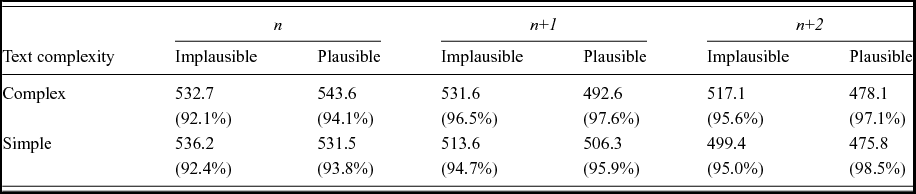
The reading times of the individual words in the critical self-paced reading sentences were analyzed at the position n (i.e. on the novel word preceded either by a semantically plausible or implausible adjective) and at the spill-over positions n+1 and n+2. A total of 183 (4.5%) observations were discarded from the analyses because they deviated from the participant's mean by more than two standard deviations. Mean reading times are given in Table 1.
Mean reading times in ms and percentage of valid values (i.e. number of data points after cutoff) for each condition at positions n, n+1, and n+2 in the self-paced reading task.

A 2 × 2 × 3 ANOVA with factors plausibility, complexity and position revealed a significant main effect of plausibility (F 1(1,16) = 7.50, p < .05; F 2(1,19) = 11.08, p < .01) and position (F 1(1,16) = 7.2, p < .01; F 2(2,38) = 3.5, p < .05). The interaction position × plausibility was significant in F 1 (F 1(1,17) = 4.21, p < .05). The triple interaction between the factors complexity, plausibility and position was marginally significant in F 2 (F 2(2,38) = 2.64, p = .08). The equivalent analysis of errors revealed that the factors plausibility and position were significant: plausibility F 1(1,16) = 14.14, p < .001; F 2(1,19) = 9.52, p < .01 (68 invalid data points in the plausible and 115 in the implausible condition), position F 1(2,32) = 6.5, p < .01; F 2(2,38) = 3.80, p < .05 (there were more invalid data points on position n (84) than on the positions n+1 (52) and n+2 (47) (Scheffe test)).
The subsequent ANOVAs over the individual positions revealed no significant effect of plausibility or complexity (both F 1 and F 2 < 1) at the novel word itself (position n). Participants read the novel words equally fast in all conditions at this position. At the position n+1, the factor plausibility was significant (F 1(1,16) = 6.51, p < .05; F 2(1,19) = 8.71, p < .01) as well as the interaction between plausibility and complexity (F 1(1,16) = 8.90, p < .01; F 2(1,19) = 5.77, p < .05). The factor complexity was not significant (F 1 and F 2 < 1). Separate analyses for the simple and complex conditions revealed that the plausibility effect (39 ms) was significant in the complex condition (t 1(1,16) = 3.59, p < .01; t 2(1,19) = 3.86, p = .001), but not in the simple condition (7 ms). At the position n+2, the only significant effect was that of plausibility (F 1(1,16) = 9.00, p < .01; F 2(1,19) = 16.15, p < .001).
We conclude that the L2 participants successfully inferred the meaning of the novel words in both syntactic conditions. Their longer reading times in the implausible condition at the spillover regions indicate that they had difficulties integrating the inferred meaning with the semantically incompatible adjective. Furthermore, we conclude that participants benefited from the syntactic complexity when inferring and/or acquiring the meaning of the novel words. The more immediate plausibility effect at the n+1 position in the complex condition indicates that the meaning of the novel words was more readily available and possibly more strongly represented when participants inferred the meaning from the syntactically complex texts.
Semantically primed lexical decision
After completing the self-paced reading and the lexical decision task (see Online Supplementary Materials), the participants took part in a semantic priming task with lexical decision. Its goal was to examine whether the participants acquired the meaning of the novel words presented in the self-paced reading task independently from the textual meaning and whether these newly acquired representations engaged in interaction with well-established semantic representations of familiar L2 words.
Method
Reaction times of lexical decisions to target words were measured. Each target word was preceded by a prime. The relation between the primes and targets was manipulated yielding a related and an unrelated condition: in the related condition, primes and targets were semantically related, in the unrelated condition there was no semantic relation between them.
In addition, there were two main prime conditions: experimental and control. In the experimental condition, primes were the novel words; in the control condition primes were familiar German words. In both prime conditions, targets were existing German words.
The control condition was included to ensure that the task parameters were sensitive for priming effects and to assess their magnitude for familiar words in L2. Recent studies show that semantic priming is weaker with L2 learners than with native speakers (Phillips, Segalowitz, O’Brien & Yamasaki, Reference Phillips, Segalowitz, O’Brien and Yamasaki2004) and in some studies they have not been observed at all (Clay et al., Reference Clay, Bowers, Davis and Hanley2007).
The experimental condition had two subconditions: the novel primes (in the related condition) were paired (i) with semantically related targets that had not been previously associated with the novel words (i.e. the targets did not appear in the previous texts) and (ii) with semantically and contextually related targets that co-occurred (three to five times) together with the novel word in the short texts in the self-paced reading task. This distinction is important, because semantic priming between a novel word and a word that was associated with it during the learning stage (which was often the case in the previous word-learning studies in L1, e.g. Mestres-Misse, Camara, Rodriguez-Fornells, Rotte & Münte, Reference Mestres-Misse, Camara, Rodriguez-Fornells, Rotte and Münte2008; Perfetti et al., Reference Perfetti, Landi, Oakhill, Snowling and Hulme2005) does not necessarily imply that a new lexical representation has been fully integrated into the existing semantic memory because the link between the two representations could also be interpreted as episodical (see Tamminen & Gaskell, Reference Tamminen and Gaskell2012, for a detailed reasoning on this topic).
Materials
The 20 novel words from the self-paced reading task used as primes were paired with 20 semantically related and 20 semantically and contextually related targets to create the experimental related condition. The types of semantic relationships between the primes and the semantically related targets were controlled and included synonymy, hyponymy, hypernymy, and meronymy. The semantic relations between the primes and targets in the experimental semantic group were matched pairwise with those in the control semantic condition whenever possible, e.g. Welb ( = Melisse “balm”) – Pflanze “plant” in the experimental semantic condition and Merkur “Mercury” – Planet “planet” in the control semantic condition both show a hyponym-hypernym relation. The frequency and the length of the targets in these groups were also matched. Pretests established the correspondence in the type of relationship between the matched pairs of the two groups as well as the familiarity of the existing words used in the experiment.
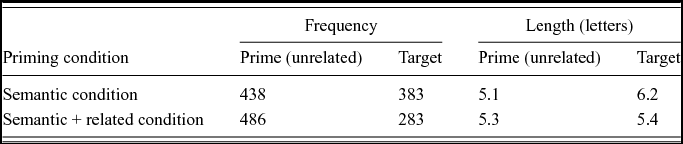
Each prime appeared in the experiment twice, once in the semantic and once in the semantic + contextual condition. Each target also appeared twice, once in the related and once in an unrelated condition. The properties of the targets and unrelated primes in both conditions are summarized in Table 2.
Mean length and frequency (according to Celex Lexical Database, Baayen, Piepenbrock & Gulikers, Reference Baayen, Piepenbrock and Gulikers1995) of targets and unrelated primes in the semantic and semantic + contextual conditions.

In addition to the three conditions mentioned (experimental semantic, experimental semantic + contextual, and control) with 3 × 20 pairs, i.e. 120 trials, 160 filler trials were also included. Twenty of these pairs had a word as a target and a pseudoword as a prime so that the novel words were not the only primes that the participants might not recognize. Together, there were 140 trials that required a “yes” response and 140 trials that required a “no” response. Out of the 140 trials with a pseudoword as a target, 40 had a pseudoword also as a prime and 100 had a word as a prime. Among the pseudowords that were presented as primes were the 20 pseudowords that had appeared in the lexical decision task. Half of them were followed by a word, the other half by a pseudoword target. Thus, not all words that participants saw for the first time in the experimental session were followed by a word.
Procedure
Each session started with a practice block of 10 trials. Afterwards 292 trials followed in four blocks (73 in each block). The length of the pauses that separated the blocks was determined individually by the participants. Each block started with three additional practice items.
Each trial started with a fixation sign (250 ms), followed by an unmasked prime (450 ms)Footnote 6 after which a target appeared. Participants had to make a decision about its lexical status by pressing a YES or a NO button. After participants pressed the response button or after a maximum time window of 3500 ms, the stimulus disappeared and, after an interstimulus interval (blank screen) of 500 ms, the next trial started. Primes and targets were coded with different colours. Participants were instructed to make their lexical decision only for the (green) target words/pseudowords and ignore the primes. The task took approximately 12 minutes.
The order in which the items appeared on the screen was individually randomized in a constrained manner for each participant. A maximum of three items of the same status (i.e. semantically related, unrelated, semantically and contextually related, fillers of different conditions) and with the same intended answer (YES, NO) were allowed to appear after each other.
Results and discussion
The data of two of the 68 participants were excluded from the analyses because of too many wrong answers and extremely slow reaction times (over 1100 ms), so that the total number of participants analyzed was 66. Again, single measurements that differed from a participant's mean reaction time by more than two standard deviations were excluded. The analyses in the critical semantic and semantic + contextual conditions were performed over the trials whose novel word primes each individual participant recognized as existing German words in the lexical decision task (c. 61% on average, see Online Supplementary Materials) and to whose targets each participant correctly responded “yes” within the given time limit.
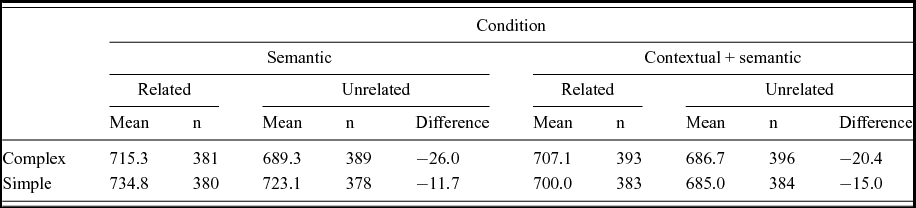
The results for the critical groups are summarized in Table 3.
Mean reaction times (in ms), number of analyzed data points and their corresponding percentages out of total number of items per condition, for all priming conditions in the semantic priming task.

The analysis (t-tests) of the control semantic condition with familiar German words revealed a significant semantic facilitation effect. Participants were almost 25 ms faster in the related than in the unrelated condition: (t 1(1,65) = 3.91, p < .001; t 2(1,19) = 2.55, p < .05).
The ANOVAs with factors relatedness (related vs. unrelated) and type of relation (contextual + semantic vs. semantic) in the critical conditions revealed a significant inhibition effect for relatedness. Participants were about 20 ms slower in the related than in the unrelated condition (F1 (1,65) = 4.81, p < .05; F2 (1,39) = 7.91, p < .01). The factor type of relation was also significant in F1 (F1 (1,65) = 6.30, p < .05), but not in F2 : participants tended to be faster in the contextual + semantic than in the semantic condition, which might be due to the fact that they responded to different targets in the two conditions.
In the ANOVA analysis which also included the factor complexity (see Table 4), a tendency towards significance was observed for the factors complexity and relatedness and the interaction between type of relation and complexity. complexity and its interaction with type of relation were marginally significant in F1 , but not in F2 (complexity: F1 (1,16) = 3.77, p = .07, F2 < 1; type of relation × complexity: F 1(1,16) = 3.1, p = 0.09, F2 < 1), relatedness was significant in F2 , but not in F1 (F1 (1,16) = 2.50, p = .13, F2 (1,39) = 7.63, p < .01).
Mean reaction times (in ms) and number of data points analyzed (n) for targets whose primes appeared in simple vs. complex context in the previous experiment (for all conditions).

Although no significant interaction between the factors relatedness and complexity was observed, separate analyses for the semantic and contextual + semantic conditions were performed to verify that complexity did not affect the more theoretically relevant semantic condition, in which there was a larger numerical difference between the complex and simple conditions. The analyses of the semantic condition confirmed that the semantic effect was larger in the complex (–26 ms) than in the simple condition (–11.7 ms): F1 (1,16) = 5.50, p < .05; F2 (1,19) = 3.64, p = .06.
The semantic effect observed in the critical conditions indicates that semantic representations of the novel words developed associations with semantically related representations and engaged in interaction with their meanings. The effect in the semantic condition which cannot be interpreted as based on episodic links between the primes and targets that would have developed due to their co-occurrence in the same text was of the same size as in the semantic + contextual condition. Moreover, the presence of a weak complexity effect in this condition indicates that participants established stronger semantic representations for novel words that appeared in syntactically complex contexts.
Interestingly, while the semantic priming effect with familiar words as primes in the control condition was that of facilitation, the effect of semantic relatedness for the novel words was that of inhibition: participants were slower when making the lexical decision about targets when the targets were preceded by semantically related novel words than when they were preceded by unrelated targets. This result is similar to findings in L1 reported in several studies by Dagenbach and colleagues (Carr & Dagenbach, Reference Carr and Dagenbach1990; Dagenbach, Carr & Barnhardt, Reference Dagenbach, Carr and Barnhardt1990a; Dagenbach, Horst & Carr, Reference Dagenbach, Horst and Carr1990b).
Dagenbach et al. (Reference Dagenbach, Carr and Barnhardt1990a) reported experiments in which participants learned infrequent L1 English words from definitions. In a subsequent lexical decision task, facilitatory priming was observed for related primes whose meaning participants could recall and inhibitory priming for primes that were recognized, but whose meaning could not be recalled. However, the inhibition effect was significant only when participants were explicitly asked to recall each prime's meaning and to use it to anticipate the target. In contrast, in the present study L2 participants were not encouraged to use the primes to predict the targets – the attention of the participants was not directed to the primes at all.
The results of the present study parallel those of Dagenbach et al. (Reference Dagenbach, Carr and Barnhardt1990a) in L1 English. As seen from the results obtained in the VKS (see Online Supplementary Materials), participants were not able explicitly to recall the meaning of most new words that were used as primes, even though they recognized their form. The fact that we did observe a semantic effect, however, implies that participants established weak semantic representations for most of these words (even though they were not consciously aware of knowing their meanings) and that the interaction between them and earlier established representations took place, i.e. they were in some way incorporated in the semantic network of their L2 mental lexicon.
Incorporation of an incidentally acquired novel word's meaning into the mental lexicon of an L2 learner after only three exposures, as in our experiment, has not yet been demonstrated. Previous studies reporting evidence for a similar integration of novel words into semantic memory in L1 (Borovsky et al., Reference Borovsky, Elman and Kutas2012; Mestres-Misse et al., Reference Mestres-Misse, Rodriguez-Fornells and Münte2007) revealed no differences in brain potentials between known words and novel words. Our results show that newly learned words and known words can act differently in their priming capacity in the case of L2 learners, producing inhibition when a representation is very weak, and facilitation when the meaning is known and can be explicitly recalled. This interpretation of the inhibition vs. facilitation effects is supported also by Bordag, Kirschenbaum, Rogahn & Tschirner (Reference Bordag, Kirschenbaum, Rogahn and Tschirner2014b) (see Online Supplementary Materials for a summary of the relevant results and analogical additional analysis of the present data). As stipulated by Bordag et al. (Reference Bordag, Kirschenbaum, Rogahn and Tschirner2014b), the transition from a weak to a strong representation does not need to be gradual: L2 learners already have at their disposal a large set of semantic representations developed during their L1 acquisition that are assumed to be shared across languages (e.g. as in the Revised Hierarchical Model, see Kroll & Stewart, Reference Kroll and Stewart1994), at least for concrete nouns like those in the present study. If a new word is encountered, L2 learners try to infer its meaning based on the available information. The information might be sufficient to link the inferred meaning with an already established semantic representation. In that case, the newly stored word form would be directly linked to a strong semantic representation established earlier. On the other hand, if the information is insufficient to recognize that the new meaning matches an already existing semantic representation, or if no matching semantic representation exists, a new semantic representation is established that is most likely very weak, since the new word has just been encountered for the first time. The weak representation can grow stronger due to later encounters or, if the learner later recognizes that the new meaning actually matches an already exiting semantic representation, the word form can be ‘rewired’ to this matching representation and the weak one disappears.
We interpret the semantic inhibition effect from newly learned words presented as primes in accordance with a neurally inspired theory of attention by Walley and Weiden (Reference Walley and Weiden1973) as further developed in the context of vocabulary acquisition by Dagenbach and colleagues (Dagenbach et al., Reference Dagenbach, Carr and Barnhardt1990a; Dagenbach et al.,1990b). According to Walley and Weiden (Reference Walley and Weiden1973), attention works on the so called centre-surround principle: it increases the activation of codes towards which it is directed while decreasing the activation of those that are to be ignored. Dagenbach et al. (Reference Dagenbach, Carr and Barnhardt1990a) assume a centre-surround inhibition around the weakly represented meanings of the new words: “The spotlight of facilitation is surrounded by a penumbra of inhibition. The result is to make the desired code ‘pop out’ from the similar but unwanted codes stored near in the semantic space” (Carr & Dagenbach, Reference Carr and Dagenbach1990, p. 343).
We stipulate that at the initial stages of learning after just a few occurrences of a new L2 lexical item, the memory traces of its semantic representation are still very weak and thus difficult to be activated or even selected. Attempts to retrieve such representations might be hindered by stronger semantically related competitors that have much lower activation thresholds and higher potential for being selected. To enable the retrieval of the weak representations, we assume together with Dagenbach and colleagues that an inhibitory mechanism exists that inhibits stronger codes to enable retrieval of information that has just been added to semantic memory (or possibly episodic memory – see “General discussion” section).
General discussion
The novel combination of several experimental paradigms in one testing session allowed a multi-facetted view of initial stages of IVA during reading in L2. The results of the self-paced reading task showed that syntactic complexity significantly contributes to IVA during reading in L2, thus supporting the second hypothesis outlined in section “Text reading and self-paced reading” that reduced text readability positively affects incidental learning. The semantic plausibility effect in the spill-over region directly following the new word (n+1) which was observed for novel words that appeared in the syntactically complex texts (compared with those that appeared in the syntactically simple ones) indicates that the meaning representations inferred from the complex texts were stronger and more readily available than the meanings of the novel words which participants derived from the syntactically simple texts. This finding was also supported by the larger semantic effect for novel words that had appeared in syntactically complex texts in the semantic condition of the priming experiment. The plausibility effect observed on the next position (n+2) for novel words that appeared both in the syntactically simple and complex texts shows that participants also successfully derived the meanings of the novel words that appeared in syntactically simple texts, their representations, however, were weaker and less accessible, since the reaction to the semantic incompatibility with the implausible adjective appeared only later.
These findings imply that syntactic complexity contributes to IVA and suggests that meaning inference and/or the establishment of the semantic representation of new words profits from the increased attention to the word level in syntactically complex contexts. This result is in line with approaches that emphasize the distinction between the process of inferring the meaning of an unknown word and its actual acquisition (Rieder, Reference Rieder2002a, Reference Riederb): the connection between a concept of the contextual meaning which the reader infers and the form of the unknown word that is necessary to acquire word knowledge is not automatic. It requires the reader to focus on the unknown word and an active shift of attention from the textual to the word level.
Our results indicate that syntactic complexity is an additional trigger to learner's shift from the text level to the word level next to the earlier established triggers like the prominence of the word form, or the word's centrality for the text meaning (Rieder, Reference Rieder2002a). The individual meaning of each word (as well as of every syntactic relation) in a syntactically demanding context becomes vital in order to be able to construct the mental model of the meaning of the text at all. At the moment when the global goal of text comprehension cannot be easily achieved, the attention shifts from this goal to its elementary components. Word forms and the meanings mapped to them are scrutinized more closely to assure their validity and appropriateness for the given context. Sentences are read slower or re-read which enables allocating more attention and resources to the individual words which they contain. These conclusions are also supported by findings from studies on the impact of text genre, where the more demanding genre (expository) was found to contribute more to incidental vocabulary acquisition compared with the narrative genre which is perceived as easier with respect to text comprehension (e.g. Shokouhi & Maniati, Reference Shokouhi and Maniati2009).
Semantic priming (see McNamara, Reference McNamara2005, for an extensive review) is an example of lexical engagement, where exposure to one word (prime) influences the processing of another word (target) (Leach & Samuel, Reference Leach and Samuel2007). Applied to the case of new word learning, if a new word has been integrated in existing lexical–semantic networks, it should act as an effective prime when presented shortly before a related target.
In the present priming study, we observed effects for which there is little or no evidence in the area of L2 research. In the control semantic condition, we successfully replicated the semantic facilitation effect with known words in L2. While semantic priming in L1 is a robust and long established finding (Meyer & Schvaneveldt, Reference Meyer and Schvaneveldt1971), semantic priming effects in L2 and between L1 and L2 (in both directions) are less reliable, often weaker and sometimes not observed at all (Williams & Cheung, Reference Williams, Cheung, Trofimovich and McDonough2011; for overview see Altarriba & Basnight-Brown, Reference Altarriba and Basnight-Brown2007). In the present experiment, however, we observed semantic priming between L2 primes and targets that is in magnitude the same as semantic priming effects typically observed in L1.
An important finding is the semantic inhibition effect observed when novel words were presented as primes. To our knowledge, no semantic effect for new incidentally learned words in L2 has been reported to date and our study represents the first evidence of their semantic engagement. Based on these results and results reported in Bordag et al. (Reference Bordag, Kirschenbaum, Rogahn and Tschirner2014b), we assume that the retrieval of new representations that have just emerged in the semantic memory is supported by an inhibition mechanism similar to the one described by Dagenbach et al. (Reference Dagenbach, Carr and Barnhardt1990a). When a word form of newly represented meaning is presented on the screen (e.g. Welb), it activates the corresponding semantic representation that emerged based on the inference process. From this representation the activation spreads to its semantically related representations, e.g. PLANT, GREEN, TEA, GARDEN, LEAF, etc. While the activation received by the weak representation may not be sufficient for its selection, the activation that spreads from it to the earlier established and thus more strongly represented semantically related competitors might be sufficient or close to sufficient for their selection. Due to higher frequency of exposure, the semantically related competitors have much lower activation thresholds and thus a higher potential for being selected than the new weak representation. We assume that in order to enable selection of newly emerged semantic representations, an inhibition mechanism exists that suppresses the activation of the strong competitors to enable selection of the weak representation connected with the relevant (i.e. presented) orthographical/phonological word form. Consequently, if a target, e.g. “plant” appears after the prime Welb “balm/Melissa”, the (rest of the) inhibition that the semantic representation PLANT was exposed to at the prime presentation needs to be overcome to reach the activation threshold. The selection of the word “plant” thus takes longer after the presentation of Welb than after the presentation of a semantically unrelated prime which had not inhibited it.Footnote 7
In our account we assume that the newly acquired meanings are stored in the L2 mental lexicon. The main indication for this assumption is the semantic interaction between the new representations and previously acquired ones observed in the semantic priming task. It is further supported by the pattern of results in the lexical decision task, in which the “yes” responses to the recognized novel words were faster than the “no” responses to the unrecognized novel words, which parallels the pattern of results for existing words (fast “yes” responses) and pseudowords (slower “no” responses). Conversely, in an analogous experiment with L1 native speakers of German, Bordag, Kirschenbaum, Opitz and Tschirner (Reference Bordag, Kirschenbaum, Opitz, Tschirner, Torrens and Escobar2014a) observed slower reaction times to recognized than to unrecognized novel words (while still observing faster reaction times to existing words than to pseudowords). The authors interpret this result as an indication that the L1 novel words were not integrated into the L1 lexicon, but rather were stored in the episodic memory, which is supported by the lack of any evidence for interaction between the new semantic representations and those established earlier. Slower reaction times to recognized novel words are interpreted as a re-evaluation of an original negative response to a word-status of the novel word into a positive one as required by the instruction (score with “yes” also the words that you encountered for the first time only in the present session), thus implicitly turning the lexical decision task into an old–new episodic memory recognition task. In the L2 data, we do not find evidence for such interpretation.
Recent theories propose various accounts regarding the location of storage of familiar L2 and new L1 words and regarding the course of development of their representations. The Episodic L2 Hypothesis (Jiang & Forster, Reference Jiang and Forster2001; Witzel & Forster, Reference Witzel and Forster2012) proposes that L2 words learned in adulthood can only be represented episodically and can no longer enter the mental lexicon, possibly due to reduced neural plasticity. The hypothesis is, however, still in its infancy and no definite conclusions can be drawn yet, except that the latest experiments indicate that L2 words learned relatively late in life are stored in a different memory system from L1 words (Witzel & Forster, Reference Witzel and Forster2012). This weaker claim, namely that L2 words are stored in a different memory system from L1 words, but that this system is not identical with episodic memory, is in general compatible with the results of this study which show interaction between new and established L2 semantic representations. The potential problem of interpreting our data within the Episodic L2 Hypothesis is that according to the original definition of episodic memory, information on this level is stored in sparse, isolated and non-overlapping representations to avoid new information from interfering with existing information, or two pieces of new information interfering with each other (McClelland et al., Reference McClelland, McNaughton and O’Reilly1995; Tamminen, Reference Tamminen2010, p.45). This nature of the representations would not allow semantic competition as observed in the present study.
The related CLS based account of Leach and Samuel (Reference Leach and Samuel2007) identifies the traces of the new words that emerge in episodic memory as the knowledge associated with lexical configuration, while the slower learning process corresponds to the emergence of lexical engagement. The compatibility of the assumptions of this account with the data presented in our study depends on whether we allow for interaction between units of different memory systems, or not. If not (Jiang & Forster, Reference Jiang and Forster2001), it is difficult to explain the semantic interaction between the newly learned primes and the familiar targets in our study, unless we assume that they would result from post-lexical strategic behaviour due to the unmasked presentation of our primes. In case of interaction between the episodic and the semantic memory system as favoured in the current literature (e.g. Greve, van Rossum & Donaldson, Reference Greve, van Rossum and Donaldson2007), the results of this study could be interpreted within the CLS-based theories. In this case, the inhibition effect could also be viewed as a manifestation of the confrontation of units (novel prime and familiar target) from two memory systems (episodic and semantic): as long as the new word form is linked with a representation in the episodic memory, related semantic representations are inhibited. After the new representation is consolidated (i.e. integrated into the lexical–semantic network), or after the new word form is rewired to an already established semantic representation within the existing semantic network, it induces facilitation in semantic priming.
Contrary to CLS-based accounts that predict a period of consolidation for lexical engagement effects to appear, several recent studies using electroencephalography (EEG) suggest that novel word meaning can be integrated into the existing semantic networks only a few minutes after learning (Borovsky et al., Reference Borovsky, Kutas and Elman2010; Mestres-Misse et al., Reference Mestres-Misse, Rodriguez-Fornells and Münte2007; Shtyrov et al., Reference Shtyrov, Nikulin and Pulvermüller2010). A recent study by Borovsky et al. (Reference Borovsky, Elman and Kutas2012) found, for example, ERP evidence for a rapid neural process that can integrate information about word meanings into the mental lexicon of adult native speakers. Nonetheless, Tamminen and Gaskell (Reference Tamminen and Gaskell2012), who interpret their own data within a CLS framework and who point out that the new words in the above-mentioned studies might have been stored in a form of transient, episodic traces rather than in the mental lexicon, actually measured priming themselves in their two experiments both immediately after training, when the novel words were supposed to be in an unconsolidated state and thus putatively incapable of semantic engagement, and after a one- or seven-day period of offline memory consolidation. The data in our study also suggests that semantic engagement of newly learned L2 words with existing representations is possible without a consolidation period, but it might be of a different character than the engagement among consolidated representations (inhibition).
In summary, the priming effect in this study was observed under several acquisition or testing conditions, and characterized by properties that link it with some previous studies and theoretical accounts, and dissociate it from others. The specific conditions in this study included the following parameters: (i) L2 adult learners were examined, (ii) the new words were acquired incidentally, (iii) and without intensive training, (iv) their meaning was mostly not consciously recollected, and (v) unmasked priming was used. The specific priming effect properties were: (i) inhibition effect for novel words, (ii) it appeared also with targets that did not co-occur with the novel words during the learning phase and thus no direct association between them could have been established, and (iii) it was measured directly after learning without any consolidation period.
Conclusion
Our study demonstrated for the first time that syntactic complexity positively influences inference and emerging meaning representation of new words during incidental acquisition while reading in L2; a result important for considering text modifications for learning purposes (e.g. graded readers). We further provided first experimental evidence of semantic engagement of incidentally acquired new words with earlier established semantic representations in the L2 lexicon. At present, it is not possible to decide which acquisition or testing condition contributes to which aspects of the priming effects observed in this and previous studies. In order to do so, it would be necessary to disentangle and explore separately factors that may potentially account for different outcomes in the research so far. One of the essential distinctions that we intend to assess in future studies is the one between representation and memory location of incidental knowledge that was primarily acquired through implicit learning compared to intentional knowledge gained explicitly during intensive training (this dissociation touches on the well-established, though not uncontroversial distinction, between acquisition and learning). It is conceivable that such acquisition modalities might affect the storage location of the new units and/or the speed of their transition to another memory system. Equally important might be the examination of the possible switch of connection between a new word form in a new, weak representation and an earlier established, strong representation at the moment when the match between the established representation and the emergent meaning is recognized.
Appendix 1.
Properties of the 20 experimental texts used in the first task

Appendix 2. Example text for the pseudoword Ebel “clay” in a simple and complex version
Karla hat ein neues Hobby. Sie stellt selbst Vasen, Teller und Tassen her. Dafür verwendet sie als Material einen speziellen Ebel aus einem Laden in Dresden. Sie fährt alle drei Monate dorthin. Sie kauft sich dort alles Notwendige für das nächste Vierteljahr. Der Ebel von dort hat eine besonders gute Qualität. Deswegen kann sie daraus sehr dünne und leichte Vasen machen. Allerdings ist dieser Ebel auch sehr dunkel. Deshalb muss sie die Vasen am Ende immer mit bunter Farbe anmalen.
Karlas neues Hobby ist es, selbst Vasen, Teller und Tassen herzustellen. Der von ihr dafür als Material verwendete spezielle Ebel kommt aus einem Laden in Dresden, wohin sie alle drei Monate fährt, um dort alles, was sie im nächsten Vierteljahr benötigen wird, zu kaufen. Der Ebel von dort hat eine besonders gute Qualität, weswegen daraus sehr dünne und leichte Vasen gemacht werden können. Allerdings ist dieser Ebel sehr dunkel, so dass die Vasen am Ende mit bunter Farbe angemalt werden müssen.
Appendix 3.
List of low-frequency words and corresponding pseudowords (used as novel words in the study) and related target words in priming task