Oxacillinases (OXAs) are a group of enzymes belonging to molecular class D β-lactamases, which are characterized by their ability to hydrolyze and confer resistance to β-lactam antibiotics. The early enzymes in this group were penicillinases that could hydrolyze oxacillin and penicillin. These enzymes were originally found in Acinetobacter baumannii, but later carbapenem-resistant OXA β-lactamase types (eg, OXA-48) were found to have migrated into Enterobacterales. Reference Evans and Amyes1 Among Enterobacterales, OXA-48 was first identified in a Klebsiella pneumoniae isolate from Istanbul, Turkey in 2001. Reference Poirel, Heritier, Tolun and Nordmann2
Although chromosomally inserted OXA-48–type gene exists in Enterobacterales, plasmid carriage predominates. In Acinetobacter spp, bla OXA genes are present on different plasmids, whereas the bla OXA-48 gene in Enterobacterales seems to be located on a single plasmid type. Reference Pitout, Peirano, Kock, Strydom and Matsumura3 This IncL/M-type plasmid has been shown to transfer between species at high rates. This transfer may explain the predilection for the rapid spread of OXA-48 enzymes to many bacterial species rather than propagation through clonal lineages. OXA-48 and closely related enzymes such as OXA-181, hydrolyze penicillins, and carbapenems but not extended-spectrum cephalosporins. However, many OXA-48–producing bacteria coexpress extended-spectrum β-lactamase (commonly CTX-M-15 or SHV-12) conferring pan–β-lactam resistance. Reference Potron, Nordmann, Rondinaud, Jaureguy and Poirel4 When the OXA-48 carbapenemase gene enters the Proteeae tribe of Enterobacteriaceae (eg, Proteus, Providencia, and Morganella, which are intrinsically resistant to colistin and tigecycline), treatment options are severely limited. Reference Sah, Khadka and Shrestha5
Carbapenem-resistant Enterobacteriaceae accounted for 19% of all ICU-related healthcare-associated infection outbreaks over a 5-year period in an academic hospital in the United States. Reference Kanamori, Weber, Gergen, DiBiase, Sickbert-Bennett and Rutala6 Simultaneous outbreaks of OXA-48–carrying Enterobacteriaceae and A. baumannii in an intensive care unit have been described. Reference Robustillo-Rodela, Perez-Blanco, Ruiz, Carrascoso, Iglesias and Martin7 In Singapore, bla OXA-positive isolates constituted 13.7% of all 307 carbapenemase-producing Enterobacteriaceae (CPE) isolates from 161 subjects over a 5-year period between 2010 and 2015, and its incidence remained stable between 2012 and 2015. Reference Marimuthu, Venkatachalam and Khong8 Bla OXA (OXA-48 and OXA-23) constituted 1 of 3 main types of carbapenemase genes in cocirculation in Singapore since CPE was first reported here in 1999 Reference Koh, Babini, Woodford, Sng, Hall and Livermore9–Reference Balm, Ngan, Jureen, Lin and Teo12 : K. pneumoniae carbapenemase (KPC) genes (50.2%) and New Delhi metallo-β-lactamase (NDM) genes (31.6%).
We describe 3 OXA-48–like outbreaks between 2018 and 2020, and the risk associated with OXA-48 carriage in the 2020 outbreak.
Methods
Singapore General Hospital (SGH) is a tertiary-care academic medical center in Singapore with an active hematological and solid-organ transplant service that also incorporates a cardiothoracic and National Burns Centre within its premises. SGH has 1,750 beds in 29 wards and >70,000 annual admissions. General wards and critical care units have both single and 4–7-bed rooms. Also, 85 beds (single and cohort) are available for patients requiring contact precautions prioritized for CPE patients allowing mixed CPE types.
CPE surveillance program
Active surveillance for CPE is conducted through molecular testing on specimens from rectal swabs or stool for (1) persons with hospitalization in the preceding year; (2) adult patients admitted to critical care units, hematology, oncology, and renal departments; and (3) every 2 weeks for patients hospitalized beyond 2 weeks. Critical care units include surgical and medical intensive care and intermediate care units.
Real-time polymerase chain reaction (Cepheid GeneXpert Xpert Carba-R Assay, Cepheid, Sunnyvale, CA) was used to amplify the DNA of organism present in stool samples or rectal swabs collected using ESwab (Copan ESwab 480C, Copan Diagnostics, Murrieta, CA). The Xpert Carba-R assay is an FDA-approved commercial assay, and the test was validated in our diagnostic laboratory in accordance with College of American Pathologists (CAP) regulations. This assay detects proprietary sequences for blaKPC, blaNDM, blaOXA-48, blaIMP-1, and blaVIM.
CPE identified beyond 72 hours of hospitalization is attributed to SGH (healthcare onset, HO).
CPE prevention and control measures
Patients with CPE are either isolated in single rooms or cohorted with up to 5 other CPE patients (irrespective of CPE type), and contact precautions with use of gown and gloves are followed. The patient environment is disinfected with sodium hypochlorite 1,000 ppm solution followed by ultraviolet germicidal irradiation or hydrogen peroxide vaporization.
Patient contacts in the same room with a patient with CPE are screened for CPE.
Outbreaks
An increase from baseline (ie, room-, ward-, and hospital-level data) in the number of patients with genotype-specific CPE bacterial isolates (ie, NDM, KPC, and OXA-48), clustered in 1 location or spread hospital wide, triggers investigations and concurrent interventions to prevent transmission. In outbreaks, for patients with OXA-48–type CPE on screening sample, rectal swabs are repeated for culture, species identification and antimicrobial susceptibility testing. Investigations include screening of exposed contacts for CPE by culture, environmental sampling, environmental, equipment, and hand hygiene audits, and if the outbreak is prolonged, a case–control study is conducted to identify risk factors associated with CPE acquisition.
Environmental samples are taken from sinks in patient rooms and shared toilets and shower traps after the patients have been transferred out because these may be reservoirs for CPE acquisition. Samples are also taken from shared equipment such as commodes. Environmental disinfection is enhanced followed by environmental resampling 2 weeks later. Selected patient and environmental isolates are typed either through pulsed-field gel electrophoresis (PFGE) or whole-genome sequencing (WGS).
Case–control study
For the 2020 outbreak, a retrospective case–control study was conducted in which cases were inpatients with OXA-48–producing K. pneumoniae isolated between September and November 2020. Controls were inpatients tested negative for OXA-48 on rectal swabs during the same period and were selected at a 1:3 case-to-control ratio using simple random sampling.
Demographic and clinical data were extracted from the hospital electronic data system: admission to ICU, presence of devices such as nasogastric tube, indwelling catheter or vascular access catheters and antibiotic exposure for both cases and controls. Information on hospital location at time of OXA-48 detection for cases and negative CPE screen for controls, movement during inpatient stay and contact with known CPE cases, either spatially (cases had occupied same bed in the preceding 3 months), or temporally (collocated within the same cohort room), were collected using a contact-tracing algorithm in the hospital’s electronic data system. Duration at risk was considered the number of days from hospital admission to OXA-48 isolation for cases and until day of rectal swab for control patients.
Statistical analyses were performed using SPSS version 26.0 software (IBM, Armonk, NY). Categorical variables were analyzed using the Fisher exact test. The Mann-Whitney test was used to analyze continuous data variables. We used the Kaplan-Meier method to investigate effect of risk variables on duration at risk. All variables with P < .05 in univariate analysis were included in conditional logistic regression model as potential predictors of OXA-48 carriage. All test of study hypothesis were 2-tailed with P < .05 considered statistically significant.
Results
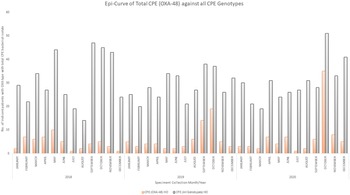
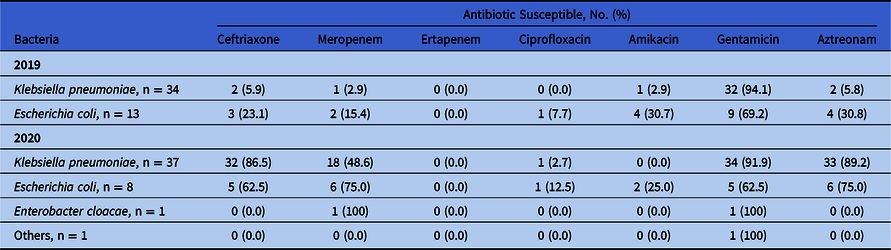
Hospital wide, the median number of patients with healthcare-associated OXA-48 was 2 per month (Fig. 1). In the 3-year period between 2018 and 2020, 3 OXA-48 outbreaks were investigated and managed. The first in March 2018 involved 4 patients; the second in August 2019 involved 55 patients; and the third in September 2020 involved 49 patients (Table 1a). In the 2019 outbreak, 46 patients were culture positive, harboring 47 OXA-48–carrying bacteria, and in the 2020 outbreak, 41 patients were culture-positive, harboring 47 OXA-48–carrying bacteria. The antimicrobial susceptibilities of these bacterial isolates from the outbreaks are shown in Table 1b. A case–control study was conducted for the 2020 outbreak to identify risk association with OXA-48 carriage.
Incident cases of healthcare onset OXA-48 bacterial isolate. Note. HO, healthcare onset; CPE, carbapenemase-producing Enterobacteriaceae.

Distribution of Unique Patient OXA-48 Bacterial Types During the Outbreak Periods a

a Some patients had >1 bacteria type.
Antimicrobial Susceptibility Profile of OXA-48 Bacterial Isolates From the 3 Outbreaks

March–June 2018 outbreak
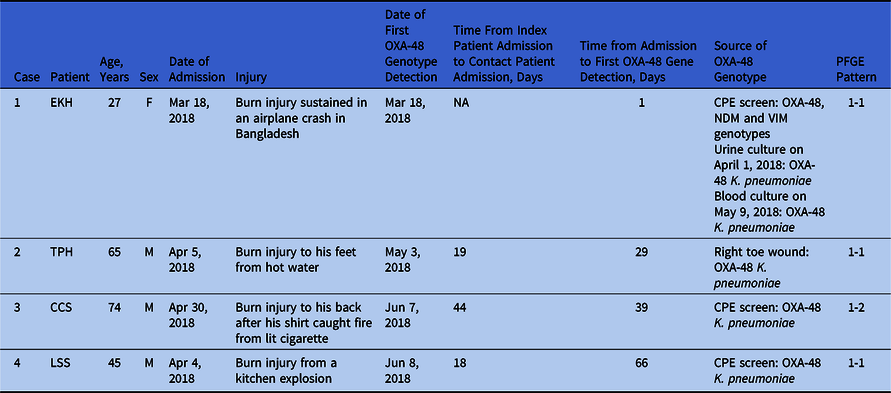
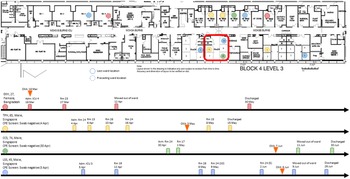
Between March 18, 2018, and June 8, 2018, 4 patients in a 29-bed burn unit in SGH were found to have OXA-48 carbapenemase-producing K. pneumoniae isolates. The first patient was a 27-year-old female from Bangladesh who was transferred to SGH on March 18, 2018, for management of burn injuries sustained in an airplane crash. Her screening rectal swab on admission was positive for the OXA-48 gene. Following her admission, 3 other patients with no preceding travel outside Singapore, had OXA-48 K. pneumoniae isolated from samples taken on days 29 (clinical), 39 (screening), and 66 (screening) following their admission to the unit (Table 2). During the index patient’s 73 days of hospitalization, there was temporal overlap with the other 3 patients who were admitted on days 18, 19, and 44 following her admission. The index patient stayed in a single room during her hospitalization. The other 3 patients did not occupy any rooms she had been in, but they shared the same cohort room (Fig. 2).
OXA-48 Type K. pneumoniae Cluster in Burn Units in 2018

Burns unit with 2018 OXA-48 case cluster.

Samples from the drainage in the cohort room bathroom tested positive for the same organism. PFGE analysis of all 4 patient and environmental isolates showed that they were of the same pattern. Transmission from environmental contamination was inferred from clinical epidemiological association. Interventions included ascertaining compliance with CPE active surveillance, hand hygiene, isolation, or cohort placement with contact precautions for patients with OXA-48 carriage and strict environmental cleaning measures. No further OXA-48–type isolate patient clusters have been identified in this specialized unit.
August–November 2019 outbreak
Between August and November 2019, 55 inpatients from 26 different wards had OXA-48–carrying CPE. From 46 of these 55 patients, 47 bacterial isolates (34 K. pneumoniae and 13 Escherichia coli) were cultured, with 1 patient having 2 different bacterial species (Table 1). Of these, 6 were from clinical samples, and 4 of these were associated with infections: 2 bloodstream, 1 abdominal wall, and 1 Tenckhoff catheter insertion site. Environmental samples were taken from shared equipment, sink P traps, and shower drains. Two samples from 46 commodes and 2 samples from 27 shower drains were positive for OXA-48. Whole-genome sequencing of isolates from 18 patients and 3 environmental samples showed that 17 K. pneumoniae patient isolates and 3 environmental isolates belonged to the same core genome multilocus sequence type 3412 (cgMLST 3412), suggesting that they were genetically closely related. In addition, 1 K. pneumoniae patient isolate belonged to cgMLST 97, which was unrelated to the other sequenced isolates.
In addition to the usual cleaning and disinfection of commodes by ward staff between each use, they were cleaned by environmental services staff once daily. Environmental cleaning of affected wards was enhanced with the use of 1,000 ppm sodium hypochlorite daily, brushing and disinfection of sink traps by pouring of 250 mL sodium hypochlorite 5,000 ppm 3 times weekly and changing of P traps for sinks upon patient discharge or transfer. Weekly samples from the drainage system (both drainage point and P traps) after disinfection confirmed clearance of the OXA-48 isolates. Subsequently, brushing was stopped to prevent aerosolization, and sodium hypochlorite was changed to 1,000 ppm 500 mL to prevent corrosion. Daily audits showed that the hand and environment hygiene compliance rates were between 80% and 90%.
September–November 2020 outbreak
Between September and November 2020, 49 inpatients from 27 different wards were found to have OXA-48–carrying CPE. A rapid rise in healthcare-onset OXA-48 CPE from a mean of 2 patients per month to 13 in the first 2 weeks of October 2020 triggered an outbreak investigation. Overall, 47 bacterial isolates were cultured from 41 of these 49 patients, with 6 patients having 2 different bacterial species each: 37 K. pneumoniae, 8 E. coli, 1 Enterobacter cloacae (Table 1.) All were screening samples, and 36 K. pneumoniae and 8 E. coli isolates had the same PFGE pattern. Immediate reinforcement of isolation of CPE patients was conducted. Sink P traps were initially changed in affected wards only, but routine 2-weekly change hospital-wide was instituted after the outbreak was noted to be hospital-wide on October 21, 2020. Environmental samples were collected from sink P traps and shower drains. Environmental cleaning of affected wards was enhanced with 1,000 ppm sodium hypochlorite twice daily and sinks were disinfected with 250 mL 5,000 ppm sodium hypochlorite 3 times each week initially and then weekly from October 10, 2020.
A case–control study was initiated in the third week of October as the number of incident cases continued to rise.
Case–control study
For the case–control study during the 2020 outbreak, 49 OXA-48–producing CPE cases and 147 controls were identified.
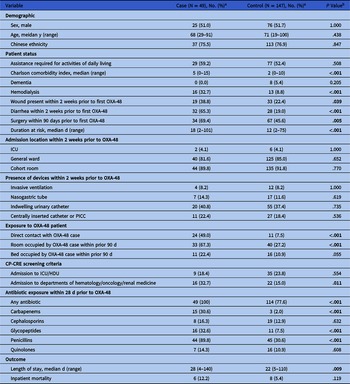
The clinical and epidemiological characteristics are shown in Table 3. Cases and controls were comparable in terms of gender, race, age, as well as ADL status. Compared to controls, cases had higher Charlson comorbidity index scores (CCI, 5 vs 2; P < .001), longer duration at risk (18 days vs 12 days; P < .001), and longer hospitalizations (28 days vs 22 days; P = .009). Higher proportions of cases were on dialysis (32.2% vs 8.8%; P < .001), had diarrhea in the preceding 2 weeks (65.3% vs 19.0%; P < .001), or were in a room that was previously occupied by an OXA-48–positive patient (67.3% vs 27.2%; P < .001). Nearly half of the patients (49.0%) had contact with OXA-48–positive case (vs 7.5% in control group, P < .001). Higher proportions of cases had prior exposure to carbapenems, glycopeptides, and/or penicillin within 28 days preceding OXA-48 detection (P < .001 for all 3 drugs).
Baseline Characteristics of Patients in Case-Control Study in the 2020 OXA-48 Outbreak

Note. ICU, intensive care unit. HDU, high-dependency unit. PICC, peripherally inserted central venous catheter.
a Units unless otherwise specified. Categorical data are shown as no. (%), Continuous data are shown as median (range).
b Fisher exact test (categorical data) and Mann-Whitney test (continuous data).
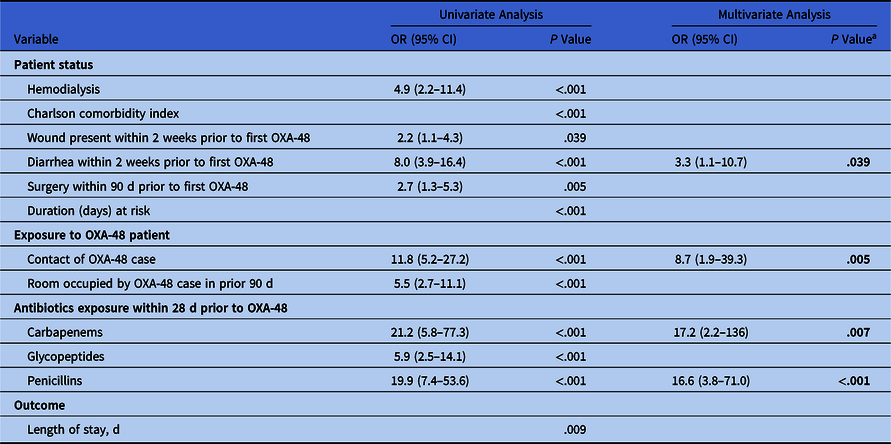
In the multivariate analysis, we identified the following independent risk factors for OXA-48 carriage: diarrhea within the preceding 2 weeks (OR, 3.3; 95% CI, 1.1–10.7; P = .039), contact with an OXA-48–carrying patient (OR, 8.7; 95% CI, 1.9–39.3; P = .005), and exposure to carbapenems (OR, 17.2; 95% CI, 2.2–136; P = .007) and/or penicillin (OR, 16.6; 95% CI, 3.8–71.0; P < .001) (Table 4).
Risk Factors for OXA-48 Colonization or Infection in the 2020 OXA-48 Outbreak

*Multiple logistic regression, Note. OR, odds ratio; CI, confidence interval.
a Multiple logistic regression.
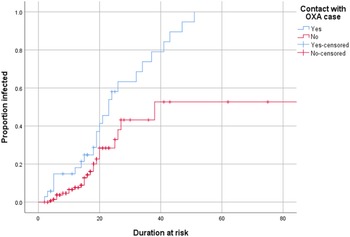
Although cases had longer duration at risk, the Kaplan-Meier analysis revealed that prior contact with OXA-48 patients was more important in determining risk of OXA-48 colonization or infection, which undermined the effect of duration at risk (Fig. 3). For same duration at risk of 40 days, nearly 80% of patients with contact had an OXA-48 bacterial isolate, compared to 50% in patients without contact (log-rank test P = .002).
Kaplan-Meier survival plot for OXA-48 infection or carriage.

The PFGE of K. pneumoniae isolates across 2018, 2019, and 2020 identified 4 major PFGE patterns. Probable links to the same outbreak were based on epidemiological inferences of the 3 outbreaks.
Discussion
Investigations into healthcare outbreaks with multidrug-resistant pathogens typically begin with the identification of resistant strains from the same bacterial species. Propagation of antimicrobial resistance in healthcare settings, however, is not limited to transfer of bacterial species between patients; it is also due to the transfer of plasmids between and across different bacterial species. Active surveillance and outbreak investigations incorporating molecular testing methods have enabled the detection of outbreaks caused by the transmission of conjugative plasmids encoding antimicrobial resistance across bacterial species rather than clonal expansion of one bacterial species (to which outbreaks have traditionally been attributed). Reference de Man, Yaffee and Zhu13
The OXA-48 outbreaks at our institution are less likely to have been detected without molecular-based active surveillance methods because antimicrobial resistance in OXA-48–producing Enterobacteriaceae is not consistently phenotypically expressed. Reference Gupta, Limbago, Patel and Kallen14,Reference Nordmann, Gniadkowski and Giske15
The 3 distinct multispecies OXA-48 outbreaks over 4 years at our institution were associated with environmental reservoirs, and selection pressure from antimicrobial use contributed. Bacterial relatedness within each outbreak was established using PFGE in the 2018, 2019, and 2020 outbreaks and using WGS in the 2019 outbreak. Acquisition was attributed to the environment because the outbreaks were widespread and COVID-19 pandemic–related changes in clinical workflows and infection prevention practices that primarily focused on contact and droplet transmission did not appear to affect CPE acquisition. Reference Wee, Conceicao and Tan16
Several OXA-48 carbapenemase-related outbreaks in Europe have been attributed to monoclonal spread of K. pneumoniae strains with cocarriage of bla CTX-M-15. Reference Potron, Kalpoe, Poirel and Nordmann17–Reference Adler, Solter and Masarwa19 Although clonal spread of carbapenem-resistant bacteria harboring multiple antimicrobial-resistant genes is a global threat, 20 our report includes a multispecies OXA-48 outbreak in 2020. This finding suggests a horizontal transfer of the resistance gene through plasmids, as was characterized in a large outbreak of OXA-48 in in a Dutch hospital in May 2011 that involved 118 patients, with mostly K. pneumoniae and E. coli OXA-48 isolates. Reference Hidalgo, de Been and Rogers21 Bla OXA-48 is typically embedded in transposon Tn1999.2 and is located on a ∼62-kb IncL/M plasmid that has the ability to self-conjugate between species.
Prolonged outbreaks of OXA-48–carrying bacteria have been attributed to fluoroquinolone use Reference Dautzenberg, Ossewaarde, de Greeff, Troelstra and Bonten22 and sink traps, Reference Regev-Yochay, Smollan and Tal23 whereas short outbreaks are associated with the use of a contaminated duodenoscope. Reference Bourigault, Le Gallou and Bodet24 However, in the OXA-48 outbreak in 2020 at our institution, diarrhea in the preceding 2 weeks, contact with another patient with OXA-48, and exposure to carbapenems and penicillin were risk factors identified. Diarrhea as a risk factor for OXA-48 acquisition may be related to increased healthcare worker contact and/or increased exposure to hospital equipment (commode) and environment (shared toilets). In an earlier CPE case–control study at our institution between 2011 and 2013, the presence of central venous devices and exposure to penicillins and glycopeptides were identified as risk factors. Reference Ling, Tee and Tan25 There was no association with procedures or the presence of devices in our study. Antimicrobial use has been consistently associated with OXA-48 carriage; hence, antimicrobial stewardship remains critical in the prevention of these outbreaks.
Interventions aimed at environmental disinfection and prompt isolation of patients colonized with CPE appeared to have been effective in ending the outbreaks in our institution. CPE in sink and shower drains may be indicative of CPE reservoirs for acquisition or CPE burden from patient shedding. However, in OXA-48 outbreaks, enhanced equipment and environmental disinfection, in addition to surveillance, isolation, hand hygiene and barrier precautions, have been reported as effective interventions. Reference Adler, Solter and Masarwa19,Reference Regev-Yochay, Smollan and Tal26,Reference Bourigault, Le Gallou and Bodet27
Plasmids carrying genes such as OXA-48 may originate in the environment, as evidenced by the presence of related genes in waterborne environmental bacterial species. Reference Potron, Poirel and Nordmann28 Selective pressure exerted by antimicrobials may lead to the expression of bla OXA genes, which may be dormant in their natural progenitors. Reference Poirel, Naas and Nordmann29 The ecological conditions in our hospital at certain times of the year may be favorable for bla OXA-48 gene expression, resulting in recurring outbreaks. Horizontal infection prevention measures targeting enhanced environmental disinfection may avert future outbreaks.
Several methodological issues pertaining to selection of control groups for case control studies involving multidrug-resistant organisms have been highlighted. Reference Bonten30,Reference D’Agata31 Adjustment for colonization pressure has been recommended because this is an established risk factor for carriage of multidrug resistant bacteria. Reference Merrer and Santoli32–Reference Ajao, Harris and Roghmann34 In our hospital, cases and controls were identified on CPE screening done at 2-week intervals following admission, indicating that the outbreaks occurred among patients with prolonged hospitalization (ie, mean length of hospital stay 5–6 days). To determine the risk association between time at risk and OXA-48 carriage in this cohort of patients with longer hospital stays, time at risk was not matched in the selection of controls. Another limitation in using this control cohort is that carbapenem use as a risk factor may not be accurate. Reference Harris, Karchmer, Carmeli and Samore35
In conclusion, multispecies OXA-48 outbreaks in our institution are likely related to a favorable ecological conditions and selective pressure exerted by antimicrobial use. In addition to individual patient surveillance for the presence of multidrug-resistant organisms, integration of the molecular surveillance epidemiology of the healthcare environment is important in understanding the healthcare-associated infection risk to patients. Tailoring interventions to local epidemiological and ecological conditions and an effective antibiotic stewardship program are integral to prevention of these multidrug-resistant bacteria.
Acknowledgments
We acknowledge contact tracers, nurses, and environmental services staff who have been integral to the CPE prevention and control efforts.
Financial support
No financial support was provided relevant to this article.
Conflicts of interest
All authors report no conflicts of interest relevant to this article.