


Introduction
After the end of Reconstruction, Southern states enacted a series of state and local laws to enforce segregation between African Americans and whites. While Jim Crow laws governed many aspects of Southern life, they were also used to disenfranchise African Americans by erecting barriers in the voter registration process. Restrictions such as the white only primary, poll taxes, and literacy and property requirements were together responsible for the nearly complete disenfranchisement of African Americans in the early 20th century American South. While there is a strong intellectual consensus around the general effectiveness of these disenfranchisement provisions at preventing Black voter registration, data limitations and difficulty isolating the independent effect of any individual provision on Black registration have made it difficult for researchers to fully understand the features of these provisions that would both ensure the disenfranchisement of Black Americans and limit the effects for white citizens.
In this paper, we present a data-driven historical case study of African American disenfranchisement in Louisiana. First, we review the historical record of disenfranchisement efforts in Louisiana. The disenfranchisement process in Louisiana began with a new state constitution in 1898, which limited Black voting through the use of, among other things, strict literacy and property requirements for registration. These requirements, however, would also have the unintended effect of significantly depressing white voter registration in the state. We explore how the addition of the Understanding Clause to literacy tests allowed for finer grained discrimination that could be targeted at African Americans with little effect on white citizens.
Using a new data source, based on historical records from Louisiana, we document the empirical effects of post-Reconstruction efforts to disenfranchise African American voters in the state. We empirically document how changes to the Louisiana state constitution almost completely removed Blacks from voter rolls and had knock-on effects on white voters. In a second analysis, we take advantage of temporal and geographic variation in the implementation of the Understanding Clause to show that the discretion afforded local officials in determining implementation and compliance with this provision allowed for the targeted disenfranchisement of Blacks with little effect on white voters. We discuss the implications of these findings for modern voter eligibility requirements. In particular, we note that contemporary voter ID requirements, which grant similar discretion to local officials and which also lack sufficient oversight, create conditions for discrimination.
African American Disenfranchisement in Louisiana
Like many southern states, Louisiana included a number of disenfranchisement provisions in its state constitution passed in 1898. State officials sought to craft methods for disenfranchising Black voters that would not violate the 15th amendment. As V.O. Key states, these provisions were “phrased to exclude from the franchise not Negros, as such, but persons with certain characteristics most of whom would be Negro” (Reference Key1949, 538). State lawmakers included both property and literacy requirements along with a poll tax in Louisiana’s 1898 constitution to stop Blacks from voting. The constitution also included what was known as the Grandfather Clause, which effectively waived the property and literacy requirements for anyone with voting rights on or before January 1, 1867, or the grandchild (son) of a person with such rights, effectively protecting the votes of poor and illiterate whites in the state.
However, the so-called Grandfather Clause was the first of these restrictions that was struck down in the Supreme Court’s 1915 decision in Guinn v. United States. This decision put pressure on white lawmakers to devise other “legal” means of suppressing Black votes that would not also disenfranchise large swaths of the white population. In response, state lawmakers called a new constitutional convention in 1921. During the convention, they modified the state’s literacy requirement by adding an Understanding Clause, which stipulated that in order to register to vote in the state, residents must be able to give a “reasonable interpretation” of a section of the state’s constitution. The provision also included language meant to accommodate the many illiterate white residents of the state, noting that if the individual could not read or write they must be able to provide a similarly “reasonable interpretation” when the section of the state’s current constitution is read to them. The Understanding Clause was already part of the state constitutions in Mississippi, South Carolina, Virginia, and Georgia (Kousser Reference Kousser1974).
Despite the importance of this additional hurdle to registration, the provisions in the 1921 constitution offered little in the way of specific guidelines related to how the Understanding Clause was to be implemented. Indeed, important questions remained, such as what sections of the state constitution would be used for the test? What constituted a “reasonable interpretation,” and whose responsibility would it be to determine whether these interpretations were in fact reasonable? Some suspect that this ambiguity was by design and was meant to give parish registrars nearly carte blanche authority to discriminate against Black residents (U.S. v. Louisiana, 225 F. Supp. 353 1963). With few specific directives, local officials could exercise a great deal of discretion in how, when, and to whom the Understanding Clause was applied. However, for decades, the Understanding Clause was rarely if at all applied (Fairclough Reference Fairclough2008). In its investigation of Louisiana’s use of the Understanding Clause, the U.S. Department of Justice found no evidence that any of the state’s registrars actually administered the Understanding Clause before 1950 (U.S. v. Louisiana, 225 F. Supp. 353 1963; Louisiana v. U.S., 380 U.S. 145 1965). The reason for this, the Justice Department contends, is that
It was not needed. The Democratic white primary made registration futile for Negroes. The Democratic State Central Committee, acting under authority granted to it by the State, restricted all candidates and voters in the Democratic Party primary elections for state officers to white persons. (U.S. v. Louisiana, 225 F. Supp. 353 1963)
However, with the repeal of the state’s poll tax in 1936 and the Smith v. Allwright decision in 1944, which found white-only primary elections unconstitutional, officials in Louisiana were left once again with few “legal” means of excluding Black voters. Blacks in many parts of the state realized this, and by the early 1950s they began showing up at local registrars’ offices demanding to be allowed to register to vote (Fairclough Reference Fairclough2008). It is at this point that some parish registrars began implementing the Understanding Clause. Justice Department officials discovered that from 1954 to 1965, twenty-one parishes implemented some version of the Understanding Clause (U.S. v. Louisiana, 225 F. Supp. 353 1963). The rise of the Understanding Clause in the 1950s was presumably an attempt to suppress Black registration while also maintaining fairly open access to the franchise for white citizens by empowering local election officials.
A strategy of facilitating discriminatory outcomes in ballot access by granting discretion to local election officials is consistent with research on bureaucratic decision making. That is, legislators can facilitate discrimination by giving discretion to local officials. As Lipsky (Reference Lipsky1980, 23) puts it, “[d]iscretion provides opportunity to intervene on behalf of clients as well as to discriminate among them.” Conversely, unambiguous directives and oversight increase bureaucratic accountability and reduce the ability to discriminate (Brodkin Reference Brodkin1997). In a study of a voter ID law in Massachusetts, Cobb, Greiner, and Quinn (Reference Cobb, James Greiner and Quinn2010) find strong evidence of racial discrimination in requests for voter ID. They find that in the 2008 election the probability that a “Black or Hispanic voter was asked for ID is approximately 10 percentage points higher than the probability that an otherwise similarly situated white voter was asked for ID” (Cobb, Greiner, and Quinn Reference Cobb, James Greiner and Quinn2010, 22). In another example of local officials using their discretion for discriminatory purposes, White, Nathan, and Faller (Reference White, Nathan and Faller2015) found that election administrators were much less likely to respond to voter information requests from individuals with Latino aliases than those with putatively non-Latino white aliases.
This theoretical and empirical foundation provides a useful framework for understanding the strategic considerations of white segregationists in the Jim Crow South. Louisiana’s adoption of the Understanding Clause was an attempt to maintain the status quo in electoral politics. It did so by giving local officials the latitude to apply the test for registration in a disparate manner. As such, we focus on two key empirical questions. Did the original literacy and property requirements affect whites as well as African Americans? Next, as we outlined above, actual use of the Understanding Clause did not occur until the 1950s and was only applied to a subset of the parishes in Louisiana. The second empirical investigation focuses on whether the use of the Understanding Clause in these parishes slowed the growth of African American registration in the postwar period without affecting registration for whites. Both analyses add to the extant literature that has focused on how Jim Crow laws affected political participation (Alt Reference Alt, Davidson and Grofman1994; Reference Alt and Peterson1995; Fresh Reference Fresh2018; Kousser Reference Kousser1974; Lawson Reference Lawson1999; Matthews and Prothro Reference Matthews and Prothro1963; Nimmo and McCleskey Reference Nimmo and McCleskey1969; Rusk and Stucker Reference Rusk, Stucker, Silbey and Bogue1978; Thompson Reference Thompson1986). Next, we review a new data source that allows us to provide empirical evidence on both questions.
Data
This paper uses a new data source for both empirical analyses (Keele, White, and Cubbinson Reference Keele, White and Cubbinson2021). Our data is based on historical voter registration records from the Louisiana State Archives. The original documents provide a nearly complete record of voting registration by parish by year and race from 1878 to 2010—more than a century of data. The data are remarkably complete, with 64 parishes per year only 13 cases (0.3%) are missing over this time span. Moreover, for the period from the early 1950s to the early 1970s, there are only two missing values. We used a moving average estimator to impute these missing values. Much of our analysis focuses on the post-1950 period, so the threat of bias from missing data there is minimal.
For our analysis, we constructed two datasets. The first dataset is a simple time series dataset. The time series is the percentage of the eligible population registered to vote in the state of Louisiana from 1878 to 1990. The time series is biennial by election year. We then stratified this time series by race. To our knowledge, this is the only longitudinal data source on voter behavior in the South that spans from Reconstruction to the modern era. The second dataset is a parish level dataset from 1950 to 1968. This dataset contains the percentage of the eligible population registered to vote in each parish for both African Americans and whites. We also merged in census data on the percentage of African Americans and the percentage of African Americans in schools in each parish. Finally in the second dataset, we included an indicator for use of the Understanding Clause. We used the U.S. Justice Department’s investigation of Louisiana voting practices outlined in U.S. v. Louisiana to identify which Louisiana parishes implemented the Understanding Clause and which did not. As discussed earlier, investigators for the U.S. Justice Department found that although the Understanding requirement became law in the 1920s, it was not actually put into effect in any Louisiana parishes until 1954. At that time, 21 of the state’s 64 parishes actually implemented the Understanding Clause.Footnote 1 To that end, we included an indicator variable if the parish used the Understanding Clause for voter registration in the 1950s.
Empirical Analysis I: Historical Trends in Voter Registration in Louisiana
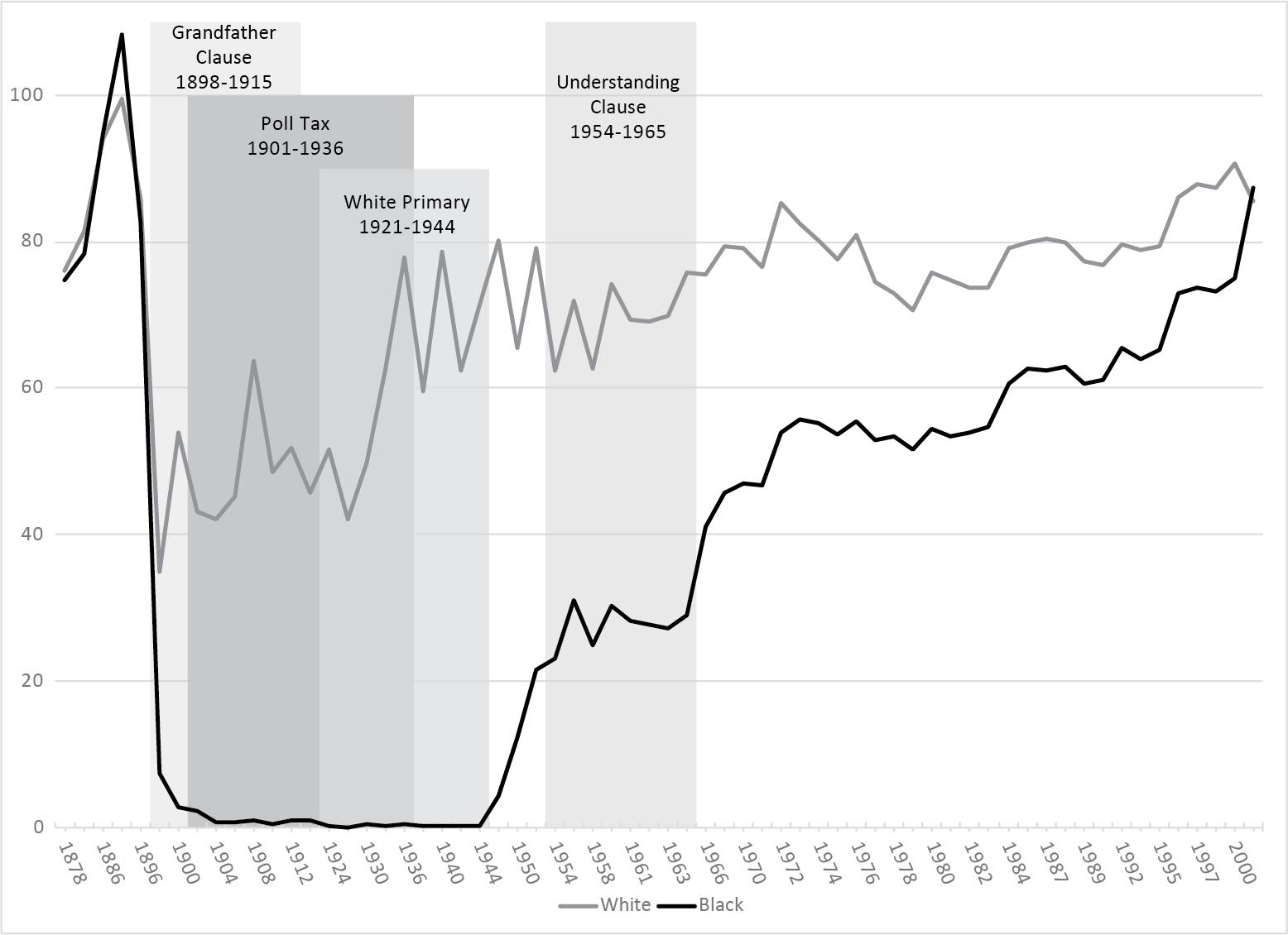
In the first analysis, we use our data source to focus on the empirical question of whether early restrictions on Black voter registration had effects on white voters. Here, we conduct a descriptive time series analysis where we plot the percentage of white and African Americans registered to vote from 1878 to 2010. Figure 1 contains the results. First, following the 1898 constitutional convention, registration rates dropped dramatically for both whites and African American voters. Prior to 1898, more than 80% of whites were registered to vote. However, by 1900, just under 40% were registered to vote. Registration rates among whites do not fully recover until the 1930s. Literacy requirements and poll taxes were universal restrictions on voting rights and while the Grandfather Clause applied generally to most whites, many were either unwilling or unable to take advantage of that exception. However, African Americans in Louisiana were nearly completely disenfranchised, until the 1940s when registration rates among African American began to rise. In the 1940s, there are large gains among African Americans, as nearly 30% are registered to vote. However, larger gains do not come until the passage of the Voting Rights Act in 1965. Notably, African American registration appears to stall in the 1950s—just as the Understanding Clause became more widely used. Next, we explore the possible relationship between the Understanding Clause and African American registration rates.
Proportion of African American and White Voters Registered to Vote from 1878 to 2010 with Key Historical Periods Noted

Empirical Analysis II: Estimating the Effect of the Understanding Clause
We conduct a second empirical analysis that focuses on the effect of the Understanding Clause. We exploit the fact that only a subset of parishes enforced the Understanding Clause during the 1950s. First, we define notation. In our case, the Understanding Clause acts as a treatment that is administered at the parish level, and we wish to observe whether this treatment changes voter registration rates. Each parish has two potential outcomes. The first potential outcome is
 $ {Y}_{it}^T $
if parish i is treated in period t. The second potential outcome is
 $ {Y}_{it}^C $
if parish i is untreated in period t. The variable Dit
is an indicator that is 1 if parish i enforces the understanding clause but is zero otherwise in year t. We define the observed outcome as a function of the potential outcomes and observed treatment status:
 $ {Y}_{it}={D}_{it}{Y}_{it}^T+\left(1-{D}_{it}\right){Y}_{it}^C $
. Let X
it
be a matrix of observed pretreatment characteristics for all parishes. Our goal is to identify and estimate the causal effect fo Dit
on Yit
. The difficulty is that parishes selected their own treatment status. When units select into treatments, outcomes may reflect pretreatment differences in treated and control groups rather than treatment effects (Cochran Reference Cochran1965; Rubin Reference Rubin1974). That is, any effects we observe could be a function of baseline difference in the parishes rather than the use of the Understanding Clause.
The possibility of such bias is very real. We have a limited amount of data that describes parishes prior to the treatment going into effect. However, we have two key measures from the census: the percentage of the parish population that is Black and the percentage of the Black population under the age of 20 that is enrolled in school (U. S. Census Bureau 2015). Table 1 compares treated and control parishes on these two measures from 1950–before parishes started applying the Understanding Clause. While there is little difference in terms of school enrollment, there is a large difference in terms of percentage of Blacks. In treated parishes, Blacks were nearly 42% of the population, and in control parishes Blacks were just over 32% of the population. This suggests a clear systematic difference between those places that used the Understanding Clause. Even more critically, it may be the case that there are unobserved differences between treated and control parishes. That is, treated parishes may have higher levels of racial hostility that would lower voter registration rates even without the use of the Understanding Clause. Next, we outline the approach we use for identification and estimation of causal effects.
Comparison of Treated and Control Parishes

Note: Treated parishes employed the Understanding Clause in the 1950s.
Design and Methods
Given that our data are structured longitudinally, there is one obvious approach we might take to causal identification. That is, we might use the differences-in-differences (DID) method for causal effects. Under DID, we assume that the outcome is described by the following data generating process:
 $$ {Y}_{it}={\beta}_0+{\beta}_1{D}_{it}+{\beta}_2{X}_{it}+{\alpha}_i+{\lambda}_t+{u}_{it} $$
Here, β 1 represents the causal effect of interest: the effect of the Understanding Clause on voter turnout. The terms αi and λt represent parish and time fixed effects respectively, while Xit represents time-varying factors that affect registration rates. Under a DID strategy, we eliminate bias from two specific forms of unobserved confounding. The parish fixed effects eliminate the effect of all time invariant bias—observed and unobserved. For example, any parish-specific factors such as the form of parish government are controlled for. The time fixed effects remove the effect of unobserved factors that change over time but not across parishes. This includes state-level electoral trends or voter regulations that are enforced state wide. Moreover, as we noted above, we should be concerned about the possibility of bias from differing levels of unobserved racial hostility. However, if unobserved levels of racial hostility are time invariant during our study period, a DID approach would control for that form of bias. In general, we expect that racial hostility is time invariant during the period of our study.
Whatever the advantages of the DID model, we must still control for all time-varying confounders. As such, while we have eliminated the effects of some specific types of confounders, we must assume that all time-varying factors are observed—a strong assumption. Moreover, if we use DID we must also assume that past treatments do not directly influence current outcome and past outcomes do not affect current treatment (Imai and Kim Reference Imai and Kim2018). As a robustness check, we adopt an analytic plan outlined in Angrist and Pischke (Reference Angrist and Pischke2009, 246–247) and more fully realized in Ding and Li (Reference Ding and Li2019). One alternative to the DID method, is to use the lagged dependent variable (LDV) approach, where we control for X it and Y it−1. Ding and Li (Reference Ding and Li2019) prove how the DID and LDV approaches can be used to calculate bounds on the causal effect of interest. This is possible because the two methods share a bracketing property. That is, if the model conditioning on an LDV is correct, but we fit the DID model, the estimate of the treatment effect for the Understanding Clause will be too large, as the unestimated lag parameter will be additive with the treatment effect through the error term. Conversely, if the DID model generated the data and we estimate a model that conditions on past outcomes, this will generate a correlation between the treatment and the lagged outcome which will bias the treatment effect downward. Therefore, we can view the estimates from these two methods as bounds on the causal effect of interest. Ding and Li (Reference Ding and Li2019) prove that this bracketing property holds nonparametrically and develop a key diagnostic test. See Keele, Malhotra, and McCubbins (Reference Keele, Malhotra and McCubbins2013) for another example of applying these bounds in political science. See the appendix for more details on these bounds.
In our analysis, we used 1950 as the baseline pretreatment year. We then used 1960 as the outcome year. Given that parishes started to implement the Understanding Clause in 1954, using 1960 as the outcome year allows us sufficient time for the effect of the treatment to go into effect. We used this two-period data configuration, as the results in Ding and Li (Reference Ding and Li2019) have not been extended to multiple periods. This approach also avoids inferential errors due to serial correlation—a strategy suggested in Bertrand, Duflo, and Mullainathan (Reference Bertrand, Duflo and Mullainathan2004). We estimated the DID model for the treatment effect using a standard linear specification:
 $$ {Y}_{it}={\beta}_0+{\beta}_1T+{\beta}_2{D}_i+{\tau}_{DID}T\times {D}_i+{\theta}^{\prime }{X}_i+{\varepsilon}_{it}, $$
where T is an indicator for the period 1960 and Xi represent control variables. Specifically, we controlled for the percentage of African Americans in the parish and the percentage of African Americans under 20 with some education. Under the bracketing approach, τDID serves as an upper bound for the effect of the Understanding Clause on registration rates. We implemented the LDV method using a simple distributed lag model with one lag for the outcome:
 $$ {Y}_{i1960}=\alpha +\beta {Y}_{i1950}+{\tau}_{LDV}{D}_i+{\theta}^{\prime }{X}_i. $$
Here, τLDV serves as a lower bound for the effect of the Understanding Clause on registration rates such that we should find τDID > τLDV . We implemented the bracketing approach separately for white and African American voter registration rates expressed as percentages.
Results
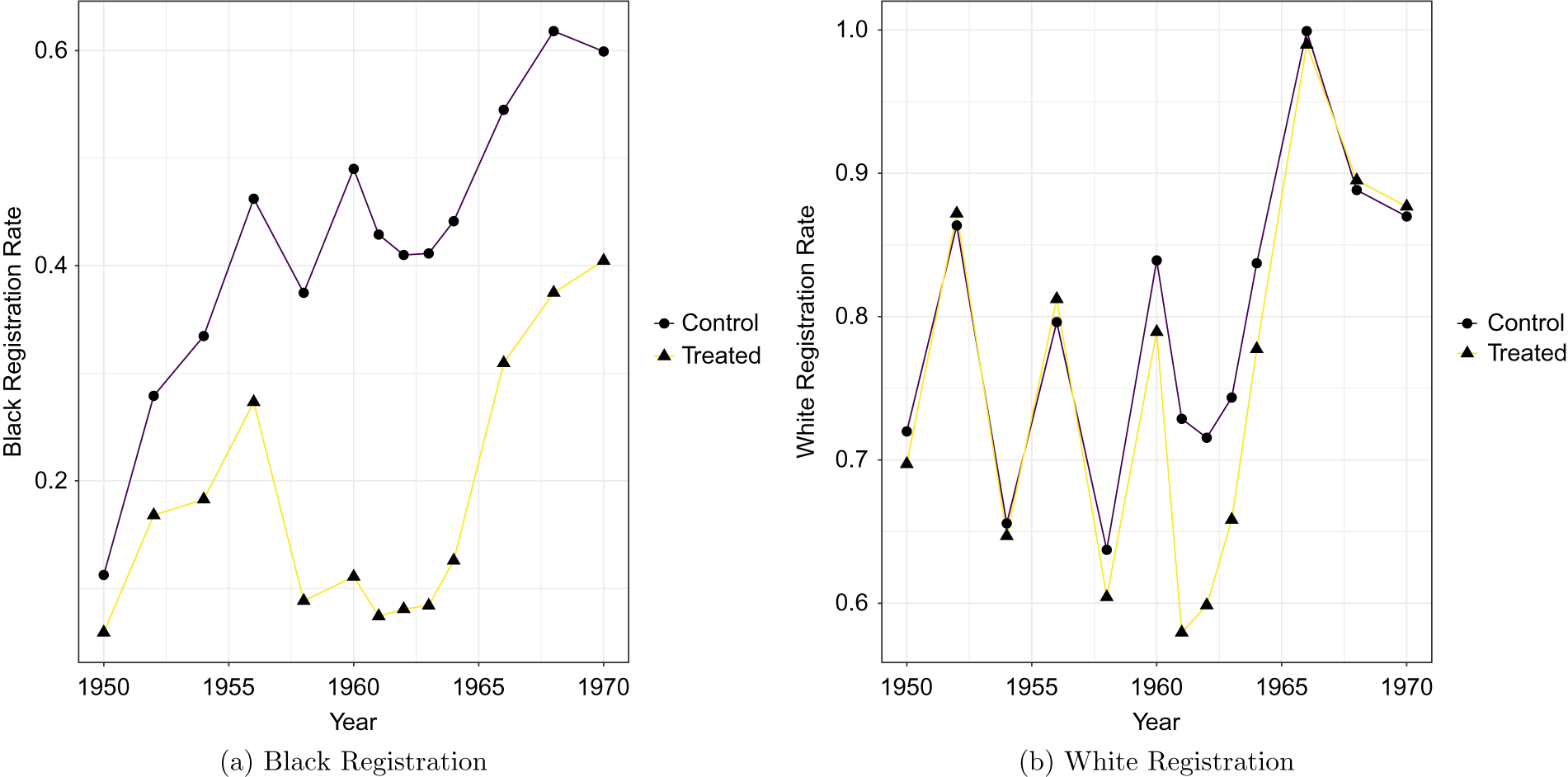
First, we present the raw data. Figure 2 contains a plot of the average proportion of African Americans registered to vote and the average proportion of whites registered to vote. In the plot, we compare average registration by whether the parish enforced the Understanding Clause. For Blacks, parishes that never enforced the Understanding Clause had higher levels of voter registration than parishes that did enforce the clause. Presumably, racial animosity was lower in these parishes, perhaps because there were fewer Blacks. All places were following an upward trend in voter registration. However, in parishes that enforced the Understanding Clause, we observe a sharp drop in registration between 1950 and 1960. Voter registration levels stay low until after 1965 when the Voting Right Act went into effect. For whites, there is a smaller gap between treated and control parishes that narrows more quickly.
Proportion of Registered Voters by Race and by Understanding Clause Status. Treated Parishes Enforced the Understanding Clause and Control Parishes Did Not

Table 2 contains the estimates based on the DID model. For African Americans, the percentage of registered voters decreased by 31.4%. For whites, the percentage of registered voters decreased by 2.5%. The confidence interval for the first estimate is bound away for zero but not for the second estimate. We report full LDV results in the appendix, but the results are consistent with the DID estimates. Using the LDV method, the estimated effect of African Americans is –29.8%, which translates into a nearly 30-point drop in registration rates. For whites, the effect is –2.2%. The 95% confidence intervals for the first estimate is bounded away from zero and includes zero for the second estimate. We would argue that it is reassuring that the results of our analysis are not very sensitive to whether we use an LDV or DID approach.
DID Estimates of the Effect of the Understanding Clause on Voter Registration Rates

Note: Outcome is percentage of African Americans or whites registered to vote in the parish, with 95% confidence intervals in brackets
In general, we find that use of the Understanding Clause worked as intended. It allowed local officials to disenfranchise African American voters while generally avoiding adverse effects for white voters. These results underscore the pernicious nature of this type of voting restriction. That is, it allowed local voting officials to apply what should have been a strict standard to voters differentially by race. It becomes much more difficult for African Americans to register, while white voters are generally unaffected.
Discussion
In this paper, we leveraged the temporal and spatial variation in the implementation of Jim Crow voting restrictions to better understand how African American voter registration rates were affected by these different laws. Using time series data of Black registration rates in Louisiana from Reconstruction to 2010, we saw that the various voting restrictions implemented by state officials to disenfranchise Black voters dramatically decreased the rates of Black voter registration in the state. We then leveraged the uneven implementation of the states voter understanding requirement to show how the implementation of this requirement, in the early 1950s, stymied the growth of African American voter registration. We were also able to test whether these laws had secondary effects for white voter registration rates. While we find that overall these restrictions did indeed decrease white voter registration, the Understanding Clause successfully disenfranchised Black voters without decreasing white voter registration.
One might ask whether our empirical results have any relevance for contemporary politics in an age when methods like the Understanding Clause have long been outlawed? These results highlight that voting restrictions that give local officials greater authority to deny the franchise may be particularly susceptible to discriminatory outcomes. A critical component of the Understanding Clause was providing local elected officials a method for screening out Black voters, while allowing white voters to register. We think one could reasonably argue that a similar mechanism could be at play for voter identification laws. Voter identification laws could be used to disenfranchise voter if local officials were to screen voters for not just photo identification but specific forms of identification. Here, local officials could screen out Black voters by rejecting legitimate forms of photo ID or not allowing Black voters to vote provisionally. Exact knowledge of voter identification law details is likely to be asymmetric with local officials being much more aware of these details. This asymmetry could then be used to discourage Black voters. As such, the effectiveness of the Understanding Clause could provide a template for current efforts at Black disenfranchisement via voter identification laws.
Supplementary Materials
To view supplementary material for this article, please visit http://dx.doi.org/10.1017/S0003055421000034.
DATA AVAILABILITY STATEMENT
Replication files are available at the American Political Science Review Dataverse: https://doi.org/10.7910/DVN/9CEQKX.
ACKNOWLEGMENTS
We thank Adriane Fresh for helpful comments.
CONFLICT OF INTEREST
The authors declare no ethical issues or conflicts of interest in this research.
ETHICAL STANDARDS
The authors affirm this research did not involve human participants.






Comments
No Comments have been published for this article.