Natural whey starters (NWS) are undefined cultures of lactic acid bacteria (LAB) obtained from the incubation of cheese whey collected at the end of the cheese-making process. NWS are characterised by the presence of thermophilic LAB and are used for the manufacture of Italian, long-ripened cheeses such as Grana Padano, Provolone and Parmigiano Reggiano (Beresford et al. Reference Beresford, Fitzsimons, Brennan and Cogan2001; Lazzi et al. Reference Lazzi, Rossetti, Zago, Neviani and Giraffa2004). Bacteriophage infections represent a serious problem in dairy fermentative processes, and their inhibitory effect against lactic acid starters has been recognised for more than 70 years (Moineau & Lévesque, Reference Moineau, Lévesque, Kutter and Sulakvelidze2005). Culture rotation programs and direct to vat-inoculation of starters are long-standing practices to control phage infections in industrial fermentation, whereas similar approaches cannot be applied to undefined cultures. Although it is believed that the richness and heterogeneity of the microbial composition may represent a natural barrier against phage infection problems, phage contamination of undefined starter cultures frequently occurs because they are propagated under non-aseptic conditions, without any control measures (Carminati et al. Reference Carminati, Zago, Giraffa, Quiberoni and Reinheimer2011). Thus, it is possible that a number of LAB strains that compose the NWS could be infected by phages, altering the metabolic activity of the culture. Zago et al. (Reference Zago, Comaschi, Neviani and Carminati2005) reported the presence of active lytic phages attacking Lactobacillus helveticus strains in NWS used for production of long-ripened cheeses. Similarly to other ecosystems, bacteriophages are suggested to play an ecological role within NWS, acting as a biological pressure, leading the spontaneous selection of phage-resistant strains, able to counteract the loss of the sensitive ones, thus preserving the overall technological performances of the cultures (Zago et al. Reference Zago, Rossetti, Bonvini, Remagni, Perrone, Fornasari, Carminati and Giraffa2008a).
Few studies on Lb. helveticus phages are available. Earlier investigations of Sozzi & Maret (Reference Sozzi and Maret1975) and Séchaud and colleagues (1992) described the characteristics of Lb. helveticus phages isolated, respectively, from Emmental starters and cheese whey in French factories, whereas Quiberoni et al. (Reference Quiberoni, Suarez and Reinheimer1999) studied the inactivation of Lb. helveticus phages by thermal and chemical treatments. The aim of this work was to study the biodiversity of 21 Lb. helveticus phages isolated from different NWS by comparing host range, structural proteins and genome characteristics. This study contributes to increase the knowledge on the biodiversity of Lb. helveticus phages.
Materials and methods
Bacterial strains, bacteriophages and culture media
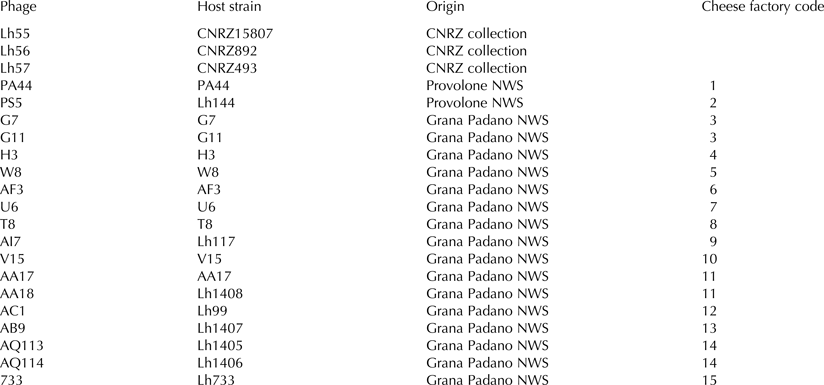
Twenty-one Lb. helveticus phages and their host strains used in this study are listed in Table 1. Sixteen bacteriophages were isolated from Grana Padano NWS, two from Provolone NWS after an enrichment procedure (as described by Zago et al. Reference Zago, Comaschi, Neviani and Carminati2005) and three were from official culture collections. The real presence of Lb. helveticus phages was confirmed by specie-specific PCR as reported by Zago et al. (Reference Zago, Rossetti, Reinheimer, Carminati and Giraffa2008b). To determine phage host range, 100 genotypically diverse Lb. helveticus strains previously isolated from different NWS were used. The Lb. helveticus strains have been previously typed (data not shown) by RAPD-PCR fingerprinting according to Rossetti & Giraffa (Reference Rossetti and Giraffa2005). Strains and phages were maintained as frozen stocks at −80 °C in the presence of 15% (v/v) glycerol as cryoprotective agent. MRS-Ca broth and agar were routinely used to grow and plate bacteria or to propagate and count phages at 42 °C.
Lactobacillus helveticus bacteriophages and its host strains used in this study

CNRZ, National Centre for Zootechnical Research; INRA, France; NWS, natural whey starter
Host range determination
A microtitre plate assay (Zago et al. Reference Zago, De Lorentiis, Carminati, Comaschi and Giraffa2006) was used. Briefly, an overnight culture from different host bacteria with each phage were inoculated in microtitre plates at a m.o.i (multiplicity of infection) of 0·1, which had been filled with MRS-Ca broth containing bromocresol purple as growth indicator. All plates were incubated at 42 °C under anaerobic conditions and, after 8 h, scored for presumptive lysis of indicator strains (no colour change of the indicator). All presumptive lytic phage-host combinations were further confirmed by the turbidity test (Zago et al. Reference Zago, Comaschi, Neviani and Carminati2005).
RAPD-PCR analysis
Phages were propagated on the appropriate indicator strains (Table 1) in 50 ml MRS-Ca broth. After lysis, the cultures were filtered, treated for 30 min with 1 μg/ml DNase I and 1 μg/ml RNase (Sigma-Aldrich, Milan, Italy), and concentrated by centrifugation (100 000 × g, 1 h, 4 °C). Phage DNAs were extracted from concentrated phage particles and purified by the methods previously described (Zago et al. Reference Zago, De Lorentiis, Carminati, Comaschi and Giraffa2006). Phages were identified by species-specific PCR as described by Zago & colleagues (2008b) and typed by RAPD-PCR with primers M13 with sequence 5′-GAGGGTGGCGGTTCT-3′ (Huey & Hall, Reference Huey and Hall1989) and OPL5 with sequence 5′-AACGCGCAAC-3′ (Gutiérrez et al. Reference Gutiérrez, Martìn-Platero, Rodrìguez, Martinez-Bueno, Garcia and Martinez2011). DNA bands were separated on 1·5% (w/v) agarose gel and visualised by GelRed™ solution (Biotium, Hayward, California, USA) staining. One-kb plus DNA Ladder and λ-HindIII DNA ladder (Invitrogen, Milan, Italy) were used as DNA molecular weight marker.
Restriction analysis of phage DNA
Phage DNAs were cleaved with EcoRI and EcoRV restriction enzymes (New England BioLabs, Hertfordshire, UK), according to manufacturer's instructions. Digested DNA fragments were heated for 10 min at 70 °C, held in ice, separated on 1·5% (w/v) agarose gel and visualised by GelRed™ solution (Biotium) staining. λ-HindIII DNA ladder (Invitrogen) was used as DNA molecular weight marker.
Bacteriophage structural proteins
Concentrated phage particles were used to extract structural phage proteins, which were analysed by SDS-PAGE electrophoresis according to De Antoni et al. (Reference De Antoni, Zago, Vasek, Giraffa, Carminati, Briggiler, Reinheimer and Suarez2010).
One-step growth curve
One-step growth experiments were performed as described by Adams (Reference Adams1959). Briefly, each Lb. helveticus indicator strain was infected at a m.o.i. of 2 with its phage. After incubation at 42 °C for 30 min for adsorption, the infected culture was diluted to exclude secondary infection and subsequent decimal dilutions were made and incubated at 42 °C. The number of phages was determined every 60 min (up to 360 min) by the double-layer plate method. Assays were carried out in triplicate. The kinetic parameters of phage infection that could be determined by the one-step growth curve were the latent period, the burst time and the burst size. Latent period was defined as the time interval between the adsorption and the beginning of the first burst, as indicated by the initial rise in phage titre. Burst time was the time before the increase in the number of lysis plaques occurred. Burst size was calculated as the ratio of the final count of liberated phage particles to the initial count of infected bacterial cells during the latent period.
Statistical analysis
Host spectra, RAPD and endonuclease restriction profiles of phage DNAs were analysed by BioNumerics software (version 6.6, Applied Maths, St. Martens-Latem, Belgium). Dendrograms were generated after cluster analysis using the Dice correlation coefficient (for host spectra) or the composite data set and the Pearson correlation coefficient (for RAPD and restriction endonuclease profiles), and the unweighted pair group method using arithmetic averages (UPGMA). For the determination of latent period, burst time and burst size on the one-step growth curves, DMFit web edition was used (http://modelling.combase.cc/DMFit.aspx); data were fitted using the complete model of Baranyi & Roberts (Reference Baranyi and Roberts1994).
Results
Host range determination
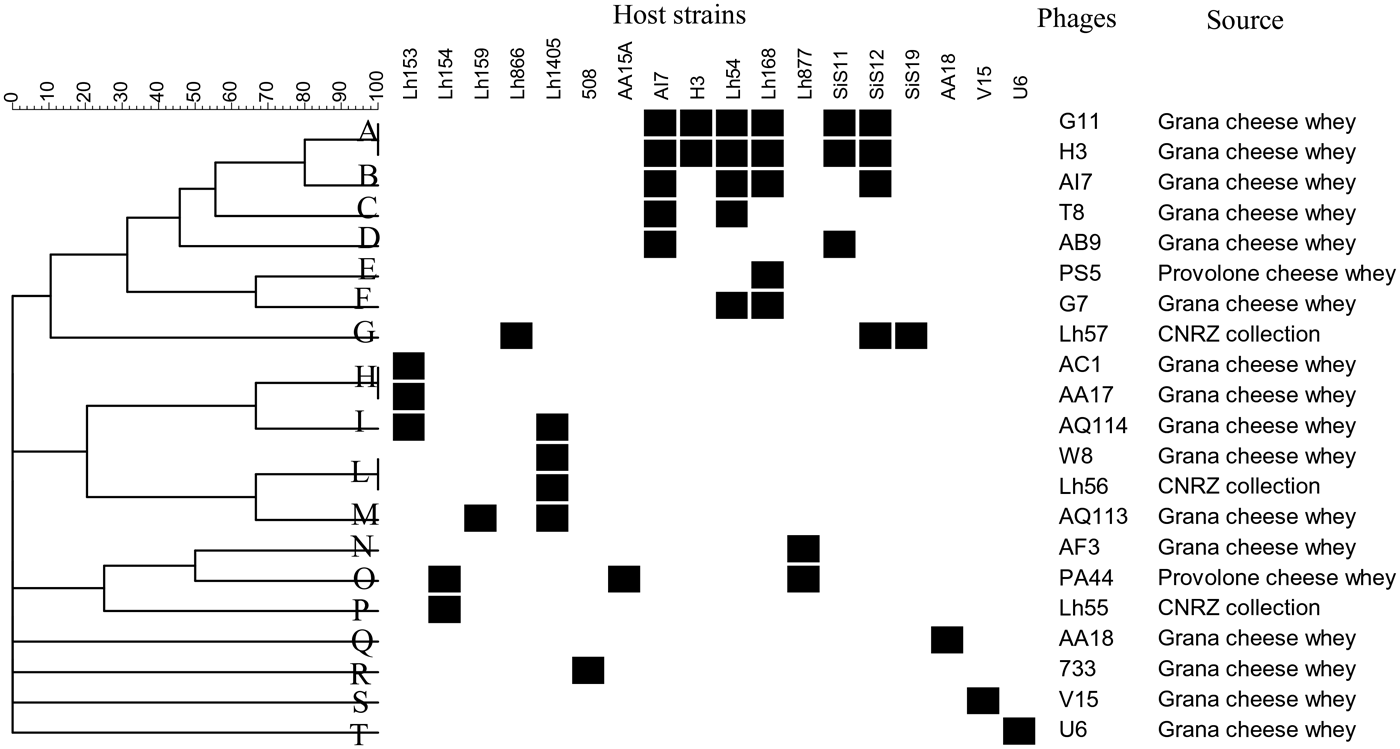
The host range of the 21 phages enabled the grouping of the phages into 18 clusters (Fig. 1). Only three clusters (A, H, J) grouped two phages; notably, the cluster A included two phages (G11 and H3) capable of multiplying on six strains. The other 15 clusters were represented by only one phage. Overall, the 21 phages showed a narrow host range, with a lytic activity restricted to only one strain for 11 out of the 21 bacteriophages (Fig. 1).
Host range profiles of 21 Lb. helveticus phages against 100 Lb. helveticus strains. Positive lysis of the only susceptible strains is indicated by a black box. Cluster analyses were carried out by BioNumerics software using the Dice correlation coefficient, and the unweighted pair group method using arithmetic averages (UPGMA). On the top side of the branches the numbers indicated the % of similarity. Letters on the dendrogram indicated the different clusters.
Fingerprinting analysis
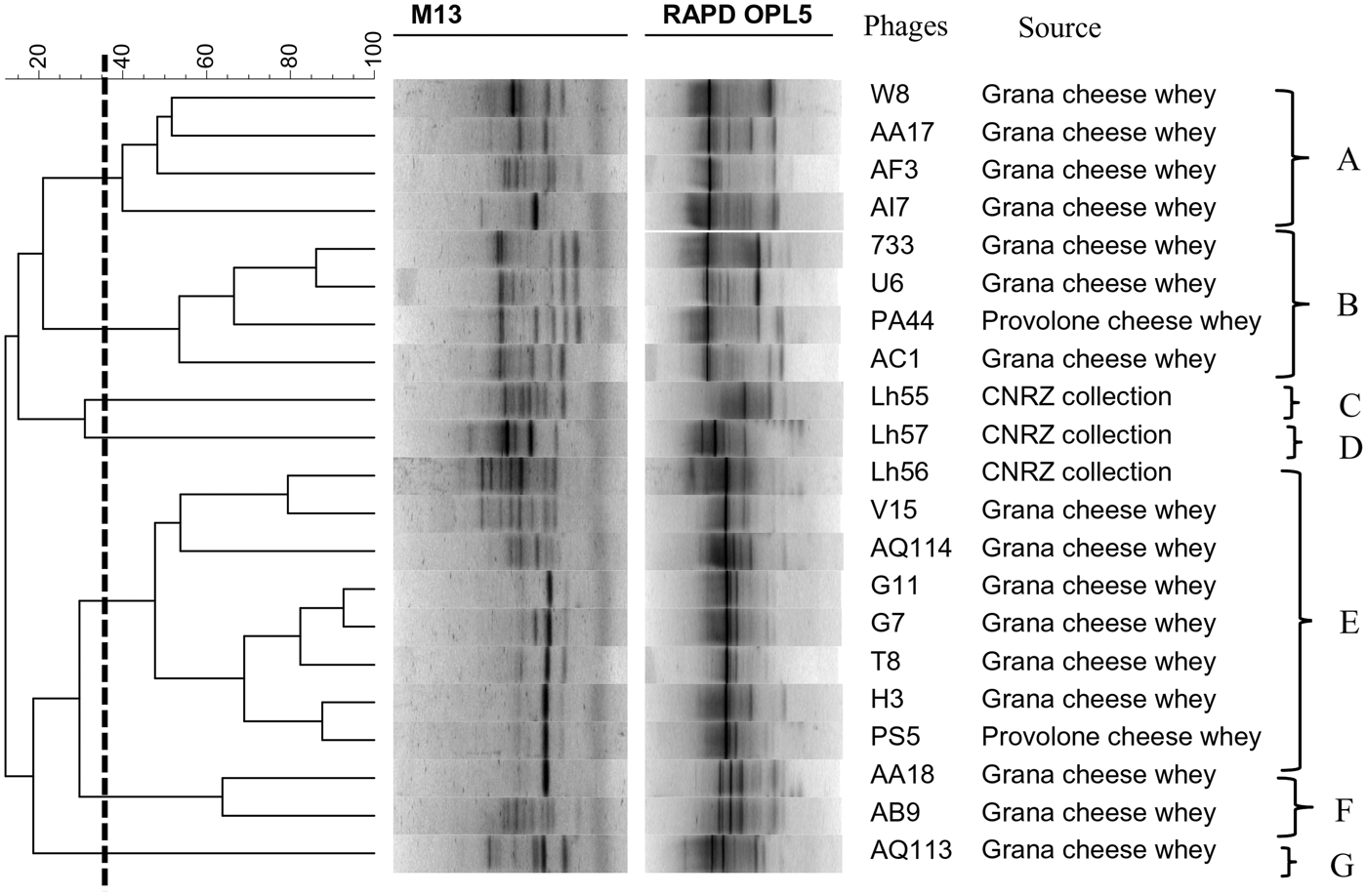
The cluster analysis of the RAPD profiles allowed a discrimination of all phages in seven clusters (Fig. 2). The clusters grouped from eight (cluster E) to two phages (cluster F) and three clusters contained only one phage (C, D, G). Phages grouped regardless of the NWS origin.
Clusters analyses of the RAPD band patterns of 21 Lb. helveticus bacteriophages using the primers M13 and OPL5. Cluster analysis were carried out by BioNumerics software using the composite data set, the Pearson correlation coefficient, and the unweighted pair group method using arithmetic averages (UPGMA). On the top side of the branches the numbers indicated the % of similarity. The identity level for genotypes discrimination is represented by a dashed line at 35% of similarity as indicated by the software.
Characterisation of bacteriophages
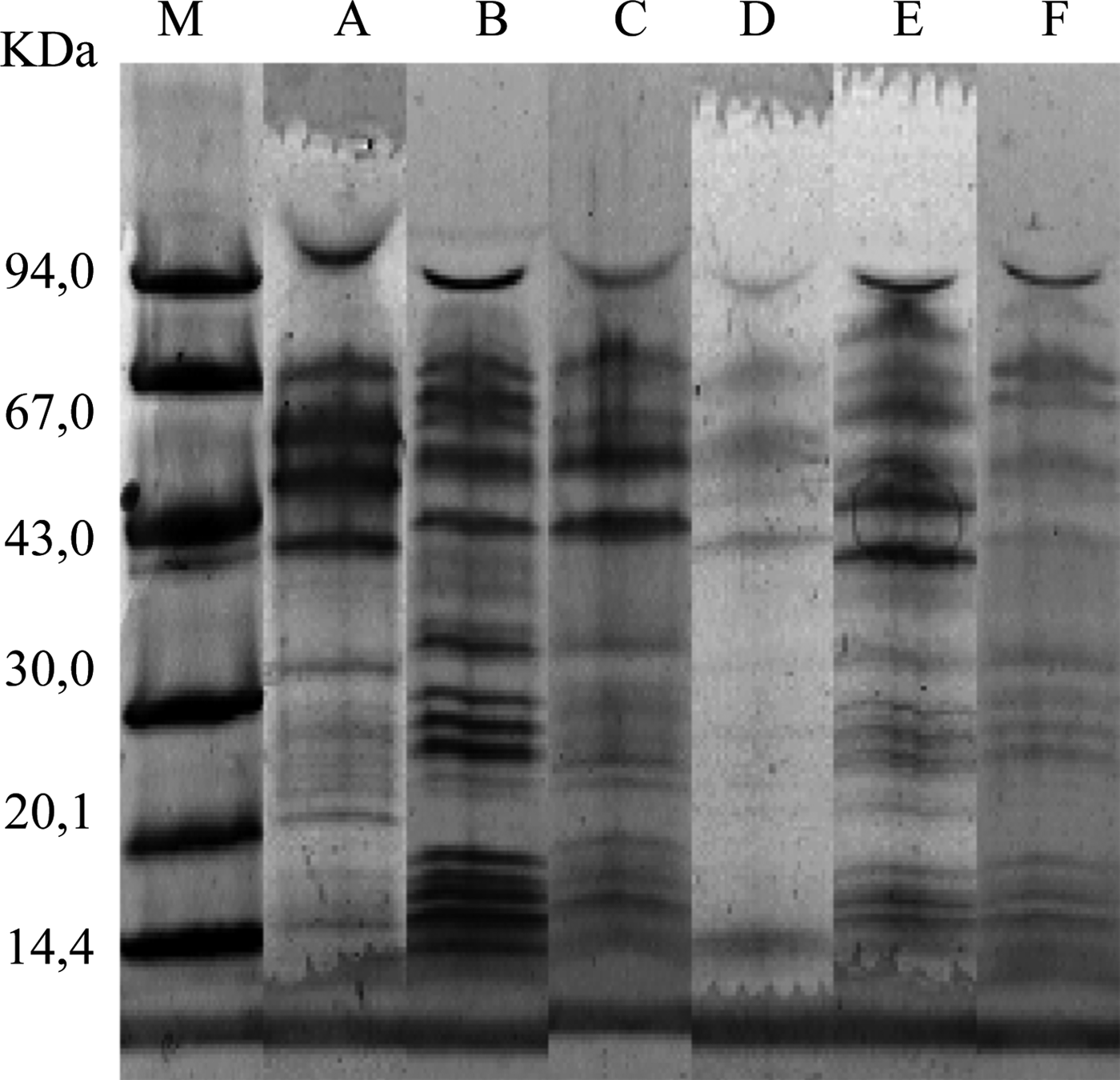
Only six (ФLh55, ФLh56, ФAQ113, ФAQ114, ФAA18, ФAB9) out of the 21 bacteriophages were able to form lysis plaques by agar layer technique on MRS-Ca (data not shown). The six plaque-forming phages were then chosen for further analysis. These six phages belonged to six different host range clusters (D, I, J, K, N, O) and four RAPD clusters (C, E, F, G), but they showed a uniform structural protein profile, represented by three groups of similar bands sized around 14·4–20·1, 30 and 43–67 KDa (Fig. 3).
Structural protein profiles of six Lb. helveticus bacteriophages, processed with BioNumerics software to normalise bands. After concentrations the purified phage proteins were separated by SDS–PAGE. Lanes: A, ФLh55; B, ФLh56; C, ФAQ113; D, ФAQ114; E, ФAB9; M, Molecular Weight Marker (GE Healthcare, Italy).

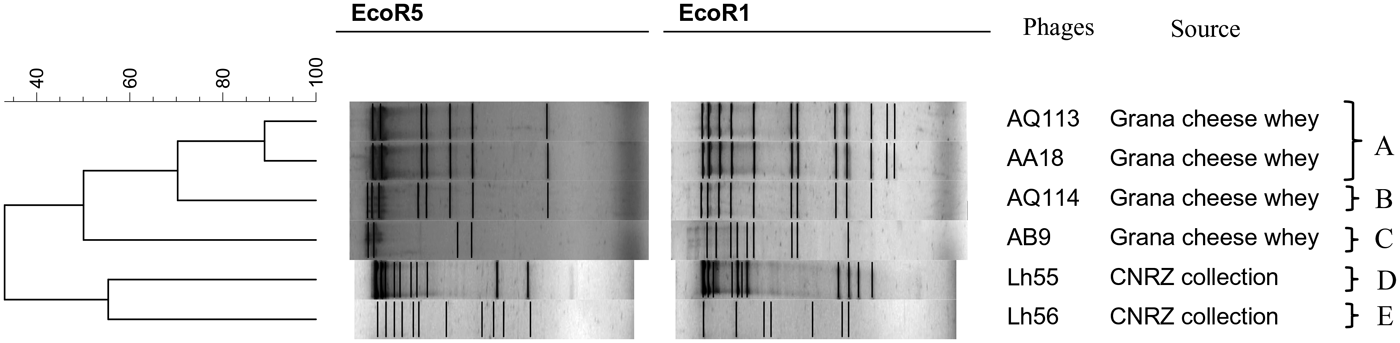
No evidence was found for the presence of cohesive, protruding ends (cos) in the six genomes, and ligation of its DNA did not alter the restriction patterns after the heat treatment of the digestion fragments (data not shown) as described by Kilic et al (Reference Kilic, Pavlova, Ma and Tao1996). Therefore, the Lb. helveticus phages likely utilize the pac mediated DNA packaging. The composite dendrogram generated after the cleavage of the phage DNA with the enzymes EcoRI and EcoRV showed five different clusters, of which only the cluster A included two phages (Fig. 4).
Composite dendrogram of EcoRI and EcoRV, computer generated restriction profiles of 6 Lb. helveticus phages. Cluster analysis was carried out by BioNumerics software using the composite data set function, the Dice correlation coefficient, and the unweighted pair group method using arithmetic averages (UPGMA). On the top side of the branches the numbers indicated the % of similarity.
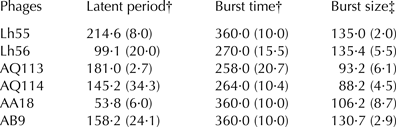
As shown in Table 2, a latent period less than 150 min was observed for four out of the six phages, whereas phages ΦLh56 and ΦAA18 showed a latent period less than 100 min. ΦLh55, ΦLh56, ΦAA18 and ΦAB9 had a burst size greater than 100 PFU/infected cell, and in particular ΦLh55 and ΦLh56 had the highest burst size with a value of 135 PFU/infected cell. ΦAQ113 and ΦAQ114 showed a burst size around 90 PFU/infected cell. ΦLh56 appeared as the most virulent phage between the six studied, with the highest burst size occurring in less time (270·0 ± 15·5 min).
Latent period, burst time and burst size of 6 Lactobacillus helveticus phages
Data are the means of three determinations
† Minutes (±sd)
‡ Indicated as PFU ml−1 infected cell (±sd)
Discussion
The knowledge on the diversity and properties of Lb. helveticus phages is important for evaluating their characteristics and behaviour during the cheese-making process and the consequence of their presence on the final product quality. In particular, 18 of the 21 Lb. helveticus phages studied here were isolated throughout 10 years from NWS without acidification problems. This suggests the simultaneous maintenance of phages and sensitive strains within the cultures, as shown in previous studies (Zago et al. Reference Zago, Comaschi, Neviani and Carminati2005, Reference Zago, Rossetti, Bonvini, Remagni, Perrone, Fornasari, Carminati and Giraffa2008a). Specifically, Φ AQ113 has already been characterised and sequenced in a previous work (Zago et al. Reference Zago, Scaltriti, Rossetti, Guffanti, Armiento, Fornasari, Grolli, Carminati, Brini, Pavan, Felsani, D'Urzo, Moles, Claude, Grandori, Ramoni and Giraffa2013) and it belonged to Myoviridae family. Host range spectra of all the bacteriophages were narrow. These data differed from the results obtained by Séchaud et al. (Reference Séchaud, Rousseau, Fayard, Callegari, Quénee and Accolas1992) where most of the Lb. helveticus phages studied were able to lyse 60–90% of the strains. In their work, Séchaud and colleagues performed the sensitivity tests also on 4 strains isolated from CRA-FLC collection (formerly ISLC collection) and only one was sensitive to phages. These results could be explained by the different dairy sources from which phages were isolated in the two studies. Host range spectra evidenced a wide diversity within phages. This diversity was partly confirmed by genotyping of phage DNAs. Little correlation was observed between host range and RAPD grouping, which is in agreement with previous studies (Le Marrec et al. Reference Le Marrec, Van Sinderen, Walsh, Stanley, Vlegels, Moineau, Heinze, Fitzgerald and Fayard1997). However, the above results are indicative of the great biodiversity between Lb. helveticus phages studied here. Only six phages, out of the 21 investigated, were able to form lysis plaque. This event is quite common in phages of thermophilic lactobacilli, especially Lb. helveticus (Carminati et al. Reference Carminati, Zago, Giraffa, Quiberoni and Reinheimer2011; Zago et al. Reference Zago, Scaltriti, Fornasari, Rivetti, Grolli, Giraffa, Ramoni and Carminati2012). Difficulties may range from the presence of small plaques difficult to distinguish, to the slow diffusion of the phage in the agar layer or simply to the failure of the plaque development (Abedon & Yin, Reference Abedon, Yin, Clokie and Kropinski2009). Structural protein profiles of the six plaque-forming phages were very similar, showing three groups of similar bands. These data could suggest that the protein profile could serve as a marker of species for Lb. helveticus bacteriophages. In particular bands of 43 and 67 KDa were identified as putative tail sheath protein and major head protein, respectively as described for phage ΦAQ113 (Zago et al. Reference Zago, Scaltriti, Rossetti, Guffanti, Armiento, Fornasari, Grolli, Carminati, Brini, Pavan, Felsani, D'Urzo, Moles, Claude, Grandori, Ramoni and Giraffa2013). The results obtained from the restriction analysis validated the genetic biodiversity between phages already underlined by RAPD data. At the same time latent period, burst time and burst size data evidenced that phages were active and virulent and confirmed once more the high level of phage biodiversity. In conclusion, this study underlined the biodiversity of Lb. helveticus phages isolated from different NWS. It also confirmed the widespread presence of phages in dairy factories and their virulence, that is counterbalanced by the presence in the NWS of an unknown number of strains, with different phage sensitivity, that represent a natural barrier against phage infection. The high level of resistance of starter strains to phage infection may hinder massive phage multiplication in NWS and explain the finding of phages in cultures without acidification problems. Occasionally, the concomitant presence of different phages active against the most part of strains within the same culture might however lead to the generation of a defective product (Madera et al. Reference Madera, Monjardin and Suarez2004). In this context, more research is warranted to further unravel the ecological role of phages and to evaluate their impact on the fermentation process. Concurrently, the abundance of the presence of phages in cheese whey starters underlines once again the importance of phage control strategies in the dairy industry.
This work was supported by partial grants from BIODATI Project (D.M. MIPAAF 15421/7303/11).