Highlights
-
Rural people with multiple sclerosis (PwMS) and those with lower socioeconomic status (SES) reported more unmet needs than urban or higher SES PwMS.
-
Cognitive fatigability (CF) combined with fatigue contributed to greater unmet needs across various domains.
-
PwMS identifying CF as an unmet need reported more difficulties across contributing factors.
Introduction
Multiple sclerosis (MS)-related fatigue is a persistent feeling of a lack of physical and/or mental energy. Reference Braley and Chervin1 Cognitive fatigability (CF) is a related but distinct concept that pertains specifically to task performance. Reference Kluger, Krupp and Enoka2 CF is reflected by declines or increased variability in performance during sustained cognitive tasks. CF can be assessed both objectively through cognitive testing Reference Bryant, Chiaravalloti and DeLuca3 and, as in the current study, subjectively through patient-reported outcomes. Reference Luo and Holtzer4 In MS, fatigue and fatigability can occur independently or together, both of which impact therapeutic outcomes. Reference Bertoli and Tecchio5 Distinguishing between them remains a challenge as perceived fatigue is often, but not always, associated with CF. Reference Loy, Taylor, Fling and Horak6 MS-related fatigue is linked to depression, Reference Kroencke, Lynch and Denney7 sleep disorders Reference Strober and Arnett8 and physical inactivity, Reference Gervasoni, Anastasi and Di Giovanni9 and objective CF is similarly predicted by depression, anxiety and sleep disturbances. Reference Mackay, Johnson, Moodie, Rosehart and Morrow10 Perceived CF may be predicted by levels of physical activity and self-reported cognitive function. Reference Feinstein, Amato and Brichetto11 These shared predictors suggest that fatigue and CF may arise from common underlying factors. Thus, addressing CF requires a comprehensive approach that considers the interrelatedness of these factors.
A needs assessment (NA) can be used to determine whether the needs of people with MS (PwMS) who experience CF are being met by evaluating unmet healthcare needs, including health education, treatment and rehabilitation, as well as broader social and environmental factors. It incorporates patient feedback and professional expertise to prioritize care needs before interventions are implemented. Reference Maneotis and Krauss12 Past NAs have identified the top needs of PwMS and their significant others, Reference Koopman, Benbow and Vandervoort13 assessed support arrangements, provided information about service usage and compared perspectives between PwMS and their care partners. Reference Aronson, Cleghorn and Goldenberg14 Despite the presence Reference Berard, Fang and Walker15 and detrimental impact Reference Sievertsen, Gino and Piovesan16 of CF in MS, no NA has been conducted to evaluate the disruptiveness of CF or its contributory factors. In addition, no NA has evaluated how PwMS feel that current healthcare and community support systems address these concerns. An NA should also consider how these needs may vary on the basis of social determinants of health (SDOH) such as socioeconomic status (SES) Reference Wang, Tian and Fitzgerald17 and community type. Reference Buchanan, Stuifbergen, Chakravorty and Wang18
We aimed to (1) obtain information directly from the PwMS about factors known to contribute to CF, (2) identify which factors that the PwMS felt were disruptive and insufficiently addressed at present (i.e., their needs), (3) consider the influence of the SDOH on these needs, (4) investigate whether PwMS who identify CF as an unmet need report greater difficulties related to CF contributing factors than those who do not, (5) assess whether unmet needs vary based on the type of fatigue experienced and (6) inform future interventions designed to target CF.
Methods
Participants
A total of 100 PwMS from the Ottawa Hospital MS Clinic were enrolled. Sample size was determined based on previous NAs involving PwMS, Reference Fakolade, Latimer-Cheung, Parsons and Finlayson19,Reference Edwards, Fakolade, Lindale and Pilutti20 considering both the effect sizes observed in earlier studies and practical constraints on recruitment. The eligibility criteria included a confirmed diagnosis of MS, age of at least 18 years and English fluency.
Procedure
This study was approved by the Ottawa Health Science Network (20230572-01H) and the University of Ottawa, Research Ethics Boards (H-11-23-9890). Participants who consented to the research study were identified via electronic health records and were invited to complete an online NA survey following informed consent. Demographic and clinical characteristics were collected, and individuals completed self-report questionnaires as outlined below. The survey included items examining CF itself, as well as other factors known to contribute to CF: fatigue, cognitive impairment, mood symptoms, physical activities, sleep disturbances and contextual factors. The choice of these items was informed by our team’s clinical expertise and existing literature, Reference Mackay, Johnson, Moodie, Rosehart and Morrow10,Reference Feinstein, Amato and Brichetto11,Reference Berard, Smith and Walker21,Reference Abou, Fritz and Kratz22 and these items were then used to calculate the Need Index (NI) for each factor.
Survey details
Demographic characteristics
Sociodemographic information included age, sex, gender identity, marital status, ethnicity, education level, employment status, annual household income, living situation and community type as defined by Statistics Canada.
Clinical characteristics
The respondents indicated their MS diagnosis date, disability level using the Patient Determined Disease Steps (PDDS), the date of their most recent MS relapse, any previous cognitive assessments, comorbid health conditions, substance use and types of fatigue experienced.
Patient Determined Disease Steps (PDDS)
A valid patient-reported outcome of MS disability whereby individuals indicate their level of mobility impairment and symptom burden Reference Learmonth, Motl, Sandroff, Pula and Cadavid23,Reference Hohol, Orav and Weiner24 on a scale of 0 (normal) to 8 (bedridden).
Modified Fatigue Impact Scale (MFIS)
A 21-item multidimensional questionnaire adapted from the Fatigue Impact Scale. Reference Fisk, Pontefract, Ritvo, Archibald and Murray25 The MS Council for Clinical Practice Guidelines recommended the use of the MFIS to assess MS-related fatigue. 26 A 5-point Likert scale assesses the perceived impact of fatigue on daily activities over the past four weeks, compiled into three subscales: physical, cognitive and psychosocial fatigue. Scores range from 0 to 84, with 38 commonly used as the cut-off to discriminate between fatigued and non-fatigued individuals. Reference Kos, Kerckhofs, Carrea, Verza, Ramos and Jansa27
Pittsburgh Fatigability Scale (PFS)
Ten items designed to evaluate performance fatigability Reference Glynn, Santanasto and Simonsick28 and validated in PwMS. Reference Carlozzi, Boileau, Murphy, Braley and Kratz29 The PFS contains two subscales: physical fatigability (PF) and mental fatigability (equivalent to CF). Respondents rate the level of both PF and CF they imagine they would feel after completing activities of varying intensity and duration using a 5-point Likert scale. Scores for both subscales range from 0 to 50. PF was excluded from the current analysis, as prior research links perceived fatigue with CF but not with PF. Reference Aldughmi, Huisinga, Lynch and Siengsukon30 A PFS-mental score of ≥13 indicates greater CF in older adults. Reference Cohen, Meinhardt and Gmelin31,Reference Simonsick, Schrack, Santanasto, Studenski, Ferrucci and Glynn32
Perceived Deficits Questionnaire – 5-Item Version (PDQ-5)
The PDQ is part of the MS Quality of Life inventory Reference Fischer, Rudick, Cutter and Reingold33 and was designed exclusively for PwMS to measure self-reported cognitive impairment. Reference Sullivan, Edgley and Dehoux34 It consists of five questions about perceived cognitive deficits over the past month. Each item is scored on a 4-point Likert scale. A total score can vary from 0 to 20, with higher scores indicating a greater perceived deficit. Due to the absence of an established cut-off score for the PDQ-5, we applied a threshold of ≥10, which may be indicative of the presence of cognitive impairment.
Hospital Anxiety and Depression Scale (HADS)
Developed to assess depression and anxiety in adults receiving general medical care in an outpatient clinic Reference Zigmond and Snaith35 and validated in PwMS. Reference Honarmand and Feinstein36 It includes 14 items measured via a Likert scale, with 7 each for anxiety and depression. The cumulative scores range from 0 to 21. A score of 0–7 on either subscale suggests a lack of anxiety or depression, a score of 8–10 suggests borderline anxiety or depression and a score of 11–21 suggests clinical anxiety or depression. Reference Zigmond and Snaith35
Pittsburgh Sleep Quality Index (PSQI)
Evaluates sleep disruptions and sleep quality over the previous month Reference Buysse, Reynolds, Monk, Berman and Kupfer37 and has been validated in PwMS. Reference Jerković, Mikac and Matijaca38 It includes 19 items rated on a 0–3 scale, forming seven component scores. Total scores range from 0 to 21, with higher scores suggesting poorer sleep quality. A total score of >5 indicates poor sleep. Reference Park39
Godin Leisure-Time Exercise Questionnaire (GLTEQ)
Developed to assess leisure-time physical activity in healthy adults Reference Godin and Shephard40 and is a reliable physical activity measure in ambulatory PwMS. Reference Motl, McAuley, Snook and Scott41 It examines weekly frequencies of strenuous, moderate and mild activities. Scores of ≥24 suggest an active lifestyle, scores of 14–23 suggest moderate activity and scores of <14 indicate insufficient activity. Reference Godin42
Contextual Burden Scale
Context refers to external elements, such as our social obligations (e.g., caregiving), our physical surroundings (e.g., noise and light) and our activity demands (i.e., workload). Ten items were used to assess the impact of context on fatigue, via a 5-point Likert scale, with scores from 0 to 40. Scores of ≥21 indicate the presence of contextual factors impacting functioning. This scale was developed by our team for the purpose of this study and has not been previously validated.
Assessment of unmet needs
The scale consisted of 21 items, with three each representing the seven factors identified as contributing to unmet needs: fatigue, CF, cognitive impairment, mood symptoms, physical activities, sleep disturbances and contextual factors. Respondents rated how disruptive these factors were to their everyday lives on a 5-point Likert scale and then rated the same items to indicate how well these issues were addressed by existing community support and healthcare systems. An NI was calculated following the Concerns Report Method to measure the extent to which a need was met. Reference Schriner and Fawcett43 Ratings for disruptiveness and how well they were addressed were converted into percentages using the following formula Reference Fawcett44 :
 $${{4n(4) + 3n(3) + 2n(2) + 1n(1) + 0n(0)} \over {N(4)}} \times 100 \\= \% Disruptiveness \; {OR}\% \; Well\hbox{-}Addressed$$
where 4n = the number of participants who rated the item as 4, 3n = the number of participants who rated the item as 3, and so on, and N = the total number of responses to the survey that were completed. Reference Schriner and Fawcett43 This formula produced % disruptiveness and % well-addressed scores, with 100% being the maximum and 0% being the minimum. The NI for each item was then calculated by subtracting the percentage of how well an issue was addressed from its perceived disruptiveness (i.e., NI = % Disruptiveness – % Well-Addressed). An NI of ≥ 50% indicates an unmet need Reference Fakolade, Latimer-Cheung, Parsons and Finlayson19 .
Data analysis
The survey data were imported into IBM SPSS (version 29). Sociodemographic and clinical characteristics were summarized with frequency and descriptive statistics. Chi-square analyses assessed relationships between community settings and unmet needs, as well as between SES and unmet needs. Fisher’s exact test was used when expected frequencies were <5. Chi-square analyses assessed whether having CF as an unmet need was associated with difficulties (i.e., met cut-offs) in self-reported sleep, fatigue, cognitive impairment, mood, physical activity and contextual factors. One-way multivariate analysis of variance (MANOVA) compared the impact of different MS-related fatigue profiles (i.e., fatigue only and both fatigue and CF) on various NIs.
Results
Participant characteristics
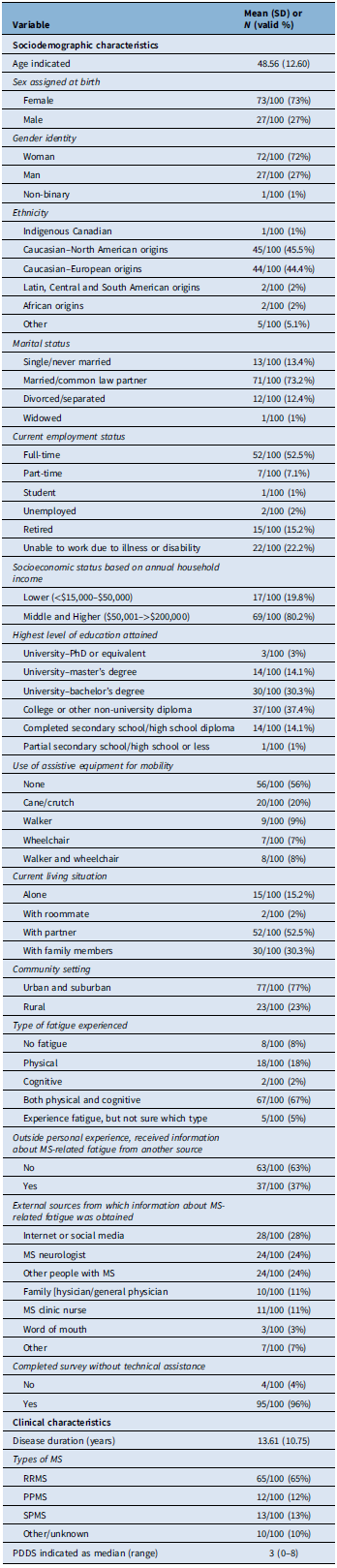
The recruitment flowchart is illustrated in Figure S1. Table 1 provides a summary of the participants’ sociodemographic and clinical characteristics. The sample indicated significant levels of fatigue, with a mean MFIS score of 41.44 (SD = 17.75), and perceived CF, with a mean PFS-mental score of 16.76 (SD = 12.95).
Characteristics of the participants

Note: RRMS = relapsing-remitting MS; PPMS = primary progressive MS; SPMS = secondary progressive MS; PDDS = Patient Determined Disease Steps.
Group-based Need Index findings
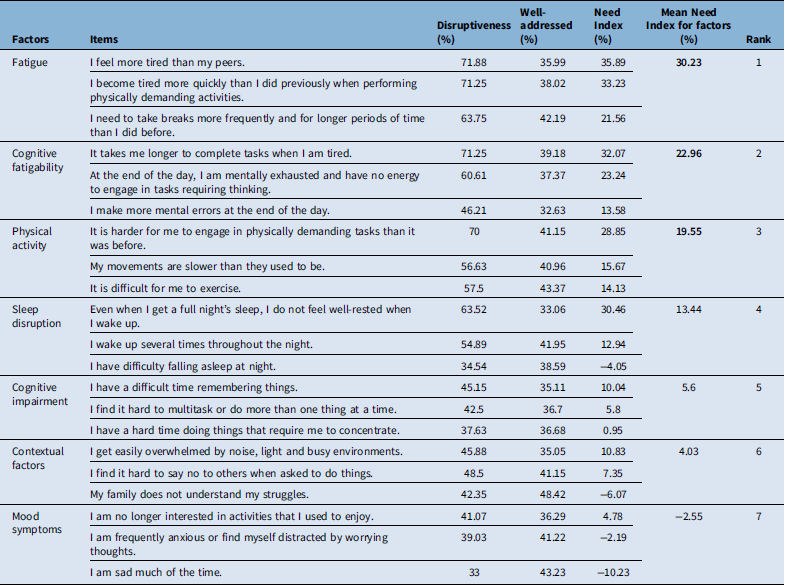
Table 2 presents group-based NIs across the seven factors. None of the factors met the threshold (NI ≥ 50) to be considered unmet needs. At the group level, the top three areas of concern were fatigue, CF and physical activity. Conversely, mood was identified as the only fulfilled need.
Need indices for corresponding factors and survey items

Note: The bolded values in the “mean Need Index for factors” column represent factors that were reported more frequently; however, these factors did not meet the ≥50 threshold required to be classified as unmet needs.
Individual-based Need Index findings
Group-level results may not accurately reflect the opinions of all individuals. As such, a finer-grained analysis was performed to look at individual NIs using this formula:
 $$\left( {{{{\rm{Rating\;on\;each\;item\;by\;each\;participant}}} \over 4}} \right) \times 100 \\= \;\% \;Disruptiveness\;{OR}\% \;Well{{-}}Addressed{\hbox .}$$
Individual-level findings revealed a broader array of needs, showing that a substantial number of participants identified unmet needs within each domain, with more than a third of the sample identifying fatigue and CF as unmet needs (Figure 1).
Percentage of individuals with unmet needs in each factor.

Impact of social determinants of health on needs
Figure 2 displays the percentages of rural and urban respondents identifying unmet needs. Significant differences in unmet needs were found between community settings for fatigue, CF, cognitive impairment, physical activity and sleep (Table S1). Odds ratios indicated rural PwMS were more likely to report fatigue (2.86 times), CF (3.75 times), cognitive impairment (4.56 times), physical activity (5 times) and sleep (3.10 times) as unmet needs compared to urban PwMS.
Percentage of rural and urban respondents identifying unmet need.

Figure 3 shows the percentages of respondents from lower and higher SES identifying unmet needs. Significant differences were found between SES groups in unmet needs for mood symptoms and contextual factors (Table S2). PwMS with lower SES were more likely to report unmet needs for mood symptoms (5.6 times) and contextual factors (5.5 times) than those with higher SES.
Percentage of respondents from lower and higher socioeconomic statuses (SES) identifying unmet needs.

Group differences between those who do and those who do not identify CF as an unmet need
Significant differences were found for sleep quality, fatigue, cognitive impairment, CF, depression and contextual factors between those who identified CF as an unmet need versus those who did not (Table S3). Odds ratios indicated that those with poor sleep (6.25 times), fatigue (6.25 times), cognitive impairment (5.87 times), moderate to severe depression (6.07 times) and issues with contextual factors (12.91 times) were more likely to report CF as an unmet need.
Group differences in NIs between fatigue profiles
Most respondents (42%) (N = 42) met cut-offs for fatigue and CF on both MFIS and PFS Mental Subscales, respectively, while 23% (N = 23) met the MFIS cut-off for fatigue alone, and 4% (N = 4) met the PFS Mental Subscale cut-off for CF alone. Although 46.5% (N = 46) of participants experienced CF, the CF-only group was considerably smaller, as most with CF also reported fatigue. Given the small size of the CF-only group, comparisons of NI scores were limited to the fatigue-only group and the group with both fatigue and CF.
A MANOVA using Pilla’s trace revealed no significant overall difference in NIs between groups, V = 0.20, F (7, 47) = 1.56, p = 0.16 (>.05). However, separate univariate ANOVAs (Table S4) revealed significant group differences in NIs for fatigue (F (1, 53) = 5.19; p = .027 (<.05); partial η 2 = .089), CF, (F (1, 53) = 4.48; p = .039 (<.05); partial η 2 = .078) and cognitive impairment (F (1, 53) = 5.41; p = .024 (<.05); partial η 2 = 0.93). No significant group differences were found for mood, physical activity, sleep and contextual factors. Those with both fatigue and CF had higher NIs than those with fatigue alone (Table S5).
Discussion
An online NA survey was administered to PwMS to obtain information directly from these individuals about factors known to contribute to CF. This study sought to identify the most disruptive and insufficiently addressed needs for PwMS, while considering factors that may have impacted these unmet needs. Overall, the sample closely reflected a typical Canadian MS population, 45 in terms of sex distribution (female: male = 2.70:1), disease subtype (65% relapsing-remitting MS [RRMS]) and age (mean = 48.56, SD = 12.60), supporting generalizability.
Group- and individual-based Need Index findings
At the group level, no unmet needs were identified, possibly due in part to the use of a stringent cut-off (e.g., an NI of ≥ 50%) for defining unmet needs. Recent research has adopted lower thresholds (e.g., an NI of ∼ 30%), suggesting that the higher the NI, the higher the concern in relation to the item. Reference Pétrin, McColl, Donnelly, French and Finlayson46 This more lenient threshold aligns more closely with the NI scores from our sample for the top three prioritized concerns: fatigue (NI = 30.23), CF (NI = 22.96) and physical activity (NI = 19.55).
Although group-level analysis did not reveal unmet needs under the more conservative definition, individual-level analyses suggested that rural PwMS and those with lower SES reported more unmet needs. The predominance of urban and suburban participants (77%) with middle or higher SES (80.2%) in our sample may explain, at least in part, the absence of unmet needs at the group level, given greater potential to access services as needed. Additionally, all participants were served by an urban tertiary care center in a country with universal healthcare access, likely because needs were largely perceived as being met in the group as a whole. Although there continue to be gaps in the system Reference Walker, Gardner, Freedman, MacLean, Rush and Bowman47 and room for improvement, if this survey were conducted in a context with greater disparity in healthcare access, the findings may have identified greater group-level needs.
Individual-level analyses uncovered a broader spectrum of unmet needs, with fatigue being the most reported unmet need (42.9%), followed by CF (35.5%), sleep disruption (27.5%), physical activity (25.5%), cognitive impairment (20%) and contextual factors (19.6%). Despite mood being a fulfilled need at the group level, 17.4% of individuals identified mood as an unmet need. The clinical presentation of MS varies widely, Reference Silveira, Guedes, Maia, Curral and Coelho48 with each individual having unique needs. Reference Maida, Abbadessa and Cocco49 When these needs are unmet, patients are left to manage their illness on their own. Reference Maida, Abbadessa and Cocco49 MS care must be personalized Reference Maida, Abbadessa and Cocco49 to ensure appropriate intervention specific to the individual, as seen in precision medicine. The complex interplay of multiple contributing factors likely exacerbates the burden of unmet needs on individuals when left unaddressed. Personalized interventions should be developed on the basis of individual-level assessments to target specific needs. Reference Henschke, Desborough and Parkinson50 This approach helps identify those at highest risk of unmet needs, leading to better resource allocation and more effective outcomes.
Impact of social determinants of health on needs
Rural PwMS and those with lower SES reported more unmet needs. This aligns with the findings of previous NAs, which reported that a high proportion of people with progressive MS living in rural areas reported more non-pharmacological unmet needs. Reference Lonergan, Kinsella and Fitzpatrick51 PwMS in rural areas may have limited healthcare access, fewer specialists, long travel distances for care and a lack of specialized rehabilitation centers. Reference Buchanan, Stuifbergen, Chakravorty and Wang18 For example, sleep issues often require sleep specialists, therapy programs or support groups, which may be inaccessible in rural settings. Additionally, lower health literacy may contribute to rural residents’ unmet needs, as individuals may lack awareness of symptom management strategies, particularly for fatigue and cognitive impairment, where self-management is key. Reference Gillis, Sears, Kulig and Williams52 No significant rural/urban group differences were found in unmet needs related to mood and contextual factors, possibly because our sample had relatively low levels of depression (89% with no or mild depression) and anxiety (77% with no or mild anxiety), which may account for the smaller proportion of individuals identifying this as an unmet need (17.4%). Additionally, 65% of participants had RRMS, whereas depression is more prevalent in progressive forms of MS. Reference Young, Langdon and Rog53 Notwithstanding the absence of significant differences between rural and urban participants in mood-related unmet needs, access to evidence-based therapy (e.g., cognitive-behavioral therapy) remains limited more generally. Reference Freedman, Oh and Feinstein54 Moreover, those in rural Canada often have limited access to mental health specialists and reduced availability of evidence-based psychotherapy services, Reference Friesen55 which may result in underdiagnosis and undertreatment of mood disorders. While mood disorders can sometimes be managed by general practitioners who are able to prescribe antidepressants, undertreatment of depression and anxiety in MS remain common. Reference Freedman, Oh and Feinstein54 Therefore, future research should examine mental health support needs more thoroughly in rural MS populations.
PwMS with lower SES reported more unmet needs related to mood symptoms and contextual factors. In MS, higher SES is associated with a lower burden of psychiatric symptoms and better recovery from mental health treatment. Reference Wang, Tian and Fitzgerald17 Lower SES is connected to financial stressors that exacerbate mood disorders Reference Brannen, Dyck, Hardy and Mushquash56 and restrict access to mental health services. Without adequate support, individuals may struggle to manage mood symptoms. Additionally, lower SES is tied to housing instability, poor living conditions, unsafe neighborhoods or frequent relocations, creating insecurity and stress that exacerbates contextual challenges. They may face added pressures related to work and family, such as managing multiple low-paying jobs or caregiving responsibilities.
Group differences between those identifying CF as an unmet need and those who do not
PwMS who indicated that CF was an unmet need reported more difficulties across factors known to contribute to CF, demonstrating that CF may not be an isolated issue but is closely linked to other challenges. Reference Berard, Smith and Walker21 This highlights the need for interventions targeting both CF and its related factors. However, contrary to prior findings linking CF to anxiety Reference Mackay, Johnson, Moodie, Rosehart and Morrow10 and improved cognition in less fatigued PwMS with moderate physical activity, Reference Redlicka, Zielińska-Nowak, Lipert and Miller57 we found no significant differences in the likelihood of meeting the cut-off values for anxiety and physical activity between those reporting CF as an unmet need and those who did not. This discrepancy may be due to the limitations of a survey study in which patient-reported outcomes were used, which allowed for only subjective rather than objective measurements of CF.
Group differences in need indices between fatigue profiles
PwMS with both fatigue and CF combined reported higher NIs in all areas than those with fatigue alone, suggesting distinct fatigue profiles. Notably, 42% of the participants experienced both fatigue and CF, suggesting that they are often experienced together. This overlap may reflect a compounding effect, whereby fatigue (subjective feelings of exhaustion) and CF (performance decline with sustained mental effort) mutually exacerbate each other, resulting in more unmet needs across various domains and hindering the capacity to problem-solve ways to meet needs using available resources. This further suggests the need for interventions that address both CF and fatigue together in PwMS.
Implications for rehabilitation
These findings highlight the importance of conducting comprehensive NA prior to the development and implementation of interventions for PwMS. NA surveys gather direct input from PwMS, enabling clinicians and researchers to better understand patient-reported priorities and to design and deliver targeted interventions that reflect lived experiences and promote patient-centered care. Given that MS-related CF is multifactorial, intervention targeting CF should address the broad range of contributing factors to improve the efficiency and impact of rehabilitation.
Future directions
Given that the top needs were fatigue, CF and physical activity, it is essential that future interventions explicitly target these factors. Existing, easy-to-access programs can be leveraged, such as the MS Society UK’s online MS-Fatigue Management Course 58 and NeuroSask, a virtual program supporting movement, wellness and social connection for people with neurological conditions. 59 As PwMS in rural areas and those with lower SES report greater unmet needs, a more targeted approach for these individuals is warranted. This may include conducting interviews with PwMS from rural and lower SES backgrounds, as well as clinicians working with these groups, to better understand relevant barriers and facilitators.
Limitations
Our sample was not restricted to PwMS with CF only; it included PwMS with varying fatigue profiles. This should be considered when interpreting findings. Future research would benefit from samples specifically selected based on CF criteria to better isolate its effects. Additionally, our sample was from one tertiary care MS Clinic in a country with universal health care, which may have introduced bias. Results might differ with a broader sample from various MS communities/regions with less equitable healthcare access. The online survey method may have introduced selection bias, as individuals with less technological proficiency may not have participated. However, only 4% reported requiring technical assistance when completing the survey. The self-reported data also have limitations, as clinical outcome variables (e.g., disability level) were not verified through medical records, potentially leading to recall bias. The study also relied on subjective experiences rather than objective measurements. Future research should also employ longitudinal designs to assess how unmet needs evolve over time, particularly following targeted interventions.
Conclusions
This was the first study to administer an NA survey examining the unmet needs associated with MS-related CF. Our findings reveal potential gaps in care and highlight the influence of community type and SES on unmet needs, underscoring the need for personalized, tailored interventions to effectively address CF. Addressing these SDOH may help clinicians reduce the barriers faced by PwMS and improve outcomes. The results will help inform a CF intervention planned by our group in the future. Reference Walker, Berard, Islam, Pilutti, Morrow and Finlayson60 By actively incorporating direct input from PwMS, targeting all contributing factors to CF and delivering the intervention in a way that is accessible to all participants across SES levels and community settings, we are ensuring that the planned intervention will be responsive to real-world challenges.
Supplementary material
The supplementary material for this article can be found at https://doi.org/10.1017/cjn.2026.10531.
Data availability statement
The data that support the findings of this study are available from the corresponding author upon reasonable request.
Acknowledgments
The authors express their sincere gratitude to the PwMS who participated in this study; their time and effort were invaluable.
Author contributions
Tamanna Islam: Conceptualization, Data curation, Formal analysis, Funding acquisition, Investigation, Methodology, Project administration, Visualization, Writing – original draft. Jason A. Berard: Conceptualization, Formal analysis, Investigation, Methodology, Project administration, Supervision, Writing – review & editing. Lisa A.S. Walker: Writing – review & editing, Supervision, Resources, Project administration, Conceptualization, Formal analysis, Methodology.
Funding statement
This work was supported in part by scholarships to T. Islam from the University of Ottawa Brain and Mind Research Institute and the Canadian Psychological Association. There were no other funding sources.
Competing interests
The authors have no competing interests to declare.
Prior presentation
This work was presented as a poster titled “Needs Assessment for Those with Multiple Sclerosis: Examining Needs Related to Cognitive Fatigability” by T. Islam on February 28, 2025, at the Americas Committee for Treatment and Research in Multiple Sclerosis (ACTRIMS) Forum 2025, in West Palm Beach, Florida, USA.