

Introduction
This study was undertaken in the Australian Capital Territory (ACT), which includes the national capital, Canberra. Road safety innovation involves the development of cost-effective strategies to reduce mortality and the severity of injuries. Bystander first aid is increasingly important because the average emergency response time for ambulance services, in Australia, including in metropolitan settings, may result in delayed treatment and in many cases simple first aid interventions applied at the scene of the road traffic crash (RTC) before the arrival of an ambulance can save lives. After a RTC involving injury, the factors most likely to lead to death or disability are obstruction of the airway and uncontrolled bleedingReference Oxer1. These factors are amenable to simple and early first aid intervention. Little is known about the prevalence of first aid qualification and/or skill among the driving population, the likelihood that drivers will be involved in situations where first aid skills may be utilized, or the type of first aid intervention that has been used. The likelihood that a skilled bystander will intervene also is not known. A related question concerns the factors that motivate or de-motivate drivers in providing first aid care.
In Australia, an early study by Oxer investigated the use of first aid by bystanders in RTC situations and concluded that 23% of road trauma patients attended by an ambulance had received some form of first aid prior to arrival of the ambulance.Reference Oxer1 Treatments included airway management (2%); cardiopulmonary resuscitation (1.4%); bleeding control (4.5%); positioning (62%); defibrillation (0.05%); and other first aid measures such as reassurance and comfort (30%). In Sweden, Larsson et al utilized a questionnaire distributed by the Swedish National Road Administration to survey 2,800 randomly selected drivers. Thirty-nine percent had received first aid training, and 30% had used their skills. Fourteen percent of those with training had been bystanders at RTCs, and at 20% of crashes a bystander had administered first aid.Reference Larsson, Martensson and Alexanderson2
These studies raise several questions relevant to Australia where distance and a widely dispersed population may result in long emergency response times for prehospital medical care providers. There is little literature discussing the role, actions, and perceptions of rendering first aid at a RTC.Reference Mabbott3 Statistics released by the Australasian Council of Ambulance Authorities4 show a gradual increase in the average time taken for ambulances to arrive at the scene of a RTC across Australia. Consequently the potential role of lay first aiders in minimizing harm and improving outcomes for the injured may be increasingly important. The Council of Ambulance Authorities reports that, in the Australian Capital Territory, in 50% of cases, an ambulance arrives within 7.5 minutes to a Code 1 call, and in 90% of cases, an ambulance arrives within 13.3 minutes.4 Average times are extended in rural and remote locations.
A report released by St John Ambulance Australia, argues that the first trained responder at the site of an accident can assist in the delivery of timely treatment for potentially life-threatening or disabling injury.5 As Pearn highlights, the domain of basic life support inescapably belongs to incidental bystanders or first responders.Reference Pearn6
Overall, the literature supports the potential value of more pervasive first aid training as an element in strategies to reduce mortality and to improve the outcomes for those injured in RTCs. It is important to consider the potential impact of bystanders trained in first aid care at RTCs. This study identified the proportion of licensed drivers in the ACT that have had first aid training, how many have or would utilise their skills if required, what factors influence the decision to provide first aid care and what type(s) of first aid interventions have been used by bystanders? The study addresses these questions and aims to provide knowledge that can be applied to driver training, the development of public, first aid training, and other community capacity and capability building strategies to mitigate the effects of road trauma.
Methods
An e-mailed information sheet was sent to ACT Government employees inviting participation. The potential population of respondents was 12,500. Participants accessed an anonymous, Internet-based survey of 22 questions that was completed online. Ethics approval was obtained from the ACT Health and Community Care Human Research Ethics Committee and the University of Canberra Committee for Ethics in Human Research.
Descriptive statistical analysis of quantitative data initially was undertaken using the Statistical Package for the Social Sciences, (SPSS Version 14.0, SPSS, Inc., Chicago IL) and thematic analysis of qualitative data was completed. Further detailed comparative statistical analysis was completed using STATA software (version 9.2) AQ1.
Various binary and count outcomes were obtained from the questionnaire, and were assessed using both univariate and multivariate analysis. Univariate analysis was performed using chi-square tests to assess the association between each dependent variable and level of education, health-care job category, whether or not first aid training had been performed within the last three years, age (in age groups 17–24, 25–34, 35–44,45–54 and 55–65+ years of age) and gender.
Multivariate analysis was performed using generalized linear models with logistic and Poisson family distributions for the binary and count outcomes respectively. All model effects are reported as either odds ratios or incidence rate ratios for binary and count outcomes respectively, and were obtained after a priori adjustment for education, healthcare job category, age, gender, and whether or not first aid training had been performed within the last three years.
Effects of independent variables were considered significant for p <0.05.
Intervention at RTCs
Univariate and multivariate analysis were performed on all data for the question, “Have you used first aid at the scene of a car accident in the last three years?” Univariate analysis was performed on the data for the subset of 85 subjects who had performed first aid in the last 3 years for the following questions:
• What first aid skills did you use at that time for the victim?
• During (or after) your intervention, did any of these things concern you?
• Why did you not use first aid at the accident scene?
In all analyses involving education, there were missing data for 21 subjects.
Results
Response Rate
A total of approximately 12,500 persons were invited to participate via email, though a proportion of these email accounts were inactive, and 773 responded, providing a response rate of 6.2%.
Age and Gender
When broken down by age group, the study population was similar to the broader ACT population. The breakdown by age group was; 62 (8%) <24 years, 170 (22%) were 25–34 years, 190 (24.6%) were 35–44. The majority of respondents, 242 (31.3%) were 45–54 years of age, 104 (13.5%) were ≥55 years of age, and 5 (0.6%) did not specify their age.
Females dominated the sample group (530, 69%). This gender breakdown was true even when the health professionals were excluded from the sample; 368 (64%) (n=368) were female, and 207 (36%) male.
Level of Education
The largest group 254 (32.9%) were university graduates. University post-graduates were the second largest group, representing 196 (25.4%) of the sample, followed by technical college graduates, secondary school graduates, and apprenticeship holders.
Vehicle Ownership
The majority 749 (96.9%) of the participants owned a car.
Healthcare Qualification
Because the sample was drawn from within the ACT government workforce, a relatively large proportion of the pool of potential respondents were health professionals. A total of 198 (25.6%) of the respondents indicated that they held a healthcare qualification; 83.1% of this group were female and 16.9% were male. This difference is related, in part, due to a proportion (77, 42.1%) of the health professionals working within the ACT government and completing the survey were nurses and the nursing workforce in Australia predominately is female. The nursing category reflected the expected gender differential with 70 (91%) being female and only 7 (9%) being male.7
First Aid Training
Participants were queried about their first aid training. A total of 602 (77.9%) of the sample population had attended some form of first aid training. There was no statistically significant difference between males and females in the proportion having completed first aid training (77% of males and 78% of females). Only 223 (28.8%) of the sample had completed first aid training during the last three years, and were considered to have a current qualification.
Reasons for Participating in a First Aid Course
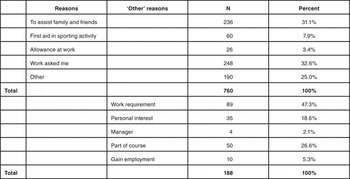
Motivation for participating in a first aid course are listed in Table 1. Assisting family and friends (236, 31.1%) along with being a pre-requisite for work (248, 32.6%) were the most common reasons provided. The responses for “other” reasons for participating in a first aid course were examined separately. Being a work requirement (89, 47.3%) was the most common, followed by being part of a course curriculum (50, 26.6%).
Reasons for doing a first aid course

Provision of First Aid at RTCs
The majority of the sample (688, 89%) had not provided first aid at a RTC. There were no differences in likelihood between females or males. Seventy-five percent of participants who provided first aid were travelling in a vehicle when they witnessed the RTC. There were no differences in the number of those providing first aid alone (33, 30.8%), and those providing first aid with others (34, 31.8%). One-quarter of the sample who were present at a RTC felt that first aid was “unnecessary”, and in 7.5% of cases, other people gave first aid.
Having used first aid at an accident scene in the last three years was associated with having a healthcare qualification (p < 0.001), level of education (p < 0.001), type of healthcare category (p < 0.001), and having trained in first aid (p < 0.001).
Respondents without any healthcare qualification were 80% less likely to have used first aid at an accident (OR = 0.2, 95% CI = 0.08–0.49, p < 0.001). Having trained for first aid and being in the 25–34 year age group compared to the 17–24 year age group increased the likelihood of having used first aid at an accident in the last three years (OR = 2.7, 95%CI = 1.1–6.5, p = 0.03) and (OR = 8.9, 95%CI = 1.1–71.4, p = 0.04) respectively, independent of gender and education.
Types of First Aid Treatment Provided at RTCs
Ensuring safety at the scene was most commonly listed type of care provided (85, 37.8%). Changing posture was an intervention provided by 33 (14.7%), and opening an airway was utilized by 12 (5.3%). Other treatments applied included controlling bleeding, (29, 12.9%), applying a dressing (16, 7.1%), helping breathing (9, 4%), stabilizing a fracture (8, 3.6%), and providing cardiopulmonary resuscitation (1, 0.4%).
When asked what type of first aid care they had given, respondents who selected the “Other” category in this question included the following: (1) comfort or reassurance (22, 64.7%); (2) an assessment of the patient (5, 14.7%); (3) treated for shock (4, 11.8%); and 8.8% (4) immobilization of the victim (3, 8.8%). Other first aid treatments mentioned included applying pressure bandages, providing water and blankets, calling for help, and supporting the patient as they died.
The total number of first aid methods applied at an accident in the last three years was associated with level of education (p = 0.02). There were no statistically significant independent predictors of the total number of methods applied at an accident during the last three years.
Opened an Airway—Having a healthcare qualification was associated with having opened an airway (p = 0.04). There were no statistically significant independent predictors of having opened an airway.
Maintained Safety—There was no statistical association between education, gender and having trained or not having trained in first aid and having maintained safety at an accident. There was an increase in odds of having maintained safety with increasing age (OR = 2.4, 95%CI = 1.2–5.1, p = 0.02).
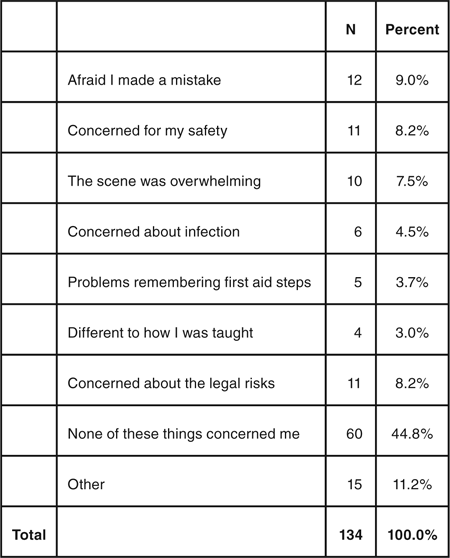
Concerns During or After Intervention—Participants were asked about their concerns either during or after they had intervened. Many participants (60, 44.8%) were not concerned after intervention. The principal concerns listed by participants were that they were afraid they had made a mistake (12, 9.0%), and equal concern for safety (11, 8.2%) and legal risks (11, 8.2%; Table 2).
During (of after) your intervention, did any of these things concern you?
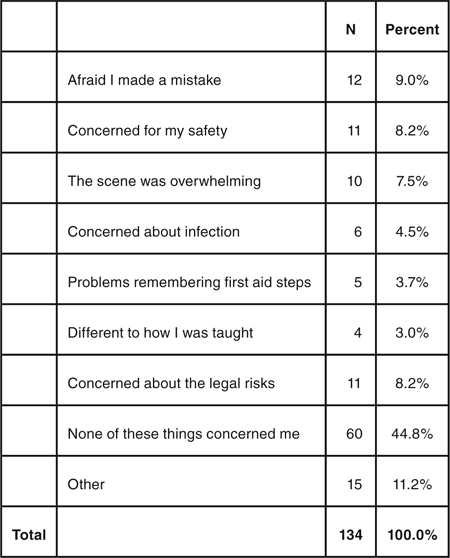
Concerns about the Scene Being Overwhelming—Subjects trained in first aid were 7.4 times less likely (p = 0.02) to be concerned about the scene being overwhelming. However, this association was not statistically significant after adjusting for age, sex, and level of education.
Concerns about Infection—Ten percent of those with a healthcare qualification were concerned about infection compared to none of the subjects who did not have a healthcare qualification (p = 0.04). Since all those concerned about infection were nurses, there also was an association with the type of healthcare qualification (p = 0.02). There were no other statistically significant associations with having concern about infection at a RTC. Determination of an odds ratio and significance value for healthcare qualification and healthcare categories were not possible due to all of the cases being in one category.
No Concerns after Intervention—Although there was no association between having no concerns at a RTC and the level of education of the subject (p = 0.17), in multivariate analysis, this association became statistically significant (OR = 0.55, 95%CI = 0.33–0.92, p = 0.02). Thus, subjects with higher levels of education were less likely to have had no concerns. In particular, postgraduate students were less likely to have no concerns at a first aid accident compared to subjects with only a high school education (OR = 0.13, 95%CI = 0.02–0.99, p = 0.049). In addition, females were less likely to have had no concerns compared to males (OR = 0.17, 95%,CI = 0.05–0.60, p = 0.006).
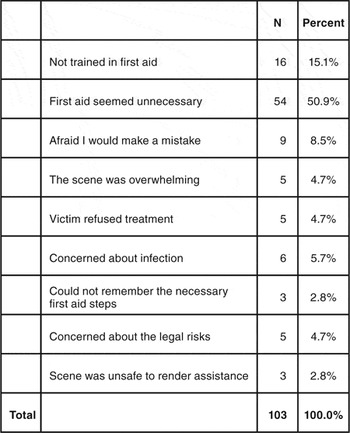
Reasons for Not Intervening—No statistically significant associations were found for the reasons that people chose not to intervene at the accident scene. Of those people who did not intervene 54 (50.9%) felt that first aid seemed unnecessary at the accident scene, and 16 (15.1%) did not intervene, as they were not trained in first aid. Other reasons for not intervening at the accident scene are listed in Table 3.
Reasons for not using first aid at the accident scene

Qualitative Data Analysis
Qualitative data were collated from the final question in the survey, which asked participants if there was anything they would like to share about their first aid experience. The data were analysed for recurring themes using the 14-step process described by Burnard.Reference Burnard8 The research team reads and re-reads the responses noting, headings, or key phrases, which are then grouped into sub-headings. Once all sub-headings are identified, similar headings are collapsed into key themes and each sub-heading is allocated to a theme. Each theme has been identified and some exemplars provided to assist in understanding the theme.
The four key themes identified in the thematic analysis were:
1 A sense of confidence;
2 Concern for self;
3 Being a first aider; and
4 Self esteem and being disregarded.
In addition, a fifth subject theme, “training and resources required”, which addresses the practical issues of first aid delivery and the need for compulsory first aid training also was reported.
Sense of Confidence—Some participants felt that having completed a first aid course gave them confidence to intervene. Similarly, participants stated that more recent first aid training resulted in greater levels of confidence.
125. First aid training has given me the confidence to render assistance when necessary.
406. Not using a skill regularly increases the likelihood of forgetting and of losing confidence with ability
Other participants in the study felt that rendering assistance at the scene of a RTC takes providers out of their comfort zone, leaving them fearful of making the situation worse.
487. I forgot everything I was taught and on reflection put myself and other road users at risk.
718. Being present at the scene of a major RTC took me right out of my comfort zone….situation demanded skills far above those of a first aid provider.
Overall, participants linked a level of confidence to having the skills necessary to treat victims and the amount of exposure to a scene where the provision of first aid was necessary.
Concern for Self—Participants also discussed the issue of concern for self, which was related to the potential for litigation and safety. The possible legal ramifications associated with providing first aid to a victim of a RTC were highlighted by a number of participants in the study.
103. I would also be concerned about the potential to be sued by a family member if I was unable to save someone, or they were left severely disabled, whether or not my intervention had contributed.
Infection was also described by participants as one of the concerns of intervening at a RTC.
351. I would be concerned these days about treating an injured person who was bleeding. … I would leave an accident site if a person was behaving violently and offer no assistance.
Being a First Aider—Assuming the role of first aider at the scene of a RTC raises several issues for responders. For example, first aiders may be apprehensive about giving first aid treatment, be ill prepared, and yet feel obligated to use their knowledge and to be of assistance.
248. I believe first aid training would improve my confidence in the event of being at the scene of a car accident —but at the same time I don’t really want the responsibility.
When I arrived at the scene there were around 10 bystanders all doing nothing. I am constantly amazed at…the number of people willing to stand around and watch the aftermath of an accident but not offer to assist.
Self-Esteem and Being Disregarded—Many of the participants found their experience of providing first aid distressing and concerning. The apparent lack of opportunity to debrief on victim outcomes, left many participants feeling helpless and upset.
613. There was no debriefing or support for the first aid assistant… It was an extremely traumatic experience and we were given no information … after we left the scene despite phoning and asking how the other victims were.
Some participants had negative feelings about their interaction with emergency crews.
218. ... total disregard by fire, police and ambulance officers to the assistance provided by witnesses before the arrival of the emergency staff.
Training and Resources Required—The potential for first aid training as a compulsory component of the drivers license, was identified as an issue.
805. Yes, I honestly believe first aid should be compulsory. As soon as you are able to have a drivers licence, you should also obtain a first aid certificate.
Previous studies have discussed the issues surrounding mandatory first aid training for all licence holders.5 This theme was strongly represented by the participants throughout the qualitative section of the survey with many feeling that the benefits of knowing basic first aid would outweigh the costs involved.
Discussion
It may be argued that healthcare professionals are more likely to respond to a health research survey. For this reason, the results are presented for healthcare professionals and lay people as separate cohorts, and the findings are discussed in relation to these different cohorts. It also may be argued that people who have attended a RTC and used first aid could have been more likely to respond to the survey. It has not been possible to determine the extent of this effect but it should be noted that the principal focus of this study has been to investigate the first aid interventions used and the factors affecting individuals who have used first aid.
In 2006, 13 people died on ACT roads.9 A primary goal of basic first aid is to maintain airway, breathing, and circulation until expert medical support can be provided. First aid is defined as any subsequent measures that are provided to people once the affected person has been protected from further injury and help has been summoned.Reference Larsson, Martensson and Alexanderson2 Oxer notes that following a RTC, the two factors most likely to kill are obstruction of the airway causing suffocation, and uncontrolled bleeding.Reference Oxer1 Realistically it is possible to provide the community with the skills to provide vital early intervention for victims of road trauma in order to reduce mortality and morbidity associated with RTC.
Hussain and Redmond found that 56.6% of the prehospital deaths that occurred in North Staffordshire (Great Britain), were due to RTCs.Reference Hussain and Redmond10 They studied the proportion of fatalities, both at the scene of accidents and before reaching the hospital, that were deemed to be preventable by early intervention. The results show that at least 60 people died before reaching the hospital, and that up to 85% of those 60 people probably died due to airway obstruction.Reference Hussain and Redmond10 Similarly, Khangure found that airway obstruction was a contributing factor in the death of 123 cases (6.9%) in Australia from 1990–1997.Reference Khangure11 It is argued that a significant proportion of pre-hospital deaths may be preventable with the application of simple first aid techniques, which can be taught to the lay community. Several studies report a low incidence of first aid intervention at RTC. Henriksson et al suggest that the absence of first aid intervention contributed to the death of 4% of traffic accident victims. Reference Henriksson, Ostrom and Eriksson12 Mabbott notes that 7% of deaths can be related to a lack of first aid and Ashour et al suggest that 4.5% of potential prehospital deaths may have been prevented with first aid intervention. Reference Mabbott3,Reference Ashour, Cameron, Bernard, Fitzgerald, Smith and Walker13
This research indicates that a substantial proportion of Australian road users have received training in first aid at some time in their lives (77%). The value and outcomes of first aid training programs were examined by Peterson and Russell who found that both immediately and six months after some type of first aid training, people are more likely to stop and provide assistance at a motor vehicle crash.Reference Peterson and Russell14 However, confidence and skill in applying first aid declines over time, and only 28% have a current first aid qualification. Level of confidence and fear of making a mistake are important in determining whether an individual will choose to intervene at the scene of a RTC.Reference Jelinek, Gennat, Celenza, O’Brien, Jacobs and Lynch15 Consequently, it is important that a higher proportion of road users are encouraged to undertake and maintain first aid training throughout their driving career. Notably the majority of people with a first aid qualification undertook their training to assist family and friends or as a prerequisite for work. There is potential for these positive motivating factors to be extended through public education campaigns so that people may be encouraged to support their community by becoming first aid qualified. In addition, because many first aiders have gained their qualification as a component of other education it may be possible to increase the proportion of educational or training programs that have first aid content, including through school education. A study by Mauritz et al in Germany highlighted that out of 2,812 trauma situations, a bystander assisted in 57% (1602) of cases. Reference Mauritz, Pelinka, Kaff, Segall and Fridrich16 Bystanders who assisted with first aid included police, relatives, friends, and strangers. Jelinek et al found that with more training and more knowledge of correct procedures, people were more likely to perform basic first aid.Reference Jelinek, Gennat, Celenza, O’Brien, Jacobs and Lynch15
It appears that people who have been exposed to first aid training have a greater level of awareness of the equipment that may be required, and are more likely to become involved in providing care. In addition, the results of this study suggest that life experience associated with age groups 25 years and older underpins greater confidence and an increased likelihood of intervening. For example, older participants were more likely to engage in activities such as ensuring scene safety and providing reassurance to the injured.
Of the skills utilised by people who intervene at a RTC, ensuring safety at the scene is the most common intervention. The true impact of this activity by bystanders is difficult to measure. However it is reasonable to conclude that the extent of mortality and morbidity associated with RTC is reduced by the application of simple measures aimed at ensuring the safety of the scene and casualties.
First aid interventions, including changing posture, opening an airway, and controlling bleeding were important interventions that have the potential to save lives. These three forms of intervention are easily taught to and applied by lay people, have a potential impact on survival, and appear to be commonly used interventions at RTCs. As Ashour et al found, a possible 4.5% of patients might have survived a traumatic RTC if the simple measures of preventing airway obstruction and controlling blood loss were assured.Reference Ashour, Cameron, Bernard, Fitzgerald, Smith and Walker13 In this study 14.7% of first aid interventions included changing posture, 5.3% included opening an airway and 12.9% controlled bleeding. Given that many RTCs are at low speed and involve only minor injury these rates are surprisingly high, and highlight the potential value of basic first aid training for drivers.
A significant proportion of the first aid care provided at the scene of RTC includes providing comfort and reassurance. These interventions were identified by participants as a valuable form of first aid care. While comfort and reassurance was not listed as a category within the questionnaire, participants commonly described this activity when asked about other types of treatment applied at a RTC. The relative importance of this activity is arguable though it may be concluded that reassurance plays a role in reducing the shock associated with injury, in improving patient vital signs, and on scene management by assisting emergency services to care for the majority of victims who may only have minor injuries. The potential role of this aspect of first aid at RTCs is worthy of further study.
Three key concerns about providing first aid listed by participants were, fear of making a mistake, concern for safety and concern about litigation. These factors have been identified previously and continue to be a cause for concern among those who volunteer to intervene at RTCs.Reference Mabbott3,Reference Jelinek, Gennat, Celenza, O’Brien, Jacobs and Lynch15,Reference Eisenburger and Safar17 Mabbott suggests that people do not render assistance at RTCs because of the perception of potential personal harm (such as contracting an infectious disease) and the perceived risk of litigation.Reference Mabbott3 In concurrence with Mabbott, Eisenburger and Safar note that fear of legal prosecution seems to make some bystanders and health professionals hesitate to act. Reference Eisenburger and Safar17 The fear and safety concerns of interveners also were explored by Jelinek et al who noted that a reluctance to intervene and provide first aid predominantly resulted from fear of health and safety risks such as infection. Reference Jelinek, Gennat, Celenza, O’Brien, Jacobs and Lynch15 First aid training for road users should address these issues and provide clear guidance about the legal protection applicable to members of the public intervening to provide care and strategies to ensure their safety. In addition, more flexible and accessible strategies for maintaining first aid knowledge are required. A further useful strategy may be the development of public information campaigns that help to alleviate these fears and encourage people to intervene.
Providing first aid in emergency situations may be overwhelming and traumatic. Encouraging more people to learn basic first aid and to intervene will rely to some extent on the development of improved strategies to provide support to those who have given first aid care at a RTC. This has been supported by other studies in which it is noted that debriefing was crucial.Reference Axelsson, Herlitz, Ekstrom and Holmberg18 Better post-intervention care for lay rescuers enables them to repeat a past endeavour and encourages others to learn and perform basic life support.Reference Axelsson, Herlitz, Karlsson, Lindqvist, Graves, Ekstrom and Holmberg19 Goniewicz explored the reasons people are not willing to intervene.Reference Goniewicz20 This study of 560 government drivers, found primarily psychological barriers. These included feelings of inadequacy; frequently expressed as a lack of the necessary first aid skills, due to poor quality training and/or poor skills transfer. Eisenburger et al also noted that psychological barriers impact on whether or not bystanders intervene. Reference Eisenburger and Safar17
Reactions to providing first aid at a RTC have been explored in some studies. Axelsson et al found that the emotional reactions of bystanders post-intervention were related to victim out-come and whether the victim lived or died.Reference Axelsson, Herlitz, Karlsson, Lindqvist, Graves, Ekstrom and Holmberg19 Emergency services and community healthcare agencies should collaborate to ensure that bystanders are provided with appropriate information and support. This task often is considered difficult and relegated as a lower priority. However, it seems that many people who intervene at RTCs would benefit from support, and that this may positively influence their peers.
Conclusions
This research highlights key issues in the delivery of first aid at RTCs. Given that emergency ambulance care is on average available 7–13 minutes after the initial call for assistance is received, the role and potential impact of immediate first aid care is significant. It is argued that mortality and morbidity associated with RTC can be improved by strategies that increase the likelihood that a first aid trained person will be in attendance and provide more appropriate support and information to those who intervene at RTCs during the crucial minutes before an ambulance arrives.
Abbreviations:
ACT = Australian Capital Territory
RTC = road traffic crash
Funded by the NRMA ACT Road Safety Trust, Canberra, Australia