Introduction
Yuzhniy Oleniy Ostrov on Lake Onega, Russia, is the largest known Late Mesolithic burial ground in northeast Europe (Fig. 1). Altogether 177 burials of men, women and children were recovered in the archaeological rescue excavations from 1936–38 (Gurina Reference Gurina1956; Jacobs Reference Jacobs1992; Ravdonikas Reference Ravdonikas1956; Yakimov Reference Yakimov1960). Most of the burials are relatively well preserved, containing human skeletal remains and a variety of grave goods, such as bone, antler, and stone tools, weapons and ornaments. Burial features seem relatively uniform throughout the cemetery. The grave materials from Yuzhniy Oleniy Ostrov are curated at the Peter the Great Museum of Anthropology and Ethnography (the Kunstkamera) in St Petersburg, Russia. Field records are not available, but descriptions of the excavations, burials and their finds can be found in an extensive monograph by Nina Nikolaevna Gurina (Reference Gurina1956). Gurina describes the find places for many artefact types in her drawings, but it is not possible to determine the location of every individual find. After Gurina, several other researchers investigated the materials; for example, from the perspectives of physical anthropology (Jacobs Reference Jacobs1995; Yakimov Reference Yakimov1960), social organization (Jacobs Reference Jacobs1992; Khlobistina Reference Khlobistina1978; O´Shea & Zvelebil Reference O´Shea and Zvelebil1984), chronology (Price & Jacobs Reference Price and Jacobs1990), genetics and aDNA (Der Sarkissian et al. Reference Der Sarkissian, Balanovsky, Brandt, Khartanovich and Buzhilova2013; Semenov & Bulat Reference Semenov and Bulat2016, 43), and animal remains found in the graves (Mannermaa Reference Mannermaa, Grünberg, Gramsch, Larsson, Orschiedt and Meller2016; Mannermaa et al. Reference Mannermaa, Panteleyev and Sablin2008; Reference Mannermaa, Gerasimov, Girya and Sablin2017; Reference Mannermaa, Rainio, Girya and Gerasimov2021; Reference Mannermaa, Rainio, Nygren, Girya and Gerasimovforthcoming). Recent results have confirmed that the deceased hunter-gatherers were buried over a relatively short period of time, c. 8200–8100 cal. bp (Schulting et al. Reference Schulting, Higham and Bronk Ramsey2018), and had heterogeneous genetic backgrounds (Der Sarkissian et al. Reference Der Sarkissian, Balanovsky, Brandt, Khartanovich and Buzhilova2013; Semenov & Bulat Reference Semenov and Bulat2016, 43). The use of the cemetery coincides precisely with a dramatic climatic downturn, known as the 8200 cal. bp Cold Event, that triggered changes in local cultural, social and economic practices in different parts of the northern hemisphere (Schulting et al. Reference Schulting, Higham and Bronk Ramsey2018; see also Manninen Reference Manninen2014).
Location of the Yuzhniy Oleniy Ostrov site on Lake Onega in northwest Russia.

The find material from Yuzhniy Oleniy Ostrov comprises approximately 6000 animal-tooth pendants: that is, grooved or perforated animal teeth extracted from the jaws. According to Gurina (Reference Gurina1956), 4372 of them are incisors of the Eurasian elk (Alces alces), 1155 are incisors of the Eurasian beaver (Castor fiber) and 170 are canines of the brown bear (Ursus arctos). Teeth of the domestic dog (Canis familiaris), grey wolf (Canis lupus), wild reindeer (Rangifer tarandus) and wild boar (Sus scrofa) are rare, but present. The tooth pendants have been found in at least in 96 separate burials, often in great numbers. The number of elk teeth varies from 0 to 303 per grave, whereas the beaver and bear teeth are somewhat rarer. In most graves, the tooth pendants appear side-by-side in tight rows, or in more scattered bunches, or in row-like formations on the skull, neck, arms, chest, pelvis, thighs, or feet of the deceased. Although the garments and possible suspension loops for pendants have decayed in the ground, it seems evident that these rows or formations were originally either fringes or edge-decorations on Mesolithic garments, or accessories. Similar animal-tooth pendants have been found in most Mesolithic and Neolithic cemeteries in Northern Europe, as well as in Upper Palaeolithic contexts to the south (e.g. Albrethsen & Brinch Petersen Reference Albrethsen and Brinch Petersen1976; Burenhult Reference Burenhult and Burenhult2002; Butrimas Reference Butrimas, Grünberg, Gramsch, Larsson, Orschiedt and Meller2016; Choyke Reference Choyke, Choyke and Bartosiewicz2001; d’Errico & Vanhaeren Reference d'Errico and Vanhaeren2002; Ismail-Weber Reference Ismail-Weber, Grünberg, Gramsch, Larsson, Orschiedt and Meller2016; Jaanits Reference Jaanits1957; Janzon Reference Janzon1974; Jonuks & Rannamäe Reference Jonuks, Rannamäe, Livarda, Madgwick, Riera and Mora2018; Larsson Reference Larsson1988; Reference Larsson2012; Poplin Reference Poplin1972; Stenberger Reference Stenberger1943; Trinkaus & Buzhilova Reference Trinkaus and Buzhilova2018; Vanhaeren & d’Errico Reference Vanhaeren and d'Errico2005; Zagorska & Lõugas Reference Zagorska, Lõugas, Lang and Kriiska2000; Zagorskis Reference Zagorskis2004). They comprise incisors or canines of the wild boar, Eurasian elk, red deer (Cervus elaphus), aurochs (Bos primigenius), red fox (Vulpes vulpes), grey wolf (Canis lupus), domestic dog, pine marten (Martes martes), different seals, and several other animals, in accordance with the local wildlife populations and known exchange networks. In these graves, the tooth pendants likewise appear in rows, row-like formations, or bunches that have been interpreted as the remains of bodily ornaments and garment decorations. Use-wear analysis of the perforated teeth from Zvejnieki, Latvia, indicates that some of these decorations were worn for a long time before their deposition in the graves, while others were fresh and intact (Larsson Reference Larsson, Larsson and Zagorska2006). In Šventoji, Lithuania, the perforated teeth were apparently worn on a daily basis (Osipowicz et al. Reference Osipowicz, Piličiauskiene, Orlowska and Piličiauskas2020). Our analysis of the wild boar and seal teeth from Ajvide, Sweden, brings out a pattern of pits and scratches on the tooth roots, suggesting that the pendants served as portable sound instruments or rattles, in addition to their decorative and possible symbolic functions (Rainio & Mannermaa Reference Rainio and Mannermaa2014).
In this article we will explore the animal-tooth pendants of Yuzhniy Oleniy Ostrov anew, and more closely than has been done since Gurina's (Reference Gurina1956) extensive work. Using a sample of pendants from several graves, we aim to define which animals and teeth were used to make these pendants and composite sets, in order to revise and possibly complete Gurina's earlier determinations. We also aim to track down all traces of manufacture and use that can provide information on how the pendants were modified, suspended, or carried; or, alternatively, whether they were left unused. Inspired by the wear patterns found on the Ajvide pendants, special attention is drawn to the potential function or use as rattles. The present article serves to test this hypothesis further by making use of a broader assemblage of material and an elaborated methodology, as well as different types of teeth. Identifying rattles in the Mesolithic archaeological record would be ground-breaking from the perspective of sound archaeology and the prehistory of music, as there has been no evidence of such instruments in the past. Identifying Mesolithic rattles, however, would not be especially surprising. According to several ethnomusicologists, strung rattles of shells, bones, teeth, hooves, or beaks can be considered to be among the earliest musical or sound instruments (Blades Reference Blades1970, 36–7; Sachs [1929] Reference Sachs1965, 8–9). These sound producers, suspended from the neck, arms, legs, or clothing, are found almost universally across the globe. They shake and collide during the bearer's movements, producing a rattling sound that is often used to highlight dancing. Among the natives of the Pacific Northwest and northern Canada, for example, rattling aprons, head-dresses, necklaces and mittens were used to accompany rituals and ceremonial dances (BM 2021; Krause [1885] Reference Krause and Gunther1956, 140, 168, 202; NMAI 2021; NMNH 2021; Ray Reference Ray1967, 27–8, 32–3). Among the Sámi in northern Fennoscandia, rattling bunches of bones, claws, teeth, metal rings and bells were used to accompany shamanic rituals and drumming (Itkonen Reference Itkonen1948, 336, 337, 351, 366; Leppäaho Reference Leppäaho1937, 140–41). In sound-archaeological research to date, traceological methods or approaches have been applied to the instrument categories of bone aerophones and lithophones (e.g. Kleinitz Reference Kleinitz and Zych2010; Lawson & d’Errico Reference Lawson, d'Errico, Hickmann, Kilmer and Eichmann2002).
Samples of Mesolithic and fresh animal teeth
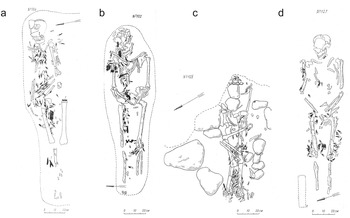
The animal-tooth pendants from Yuzhniy Oleniy Ostrov are largely curated in the archaeological collections of the Kunstkamera in St Petersburg. Our research material, comprising a sample of 100 so-called elk teeth, was selected from these collections, from four different graves. Initially, we aimed to sample graves that contained a large number of elk teeth in an accurately documented position on the body, as well as in an excellent state of surface preservation. Unfortunately, none of the graves in the cemetery met all these criteria, due to the rough excavation methods of the 1930s, the intensive sprinkling of ochre on the grave goods and general corrosion. As our main aim was to study traces of manufacture and use, we prioritized the surface preservation of the teeth, thereby leaving out several promising and informative find contexts, such as the tooth sets in extremely neat rows in graves 13, 64, 65 and 97 (cf. Gurina Reference Gurina1956, 188–94, figs. 98–108). In the selected graves 76a, 102, 125 and 127, the teeth are best preserved in Yuzhniy Oleniy Ostrov: moderately so for the roots, but excellently so for the crowns. However, the teeth in these graves were scattered in loose row-like formations or over a fairly large area, so that it is not possible to trace their exact position or original sequence on the body (Fig. 2). The find coordinates of individual specimens are also missing from the records. Grave 76a contains 140 elk teeth on the chest, waist, pelvis and right thigh of an adult male (Gurina Reference Gurina1956, appendix 1: 318, 322, fig. 39; Yakimov Reference Yakimov1960). Grave 102 contains 120 elk teeth on the right shoulder, chest, waist, pelvis, right thigh and left knee of an adult female (Gurina Reference Gurina1956, fig. 98, appendix 1: 341, fig. 51). Grave 125 is an exceptional tilted grave, where the deceased, an elderly male, is buried in a half-sitting position. During the post-depositional processes, the grave goods, among them 83 elk teeth, have shifted down to his lower limbs (Gurina Reference Gurina1956, appendix 1: 362, fig. 64; Yakimov Reference Yakimov1960). Grave 127 contains 90 elk teeth along the thighs and between the knees of an adult female, probably forming the remains of a decorative fringe on an apron (Gurina Reference Gurina1956, appendix 1: 362, fig. 65; Yakimov Reference Yakimov1960). In addition, a few elk teeth lie on her right humerus. From each of these graves, or rather the boxes storing their tooth finds, a sample of 25 teeth was selected at random, rejecting only badly broken fragmentary specimens. In a later phase, a couple of teeth turned out to have excessively glued or prepared surfaces and were excluded from the traceological analysis. Thus, the number of the analysed Mesolithic teeth was eventually 97.
Nina Gurina's (Reference Gurina1956: appendix 1: figs. 39, 51, 64, 65) drawings showing the location of the elk teeth (in black) in the Yuzhniy Oleniy Ostrov graves: (a) 76a; (b) 102; (c) 125; (d) 127.

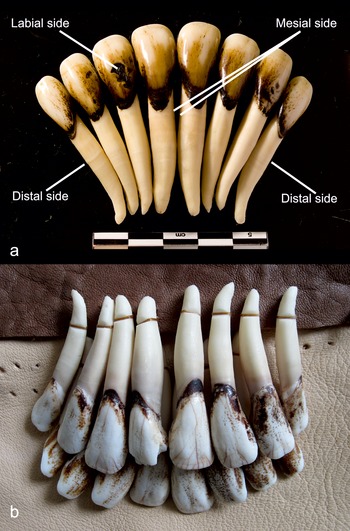
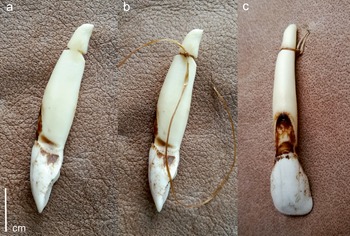
Reference material, comprising c. 180 fresh animal teeth, was purchased from licensed hunters in Finland and Russia and collected from the Finnish Museum of Natural History and the Zoological Institute of the Russian Academy of Sciences (Fig. 3a). Around 60 of these teeth were an anatomical match for the type of Mesolithic teeth under study here (Eurasian elk incisors); the rest of them were of different types, but represented the same species (Eurasian elk premolars and molars). The purchased jaws were boiled or decomposed in water before carefully extracting the teeth. At the next stage, some of the extracted teeth were worked into portable pendants using flint blades and modern needle files, and following the example of the groove types discovered on the Mesolithic teeth. The modern files were used to spare the worker's hands and time, as they appeared to produce the right type of grooves and had no influence on the macro- and micro-wear on the crowns, which is the main concern of our study. Even though the find contexts in Yuzhniy Oleniy Ostrov do not provide any detailed information about the suspension or lacing methods of the pendants, hypotheses about these were formulated and tested in practice. The purchased teeth were finally tied with artificial sinew string and hung in bunches and single and overlapping rows from leather patches (Figs. 3b, 4). These type models of the Mesolithic tooth sets, or ornamental rows, comprised altogether 160 teeth.
Reference material used in the study: (a) a set of eight incisors (from left to right, Incisor 4–1 dex, Incisor 1–4 sin) extracted from the lower jaw of the Eurasian elk (Alces alces). Incisor 4 can be also called canine; (b) two sets of Eurasian elk incisors (16 pieces) worked into pendants and suspended from a leather patch. Dental terms of direction indicated (see also Fig. 8b). (Photographs: Authors.)

Suspension methods of the experimental teeth step by step: (a) first, a root tip is grooved; (b) secondly, sinew string is twisted around the grooved root tip and knotted tightly; (c) thirdly, the sinew string is tied to the substratum. (Photographs: Authors.)

Osteological, traceological and experimental methods
Osteological analysis of the animal teeth from Yuzhniy Oleniy Ostrov was carried out at the Kunstkamera. All 100 teeth were identified with the help of the reference collection as to their species and tooth type. All first incisors (I1) were further investigated to give a rough age estimation of the individual, using the following five age groups: <1 year, 1–3 years, 4 years, 4–9 years and >10 years. The age estimations and groups are based on the method created by hunters for the occlusal wear of the first mandibular incisor of the Eurasian elk (Mannermaa et al. Reference Mannermaa, Rainio, Nygren, Girya and Gerasimovforthcoming; Partanen & Partanen Reference Partanen and Partanen1992). Technological and macro- and microwear analysis of the Yuzhniy Oleniy Ostrov teeth was carried out at the Experimental-Traceological Laboratory of the Institute for the History of Material Culture in St Petersburg. Traces and other details of the surface were observed with Olympus Metallographic BH2 microscopes with magnifications of up to 200×. The most interesting features and exemplary cases were photographed with macro lenses and a microscope camera. Prior to the analysis, we made preliminary observations about the teeth and their relevant traces to formulate an informative and, at the same time, functional documentation sheet. These observations indicated that the surfaces of the roots were often largely destroyed, while the crowns that were coated with enamel were full of discernible marks. In the proper analysis, the documentation sheet was filled out for every specimen with appropriate data, including contextual and osteological data as well as technological and macro- and microwear marks, recorded through drawings and textual descriptions for the four sides of the roots and crowns (Fig. 5). In the post-processing phase, the information on the sheets was summed up and tabulated.
Example of the documentation sheet used for the traceological analysis.

The fresh teeth of the reference collection were analysed microscopically using the same equipment. This comparative analysis was necessary for identifying possible natural traces on the crowns and differentiating them from the discovered manufacture and use-wear marks. In addition, the idea was to interpret the marks on the Mesolithic teeth by means of experiments with the reference material. To generate similar marks and patterns, a few of the fresh teeth were subjected to scraping, retouching and grinding, using flint and slate tools. Those turned into portable pendants were tied to the arms, hips and thighs of the researcher and worn on daily chores, including walking and light jumping, for a period of one month, two hours per day. The wearing experiment reached its climax with a ‘Stone Ageish Disco’, where 160 tooth pendants on the researcher were subjected to intensive dancing and jumping for a period of six hours. As part of the sound installation ‘Bone Garden’ at the New Performance Turku Festival in Turku, Finland (11 August 2015), the ‘Disco’ also served artistic purposes (see Carvalho et al. Reference Carvalho, La Frenais and Henttunen2016; Rainio et al. Reference Rainio, Mannermaa and Valkeapää2017). Moreover, it provided an opportunity to observe the movements of the suspended pendants and the sensorial experiences created by them, as well as the bodily and psychological responses to their functioning in the dancer herself. Thus, eventually, the research methodology included elements from somatic practices where a dialogue between the researcher and archaeological material is encouraged and intensified to create perceptual experiences and knowledge potentially shared from past human beings (Edgeworth Reference Edgeworth2012; Tuominen Reference Tuominen, Marila, Ahola, Mannermaa and Lavento2020).
Results
Osteological determinations
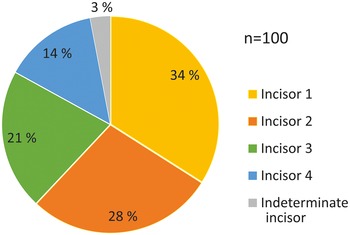
Osteological analysis indicates that all chosen Yuzhniy Oleniy Ostrov teeth are incisors of the Eurasian elk. All types of incisors (I1–4 or I1–3 and incisiform canine) from both the sinistral and dextral sides (sin/dex) appear to have been used for making the pendants, although there is a slight emphasis on the first and second incisors (I1–2), that is, the largest ones (Fig. 6). The third and fourth incisors (I3–4) were also used, but to a lesser extent. These smaller incisors have short and thin roots that might have been more difficult to groove. However, the differences in the distribution are relatively small, and most likely coincidental due to our small sample size and sampling technique, in which the teeth were selected from the store boxes at random.
Distribution of the Eurasian elk (Alces alces) incisor types in the research material from Yuzhniy Oleniy Ostrov.

The age distribution of the utilized elks shows some variance. The age profile varies a bit from grave to grave, but a general trend is that young adult individuals (age group 1–3 years) are well represented in all graves: 76a, 102, 125 and 127 (Fig. 7). On the other hand, very old individuals (age group >10 years) are also well represented in graves 125 and 127. All newly erupted permanent incisors have roots with thin walls and open root canals, as well as intact and unworn crowns. At the approximate age of four years, the occlusal parts of the crowns are so worn from chewing that the dentine is revealed, leaving dark brown stripes on the chewing surfaces. When the animal becomes older, more dentine is revealed and the dark stripe becomes broader. The root canals are also closed. Thus, the teeth of young and old elk have a different appearance and characteristics that might have been relevant to the makers of the pendants. For example, the open root canals of the young individuals might have created louder rattling sounds than the closed canals of the old individuals. However, the divided distribution in this sample does not allow for drawing any well-defined conclusions.
Age estimation of the Eurasian elk (Alces alces) incisors in the research material from Yuzhniy Oleniy Ostrov.

Traces of scraping, grooving and grinding
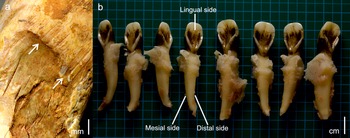
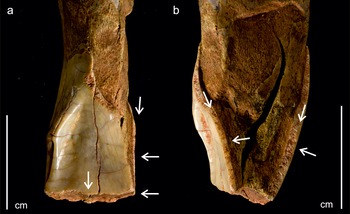
The use-wear analysis indicates that the roots of the Yuzhniy Oleniy Ostrov teeth were scraped. Ten per cent of the studied specimens show groups of longitudinal, mutually parallel striations or scratches along the root axis (Figs. 8a, 9). This trace type can be found in all studied graves: 76a, 102, 125, and 127 (Fig. 10). Taking into account that the root surfaces are only poorly preserved, these technological marks must originally have been fairly common. The scraping was probably performed with a lithic blade, to clean out the periodontal tissues that surrounded the root after it was extracted from the jawbone. Periodontal tissues were clearly observable when the teeth of the reference material were boiled and pulled out from their sockets (Fig. 8b).
Longitudinal striations (indicated by arrows) and periodontal tissues on the tooth root: (a) macrographic image of Incisor 2 dex from grave 102 (MAE 5716-443); (b) eight newly extracted teeth from the reference material. Dental terms of direction indicated (see also Fig. 3a). (Photographs: Authors.)

Incidence of the observed manufacture and macro- and microwear marks in the research material. Ground-1 = ground roots, Ground-2 = ground crowns.

Incidence of the observed manufacture and macro- and microwear marks per grave. Ground-1 = ground roots, Ground-2 = ground crowns.

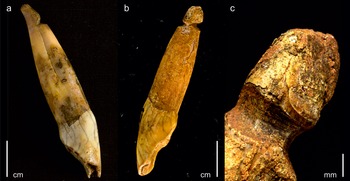
Practically all of the roots of the Yuzhniy Oleniy Ostrov teeth were grooved. Ninety-nine per cent of the studied specimens show distinctly cut grooves or furrows near the root tips (Figs. 9, 11). Cross-sections of the grooves vary from V to U and O, suggesting that the grooves were made with more-or-less blunt blades, or blades of varying material. The width of the grooves varies from 1 to 3 mm. In some specimens the grooves are found on the mesial or labial side of the root, in other specimens on both mesial and labial sides or labial and lingual sides. In some specimens the grooves run around the whole root tip, or most of it. Their depth (0.5–2 mm) depends on the thickness of the side used. An interesting feature is that one of these grooving styles or selection of sides appears to dominate per each individual studied grave, albeit the cross-sections vary all along the line. The dominance percentages in graves 76a, 102, 125 and 127 are 72, 96, 80 and 36 per cent, respectively. This suggests that the grooves were made somewhat systematically, possibly by one person using different tools. It also suggests that the teeth in these graves might have belonged to a single ornament, despite their large total number. The purpose of the grooves was undoubtedly to accommodate a suspension loop, and thus to turn the teeth into portable pendants. The string forming the loop must have been very thin, judging from the depth of the grooves. In a few cases, the presence of the loop is evidenced by a slight wear mark on the unworked side of the root tip. To ensure a firm grip, the string was probably wound around the root tip, perhaps a couple of times, and then knotted tightly.
Different type of grooves on the root tip: (a) single groove on the labial side of Incisor 1 sin from grave 127 (MAE 5716-612); (b) opposing grooves on the labial and lingual sides of Incisor 1 dex from grave 127 (MAE 5716-612); (c) macrographic image of an almost circular groove in Incisor 4 sin from grave 13 (MAE 5715-61: 55). (Photographs: Authors.)

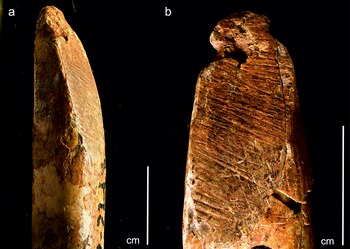
A handful of the Yuzhniy Oleniy Ostrov teeth were systematically abraded or ground. Six per cent of the studied specimens show rough parallel striations on the mesial sides of the root tips, which have become remarkably thin, almost pointed (Figs. 9, 12). All of these teeth come from the same grave, 127 (Fig. 10). All of them are provided with grooves, and one even shows an unfinished perforation. This perforation might provide an explanation for the grinding of the root tips, because similar abrasions are found in perforated Yuzhniy Oleniy Ostrov bear canines, where their purpose was obviously to facilitate drilling (Gurina Reference Gurina1956, 136, fig. 82). This would mean that a few elk teeth in grave 127 were originally meant to be drilled. An alternative explanation is that the roots were ground to attach the pendants more tightly together, as in a bundle, or possibly by gluing. Furthermore, 3 per cent of the studied specimens show parallel striations on different sides of the crown (Figs. 9, 13). These teeth (3 pcs) also come from grave 127 (Fig. 10). The abrasions form slight facets or flat areas on the crown surfaces, altering their form and size slightly. The purpose of the grinding, in this single isolated case, was perhaps to fit the pendants into a very tight composite set or row.
Ground surface with rough parallel striations on the mesial side of the root tip: (a–b) Incisor 1 sin from grave 127 (MAE 5716-612). (Photographs: Authors.)

Ground facets with parallel striations (indicated by arrows) on the mesial, distal and lingual sides of the crown: (a–b) macrographic images of Incisor 1 sin from grave 127 (MAE 5716-612). (Photographs: Authors.)

Traces of retouching and wearing
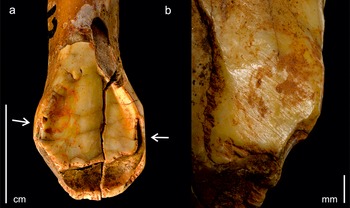
The macro- and microwear analysis indicates that the crowns of the Yuzhniy Oleniy Ostrov teeth are regularly broken or flaked. Twenty-two per cent of the studied specimens show sharp splits and chips on the margins of the crown, either on the mesial or distal side, or both of them, or on the chewing surface (Figs. 9, 14). In some cases, flaking is so intense that only a stub of the crown is left. This trace type occurs in all studied graves: 76a, 102, 125 and 127 (Fig. 10). Their origin is not straightforward to explain. In some cases, it appears as if the crowns had been retouched or modified on purpose, by sharp blows from above or underneath the teeth. Some of the crowns could also have been flaked accidentally, while wearing the pendants, judging from the more-or-less similar splits that sprang up in the experimental teeth (see below). Lastly, some of the chewing surfaces could have been worn through naturally, provided that the animals had very long lives. Either way, these traces are clearly of Mesolithic origin, because other type of wear marks can be observed on top of them (see below).
Flaked edges of the crown (indicated by arrows): (a–b) macrographic images of Incisor 1 dex from grave 127 (MAE 5716-612). (Photographs: Authors.)

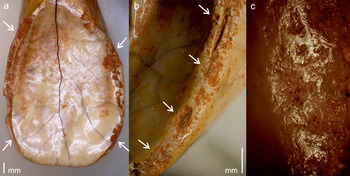
Almost all of the crowns of the Yuzhniy Oleniy Ostrov teeth are pitted or pecked, to use a term adopted from rock-art research. Seventy-nine per cent of the studied specimens show small pits, pecks, or craters on the margins of the crown, mostly on the round perimeters of the lingual side, but also on the labial side near the chewing surface (Figs. 9, 15). The number of the pits varies from separate clusters and symmetrical pairs of clusters to heavily worn whole perimeters. In cases where the perimeters are flaked, the pitted areas always appear on top of the flaked surfaces. This trace type is found in all studied graves, most abundantly in graves 102 and 127 (Fig. 10). The type has not been described in the traceological literature before. Pits like this must have been caused by percussive contact with some solid material, such as stone, hard wood, shell, bone, or enamel. Repetitive hits or impacts crumbled away portions of the enamel, especially along the round perimeters, where the enamel coat is at its weakest due to the presence of a seam. Similar hits on other parts of the enamel would not necessarily have caused any traces. The most logical candidates for this solid material are the other tooth pendants, which would have been shaken on their loops in the same set or row. The varying intensity of the wear patterns could reflect different uses of these ornaments or, perhaps, different suspension methods. Whatever the circumstances, it is certain that the flaking of the crowns happened first, then the pitting. Similar pitting could not be detected on the modern fresh elk teeth of the reference material.
Clusters of pits and craters (indicated by arrows) on the perimeters of the crown: (a) Incisor 2 dex from grave 102 (MAE 5716-443); (b) macrographic image of Incisor 1 dex from grave 76a (MAE 5716-321: 1004); (c) micrographic image (100x) of Incisor 1 sin from grave 127 (MAE 5716-612). (Photographs: Authors.)

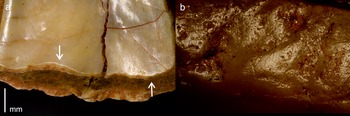
Almost all of the crowns of the Yuzhniy Oleniy Ostrov teeth are polished and rounded. Eighty-three per cent of the studied specimens show slight abrasion, rounded ridges and grids of diverging scratches on the surface of the pitted perimeters and flaked margins of the crown (Figs. 9, 16). These traces are found on top of the above-mentioned pits, craters and splits, and are visible because of them: intact parts of the enamel are intrinsically so smooth and polished that it is difficult to distinguish similar human-related wear in them. This trace type occurs in all pitted and flaked teeth, in all studied graves: 76a, 102, 125 and 127 (Fig. 10). The trace type can be regarded as general wear, associated with carrying and wearing the pendants. It is caused by sustained contact with some slightly abrasive, soft material, such as clothes or the skin of the bearer. The general wear on the crowns indicates that the vast majority of the studied pendants, if not all, were used before they were put into the graves. This carrying and wearing—or at least the demonstrable part of it—took place after the pendants were pitted and flaked. Carrying and wearing before the pitting or flaking did not necessarily leave recognizable traces on hard enamel.
Rounded edges (indicated by arrows) and diverging scratches on the perimeters of the crown: (a) macrographic image of Incisor 1 dex from grave 127 (MAE 5716-612); (b) micrographic image (200×) of Incisor 1 sin from grave 76a (MAE 5716-321). (Photographs: Authors.)

Manufacturing and wearing experiments
The experiments with the elk incisors of the reference material aid in understanding the formation of the marks found in the Yuzhniy Oleniy Ostrov teeth. First, scraping off periodontal tissues with a flint blade creates parallel scratches along the root axis, similar to those recorded on the Mesolithic teeth. Likewise, grinding the roots and crowns of the teeth against a sandstone or similar surface creates striated areas or facets, comparable to those on the Mesolithic teeth. The same treatment of the crown perimeters, however, does not produce any of the pitting types that were reported above. Nor does the abrading of the perimeters against a hide or other materials. Making a groove with a lithic tool appears to be a fairly simple and straightforward process, taking only a few minutes. The most useful sides of the root for grooving are the mesial and labial sides, with their convex contours. These sides were also preferred by Mesolithic makers. The thin mesial side enables the making of a shallow groove, whereas the thick labial side allows for a deep groove, also leaving space for another, securing groove on the opposing lingual side. Making a circular groove around the root tip is risky, because it makes the tip very thin and prone to breakage. All of these types of groove are able to accommodate a secure suspension loop. Even one groove on one side is good enough, provided that the groove is deep and the string thin and knotted tightly. A shallow groove can also work for a while, but the loop in this case can suddenly come out. The safest way to attach the string is to make a perforation, but that is a much more arduous process than grooving.
The wearing experiment provided insight into the functioning of the elk incisor pendants (Supplementary materials: Video). Suspension from the root tip enables the lower part of the pendant to move freely, to and from the side. In elk incisors, the lower part, comprising the root and the crown, is especially long and prone to moving. If the knotted tips are tied to the substratum tightly, the pendants move moderately and in a somewhat organized manner. If the knotted tips are tied to the substratum loosely, the pendants move a lot, and all around. The tying methods used in Yuzhniy Oleniy Ostrov are of course unknown to us, but the grave contexts might provide some clues to them: in graves such as 13, 25, 61, 95, 97 and 129, the teeth appear in extremely neat rows (Gurina Reference Gurina1956, figs. 103–105, 108, appendix 1: figs. 13, 66), while in the studied graves 76a, 102 and 127 they form scattered row-like clusters or bunches. However, taphonomic processes, among other things, might have influenced the location and sequence of the teeth. The moving pendants would hit and bounce off the substratum, leather, or clothes, as well as adjacent tooth pendants. The larger the movements, the more frequent the collisions between the teeth. The parts that collide are the most protruding parts of the pendants: the margins and perimeters of the crowns. The hits produce soft rattling sounds and wavering broadband fields of sound when the number of the pendants is larger. Even three or four pendants in short and tight strings are enough to create some rattle. The fields of sound follow each movement of the body part to which the pendants are tied. The most movable body parts, such as upper and lower limbs, produce the largest amount of sound, as well as the strongest sounds. By walking, stamping, jumping, or dancing it is possible to create steady sets of sounds, a so-called musical pulse (Supplementary materials: Sound sample).
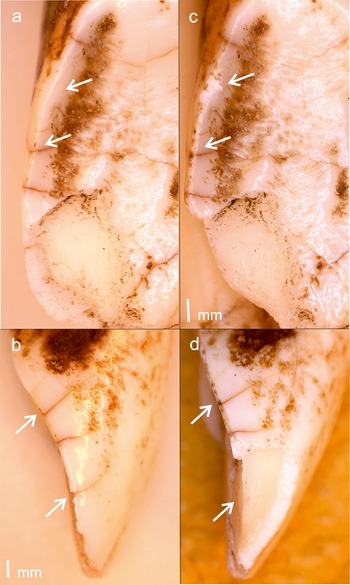
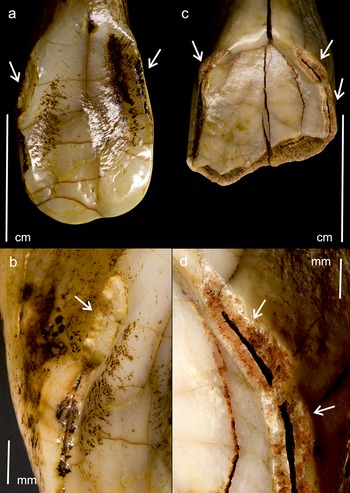
The macro- and microwear analysis of the elk-incisor pendants that went through the wearing experiment yielded interesting results. After wearing the 40 pendants on daily chores for a month (60 hours), and exercising by walking and light jumping to the rattling sound, there were no noticeable traces to be seen on the teeth (Figs. 17a, b). After dancing and jumping with them intensively for six hours, in the ‘Stone Ageish Disco’, at a frenetic tempo, the situation changed dramatically (Figs. 17c, d). Several pendants now showed sharp splits and chips on the margins of the crown, left by abrupt pieces that had flaked off and fallen out. More importantly, several pendants showed pits or craters on the perimeters of the lingual side, in separate clusters or symmetrical pairs of clusters around the enamel seam. It is obvious that they had emerged in the course of the “disco” due to the collisions with and strikes against the adjacent teeth. These traces resemble the pitting or pecking that was found in the Yuzhniy Oleniy Ostrov teeth, and they also occurred in exactly the same places (Fig. 18). However, the two findings are not identical: while the Mesolithic teeth received hits from one, more-or-less controlled direction, the experimental teeth received hits from all directions, in a seemingly uncontrolled way. These differences might be related to different methods for tying the pendants, either tightly or loosely, or the varying intensities of the bearers’ movements.
Experimental Incisor 2 sin: (a–b) before the ‘Stone Ageish Disco’ wearing experiment; (c–d) after six hours of jumping and dancing in the ‘Stone Ageish Disco’. Arrows indicate the transformed spots. (Photographs: Authors.)

Comparison of wear patterns on the perimeters of the crown: (a–b) experimental Incisor 2 sin after the ‘Stone Ageish Disco’; (c–d) Mesolithic Incisor 1 sin from grave 127 (MAE 5716-612). Arrows indicate the spots with pits and craters. (Photographs: Authors.)

Discussion
Technologies and uses of the tooth pendants
Our osteo-traceological approach to the elk-tooth pendants of Yuzhniy Oleniy Ostrov reveals rich new information on their manufacture and use. Firstly, it indicates that the hunter-gatherers using this burial ground made the tooth pendants from highly homogenous raw material. All of the pendants in our sample of 100 specimens were made from the teeth of the Eurasian elk, utilizing only incisors. This confirms Gurina's (Reference Gurina1956) earlier determinations and observations about the dominance of elk incisors in the grave materials. Although the distribution of different incisor types (I1–4 sin/dex) is not quite even, it seems probable that all eight incisors from one individual were used. This might have been important for either symbolic, economical, or ornamental reasons; for example, for building up coherent and compact sets. Maintaining an intact or unworn look of the crowns does not seem to have been important, because teeth of both young adult and very old individuals were used. However, a more extensive and systematic study is needed to understand better the possible preferences for certain tooth types and age groups of elks.
Secondly, almost all of the elk teeth in our sample were turned into pendants by making a groove in the root tip. The teeth in the same grave were often grooved in a uniform style, as if by one and the same person. However, the varying cross-sections of these grooves indicate that they were made with different tools on several occasions. Making a perforation to the root tip was tried perhaps once, but was left half-complete. Another explanation for the ground roots in grave 127 is that they were modified to fit better together with other pendants in tight sets or rows. The same explanation might also apply to the occasionally ground and retouched crowns. The processing of the teeth generally started with root scraping. The observed material and technological uniformity is rather exceptional within the Mesolithic and Neolithic cemeteries of Northern Europe, where graves and composite sets usually contain an array of teeth from several different species, as well as an array of different tooth types and working methods (e.g. Albrethsen & Brinch Petersen Reference Albrethsen and Brinch Petersen1976; Brinch Petersen Reference Brinch Petersen2015, 147–51, fig. 40: 5; Burenhult Reference Burenhult and Burenhult1997, 55–57; Reference Burenhult and Burenhult2002; Larsson Reference Larsson1988, 125–134; Reference Larsson, Larsson and Zagorska2006; Zagorska & Lõugas Reference Zagorska, Lõugas, Lang and Kriiska2000; Zagorskis Reference Zagorskis2004). The uniformity gives the impression that the tooth pendants at Yuzhniy Oleniy Ostrov were made under strict cultural rules or norms by a highly homogenous group of people. This parallels the new radiocarbon dates indicating a narrow time-frame for the use of the cemetery (Schulting et al. Reference Schulting, Higham and Bronk Ramsey2018), but contrasts with aDNA results suggesting multi-ethnic origins (Der Sarkissian et al. Reference Der Sarkissian, Balanovsky, Brandt, Khartanovich and Buzhilova2013; Semenov & Bulat Reference Semenov and Bulat2016, 43). Perhaps a common material culture, covering raw materials, techniques, personal ornaments, and even their sounds, was a way to moderate individuals’ varying origins and sustain group cohesion and a feeling of togetherness and unity (cf. Mannermaa et al. Reference Mannermaa, Rainio, Girya and Gerasimov2021).
Thirdly, our use-wear analysis indicates that the people in Yuzhniy Oleniy Ostrov did in fact carry the tooth pendants before depositing them in the graves. The pendants hung on their suspension loops and rubbed against the skin or clothing of the bearer until the crowns of the teeth became polished, rounded and scratched. This type of general wear does not emerge in an instant (cf. Choyke Reference Choyke, Barbiera, Choyke and Rasson2009, 36; Duffy et al. Reference Duffy, Duffy and Choyke2013 Larsson Reference Larsson, Larsson and Zagorska2006, 276). In addition, the crowns developed a characteristic wear pattern, called pitting or pecking, on the enamel seams. This pattern has not previously been reported in the traceological literature, which until now has mainly focused on the perforated roots and root tips of the animal teeth, where human-related traces are more easily distinguishable from natural traces (e.g. Larsson Reference Larsson, Larsson and Zagorska2006; Osipowicz et al. Reference Osipowicz, Piličiauskiene, Orlowska and Piličiauskas2020; Vanhaeren & d’Errico Reference Vanhaeren and d'Errico2005; see also Van Gijn Reference Van Gijn, Louwe Kooijmans and Jongste2006 & Reference Van Gijn, Bar-Yosef Mayer, Bonsall and Choyke2017 on pendants of other materials). Pits, or craters coming close to pitting, have been reported earlier on the roots of mammalian canines in the Neolithic site of Ajvide in Sweden (Rainio & Mannermaa Reference Rainio and Mannermaa2014). On the whole, the macro- and microwear on the Yuzhniy Oleniy Ostrov tooth pendants indicate that these artefacts were not solely grave gifts, made only for the funeral ritual and shortly before it. Nor were these pendants made from quite fresh teeth placed separately as gifts into the graves.
Sensorial experiences generated by the tooth pendants
Our active movement experiment, called the ‘Stone Ageish Disco’, produced a wear pattern that comes close to the Mesolithic pitting or pecking. In this experiment, 40 fresh elk incisors, among other teeth, were tied to the body parts of the dancer, where they hit and rattled against one another for six hours. Hence, the resulting pits and craters can be called traces of rattling. In a similar wearing experiment with less intense movements and softer sounds, these traces of rattling did not develop, even though the experiment lasted for c. 60 hours. This means that, in order to emerge, this trace type needs an intensive energy boost, like a dance or dance session, or alternatively a much longer rattling time than we could arrange. A short energy boost once in a while during the use of the pendants would explain the emergence of the pitting on the Yuzhniy Oleniy Ostrov teeth, whereas daily use—between these heated sessions—would account for the formation of the polish, rounding and scratches on the pitted surfaces. During the dance sessions the pendants clashed hard together, while in daily use they primarily touched the substratum. In both cases they created a rattling sound. It is difficult to make a more detailed assessment about the time needed for the creation of the Mesolithic traces. One such dance session would not have been enough, because the pitting on the Mesolithic teeth was more pervasive and penetrating than the wear we produced on the experimental teeth. Possibly some additional substance, such as sweat or pigment from the bearers’ clothing, was involved in amplifying the abrasive effect. Moreover, the development rate of the general wear on the pitted surfaces is not sufficiently understood. A somewhat swift rate would enable the development of polish, rounding and scratches in daily use—between the occasional dance sessions—whereas a very slow rate would indicate that the studied pendants had not been rattled intensively for a long time. Would that suggest that mainly fresh, recently made pendants were used for dancing, and that the well-worn pendants laid in graves had been used lately for only less motile, tardy activities? Or that the pendants at some point were removed from the rattle setups and rehung as less mobile ornaments on clothing? These would be questions for follow-ups with more extensive experiments. As the observed general wear is a very typical indicator of carrying and wearing, its development in connection with taphonomic processes seems improbable.
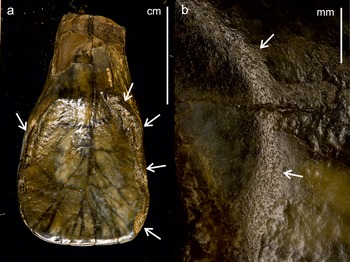
The Mesolithic pitting and traces of rattling are not identical with regard to microscopic details, such as the angle-of-arrival of the hits. The more random and uncontrolled angles on the experimental teeth might be explained by the relatively loose strings that fastened the pendants to the substratum. Either shorter strings or more complicated, tighter lacing methods might have created more consistent angles resembling those on the Mesolithic teeth. The strength and extent of the body movements or gestures might also have an effect on the angles. Either way, the impact traces on the Mesolithic teeth substantiate that the pendants were movable enough to hit something, that is, to sound and act as rattles. According to ethnographic records, the suspension methods for pendants are very diverse: from simple loops and strings to elaborate lacing and knotwork (Ho‘oulu Cambra Reference Ho‘oulu Cambra and Sadie1984a, Reference Ho‘oulu Cambra and Sadieb; Rainio & Tamboer Reference Rainio and Tamboer2018; Vang Petersen Reference Vang Petersen, Grünberg, Gramsch, Larsson, Orschiedt and Meller2016, figs. 11a, b). With the most secure methods, the pendants are fastened so carefully that they cannot move or rattle at all (Brinch Petersen Reference Brinch Petersen2015, fig. 41: 6; Vang Petersen Reference Vang Petersen, Grünberg, Gramsch, Larsson, Orschiedt and Meller2016, fig. 3). In the future, these varying suspension or attachment methods could be tested more systematically. In addition, further testing could be performed by using a machine to rub or strike a sample of fresh teeth against other teeth, antler, slate and flint, and under the influence of human sweat and ochre. Finally, tooth pendants from other Mesolithic burial and settlement sites, as well as tooth rattles from ethnographic collections, could be added to the research material. For example, it would be interesting to look for bits of broken or flaked elk teeth in the sediments of presumable ritual areas, to identify potential arenas for dancing. Our preliminary survey of an elk-tooth pendant from the Mesolithic layer of the Zamostie 2 site in the Moscow region of Russia showed clear pitting or pecking on the lingual surface around the enamel seams (Fig. 19). The morphology of the macro- and microrelief of these traces is identical to what we found in Yuzhniy Oleniy Ostrov. This one find, even if it is the only one so far, is striking evidence of the uniform behaviour associated with elk-tooth pendants in Mesolithic times across a very large span of Eastern Europe.
Clusters of pits and craters (indicated by arrows) on a Eurasian elk incisor from the Mesolithic layer of the Zamostie 2 site in the Moscow region, Russia: (a) general view; (b) macrographic image. (Photographs: Authors.)

Whether or not the actions produced traces, our experimental tooth sets created rattling sounds and fields of sound. Thus, the tooth pendants of Yuzhniy Oleniy Ostrov lead us onto the trail of the Mesolithic sound world and sound instruments, one of the oldest of their kind in Europe apart from Upper Palaeolithic bone flutes, whistles, or pipes, and possible rasps, rock gongs and bullroarers (Buisson Reference Buisson1990; Conard et al. Reference Conard, Malina and Münzel2009; De Angeli et al. Reference De Angeli, Both, Hagel, Holmes, Jiménez Pasalodos and Lund2018, 14–51; Morley Reference Morley2003, 32–69; Reference Morley2013, 32–129). The perforated shells from Middle Palaeolithic caves in Blombos, South Africa, or Skhul and Qafzeh in the Middle East, could represent the oldest known rattles (Garfinkel Reference Garfinkel2018; Vanhaeren et al. Reference Vanhaeren, d'Errico, Van Niekerk, Henshilwood and Erasmus2013). This type of instrument consisted of shells, teeth, bones, or hooves worn on dresses and as accessories, and could potentially have been common in prehistory, taking into consideration that the pendants or beads of these materials are frequent and numerous finds in Upper Palaeolithic, Mesolithic and Neolithic contexts (Garfinkel Reference Garfinkel2018; Lund Reference Lund1984; Rainio & Mannermaa Reference Rainio and Mannermaa2014; Shaham & Belfer-Cohen Reference Shaham, Belfer-Cohen, Choyke and Bar-Yosef Mayer2017). However, due to the decay of small but critical components, such as suspension loops, strings, or dentine surfaces, it is difficult to find hard evidence in support of this hypothesis. The traces discovered in this article serve as the first systematic attempt to rectify this situation: to prove that an auditory dimension resided within these artefacts, in addition to their decorative or symbolic meanings and functions. In the future, a similar traceological approach could be used to analyse traces on the possible rattle costumes from Sunghir, Russia, or Skateholm, Sweden (Larsson Reference Larsson1988; Trinkaus & Buzhilova Reference Trinkaus and Buzhilova2018), or on other presumed struck idiophone finds, such as the bone percussion plaques from Mezine, Ukraine, or lithophones and scraped idiophones from European cave and open-air sites (see Álvarez & Siemens Reference Álvarez, Siemens, Hickmann and Hughes1988; Henschen Nyman Reference Henschen Nyman, Hickmann and Hughes1988; Kossykh Reference Kossykh, De Angeli, Both, Hagel, Holmes, Jiménez Pasalodos and Lund2018; Morley Reference Morley2013, 109–21; Reznikoff Reference Reznikoff, Hickmann, Kilmer and Eichmann2002).
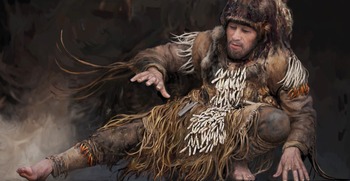
Moreover, the tooth pendants of Yuzhniy Oleniy Ostrov lead us onto the trail of Mesolithic body movements, gestures and dance. To produce sound with this type of bodily instrument, the player must move the body part from which the pendants are hanging. To produce a set of consecutive sounds, the player must perform a set of consecutive gestures or movements. While a steady set of sounds easily transforms into a regular musical pulse (cf. Morley Reference Morley2013, 243–53), the physical gestures and movements form a rhythmically organized whole that can be understood as dance. Thus, a form of embodied music and dance (cf. Leman & Maes Reference Leman and Maes2014) almost automatically arises from the playing technique of these instruments, one might say at their instigation (Fig. 20). During our experimental ‘Disco’, it indeed felt as if the tooth pendants were dictating the movements, pulse, and tempo as independent agents, instead of the dancer, who became a subservient follower of the rhythm, almost an outside observer of the actions. This feeling, mixed with accelerated heartbeat, respiration, rising blood pressure, sweat and exhaustion probably comes close to the feelings of depersonalization and dissociation from the body that are characteristic of dance trance and other altered states of mind (e.g. Hutson Reference Hutson2000; Lewis-Williams Reference Lewis-Williams2003, 167; Reynolds Reference Reynolds1998; see also Husain et al. Reference Husain, Thompson and Schellenberg2002; Needham Reference Needham1967). In contemporary neo-shamanic practices, rhythmic sounds of rattles are used to induce ecstatic trance (Goodman Reference Goodman1990). It is interesting to notice that in present-day hunter-gatherer communities all across the world, music and dance are inevitably and intimately linked together and practised by all members of the group or community, particularly during the most difficult subsistence seasons (Morley Reference Morley2013, 11–31). The abrupt climatic cooling experienced by the people using Yuzhniy Oleniy Ostrov might be seen as an analogous stress factor. According to ethnomusicologists and music psychologists, moving together rhythmically and following the same pulse tends to blur the self-awareness of the participants and evoke and sustain group cohesion, solidarity and a feeling of togetherness (McNeill Reference McNeill1995; Morley Reference Morley2013, 1–35, 243–53, 275–306; Szabó Reference Szabó, Aldridge and Fachner2006). As somewhat similar experiences can be gained in present-day discos and rave parties, our concept of the ‘Stone Ageish Disco’ might not be so far-fetched in the Mesolithic context, after all.
Adult male from grave 76a drawn as if he were alive during a dance session: 140 elk teeth on the chest, waist, pelvis and thighs rattle rhythmically and loudly. (Drawing: Tom Björklund.)

Conclusion
In this article we have examined animal-tooth pendants from Yuzhniy Oleniy Ostrov to obtain new information on the manufacture and use of these composite bodily ornaments. Our osteological analysis indicates that only the incisors of the Eurasian elk were chosen for making these pendants. No particular pattern was observed concerning different incisor types or the age of the animals. The traceological analysis indicates that all of the incisors were fashioned into pendants by grooving the root tips. No perforations were made. The various manufacturing techniques utilized include scraping, grinding and the retouching of the roots and the crowns. Traces of wear are extremely common, consisting of general wear and distinctive pits or pecks on the crown perimeters. These traces indicate that the pendants were not only grave gifts, but were also carried extensively and worn in contact with soft and solid materials. The pattern of pits or pecks, suggesting an impact contact with solid material, is the most important finding of our study. In the wearing experiment, a similar type of pattern emerged when the pendants of fresh elk teeth were hung in rows and bunches and struck against one another. Although the microscopical details of these two patterns are not identical, collisions between adjacent tooth pendants are the most logical and plausible explanation for the pitting on the Mesolithic teeth. These collisions also created a rattling sound. Thus, the elk incisors of Yuzhniy Oleniy Ostrov appear to bear evidence of previously unexplored sonic experiences of Mesolithic hunter-gatherers, also providing insight into the early history of embodied music and dance activities, as well as the instrument category of rattles.
Supplementary materials
Video: 94 Eurasian elk teeth sewn on an apron hit and bounce off the substratum and adjacent tooth pendants as the bearer moves, first at real speed, then in slow motion (–75%). Video by Julia Shpinitskaya: https://youtu.be/K-EE9YY6pHY
Sound sample: 160 animal-tooth pendants rattle on the arms, hips and thighs of the performer. Excerpt from the sound installation ‘Bone Garden’ at the New Performance Turku Festival (11 August 2015): https://youtu.be/gRpxQOx9ugs