1. Introduction
The end-Ordovician glaciation profoundly influenced the biogeographic distribution of shelly fauna mainly based on latitudinal differences, as shown by time equivalence of brachiopods of the tropical Edgewood province with those of the higher-latitude Kosov and Bani provinces (e.g. Rong & Harper, Reference Rong and Harper1988; Cocks & Fortey, Reference Cocks and Fortey2002; Harper et al. Reference Harper, Rasmussen, Liljeroth, Blodgett, Candela, Jin, Percival, Rong, Villas, Zhan, Harper and Servais2013; Harper, Hammarlund & Rasmussen, Reference Harper, Hammarlund and Rasmussen2014; Candela, Reference Candela2015).
In South China, where the Global Boundary Stratotype Section and Point (GSSP) for the Hirnantian Stage is located (Chen et al. Reference Chen, Rong, Fan, Zhan, Mitchell, Harper, Melchin, Peng, Finney and Wang2006), reliable records of postglacial carbonates and shelly faunas immediately following the Hirnantian glaciation were lacking (e.g. Rong & Zhan, Reference Rong, Zhan, Rong and Fang2004) until the recent recognition of postglacial shallow-water coral faunas ranging from late Hirnantian to mid-Rhuddanian age in the Upper Yangtze Region (Wang et al. Reference Wang, Zhan, Percival, Huang, Li and Wu2015; Wang, Zhan & Percival, Reference Wang, Zhan and Percival2016). That has permitted the establishment of a complete succession of coral faunas through the Ordovician–Silurian transition in this region, thus contributing to the high resolution of Hirnantian stratigraphy regionally and globally.
The aim of the present paper (which is adapted from the doctoral thesis of the senior author: Wang, Reference Wang2014) is to document the coral faunal succession through this critical interval in South China and to discuss global implications of this discovery for carbonate stratigraphy and macroevolution. We demonstrate the existence of three successive phases of response by the coral fauna to the Hirnantian glaciation: an adaptive phase, followed by an early survival phase and finally a late survival phase that persisted into the early Silurian. We review the concept and global occurrences of the Edgewood fauna, and propose that this fauna is probably associated with the late Hirnantian postglacial stage rather than being coeval with other two older faunas of early–middle Hirnantian age. This leads to a new interpretation of macroevolutionary processes across the Ordovician–Silurian transition. Our concepts of glacial and postglacial intervals comprising the end-Ordovician glaciation follow Wang, Zhan & Percival (Reference Wang, Zhan and Percival2016).
2. Coral faunal turnover through Ordovician–Silurian transition in South China
Corals spanning the latest Ordovician to the earliest Silurian interval were studied at many localities in northern Guizhou, South China, which are grouped into four different areas labelled A, B, C and D in Figure 1. Previous research into the Hirnantian GSSP conducted in this region has established a robust stratigraphic framework across the Ordovician–Silurian transition, providing a solid foundation on which to assess the turnover of major marine faunas through this interval (Fig. 2). Three successive coral faunas, respectively representing an adaptive phase during the glaciation, a short-lived early survival phase (restricted to immediately following the glaciation), and a late survival phase related to the continuing postglacial episode, are differentiated herein (Figs 2–4).
Studied Ordovician–Silurian boundary sections yielding corals in northern and northeastern Guizhou, SW China (palaeogeographically located in the southern part of the Upper Yangtze Platform, South China palaeoplate). Area A: Kuanyinchiao Formation yielding Hirnantia brachiopod fauna and corals in its lower and middle parts, and early survival phase corals in its top part (Wang, Zhan & Percival, Reference Wang, Zhan and Percival2016). Area B: Kuanyinchiao Formation containing only early survival phase corals (Wang, Zhan & Percival, Reference Wang, Zhan and Percival2016). Area C: distribution of the Shiqian Formation (uppermost Hirnantian) (Wang et al. Reference Wang, Zhan, Percival, Huang, Li and Wu2015). Area D: distribution of the Wulipo Bed (middle Rhuddanian). Hollow triangles represent the detailed sites of our studied sections. Thick dashed line indicates the possible palaeoshoreline during the Ordovician–Silurian transition while the area coloured in light yellow indicates the Cathaysian Oldland and its northern part on the Upper Yangtze Platform (modified from Rong et al. Reference Rong, Chen, Wang, Zhan, Liu, Huang, Tang, Wu and Wang2011).

Coral occurrences and faunal turnover across the Ordovician–Silurian transition in the Upper Yangtze Region, South China. The correlation chart is based on Wang et al. (Reference Wang, Zhan, Percival, Huang, Li and Wu2015) and Wang, Zhan & Percival (Reference Wang, Zhan and Percival2016). Abbreviations: 1 – adaptive phase coral fauna; 2 – early survival phase coral fauna; 3 – range of the late survival coral fauna recognized in South China.

Taxonomic list of the three successive coral faunas across the Ordovician and Silurian transition in the study areas, based on He, Chen & Xiao (Reference He, Chen and Xiao2007), Wang (Reference Wang2014) and Wang & Zhan (Reference Wang, Zhan, Zhan and Huang2014, Reference Wang and Zhan2015).

Representative corals of distinct coral faunas across the Ordovician–Silurian transition on the Upper Yangtze Platform in South China. Note that those corals of the Edgewood coral fauna illustrated here are from the middle Rhuddanian Wulipo Bed. See Figure 2 for explanations of phases 1–3. Abbreviations: Lamb. = Lambeophyllum?, Para. = Paramplexoides.

2.a. The adaptive phase coral fauna
The coral fauna occurring in the lower and middle Kuanyinchiao Formation in area A (Figs 1–3) lacks tabulates and is dominated by solitary streptelasmatid rugosans (He, Chen & Xiao, Reference He, Chen and Xiao2007) (Figs 3, 4). This fauna is of early–middle Hirnantian age and hence coincident with the glaciation, because it overlies the Metabolograptus extraordinarius graptolite Biozone (lower Hirnantian) and underlies the M. persculptus graptolite Biozone (upper Hirnantian) (Rong & Li, Reference Rong and Li1999). It is also associated with the typical Hirnantia shelly fauna, which has been regarded as inhabiting cool-water environments related to the glaciation. Considering the water temperature, the coral diversity seems surprisingly high, with more than 15 genera present (Fig. 3). Hence we interpret this coral fauna as comprising the adaptive phase. It is similar to, but not identical with, the Borenshult coral fauna, well known from central and south-central Sweden (Neuman, Reference Neuman1969, Reference Neuman1975), which is characterized by the development of solitary streptelasmatids associated with rare tabulates.
2.b. The early survival phase coral fauna
The early survival phase coral fauna occurs near the top of the Kuanyinchiao Formation in area A and throughout the entire Kuanyinchiao Formation in area B (Figs 1–3). Its dominant constituents are the rugosans Lambeophyllum? and Paramplexoides (Figs 3, 4), the former being a much older genus common in the upper Sandbian (Upper Ordovician) of Laurentia, whereas Paramplexoides is usually reported from rocks of Silurian age in low-latitude regions, such as North China (Gao, Reference Gao, Zhu, Zheng and He1987), South China (e.g. He & Chen, Reference He and Chen1999), Anticosti Island (McLean & Copper, Reference McLean and Copper2013) and Australia (McLean, Reference McLean1974). Lambeophyllum?, along with its typical associates Favistina and Palaeophyllum, indicates a warm-water environment (Webby, Reference Webby, Webby and Laurie1992). This fauna is completely distinct from the underlying cool-water coral fauna, and its stratigraphic position indicates that it succeeds the glaciation episode (Wang, Zhan & Percival, Reference Wang, Zhan and Percival2016). With its restricted composition of just two to three rugose genera (Fig. 3), we interpret this fauna to represent the early survival phase.
2.c. The late survival phase coral fauna
Another coral assemblage occurs in the topmost Hirnantian to the lowest Silurian Shiqian Formation in area C and in the middle Rhuddanian Wulipo Bed in area D (Figs 1–3). Both occurrences contain rugosans closely resembling Streptelasma subregulare and tabulates including Paleofavosites, Halysites and Propora (Wang, Reference Wang2014; Wang et al. Reference Wang, Zhan, Deng and Yu2014; Wang & Zhan, Reference Wang and Zhan2015) (Figs 3, 4). This fauna is very similar (even at species level) to the low-diversity Edgewood coral fauna of the central-eastern USA, characterized by rugosans overwhelmingly dominated by Streptelasma subregulare and tabulates including Paleofavosites subelongus, Halysites alexandricus and Propora thebesensis (Elias & Young, Reference Elias, Young, Webby and Laurie1992; Elias et al. Reference Elias, Young, Lee, Bae, Harper and Servais2013a ). Our interpretation of the coral fauna in South China as comprising a late survival phase is based on the reappearance of tabulate corals. Compared to the preceding early survival phase, diversity in this phase increases considerably, up to four rugosans (commonly one predominant, the others rare or absent) and four to five tabulates for each locality (Fig. 3). Furthermore, all taxa that occur in this late survival phase continue into younger Silurian strata where diversity returns to levels of the preglacial Late Ordovician.
3. Hirnantian biostratigraphy in South China
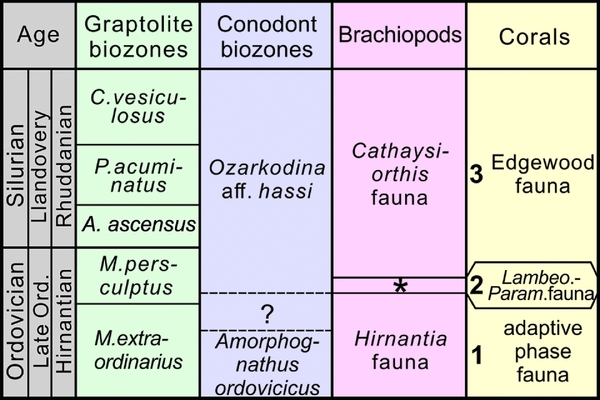
Coral faunal turnover across the Ordovician–Silurian transition in South China is highly consistent with trends displayed by the brachiopod fauna, with similarly robust biostratigraphic control provided by graptolites and conodonts (Fig. 5). Specifically, the adaptive phase coral fauna co-occurs with the typical Hirnantia brachiopod fauna (He, Chen & Xiao, Reference He, Chen and Xiao2007). The early survival phase of the coral fauna coincides with the appearance of the Dalmanella testudinaria–Dorytreta longicrura brachiopod community (Rong & Li, Reference Rong and Li1999), which was originally interpreted as a variant of the Hirnantia fauna. The late survival coral fauna correlates with the Cathaysiorthis brachiopod fauna (Rong et al. Reference Rong, Huang, Zhan and Harper2013) and the Ozarkodina aff. hassi conodont Biozone (Wang & Aldridge, Reference Wang and Aldridge2010; Wang et al. Reference Wang, Zhan, Percival, Huang, Li and Wu2015).
Correlation of faunal successions of graptolites, conodonts, brachiopods and corals across the Ordovician–Silurian transition in South China. Conodont zonation is based on a compilation of available data (Chen et al. Reference Chen, Rong, Mitchell, Harper, Fan, Zhan, Zhang, Li and Wang2000; Wang & Aldridge, Reference Wang and Aldridge2010; Wang et al. Reference Wang, Zhan, Percival, Huang, Li and Wu2015). Brachiopod succession is based on Rong & Li (Reference Rong and Li1999) and Rong et al. (Reference Rong, Huang, Zhan and Harper2013), with the asterisk indicating the horizon of the Dalmanella testudinaria–Dorytreta longicrura brachiopod community. See Figure 2 for explanations of phases 1–3.

4. Discussion regarding the Edgewood fauna
While the distinctive Edgewood fauna is well known and widely recognized, its exact age and relationship with the famous Hirnantia fauna and Hirnantian glaciation is still uncertain; furthermore, related concepts (e.g. Edgewood faunal province of some authors) have been used in many different ways by various researchers, and require investigation and definition.
4.a. Review of the concepts related to the Edgewood fauna
The idea of an Edgewood fossil assemblage was originally proposed by Savage (Reference Savage1916, Reference Savage1918), referring to a fauna dominated by brachiopods from limestone in the Edgewood Formation (now Edgewood Group) in the central-eastern USA. Subsequent usage of the terminology is largely dependent on whether corals or brachiopods were under study. Amsden (Reference Amsden1974) referred to the Edgewood fauna of brachiopods from Oklahoma, Illinois and Missouri, and restricted its age to the Late Ordovician. Rong & Harper (Reference Rong and Harper1988), in a global review of the Hirnantia fauna, discussed brachiopods from the Lower Edgewood fauna as part of the North American Midcontinent fauna. Significantly, they found that the Lower Edgewood fauna did not contain true Hirnantia, but nevertheless retained a probable latest Ordovician (Hirnantian) age for these Laurentian assemblages. Most recently, Harper et al. (Reference Harper, Rasmussen, Liljeroth, Blodgett, Candela, Jin, Percival, Rong, Villas, Zhan, Harper and Servais2013) defined a widely distributed Edgewood Province of Hirnantian age for rhynchonelliformean brachiopods, extending over much of Laurentia (including the Williston Basin of Manitoba, Canada), to Kolyma of Russia (Koren & Sobolevskaya, Reference Koren and Sobolevskaya2008), Siberia, Tarim and several Kazakh terranes. Coral workers (e.g. Elias, Reference Elias1982; Elias et al. Reference Elias, Young, Lee, Bae, Harper and Servais2013a ) also identified an Edgewood Province as a biogeographic unit, but much more restricted in extent comparable with the original concept of Amsden (Reference Amsden1974), containing an Edgewood coral assemblage (Elias & Young, Reference Elias, Young, Webby and Laurie1992, Reference Elias and Young1998). Coral faunas resembling the Edgewood fauna, from the Williston Basin of Manitoba, Canada (Elias et al. Reference Elias, Young, Stewart, Demski, Porter, Lukie, Nowlan and Dobrzanski2013b ; Demski et al. Reference Demski, Wheadon, Stewart, Elias, Young, Nowlan and Dobrzanski2015), probably belong to the Edgewood Province sensu Elias et al. (Reference Elias, Young, Lee, Bae, Harper and Servais2013a ).
4.b. The age of the Edgewood fauna and its relationship with the Hirnantia fauna
Owing to the lack of biostratigraphically key fossils (e.g. graptolites), the age of the Edgewood fauna has always been imprecise and variable, for example, assigned by some authors to the Hirnantian (Amsden, Reference Amsden1974; Amsden & Barrick, Reference Amsden and Barrick1986; Rong & Harper, Reference Rong and Harper1988; Harper et al. Reference Harper, Rasmussen, Liljeroth, Blodgett, Candela, Jin, Percival, Rong, Villas, Zhan, Harper and Servais2013; Bergström et al. Reference Bergström, Eriksson, Young, Ahlberg and Schmitz2014), and by others to the Ordovician–Silurian transition interval (Elias & Young, Reference Elias, Young, Webby and Laurie1992; Loydell et al. Reference Loydell, Mallett, Mikulic, Kluessendorf and Norby2002; Butcher, Mikulic & Kluessendorf, Reference Butcher, Mikulic and Kluessendorf2010). For the same reason, its relationship with the Hirnantia fauna, and thus, more importantly, with the major Hirnantian glaciation, is still ambiguous, although the Edgewood fauna has been widely considered to be generally coeval with the Hirnantia fauna, forming the component fauna of one of the three biogeographic units recognized during the Hirnantian Stage in terms of brachiopods (e.g. Rong & Harper, Reference Rong and Harper1988; Cocks & Fortey, Reference Cocks and Fortey2002; Harper & Rong, Reference Harper and Rong2008; Harper, Hammarlund & Rasmussen, Reference Harper, Hammarlund and Rasmussen2014; Candela, Reference Candela2015).
Our study provides some insights into solving these problems. In South China, corals equivalent to the typical Edgewood fauna clearly occur above the Hirnantia fauna and are therefore interpreted as representing a postglacial fauna after the second pulse of the end-Ordovician mass extinction. Moreover, the range of corals from late Hirnantian to middle Rhuddanian suggests that the Edgewood fauna probably extends across the Ordovician–Silurian boundary rather than being restricted to the Hirnantian as previously thought. Other data supporting this interpretation include:
-
(1) The Ozarkodina hassi conodont Biozone has recently been recognized from rocks containing the Edgewood fauna in the central-eastern USA (Bergström, Kleffner & Schmitz, Reference Bergström, Kleffner and Schmitz2012; Bergström et al. Reference Bergström, Eriksson, Young, Ahlberg and Schmitz2014) and the Williston and Hudson Bay basins of Manitoba (Demski et al. Reference Demski, Wheadon, Stewart, Elias, Young, Nowlan and Dobrzanski2015). This biozone ranges from late Hirnantian to Rhuddanian (Zhang & Barnes, Reference Zhang and Barnes2002; Bergström et al. Reference Bergström, Eriksson, Young, Ahlberg and Schmitz2014).
-
(2) The brachiopods of the Edgewood fauna of Laurentia have been considered as coeval with the Hirnantia fauna (early to middle Hirnantian), representing a separate biogeographic province (Rong & Harper, Reference Rong and Harper1988). However, there is a case where brachiopods assigned to the Edgewood fauna occur stratigraphically above the Hirnantia fauna, in the Oslo region of Norway (Brenchley & Cocks, Reference Brenchley and Cocks1982; Owen, Harper & Rong, Reference Owen, Harper, Rong, Barnes and Williams1991). Since the typical Hirnantia fauna has been documented in many subtropical or tropical regions (Cocks & Fortey, Reference Cocks and Fortey2002; Cocks & Cooper, Reference Cocks and Cooper2004), a more reasonable explanation for the differences between these two faunas may be stratigraphic separation rather than latitudinal variation (Rong & Harper, Reference Rong and Harper1988) or physical isolation (Cocks & Fortey, Reference Cocks and Fortey2002).
-
(3) Recent chemostratigraphic data show that the horizons containing the Edgewood fauna correspond to the decreasing limb of the Hirnantian Isotope Carbon Excursion (HICE) (Bergström, Saltzman & Schmitz, Reference Bergström, Saltzman and Schmitz2006; Koren & Sobolevskaya, Reference Koren and Sobolevskaya2008; Bergström, Kleffner & Schmitz, Reference Bergström, Kleffner and Schmitz2012; Demski et al. Reference Demski, Wheadon, Stewart, Elias, Young, Nowlan and Dobrzanski2015). Age control of these strata is provided by the co-occurrence of the O. hassi conodont Biozone and the M. persculptus graptolite Biozone (Bergström et al. Reference Bergström, Eriksson, Young, Ahlberg and Schmitz2014). This indicates a latest Hirnantian or younger age for this fauna, which is also in good agreement with our deduction that it might represent a postglacial fauna after the second pulse of the end-Ordovician mass extinction.
-
(4) Many rocks yielding the Edgewood fauna are oolitic or else show other indications of deposition in a warm-water environment (e.g. Amsden, Reference Amsden1974; Elias et al. Reference Elias, Young, Lee, Bae, Harper and Servais2013a ), which is also consistent with our conclusion.
-
(5) Such an age assignment also provides a more logical explanation for the fact that there is a remarkable stratigraphic hiatus beneath the Edgewood fauna in Laurentia, which coincides precisely with the regression related to the early–middle Hirnantian glaciation.
5. Implications for the influence of Hirnantian glaciation
The new correlation scheme we recognize between South China and carbonate platforms in low latitudes (such as Laurentia) is consistent with that of the Gondwanan glacial areas where an atypical Hirnantia fauna occurs in the glacial marine sediments that underlie the M. persculptus graptolite Biozone (Sutcliffe et al. Reference Sutcliffe, Harper, Salem, Whittington and Craig2001; Delabroye & Vecoli, Reference Delabroye and Vecoli2010). This facilitates an alternative interpretation of the relationship between the bio-events and the Hirnantian glaciation (Fig. 6), as briefly outlined below.
Possible relationships between the bio-events and glaciation through the Ordovician–Silurian transition.

The Hirnantia fauna, which developed following the first pulse of the end-Ordovician mass extinction near the beginning of the Hirnantian stage, probably is ubiquitous from high to low latitudes in cold/cool water settings. The Edgewood fauna, which was widely accepted as being coeval with the former, actually did not occur until the commencement of deglaciation.
Subsequent global warming and sea-level rise during the late Hirnantian (latest Ordovician) coincided with the second pulse of the extinction event during which the Hirnantia fauna almost completely disappeared, possibly only surviving in one case into the earliest Silurian (Harper & Williams, Reference Harper and Williams2002; Rong et al. Reference Rong, Chen, Zhan, Fan, Wang, Zhang, Li, Huang, Wu, Wang and Liu2010). The warming event also resulted in the rapid reconstruction of ecosystems in shallow-water, well-oxygenated settings. This newly established ecosystem, characterized by the development of distinct brachiopod faunas (e.g. the Edgewood and the Cathaysiorthis brachiopod faunas), the Edgewood coral faunas and conodont faunas of low diversity, signified the initial recovery phase before the full recovery of ecosystems in the late Rhuddanian (early Llandovery, early Silurian).
6. Concluding remarks
Principal results of this study are summarized below:
-
(1) Three distinctive coral faunas (interpreted as an adaptive phase, followed by an early survival phase and finally a late survival phase that persisted into the early Silurian) are recognized throughout the Ordovician–Silurian transition in South China, with corals of the youngest phase markedly resembling those from the Edgewood fauna occurring stratigraphically above the Hirnantia fauna.
-
(2) The coral succession (together with other available data) suggests that the Edgewood fauna, which inhabited shallow water in subtropical or tropical regions, probably represents a postglacial fauna following the early–middle Hirnantian glaciation rather than being coeval with the older glacial-related Hirnantia fauna.
-
(3) Evidence from South China implies that the Edgewood fauna commences in the very latest Hirnantian and extends into the middle Rhuddanian, considerably younger than previously believed.
-
(4) On the basis of the new Hirnantian carbonate correlation, we argue that the end-Ordovician glaciation affected even the tropical regions, typically manifested by the flourishing of the Hirnantia fauna, or presence of a conspicuous stratigraphic gap.
-
(5) The new correlation also implies that the recovery after the second pulse of the end-Ordovician mass extinction was more rapid than previously believed. This interpretation is based on the widespread distribution of the Edgewood fauna, which occupied a vast area extending from Laurentia to eastern peri-Gondwana blocks or terranes (e.g. South China).
Acknowledgements
Wang Yi, Tang Peng, Wu Rongchang, Luan Xiaocong and Liang Yan are thanked for their assistance in the field. We are also grateful to the anonymous reviewers for helpful comments that improved the final paper. Financial support for this study came from the National Natural Science Foundation of China (41521061, 41290260 and 41472006) and the State Key Laboratory of Palaeobiology and Stratigraphy (LPS) (Y526050104). Ian Percival publishes with permission of the Executive Director of the Geological Survey of New South Wales. This paper is a contribution to IGCP (International Geoscience Programme) Project 591 ‘The Early to Middle Paleozoic Revolution’.