Introduction
Background and aims
Working in an oncology setting can be both a rewarding and challenging experience for healthcare professionals. Like doctors and nurses, radiation therapists (RTs) play a central role in the care of cancer patients, working intensively with patients over extended periods of time. They provide technically sophisticated radiation treatment to manage patients’ physical disease, but are also valued by patients for the important information, support, reassurance and comfort they provide.Reference Halkett and Kristjanson1 Emotion-focussed patient care and communication is an important part of any clinician's skill-set when working with patients, and is defined in this article as communications by health professionals that directly or indirectly address a person's emotional state or wellbeing. This may include building an emotionally supportive relationship, providing information or explanations about treatment to allay fears, engaging in verbal or non-verbal communications that are experienced by the patient as emotionally supportive, or engaging in more focussed discussions about strategies, solutions or referrals that may assist in managing a patient's emotional wellbeing. The aim of this study was to explore RTs’ challenges and experiences in providing emotion-focussed care and communication to patients, with particular focus on how this aspect of patient care contributes to RTs’ job stress, job satisfaction and burnout.
Patients experience a range of emotions during their cancer treatment and RTs (who often see patients on a daily basis) may play a particularly important role in responding to cancer patients’ emotional needs. For example, a study by Halkett and Kristjanson found that breast cancer patients emphasised the importance of ‘achieving a sense of emotional comfort’ from their RTs, and that this was primarily achieved by forming relationships with RTs and being provided with information about their treatment.Reference Halkett and Kristjanson1 However, studies suggest there are numerous barriers that RTs face when communicating with or providing information to patients. For example, a second study by Halkett et al. found that RTs’ lack training in emotion-focussed communication with patients and are least confident in conversations with patients about psychosocial issues.Reference Halkett, Merchant and Jiwa2 They also found that time constraints and the competing need to focus on technical tasks interfere with effective communication when patients are distressed or anxious. A study of RTs by Probst and Griffiths also found that the lack of time RTs had to address tasks such as building rapport, came at a cost to RTs job satisfaction.Reference Probst and Griffiths3 Thus, RTs’ exposure to the various stresses or challenges in the provision of emotion-focussed care may make them vulnerable to job stress or burnout and further investigation is warranted into this area of patient care for RTs.
Theories of burnout and the role of job stress and job satisfaction
Burnout is a common occurrence for employees across all different workplace settings, but has been of particular interest to researchers among healthcare professionals. Burnout is a state of emotional or physical depletion after a prolonged period of stress and is commonly conceptualised as having three distinct dimensions, including emotional exhaustion, depersonalisation and personal accomplishment.Reference Grunfeld, Whelan, Zitzelsberger, Willan, Montesanto and Evans4, Reference Maslach, Jackson and Leiter5 Emotional exhaustion is often referred to as the first stage in burnout, and is characterised by feeling emotionally overextended or overwhelmed.Reference Leiter and Maslach6 Depersonalisation includes feelings of cynicism, detachment or dehumanisation. A decreased sense of personal accomplishment (where low levels are a sign of increased burnout) involves negative self-judgements of ones achievements or self-worth in the workplace.Reference Grunfeld, Whelan, Zitzelsberger, Willan, Montesanto and Evans4, Reference Maslach, Jackson and Leiter5 The effect of cumulative stressors in the workplace is thought to cause burnout, and staff who have inadequate personal or organisational resources to cope with workplace demands may be particularly vulnerable to burnout.Reference Omdahl and O'Donnell7 Job satisfaction in turn, has been cited as a possible buffer or protective factor against burnout.Reference Graham, Ramirez, Field and Richards8, Reference Ramirez, Graham, Richards, Cull and Gregory9
Prevalence studies
Few studies appear to have examined burnout rates in RTs specifically. The largest study to do so was by Ackroyd and Adams on 502 RTs across the United States.Reference Trufelli, Bensi and Garcia10 They found burnout on all three burnout dimensions was significantly higher than norms of US medical workers. This is a source of concern given the many known negative consequences of stress and burnout for cliniciansReference Akroyd and Adams11–Reference Rafnsdottir, Gunnarsdottir and Tomasson13, patientsReference Ramirez, Graham, Richards, Cull and Gregory9, Reference Rafnsdottir, Gunnarsdottir and Tomasson13–Reference Williams, Manwell, Konrad and Linzer19 and organisations alikeReference Probst and Griffiths3, Reference West, Huschka and Novotny20. Similarly, a study of 75 Canadian RTs found that RTs had higher burnout on two of the three scales of burnout than other cancer employeesReference Schaufeli and Enzmann21, suggesting that RTs may be a clinician group particularly vulnerable to burnout. In contrast, a study of RTs in the state of Florida, USA, found that burnout on all three scales was significantly lower than US norms for doctors and nursesReference Smoke and Sale22, however, the numbers in this study were small (n = 45). No studies were identified that examined levels of job stress or satisfaction in RTs specifically, but studies of oncology clinicians more generally found that up to 45% of clinicians reported significant amounts of stress in their jobs, while up to 74% experienced significant amounts of job satisfaction.Reference Grunfeld, Whelan, Zitzelsberger, Willan, Montesanto and Evans4, Reference Ramirez, Graham, Richards, Cull and Gregory9, Reference Johnson, Roberts, Trotti, Harvey and Greenberg23 The extent to which emotion-focussed patient care and communication contributes to job stress and burnout in RTs’ remains unclear.
Factors contributing to job stress, job satisfaction and burnout
It is widely accepted that workload and other organisational factors such as lack of resources and support are key contributors to job stress and burnout.Reference Grunfeld, Whelan, Zitzelsberger, Willan, Montesanto and Evans4, Reference Akroyd and Adams11, Reference Rafnsdottir, Gunnarsdottir and Tomasson13, Reference Grunfeld, Zitzelsberger, Coristine, Whelan, Aspelund and Evans24, Reference Sherman, Edwards, Simonton and Mehta25 It is also widely accepted that a key source of clinician job satisfaction is the provision of patient care,Reference Grunfeld, Whelan, Zitzelsberger, Willan, Montesanto and Evans4, Reference Graham, Ramirez, Field and Richards8, Reference Ramirez, Graham, Richards, Cull and Gregory9, Reference Girgis, Hansen and Goldstein26 yet studies also indicate that certain aspects of patient care, such as working with patient distress and suffering, can be a source of clinician burnout.Reference Akroyd and Adams11, Reference Johnson, Roberts, Trotti, Harvey and Greenberg23, Reference Graham, Ramirez, Cull, Finlay, Hoy and Richards27, Reference Escot, Artero, Grandubert, Boulanger and Ritchie28 According to theories of burnout, this is likely to occur when the task of helping patients who are suffering or in distress, exceeds the clinician's skills or capabilities.Reference Omdahl and O'Donnell7
Clinicians’ communication skills appear central to the task of addressing patients’ emotional concerns, and RTs may receive little training in this area.Reference Halkett, Merchant and Jiwa2 It is therefore possible that RTs who lack training or confidence in this area of patient care may be at particular risk of burnout. In support of this idea, studies have linked clinician's lack of confidence in patient communication, insufficient communication training and a perceived need for communication training with to higher levels of burnout.Reference Akroyd and Adams11, Reference Girgis, Hansen and Goldstein26, Reference Sherman, Edwards, Simonton and Mehta25, Reference Taylor, Graham, Potts, Richards and Ramirez29, Reference Sharma, Sharp, Walker and Monson30 However, studies testing whether communication training reduces stress or burnout have found little or no evidence for this effect.Reference Travado, Grassi, Gil, Ventura and Martins31–Reference Bragard, Libert and Etienne35 One study actually found that communication training of oncologists led to worsened burnout on the emotional exhaustion dimension, 3 months after training.Reference Turner, Clavarino and Butow36 In addition to the potential role that training and confidence in emotion-focussed communication may play in clinician stress and burnout, other factors such as workload or workplace barriers to emotion-focussed care and communication with patients may also add to the challenges of this care.
In summary, it remains unclear how the emotional aspects of patient care and communication may contribute to RTs’ stress and burnout. The first aim of this study was therefore to examine the levels and sources of job stress and job satisfaction in an Australian sample of RTs, and determine the prevalence of burnout as compared with data from the large study of burnout in RTs by Ackroyd and AdamsReference Trufelli, Bensi and Garcia10 as well as to normative data available on doctors and nurses.Reference Maslach, Jackson and Leiter5 The second aim of this study was to explore whether job stress, satisfaction and burnout are related to various demographic or patient-contact factors, barriers and supports to emotion-focussed communication and care, or levels of clinician training and confidence in emotion-focussed communication.
Methodology
Participants
Participants included RTs (Interns and Grades 1–6) at the Peter MacCallum Cancer Centre, Australia's only public hospital dedicated to cancer treatment, research and education (known as ‘Peter Mac’). Patients at the hospital are predominantly adult, though some paediatric patients are seen. Given the study's focus on aspects of direct patient care, only RTs who had one or more hours of direct clinical contact with patients per week (the minimum amount recordable) were included in this study. Participation was sought via email invitation to all members of the RT department (n = 225), with a link to an anonymous online questionnaire.
Measures
The questionnaire content was designed specifically for this study, with the exception of the Maslach Burnout Inventory (MBI).Reference Fujimori, Oba and Koike37 Pilot testing was conducted on a small sample of RTs to ensure readability, comprehension and acceptability of the questionnaire package. Full details of the MBI and other variables measured in this study are outlined below.
Demographic and practice information
Basic demographic and practice information was collected from participants, including age, sex (male or female), current marital status (married/de facto or single) and years of experience as an RT. RT grade (reflecting role and seniority) was also recorded. Participants were also asked about the area of RT they predominantly worked in (treatment, planning, education, research or brachytherapy).
Patient contact
Two measures of patient contact were used in this study. The first included the hours of work that involved patient contact each week. The second was the frequency with which RTs had contact with patients presenting specifically with ‘noticeable’ emotional concerns. This variable was measured by four questions asking how often participants worked with patients who were noticeably: anxious, worried or fearful; frustrated or angry; depressed withdrawn; or distressed or tearful. Frequency was rated on a seven-point Likert scale ranging from 1 = ‘never’ to 7 = ‘every day’. The four groups of emotions were chosen because they covered a range of common emotions that patients experience, and they corresponded to the four emotions covered in a communication workshop run at Peter Mac (described below), at which a proportion of the participants in this study had attended. A total frequency score was created by summing these four items (range 4–28). Cronbach's α coefficient for internal consistency was 0·91.
Barriers and supports to emotion-focussed communication with patients
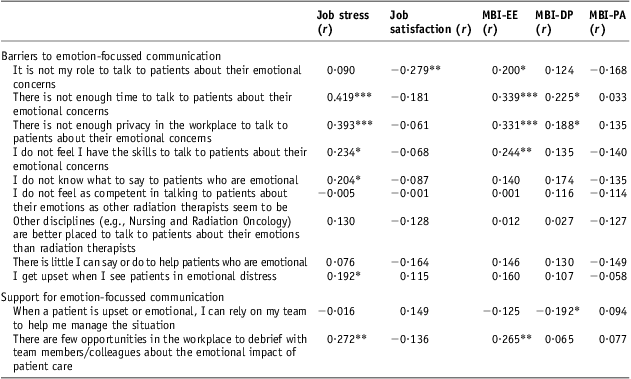
Participants rated the extent to which they agreed or disagreed with statements about nine potential ‘barriers’ to emotion-focussed communication and two potential ‘supports’ to emotion-focussed communication (one inversely measuring support; see Table 6). Individual responses were recorded on a five-point Likert scale from 1 = ‘agree strongly’ to 5 = ‘disagree strongly’.
Prior training in emotion-focussed communication with patients
Attendance was recorded at a four-hour Cancer Council Victoria workshopReference Maslach, Jackson and Leiter38 run for clinical staff at the Peter Mac on emotion-focussed communication (titled ‘Eliciting and responding to emotional cues’). The workshop focussed specifically on how to communicate with patients who are angry, anxious, distressed or depressed. This learner-centred, small-group workshop included role-play practice of emotion-focussed communication skills with a professional actor simulating the patient role. The workshop was repeated on regular occasions between 2007 and 2011, with RT management encouraging both junior and senior staff to attend a workshop over this time.
Participants were also asked whether they had attended any other training (workshop/coursework) in emotion-focussed communication (e.g., responding to patients’ emotions). Training could include undergraduate or postgraduate training at a university, hospital or other forum. Training did not have to be a part of their RT course of study.
The total hours of prior training received in emotion-focussed communication was calculated by combining hours of attendance at the four-hour ‘Eliciting and Responding to Emotional Cues’ workshop with hours of any other emotion-focussed communication training received.
Confidence in emotion-focussed communication with patients
Participants were asked to rate how confident they were in talking to patients about four groups of common emotional concerns (as used to measure patient workload, see above). Responses were recorded on a five-point Likert scale from 1 = ‘not at all confident’ to 5 = ‘very confident’, and the four questions combined into a total score. Cronbach's α coefficient for internal consistency for this measure was 0·93
Levels and sources of job stress and job satisfaction
Participants were asked two single-item questions about how stressful and how satisfying they found their current work role, with responses to each question recorded on a five-point Likert scale from 1 = ‘not at all stressful/satisfying’ to 5 = ‘very stressful/satisfying’. Participants also rated the extent to which a range of factors contributed to their job stress and satisfaction, with responses measured on a five-point Likert scale ranging from 1 = ‘not at all’ to 5 = ‘very much’. Thirty-one possible sources of stress and 14 sources of satisfaction were listed (see Tables 4 and 5).
Burnout
The Maslach Burnout Inventory-Human Services Survey (MBI-HSS) was used to measure Burnout.Reference Fujimori, Oba and Koike37 This 22-item scale has three subscales: Emotional Exhaustion (MBI-EE: nine items related to feelings of being emotionally overextended); Depersonalisation (MBI-DP: five items related to feeling numb or uncaring about the care or treatment of patients); and Personal Accomplishment (MBI-PA: eight items relating to feelings of competence and achievement. Scores on this scale are inversely related to burnout). Emotional exhaustion and depersonalisation are separate factors but are usually moderately correlated, whereas personal accomplishment is independent of these scales and typically has only low correlations with them. Responses were measured on a seven-point Likert scale of frequency (response options range from 0 = ‘never’ to 6 = ‘everyday’). Responses were summed to give a total score for each subscale, with high levels of burnout being defined by a cut-off based on the upper third of the normative distribution.Reference Maslach, Jackson and Leiter5 The reliability and validity of this measure has been well documented. For this study, the Cronbach's α for the MBI-EE, MBI-DP and MBI-PA scales, respectively, were 0·88, 0·51 and 0·76. The MBI-DP α was lower than that found by the authors of this scale (0·79), while the α for the remaining scales were comparable to those found by the authors of this scale (0·90 and 0·71, respectively).Reference Maslach, Jackson and Leiter5
Data analyses
T-tests were used to compare means on the three MBI burnout subscales to findings from Ackroyd and Adams US study on RTsReference Trufelli, Bensi and Garcia10 as well as MBI normsReference Maslach, Jackson and Leiter5. Ackroyd and Adams paper was chosen as a comparison study because of its large sample size, diverse sampling from across the United States, and use of the MBI scale (allowing direct statistical comparison to the current study as well as MBI norms of doctors and nurses, a more widely studied clinician group in the burnout field). The percentage of RTs endorsing the top two likert response options (e.g., ‘agreed’ or ‘strongly agreed’, ‘quite’ or ‘very confident’, etc.) were used to present data on sources of job stress and job satisfaction. Independent t-tests and one-way between-groups ANOVAs (with Tukey's post hoc comparisons) were used to compare mean levels of job stress, job satisfaction and scales of burnout for groups (as seen in Table 1) of age, sex, marital status, RT grade, years of experience, work role (comparing treatment versus planning only), hours of patient-contact per week and the frequency of working with patients presenting with noticeable emotional concerns.
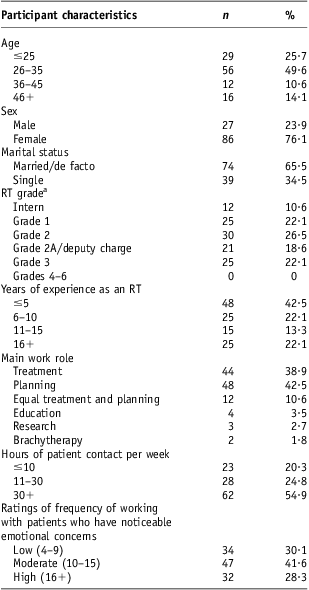
Participant characteristics and contact with patients

Notes: aDefinition of RT Grades: interns = Graduates completing 12 months work experience before registration; Grade 1 = newly registered and practicing RTs; Grade 2 = 2+ years experience plus skills in education and technical support; Grade 2A/deputy charge = ability to deputise or support charge RT; Grade 3 = charge RT, in charge of clinical planning or treatment units; Grade 4 = senior heads of sections; Grade 5 = deputy director; Grade 6 = director of RT department.
Abbreviation: RT, radiation therapist.
Bivariate Pearson correlations were conducted between job stress, job satisfaction and scales of burnout, and the barriers, supports, hours of training and confidence levels in emotion-focussed communication. Independent t-tests were used to compare scores of job stress, satisfaction and burnout for those who had attended the four-hour ‘Eliciting and Responding to Emotional Cues’ workshopReference Maslach, Jackson and Leiter38 to those who had not attended.
Results
Of the 225 RT staff sent the questionnaire, 130 were returned. Fifteen were excluded from analyses because of incomplete response sets, and two were excluded because of not currently working in any clinical capacity with patients, leaving 113 eligible participants for inclusion in the final analyses.
Participant characteristics and patient contact
The average age of participants was 32·7 years (SD = 10·06, range 21–64), and the average years of experience of working as an RT was 10·5 (SD = 9·74, range 1–41). Participants reported working an average of 29·5 hours/week in clinical contact with patients (SD = 5·84, range 1–47). All other participant characteristics can be seen in Table 1.
Prior training in emotion-focussed communication
A total of 54·9% (n = 62/113) had attended some form of emotion-focussed communication training, of which just over 40% (n = 47, 41·6%) had attended the four-hour ‘Eliciting and Responding to Emotional Cues’ workshop.Reference Maslach, Jackson and Leiter38 Across the entire sample, the average hours of emotion-focussed communication training received was 4·60 hours (SD = 7·49, range 0–40).
Prevalence of job stress, job satisfaction and burnout
Twelve per cent (n = 14/113, 12·4%) reported that overall their current work role was ‘quite’ or ‘very stressful’. Approximately three-quarters (n = 83/113, 73·5%) reported that overall their current work role was ‘quite’ or ‘very satisfying’.
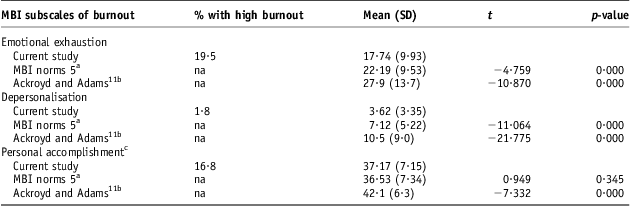
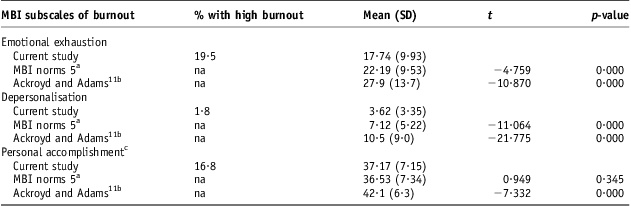
Nineteen and a half per cent of the sample had high burnout on the MBI-EE scale. Fewer (16·8%) had high burnout on the MBI-PA scale while only 1·8% had high burnout on the MBI-DP scale. T-tests indicated that participants in this study have significantly lower mean burnout levels on MBI-EE and MBI-DP scales than Ackroyd and Adams study of RTsReference Trufelli, Bensi and Garcia10 as well as MBI normative data on doctors and nursesReference Maslach, Jackson and Leiter5 (see Table 2). In contrast, burnout was significantly worse on the MBI-PA subscale (with lower raw scores indicating higher burnout on this scale) compared with RTs in Ackroyd and Adams’ study, and not significantly different to MBI norms of doctors and nurses. Correlations between job stress, job satisfaction, and scales of burnout can be seen in Table 3.
Prevalence of burnout and comparisons to other studies and norms
Notes: aMBI norms: n = 1104 US doctors and nurses.
bAckroyd and Adam's sampleReference Akroyd and Adams11: n = 502 RTs surveyed across the United States.
cPersonal Accomplishment: the lower the mean score, the higher the burnout. This scoring is the reverse of the other two MBI scales.
Abbreviations: MBI, Maslach Burnout Inventory; SD, standard deviation; na, not available.
Pearson correlations between job stress, job satisfaction, and scales of burnout

Notes: Higher scores on MBI-EE and MBI-DP indicate higher burnout, while higher scores on MBI-PA indicate lower burnout.
*p < 0·05, **p < 0·01, ***p < 0·001.
Sources of job stress and job satisfaction
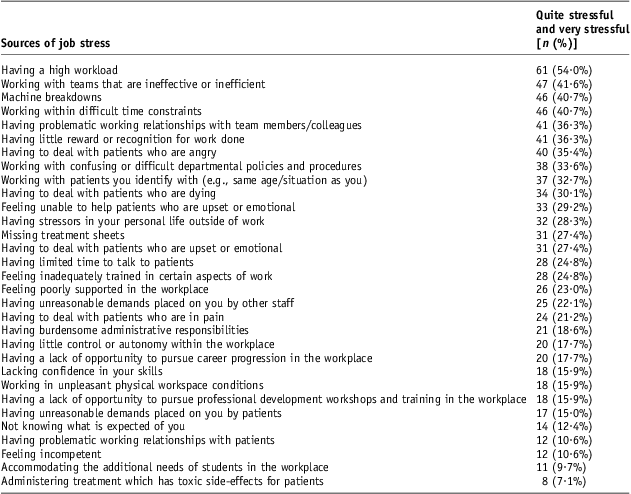
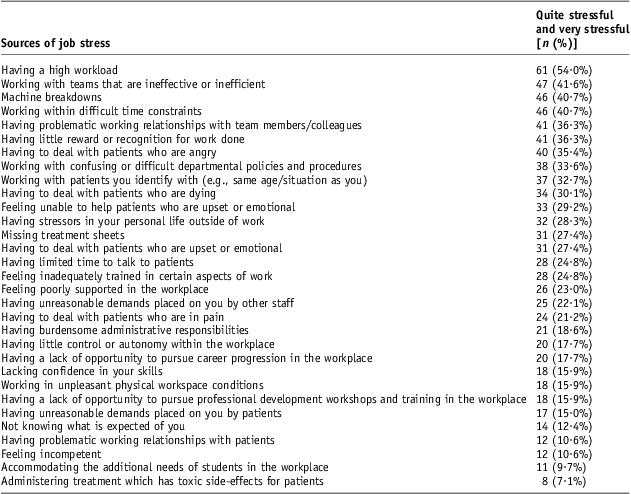
The degree to which individual sources of job stress and satisfaction were experienced by participants can be seen in Tables 4 and 5. The top five sources of job stress included organisational factors and issues of team functioning, including high workload (54·0%), working with inefficient teams (41·6%), machine breakdowns (40·7%), working within difficult time constraints (40·7%) and problematic team relations (36·3%). Stress relating specifically to the provision of emotion-focussed aspects of care was endorsed by fewer RTs (e.g., working with patients who are angry 35·4%, or upset or emotional 27·4%). A smaller but reasonable number of RT endorsed questions suggestive that job stress from emotion-focussed care was related to a lack of abilities, skills or support in their role. For example, feeling unable to help patients who are upset or emotional was a source of stress for 29·2% of participants. Feeling poorly supported was a source of job stress for approximately one-quarter of the sample (23·0%), while lacking confidence in skills or feeling incompetent were endorsed by only 15·9% and 10·6%, respectively.
Sources of job stress
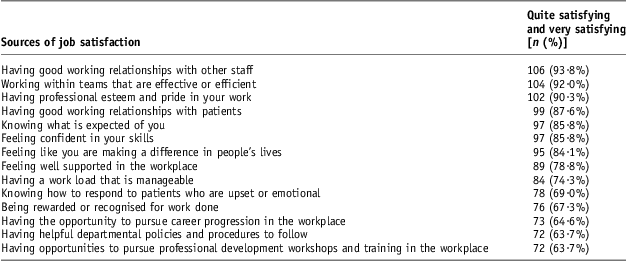
Sources of job satisfaction
Top sources of job satisfaction included aspects of work that involved positive interpersonal relations with other staff or patients, including having good working relationships with other staff (93·8%), working with effective teams (92·0%) and having good working relationships with patients (87·6%). Feeling confident in skills was endorsed by 85·5% and knowing how to respond to patients who are upset or emotional was endorsed as a source of job satisfaction by 69·0%.
Factors associated with job stress, job satisfaction and burnout
Demographic factors and patient contact
ANOVA analyses found no significant group differences of age, sex, marital status, RT grade, years of experience, main work role (treatment versus planning) or hours of patient contact per week on scores of job stress, job satisfaction or the three scales of burnout, as per groupings seen in Table 1. Levels of job stress, and scores on the MBI-EE and MBI-PA burnout scales differed significantly across the three levels of contact with patients with noticeable emotional concerns [job stress: F(2,110) = 3·26, p = 0·04; MBI-EE: F(2,110) = 3·67, p = 0·03; MBI-PA: F(2,110) = 4·38, p = 0·02]. Post hoc Tukey's comparisons indicated that RTs who had the most frequent contact with patients with noticeable emotional concerns, had significantly more job stress (M = 2·76, SD = 0·80, p = 0·04) and burnout on the MBI-EE scale (M = 20·97, SD = 10·96, p = 0·02) than those with the least contact with patients (M = 2·26, SD = 0·67 and M = 14·50, SD = 8·21, respectively). In contrast, Tukey's post hoc comparisons indicated that RTs who had the most frequent contact with patients with noticeable emotional concerns, had significantly less burnout on the MBI-PA scale (M = 40·0, SD = 5·1, p = 0·01) compared with those with the least contact with patients (M = 35·1, SD = 8·3), where high scores indicate low burnout on this scale. No statistical differences were found between other group comparisons at p ≤ 0·05.
Barriers and supports to emotion-focussed communication
A variety of significant correlations were found between job stress and burnout and the barriers and supports to emotion-focussed communication (see Table 6). Notably, not having enough privacy, time or skills for emotion-focussed communication with patients was significantly correlated to job stress, as well as one or both of the MBI-EE and MBI-DP scales. Not knowing what to say to patients who are emotional, and getting upset when seeing patients in emotional distress, were significantly correlated to job stress only (r = 0·204, p < 0·05 and r = 0·192, p < 0·05, respectively). The belief that it is not RTs’ role to talk to patients about their emotional concerns was significantly associated with higher burnout on the MBI-EE scale (r = 0·200, p < 0·05).
Pearson correlations of job stress, job satisfaction and burnout to barriers and supports to emotion-focussed communication
Notes: Higher scores on MBI-EE and MBI-DP indicate higher burnout, while higher scores on MBI-PA indicate lower burnout.
*p < 0·05, **p < 0·01, ***p < 0·001.
Abbreviations: MBI-EE, Maslach Burnout Inventory-Emotional Exhaustion; MBI-DP, Maslach Burnout Inventory-Depersonalisation; MBI-PA, Maslach Burnout Inventory-Personal Accomplishment.
Results also indicated that being able to rely on their team for support when managing patients with emotional concerns is associated with reduced burnout on the MBI-DP scale (r = −0·192, p < 0·05), while having fewer debriefing opportunities in the workplace was significantly associated with greater job stress (r = 0·272, p < 0·01) and worse burnout on the MBI-EE scale (r = 0·265, p < 0·01). None of the barriers and supports to emotion-focussed communication were significantly correlated to the MBI-PA scale of burnout.
In regards to job satisfaction, lower job satisfaction was significantly correlated to RTs feeling like it is not their role to talk to patients about their emotional concerns. Job satisfaction was not correlated with any other barrier or support.
Prior training in emotion-focussed communication
Hours of emotion-focussed communication training was not significantly correlated with job stress, job satisfaction or any burnout scale (see Table 7). Interestingly however, t-tests revealed that higher burnout on the MBI-EE scale was associated with attendance at the four-hour ‘Eliciting and Responding to Emotional Cues’ workshop [M = 19·96, SD = 10·50, versus M = 16·17, SD = 9·27, t(111) = 2·027, p = 0·045]. This finding was contrary to expectations. No other significant differences were found on t-tests between attendance at this workshop and means scores of job stress, job satisfaction or the remaining two MBI scales of burnout.
Pearson correlations of job stress, job satisfaction and burnout to hours of emotion-focussed training attended and confidence levels in emotion-focussed communication

Notes: Higher scores on MBI-EE and MBI-DP indicate higher burnout, while higher scores on MBI-PA indicate lower burnout.
*p < 0·05, **p < 0·01, ***p < 0·001.
Abbreviations: MBI-EE, Maslach Burnout Inventory-Emotional Exhaustion; MBI-DP, Maslach Burnout Inventory-Depersonalisation; MBI-PA, Maslach Burnout Inventory-Personal Accomplishment.
Confidence in emotion-focussed communication
Correlations in Table 7 indicated that higher confidence in emotion-focussed communication was associated with less job stress (r = −0·238, p < 0·05) and less burnout on the MBI-PA scale (r = 0·217, p < 0·05), however, no significant relationship was found with job satisfaction or the MBI-EE and MBI-DP scales of burnout (Table 7).
Discussion
This study provides important insights into the role that emotion-focussed care and communication with patients may play in the job stress, job satisfaction and burnout that RTs’ experience in the workplace. Three-quarters of RT staff surveyed in this study reported feeling quite or very satisfied overall in their current job, which is comparable to satisfaction rates reported in other oncology clinician groups.Reference Ramirez, Graham, Richards, Cull and Gregory9, Reference Johnson, Roberts, Trotti, Harvey and Greenberg23 RTs in the current study reported low levels of job stress (12·4%) compared with a high of 45% reported in other oncology clinicians.Reference Ramirez, Graham, Richards, Cull and Gregory9, Reference Johnson, Roberts, Trotti, Harvey and Greenberg23 Given job stress is meant to be a precursor to burnout, one might expect that burnout levels would be similarly low in the current study's population. Results partially supported this supposition, with RTs in current study demonstrating significantly less burnout on the MBI-EE and MBI-DP burnout scales compared with RTs in Ackroyd and Adam's study and MBI normative data for doctors and nurses.Reference Maslach, Jackson and Leiter5, Reference Trufelli, Bensi and Garcia10 In contrast however, participants were found to have significantly greater mean levels of burnout on the MBI-PA scale than RTs in Ackroyd and Adam's study.Reference Trufelli, Bensi and Garcia10 The specific reasons for these different findings is unclear, however, they may reflect the ‘geographical heterogeneity’ found in burnout when it is compared across different hospital settings and countries39 as well as the independence of the MBI-PA scale to the more strongly correlated MBI-EE and MBI-DP scales.Reference Maslach, Jackson and Leiter5 It is certain, however, that rates of emotional exhaustion and depersonalisation were relatively low in the current study's population compared with other healthcare groups, but that factors may be impacting their capacity to achieve a sense of personal accomplishment in the workplace compared with RTs in other settings.
In exploring the factors contributing to job stress (a precursor to burnout), aspects of emotion-focussed care and communication were surveyed, and results confirm that this type of patient care does indeed contribute to job stress in RTs surveyed, but only in around one-third of the sample. In contrast, just over two-thirds of RTs in this study indicated that knowing how to respond to patients who are upset or emotional was a source of job satisfaction, while even greater numbers report satisfaction from having good working relationships with patients and feeling they are making a difference in people's lives. Previous studies have also found that direct patient care is quite important in clinician's deriving job satisfaction from their workReference Probst and Griffiths3, particularly when there is a good patient–clinician relationship or when the clinician feels that emotionally laden issues (e.g., death and dying) are managed well.Reference Akroyd and Adams11 It is possible that RTs in the current study derive either (or both) stress or satisfaction from working with patients who are in emotional distress, but that their reaction (stress or satisfaction) may depend upon a range of mediating factors. Other sources of job stress more frequently endorsed by RTs included heavy workload, problematic organisational factors (such as machine breakdown, working within difficult time constraints, little reward or recognition), and poor team functioning and problematic team relations. These themes are consistent with common workplace and organisational factors found in literature more generally.Reference Probst and Griffiths3, Reference Akroyd and Adams11, Reference Rafnsdottir, Gunnarsdottir and Tomasson13, Reference Johnson, Roberts, Trotti, Harvey and Greenberg23–Reference Sherman, Edwards, Simonton and Mehta25
When directly testing the relationship of different variables to job stress, job satisfaction and dimensions of burnout, surprisingly none of the personal and demographic factors (e.g., age, sex, marital status, RT grade, years of experience and work role) were found to have any relationship with job stress, satisfaction or burnout. This contrasts some of the burnout literature that has linked age, gender and years of experience in particular to MBI burnout scores in oncology populations.Reference Akroyd and Adams11, Reference Sharma, Sharp, Walker and Monson30, Reference Elit, Trim, Mand-bains, Sussman and Grunfeld40–Reference Poulsen, Poulsen, Khan, Poulsen and Khan42 In regards to patient contact, no significant differences of job stress, satisfaction or burnout were seen across different levels of patient contact per week. In contrast, when focussing on emotion-focussed patient care specifically, RTs who saw patients with noticeable emotional concerns most frequently (e.g., patients who were angry, distressed, depressed or anxious), had significantly higher job stress and burnout (on the MBI-EE scale) but significantly lower burnout on the MBI-PA scale than those who saw patients least frequently. Though a little surprising that results for burnout on the MBI-PA scale should differ in their direction to results found for job stress and MBI-EE, this scale is known to be independent of the MBI-EE and MBI-DP scales.Reference Maslach, Jackson and Leiter5 As such, results suggests that working specifically with patients’ emotional concerns may indeed present unique challenges, as well as rewards for staff, over and above the demands of usual patient care.
When examining the barriers and supports to emotion-focussed communication identified in this study, results suggest that there may be a variety of factors that mediate the impact emotion-focussed patient communication has on RTs’ experience of job stress or burnout. For example, a lack of available time, privacy and clinician skill were all factors that were significantly associated with job stress and dimensions of burnout. Probst and GriffithsReference Probst and Griffiths3 also identified time as a central factor in RTs’ stress levels in their workplace, while Halkett et al.Reference Halkett, Merchant and Jiwa2 found that lack of time had a particular impact on effectively communicating with patients who were anxious or distressed. Results also highlighted the importance of team support and debriefing opportunities when engaging in emotion-focussed patient care, similar to Bragard et al.'s study that linked emotional exhaustion in RTs to dissatisfaction with support from supervisors.Reference Bragard, Etienne and Libert43 These findings point to practical and useful ways in which workplace stressors can be addressed. For example, issues of time might be tackled by increasing staffing levels or better spacing patient appointments, whereas improving RT support or skill levels might be achieved through increased mentoring, supervision or targeted training. It would be interesting for future research to trial the implementation of strategies such as these, and measure changes in job stress and burnout over time. Removing barriers to emotion-focussed patient care might not only reduce burnout, but enable staff to more fully experience the rewards that this care appears to provide them.
One of the central questions of this study was whether increased RT training in emotion-focussed communication specifically, was associated with less stress or burnout. Contrary to expectations, no relationship was found between the total hours of emotion-focussed communication training and job stress or burnout. Unexpectedly, however, higher burnout on the MBI-EE scale was significantly associated with attendance at the four-hour ‘Eliciting and Responding to Emotional Cues’ workshop. This finding raises interesting questions. A previous study by Fujimori et al. found that communication skills training led to higher burnout on the MBI-EE scale.Reference Turner, Clavarino and Butow36 These authors suggested that communication training might increase pressure on staff to be supportive and helpful to patients or may weaken their usual defences against the emotional impact of patients care, thus worsening burnout. They also suggested that training may encourage increased interactions with patients such that staff already emotionally exhausted, become more exhausted. Finally, they suggested that staff may undertake the workshop with unrealistic expectations of the gains they might achieve from the workshop. If these expectations are not met, clinicians may feel more helpless in their roles. It is possible that the same factors may have contributed to findings in this study. However, a causal relationship cannot be drawn from our results, and it is possible that RTs attendance at the workshop disproportionately favoured those with pre-existing high levels of burnout.
A more useful outcome measure than training might be RTs’ confidence in emotion-focussed communication, as confidence more directly taps into each clinician's subjective sense of self-efficacy and belief in their ability to communicate and help patients. Halkett et al. found that RTs are least confident in discussing psychosocial issues with patients,Reference Halkett, Merchant and Jiwa2 and the current study found that lower confidence was indeed associated with higher job stress and burnout on the MBI-PA scale. Replication of this finding and clarification of the causal direction of this relationship would be helpful in future studies, but the results here suggest that stress and burnout may be affected by an individual's perception of their ability to manage emotion-focussed encounters with patients confidently.
In conclusion, fewer RTs in this study report job stress than found in studies of other cancer clinicians, whereas levels of job satisfaction seem comparable.Reference Grunfeld, Whelan, Zitzelsberger, Willan, Montesanto and Evans4, Reference Ramirez, Graham, Richards, Cull and Gregory9, Reference Johnson, Roberts, Trotti, Harvey and Greenberg23 When compared with RTs in a large US study and MBI norms of doctors and nurses,Reference Maslach, Jackson and Leiter5, Reference Trufelli, Bensi and Garcia10 RTs in this Australian sample experienced less burnout on the MBI-EE and MBI-DP scales, but worse burnout on MBI-PA scale. Further analyses suggest that emotion-focussed patient care may place clinicians at risk of stress or burnout in some circumstances, however, may also be associated with significant job satisfaction and personal accomplishment. Factors that may increase RTs vulnerability to stress and burnout include having workplace barriers that impede emotion-focussed communication and care (e.g., lacking time or privacy for these communications), and when staff lack support or confidence in their emotion-focussed communication with patients. Attendance at the four-hour ‘Eliciting and Responding to Emotional Cues’ workshop had no relationship with job stress and two of the three scales of burnout (MBI-DP, MBI-PA), but unexpectedly, was associated with higher burnout on the MBI-EE scale. Further research to replicate this finding is required, and to determine the causal direction of this relationship.
One of the major limitations of this study was that analyses were exploratory in nature and multiple comparisons or correlations were made with no correction for type I error. Further research is therefore required to clarify and confirm the findings in this study. The causal direction of relationships cannot be assumed from the findings either and all participants were sourced from the one worksite, greatly limiting the generalisability of results. The Cronbach's α measure of internal consistency for MBI-DP scale of burnout was quite low, possibly because of limited variability of responses (only low numbers of participants endorsed burnout on this scale), and the MBI was the only formally validated measure used in this study. As such, interpretation of results should be made with some caution.
Despite these limitations, the results of this study have important implications for radiation therapy and other clinical departments in oncology settings. The results point the way to practical methods in which staff can be facilitated to provide emotion-focussed care and communication with patients while reducing their risk of stress and burnout. Strategies may include improving staff skills or confidence, improving staff support, and ensuring staff have the time and privacy to communicate with patients who present with emotional concerns. It remains unclear whether clinician training in emotion-focussed communication with patients has the potential to positively impact clinician stress or burnout, or may in fact worsen stress and burnout for some staff. Further research is required to clarify this. Ultimately, however, efforts to identify workplace contributors to clinician stress and burnout will create a more positive and rewarding work culture for clinicians, and will have benefits for both clinicians and patients alike.
Acknowledgements
We wish to thank both the Clinical Psychology and Radiation Therapy departments for their assistance with the publication of this article.