Private pension systems based on individual savings accounts have been spreading around the world over recent decades (Kotlikoff, Reference Kotlikoff and Feldstein1998; Sass, Reference Sass, Clark, Munnell and Orzag2006; Baily and Kirkegaard, Reference Baily and Kirkegaard2009; Barr and Diamond, Reference Barr and Diamond2009). These schemes normally operate under a private market framework that relies, on the one hand, on specialized firms that provide a long-term service managing savings for old age, for which a set of processes is required during the employee's accumulation and passive phases; and, on the other hand, the demand (voluntary or mandatory) made up of workers acquiring this service. The interaction of supply, demand, the regulatory framework and structural aspects within which the markets are confined, result in a price or fee for services in this industry.Footnote 1
The dynamics of fees in the private pension industry have been a controversial subject in the debate, particularly in those systems where private saving is mandatory,Footnote 2 because of its likely diminishing effect on pensions and consumer welfare. Thus, behind this issue, a singular political-economic dynamic has constantly been present.Footnote 3 For example, Modigliani and Muralidhar (Reference Modigliani and Muralidhar2005) find in the case of Latin America that the fees applied reduce the expected replacement rate by between 12% and 26%. Bateman et al. (Reference Bateman, Kingston and Piggott2001), as well as Creighton and Piggott (Reference Creighton, Piggott, Clark, Munnell and Orzag2006), highlight the fact that a fee of 1% of the assets under management (AUM) may reduce pension returns by between 19% and 22%. From another point of view, Baily and Kirkegaard (Reference Baily and Kirkegaard2009) note the effect that these fees may have above all on the low-income segments of the population. Another dimension of the criticism is related to comparisons on two levels: one focused on the explicit price charged by pension companies, compared with the free or social costs of a ‘pay-as-you-go system’Footnote 4 (Mitchell, Reference Mitchell and Feldstein1998); and the other, contrasting the private systems of different countries, where prices of some schemes are seen as higher than others (Gill et al., Reference Gill, Packard and Yermo2005; Tapia and Yermo, Reference Tapia and Yermo2008). At the same time, the different analyses of the causes underlying the prices charged by pension companies have been based on different perspectives of economic analysis, such as the way in which markets are structured, problems of supply and demand, aspects of the regulatory framework and the structural framework of each country related to its socioeconomic characteristics and institutional development.
Considering the multidimensional nature of this problem, this study pursues three important objectives. First, it will provide a complete review of the relevant literature on the different factors affecting pension fees. Second, a global dataset of pension fees will be constructed, and the corresponding industrial organization and economic factors that surround each system will be presented. Third, this research will analyze the effect that different factors have on the level of fees charged in the pension industry using a sample of 53 countries in different geographical areas with an individual account pension system.
After this introduction, Section 1 briefly discusses the different forms of administrative charges made by pension funds. Section 2 analyzes the main channels through which the prices charged in the industry could be affected. Section 3 reviews market behavior and carries out estimates to explore the variables affecting fees in the industry. Finally, Section 4 presents the conclusions of our research.
1 Prices in the pension industry
The prices charged in the private pension industry can take a variety of forms. Whitehouse (Reference Whitehouse2000), for example, gives us a broad classification of administrative charges in pension systems, each with a different level of complexity. One of the typical charges in the industry emulates the operation of mutual funds. However, the objectives and the respective regulatory scopes of the two can diverge (Jame, Reference Jame2010). Within this framework, for example, there could be fixed charges (amounts in the corresponding currency) for record-keeping in the systems; charges for custody; charges for the management of asset investment (usually as a percentage based on AUM); and others. This form of charging may become somewhat more complicated if the company agrees on a fee with the saver in exchange for a greater return on the fund or a more successful management.Footnote 5 This form of charge, in the style of a mutual fund, tends to occur in voluntary pension plans, where savers can, in many cases, define their desire to participate in the system and the percentage to save (Creighton and Piggott, Reference Creighton, Piggott, Clark, Munnell and Orzag2006; Baily and Kirkegaard, Reference Baily and Kirkegaard2009).
When the private pension market in a particular country has established fees as a percentage of the AUM, this assumes the previous existence of a market these pension funds can enter, so that this industry does not begin with a zero balance. In contrast, other experiences, such as those of various emerging countries in Latin America and Eastern Europe, have emulated the Chilean pension model (the AFP modelFootnote 6 ). In this case, industries were created separately from any other kind of mutual fund management, and since they did not initially have the capacity of scale to charge fees on assets, they included a charge based on the salary (Pollner and Lasaga, Reference Pollner and Lasaga2003). Others that began charging salary-based fees moved toward charging a percentage of AUM (as is the case in Mexico and Peru) once the industry had reached a reasonable size of assets. However, the experience of some countries that have established a fixed charge in local currency for the entire administrative process of the pension service during the accumulation phase is worth pointing out. This is the case in New Zealand (Impavido et al., Reference Impavido, Lasagabaster and Garcia-Huitron2010), which has used the regulation of public utility companies as a model. Here a function of production is determined, and a fixed price to charge each participant in the system is calculated.
It is important to note that the charges pension savers are subject to for the retirement pension service, which may be attributed to the costs of record-keeping, collection, asset management, custody and management in the accumulation phase, are, in many cases, integrated with charges that do not correspond directly to this objective. Various regulations include, within these administrative fees, those charged for providing pension savers with disability and survivorship insurance in the case of death or an accident that prevents them from continuing to save for old age. If there is a claim resulting from these causes, it generates a pension or income in favor of holders or of their survivors.Footnote 7 It should be pointed out that this research will not analyze the charges for insurance mentioned above, which are determined by other factors, more related to the insurance industry. This study will focus solely on the costs related to the retirement pension market.
2 Factors behind the administrative charges for pensions
The calculation of price levels in the retirement pension industry involves multiple aspects. The points of view of industrial organization (or industry supply), demand, the regulatory market and structural variables are all aspects that are important when it comes to determining prices. It is also relevant to consider that pension markets around the world can take on different structures. A pension market could be organized, for instance, considering a type of retail structure, meaning that each worker or participant makes direct contact with the pension company that is going to provide the service. This is, for instance, how private mandatory pension markets are organized in some Latin American and Eastern European countries. This is also the common way in which any person could voluntarily take out retirement insurance offered by either an insurance company or other specialized firm around the world. In other areas, such as many OECD countries, pension schemes are normally organized under the structure of pension plans sponsored by the employer, unions or labor organizations. The sponsor could either take responsibility of managing the fund or hire a specialized expert (a trustee) to manage it (Yermo, Reference Yermo2002).
On the supply structure side, one of the most notable problems is the fact that some of these industries have few firms. This may lead to the presence of oligopolistic structures in parallel with high fixed costs and sunk costs (Baumol and Willig, Reference Baumol and Willig1981; James et al., Reference James, Smalhout and Vittas1999; Paz and Ugaz, Reference Paz and Ugaz2003; Tapia and Yermo, Reference Tapia and Yermo2008; De la Torre and Rudolph, Reference De la Torre and Rudolph2012). According to them, the barriers to entry are fortified by a concentration of functions in a single entity. Others highlight the constant sales and marketing campaigns of some agents, which raise costs (James et al., Reference James, Smalhout and Vittas1999; Modigliani and Muralidhar, Reference Modigliani and Muralidhar2005).
Other studies focus on demand aspects. Here the way that participants choose either the company to manage their assets or the type of investment portfolio that is best suited to their profile becomes particularly important; the results could also be conditioned by the existence of a voluntary or mandatory scheme (Impavido et al., Reference Impavido, Lasagabaster and Garcia-Huitron2010). A number of studies highlight the difficulties workers have in understanding all the complexities of the pension systems, which may affect their capacity for making decisions (Tapia and Yermo, Reference Tapia and Yermo2008; Castaneda and Rudolph, Reference Castaneda and Rudolph2011). Arenas et al. (Reference Arenas de Mesa, Bravo, Behrman, Mitchel, Todd, Kay and Sinha2008), for example, finds that the tools Chilean workers can use to choose the company that is to manage their pension fund are fairly precarious. Similar conclusions are reached by Whitehouse (Reference Whitehouse2000) and Berstein and Cabrita (Reference Berstein and Cabrita2007).
In these situations, it may be insufficient to simply provide better information or the opportunity of choice (Dobronogov and Murthi, Reference Dobronogov and Murthi2005; Tapia and Yermo, Reference Tapia and Yermo2008). The alternative could be a strategy for transmitting comprehensible information, especially for the groups with the lowest levels of education. From another perspective, Hastings et al. (Reference Hastings, Mitchel, Chyn, Mitchel and Lussardi2011) find that the design of how to present information to workers increases the sensitivity of the choice of the pension fund with respect to its price. Based on an analysis of surveys in Chile, the study finds that presenting the effects of fees charged by pension companies in terms of losses increases the reaction of workers with lower education levels to the price and reduces the weight of other criteria.
Another view of the problem of demand is based on the passivity or inertia of consumers to declare their choice for a particular pension fund. This can be seen, for example, in the fact that many pension savers tend to remain relatively stable once they choose a pension fund, despite the difference in prices or returns that may exist in the market. In contrast, as we mentioned earlier, it may be that consumer mobility from one pension fund to another is more related to the proximity of the sales force, as described by Berstein and Cabrita (Reference Berstein and Cabrita2007). All of these problems are important from a broader social perspective, because as pointed out by Benartzi and Thaler (Reference Benartzi and Thaler2007), it is precisely those individuals with lower incomes and lower educational levels who are the most exposed to losses as a result of poor investment decisions. Various studies therefore propose an active role for the regulator to promote a better strategy for information in the pension industry (Greenwood et al., Reference Greenwood, Sanchez and Wang2010).
Considering the problems from the demand perspective, it is possible to think that a specific industrial setting can help. For example, an Occupational Pension Plan (pension plans sponsored by the employer or a relevant organization on behalf of the worker) could be a good alternative to counterbalance the relative ignorance of the participants to understand all the complexities of a pension system. Because a better informed sponsor is in charge of setting the pension plan and negotiating with the potential pension fund managers, it could be possible to obtain lower administrative charges. Likewise, the decision to implement either a voluntary or mandatory pension fund could have different effects on the power of the demand. On the one hand, one might believe that voluntary participation generates a more informed demand that would be more exigent and conscious about its decision and the fees charged. Notwithstanding, on the other hand, the implementation of a mandatory system could take better advantage of scale economies in the industry.
The special characteristics on the supply and demand sides in this industry, combined with social objectives that the state pursues in watching out for risks when the population reaches its elderly phase of life, conditions the introduction of a regulatory framework with which to minimize the failures in these markets. The literature has basically included different prospects for regulatory action; for example, by establishing specific investment regimes to condition the level of flexibility for investment in different types of assets, and thus indirectly affecting the prices of certain pension funds due to their greater complexity and added value (Castaneda and Rudolph, Reference Castaneda and Rudolph2011; De la Torre and Rudolph, Reference De la Torre and Rudolph2012). Similarly, others have studied the effects of decisions made to exert greater regulatory pressure on the market, as in the case of Slovakia and El Salvador, where limits were established on fees; or in the case of Mexico, where there is an annual negotiation process for the fees charged in the pension industry (Rudolph, Reference Rudolph2012). However, in the case of Slovakia, this type of limitation on prices may lead to pension companies taking a more conservative stance in their portfolio management processes, which in the end may generate lower aggregate value for the pension saver. Other authors, such as Creighton and Piggott (Reference Creighton, Piggott, Clark, Munnell and Orzag2006), point out that the regulatory framework is not sufficient to reduce the level of fees.
Another element discussed in this regard is the implication of regulation on portfolio management decisions that may have an effect on costs. Investment decisions, swayed by the respective financial regimen, may lead, for example, to active investment in short-term financial instruments, or to a very passive role by investing, for example, only in government bonds. Such risks and costs will affect the efficiency of long-term decisions and may have an effect on future pensions (James et al., Reference James, Smalhout and Vittas1999; Tapia and Yermo, Reference Tapia and Yermo2008; Ballester et al., Reference Ballester, Fernandez and Matallin2007; Castaneda and Rudolph, Reference Castaneda and Rudolph2011; De la Torre and Rudolph, Reference De la Torre and Rudolph2012).
A different regulatory outlook from those mentioned above was incorporated in Chile in 2008 with the process of auctions for the portfolios of new pension savers as part of the pension reforms introduced that year. This scheme consists of calling for bids from the pension companies in operation at the time and any new ones that wish to participate in the industry, offering a price for managing the portfolios of new pension savers who join the system for a period of 2 years. This flow of new pension savers is granted to the pension fund company that offers the lowest price in the auction process. So far, two bidding processes have been carried out that led to reductions in the average fees in the industry, although with differences at the level of individual firms (Reyes, Reference Reyes, Das, Strovsky, Pennock and Szymanski2009; Ministerio de Trabajo y Prevision Social, 2011).Footnote 8 There are also other portfolio auction processes with different characteristics. This is the case of New Zealand, where all workers, not only new ones, who do not choose a pension company or portfolio, are incorporated in the process. In this case, the winning pension company receives a longer period of exclusivity in the management of the portfolio, but there are also other types of fees and subsidies from the state for the charging of lower fees (Inland Revenue Department and the Ministry of Economic Development of New Zealand, 2006). In general, it can be said that an auction process is created in some ways to reduce the vertical integration in the industry, as the regulator incorporates an arbitration element in the process of supply and demand.
As part of the regulatory decisions, some countries are moving toward separating functions, whereas before they were concentrated in a single pension company, such as in the case of Estonia, following the Swedish pension system, which has a history of competitive fees (Rudolph, Reference Rudolph2012). However, it is important to stress that in other countries with lower levels of development, such as India and Sri Lanka, this kind of organization has presented problems of an administrative nature.
The fact that similar regulatory policies, such as those mentioned in the previous paragraph, do not yield similar results in all geographical areas, could mean that the structural characteristics of each reality plays an important role. Thus, the effects of the supply structure, demand factors and regulatory decisions can be conditioned by factors such as the level of participation of the labor force in the pension industry, which limits the possibility to take advantage of economies of scale (Palmer, Reference Palmer2006; Tapia and Yermo, Reference Tapia and Yermo2008; Bikker et al., Reference Bikker, Steenbeek and Torracchi2010). The level of GDP per capita and poverty levels (World Bank, 1994; Gill et al., Reference Gill, Packard and Yermo2005; Robles, Reference Robles2012) are aspects that condition the aggregate capacity of savings in a country. One topic included in Levy (Reference Levy2008) is the enormous problem that the informal economy creates in developing countries, and in particular for social security systems, which rely on the role played by companies in withholding payments to workers. If the labor markets are affected by informality, the pension systems also tend to have similar problems. These limitations also impact the financial markets. The lower aggregate saving capacity conditions the possibility to generate deep capital markets to invest in long-term assets (Ballester et al., Reference Ballester, Fernandez and Matallin2007; Tapia and Yermo, Reference Tapia and Yermo2008). For example, this limits the capacity to diversify and obtain transactions at competitive prices, which in the end impacts the cost structure.
Another structural element that conditions market behavior is the institutional framework associated with factors such as the operation of the state and its capacity to enforce laws (World Bank, 1994; Gill et al., Reference Gill, Packard and Yermo2005; Hinz and Holzmann, Reference Hinz and Holzmann2005; Levy, Reference Levy2008; Carranza et al., Reference Carranza, Melguizo, Tuesta, Hinz, Holzmann, Tuesta and Takayama2012; Holzmann et al., Reference Holzmann, Hinz, Tuesta, Hinz, Holzmann, Tuesta and Takayama2012). In fact, any problem that the state may have with controlling compliance with labor and social regulations in order to apply the law may have significant effects on the participation rate. The limited effectiveness of the state in developing countries often leads the regulator to transfer responsibility to companies. Thus, in the case of the pension industry, there are many cases in which the administrative burden of companies is increased because of this transfer of functions from the state.Footnote 9 At the same time, the lack of effectiveness is reflected in limited actions implemented by some regulators to help workers make informed decisions and improve their financial literacy (Tapia and Yermo, Reference Tapia and Yermo2008).
3 Estimates of the factors behind fees in the private pension industry
In the previous section, we mentioned the different channels through which prices may be affected in the pension industry. In general, we highlighted that the various perspectives could be grouped together in terms of the importance of the organization channels, scale size and aspects of a structural nature in the countries, all of which could have an effect on fees.
We will begin by standardizing the variable to be explained, which in this case is the fee (or fees) charged for administration in the private pension industry. Based on our discussion above that there are different forms of charging fees in each country, one way of obtaining a common indicator is to calculate the ratio of the total income received in the pension industry from the fees charged, divided by the total pension savers’ AUM in this industry (Impavido et al., Reference Impavido, Lasagabaster and Garcia-Huitron2010). For practical purposes, when we refer in this study to the concept of fees, costs, administrative charges or prices, we will be referring to this ratio. In the case of pension fees, most of the figures we are discussing below will show the historical average ranging from 1990 to 2011. The period of the average for each case will vary depending on the available data. In specific cases, we will refer to the last available data for the pension fee. Given that there is not a single source of information for fees and other relevant variables considered in this study from a worldwide perspective, a database is compiled from different sources, most of them from each country's official documentation and multilateral organization research.Footnote 10
3.1 Stylized facts in the market
The existence of diverse structures for charging fees in pension systems around the world can be summed up by using a ratio that considers income from different fees, with respect to the total assets under management in the industry. The information of the private systems in this study takes into account the fees in those countries with mandatory and voluntary systems. We differentiate each one in the dataset.Footnote 11
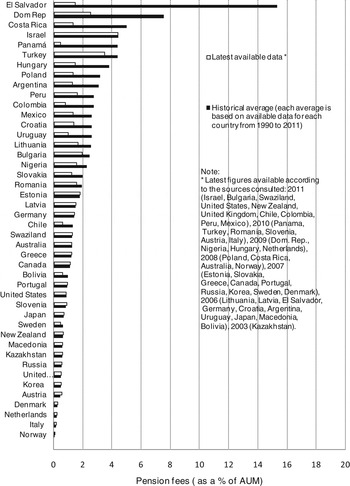
Figure 1 shows the historical average and the latest available data of the fees indicator as a percentage of AUM for each available period per country (most of them mandatory systems). In the case of the historical average, it can be seen that there is great diversity among the 53 countries analyzed in this study, where data from 44 countries on fees has been obtained. At one end is the case of El Salvador, a pillar-two system whose ratio of fees is 15.3% as an annual historical average, which is fairly high considering that the sample average is 2.8%. There are almost a dozen countries with fees above the average, mostly emerging economies. At the other end are countries such as Norway, Italy and The Netherlands, with average fees of under 0.2%. In the case of pension fees for the latest available data, the average for the countries in the sample is 1.14%, lower than the one obtained above when considering the historical average data of each country. In this case, we have Israel charging the maximum level of fees, followed by Turkey and the Dominican Republic. Norway had the lowest fee in 2008, at 0.016%. This information makes it consistent to state that the subject of age of the system and greater vertical integration of the functions are elements that affect the ratio in some countries. Indeed, in the case of the age of the pension system, it appears to have a significant effect on the ratio of fees charged, because a more mature system would be associated with greater accumulation of assets managed, creating the possibility that the ratio of fees charged by pension companies to total managed assets may be lower in several countries. Meanwhile, it appears that those countries that have higher fees are those with vertically integrated pensions industries,Footnote 12 which we will see later on in this section.
World-wide pension fees.

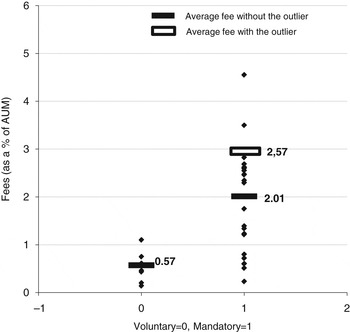
Are fees affected by a voluntary or mandatoryFootnote 13 requirement to contribute to a pension system? In Figure 2 we can observe in this sample that voluntary pension systems have, on average, lower fees than mandatory pension schemes. This result also holds true when the data of El Salvador, a clear outlier in the sample with an average fee of 15.3%, is considered. If there is a reason or not to explain this result, it is not completely clear. In fact, this classification seems to be affected by the fact that the voluntary system cases in this sample correspond with their classification as developed countries, where factors such as the size of the market and institutional development could be also relevant.
Fees in voluntary and mandatory pension systems (available historical average in each country 1990–2011). Source: Author's calculation derived from different sources detailed in the Online Appendices.

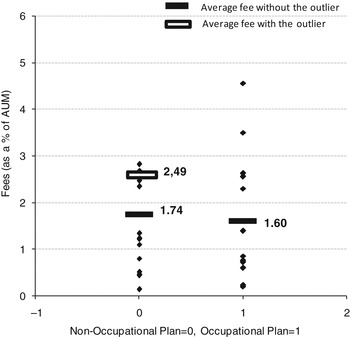
Also from an organizational point of view, one aspect that intuitively seems to affect fees in pension systems is the existing connection between the workers in a pension plan with the fund managers. Some countries have established Occupational Pension PlansFootnote 14 in which the employer or sponsor represents the workers, among other things, when negotiating fees with the pension companies. This leads us to assume that the intervention of the employer or sponsor as a representative of the workers could provide a better negotiation process to obtain lower fees. Figure 3 shows the average results for fees in the cases of occupational and non-occupational pension plans. The intuitive concept that an occupational plan presents lower fees is confirmed and also hold true when the outlier is not considered in the sample. How important are occupational pension plans to obtaining lower fees? Again, it is interesting to note that most of these occupational plans have been implemented in OECD countries, so other factors more related to the level of development of these countries could have an effect on these results. It is clear that OECD countries have a higher level of development than other countries due to their higher incomes, savings rates, negligible levels of poverty, less inequality, depth of its capital markets, lower levels of informal economy and institutional capacity, etc. All these factors, therefore, may contribute to improved market conditions, enabling the ability to charge lower fees, either because the market size allows greater interaction of supply and demand, or because it facilitates better regulatory capacity. The interactions of some of these variables with the fees charged in different pension systems are reviewed further on this section.
Fees in occupational and non-occupation plans (available historical average in each country 1990–2011). Source: Author's calculation derived from different sources detailed in the Online Appendices.

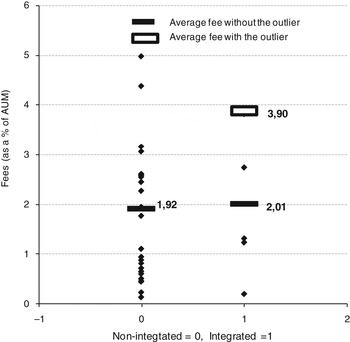
Figure 4 shows how the level of fees is related to greater vertical integration. This integration is measured through a dummy that can take the value of 1 when the different stages of production are integrated in a single company or 0 when some of these functions have been outsourced from the firm to another firm or firms. This dummy variable is constructed by analyzing the industrial organization in each country. Mainly for reasons of competition and specialization, the sign in this case should be positive; in other words, the fees should be higher if all the functions are concentrated in a single agent, as this could imply greater barriers to entry for potential competitors. This indicator has also taken into account whether the regulations include a prior auction process that acts as an intermediary between supply and demand, as carried out by an external agent (in this case, a government institution, which may be the regulator). This also represents a process of outsourcing or break in vertical integration, as it adds a stage to the process that is not integrated into the firm, so the country variable also takes the value of 0 from the year in which the measure has been included. This expected correlation is maintained when the sample includes El Salvador; although, in this last case, the average fee of pension industries vertical integrated is increased dramatically.
Fees in vertical and non-vertical integrated markets (available historical average in each country 1990–2011). Source: Author's calculation derived from different sources detailed in the Online Appendices.

The figures presented are a selection of some of the variables that can be considered relevant in explaining the behavior of administrative charges in the private pension system, following the literature review in Section 2. This approach shows some correlations that are intuitively evident; in other cases they are not so clear with respect to what was initially expected. In the next section, we will look at these different channels based on various econometric estimates.
3.2 Estimates of determinants of prices in the pension industry
Based on the review carried out earlier, we can anticipate that any impact on administrative charges in the pension industry could be through several channels. Given the gathered information – whose construction has been quite laborious and detailed in the Online Appendices – our main objective in this section is to perform an empirical analysis based on an aggregate approach of the pension industry around the world in order to identify global trends behind the cost of the pension industry. Thus, this study does not pretend to design an economic model that describes a specific industrial organization in any particular country, nor the specific behavior behind the decisions any agent takes, where other kind of data, more specific to the market level, and the country, is required. In this section, using panel data methodologies, we will estimate the multichannel effect of factors that, in accordance with the discussion in the initial section, could have an impact on administrative charges in private pension systems.
For this study, we will assume that, on average, the functional form is linear in the coefficients of these variables.Footnote 15 Considering that there are no published integrated databases, and that the information has been constructed country by country, we will work on a matrix of 44 of the 53 countriesFootnote 16 analyzed in this study, with standardized and representative information,Footnote 17 selecting 17 variables from the 149 explored.Footnote 18 These variables were selected according to the revised theory, the availability of data and those highly correlated with the dependent variable.
In order to identify the effects on the dependent variable, we will process the longitudinal data matrix using different panel data methodologies (Cameron and Trivedi, Reference Cameron and Trivedi2009), so that the conclusions can have a greater degree of analytical robustness. For this study in particular, the Individual-Specific-Effects model has been defined for the dependent scalar variable yit specified as follows in Equation (1) (Greene and Hensher, Reference Greene and Hensher2010):
 $$y_{it} \equals z^\prime\alpha _{i} \plus x^\prime_{it} \beta \plus \varepsilon _{it} \comma $$
where i, is the variable or unit of study; t, is the dimension over time;
 $x_{it} \hskip-4pt{\prime} $
, are the regressors; z′α
i
, are the random specific-individual effects; and ∊
it
, is the idiosyncratic error.
The heterogeneity or individual effect is z′α i , where zi contains a constant term and a set of individual or specific group of variables, which may or may not be observable, and which are taken as constant in time t. If zi is observed for all the individuals in the sample, then it can be handled as an ordinary linear model adjusted by least squares. Panel data models are interpreted through the error component (Uit ), which is decomposed as follows in Equation (2) (Mayorga and Munoz, Reference Mayorga and Munoz2000):
 $$U_{it} \equals \mu _{i} \plus \delta _{t} \plus \varepsilon _{it} \comma $$
where μ i , are the effects that cannot be observed and that differ between the variables studied but do not differ over time; δ t , are the effects that cannot be quantified and that vary over time but do not vary between the variables studied; and ∊ it , is the random error.
For this purpose, we have presented the four types of estimates, which can be grouped together into two areas: Fixed Effects and Random Effects (Greene and Hensher, Reference Greene and Hensher2010; Mayorga and Munoz, Reference Mayorga and Munoz2000). A method of Fixed Effects has the advantage of allowing a certain degree of endogeneity between explanatory variables, assuming that there is an unobserved variable that is constant over time and that is related to the other variables used in the model. Despite the advantage of solving a certain degree of endogeneity, the disadvantage is not being able to identify the explanatory variables that are constant over time. The estimate for the case of fixed effects was carried out through the intragroup estimator (within estimator). In other words, only the information existing within each country was used. This allows us to answer the question of how fees vary on average when they change over time. The estimate is carried out by deducting, from each explanatory variable, the time average (eliminating all those that are constant over time). In the case of methodologies of random effects (Pooled Regressions, Estimated Between Groups-Between Estimator and Generalized Least Square), they assume that each data is independent and comes from the same stochastic process, providing new and important information for the regression analysis. However, a specification error due to the lack of relevant variables or the existence of unobservable qualities in the individuals may lead to the coefficients not being consistent. The Hausman test (Greene and Hensher, Reference Greene and Hensher2010) was used to decide which assumption to use (Fixed Effects or Random Effects). This test takes advantage of the fact that if the assumption of Random Variables is correct, the coefficients estimated for Fixed Effects and by the Random Effect methodologies are consistent, so they should not be different from the statistical point of view.
In order to determine the relevant equation, we first classify the variables individually, in other words, taking into account our dependent variable and a set of explanatory variables that in accordance with the revised theory could have some relevant effect on the fee indicator. Thus, the dependent variable in this study is the ‘fees as a percentage of AUM’ in the private pension systems.
The potentially explanatoryFootnote 19 variables where selected from the 149 variables explored as follows: Number of Pension Funds, GDP Per Capita, National Savings Rate, Informality Index of the Country, Self-Employed Workers, Real Returns, Rule of Law Index, Quality of Regulation Index, Government Effectiveness Index, Stability of Public Policies, Assets Under Management, Stock Market Capitalization of the Country, Age of the Private Pension System, Pension Market Integration, Labor Activity Rate, Pension Savers, Occupational or Non-Occupational Pension System, Mandatory or Non-Mandatory Pension System.
3.3 Results of the estimates
A total of 17 variables were selected according to the revised theory, the availability of data and those highly correlated with the dependent variable. It was observed that the behavior of the coefficients in the different regressions was very unstable because of the high correlation between them that will affect the identification of the partial effects. This is why we will try to apply methodologies that aim to solve this problem such as Principal Components Analysis (PCA) that we will discuss below. The data matrix used is for 44 countries of a total of 53 countries analyzed, but for regressions we worked with a lower number of countries, as the values within the explanatory variables are not available in all cases.Footnote 20
Then, what we have detected and commented at the start of this section is the problem of multicollinearity between the variables considered relevant. Everything indicates that deciding not to include one of them could generate a problem of specification and endogeneity; but including them would put us in the situation of not obtaining the correct configuration of reality. Thus, a recommended solution is the creation of an index that maintains the largest amount of information about its components. This can be achieved by applying the methodology of PCA (Terradez, Reference Terradez2002; Holland, Reference Holland2008).
The methodology of PCA creates an indexFootnote 21 that is very similar to the weighted average, but with the difference that its weights are selected in such a way that the greatest amount of information is maintained; or to put it another way, the weight maximizes the volatility of the data contained in the variables under analysis. The aim of this type of methodology is to try to determine a set of new variables that could explain the different observed behavior in a simplified form. The procedure tries to find a new variable (that functions as an index) to explain as much as possible about the variability of the data observed by the use of a reduced number of variables (Terradez, Reference Terradez2002; Holland, Reference Holland2008). The new principal components or factors will be a linear combination of the original variables and will be independent of each other. In addition, the new factors will be interpreted after observing the relationship with the initial variables, both in terms of the sign and the size of the correlations.
The following steps have to be taken to implement this type of procedure: first, to analyze the correlation matrix for the variables (the analysis of the principal components is only meaningful if there are high correlations between the variables). Second, the criterion for selecting the factors is such that the first includes the greatest amount of information possible from the original variability; the second must include the largest amount possible of variability not included in the first factor; and so on. Of all the factors selected, those that include the largest percentage of variability (considered sufficient) will be chosen. These are the principal components. Third, the principal components are represented as a matrix, which has as many columns as principal components chosen and as many rows as there are variables; fourth, to interpret the information, the factor coefficient must be close to 1; a variable must have high coefficients with only one factor; there must not be factors with similar coefficients. Fifth, the factor points are points that the principal components have in each case and that allows them to be represented graphically. They are calculated using the following formula in Equation (3) (Terradez, Reference Terradez2002):
 $$X_{ij} \equals a_{ij} \, {\vskip3pt\ast} \, Z_{\setnum{1}\hskip1.5ptj} \plus \cdots \plus a_{ik} \, {\vskip3pt\ast} \, Z_{kj} \equals \mathop{\sum}\limits_{s \equals \setnum{1}}^{k} {a_{is} \, {\vskip3pt\ast} \, Z_{sk} } \comma $$
where Xij is one element of the matrix of i principal components and j variables included; a is one of the different coefficients; and Z is one of the standardized values of the variables in each of the individuals in the sample.
Thus owing to the multicollinearity between the explanatory variables, we have created two principal components (indices), selecting the variables according to the correlation between them and the economic significance of these variables. The components created are:
-
• Industry Scale: maintains 53% of the information and is composed of the three variables: age (the number of years the private pension system has been operating), AUM over GDP and market capitalization over GDP.
-
• Structural: maintains 66% of the information and is composed of seven variables: self-employed workers as a percent of the population; GDP per capita; workers over population; stability of policies; quality of regulation; rule of law; effectiveness of government and the informality rate.
In addition, there is the problem of one clear outlier in the sample, El Salvador, which could introduce some distortion in the estimations. Thus, we decided to perform two sets of models, one considering El Salvador, and one without including this outlier. These will allow us to observe which variables remain as the most stable.
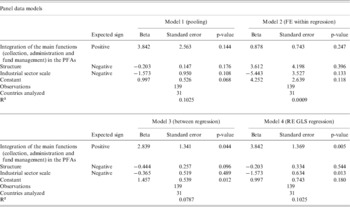
Table 1 shows four models estimated including the outlier in the sample. In this case, by applying the Hausman test,Footnote 22 we cannot reject to a 5% level of significance the null hypothesis that the Random Effects model is correct, thus, Model 4 is the model to consider for the analysis. We observe that greater vertical integration in the industry is related to a 3.8% point increase in the value of fees. It can also be seen that fees are negatively affected by the increase in the size of the industry (our variable of economies of scale), as measured by the indicator of the corresponding principal components. A variation of one unit in the index of the industry scale generates a reduction of 1.6 percentage points in administrative charges. In the case of structural variables, the index of principal components shows that this is not significant.
Estimated effects on pension fees including the outlier

Source: Author's calculations.
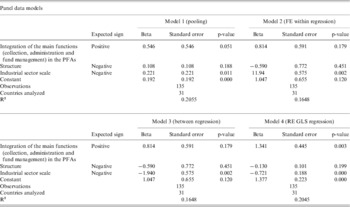
Table 2 on the other hand, shows the same four models estimated excluding the outlier observation (El Salvador). The Hausman Test in this caseFootnote 23 says that there are omitted variables that are correlated with the explanatory variables, so we must rely on Model 2 (Fixed Effect). The only significant variable in this model is the scale of the Industry, and the coefficient (−1.9) is very close to the previous results with the outlier. None of the other variables is significant.
Estimated effects on pension fees excluding the outlier

Source: Author's calculations.
Thus, we have seen that the size of the industry has a negative effect on the fees and remain stable when the sample considers or not the outlier country. While the effect of the vertical integration of the industry seems to be related with an omitted variable that is country-specific, we are unable to determine if the effect observed is only related to the industrial organization. Although we cannot dismiss the potential importance of structural factors (included in the respective index of principal components) as a determinant factor of the results in the markets, they do not appear to have a relevant impact on fee structures in the private pension system.
We also consider it interesting to test the importance to have a pension industry organized as either a voluntary or mandatory setting as well as either occupational or non-occupational scheme. As was mentioned before, the problems faced by some pension systems from the demand side (lack of information, financial illiteracy, inertial demand among others), could be ameliorated if an occupational pension plan (where a more informed sponsor represents a set of workers in negotiations) or a voluntary system (where a more conscious participant voluntarily takes place) were established.
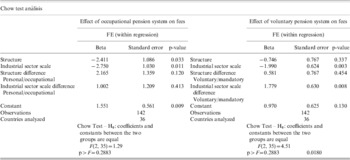
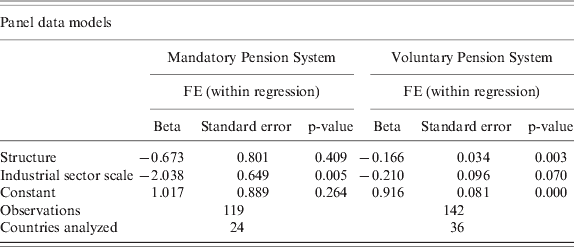
We have tested both situations by applying the Chow Test (Greene and Hensher Reference Greene and Hensher2010). By using this methodology, we test the null hypothesis of same coefficients between two conditions: being only either occupational or non-occupational as well as being either mandatory or voluntary (see Table 3). In the first case, we cannot reject the null hypothesis of the same coefficients between occupational and non-occupational pension systems. This means that countries with occupational pension systems seem not to have a level of fees statistically different from the non-occupational system. Thus, we can rely on the estimation that does not take into account this difference. However, a difference is seen when we compare the mandatory and voluntary pension systems groups. In this case, we reject the hypothesis of same coefficients, so we need to apply one regression for each group. In Table 4 for two different groups of countries (mandatory or voluntary), we can see that in countries with mandatory requirements, the effects of the industrial sector scale are much larger.
Estimated effects of the importance of occupational and voluntary pension systems on fees
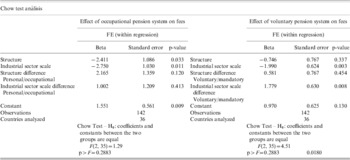
Source: Author's calculations.
Estimated effects of mandatory and voluntary pension system on fees

Source: Author's calculations.
To summarize, according to the statistical methods and the sample we worked on, the principal component indicator of the size of the market (industrial scale) shows statistical significance in the econometric regressions performed as a determinant of the level of fees. These results are maintained regardless of considering the outlying observation in the sample or not. Likewise, the relevance of this variable is also upheld in the case of different pension organizational settings, either occupational or non-occupational pension plans as well as either mandatory or voluntary pension systems. In this last case, the significance of the indicator of the size of the market is reinforced when the system is mandatory. The sample and the statistical methods used did not provide enough support that other variables could be significant to explain the level of fees.
4 Conclusions
There is extensive debate on administrative fees in pension funds. Beyond discussions in the area of economic policy, the literature has identified various factors underlying the level of prices. It has highlighted the variables of features of the industrial organization of the markets; factors of scale; and variables of a structural nature, focused on institutional characteristics and the socioeconomic conditions of the country in question. The aim of this study has been to measure this multidimensionality of effects from a global perspective, in order to identify the main determinants.
To do so, a matrix has been created with information on 44 countries from the 53 cases reviewed, in order to estimate the effects on prices through the use of four panel data methodologies. Two variables have been constructed using a PCA methodology in order to include the relative importance of a set of individual factors in a single index. The variables created are based on one index that measures the size of the industry and another that includes the structural factors of the economies.
The existence of an outlier has had a significant effect on the assumption that should ultimately be used (Random Effects or Fixed Effects). When including the outlier, we found that greater vertical integration is related to a 3.8% increase in the value of fees; and an increase in the index that measures the level of the industry scale generates a reduction of 1.6% in administrative charges. Nevertheless, excluding the outlier gives us a different picture. The study found evidence that Random Effects no longer hold, and the only stable coefficient is the scale of industry while the vertical integration of the industry is no longer significant.
The estimations allow us to observe the simultaneous effects of different variables repeatedly mentioned by the literature as potential determinants of higher or lower pension fees. The first aspect that stands out from the estimates is the non-significance of structural variables such as the level of GDP, labor market conditions, levels of informality, regulatory quality index, among other factors considered in the estimations. Second, it is also interesting to see that the vertical integration variable is only statistically significant when the outlier is considered in the model. Third, the importance of scale variable as an explanatory factor behind pension fees was found. Furthermore, it has been observed that in countries with mandatory pension systems the effects of this variable are much larger (about 2 percentage points).
Given the above, the size of the market (the variable index of scale of the industry) remains the only stable and significant variable in determining the average fees charged. Finally, while the effect of the vertical integration of the industry seems to be related with an omitted variable that is country-specific, we cannot determine if the effect that we observe is exclusively related to the industrial organization. Although we cannot dismiss the importance that structural factors may have (included in the respective index based on PCA) as a determinant factor of the results in the markets, they do not appear to have a relevant impact on fee structures in the private pension system.
Supplementary material
To view supplementary material for this article, please visit http://dx.doi.org/10.1017/S1474747213000322.