Immersion classrooms have been demonstrated to be a particularly effective way to establish second language (L2) communicative ability (Genesee, Reference Genesee1987, Reference Genesee, Bhatia and Ritchie2006; Lyster & Genesee, Reference Lyster, Genesee and Chapelle2019). Unlike a traditional L2 classroom, where the new language is the main topic of instruction, in immersion, the L2 is used for presentation of classroom content such as mathematics and science, and for interaction in general. Despite the effectiveness of immersion classrooms for the development of functional proficiency in the L2, children who participate in these programs do not uniformly attain L2 competence identical to monolingual speakers of the target language (Lyster & Genesee, Reference Lyster, Genesee and Chapelle2019).
Specifically for Canadian French immersion programs, it is often noted that immersion learners typically attain nativelike or near-native receptive L2 skills, but at the same time, their L2 production skills differ from the sociolinguistic and grammatical norms of first language (L1) French speakers (Cummins, Reference Cummins, Childs and Bostwick1998; Kowal & Swain, Reference Kowal, Swain, Johnson and Swain1997; Lyster, Reference Lyster2007; Lyster & Genesee, Reference Lyster, Genesee and Chapelle2019; Swain & Lapkin, Reference Swain and Lapkin1982). For L2 production, differences have been found for morphosyntactic features such as, but not limited to, learners’ use of verb forms (Harley, Reference Harley1993; Harley & Swain, Reference Harley and Swain1978), and grammatical gender with nouns (Warden, Reference Warden1997). Studies of immersion programs involving other languages have come to parallel conclusions about morphosyntactic production, with differences between immersion learners and L1 speakers being documented in Cherokee (Peter, Sly, & Hirata-Edds, Reference Peter, Sly, Hirata-Edds, Tedick, Christian and Williams Fortune2011), Irish (Ó Duibhir, Reference Ó Duibhir, Tedick, Christian and Fortune2011), and Spanish (Montrul & Potowski, Reference Montrul and Potowski2007) programs. In contrast to language production, immersion learners consistently demonstrate strong language comprehension ability on holistic tasks of receptive language (Genesee, Reference Genesee1987; Knell, Siegel, & Lin, Reference Knell, Siegel and Lin2007; Lindholm-Leary, Reference Lindholm-Leary, Tedick, Christian and Williams Fortune2011; Swain & Lapkin, Reference Swain and Lapkin1982; Turnbull, Lapkin, & Hart, Reference Turnbull, Lapkin and Hart2001). However, such assessments of comprehension do not provide evidence about how these learners integrate specific morphosyntactic information, or whether they interpret this information differently from L1-speaking peers.
To address the gap between investigations of morphosyntactic production versus comprehension skills in immersion-L2 learners, the present study examines the comprehension abilities of middle school-aged L2 learners who have been learning English as an L2 in a foreign language immersion classroom for more than 8 years on average. The study examined the online (i.e., moment-to-moment) comprehension of English inflectional plural–singular marking, a feature for which the participants’ L1 (Mandarin) and L2 display key differences (see Li & Thompson, Reference Li and Thompson1989), and for which speakers of Chinese languages have displayed differences in both early L2 acquisition (Jia, Reference Jia2003) and late L2 acquisition (Jiang, Reference Jiang2007). The experiment combined a visual-world eye-tracking task that measures online comprehension and a picture decision task that measures final interpretations. In so doing, this study offers a fine-grained look into the understudied area of immersion learners’ comprehension of L2 morphosyntax.
The immersion-L2 context
The key objectives of immersion education are for learners to successfully learn required curriculum through their L2 and, in so doing, obtain much greater proficiency in their L2 than peers who receive traditional L2 instruction (Genesee, Reference Genesee, Bhatia and Ritchie2006; Lyster & Genesee, Reference Lyster, Genesee and Chapelle2019). When it comes to L2 grammar, immersion education was initially based on the premise that for early start programs (i.e., at or before first grade), language learning could occur naturalistically in much the same way that L1 acquisition occurs (Genesee, Reference Genesee1984), thus obviating the need for explicit language instruction, such as teaching of grammatical rules (Lyster & Tedick, Reference Lyster and Tedick2014). Currently, however, the limitations of immersion environments are better understood, in that they do not perfectly mimic community exposure for things like the frequency of morphosyntactic constructions (Lyster, Reference Lyster2007; Peter, Hirata-Edds, & Montgomery-Anderson, Reference Peter, Hirata-Edds and Montgomery-Anderson2008), or range of sociolinguistic variation (Harley, Allen, Cummins, & Swain, Reference Harley, Allen, Cummins, Swain, Harley, Allen, Cummins and Swain1990; Mougeon, Nadasdi, & Rehner, Reference Mougeon, Nadasdi and Rehner2010; Swain & Lapkin, Reference Swain, Lapkin, Scarcella, Andersen and Krashen1990). These variations in language exposure are inherently part of the immersion learning context and are believed to underlie differences in learners’ L2 attainment. Factors such as frequency of language use, and how and with whom a language is used, impact what individuals know of their languages (Grosjean, Reference Grosjean2008), and these factors will be largely governed by learning context. Therefore, contextual factors need to be considered in explaining potential differences in morphosyntactic ability.
At a basic level, the immersion-L2 context can be situated somewhere between exposure to an L2 within a community where the L2 is the majority language (henceforth, the ML context) or within a traditional L2 classroom where the L2 is the subject of instruction (henceforth, the instructed-L2 context). The differences between the ML and instructed-L2 contexts entail immense differences in the amount and quality of L2 input learners receive (Muñoz, Reference Muñoz, Pawlak and Aronin2014). To date, studies of early learners’ acquisition of L2 morphosyntax have largely been done in ML contexts (e.g., Chondrogianni & Marinis, Reference Chondrogianni and Marinis2012; Jia & Fuse, Reference Jia and Fuse2007; Paradis, Tulpar, & Arppe, Reference Paradis, Tulpar and Arppe2016). Like these ML learners, immersion learners typically begin young, and have many hours a week of communicative L2 exposure from native speakers (or highly proficient speakers) of the L2. However, like instructed-L2 learners, the exposure that immersion learners receive is largely limited to the classroom in communities where the L2 is a foreign (or minority) language, making them similar to the participants of studies of instructed-L2 classrooms (e.g., Butler & Le, Reference Butler and Le2018; Muñoz, Cadierno, & Casas, Reference Muñoz, Cadierno and Casas2018; Sun, Steinkrauss, Tendeiro, & de Bot, Reference Sun, Steinkrauss, Tendeiro and de Bot2016). Though immersion contexts are not likely to reach the same quantity of L2 exposure as ML contexts, learners in these programs can amass around 6,000 hr of L2 exposure by their middle-school years (Turnbull, Lapkin, Hart, & Swain, Reference Turnbull, Lapkin, Hart, Swain and Lapkin1998), which far exceeds that of instructed-L2 contexts, for which L2 exposure is limited to only a few hours a week and where total classroom exposure may only be around 800 hr by the end of compulsory education, though this will vary widely by program (Muñoz, Reference Muñoz2008). Though children may begin learning an L2 at similar ages, the L2 exposure that they receive will differ depending on whether they are instructed, immersion, or ML learners. Because immersion is a distinct L2 learning context, L2 outcomes for immersion learners should be expected to differ from those of both instructed-L2 and ML learners.
Acquisition of morphosyntax in language immersion
When examining the morphosyntactic accuracy of immersion learners, many of the factors that potentially impact late learners (i.e., L2 learners who begin at or after puberty), such as cross-linguistic influence and lack of sensitivity to features with low saliency, have also been proposed to impact learners in immersion classrooms (Harley, Reference Harley1993; Lyster, Reference Lyster2007). Within Canadian French immersion programs, learners tend to show nonstandard use of the verbs être and avoir (both highly frequent), as well as, second-person pronouns, passé composé, and verbs with derivational morphemes (Harley, Reference Harley1993; Harley & Swain, Reference Harley and Swain1978). Similar to adult L2 learners, grammatical gender can be non-targetlike even up to the final years of high school for learners who began immersion in first grade, despite the feature being one French-speaking monolinguals master early (Warden, Reference Warden1997).
These differences extend beyond French immersion. In Spanish immersion in the United States, majority-L1 learners’ usage of past-tense forms (Tedick & Young, Reference Tedick and Young2016) and gender (Montrul & Potowski, Reference Montrul and Potowski2007) may have inaccuracies into fifth grade. For contexts where the language of immersion is a heritage language, there is also evidence of variable grammatical accuracy. For Irish immersion, by the fifth or sixth grade, production of genitive case can still be variable (Ní Dhiorbháin & Ó Duibhir, Reference Ní Dhiorbháin and Ó Duibhir2017; Ó Duibhir, Ní Dhiorbháin, & Cosgrove, Reference Ó Duibhir, Ní Dhiorbháin and Cosgrove2016), and usage of the Irish copula and substantive verb, as well as syntax with verbal nouns, more closely reflect correct English usage rather than Irish (Ó Duibhir, Reference Ó Duibhir, Tedick, Christian and Fortune2011). Similarly, knowledge of the complex verb system of Cherokee appears to be difficult for children in early immersion (Peter et al., Reference Peter, Hirata-Edds and Montgomery-Anderson2008), but benefits from instruction that focuses on these morphological forms (Peter et al., Reference Peter, Sly, Hirata-Edds, Tedick, Christian and Williams Fortune2011). Though little of this research specifically addresses ultimate attainment, it has been proposed that many of these nontarget features can be persistent and therefore require pedagogical intervention in order for learners to continue to progress (Harley, Reference Harley1992; Kowal & Swain, Reference Kowal, Swain, Johnson and Swain1997; Lyster, Reference Lyster2007).
In contrast to production, it is frequently noted that immersion learners are more nativelike in their L2 comprehension (e.g., Cummins, Reference Cummins, Childs and Bostwick1998; Kowal & Swain, Reference Kowal, Swain, Johnson and Swain1997; Lyster, Reference Lyster2007; Swain & Lapkin, Reference Swain and Lapkin1982; Tedick & Wesely, Reference Tedick and Wesely2015). However, this conclusion is based on the absence of conspicuous differences in global comprehension rather than close examination of these learners’ receptive abilities. Nevertheless, the claim that immersion learners typically have strong L2 comprehension is well supported as they reliably demonstrate L2 skills sufficient for completing appropriate grade-level content (Alanís, Reference Alanís2000; Cazabon, Nicoladis, & Lambert, Reference Cazabon, Nicoladis and Lambert1998; Cheng, Li, Kirby, Qiang, & Wade-Woolley, Reference Cheng, Li, Kirby, Qiang and Wade-Woolley2010; Genesee, Reference Genesee1987; Harley, Hart, & Lapkin, Reference Harley, Hart and Lapkin1986; Knell et al., Reference Knell, Siegel and Lin2007; Lindholm-Leary, Reference Lindholm-Leary, Tedick, Christian and Williams Fortune2011; Swain & Lapkin, Reference Swain and Lapkin1982; Turnbull et al., Reference Turnbull, Lapkin and Hart2001). Assessments that measure L2 proficiency by tracking immersion learners’ holistic listening and reading comprehension (e.g., Genesee, Reference Genesee1981; Harley & Hart, Reference Harley and Hart1997; Siegel et al., Reference Siegel, Knell, Pei, Qiang, Zhao, Zhao, Chan and Rao2010; Swain & Lapkin, Reference Swain and Lapkin1982; Turnbull et al., Reference Turnbull, Lapkin, Hart, Swain and Lapkin1998) are certain to have more validity in predicting academic success than a psycholinguistic experiment, yet such assessments offer little evidence about the precise nature of immersion learners’ comprehension of particular linguistic features. As a result, how these populations interpret specific components of L2 morphosyntactic structures is a relatively unresearched topic. In contrast to holistic comprehension measures, production is often evaluated using targeted tasks such as elicitation, sentence repetition, or detailed error analysis from oral interview transcriptions (e.g., Bild & Swain, Reference Bild and Swain1989; Day & Shapson, Reference Day and Shapson1987; Harley et al., Reference Harley, Allen, Cummins, Swain, Harley, Allen, Cummins and Swain1990; Harley & Hart, Reference Harley and Hart1997; Thomas, Williams, Jones, Davies, & Binks, Reference Thomas, Williams, Jones, Davies and Binks2014; Turnbull et al., Reference Turnbull, Lapkin, Hart, Swain and Lapkin1998). In sum, the comprehension and production abilities of immersion learners are not evaluated at comparable levels of scrutiny.
Though the trend is to use holistic assessment for receptive L2 skills, a notable exception to this is Lew-Williams (Reference Lew-Williams2017). In this study, eye-tracking was used to examine the receptive ability of English-L1 learners learning L2 Spanish in two-way immersion classrooms. These participants’ performance was compared with that of their Spanish-L1 classmates. Prior eye-tracking research has shown that L1 speakers of languages with grammatical gender can use gender-marked determiners to identify noun referents more rapidly, but that late L2 learners typically do not use gender information this way (Hopp, Reference Hopp2013; Lew-Williams & Fernald, Reference Lew-Williams and Fernald2010), suggesting that the sometimes inconsistent usage of grammatical gender of even highly proficient L2 speakers is not only reflective of productive abilities but comprehension as well (Grüter, Lew-Williams, & Fernald, Reference Grüter, Lew-Williams and Fernald2012). In Lew-Williams (Reference Lew-Williams2017), three separate eye-tracking experiments measured participants’ ability to identify upcoming nouns using Spanish determiners with abstract grammatical gender; grammatical gender that coincided with the notional gender of the noun (e.g., the Spanish translations of “the man” or “the woman”); or number information. The English-L1 participants in fourth or fifth grade, like Spanish-L1s’ peers, were able to use notional gender and number-marked determiners to identify referents. However, unlike their Spanish-L1 peers, they could not use grammatical gender this way, suggesting that the acquisition of these immersion learners was similar to late L2 learners. Lew-Williams concluded that the lack of semantic transparency of features like grammatical gender may be an obstacle to acquisition in L2 contexts that have more limited input than ML contexts, but that it remained unclear whether the advantage for interpretation of notional gender and number was semantic transparency or the result of transferred L1 processing skills.
Number marking in English and Mandarin
Mandarin and English differ substantially in how and when number information on nouns is conveyed, and this has been proposed to impact Mandarin speakers’ L2 acquisition of English (e.g., Jiang, Reference Jiang2007; Luk & Shirai, Reference Luk and Shirai2009). While nouns can be quantified in both languages, a key difference between them is that number marking is a nonoptional feature of English nouns (Corbett, Reference Corbett2000). Nouns in Mandarin have what can be referred to as general number (Corbett, Reference Corbett2000; Rullmann & You, Reference Rullmann, You, von Heusinger and Turner2006), meaning that a noun can be expressed without reference to number. As a result, bare Mandarin nouns, unmarked for number, are very common in typical usage (Cheng & Sybesma, Reference Cheng and Sybesma1999; Li, Reference Li1999; Li & Thompson, Reference Li and Thompson1989). They are, therefore, ambiguous in this regard when used outside of a discourse context.
The attention that English plural marking has received in previous L2 literature for L1 speakers of Mandarin, (e.g., Jia, Reference Jia2003; Jiang, Reference Jiang2007; Luk & Shirai, Reference Luk and Shirai2009; Wen, Miyao, Takeda, Chu, & Schwartz, Reference Wen, Miyao, Takeda, Chu and Schwartz2010; Xu Rattanasone, Davies, Schembri, Andronos, & Demuth, Reference Xu Rattanasone, Davies, Schembri, Andronos and Demuth2016) suggests the feature is a good candidate for one that is less likely to benefit from positive language transfer, and therefore needs to be learned anew through L2 exposure. This difference between Mandarin and English also applies to Cantonese (Cheng & Sybesma, Reference Cheng, Sybesma, Cinque and Kayne2005), Japanese (Nakanishi & Tomioka, Reference Nakanishi and Tomioka2004), and Korean (Kwon & Zribi-Hertz, Reference Kwon, Zribi-Hertz, Bonami and Cabredo Hofherr2004), and thus, relevant research involving these languages is also discussed. These languages all contrast with English in that, for each, plural–singular marking is optional, depending on discourse context, while in English it is an obligatory grammatical feature.
Acquisition of English plural–singular marking
In the L1 acquisition of English, plural –s is one of the earliest grammatical morphemes produced consistently by monolingual English-speaking children (Brown, Reference Brown1973; de Villiers & de Villiers, Reference de Villiers and de Villiers1973). Data from overregularization errors indicate that English-L1 children generally have productive knowledge of plural –s by the age of 4 (Matthews & Theakston, Reference Matthews and Theakston2006), though these children may not master it to adult levels until the age of 7 or later (Berko, Reference Berko1958; Graves & Koziol, Reference Graves and Koziol1971). Around 28 months, young English speakers are likely aware that cats deconstructs into cat and –s (Zapf & Smith, Reference Zapf and Smith2007). For semantic understanding, children around 24 months demonstrate knowledge of the plural–singular distinction (Barner, Thalwitz, Wood, Yang, & Carey, Reference Barner, Thalwitz, Wood, Yang and Carey2007; Li, Ogura, Barner, Yang, & Carey, Reference Li, Ogura, Barner, Yang and Carey2009), though, at this early stage, they may not have successfully mapped it to every phonological marker (i.e., to verb inflections, quantifiers, or all allomorphs of –s; Davies, Xu Rattanasone, & Demuth, Reference Davies, Xu Rattanasone and Demuth2017; Kouider, Halberda, Wood, & Carey, Reference Kouider, Halberda, Wood and Carey2006; Wood, Kouider, & Carey, Reference Wood, Kouider and Carey2009).
For young English L2 learners in ML contexts, Dulay and Burt (Reference Dulay and Burt1974) initially proposed that the acquisition of English morphemes was not impacted by L1. However, their own data show a very large discrepancy between the Spanish-L1 and Chinese-L1 language groups for plural marking, with the Spanish L1s marking the feature approximately 90% of the time in elicited speech and the Chinese speakers doing so only about 50% of the time. More recent evidence from measurement of receptive language ability indicates that in early preschool exposure to English, speakers of Chinese L1s may acquire English plural marking more slowly than monolinguals and L2 peers who speak other L1s. In a study of preschool-aged children, Xu Rattanasone et al. (Reference Xu Rattanasone, Davies, Schembri, Andronos and Demuth2016) used a pointing task with touchscreen tablet computers to measure 3- and 4-year-old childrenʼs ability to correctly interpret singular or plural marked nouns. In the experiment, English-L1 children performed above chance for both plural and singular marking with nonce nouns. Speakers of non-Chinese L1s were only above chance for plural items, and those with a Chinese L1 were only above chance for singular items. When the singular and plural conditions were compared, the English L1s and non-Chinese L1s were both significantly better with plural than singular. However, there was no difference between the types for the Chinese L1s. Xu Rattanasone et al. (Reference Xu Rattanasone, Davies, Schembri, Andronos and Demuth2016) concluded that the Chinese L1s showed greater difficulties acquiring inflectional morphology at that time point in development.
For young Korean- and Japanese-L1 children in ML contexts, production of plural –s appears to come later in L2 English than in L1 English relative to other grammatical morphemes. In specific contrast to L1 acquisition, Hakuta (Reference Hakuta1976) and Shin and Milroy (Reference Shin and Milroy1999) found that the phonologically identical possessive –s was acquired before plural marking for the children they studied. The authors of both studies ascribe this L1–L2 English disparity to the lack of an obligatory plural marking morpheme in the childrenʼs prior learned L1s, Japanese and Korean, respectively.
In a 5-year longitudinal study of Mandarin speakers, Jia (Reference Jia2003) studied participants’ production of English inflectional plural marking in picture descriptions and spontaneous speech. Her participants were 10 children and youths whose English development in an ML context began between 5 and 16 years of age. Despite the duration of exposure, three of the participants fell short of the 80% criterion score for consistent plural production. Participants’ most common error was to use an unmarked noun that should be marked plural with either regular or irregular inflection. Jia noted that each participant across all rounds of measurement tended to use the same nouns correctly marked at some times and erroneously unmarked at others, even within the same testing session. Age of English onset (AoO) and language environment explained some but not all of the variation between learners.
With the exception of Xu Rattanasone et al. (Reference Xu Rattanasone, Davies, Schembri, Andronos and Demuth2016), studies of early ML L2 acquisition relied on participant childrenʼs ability to produce plural marking. In contrast, L2 research with adult late-L2 participants has used self-paced reading experiments with response times measuring receptive sensitivity to errors with plural–singular marking. Jiang and colleagues (Jiang, Reference Jiang2007; Jiang, Novokshanova, Masuda, & Wang, Reference Jiang, Novokshanova, Masuda and Wang2011) used this paradigm to provide evidence that nativelike acquisition of plural marking was extremely difficult or impossible for L2 learners without an equivalent morphological feature in their L1. In Jiang (Reference Jiang2007) and Jiang et al. (Reference Jiang, Novokshanova, Masuda and Wang2011), participants were presented with lists of stimuli that probed sensitivity to error stimuli for plural marking in sentences like “*The teacher noticed that three of his student were always missing,” and for verb subcategorization, as in “*Joeʼs father didn’t show him drive the car that day.” In both studies, the optional-number-L1 participants (Chinese and Japanese, respectively) were only sensitive to the verb subcategorization errors as measured by slower reading times for stimulus sentence regions subsequent to the error. In Jiang et al. (Reference Jiang, Novokshanova, Masuda and Wang2011), a comparison group of Russian-L1, English-L2 speakers was also included. The prediction was that the Russian speakers would show sensitivity to both verb subcategorization errors and plural errors, because Russian, like English, obligatorily marks plural. This prediction was borne out as the speakers of the L1 more like English demonstrated sensitivity to plural errors.
The two L1 participant groups in Jiang et al. (Reference Jiang, Novokshanova, Masuda and Wang2011) were matched for performance on a cloze task used to gauge proficiency, and were similar in other aspects of English experience such as AoO and years of formal instruction, though the Japanese L1 group began earlier and had more years of formal instruction than the Russian L1s. Nevertheless, two subsequent studies found that Chinese and Japanese (Wen et al., Reference Wen, Miyao, Takeda, Chu and Schwartz2010), and Korean speakers (Song, Reference Song2015) can show evidence of monolingual-like knowledge of English plural inflection. Both studies were largely replications of the Jiang studies, but they included the two key modifications of separating the L2 learners into intermediate and advanced proficiency groups, and reducing the syntactic complexity of experimental stimuli. Wen et al. (Reference Wen, Miyao, Takeda, Chu and Schwartz2010) pointed out the stimuli of the previous studies were grammatical and ungrammatical partitive constructions (e.g., … three of his students …), requiring tracking agreement across multiple hierarchical nodes. This syntactic complexity has been demonstrated to influence L2 sensitivity to grammatical gender agreement (Keating, Reference Keating2009). Thus, it was unclear whether L2 participants’ difficulties were with plural marking or syntactic complexity. To address this, the stimuli used in Wen et al. consisted of phrases with an adjective separating the number-marked determiner and the noun (e.g., these nice houses), while Song (Reference Song2015) included stimuli of both types. Both studies found evidence of nativelike knowledge for advanced, but not intermediate learners.
In sum, the acquisition of plural–singular marking in English L2 has been examined for both Mandarin-L1 children residing in ML contexts and late-L2 Mandarin L1 adults, who where reported, began in instructed contexts. To date, no studies have examined the comprehension of this morphosyntactic feature in early immersion learners of English.
The present study
The main goal of this study was to investigate comprehension of a single semantically transparent morphosyntactic feature, English inflectional plural–singular marking, by a group of L2-English immersion learners whose L1 is Mandarin. The study employs an experimental task and compares adolescent early L2-immersion learners in Northern Taiwan with age-matched Canadian monolinguals who speak English as their L1. The immersion learners in this study have had long-term and extensive exposure to their L2 from preschool. Though the appropriateness of monolingual–bilingual comparisons is often questioned, an empirical comparison is a better alternative than a priori assumptions about how adolescent language users interpret morphological features on experimental tasks. If specific learning contexts (whether L1 or L2) impact acquisition, then group differences should be expected. Nevertheless, comparisons can be informative without the expectation of identical performance.
Though the L2-immersion group has extensive exposure to English, quantifying this exposure in relation to the monolingual group is difficult. Given that greater language exposure is associated with L2 vocabulary size, receptive vocabulary has previously been used as an estimate reflecting general proficiency (Unsworth et al., Reference Unsworth, Argyri, Cornips, Hulk, Sorace and Tsimpli2014). In addition, larger vocabulary sizes have been shown to predict ML learners’ accuracy with inflectional morphemes (Paradis et al., Reference Paradis, Tulpar and Arppe2016) and to decrease both L1 and L2 processing times (Brysbaert, Lagrou, & Stevens, Reference Brysbaert, Lagrou and Stevens2017). For these reasons, receptive vocabulary size was included in our analysis.
In order to compare comprehension by the two study groups, this study employed a visual-world eye-tracking task measuring online comprehension combined with a picture decision task reflecting accuracy of sentence interpretation. Data from these tasks were used to examine the following research questions:
Do adolescent L2-immersion learners differ from age-matched monolinguals in offline interpretation of English plural–singular marking?
Hypothesis 1: This research question is addressed by accuracy and response times on the picture decision task. Two predictions are formed based on previous research for Mandarin-L1 participants in both ML and late instructed-L2 contexts, and for immersion contexts in general. First, the immersion participants of this study are predicted to be less accurate in picture decisions. Second, a larger receptive vocabulary size is expected to predict greater accuracy and faster button response times. How the immersion participants will behave in comparison to the monolinguals for response times in general is less clear and therefore, no specific prediction is made.
Do adolescent L2-immersion learners differ from age-matched monolinguals in online comprehension of English plural–singular marking?
Hypothesis 2: This research question is addressed by the eye-tracking task, which tracks the proportions of looks to targets over time. It is expected that the immersion participants will be less sensitive to plural–singular marking as compared to the monolingual participants, and this will be demonstrated by delays in looks to the target images and lower overall proportions of looks to target images. Again, higher receptive vocabulary scores are expected to predict less delay in looking to targets and a greater proportion of looks to targets.
Method
Participants
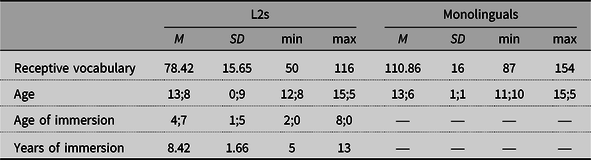
This study reports data from 33 Taiwanese middle school participants recruited from a single private high school in northern Taiwan, and studying in Grades 7, 8, or 9 (mean age = 13 years, 8 months [13;8], SD = 9 months). Data from these participants (henceforth the L2 group) were compared to that from 21 monolingual Canadian middle school participants (mean age = 13;6, SD = 13 months). In order to provide an independent baseline of proficiency, receptive vocabulary was assessed using the Peabody Picture Vocabulary Test (PPVT; Dunn & Dunn, Reference Dunn and Dunn2007), a test normed against monolinguals and that provides a score standardized for age. The standard score for the PPVT is 100, with a 1 SD range of 85 to 115. The L2 participants of this study fell below the 1 SD range with a mean score of 78.42 (SD = 15.65). This is not unexpected as similar disparities have been reported for French immersion learners (Hermanto, Moreno, & Bialystok, Reference Hermanto, Moreno and Bialystok2012). Data were collected from 37 L2 participants. However, the data of 4 participants were excluded from analysis. One excluded participant was an outlier for receptive vocabulary, scoring approximately 3 SDs below the mean for the immersion learners and 1 SD below the next lowest participant. In addition, 2 participants who had less than 5 years of immersion were also excluded. Finally, 1 participant reported having English exposure from birth from a native English-speaking father, and thus would be better classified as a heritage language speaker. All monolingual participants were included. The remaining L2 participants had been learning in an immersion context taught by a foreign teacher from an English-speaking country (e.g., the UK, US, Canada, etc.) typically since preschool (mean AoO = 4;7, SD = 17 months). After preschool, the learners attended a bilingual elementary school where half their content instruction was in Mandarin from a local teacher, and half in English. On average, they had attended an immersion program for 8 years and 5 months (SD = 20 months). All study participants were in good academic standing (i.e., they were passing their classes). Summary data are given for the L2 participants and the monolinguals in Table 1.
Age, vocabulary, and exposure data for participant groups
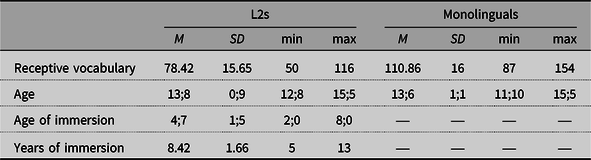
Note: Statistical means (M) are given with SD and both the minimum and maximum values for each variable. Receptive vocabulary is the standardized score on the Peabody Picture Vocabulary Test. The mean standard score for the Peabody Picture Vocabulary Test is 100 with the a 1 SD range 15 points above and below. The L2 participants fall below the 1 SD range on this monolingual-normed test. Age is the participants’ age at testing and age of immersion is the age beginning English in an immersion classroom. Both age variables are given in years and months (yy;mm).
Materials
Experimental stimuli for this study consisted of 16 sentence pairs. The head noun for each sentence appeared in either its singular or its plural form, creating 32 experimental items, which were counterbalanced across two stimulus lists containing equal numbers of singular and plural stimuli. The stimuli are provide in Appendix A. The 16 subject nouns all appear in a particular syntactic context where the noun target (e.g., either pencil or pencils in Example 1) is preceded by the definite article the, and appears before a verb that is not inflected for number. No stimulus noun appeared immediately before a word that began with either /s/ or /∫/ so that the plural allomorph, if present, should have been distinct from adjacent phonetic segments. The stimulus nouns were chosen to be highly imageable, frequent, and to be roughly balanced for the 3 potential plural allomorphs /s/, /z/, and /ǝz/ when in their plural form. According to the Corpus of Contemporary American English (Davies, Reference Davies2010), the median frequency for the nouns was 12,818 tokens per million words (IQR = 27,223 to 7,591). An example noun stimulus pair is given below.
1. Example stimulus pair
a. The pencil can be used for writing the test.
b. The pencils can be used for writing the test.
In order to prevent participants from immediately focusing on inflectionally marked number differences, stimuli also included 40 filler items that differed on a non-morphological semantic contrast (e.g., whether a shoe could be considered a womanʼs or a manʼs, or whether a flag was a Canadian flag or not). Within the experiment, there were also 24 stimulus items that differed in verb number agreement morphology. However, these are not analyzed here. Stimulus sentences were spoken by a female speaker of North American English and recorded digitally in a soundproof booth using a Korg MR-2000S studio recorder with a 44.1 kHz sampling rate and through a Countryman E6 headset microphone. The speaker was instructed to speak at a natural pace for casual speech, and the resulting mean articulation rate for the stimuli was 4.6 (SD = 0.71) syllables per second, calculated using Praat software (6.0.36; Boersma & Weenink, Reference Boersma and Weenink2017) running a script created by de Jong and Wempe (Reference de Jong and Wempe2009).
For each trial, participants saw four pictures on a computer screen. The four pictures were juxtaposed so that within each trial there were two potential target–competitor sets. For example, the four-picture stimulus display that accompanied the audio stimulus pair in Example 1 presented pictures of a single pencil, multiple pencils, and two pictures of single light bulbs that had a salient difference in type. This stimulus display is shown in Figure 1. For stimulus Example 1a, the picture of the single pencil was the target, the multiple pencils the competitor, and the pictures of the light bulbs were distractors. Target images could appear in any of the four image locations, but for each counterbalanced stimulus pair, the relative target and competitor locations were always the same (i.e., when the single-pencil image was the target, it appeared in the upper right corner of the display, and when the multiple-pencil image was the target the image also appeared in the upper right corner). In each trial, it was possible for picture pairs to differ in number of items, a non-morphological semantic contrast (for fillers), or to have one of each distinction, as in Figure 1. This was done in order to prevent participants from predicting the type of distinction in the audio stimulus.
A sample visual stimulus array. The picture set for this trial includes two noun pairs; two pencil images, and two light bulb images. The pencil images differ in number, while the light bulbs have a salient difference in type. Participants were instructed to keep their index fingers on left and right gamepad buttons and that target images could always be selected by left or right button. This trial corresponds to the example audio stimulus given in Example 1a. where the correct button would be the right button for the image of a single pencil.

Procedure
For each of the trials, participants listened to a stimulus sentence while viewing each four-picture set on a computer monitor. The audio stimulus played 1000 milliseconds (msec) after the pictures appeared. Picture sets differed for each trial. While listening to the audio stimulus through a pair of headphones, participants were tasked with deciding which picture was being referred to in the audio stimulus. Participants entered their response on a gamepad controller and were required to decide whether the picture was on the left or right side of the monitor, and to respond as quickly as possible. Participants had to respond within 3500 msec of the audio offset, after which the images on the display would disappear and no response would be recorded. A target image could appear in any of the four grid locations, with competitor images potentially appearing in either the top or bottom position on the alternate side of the screen. All potential combinations were equally probable. Participants held the gamepad in both hands and responded with their index fingers, which were held on either the left or right button. Stimulus trials were randomized for each participant with the condition that a single trial type (either plural–singular, verb, or filler) could not appear in more than three consecutive trials. For each trial, eye movements over the visual array were recorded using an SR-Research Eyelink Portable Duo set to a 500 Hz sampling rate and recording the right eye. Participants were positioned 50 cm from a 17-inch computer display with a resolution of 1,920 × 1,080 and a 60 Hz refresh rate. A head mount was not used, and participants could move their head freely. The Eyelink Portable Duo allows the distance between the participant and the display to be continuously monitored throughout the experiment. If the participant shifted outside of the optimal 42- to 62-cm range, they were asked to reposition themselves. The eye-tracker was calibrated for each participant, and between each trial a fixation point appeared at the center of the screen. When the participantʼs gaze was on the fixation point, a drift correction was performed, and the experimenter advanced the experiment to the next trial. Before beginning the experiment, participants completed three practice trials.
Results
Picture decision task: Response accuracy and response time
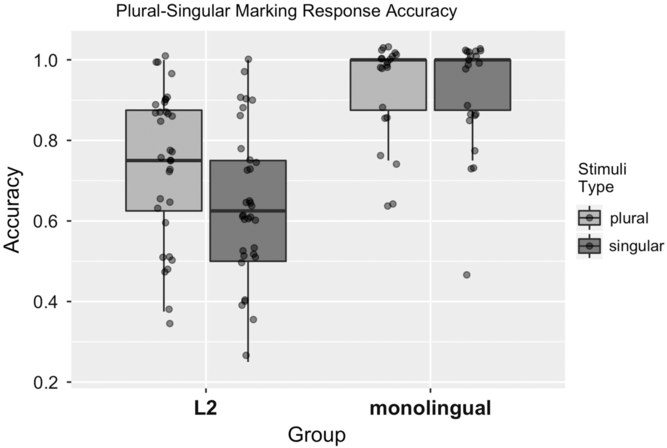
Data from both tasks were analyzed using R Statistical Software (version 3.6.0; R Core Team, 2018). The first hypothesis tested potential group differences in final interpretation reflected in picture decision task performance. Mixed-effects models were run on the accuracy and response times of button responses. These models used functions from the lme4 package (version 1.1.21; Bates, Mächler, Bolker, & Walker, Reference Bates, Mächler, Bolker and Walker2015). Trials where no button response was recorded (2.4% of trials; 2.8% for L2s and 1.8% for monolinguals) were counted as incorrect. Figure 2 presents a plot for response accuracy with responses divided by group and whether the correct response was the singular or plural image. When averaged across individual participants, the L2 groupʼs responses were 69% accurate with an SD of 14%, while the monolinguals were 92% accurate, with an SD of 12%.
Participant accuracy by participant group for both plural and singular stimulus types. Area within the boxes shows scores within the 2nd and 3rd quartile, with horizontal bars showing median accuracy. Whiskers cover data within 1.5 of the upper and lower quartile ranges. Points show individual participant accuracy for each stimulus type.
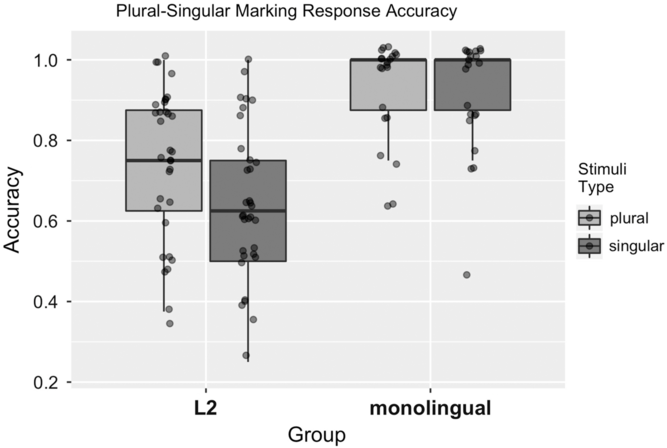
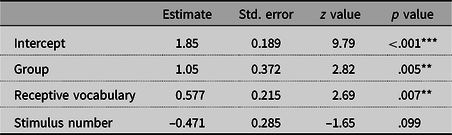
To compare accuracy of the two study groups, a binomial generalized linear mixed-effects model was run with the button response for each experimental trial as the dependent variable. In addition to group, the model was run with fixed effects for stimulus number (either plural or singular) and each participantʼs PPVT score. Inclusion of these variables was motivated by previous research showing learners can differ in responses to either plural or singular (Arias-Trejo, Cantrell, Smith, & Canto, & Elda, 2014; Xu Rattanasone et al., Reference Xu Rattanasone, Davies, Schembri, Andronos and Demuth2016), and that language proficiency may also impact whether participants respond to plural–singular marking (Song, Reference Song2015; Wen et al., Reference Wen, Miyao, Takeda, Chu and Schwartz2010). Group and stimulus number were categorical variables coded using effects coding rather than Rʼs default treatment coding, while PPVT score was a centered continuous variable. For group, monolinguals and L2s were coded as –0.5 and 0.5, respectively, and for stimulus number, singular and plural items were coded as –0.5 and 0.5, respectively. For random effects, the model included by-participant (Subject) and by-stimulus item (Item) random intercepts, as well as an uncorrelated random slope for PPVT score for Item. Following Matuschek, Kliegl, Vasishth, Baayen, and Bates (Reference Matuschek, Kliegl, Vasishth, Baayen and Bates2017), an attempt was made to add an uncorrelated random slope for stimulus number to Subject, and one for group to Item, but the lme4 package indicated that the addition of these slopes overfit the data. Including the correlation between PPVT and Item caused the model to fail to converge. A likelihood ratio test indicated that inclusion of the random slope for PPVT was warranted as it lowered the Akaike information criterion, χ2 (1) = 14.561, p < .001. In the model with the three fixed effects, only group and PPVT score made a significant contribution to accuracy. The model was also run with interactions between group and either of the variables for PPVT or stimulus number, but neither interaction was significant. Full results for this model are given in Table 2. Because group was also highly predictive of PPVT score, a point-biserial correlation for comparing dichotomous group with continuous PPVT score was run finding a moderately strong significant correlation, r pb (52) = .71, p < .001. Therefore, variance inflation factors (VIF) were calculated for the model using the vif function from the car package (version 3.0.3; Fox & Weisberg, Reference Fox and Weisberg2019). The results did not indicate that collinearity was an issue as the VIF scores were 1.36 and 1.36 for group and PPVT, respectively. These VIF scores are well below the 5 to 10 range where collinearity may be considered an issue (Levshina, Reference Levshina2015).
Model results: Picture decision accuracy
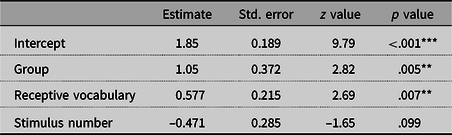
Note: Receptive vocabulary is the centered standardized score for the Peabody Picture Vocabulary Test (Dunn & Dunn, Reference Dunn and Dunn2007). *p < .05. **p < .01. ***p < .001.
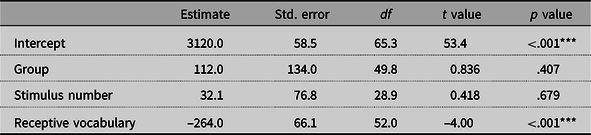
Because the participants were under time pressure to respond, response times for the picture decision task were analyzed to see if this may have impacted accuracy. To compare response times, a linear mixed model was run with response time for every individual trial answered correctly as the dependent variable. Response time was calculated as the time duration in milliseconds between the plural–singular marking cue and button press. The plural–singular cue was the end of the noun lemma for both plural and singular. For plural, this would be between the noun lemma and the beginning of the –s (… pencil[cue]s can …), and for singular, between the lemma and the onset of the next word in the stimulus (… pencil[cue] can…). Mean response times for correctly answered trials were 3285 msec (SD = 678) for the L2 participants and 2996 msec (SD = 619) for the monolinguals. A Shapiro–Wilk test indicated that response times were not normally distributed (W = 0.99, p < .001). Inspection with quantile plots and the boxcox function of the MASS package (version 7.3.51.4; Venables & Ripley, Reference Venables and Ripley2002) did not indicate analysis would benefit from transformation of the data. Participant group (either L2 or monolingual), stimulus number (plural or singular), and PPVT score were fixed effects. The same approach to random effects was taken as that for the accuracy model. Random slopes for stimulus number on Subject, and group on Item overfit the data. Further, a likelihood ratio test indicated that the random slope for PPVT on Item did not lower the Akaike information criterion, and was subsequently removed, leaving just random intercepts for Subject and Item. From this model, the data set was trimmed to just responses that fell within 2.5 SD of the mean response time (Baayen, Reference Baayen2008). This trimming resulted in eliminating 1.5% of the total observations. The lmerTest package (version 3.1.0; Kuznetsova, Brockhoff, & Christiansen, Reference Kuznetsova, Brockhoff and Christiansen2017) provided p values for models as lme4 does not provide these. This model found that only receptive vocabulary and neither participant group nor stimulus number made a significant contribution to the model either on their own or in interaction with other variables. Likelihood ratio tests comparing the full model to one with each fixed effect alternately removed also indicated that only receptive vocabulary contributed to a significantly better model, χ2 (1) = 14.724, p < .001. Results for the full model are given in Table 3.
Model results: Picture decision response times
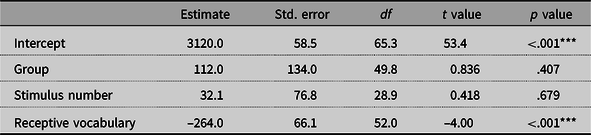
Note: Receptive vocabulary is the centered standardized score for the Peabody Picture Vocabulary Test (Dunn & Dunn, Reference Dunn and Dunn2007). *p < .05. **p < .01. ***p < .001.
Eye-tracking: Proportions of looks over time
For the second hypothesis, eye-tracking data were analyzed for differences between the participant groups in the proportions of looks after the plural–singular cue. However, because proportions are inherently bounded, proportions were transformed to empirical logits. This transformation requires aggregating over multiple observations (Barr, Reference Barr2008). The proportion of looks a participant made to each of the four stimulus images across trials was calculated for every 20-msec time bin. At the sampling rate of 500 Hz, this resulted in 10 samples per bin. These steps were performed using the R package VWPre (version 1.1.0; Porretta, Kyröläinen, van Rij, & Järvikivi, Reference Porretta, Kyröläinen, van Rij and Järvikivi2018). From these transformations, a target advantage score was calculated for the difference in looks to the target versus the competitor image for each 20-msec time bin, where a positive score indicated more looks to the target, zero indicated equal looks to the target and competitor, and a negative score indicated more looks to the competitor. Unlike for the accuracy and response time models where each trial represented one data point, each trial in the eye-tracking data represents a time series with one observation for target advantage score for every 20-msec time bin. Target advantage score served as the dependent variable for modeling.
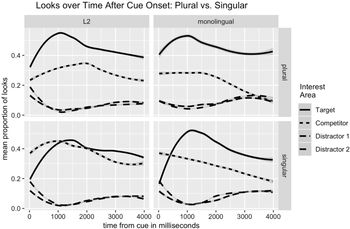
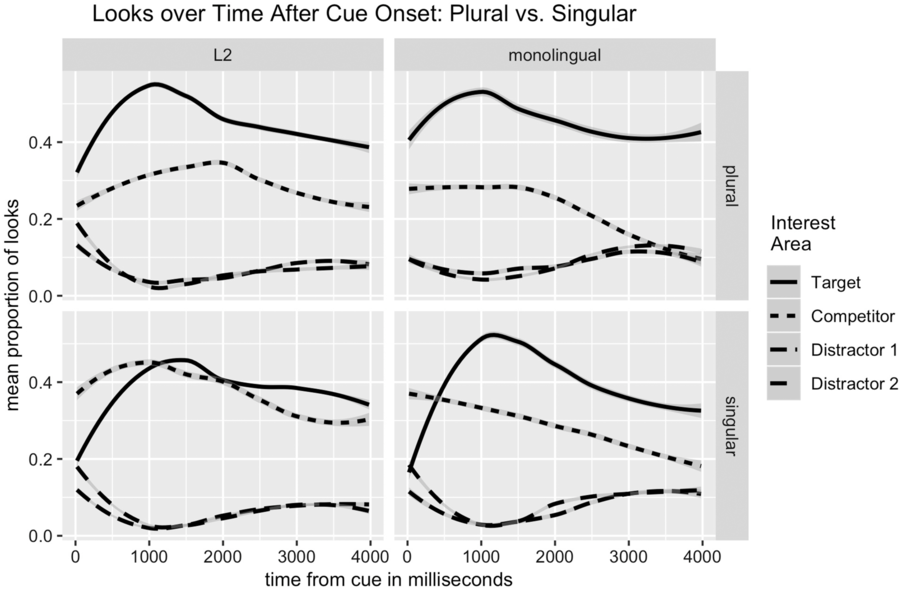
In order to model the looks for the two participant groups separately for plural and singular stimuli, an additional variable, Condition, was created, which combined the two variables. The four levels of Condition are shown in Figure 3, where the four figure panels show performance of the two participant groups (left and right) for the two stimulus types of plural (top) and singular (bottom). Figure 3 uses locally weighted smoothing (LOESS) lines to show the proportion of looks to the four interest area images averaged for each trial. The creation of Condition allowed the model to analyze the dependent variable, target advantage score, independently over time for the four different conditions of L2 responses to plural stimuli; L2 responses to singular stimuli; monolingual responses to plural stimuli; and monolingual responses to singular stimuli. These four independent time courses could then be compared for difference. This approach to the creation of Condition as a predictor variable capturing interactions between categorical variables follows van Rij, Hollebrandse, and Hendriks (Reference van Rij, Hollebrandse and Hendriks2016).
The figure shows LOESS smooth lines for mean participant looks by participant group for plural and singular stimulus types over a 4-second time interval beginning at the offset of the target noun lemma, i.e., at either the onset of the plural ‘-s’ or its absence. At the 0 point, looks to the target and competitor have already begun to diverge from the distractor images as looks to the potentially appropriate images begin shortly after the noun onset. This is expected, and shows that both groups rapidly comprehend the target noun, but have a bias toward looking at plural images.
To analyze differences in target advantage score for the time series in each trial, the eye-tracking data were analyzed with generalized additive mixed models (GAMMs; Baayen, Vasishth, Kliegl, & Bates, Reference Baayen, Vasishth, Kliegl and Bates2017; Wood, Reference Wood2006). Because GAMMs allow the comparison of nonlinear effects over time, they are well suited for use with visual-world data. GAMMs were run using the mgcv package (version 1.8.28; Wood, Reference Wood2006).
An initial model was run with the four levels of Condition and PPVT score as fixed effects. Condition was modeled as a smooth term to capture the nonlinear performance reflected in Figure 3, and as a parametric predictor in order to account for potential intercept differences between levels of factors. PPVT was also modeled as a smooth term to capture potential nonlinear influence. Rather than model the entire time course for each trial, a time window of 2000 msec beginning 200 msec postcue was selected. The 2200-msec end point was used as inspection of Figure 3 shows that looks to the target image generally peak around 1000 msec, then decrease until 2000 msec, and then plateau (with a slight continued decrease) around 2000 msec when looks to distractors are also beginning to increase. This indicates the impact of plural–singular marking on looks has largely faded beyond this approximate point, meaning looks beyond this point are less likely to be reliably associated with the experimental task.
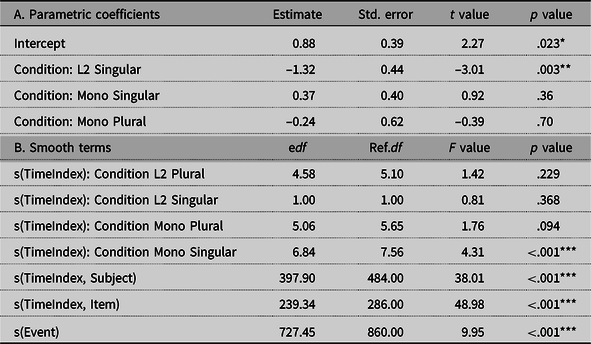
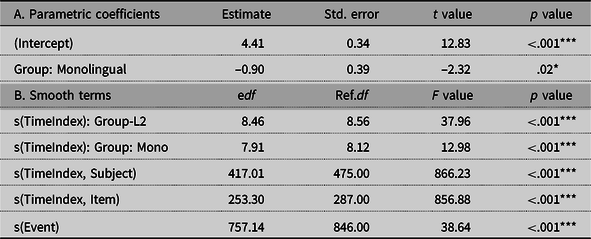
Like the generalized linear mixed-effects models, the GAMM included random effects for Subject, and Item, as well as one for each experimental trial (event). Each unique time series for Subject and Item was given its own random smooth, while event was given a random intercept. The functions acf_resid and compareML from the itsadug package (version 1.1.0; van Rij, Wieling, Baayen, & van Rijn, Reference van Rij, Wieling, Baayen and van Rijn2017) were used to calculate a rho value of .006 to correct for autocorrelation within the model, and to do model comparisons, respectively. Comparisons indicated that PPVT score did not improve the fit of the model and was therefore removed. Inclusion of Condition provided a better fit to the data than a model with just the random effects (freml difference = 70.14, p = < .001). The parametric and smooth term coefficients for this model are given in Table 4.
Generalized additive mixed model output for the eye-tracking model

Note: The table presents the parametric and smooth coefficients for the optimal model with the difference in looks to the target minus looks to the competitor image for both stimulus types, and both participant groups. The results of this model are visualized in Figure 4. *p < .05. **p < .01. ***p < .001.
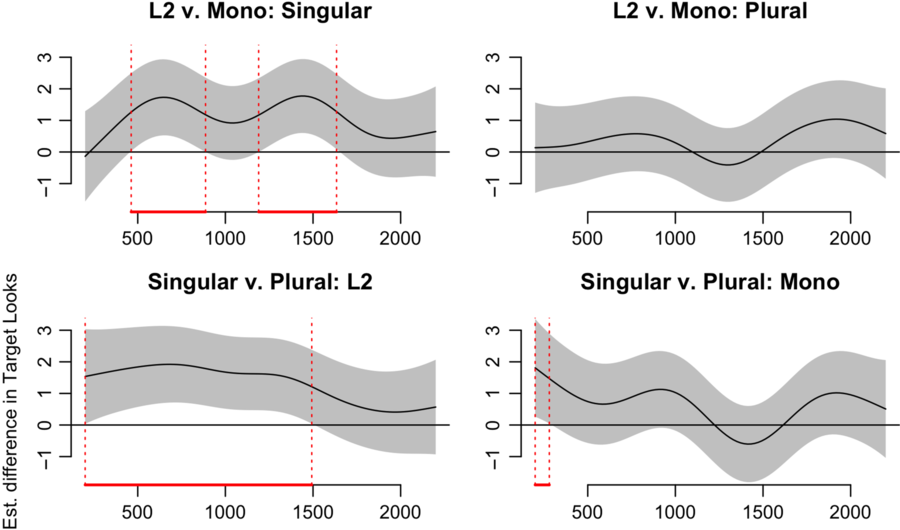
As indicated, Condition was an informative variable in explaining differences in target advantage score (i.e., the proportion of looks to either the target or the competitor image). Interpretation of GAMM results requires visual inspection of the model output, which is given in Figure 4. The top row of Figure 4 shows comparisons of the differences in target advantage score between the two groups and for the two levels of stimulus number, singular (left) or plural (right). The bottom row shows comparisons for the two stimulus types within each group (L2s on the left and monolinguals on the right). Points where the error bar shading does not cover the x-axis represent time windows with significant differences in proportions of looks. For the between group comparison for singular stimulus items (Figure 4, top left), the monolinguals have significantly more looks to the target beginning at 463 until 887 msec, and then again from 1190 to 1635 msec, indicating that the monolinguals look to singular targets more rapidly, and more in general throughout the time window. In contrast, the comparison for plural stimulus items (top right) showed no significant difference between the groups over the 2-second time window. For the two levels of stimulus number, the L2s already had significantly greater looks to the target for plural stimuli by the 200-msec intercept, which lasted until 1493 (bottom left), indicating that the L2s have a greater proportion of looks to plural targets than singulars. For the monolinguals, there was a significant difference between the two stimulus types at the 200-msec intercept, but it disappeared at 281 msec (bottom right). This small significant difference was likely the result of an early bias to look at images with multiple items.
This plot shows the output of the plot_diff function from the itsadug package for the GAMM model. The plot shows comparisons of the four levels of Condition over time in msec. In each case the first term in the plot label serves as the x-axis and the second term is represented as the smooth line in relation. Points where error bar shading does not cover the x-axis represent significant differences and are delineated by vertical dashed lines.

Post hoc analysis
The purpose of the present study was to test comprehension of plural–singular marking, specifically with the expectation that the L2 group is likely to differ in their sensitivity to this feature in relation to their general English comprehension. The evidence presented here demonstrates not only that this population of L2 English learners use the information provided by inflectional plural–singular marking less consistently but also that proficiency, in the form of greater receptive vocabulary (i.e., PPVT score), makes a difference for accurately interpreting plural–singular marking. This raises the question of whether the lower performance for the L2 participants of the present study is due to a general lack of proficiency. Here, additional data from the picture decisions for filler trials and looking behavior during experimental trials are presented to aid interpretation of this studyʼs findings.
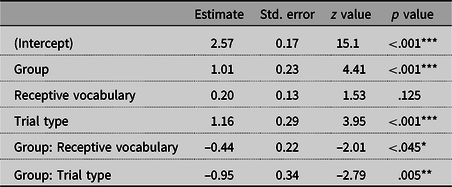
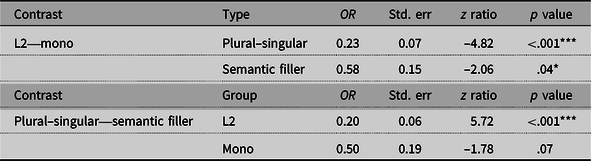
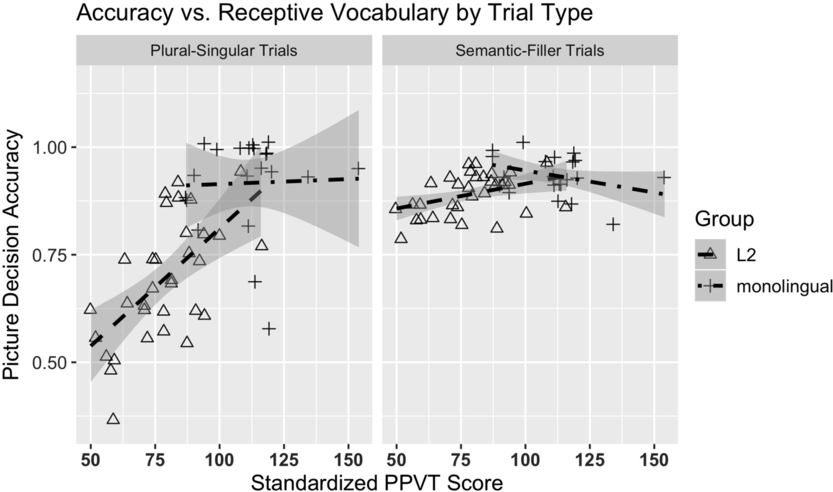
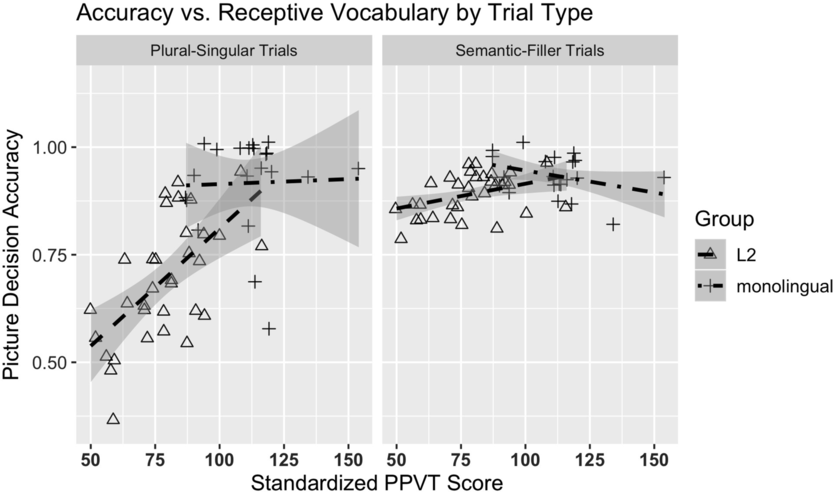
In completing the experiment, participants made button responses to all trials, including 40 fillers that required responding to a non-morphological semantic contrast. For example, one such filler trial presented the audio stimulus “The shovel is stuck into the sand” along with a target image of a toy shovel stuck upright into a sandy beach alongside a competitor image of a similar shovel lying flat. For these items, the accuracy of the two groups was more comparable, with monolingual accuracy at 93% (SD = 4%) and the L2s at 89% (SD = 4%). To further compare the group results for filler trials, a mixed-effect model predicting accuracy was run with the group variable in interactions with PPVT score and trial type (either plural–singular or semantic filler coded as –0.5 and 0.5, respectively). Due to overfitting, random effects were reduced to only a random intercept for Item with a random slope for PPVT score. The impact of each of these factors was investigated using estimated marginal means from the emmeans package (version 1.3.4; Lenth, Reference Lenth2019). Results of the model are presented in Table 5 and show that the group interactions were significant. The significant interaction between group and trial type is unpacked in pairwise comparisons shown in Table 6. These comparisons show that there was no statistically significant difference between the two trial types for the monolingual group, while the L2 group was significantly lower for plural–singular trials as opposed to the filler trials. After accounting for receptive vocabulary, a significant difference still existed between the groups for the semantic fillers. The impact of PPVT score on accuracy is illustrated in Figure 5, where comparison of the two panels shows that the monolinguals did not vary greatly among themselves or between the two trial types of plural–singular marking (left panel) and semantic fillers (right panel). In contrast, the L2s showed a much greater range in accuracy in their interpretations of the experimental plural–singular stimuli. While PPVT score significantly impacted the L2s’ accuracy for both trial types, the influence was greater for plural–singular trials.
Model results: Picture decision accuracy
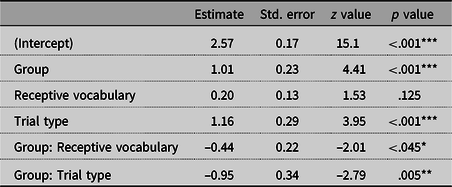
Note: Receptive vocabulary is the centered standardized score for the Peabody Picture Vocabulary Test (Dunn & Dunn, Reference Dunn and Dunn2007). *p < .05. **p < .01. ***p < .001.
Post hoc pairwise comparisons for group and trial type
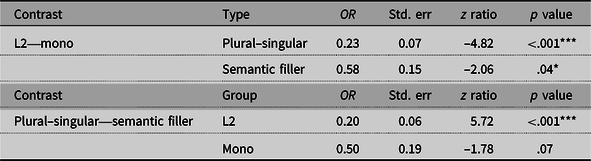
Note: Pairwise comparisons of the Group × Trial Type interaction in the post hoc picture decision accuracy model. Plural–singular trials are the experimental stimulus trials. These comparisons show that while the L2 group made significantly less accurate picture decisions than the monolinguals for both trial types, only the L2 group had a significant difference between the two trial types. *p < .05. **p < .01. ***p < .001.
Participant accuracy by participant group is plotted against PPVT score for plural-singular trials and semantic-filler trials. Points show individual participant accuracy for each stimulus type.
An additional post hoc test on the eye-tracking data was run with the aim of showing whether L2 participants understood the stimulus nouns. This examined whether upon hearing a stimulus noun such as “pencils,” L2 participants were looking at either of the pencil images, or at distractor images. To test this, an additional GAMM was run as before, but with looks to the distractor images subtracted from looks to the lemma-appropriate (either target or competitor) images as the dependent variable. An initial model was run over the original 2000-msec time window. However, a significant difference emerged late, and therefore the time window was expanded to encompass this entire difference window. (When the data points beyond 2200 msec are put into the model, the beginning of this difference shifts beyond 2200 msec.) With this model, both groups show comparable relative looks to either the lemma-appropriate images or the distractors until 2382 msec, where a significant difference emerges, showing that the L2 participants have more relative looks to the appropriate images. This lasts until 3968 msec. Results for this model are reported in Table 7. For looks that were recorded but were not in any interest area, the proportions were similar across groups at 8% (SD = 3%) and 11% (SD = 5%), for L2s and monolinguals, respectively. This post hoc analysis of the eye-tracking data indicates that both groups were similar in their ability to comprehend the noun lemmas.
Generalized additive mixed model output for looks to lemma-appropriate versus distractor images
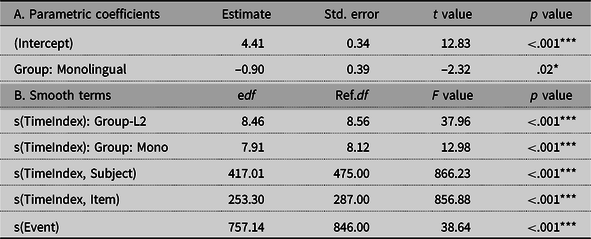
Note: This table presents the parametric and smooth coefficients for a model with the difference in combined looks to the target and competitor images minus the combined looks to the two distractor images compared across the two participant groups. The results of this model showed that the L2 group was statistically significantly more likely to be looking at the target and competitor images within a late window from 2382 msec to 3968 msec. *p < .05. **p < .01. ***p < .001.
Discussion
The purpose of this study was to investigate the comprehension of English plural–singular marking, a highly frequent and semantically transparent morphosyntactic feature, by middle school-aged, Mandarin-L1 speakers who have learned their L2-English in immersion classrooms since preschool. An age-matched monolingual control group was included to aid interpretation of the immersion learners’ task performance. The study employed a visual-world eye-tracking task, combined with a task that involved making a picture decision based on the presence or absence of the plural –s morpheme. Findings indicated that there were differences between these English immersion learners and the monolinguals in their online comprehension of plural–singular marking and in their final interpretations. These differences emerged despite the L2-immersion learners typically having begun English immersion in preschool and having more than 8 years of L2 exposure.
L2 plural–singular marking comprehension: Offline interpretation and online sensitivity
The first research question asked if the L2 group would differ in their offline interpretation of plural–singular marking, and it was hypothesized, based on research for ML learners and late instructed-L2 contexts, that they would be less accurate in responding on the picture decision task. Results for the picture decision task revealed that L2 participants were significantly less accurate than the monolinguals in their ultimate interpretations of the audio stimuli. The task used here was not designed to be difficult, and as expected, the monolinguals made highly accurate picture decisions (92% accurate), with 9 of the 21 monolinguals making no errors. In contrast, no L2 participant was 100% accurate, and only 2 of the 33 scored above 90%, with group performance at an average of 69%. In addition, as hypothesized, receptive vocabulary size, used here as a proxy for English proficiency, was a predictor of accuracy. However, after the variance explained by receptive vocabulary was accounted for, the influence of participant group remained. This evidence shows that the L2 participants were less likely to arrive at an accurate ultimate interpretation of plural–singular marking as compared to the monolinguals, though participants with larger receptive vocabularies were more likely to arrive at a picture decision consistent with the marked stimulus noun.
For picture decision response times, the only significant predictor was receptive vocabulary. This means that participants of either group were similarly fast when making a correct response to a trial and without regard to whether the stimulus was plural or singular. When L2 participants correctly interpreted the audio stimulus, they did so as quickly as the monolinguals. The difference is that these correct interpretations happened less often for the L2 participants. As participants were given a limited time to respond, the L2 participants may have been impacted by a speed–accuracy tradeoff, which does not appear to be the case for the monolinguals, though additional research is required to determine if, given more time, the L2s’ response accuracy would increase.
The second research question asked about online interpretation of plural–singular marking. In line with what was hypothesized, participant group predicted significant differences in looking behavior. However, this was limited to singular stimulus trials, with plural trials showing no difference from monolinguals (see Figure 4). For singular trials, an early difference arose between the L2 participants’ and monolinguals’ looks to target images, indicating that the L2 participants typically had a delayed response to singular nouns as compared to monolinguals. In contrast, on plural stimulus trials, the L2 participants were able to mirror the timing of monolinguals’ increasing looks to plural targets.
When the two stimulus types are compared directly, the L2 participants also showed an advantage for looks to plurals as compared to looks to singular targets. The L2 participants’ looks were significantly more likely to correspond to the appropriate image on plural trials as opposed to singular trials, and this difference lasted from cue onset until about 1500 msec (see the lower left panel of Figure 4). Though it appears that the L2 participants had an advantage for comprehension of plurals, this did not translate into greater ultimate accuracy on the picture decision task where there was not a significant difference between accuracy for the plural and singular items. In sum, the hypothesis that the L2 groupʼs looks to target images would be delayed and be lower in proportion only held for singular stimulus items. In addition, it was hypothesized that receptive vocabulary would have an impact on speed and proportion of looks. However, no statistically significant impact of receptive vocabulary was found.
In order to aid in interpretation of these results, two post hoc tests were run. A potential explanation for the accuracy difference found for the picture decision task is that the immersion learners simply had low proficiency and that findings would not be unique to interpretation of plural–singular marking. However, a post hoc test for accuracy with the filler items showed that the L2 group had significantly lower accuracy in their interpretation of the plural–singular stimuli than for the semantic filler items. In contrast, this was not true for the monolingual participants, who did not differ in their accuracy for either trial type. Despite the much smaller range in accuracy for filler trials, receptive vocabulary was still a predictor of accuracy for the L2 group. This test shows that, like research for immersion learners in other contexts, these L2 participants have good general L2 comprehension, but can exhibit differences when specific morphosyntactic features are scrutinized.
In addition, a post hoc GAMM was run on the difference between looks to the experimental images (either the target or the competitor images) versus the distractors to see if L2 participants had online difficulty interpreting the stimulus nouns. This showed that the L2 participants were as likely to be looking at lemma-appropriate images as the monolinguals within the 200- to 2200-msec postcue time window, and more likely to be looking at the experimental images after the experimental time window. However, this later advantage in looks to the target and competitor came at a time point when looks to these images were decreasing for both groups (see Figure 3) and therefore represents a slower decrease rather than an increased response. That the L2 participants tend to look at the experimental images for longer likely reflects their lesser certainty in determining the target image based solely on plural–singular marking.
A seemingly incongruous finding of the present study was that the L2 participants appeared to interpret plural marked nouns as consistently as monolinguals in online comprehension, but this did not translate into either monolingual-like accuracy on the picture decision task or even significantly greater accuracy than for singular stimuli. However, it is not uncommon for participants to differ in their performance during an online task and when completing a subsequent explicit offline task similar to that of the present study. For young children, eye movements have demonstrated understanding of others’ false beliefs (Clements & Perner, Reference Clements and Perner1994; Oniski & Baillargeon, Reference Oniski and Baillargeon2005) or verb number–agreement marking in L1 German (Brandt-Kobele & Höhle, Reference Brandt-Kobele and Höhle2010), even when this was not reflected in childrenʼs explicit answers. Thus, online tasks can show understanding earlier in development than explicit tasks. This should be predicted given that for tasks like eye-tracking, even a partial representation of a feature can be beneficial (Chang, Dell, & Bock, Reference Chang, Dell and Bock2006), whereas accomplishing an interpretive task requires integrating that information into a full utterance, a task likely to require a more robust linguistic representation.
Overall, this study supports research for child ML learners (Jia, Reference Jia2003) and late-L2 learners (Jiang, Reference Jiang2007; Jiang et al., Reference Jiang, Novokshanova, Masuda and Wang2011) that shows speakers of languages with optional number marking can have differing attainment for English plural–singular marking. Findings also support studies of language immersion that show differing attainment for some features of L2 morphosyntax (e.g., Harley, Reference Harley1993; Ó Duibhir, Reference Ó Duibhir, Tedick, Christian and Fortune2011; Warden, Reference Warden1997). This study joins Lew-Williams (Reference Lew-Williams2017) in showing that it is not only the morphosyntactic production skills of immersion learners that can be divergent from those who speak the language as an L1. In addition, this study also shows that differences in immersion learners’ comprehension are not limited to abstract features like grammatical gender.
Acquiring L2 morphosyntactic constructions in immersion
Like Lew-Williams (Reference Lew-Williams2017), this study finds that early immersion learners can have differences in L2 comprehension. In the Lew-Williams study, the author found that unlike Spanish-L1 peers, English-L1 classmates could not identify upcoming nouns by using abstract grammatical gender, but were able to use the more semantically transparent features of number and notional gender. However, it remained unclear whether it was semantic transparency or that English has both number-marked determiners and morphological forms that reflect notional gender (i.e., pronouns) for which processing skills could be transferred. In the present study, semantically transparent bound plural–singular morphology was examined. However, unlike Spanish and English, Mandarin and English differ with regard to whether number marking is obligatory. Despite having 3 fewer years of exposure to their L2 than the L2 participants of the current study, the English-L1 participants of Lew-Williams (Reference Lew-Williams2017) were similarly responsive to Spanish number marking on a task that reflected rapid comprehension as compared to their Spanish-L1 peers. In the present study, the differences between the participant groups for both the eye-tracking and the picture decision tasks maintain after more than 8 years of immersion indicating that for plural–singular marking, semantic transparency is not enough to ensure that L2-immersion learners eventually make use of this contrastive L2 feature in the same manner as those who have learned the language as an L1.
Despite the lower task accuracy for L2s, given a binomial distribution, most participants of the L2 group were above chance in their responses for both singular and plural stimulus items, indicating that they have established receptive knowledge of plural–singular inflection. Thus, the present studyʼs findings may suggest these participants’ plural–singular marking knowledge is at an intermediate stage of development. It is important to note that in the Lew-Williams study, participants responded to number-marked determiners rather than bound morphemes. For L1 English, research indicates that the bound morpheme on the noun may be a later acquired number marker as compared to features (or the combination of features) such as determiners and verb agreement (Kouider et al., Reference Kouider, Halberda, Wood and Carey2006; Wood et al., Reference Wood, Kouider and Carey2009), and thus, the differences in findings between the two studies may be the result of construction difficulty. If this is the case, it is possible that the participants of the Lew-Williams study would have had lower accuracy if limited to bound morphology and that the participants of this study would do better if number were also marked on determiners (the latter having a strong likelihood given that in Mandarin plural and singular can also be marked this way when appropriate to the discourse context). As a result, the findings of the present study may not be the result of differences between the L1 and the L2.
In addition, prior L1 developmental research has found that young children developing comprehension of plural–singular marking can be more sensitive to plural forms than singular (see Arias-Trejo et al., Reference Arias-Trejo, Cantrell, Smith and Canto, Elda2014, for L1 Spanish; Xu Rattanasone et al., Reference Xu Rattanasone, Davies, Schembri, Andronos and Demuth2016, for L1 English and L2-English speakers without a Chinese L1). Thus, the present studyʼs findings that the L2 participants had low accuracy for both plural and singular, but more looks to plural stimulus targets may also suggest these participants’ plural–singular marking knowledge has been assessed at an intermediate stage of development. However, Xu Rattanasone et al. (Reference Xu Rattanasone, Davies, Schembri, Andronos and Demuth2016) found that L1-Chinese participants were more accurate with singular stimuli and thus did not follow this pattern. Though this study cannot rule out the possibility that the L2 participants are still developing this knowledge, it is unclear how well the L1 developmental patterns of children 2 to 4 years of age generalize to adolescent L2 learners with more than 8 years of L2 exposure.
Connections to late L2 learners
Findings for late learners also support that knowledge of plural–singular marking can be late emerging for speakers of an optional-number L1. Studies that have probed receptive sensitivity to English number marking for these participants using self-paced reading (e.g., Jiang, Reference Jiang2007; Jiang et al., Reference Jiang, Novokshanova, Masuda and Wang2011; Song, Reference Song2015; Wen et al., Reference Wen, Miyao, Takeda, Chu and Schwartz2010) have differed as to whether their respective participants were as sensitive to written grammatical errors as native-speaking controls. Wen et al. (Reference Wen, Miyao, Takeda, Chu and Schwartz2010) and Song (Reference Song2015) found that advanced L2-English speakers were sensitive to the marking, but that intermediate speakers were not, indicating that this knowledge does not appear until a very high level of English proficiency is attained. In contrast, this delay does not appear to apply to English learners whose L1 also has obligatory number marking as Jiang et al. (Reference Jiang, Novokshanova, Masuda and Wang2011) compared proficiency-matched L1 groups and found only the optional number-marking-L1 group (Japanese) were less sensitive to plural–singular marking errors, while both groups performed similarly in detecting verb subcategorization errors.
An additional concern within the late-L2 literature was stimulus complexity that required noticing agreement errors beyond multiple phrase boundaries as in “*several of the board member” (Jiang et al., Reference Jiang, Novokshanova, Masuda and Wang2011). In the present study, participants were only required to interpret the noun in its correct plural or singular morphological form within a stimulus sentence. Using these stimuli, both the picture decision task and the eye-tracking data indicated that the participants differed from the monolingual participants. Generalizing between participant groups that differ in age, type of L2 exposure, and across experiment types should be done with caution. However, evidence that proficient child L2 learners can also have nontarget acquisition with features of an L2 indicates that the issue of L1–L2 differences is not (only) rooted in maturation, and that other factors can play a role.
Ultimate attainment in immersion
Despite the years of exposure that the L2 group had received, a limitation of this study is that it does not provide conclusive evidence that the participants had reached their ultimate L2 attainment. The results of the present study show that the L2 participants were above chance in their interpretation of plural–singular marking, indicating they had acquired knowledge of the L2 feature, though it is unclear why they use this marking with a consistency that differs from the monolinguals. Though the current studyʼs results show parallels with developmental patterns in L1 acquisition, explaining these results as the product of either continuing or incomplete attainment may not accurately capture usage within this context. Based on English ML contexts, plural–singular marking can be considered a frequent and reliable morphosyntactic feature. However, this assumption may not generalize to immersion classrooms (or other foreign language learning contexts). A potential advantage in studying immersion learners within a single school is that the participant group is both a study sample and a sample of the individuals with whom each participant is likely to interact. The findings of this study indicate that the interaction these L2 learners have with classmates is likely to involve seemingly less reliable use of plural–singular inflection, and given that a feature of immersion contexts is that interaction is largely limited to the classroom (Swain & Johnson, Reference Swain, Johnson, Johnson and Swain1997), this may account for a substantial proportion of their L2 interaction. A potential alternative explanation for the results found here is that the L2 participants’ usage of plural–singular marking is continuing neither in development toward a monolingual standard nor in a “fossilized” state short of that standard, but rather at a stable stage of development influenced by and potentially consistent with L1 pragmatic usage.
In studying Mandarin-L1 children and adolescents, Jia (Reference Jia2003) observed that a participant might provide obligatory plural marking on a particular noun, but then later produce the noun without the obligatory marking, even within the same testing session. However, it is important to note that neither Jia nor the current study can provide evidence that these differences in language use were unsystematic errors, and not a consistent and accurate reflection of pragmatic usage within the respective L2 users’ linguistic context. In a later study of the same participants, Jia and Fuse (Reference Jia and Fuse2007) found that whether an individualʼs linguistic environment favored the L1 or L2 impacted the likelihood of standard use of inflectional morphemes. Thus, it is possible that participants whose linguistic environments were more Mandarin dominant produced plural marking influenced by Mandarin pragmatics. Potentially, both Jiaʼs participants and the L2 participants of the present study were more likely to interpret and produce plural–singular marking when assumed to be contextually relevant, a possibility that can be probed in future research. In addition, given the possibility these immersion learners rely more on other quantifiers such as number-marked determiners, future research should aim to link L2 participants’ preferences for marking number in production with their language comprehension ability (i.e., Do L2 learners who produce more quantifiers rely more on quantifiers in comprehension?).
Conclusion
The goal of this study was to examine immersion learners’ comprehension of L2 morphosyntax. This study shows that, unlike global measures of language comprehension, more fine-grained online measures and more targeted explicit tasks demonstrate that differences exist between monolinguals and immersion learners with an early L2 start and extensive exposure to the L2. The present study provides evidence that these immersion learners do not interpret English plural–singular marking identically to monolingual English speakers. However, it remains unclear why these differences should exist for a semantically transparent, highly frequent morphosyntactic feature.