Mastitis, mammary gland inflammation, is regarded as one of the gravest dairy cow illnesses. It negatively influences milk production and, in this category of animals, it represents probably the major indication for application of antibiotics (Bradley, Reference Bradley2002; DANMAP, 2003). Most frequently, mastitis is caused by bacterial infections induced by one of the five most common pathogens of mammary gland, namely staphylococci, Str. agalactiae, Str. dysgalactiae, Str. uberis, and by various Gram-negative bacteria. Nevertheless, according to literature, udder inflammation can be caused by more than 130 types of microorganisms (Watts, Reference Watts1988).
Increasing resistance of bacteria to antimicrobial agents (Williams, Reference Williams2000) represents a threat both in human and veterinary medicine, therefore, the World Organisation for Animal Health (OIE) recommends monitoring of resistance of pathogens and commensal bacteria to antimicrobials as necessary. Such monitoring provides essential information for therapeutic measures and, at the same time, it also shows trends in development of bacterial resistance that can be considered in application of individual antimicrobial drugs in practice.
The aim of this research is to study the prevalence and antimicrobial susceptibility of pathogens causing clinical and subclinical mastitis in Slovakia.
Materials and methods
Sampling
The animals were selected on the basis of measures taken by veterinarians to prevent mastitis. They came from 42 Western Slovakian dairy cattle herds with conventional (non-organic) farming. The number of farms investigated represents 5% of Slovakian dairy farms of size category 50 to 500 animals. Between February 2015 and August 2016, a total of 633 quarter milk samples taken from 512 selected dairy cows were examined. Milk samples were examined for visible abnormalities and screened using California mastitis test (CMT). The reactions were graded as 0 for negative, +1, +2, +3 for positive. The samples from all CMT positive quarters were considered for bacteriological culture.
Bacteriological culture
Milk samples (10 µl of inoculum) were aerobically cultivated on aesculine blood agar plate and McConkey agar plate at 37 °C for 24 h. Growth on the plates was confirmed by additional laboratory tests. S. aureus was identified by means of typical colony morphology, and β-hemolysis, or by coagulase reaction (coagulase positive) when typical hemolysis zones were not present. CNS were identified by typical colony morphology and coagulase reaction. Streptococci were determined by colony morphology and CAMP-reaction, and 12 biochemical reactions (hippurate, aesculine, salicine, sorbitol, mannitol, raffinose, lactose, saccharose, inulin, trehalose, starch and glycerine), were used for typing to the species level. Enterococci were confirmed by Gram-staining and growth of typical colonies on SlaBa-plates (Slanetz & Bartley Medium, Oxoid Ltd., Basingstoke, England). A milk sample was classified as positive if at least one colony-forming unit (CFU) of S. aureus or Str. agalactiae was isolated. For other agents, the presence of at least three CFUs was needed for positive classification. Samples were classified as contaminated if three or more bacterial types were isolated from one milk sample and growth of a major udder pathogen was not identified. If growth of a major udder pathogen was found in combination with contaminating species and if the CMT was high, the sample would be diagnosed as positive for growth of the major udder pathogen (Persson et al., Reference Persson, Nyman and Gronlund-Andersson2011).
Susceptibility testing
Cns, S. aureus, Str. uberis, Str. agalactiae, and E. coli were tested for susceptibility to 16 antimicrobial agents from the following groups: penicillins, cephalosporins, tetracyclines, aminoglycosides, lincosamides, ansamycins, folate pathway inhibitors, quinolones, and others. In vitro susceptibility of the isolates against antimicrobial agents was determined by the standard disk diffusion procedure (CLSI, 2013). The diameters of the inhibition zones were evaluated (susceptible, intermediate, resistant) according to EUCAST and CLSI breakpoints (NCCLS, 2002; CLSI, 2018). Further details are provided in the online Supplementary File.
All isolates of staphylococci were in addition examined for presence of mecA-gene by polymerase chain reaction according to Strommenger et al. (Reference Strommenger, Kettlitz, Werner and Witte2003).
Results
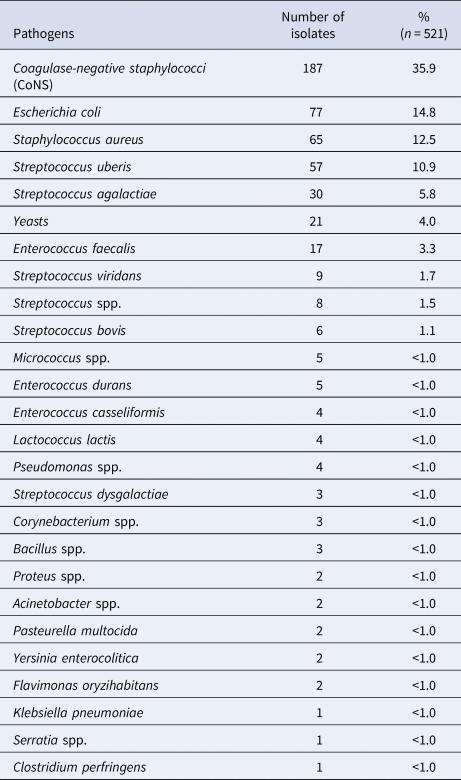
In total, 521 (82.3%) samples were identified as positive for pathogenic bacteria and 112 (17.7%) samples were identified as negative or contaminated. The results of cultivation of microorganisms are shown in Table 1. Out of 633 milk samples, 21 yeast strains and 500 bacterial strains of 25 types were isolated. Mixed infection of two pathogens was not identified. The CNS represented the most commonly detected bacteria (35.9% of positive findings); E. coli (14.8%) were the second most abundant pathogens followed by S. aureus (12.5%), Str. uberis (10.9%), and Str. agalactiae (5.8%).
Pathogens isolated from milk of dairy cows in 2015–16 in Western Slovakia

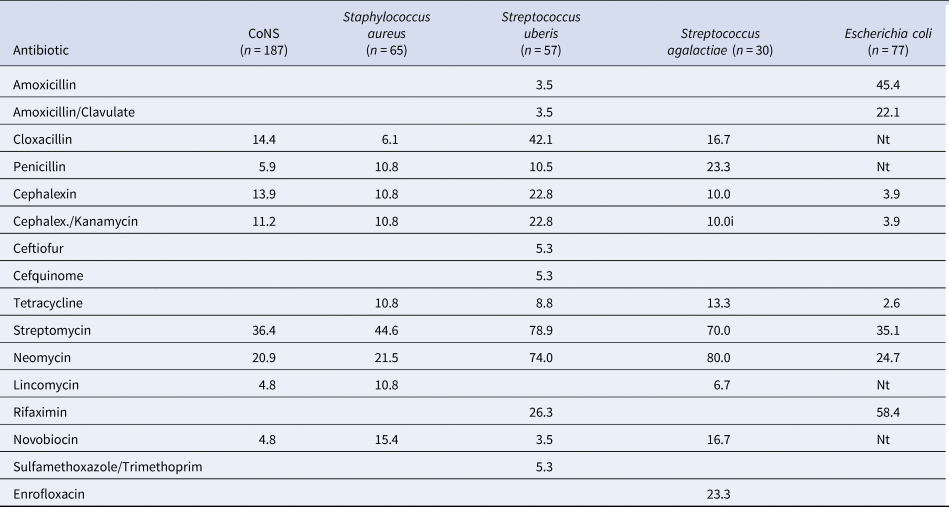
Table 2 shows results of trials testing resistance to antimicrobial agents. Out of the 416 tested isolates, 260 (62.5%) proved to be resistant to at least one antimicrobial agent; the highest number of resistant strains was found in Str. agalactiae (100%), Str. uberis (86%), and E. coli (79%). Most commonly, the isolated strains exerted resistance to streptomycin, neomycin, and also to cephalexin and penicillin. A minority of the observed strains were resistant to ceftiofur, cefquinome, sulfamethoxazole, and enrofloxacin. Altogether, 61 strains (14.7%) demonstrated simultaneous resistance to three or more groups of antimicrobial agents (multi-antibiotics resistance), out of which the most abundant were Str. uberis, Str. agalactiae, and E. coli.
Antibiotic resistance of isolated udder pathogens (% of resistant pathogens) from milk of dairy cows in 2015–2016 in Western Slovakia

Altogether, 260 out of 416 isolates (62.5%) showed resistance to at least 1 antibiotic.
The widest spectrum of resistance was found in Str. Uberis, which showed resistance to 14 types of antimicrobial agents out the 16 tested species. Other pathogens such as CNS, S. aureus, Str. agalactiae, and E. coli, were resistant to 8–10 types of antimicrobials. Generally, the lowest level of resistance was shown to the following substances: amoxicillin reinforced with clavulanic acid, ceftiofur, cefquinome, sulfamethoxazole reinforced with trimethoprim, and enrofloxacin.
The most frequently identified pathogens, CNS, demonstrated resistance to streptomycin, neomycin, cloxacillin and penicillin (36.4, 20.9, 14.4 and 5.9%). The tested CNS strains were not resistant to amoxicillin, tetracycline, ceftiofur, cefquinome, rifaximin and enrofloxacin, sulfamethoxazole reinforced with trimethoprim and enrofloxacin.
S. aureus was found to be resistant to streptomycin, neomycin, novobiocin and penicillin (44.6, 21.5, 15.4 and 10.8%). On the contrary, no S. aureus isolate demonstrated resistance to amoxicillin, amoxicillin fortified with clavulanic acid, ceftiofur, cefquinome, rifaximin, sulfamethoxazole-trimethoprim and enrofloxacin.
None of the isolates of Staphylococcus spp. were positive for presence of mecA-gene by PCR.
Str. uberis showed resistance to streptomycin (78.9%), neomycin (74%), cloxacillin (42.1%), and rifaximin (26.3%). Frequently, resistance to cephalexin (22.8%) and penicillin (10.5%) was found. No resistance to lincomycin and enrofloxacin was demonstrated in the tested Str. uberis strains.
Str. agalactiae proved to be resistant to neomycin and streptomycin (80% and 70% respectively), penicillin (23.3%) and enrofloxacin (23.3%) and, on the contrary, it did not exhibit any resistance to amoxicillin reinforced with clavulanic acid, ceftiofur, cefquinome, rifaximin or sulfamethoxazole-trimethoprim.
The tested E. coli isolates showed resistance to rifaximin (58.4%), amoxicillin (45.4%), amoxicillin reinforced with clavulanic acid (22.1%), streptomycin (35.1%), and neomycin (24.7%). No E. coli resistance was detected concerning the following antibiotics: ceftiofur, cefquinome (ESBL), sulfamethoxazole-trimethoprim, and enrofloxacin.
Discussion
The most frequently isolated udder pathogens were CNS followed by E. coli. Generally, pathogens showed frequent resistance to aminoglycosides, which are the most commonly used antibiotics to treat mastitis in Slovakia.
There is a lack of data regarding occurrence and percentage of individual mammary gland pathogens in Slovakia. Idriss et al. (Reference Idriss, Foltys, Tančin, Kirchnerová and Zaujec2013) examined 290 milk samples from Western Slovakia; CNS scored for 17.9% isolates representing thus a predominant pathogen. The E. coli and S. aureus bacteria were detected as the following most abundant pathogens, which is in accordance with the results obtained in our study. In a preceding study done in 2001–2002, Foltys and Kirchnerová (Reference Foltys and Kirchnerová2005) reported decrease of S. aureus prevalence from 29.3 to 10.3%, which complies with the level we found (12.5%). By contrast, Vasiľ (Reference Vasiľ2009) detected Str. uberis as a predominant mastitis pathogen followed by CNS and E. coli, however, these samples were collected in a different part of Slovakia with different climatic conditions, mainly with intensive farming in large-scale cowsheds.
We detected E. coli as the second most abundant isolated pathogen. Many isolates showed resistance against several groups of antimicrobial agents. Occurrence of E. coli, a major mastitis pathogen, is attributed to hygiene of living environment of dairy cows (Sumathi et al., Reference Sumathi, Veeregowda and Amitha2008; Liu et al., Reference Liu, Liu, Liu, Liu, Ali, Chen, Yin and Han2014), therefore, total elimination of E. coli is rather difficult. Intramammary infections caused by E. coli are often of limited duration, and bacteria are cleared from the quarter spontaneously. Persistent intramammary infections derived from the same E. coli genotype have been reported to occur in 5–20% of quarters (Döpfer et al., Reference Döpfer, Barkema, Lam, Schukken and Gaastra1999; Bradley and Green, Reference Bradley and Green2001; Suojala et al., Reference Suojala, Pohjanvirta, Simojoki, Myllyniemi, Pitkälä, Pelkonen and Pyorälä2011). Shpigel et al. (Reference Shpigel, Elazar and Rosenshine2008) suggested that E. coli associated with persistent bovine intramammary infection could have some unknown specific bacterial characteristics that could promote persistent infection.
In Slovakia, mastitis is treated and prevented mainly with antimicrobial agents that are applied by the intramammary route. The above observation is confirmed by a quite high percentage of strains that are resistant to at least one antibiotic (62.5%). As per standardized international terminology created by European Centre for Disease Control (ECDC) and Centre for Disease Control & Prevention (CDC) Atlanta, the multidrug-resistant (MDR) bacteria have been defined as acquired non-susceptibility to at least one agent in three or more antimicrobial categories (Magiorakos et al., Reference Magiorakos, Srinivasan and Careyetal2012). MDR represent up to 14.7% of the studied isolates. Some of them like S. aureus and Str. uberis exerted resistance to even seven or eight antibiotics. Slovak veterinarians often use preparations containing neomycin, streptomycin or novobiocin. In S. aureus, we found resistance exactly to neomycin, streptomycin and novobiocin (44.6, 21.5, and 15.4%, respectively). Moreover, also the CNS and Str. agalactiae strains showed resistance to streptomycin and neomycin. The Str. uberis pathogen exhibited also resistance to cloxacillin (42.1%) and penicillin (10.5%).
The most abundant pathogens, CNS, represented altogether 45.5% of resistant strains, although occurrence of multi-antibiotics resistance was low (5.9%). Persson et al. (Reference Persson, Nyman and Gronlund-Andersson2011) identified CNS as the second most frequent pathogen causing subclinical mastitis in Sweden; 37% of the studied strains exhibited resistance to penicillin. The CNS were isolated as the most frequent pathogens both in our trial and in a South Korean study whose authors found streptomycin and neomycin to be the subjects of the highest resistance (Park et al., Reference Park, Fox, Hancock, McMahan and Park2012).
We have not determined any isolate of staphylococci as positive for the presence of mecA-gene by PCR. Resistance to penicillin determined in 10.8% isolates of S. aureus is similar with the results from Sweden reported by Bengtsson et al. (Reference Bengtsson, Unnerstad, Ekman, Artursson, Nilsson-Ost and Persson2009) and Persson et al. (Reference Persson, Nyman and Gronlund-Andersson2011). By contrast, a recent Polish study revealed that it exerted high resistance to penicillin, reaching up to 41% (Jagielski et al., Reference Jagielski, Puacz, Lisowski, Siedlecki, Dudziak, Międzobrodzki and Krukowski2014). Even higher resistance of S. aureus to penicillin (86%) was reported in an Iranian study (Jamali et al., Reference Jamali, Radmehr and Ismail2014). Resistance of E. coli to antibiotics represents a specific problem due to the fact that it is not a specific mammary pathogen and it acts in mastitis as a secondary factor, especially in acute inflammations. Most of our isolates showed MDR to amoxicillin, streptomycin, neomycin, and rifaximin. In Sweden, Bengtsson et al. (Reference Bengtsson, Unnerstad, Ekman, Artursson, Nilsson-Ost and Persson2009) reported only 12.3% resistance of E. coli isolated from mastitis; the pathogen exerted resistance to streptomycin, which is in accordance with our findings. Liu et al. (Reference Liu, Liu, Liu, Liu, Ali, Chen, Yin and Han2014) revealed up to 87.1% resistant E. coli isolates; streptomycin, (67.1%), ampicillin (56%), cephalothin (44%), and tetracycline (48%) were identified as antibiotics with the highest resistance shown. Most of the strains exerted MDR.
The above results partly correlate with our findings, especially with the high percentage of resistant of E. coli as well as with resistance to streptomycin. The different findings on E. coli resistance can be explained by the variances in dairy farming and by selection of antibiotics used in mastitis control.
In conclusion, the most frequently isolated udder pathogens were CNS followed by E. coli. Generally, pathogens showed frequent resistance to aminoglycosides, which are the most commonly used antimicrobials in mastitis treatment in Slovakia. This manifests the system failure in general prescription of antibiotics and in their preventive application in dry-off cows. On the other hand, overall susceptibility to potentiated penicillins, cephalosporins of second generation, sulfonamides and quinolones can be taken as satisfactory. Occurrence of multi-drug resistant isolates, especially of E. coli indicates the trend of increasing environmental resistance in livestock farming.
Supplementary material
The supplementary material for this article can be found at https://doi.org/10.1017/S0022029919000694
Acknowledgements
This research was supported by the APVV-15-0072 project in response to the Slovak Research and Development Agency and by the ‘MLIEKO č. 26220220196 (Milk n. 26220220196)’ project implemented within the Research and Development Operational Program funded by the European Regional Development Fund.