KNOWLEDGE MANAGEMENT
“Knowledge Management (KM) is a cumbersome field that embraces library management through to AI” (David Griffiths).
Many law firm library and information professionals find themselves expected to “take on” Knowledge Management in addition to their Information Management role, with those outside IM and KM thinking it is “virtually the same thing”. Even when they don't have KM formally added to their role, they are often asked to lead a Knowledge Database project, help with expertise-finding or manage PSLs. Librarians and Information professionals are trained to be experts in the acquiring, searching, organizing, preserving and sharing of information. This role doesn't automatically or easily translate into expertise in the management of Knowledge flows, so it can be helpful for IM professionals to learn more about KM and the differences between IM and KM in order to engage more comfortably with strategic KM work.
This article aims to bridge that gap and explain what “Knowledge” and “Information” are, what “Knowledge Management” is, where the differences with IM lie, and how IM professionals can best help their firms to improve their efficiency and effectiveness through strategic KM tools and techniques.
WHY IS KNOWLEDGE MANAGEMENT IMPORTANT IN THE LEGAL SECTOR?
Whether they know it or not, law firms are in the ‘knowledge’ business. Law firms sell their clients solutions to existing or potential problems based on the firm's combined knowledge and experience, through their advice, representation and advocacy, and their written documents. Law firms have been managing the knowledge they are based on – effectively, ‘doing” Knowledge Management (KM) – instinctively, for hundreds of years.
Unfortunately, the legal sector continues to face unprecedented pressures: regulatory changes; pressure on fees and increased demands from clients; limitations on public sector work; competition from new market entrants; the involvement of venture capitalists and unbundled service providers; technological developments, and, of course, uncertainty and change due to Brexit. General trends towards leaner organisations outside the legal sector have also contributed to increased interest from clients in demonstrable efficiency gains. In order to thrive within this new order, law firms have to increase their strategic use of proven business tools and techniques, such as KM.
Davenport and Prusak, in Working Knowledge Footnote 1 , said: “… the only sustainable advantage a firm has, comes from what it collectively knows, how efficiently it uses what it knows, and how readily it acquires and uses new knowledge”.
KM can help firms achieve that advantage. It offers the efficiency, effectiveness and profitability gains necessary to support growth and sustainability, and help firms gain and retain their competitive edge.
Evidence for the benefits of KM itself can be difficult to tease out, because it is usually intricately entwined with other business practices, butFootnote 2 :
-
• In 2004, American research by International Data Corp suggested that Fortune 500 businesses lost $31.5bn through their failure to share knowledge within their organisations.
-
• In 2010 analysis of the US stock market performance of 79 companies across service, manufacturing and financial sectors between 1998–2003 found that the mere announcement of a Knowledge strategy could have a significant impact on an organisation's market value.
-
• Intellectual capital has been found to account for 78% of the value on the Standard and Poor's 500, and we all now know the value of the intangible resources in Google, Microsoft and Facebook.
Studying the law firm financial drivers identified by MaisterFootnote 3 against the areas where KM can offer efficiency gains, is also a useful way to demonstrate the value of KM to law firm managers in terms they are familiar with.
WHAT IS KNOWLEDGE?
Although most people know instinctively what Knowledge is, it can be helpful when understanding KM and framing strategic KM plans to clarify what the term means within a particular organisation.
NonakaFootnote 4 takes an epistemological viewpoint and defines Knowledge as “justified true belief”. Davenport and PrusakFootnote 5 have defined Knowledge as “a fluid mix of framed experience, values, contextual information, and expert insight that provides a framework for evaluating and incorporating new experiences and information. It originates and is applied in the minds of knowers”.
For those who work in law firms, it may be more helpful to define Knowledge in terms of what clients buy: clients buy the knowledge that creates solutions for their current or anticipated business or personal problems. In today's ‘information age’, much of the information on which lawyers base their services (legislation, regulations, case law) is available to everyone. Clients instruct law firms not because lawyers have exclusive access to this information or exclusive precedents, but because they have the knowledge and experience to filter the information, understand it, analyse it against a particular set of facts, and act upon it in a practical way. Clients buy the value that lawyers add to the available information, as well as the reassurance and risk management of using an experienced professional.
HOW DOES KNOWLEDGE DIFFER FROM INFORMATION?
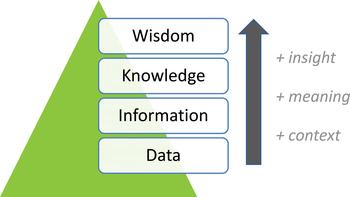
The easiest way to understand the differences between Knowledge and Information is to return to the DIK(W) pyramid, which emerged within the study of computer and information scienceFootnote 6 .
Data is a set of discrete, objective factsFootnote 7 . Information seeks to inform: it is data with a message, data that makes a difference.
Data is turned into Information in four main ways, according to Davenport and Prusak:
-
• Contextualised: the data is gathered for a purpose.
-
• Categorised: we understand the units or key components of the data.
-
• Calculated: the data is analysed mathematically or statistically.
-
• Corrected: errors are removed from the data.
-
• Condensed: data is summarised into a more concise form.
Knowledge is broader, deeper and richer than Information. It is not neat or simple. It is fluid as well as structured. It is intuitive and difficult to capture. It is part and parcel of human complexity and unpredictability.
The DIKW pyramid.

Davenport and Prusak describe four ways (the four Cs) for Information to become Knowledge, all of which require human input:
-
• Comparison: how does information about this situation compare to other situations we have known?
-
• Consequences: what implications does the information have for decision-making?
-
• Connections: how does this bit of knowledge relate to others?
-
• Conversation: what do other people think about this information?
When Knowledge is passed on, it is created in the mind of the receiver. It is therefore possible for someone to believe they are imparting Knowledge but the receiver believes it is only Information because of their respective contexts. As a result of this, Knowledge tends to be “sticky” and only really thrives in the environment which developed it.
Knowledge can be both a stock and a flow. It can be contained within an object, but also within a process. Data is contained in records or transactions; Information is within messages; Knowledge is within individuals and organisational routines and can be delivered through structured media, such as books and also within person-to-person contact.
Knowledge itself can be usefully divided into two distinct types: explicit and tacitFootnote 8 . Explicit knowledge is articulated knowledge, such as formulae, or in-depth knowledge about a particular type of customer. This kind of knowledge is more easily expressed in writing and can be contained within a database, supported by trusting networks.
Tacit knowledge is rooted in experience and includes intuitions and understandings often based on years of working. It can be the knowledge of what to do based on multiple inputs which are often unacknowledged and not understood by the knower, commonly expressed as a “hunch”. Tacit knowledge is difficult to contain within databases and is most efficiently encouraged to flow around an organisation through conversation and mentoring.
In summary:
-
• Data tends to be scattered, unrelated facts, writings, numbers, or symbols.
-
• Information tends to be selected, organized and analyzed data.
-
• Knowledge tends to be information combined with user's ability and experience that is used to solve a problem or to create new knowledge.
-
• Wisdom (if it exists as a separate entity from Knowledge at all) tends to be forward looking and thinking based on one's values and commitment.
Information is often more easily visible, objective and independent. It is often a physical product, easily transferable and duplicable, and can be categorised and managed.
Knowledge, on the other hand, is often invisible, subjective, closely related to action and decision, different in thought after processing, identified with its existing environment, transferable through learning, and not duplicable. Some Knowledge can be articulated and expressed within artefacts, but other Knowledge is more difficult to explain.
Once we understand these differences, it becomes easier to see where the challenges lie for those who usually work with Information when they begin to work with Knowledge. If one is used to working with something which is easy to categorise, contain and share, it can be challenging to change tactics in order to devise and support efficient ways of sharing something as difficult to classify and “manage” as Knowledge.
WHAT IS KNOWLEDGE MANAGEMENT?
There are many definitions of Knowledge Management (KM). Some people even say it's a nonsense: who can ‘manage’ what is known in a mind? However, taking a practical view, KM is at the very heart of law firms. It is how firms create, capture, access, apply, interpret and utilise the combined knowledge of their employees in pursuit of successful businesses, whatever their niche.
This could include:
-
• knowledge creation through workable, affordable, effective training programmes, mentoring, supervision, reflective learning and encouraging knowledge-sharing;
-
• nurturing an open reflective culture to maximise the opportunities for innovative thinking and identifying new ways to help clients;
-
• analysis of existing workflows and processes and creation of more efficient ones, as well as checklists and file management systems, and processes which minimise wasted time and incorporate relevant aspects of total quality management (TQM) systems;
-
• re-use and exploitation of existing knowledge through precedents, practice notes and knowledge packs, so no one has to reinvent the wheel and then write off potentially chargeable time, and out-dated knowledge isn't used by mistake;
-
• sharing and analysis of management and business information to facilitate better informed and evidence-based decision-making;
-
• better understanding of clients and their needs, and the sharing of that knowledge, in order to provide services which match those needs more closely;
-
• fee-earner attraction and retention through stripping their roles of repetitive tasks which don't utilise their specific talents;
-
• retention of knowledge within an organisation when people leave through redundancy, retirement or outsourcing;
-
• efficient knowledge-based marketing (newsletters, seminars, social media), so that the minimum amount of non-chargeable time is spent for the maximum return; and
-
• facilitating collaboration and networking throughout the firm to improve the flow of knowledge, whether that is technical legal information about cases, legislation and regulation, or client information for cross-selling, or experiences and top tips for more successful legal practice.
KM has been studiedFootnote 9 by a number of different disciplines (Human Resource Management, Computer Science and Information Technology, Organisational Psychology) and covers a vast array of Knowledge within an organisation (knowledge about customers, knowledge about business processes, technical legal knowledge, interpersonal and physical skills etc). Fully integrated KM strategies should aim at combining these different approaches.
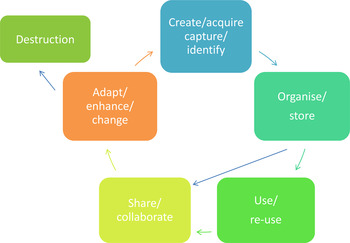
The Knowledge Cycle.Footnote 10

The simplest way to understand KM is to consider the Knowledge Cycle, which is a practical depiction of how knowledge both creates artefacts and flows around an organisation: from its creation or discovery; its usage, leverage and storage; sharing and eventually either being adapted into new knowledge or destroyed when it is no longer useful to the business.
Another definition which can work for law firms is David Gurteen'sFootnote 11 :
Knowledge Management is a business philosophy. It is an emerging set of principles, processes, organisational structures and technology applications that help people share and leverage their knowledge to meet their business objectives.
It can also be helpful to think of managing Knowledge as it is divided in terms of functionFootnote 12 :
-
• Know what – explicit knowledge, usually contained within knowledge artefacts.
-
• Know how – process-based knowledge, such as knowing the most efficient and effective way to undertake a process within one's work. It includes tacit knowledge and skills learned whilst working.
-
• Know who – having trusting networks which understand who is an expert in what knowledge and can work together.
-
• Know when – understanding when a piece of knowledge is relevant and when it is appropriate to leverage it.
-
• Know why – understanding causal relationships and why a piece of knowledge is relevant in different circumstances. Also this can refer to understanding a firm's culture and why knowledge is utilised and leveraged in certain situations.
There are many definitions of Knowledge and Knowledge Management. I always recommend that individuals work through the various definitions in the literature and then reach a definition which works for them and their firm.
WHERE DO IM AND KM OVERLAP WITHIN COMMON KM TOOLS AND TECHNIQUES?
From analysing the Knowledge Cycle and considering the definitions of Knowledge, many IM professionals will see that they probably already work in the area of organising and storing explicit, documented knowledge, as well as information. Whilst they may not have the technical black letter law knowledge of Professional Support or Knowledge Lawyers, they will already have considerable experience of knowledge databases and facilitating the access of fee earners to declarative and explicit knowledge.
There is often much emphasis within law firms on precedents and databases and this can be an ideal area for IM professionals to contribute to KM strategy straightaway.
Knowledge and precedent databases can:
-
• reduce the amount of time fee-earners spend producing documents, thereby improving productivity;
-
• take care of the repetitive work, supporting leverage and commoditisation and freeing senior fee-earners to concentrate their efforts on complex value-add work;
-
• help a firm speak in a single house style, avoiding unnecessary jargon and promoting a single branding message; and
-
• improve quality assurance.
However, precedents and databases are only one aspect of KM. Too many firms assume that, in order to improve the way Knowledge is managed within their firm, they must upgrade their existing precedent databases and/or search tools, or buy more services from online providers. This is a misconception. Knowledge repositories are only part of KM. Once basic document and information retrieval needs are met, most law firms can get a greater return on investment by using other strategic KM tools and techniques, rather than investing more in IT.
Some commonly used KM tools and techniques within law firms are:
-
• Storytelling (as a means of transferring tacit knowledge) – these can be case studies, tales from the frontline and added to mentoring and supervision, as well as within specialist review meetings or videoed databases.
-
• After action reviews – these can be individual or group learning. Individuals can reflect on their experiences through learning diaries. Groups can share post-action learning through reflective, thoughtful, non-judgemental in-person discussions. Try not to distil this learning process into a dry form-filling exercise, as this usually removes the value to the process.
-
• Knowledge mapping (a map of knowledge repositories within a company accessible by all).
-
• Communities of practice – these are groups of individuals who spontaneously band together to share their knowledge, rather than imposed groupings, and are so effective at knowledge-sharing that RumizenFootnote 13 calls them the “killer application”.
-
• Expert directories – these are often called “White Pages” and enable knowledge seeker to reach to the right experts.
-
• Knowledge repositories (databases, bookmarking etc.), with best practice transfer and precedent documents.
-
• Knowledge fairs (a “fair” similar to a craft or Christmas Fair, but with stalls demonstrating the availability of different areas of Knowledge), coffee mornings (informal opportunities to “ask and expert”), or RCTs (informal one-to-one random pairings of individuals for conversation, usually but not exclusively about work practices, knowledge and experiences)Footnote 14 .
-
• Mentoring, supervision and coaching relationships.
-
• Job-shadowing and secondments.
-
• Collaborative software technologies (wikis, shared bookmarking, blogs, social software, etc.).
-
• Identifying Knowledge brokers (these can be formal roles, such as PSLs or Knowledge Lawyers, or fee earners who take on additional roles).
WHERE CAN IM PROFESSIONALS OFFER MOST VALUE TO STRATEGIC KM ACTIVITIES?
Where an organisation already has a Knowledge Management Strategy, IM professionals can contribute by focussing on their areas of strength first, by offering their considerable expertise in the areas of codification, management and storage of information and explicit knowledge.
Whilst a lot of the KM tools and techniques listed above need to involve subject matter experts, IM professionals can contribute to KM through:
-
• Organising internal publishing functions for explicit Knowledge:
-
◦ making explicit knowledge available through Knowledge repositories, databases and sign-posting explicit knowledge through the organisation (whilst subject matter experts may need to create the Knowledge artefacts themselves, IM staff will be expert in making those artefacts visible and usable, in particular with their understanding of knowledge systems architecture, indexing and user-focus of retrieval);
-
◦ making knowledge networks visible, through knowledge mapping and experts databases/White Pages; identifying areas across the business for linking and integrating related knowledge, outside the practice silos of fee earners.
-
-
• Acting as Knowledge broker or empowering and supporting Knowledge brokers, PSLs and Knowledge Lawyers. A librarian will often be one of the few cross-discipline professionals that a fee earner would instinctively approach when faced with a difficult problem to solve. Fee earners often naturally approach library staff for help when their own research skills fail them. IM staff can then offer a wider view, pointing them towards experts and networks as well as towards alternative databases or knowledge artefacts. To support this role, IM staff can arrange Knowledge Fairs and ask-an-expert coffee mornings.
Given that the IM professional primarily and naturally deals in management of that which tends to be more easily codified (information and explicit knowledge), probably the main knowledge or skills gap relates to the facilitation of the flow and interchange of Knowledge. Historically librarians and other information professionals have tended to have a more static perception of Knowledge as a “stock” for a collection, rather than a “flow” around a network causing new Knowledge within many heads.
Further reading into the field of KM (there is a list of great books to start with in Annex 1) or attending a course or two would be useful in order to add to their knowledge on the topic and reframe their perspective.
In addition, IM staff can work embedded within a department or practice areas, or job shadow a PSL or Knowledge lawyer for a deeper understanding about how Knowledge is used and shared informally by fee earners.
Where an organisation does not have a Knowledge Management Strategy, I recommend that they take a broad approach to KM, looking at all aspects of the knowledge flow within their business, and focussing efforts as required by their business strategy. IM professionals are often asked to take on this task and are well-placed to do it. Annex 2 shows a simple method for an interim short-form KM strategy which can help a firm with improvements straightaway whilst they undertake the more onerous task of creating a KM Strategy aligned to their business strategy.
IM professionals are well placed to create this fast-track strategy and also to make valuable contributions to the audit of existing Knowledge stocks and flows, and the development of tools and techniques to meet the evolving needs of the organisation's business strategy, when devising a more comprehensive KM Stratey.
Knowledge Audits begin with a review of existing Knowledge resources and activities, and assessment of their practical efficacy, as measured by frontline fee-earners, against the current and future needs of the business. The ‘Key Resources Framework’ outlined in Managing People and Knowledge in Professional Services Firms (Nicholas Kinnie et al., Chartered Institute of Personnel and Development, 2006) may be useful to analyse internal knowledge resources.
External factors will also need to be analysed, often by analysing the current level of activity against comparable organisations, and ascertaining whether there is a maturity gap. This will be useful for background information, but remember that an organisation's KM strategy supports its own business' strategy, not its competition's. It can be useful to investigate current and likely future market conditions and pressures using SWOT (Strengths Weaknesses Opportunities Threats), PEST (Political Economic Social Technological), Porters 5 forces and Scenario Analysis.
Once the firm's internal and market environment is understood, a firm needs to decide upon an overall vision for KM and build this into a strategy, and identify the appropriate KM tools and techniques to deliver that vision. It is often at this point that specialist KM help is needed. This can be provided by training existing staff (IM staff or fee earners) in KM, bringing in an external advisor, or using a combination of training staff and having external mentoring to keep the strategy on track. Although the views of fee-earners and IM staff are obviously valuable, they are unlikely to have sufficient information and experience of all the available KM tools and techniques, and the return on investment (ROI) of each one, to provide the most effective ideas for improvements. In particular, KM experts understand the value of connecting people and the return on investment to the firm; it builds trust for future knowledge-sharing, and sparks new ideas and innovations, and they also keep abreast of the myriad technology-based solutions.
Drawing up a brand new written KM strategy can be challenging, but it will be worthwhile, as a firm's existing implicit knowledge strategy is unlikely to be the most effective way to promote its best interests or reflect its overall business strategy. A fully thought-out, explicit, written strategy will act as an ongoing, live business case, helping to justify expenditure of time and money. It will ensure everyone in the firm understands the strategy and reasoning for it, and focuses knowledge resources on the most strategically important aspects – those which minimise any wastage of time and resources, and have the highest pay-off. Lastly, it will help the implementation plans to stay on track, providing a clear framework for action, and avoiding anyone being tempted into inefficient expenditure.
SUMMARY
IM professionals have a considerable wealth of experience to offer law firms in relation to strategic Knowledge Management. Some additional training and/or mentoring can be valuable to help expand their understanding of the field and reframe their perspective, but their considerable experience with Information Management provides a perfect base on which to build new KM expertise.
ANNEX 1: FURTHER READING – where to start:
-
• Chaffey and Wood, Business Information Management, (Pearson Education Ltd, 2008)
-
• Davenport and Prusak, Working Knowledge: How Organizations Manage What They Know (Harvard Business School Press, 1998)
-
• Griffiths, Redefining KM: New Principles For Better Practice (Ark Group, 2011)
-
• Nonaka and Takeuchi, The Knowledge-Creating Company (Oxford University Press, 1995)
-
• Parsons, Effective Knowledge Management for Law Firms (Oxford University Press, 2004)
-
• Rumizen, The Complete Idiot's Guide to Knowledge Management (CWL Publishing Enterprises, 2002)
-
• Russell, Knowledge Management Handbook (Law Society Publishing, 2012)
-
• Russell, Practical Projects in Legal KM (Legal Monitor, 2015)
ANNEX 2: A MINI FAST-TRACK STRATEGY:
There is a major risk in writing strategies that the process of strategising becomes an end in itself, and valuable time for improvement can be lost to researching, analysing, defining and refining. This is where a fast-track, mini strategy can come in. This involves comparing existing KM activity against business strategy, and improving practices accordingly, straight away.
A mini strategy can take any shape and use any format, but questions to get you started could include:
-
1. What are your business's top three key objectives over the next five years?
-
2. How do current knowledge activities support these objectives within each team or department?
-
3. What budget and manpower do you have available for existing KM work and future projects?
-
4. What simple changes can you make to fill gaps in KM support for business objectives? How can you leverage existing systems to fulfil KM needs?
-
5. What large-scale changes to KM may be needed to fulfil these business objectives? What will you need to know in order to analyse possible solutions?