





Introduction
Nonprofit organizations (NPOs) are widely regarded as key actors in promoting social change and advocating for the rights of vulnerable populations. From this perspective, social workers employed in NPOs might be expected to display higher levels of engagement in policy practice (PP) and advocacy.
At the same time, in many contexts, including Italy, NPOs have become increasingly involved in the outsourcing of state welfare services. This raises questions about whether NPOs remain distinctive arenas for policy engagement, or whether their integration into state-regulated systems constrains their capacity to support advocacy-oriented practices (Ascoli & Ranci, Reference Ascoli and Ranci2002; Borzaga & Fazzi, Reference Borzaga and Fazzi2011; Gewirtz-Meydan et al., Reference Gewirtz-Meydan, Weiss-Gal and Gal2016).
Against this backdrop, it remains unclear whether social workers employed in NPOs exhibit higher levels of engagement in policy practice (PP) than those in public organizations (POs), and which factors account for any such differences.
This article addresses this issue by examining social workers’ engagement in PP across nonprofit and public organizational settings in Italy. Drawing on Gal and Weiss-Gal’s (Reference Gal and Weiss-Gal2023) framework, we conceptualize sectoral affiliation not as a direct determinant of engagement, but as a contextual configuration associated with variation in individual and organizational characteristics.
Using survey data on Italian social workers, the study compares engagement in different forms of PP across nonprofit and public organizational settings. The findings suggest that social workers employed by and working within NPOs exhibit higher levels of engagement in some—but not all—forms of PP. This higher engagement is primarily associated with the organizational structure of NPOs, which allows practitioners to operate closer to decision-making arenas, pointing to the importance of opportunity structures within organizations in shaping PP.
The article is structured as follows. The first section introduces and clarifies the terminology used to describe the role of NPOs and social workers in processes of structural change. The second section examines the factors associated with variation in PP and formulates the study’s hypotheses. The third section presents the research context and methodological approach. The fourth section reports the empirical results, and the final section discusses the findings and their implications.
A vocabulary for social workers’ and nonprofit organizations’ engagement for structural change
Contemporary scholars and practitioners in social work and nonprofit studies expect social workers and NPOs not only to provide direct support to people and communities but also to address the structural conditions that shape their lives. In social work terminology, this dual mandate is reflected in an integrated perspective that combines a social casework orientation with a social reform orientation (Branco, Reference Branco2016) (see also IASSW, IFSW, 2014).
Several umbrella terms have been used to describe the contribution of NPOs and social workers to systemic change. Among these, “policy engagement” captures a broad spectrum of actions undertaken by social workers as citizens (civic route) or as professionals (professional route) (Gal & Weiss-Gal, Reference Gal and Weiss-Gal2023, pp. 29–37). Within the latter, “policy practice” (PP) refers to activities carried out by professionals to influence the development or improvement of policies, either within organizations (internal PP) or at the level of public policy (external PP) (Gal & Weiss-Gal, Reference Gal and Weiss-Gal2023, p. 32; Weiss-Gal et al., Reference Weiss-Gal, Gal, Schwartz-Tayri, Gewirtz-Meydan and Sommerfeld2020). Internally, PP may be informal, occurring through everyday interactions, or formal, through organizational tools and mandates such as budgeting or access protocols. Externally, PP may be direct, through interactions with policymakers, or indirect, through social mobilization involving civil society organizations, professional associations, and collective action (Guidi et al., Reference Guidi, Maraviglia and Francesconi2025).
In both social work and nonprofit studies, “advocacy” is a widely used umbrella term covering diverse actors and practices and approached from different perspectives (Mosley et al., Reference Mosley, Suaárez and Hwang2023). In social work, the term often refers to practitioners upholding the rights of individual service users without seeking broader changes to the structural conditions contributing to their problems or to the institutional and organizational arrangements expected to address them (case advocacy) (Dalrymple & Boylan, Reference Dalrymple and Boylan2013, p. 3). However, advocacy may also refer to efforts aimed at promoting social justice beyond individual cases by engaging with structural issues (Dalrymple & Boylan, Reference Dalrymple and Boylan2013; Gal & Weiss-Gal, Reference Gal and Weiss-Gal2023). In nonprofit studies, advocacy typically denotes the actions of organizations rather than individual professionals (Ward et al., Reference Ward, Mason, Park and Fyall2023; see Mason, Reference Mason2015, for an exception). Thus, although the term is widespread, its use remains ambiguous and its definition subject to ongoing debate (Mosley et al., Reference Mosley, Suaárez and Hwang2023; Pekkanen et al., Reference Pekkanen, Smith and Tsujinaka2014).
Given the plurality of terms and differences in unit of analysis, aligning social work and nonprofit terminologies is not straightforward. When advocacy extends beyond the individual level, it overlaps with PP, although the two concepts do not fully coincide. Applied to individual social workers, external PP aligns with established forms of advocacy: indirect PP resembles more confrontational approaches, while direct PP corresponds to institutional or insider advocacy targeting policymakers. Internal PP can also be interpreted as a form of insider advocacy, but directed toward organizational actors such as managers.
In this article, we take the individual practitioner as our unit of analysis, while recognizing that she or he is embedded in specific organizational and welfare contexts that both constrain and enable her or his agency. We focus on different forms of PP as forms of supra-individual advocacy, ranging from more explicit (external PP) to more implicit (internal PP).
Social workers’ policy practice in a cross-sector perspective
What facilitates PP? An approach to cross-sector comparison
Both social work and nonprofit scholarship have examined the conditions under which professionals and organizations engage in efforts toward systemic change. This line of inquiry is motivated by the persistent gap between the normative centrality of such action and its relatively limited empirical manifestation (Almog-Bar & Schmid, Reference Almog-Bar and Schmid2014; Gal & Weiss-Gal, Reference Gal and Weiss-Gal2023; Lu, Reference Lu2018).
A useful framework is proposed by Gal and Weiss-Gal (Reference Gal and Weiss-Gal2023), who conceptualize social workers’ efforts to bring about structural change as shaped by three interrelated dimensions—motivation, facilitation, and opportunity—and embedded within broader institutional environments. Motivation refers to internal and relational drivers, including professional values, political self-efficacy, and skills. Facilitation captures the extent to which employing organizations enable or constrain engagement. Opportunity concerns access to policymaking arenas, including proximity to decision-makers and participation in policy processes. These dimensions are conditioned by broader institutional contexts, such as welfare regime and social work profession regulation.
Within this framework, characteristics of the employing organization play a key role, particularly through organizational culture—that is, the values, assumptions, and modes of practice that guide interpretation and define appropriate behavior (Schein, Reference Schein1990). Engagement is expected to be more likely in organizations where professional values are strong, policy engagement is legitimized, and political control is limited (Gal & Weiss-Gal, Reference Gal and Weiss-Gal2023, pp. 81–101).
From this perspective, NPOs may appear better positioned than POs to foster PP. NPOs are often associated with more flexible organizational cultures and greater receptivity to professional input, in contrast to the bureaucratic structures frequently attributed to POs (Feeney & Rainey, Reference Feeney and Rainey2010; Toepler & Anheier, Reference Toepler, Anheier, Zimmer and Priller2004). Moreover, NPOs are formally independent from direct political authority and often incorporate advocacy into their missions, which may attract professionals with stronger political orientations while also encouraging broader engagement in PP.
Although this suggests that social workers’ PP may be higher in NPOs than in POs, broader institutional evolutions in contemporary Western welfare systems complicate this expectation. The institutionalization of subsidiarity principles, the diffusion of managerialist practices, and the expansion of outsourcing have increased NPO involvement in publicly funded service delivery while simultaneously reinforcing dependence on regulatory frameworks and government procedures (Gal & Weiss-Gal, Reference Gal and Weiss-Gal2023, pp. 88–89). Under such conditions, NPOs may face pressures toward institutional isomorphism (DiMaggio & Powell, Reference DiMaggio and Powell1983), aligning their practices with market and bureaucratic logics and contributing to mission drift (Hersberger‐Langloh et al., Reference Hersberger‐Langloh, Stühlinger and von Schnurbein2021), alongside pressures toward the flexibilization and precarization of organizational and employment conditions (Baines et al., Reference Baines, Cunningham, Campey and Shields2014; Fanelli et al., Reference Fanelli, Evans and McDowell2017).
Empirical evidence calls for caution in considering NPOs as the most favorable organizational context for PP. State-funded NPOs may scale back advocacy activities or shift toward institutional and insider strategies—such as direct engagement with policymakers—particularly in restrictive political contexts (Almog-Bar & Schmid, Reference Almog-Bar and Schmid2014; Carré et al., Reference Carré, Oosterlynck, Verschuere and Raeymaeckers2025). Similar patterns are observed at the practitioner level. In Israel, PP among social workers employed by NPOs is relatively limited and largely confined to informal activities, reflecting the predominance of service provision over advocacy (Gewirtz-Meydan et al., Reference Gewirtz-Meydan, Weiss-Gal and Gal2016). In Italy, Burgalassi (Reference Burgalassi, Burgalassi and Tilli2023) distinguishes between social workers employed by more autonomous NPOs—who report higher levels of political engagement—and those working in NPOs delivering services on behalf of the State. The latter experience more constrained autonomy, particularly under subcontracting arrangements that place NPO employees within POs.
These dynamics are further complicated by heterogeneity within both sectors. POs vary in scale, sector, and political oversight, while NPOs differ in size, governance structures, revenue composition, and policy environments—factors that influence the extent and type of advocacy activities (Carré et al., Reference Carré, Oosterlynck, Raeymaeckers and Verschuere2024; Lu, Reference Lu2018; Neumayr et al., Reference Neumayr, Schneider and Meyer2015).
Taken together, this literature shows that the levels and forms of social workers’ PP depend on the interaction of individual, organizational, and institutional factors. Organizational affiliation does not function as a simple determinant of engagement, but operates through differences in culture, governance, and exposure to institutional pressures. NPOs may offer conditions conducive to PP, but the expansion of outsourcing in welfare services can constrain their autonomy, increase precarity, and alter the forms through which advocacy is pursued (Baines et al., Reference Baines, Cunningham, Campey and Shields2014; De Corte et al., Reference De Corte, Arys and Roose2022; Fanelli et al., Reference Fanelli, Evans and McDowell2017). At the same time, this trend may take different forms, as institutional dynamics depend on context and pressures do not eliminate NPOs’ agency (Almog-Bar & Schmid, Reference Almog-Bar and Schmid2014; Borzaga & Fazzi, Reference Borzaga and Fazzi2011).
The current study
Building on these premises, this study examines similarities and differences in social workers’ engagement in PP across NPOs and POs. The framework developed by Gal and Weiss-Gal (2023) guides both the formulation of the hypotheses and the design of the empirical analysis. Rather than treating sectoral affiliation as a causal factor per se, we assume that working in an NPO or a PO exposes social workers to different organizational and institutional conditions—including organizational cultures, degrees of autonomy, and regulatory and contractual constraints—which may affect their motivation, facilitation, and opportunity and, in turn, lead to different forms and levels of PP. Any such differences may partly reflect tendencies commonly associated with the two sectors, with NPOs often viewed as more flexible and advocacy-oriented, and POs as more strongly shaped by formalized procedures and bureaucratic constraints.
Consistent with the typology introduced above, PP is analyzed across four forms—internal informal, internal formal, external direct, and external indirect—capturing different modes of engagement within and beyond organizational settings. The empirical analysis distinguishes five groups of social workers: (1) those employed by NPOs and working within NPOs; (2) those employed by NPOs but working within POs under subcontracting arrangements; and public-sector social workers employed in (3) municipalities, (4) local public health agencies, and (5) central administrations, including ministries and universities.
To examine variation across these forms and groups, the analysis is structured around five hypotheses that operationalize the theoretical framework. H1 (baseline difference) posits that social workers employed by NPOs and working within NPOs report higher levels of PP across its different forms than those employed in POs, while subcontracted workers are expected to display patterns closer to public-sector employees.
We then consider individual-level factors. H2 (compositional dimension) posits that differences in PP across organizational settings are partly associated with variation in sociodemographic characteristics, which can be interpreted as background conditions shaping individuals’ capacity and opportunities for engagement within the framework. H3 (motivational dimension) posits that, net of these compositional characteristics, variation in PP is associated with differences in sociopolitical participation and political self-efficacy.
Next, we examine two aspects of the relationship between practitioners and their organizations. H4 (occupational dimension) suggests that variation in PP across its different forms corresponds to occupational characteristics—such as hierarchical position and employment arrangements—that are associated with access to decision-making arenas and the perceived risks of engagement, particularly in contexts characterized by the diffusion of fixed-term and less secure contracts. H5 (facilitation dimension) suggests that, net of the previous dimensions, variation in PP is associated with differences in organizational support for policy engagement and organizational size, as both may shape the internal organizational conditions under which PP is legitimized, coordinated, and supported.
Across these hypotheses, the analysis remains empirical in scope and does not assume that sectoral affiliation alone determines engagement. Rather, it evaluates whether observed differences in PP are better understood in relation to the individual and organizational factors through which institutional contexts operate.
Research context and method
Context
Our investigation focuses on Italy, where social work is a legally regulated profession requiring a degree, a national licensure exam, and registration with the Council of Social Work. Of approximately 47,000 registered professionals, about 40,000 are actively employed, primarily in local public entities such as municipalities and local health agencies, followed by NPOs. In this context, social workers play a key role in implementing welfare policies, while social work practice remains largely centered on casework and influenced by bureaucratic and managerial pressures (Campanini, Reference Campanini, Bassi and Moro2015; Facchini, Reference Facchini2010; Fargion, Reference Fargion2018; Garrett & Bertotti, Reference Garrett and Bertotti2017; Tousijn & Dellavalle, Reference Tousijn and Dellavalle2017).
The Italian case is particularly relevant for examining PP from a cross-sectoral perspective, as the role of NPOs in state welfare service provision has expanded significantly since the 1990s (Ascoli & Ranci, Reference Ascoli and Ranci2002; Borzaga & Fazzi, Reference Borzaga and Fazzi2011; Ranci, Reference Ranci1994). Italy currently hosts approximately 360,000 NPOs, employing around 900,000 individuals, with a strong concentration in social assistance (Istat, 2024). Social cooperatives are key actors in welfare delivery and major employers of social workers, operating largely through outsourcing arrangements and contractual relationships with public authorities, which often result in significant administrative and financial dependence on the state (Turchini, Reference Turchini2019, p. 38).
This expansion of NPOs in welfare provision has developed within broader structural features of the country, most notably pronounced territorial variation. Despite being a unitary state, Italy exhibits substantial regional differences in socioeconomic conditions and institutional capacity, often summarized as a North–South divide alongside further local heterogeneities. In the field of social policy, these disparities have been reinforced by decentralization reforms introduced in the early 2000s, which assigned primary responsibility for service organization and delivery to regions and municipalities.
Taken together, these features make Italy a particularly suitable context for this study. The coexistence of public and nonprofit providers, the widespread use of outsourcing and subcontracting arrangements, and the marked territorial variation in welfare governance create conditions in which differences in motivation, opportunity, and facilitation can be observed across organizational settings and across the different forms of PP.
Methods
The study is based on an online survey administered between 2022 and 2023 to all registered Italian social workers. The questionnaire was co-designed with the National Foundation of Social Work (FNAS) and supported by the National Council of Social Work (CNOAS), which invited its members—corresponding to the full population of licensed assistenti sociali—to participate and promoted the survey through its institutional communication channels.
The survey was distributed to approximately 47,000 registered professionals, of whom about 38,000 were employed in an organization. It yielded 11,516 responses, of which 7,806 were complete. The final analytical sample includes 6,859 social workers employed in one or more organizations who completed the questionnaire, corresponding to a response rate of approximately 18% among employed professionals. Only fully completed questionnaires from social workers employed in an organization were included in the analysis.
As is typical of online self-administered surveys, participation was voluntary, and respondents were self-selected. Although the study does not rely on a probabilistic sampling design, several elements support the robustness of the dataset. The survey was disseminated through official institutional channels without targeted recruitment, and the sociodemographic and professional characteristics of respondents closely align with those of the overall population of Italian social workers (Sanfelici et al., Reference Sanfelici, Gui and Mordeglia2020).
The questionnaire was developed by the research teamFootnote 1 drawing on the framework proposed by Gal and Weiss-Gal (Reference Gal and Weiss-Gal2023), instruments used in previous studies grounded in the same approach (Burzlaff et al., Reference Burzlaff, Kindler and Schwartz-Tayri2025; Weiss-Gal et al., Reference Weiss-Gal, Gal, Schwartz-Tayri, Gewirtz-Meydan and Sommerfeld2020), and preliminary exploratory interviews with social workers. It comprised 33 closed-ended questions covering PP, training and skills for PP, recruitment networks, attitudes toward social work and policy, organizational support for PP, sociodemographic and occupational characteristics, and political self-efficacy.
PP was measured through a set of items capturing respondents’ engagement. They were asked whether they had undertaken each of the proposed activities—either individually or with colleagues—and, if so, whether they had done so during the past year or earlier. Specifically, the questionnaire included:
-
• 12 items capturing internal PP activities, such as “trying to raise managers’ awareness of a social problem common to a group of service users” or “contributing to changes in service organization, regulations, or procedures” and
-
• 10 items capturing external PP activities, such as “involving civil society organizations to influence political decisions” or “participating, on one’s own initiative or by invitation, in municipal, regional, parliamentary, or other political-institutional bodies” (see Supplementary Material S1 for details).
Four types of PP were distinguished: internal informal, internal formal, external direct, and external indirect, the latter being conceptually closer to more confrontational forms of advocacy. These dimensions capture distinct patterns of engagement across PP activities and were operationalized through standardized indices derived from a principal component analysis conducted in previous work on the same dataset (Guidi et al., Reference Guidi, Maraviglia and Francesconi2025).
In the present study, we use the resulting component scores as indicators of engagement in each type of PP. Full details on item loadings, component structure, and variance explained are reported in Guidi et al. (Reference Guidi, Maraviglia and Francesconi2025) and summarized in Supplementary Material S2. Consistent with the analytical strategy, these indices are treated as summaries of heterogeneous engagement patterns rather than as internally consistent latent scales. This approach reflects the exploratory and activity-based nature of PP, where engagement is not expected to form highly homogeneous scales. Cronbach’s alpha coefficients for the four item groupings ranged approximately between .70 and .80, indicating acceptable internal consistency while also reflecting the heterogeneous and activity-based nature of policy practice.
The main independent variable captures social workers’ organizational setting. Five groups are distinguished: social workers employed by NPOs and working within NPOs (“Core”); those employed by NPOs but working within POs under subcontracting arrangements (“Subcontracted”); municipal social workers; social workers employed in local public health agencies; and other public-sector social workers, primarily employed by central government ministries and universities.
In line with the theoretical framework, the analysis includes four sets of predictors:
-
• Sociodemographic variables: age, gender, education level (BA, MA, PhD), and geographic area (NUTS 1);
-
• Motivational variables: political participation, measured as membership in parties, unions, or advocacy organizations, and external political efficacy, defined as individuals’ belief about the responsiveness of political institutions and officials to citizen demands and measured on a four-point Likert scale ranging from “none” to “high” (Craig et al., Reference Craig, Niemi and Silver1990);
-
• Occupational variables: hierarchical position within the organization (frontline worker, middle manager, top manager) and type of employment contract (fixed-term or permanent);
-
• Facilitation variables: organizational size, measured as number of employees, and perceived organizational support for PP (see Supplementary Material S1). The latter was measured through a six-item additive index rated on a four-point Likert scale and standardized for analysis (Cronbach’s α = 0.89).
Our analytical strategy follows the logic of the hypotheses and is implemented through a series of nested regression models. Covariates are introduced sequentially in blocks corresponding to the compositional, motivational, occupational, and organizational dimensions identified in the theoretical framework.
This stepwise specification allows us to examine how differences in PP across organizational settings change when accounting for distinct sets of theoretically relevant factors. Rather than relying on automated variable selection procedures, the models are specified ex ante based on theoretically grounded distinctions.
The aim is not to identify a parsimonious predictive model, but to assess the relative contribution of these dimensions and to evaluate how their inclusion modifies observed differences across organizational contexts. Separate models are estimated for each form of PP to capture variation across engagement domains. Results are interpreted as conditional associations rather than causal effects.
Results
Summary statistics
We begin by presenting descriptive statistics for the main variables used in the analysis (Table 1), highlighting variation across organizational settings and across the key dimensions of the theoretical framework.
Descriptive statistics for the analytical samplea

Table 1. Long description
The table presents data for a total sample size N = 6,856. It is organized into two columns: Variable and the count with percentage in parentheses.
* Type of organization: Municipality 3,181 (46 percent), Health 1,580 (23 percent), N P O _core 893 (13 percent), N P O _sub 487 (7.1 percent), and Other 715 (10 percent).
* Age class: Under 35 1,464 (21 percent), 35 to 44 1,880 (27 percent), 45 to 54 1,745 (25 percent), and 55 plus 1,767 (26 percent).
* Education: Bachelor-level 3,341 (49 percent), Master-level 2,774 (40 percent), and Postgraduate master’s or P h D 741 (11 percent).
* Area of residence N U T S 1: North 3,326 (49 percent), Center 1,258 (18 percent), and South 2,272 (33 percent).
* Gender: Female 6,493 (95 percent) and Male 363 (5.3 percent).
* External political efficacy: None 1,923 (28 percent), Low 4,287 (63 percent), and Medium or High 646 (9.4 percent).
* Political membership: Yes 1,328 (19 percent) and No 5,528 (81 percent).
* Hierarchical position: Top managers 909 (13 percent), Middle managers 1,157 (17 percent), and Frontline employees 4,790 (70 percent).
* Employment contract: Fixed-term 1,183 (17 percent) and Permanent 5,673 (83 percent).
* Organization’s size by number of employees: Up to 10 739 (11 percent), 11 to 50 2,295 (33 percent), 51 to 200 1,586 (23 percent), and Over 200 2,236 (33 percent).
* Organizational support for P P: Standardized index with mean = 0 and s.d. = 1.
a “Npo_core” indicates social workers employed by and working within NPOs; “npo_sub” indicates subcontracted social workers, that is employed by NPOs but working within POs.
The sample is predominantly composed of social workers employed in municipalities (46%), followed by those in local health agencies (23%) and NPOs, both in core (13%) and subcontracted positions (7%). The workforce is largely female (95%) and relatively evenly distributed across age groups. In line with expectations, relevant variation emerges across organizational and occupational characteristics, particularly in hierarchical positions and employment contracts, which are central to the opportunity dimension of the analysis. By contrast, political engagement remains relatively limited, with only 19% of respondents reporting membership in political or advocacy organizations.
To further illustrate how these characteristics vary across organizational settings, Figure 1 reports the distribution of key individual, occupational, and organizational variables across the five groups of social workers.
Distribution of key characteristics across the five social workers’ groups included in the study. Stacked bars report percentages; organizational support for PP is presented as a standardized index.

Fig. 1 Long description
The figure consists of ten panels. The Y-axis for all panels lists five groups: npo_core, health, municipality, other, and npo_sub.
* Gender (%): Shows nearly 100 percent female across all groups.
* Age (%): Divided into four categories from less than 35 to 55 plus. The npo_sub group has the highest proportion of younger workers (less than 35), while health and npo_core show higher concentrations of workers aged 45 to 54.
* Education (%): Categories are triennale, magistrale, and master/dott. Most groups are dominated by magistrale degrees, with npo_sub having the largest triennale share.
* N U T S 1 region (%): Categories are Sud, Centro, and Nord. Distribution varies significantly, with npo_sub showing a high concentration in Nord and health showing a high concentration in Sud.
* Political efficacy (%): Categories are None, Low, and Medium/High. Most respondents across all groups report Low efficacy.
* Political membership (%): Binary Yes or No. The vast majority in all groups report No.
* Organization support to P P: A box plot on a standardized index from minus 2 to 2. All groups center near 0, with npo_core showing slightly higher median support and health showing a high outlier.
* Hierarchical position (%): Categories are Base, Mid_managers, and Top_managers. The Base category is the majority for all groups, though npo_core has a larger share of Mid_managers compared to others.
* Job contract (%): Categories are open-ended and other. Open-ended contracts represent approximately 75 to 85 percent of all groups.
* Organization size (%): Categories are up_10, 11_50, 51_200, and above_200. The health and municipality groups are dominated by organizations with above_200 employees, while npo_sub and other are more evenly distributed across smaller sizes.
As shown in Figure 1, differences across organizational settings are particularly visible in occupational and organizational characteristics. In particular, variation in hierarchical position, employment conditions, and organizational size suggests that opportunity structures and working environments—central to the theoretical framework—are not evenly distributed across sectors. “Core” NPO social workers also differ from their counterparts in POs along several dimensions. They tend to be younger and more frequently based in Southern Italy, and are more often represented in middle- and top-level positions. They also report higher levels of perceived organizational support for PP and somewhat greater involvement in political membership.
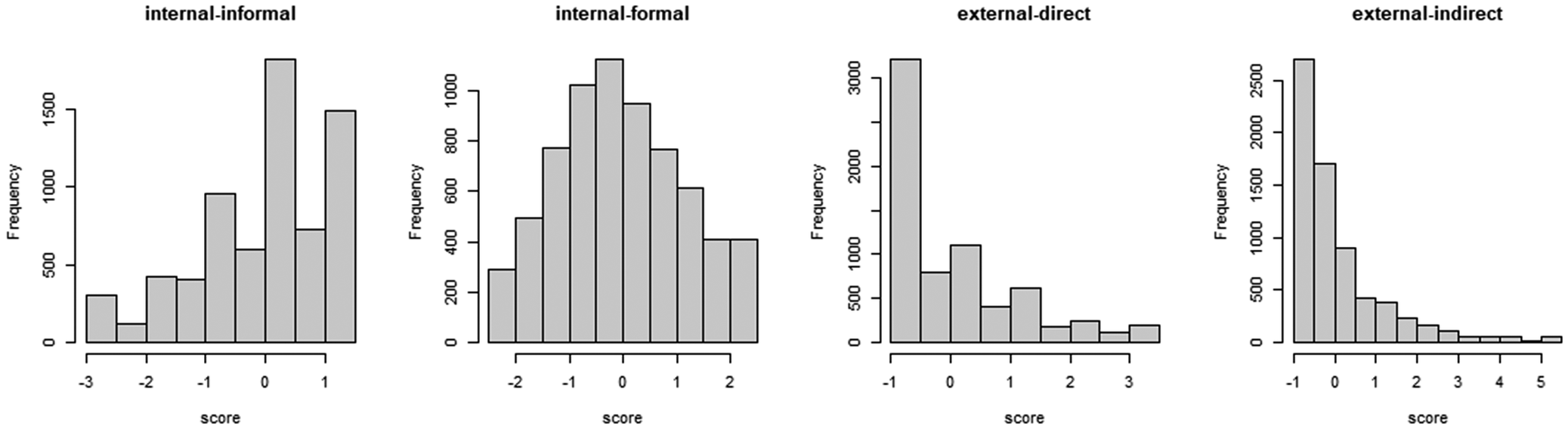
The empirical distribution of the four types of PP in our sample of 6,859 social workers is shown in Figure 2. Engagement in PP follows a clear gradient across the four dimensions: internal forms of PP are relatively widespread—particularly in their informal form—whereas engagement in external PP is considerably less frequent, especially in its indirect form.Footnote 2
Empirical distribution of the standardized component indices measuring engagement in four types of PP. Higher values indicate higher levels of engagement.

Fig. 2 Long description
A multi-panel figure containing four histograms. Each graph has a horizontal x-axis labeled score and a vertical y-axis labeled Frequency.
* Panel 1 (Top-Left) titled internal-informal: The x-axis ranges from -3 to 1. The distribution shows a general increase in frequency as the score increases, with a significant peak at a score of 0.5 and a secondary peak at 1.5.
* Panel 2 (Top-Center-Left) titled internal-formal: The x-axis ranges from -2 to 2. The data follows a bell-shaped normal distribution centered around a score of 0, with frequencies tapering off symmetrically toward -2 and 2.
* Panel 3 (Top-Center-Right) titled external-direct: The x-axis ranges from -1 to 3. The distribution is heavily right-skewed, with the highest frequency peak at a score of -1, followed by a sharp drop and smaller intermittent peaks as the score increases.
* Panel 4 (Top-Right) titled external-indirect: The x-axis ranges from -1 to 5. This distribution is also heavily right-skewed, with a maximum frequency peak at -1 and a steady, asymptotic decline in frequency as the score moves toward 5.
Baseline differences in PP across organizational settings (H1)
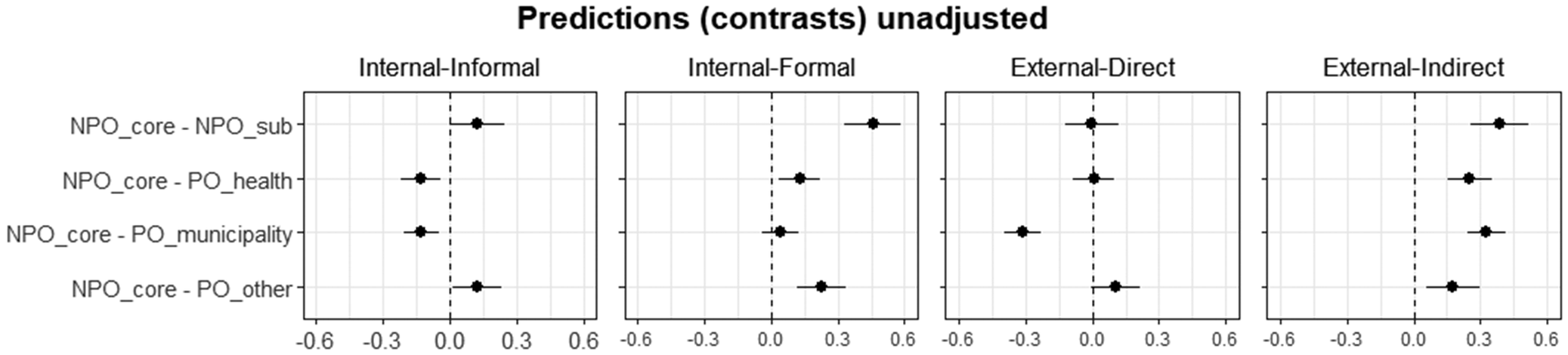
Figure 3 presents the unadjusted contrasts in PP engagement between “core” NPO social workers—the main focus of this article—and the other groups included in the study, including those formally employed by NPOs but subcontracted to POs (“npo_sub”). Contrasts are calculated by subtracting the outcomes of the comparison groups from those of “core” NPO workers. Positive values indicate higher levels of PP among “core” NPO social workers, while negative values indicate lower levels relative to the comparison groups.
Unadjusted contrasts in PP engagement between “core” NPO social workers and other groups. Positive values indicate higher engagement among “core” NPO workers; the dashed line indicates no difference.

Fig. 3 Long description
The multi-panel graph consists of four panels titled Internal-Informal, Internal-Formal, External-Direct, and External-Indirect. All panels share a common y-axis with four comparison groups: N P O underscore core minus N P O underscore sub, N P O underscore core minus P O underscore health, N P O underscore core minus P O underscore municipality, and N P O underscore core minus P O underscore other. The x-axis for all panels ranges from minus 0.6 to 0.6 with a dashed vertical line at 0.0 representing no difference.
* In the Internal-Informal panel, the first and fourth groups show positive engagement around 0.1, while the middle two groups show negative engagement around minus 0.1.
* In the Internal-Formal panel, all groups show positive engagement. The first group is highest at approximately 0.45, followed by the fourth group at 0.2, the second at 0.1, and the third near 0.05.
* In the External-Direct panel, the first, second, and fourth groups are centered near 0.0, while the third group (P O underscore municipality) shows a significant negative engagement near minus 0.3.
* In the External-Indirect panel, all four groups show strong positive engagement, with values ranging between 0.2 and 0.45. The first group (N P O underscore sub) and third group (P O underscore municipality) show the highest engagement levels in this category.
In line with H1, “core” NPO social workers exhibit higher engagement in external–indirect PP than all other groups. The differences range between approximately one-quarter and one-third of a standard deviation and are particularly pronounced when compared to subcontracted NPO workers. By contrast, their engagement in external–direct PP is lower than that of municipal social workers and does not differ significantly from that of social workers in health or other public-sector settings.
Patterns for internal PP are more mixed. “Core” NPO social workers show slightly higher engagement in internal formal practices, especially relative to subcontracted colleagues, while differences with municipal and health-sector social workers remain small. For internal informal PP, differences are limited and only marginally significant, with some evidence that social workers in POs—particularly municipalities and health agencies—report higher levels of engagement.
Overall, these findings provide partial support for H1. “Core” NPO social workers are more engaged in external–indirect PP—a proxy for more advocacy-oriented forms of engagement—and, to a lesser extent, in internal formal PP, while differences in other domains are smaller or inconsistent across organizational settings.
Sociodemographic composition (H2)
We next examine whether differences in PP across organizational settings are associated with sociodemographic characteristics (H2). Using regression analysis, we adjust for gender, age, geographical area, and education, and compute predicted contrasts in PP engagement across organizational settings. Figure 4 compares these adjusted contrasts (second row) with the unadjusted differences presented earlier (first row). Full regression parameters are reported in Supplementary Material S3.
Contrasts in PP engagement between “core” NPO social workers and other groups. Rows report unadjusted and sequentially adjusted models.

Fig. 4 Long description
A grid of 20 coefficient plots organized into five rows and four columns.
Rows from top to bottom represent sequential model adjustments:
1. Predictions unadjusted.
2. Adjusted by socio-demo vars.
3. Adjusted by socio-demo-political vars.
4. Adjusted by socio-demo-political vars and by hierarchical position.
5. Adjusted by socio-demo-political-occupational-organizational vars.
Columns from left to right represent engagement types:
1. Internal-Informal.
2. Internal-Formal.
3. External-Direct.
4. External-Indirect.
Each plot has a horizontal x-axis ranging from negative 0.6 to 0.6 with a dashed vertical line at 0. The y-axis lists four contrast groups:
* N P O underscore core minus N P O underscore sub.
* N P O underscore core minus P O underscore health.
* N P O underscore core minus P O underscore municipality.
* N P O underscore core minus P O underscore other.
Data trends:
* In the unadjusted model, most points for Internal-Formal and External-Indirect are to the right of zero, indicating higher engagement for the core group.
* As adjustments are added moving down the rows, the coefficient dots generally shift toward the left, particularly for the P O underscore health and P O underscore municipality contrasts, which move into negative territory in the final two rows.
* The N P O underscore core minus P O underscore other contrast remains consistently positive across all models and engagement types.
Overall, sociodemographic heterogeneity is associated with modest changes in the observed patterns. The most notable adjustment concerns external–indirect PP. While “core” NPO social workers continue to exhibit higher engagement than their counterparts in municipalities, local health agencies, and other public-sector settings, the magnitude of these differences decreases to below one-quarter of a standard deviation. This reduction appears to be associated, in part, with geographic composition, as “core” NPO workers are more frequently located in Southern regions, where engagement in advocacy-related activities appears to be comparatively higher.
By contrast, differences in internal informal PP remain largely unchanged after adjustment. For external direct and internal formal PP, only minor variations are observed, suggesting that sociodemographic characteristics play a limited role in shaping these forms of engagement.
Overall, these findings provide partial support for H2. Sociodemographic characteristics—particularly area of residence—are associated with some of the observed differences in external–indirect PP, but they do not fully account for variation across organizational settings.
Political attitudes (H3)
We next examine whether differences in PP across organizational settings are associated with political attitudes (H3). The regression model is extended to include indicators of political membership and perceived political efficacy, while still controlling for sociodemographic characteristics.
Figure 4 (third row) shows the resulting contrasts. Compared to the previous specification, differences in external–indirect PP between “core” NPO social workers and other groups are further reduced, whereas variation in internal formal PP remains largely unchanged. Changes in internal informal and external direct PP are similarly limited.
This pattern appears to be associated, in part, with differences in political membership across organizational settings, with “core” NPO social workers reporting higher levels of participation in political or advocacy organizations. However, the inclusion of these variables does not eliminate the observed differences in engagement, suggesting that other dimensions—particularly occupational and organizational factors—remain relevant.
Overall, these findings provide partial support for H3. Political attitudes—particularly political membership—are associated with some of the variation in external–indirect PP, but they do not fully account for differences across organizational settings. In the case of internal formal PP, political factors appear to play only a limited role.
Occupational characteristics (H4)
We next examine whether differences in PP across organizational settings are associated with occupational characteristics (H4). The regression model is extended to include indicators of employment contract and hierarchical position, while still controlling for sociodemographic and motivational variables.
Figure 4 (fourth row) shows the resulting contrasts. Compared to the previous specifications, differences between “core” NPO social workers and other groups are substantially reduced across most forms of PP. This shift is particularly evident in external–indirect and internal formal PP, where previously observed gaps narrow considerably, while changes in internal informal and external direct PP remain more limited.
This pattern appears to be associated with differences in hierarchical position across organizational settings, as “core” NPO social workers are more frequently represented in middle- and top-level roles. Once this dimension is taken into account, differences in external indirect PP between “core” NPO workers and colleagues in local public health agencies largely disappear, while gaps with municipal and subcontracted workers become minimal. A similar adjustment is observed for internal formal PP, where differences with public-sector workers are reduced and, in some cases, reversed.
Notably, contrasts with social workers employed in ministries and universities remain more stable, suggesting that this group follows a distinct pattern of engagement.
Overall, these findings provide strong support for H4. Occupational characteristics—particularly hierarchical position—are more strongly associated with variation in PP than are sociodemographic and political factors and account for a substantial share of the differences previously observed across organizational settings.
Organizational characteristics (H5)
Finally, we examine whether differences in PP across organizational settings are associated with organizational characteristics (H5). The model is extended to include organization size and perceived organizational support for PP, while continuing to control for sociodemographic, political, and occupational characteristics.
The resulting contrasts are shown in the last row of Figure 4. Relative to the previous model, the inclusion of organizational variables is associated with only limited changes in the observed patterns. Across most forms of PP, shifts in the estimated contrasts remain small.
In external indirect PP, the engagement level of “core” NPO social workers becomes statistically indistinguishable from that of most other groups, with the exception of colleagues employed in ministries and universities. In internal formal PP, the lower engagement of “core” NPO workers relative to municipal and public health social workers becomes more pronounced, while the previously higher engagement compared to colleagues in ministries and universities is reduced. Changes in internal informal and external direct PP remain limited.
Overall, these findings provide limited support for H5. Organizational characteristics—particularly perceived support for PP—are associated with only a modest share of the variation in engagement across organizational settings. Compared to the effects observed for occupational characteristics, their contribution appears more limited, suggesting that hierarchical position—and the level of access to decision-making associated with it—plays a more central role than organizational support in shaping engagement in PP.
Discussion
The findings of this study offer a nuanced account of policy practice (PP) in nonprofit (NPOs) and public (POs) organizations. Italian social workers employed by and working within NPOs (“core” NPO social workers) appear more engaged than their counterparts in POs in external–indirect PP, a proxy for more advocacy-oriented and confrontational forms of engagement. By contrast, they are less active in internal informal PP (everyday interactions within organizations) and external direct PP (direct engagement with policymakers).
On the one hand, this pattern suggests that the political “advantage” of NPO-based social workers is limited to specific forms of engagement rather than reflecting a general propensity to influence organizational or public policies. On the other hand, their stronger involvement in external indirect PP indicates that, despite integration into publicly funded service systems, NPOs may still provide practitioners with greater opportunities for policy engagement.
The multivariate analyses clarify the mechanisms underlying these patterns. Differences in PP across organizational settings are only weakly associated with practitioners’ sociodemographic characteristics and political attitudes. Although geographic location and political membership explain some variation in external indirect PP, they do not alter the overall pattern between NPO- and PO-based social workers. Similarly, perceived organizational support for PP accounts for only a limited share of variation, despite expectations that NPOs provide a more supportive environment for advocacy. By contrast, occupational characteristics—especially hierarchical position—play a more decisive role. This is particularly evident for external indirect PP and internal formal PP, the latter involving expert forms of insider influence such as shaping procedures or allocating resources.
Against this backdrop, the findings suggest that practitioners’ policy and advocacy engagement depends less on sectoral affiliation per se than on the organizational opportunity structures available within each sector. Building on Gal and Weiss-Gal’s (Reference Gal and Weiss-Gal2023) opportunity dimension, these can be defined as the distribution of positions and responsibilities that provide social workers with differential access to authority, information, networks, and decision-making processes within organizations. Accordingly, NPOs appear to constitute a more favorable environment for social workers’ PP not because they are inherently more committed to advocacy or provide stronger support for PP, but because they more frequently locate practitioners in roles connected to decision-making.
This more favorable opportunity structure may partly reflect nonprofit organizational cultures that are more open to internal democratization and to recognizing social workers as legitimate organizational leaders. At the same time, NPOs’ opportunity structures may also operate as meso-level mechanisms linking welfare governance arrangements to individual policy engagement. In contexts characterized by the outsourcing of welfare services to NPOs, such as Italy, this governance model contributes to the internal differentiation of NPOs, including the expansion of intermediate coordination roles (Beaton et al., Reference Beaton, MacIndoe and Wang2021; Castelnovo & Basile, Reference Castelnovo and Basile2025). These roles involve managing subcontracted services and maintaining relationships with public authorities and other stakeholders. This interpretation is consistent with research linking nonprofit professionalization to greater organizational rationalization and an expanded role for managerial professionals (Hwang & Powell, Reference Hwang and Powell2009). It also aligns with research showing that interorganizational collaboration requires specialized roles dedicated to coordinating relationships and activities across organizational boundaries (Williams, Reference Williams2012). Within this configuration, coordination roles act as intermediaries in hybrid welfare systems, translating contractual and administrative demands into practice and facilitating inter-organizational communication. Consequently, practitioners occupying these positions are more frequently embedded in governance arenas, increasing their exposure to policy-relevant processes and creating additional opportunities for advocacy-oriented engagement (Raeymaeckers et al., Reference Raeymaeckers, Vermeiren, Noël, Van Puyvelde and Willems2020).
The Italian context helps further explain these dynamics, although additional research is needed. In Italy, NPOs delivering social services remain strongly dependent on public authorities (Ascoli & Ranci, Reference Ascoli and Ranci2002; Borzaga & Fazzi, Reference Borzaga and Fazzi2011). While this dependence constrains financial and administrative autonomy, outsourcing and collaborative governance arrangements may also encourage the development of more articulated coordination practices and the expansion of middle-management roles (Castelnovo & Basile, Reference Castelnovo and Basile2025, p. 433; Cheng, Reference Cheng2019; Löfström, Reference Löfström2025). These arrangements, in turn, may provide social workers with greater access to information, networks, and legitimizing resources that facilitate advocacy-oriented practices.
More broadly, the findings point to the value of approaching the relationship between organizational setting and PP through a complexity lens. In particular, they suggest that several forms of heterogeneity often treated as secondary may deserve greater attention. First, the distinction between “core” and subcontracted NPO social workers indicates that, beyond the general trend of nonprofit involvement in outsourced public services, the specific arrangements governing relationships between NPOs and POs may be relevant for understanding PP. Social workers formally employed by NPOs but embedded in POs through subcontracting arrangements appear to exhibit different patterns of engagement—particularly in advocacy-oriented forms of PP—than those working within NPOs. This suggests that the degree of organizational embeddedness in public service delivery may influence both the opportunities for and the forms of policy engagement available to practitioners. Second, the findings indicate that POs should not be treated as a homogeneous environment. The opportunities for PP associated with working in municipal social services appear to differ from those associated with employment in ministries, universities, or health agencies, suggesting that organizational missions, governance arrangements, and proximity to policy processes deserve greater consideration. Third, the analysis reinforces the idea that PP itself is a differentiated phenomenon. Different forms of PP appear to be associated with different facilitating conditions and patterns of engagement. In particular, the factors associated with external indirect PP do not fully overlap with those associated with internal informal or external direct forms of engagement. Taken together, these findings suggest that broad sectoral comparisons are most informative when complemented by a closer examination of variation within sectors, organizations, and forms of PP.
Building on these findings, the study contributes to policy practice and nonprofit studies by shifting attention from sectoral identity to the organizational conditions under which advocacy-oriented engagement becomes possible. The results suggest that NPOs and POs differ less in their normative commitment to advocacy than in the extent to which their internal role structures enable social workers to influence policy. In particular, the greater prevalence of middle- and senior-management positions among social workers in NPOs emerges as a key factor associated with higher levels of policy engagement. This pattern may reflect both features of nonprofit organizational cultures and the increasing organizational complexity associated with NPOs’ expanding role in outsourced service provision. From this perspective, involvement in publicly funded service delivery does not necessarily constrain advocacy. By fostering internal role differentiation and additional layers of management, it may instead indirectly create opportunities for policy influence.
The study also contributes to the Gal and Weiss-Gal (Reference Gal and Weiss-Gal2023) framework by emphasizing the interaction between welfare governance dynamics and organizational conditions within employing organizations. While motivation and facilitation remain relevant, they appear secondary to occupational positioning and access to decision-making arenas. Accordingly, engagement in PP appears to depend less on explicit organizational support than on how organizations allocate roles, responsibilities, and access to decision-making processes among their members. Future research should further examine how nonprofit organizational culture interacts with outsourcing and governance arrangements to shape these opportunity structures.
However, some limitations of our study should be noted. It relies on cross-sectional survey data and does not allow causal inference. In addition, self-reported measures and the focus on Italy may limit generalizability to other welfare regimes.
Conclusion
The findings of this study suggest that, even under conditions of strong institutional interdependence between the State and NPOs, the latter may still constitute important spaces for social workers’ advocacy and policy practice (PP). More specifically, differences in advocacy-oriented forms of PP between nonprofit and public organizations (POs) appear to be associated less with sectoral identity itself than with the organizational opportunity structures available to practitioners. In particular, the greater availability of intermediate and managerial roles in NPOs—and the broader access these positions provide to authority, information, networks, and decision-making processes—appears to be closely associated with the higher engagement of NPO-based social workers in advocacy-oriented forms of PP.
This opportunity structure may have both cultural and institutional roots, reflecting organizational cultures that are more open to practitioner participation as well as governance arrangements that require greater coordination and managerial differentiation. Rather than treating the distinction between NPOs and POs as a fixed divide, our findings suggest that advocacy-oriented forms of PP are shaped by the formal and informal distribution of power within workplaces, which is itself embedded in broader institutional arrangements of welfare governance. More generally, the study highlights the importance of unpacking heterogeneity within sectors, organizations, and forms of PP rather than relying on broad sectoral categories alone. Differences between “core” and subcontracted NPO social workers, between different types of public organizations, and across forms of PP suggest that policy engagement is influenced by a variety of organizational and institutional arrangements that remain insufficiently explored.
Future research should therefore combine cross-sector comparisons with a closer examination of the relationships between practitioners’ policy engagement, internal organizational power structures, and institutional collaboration between nonprofit organizations and public authorities. In contexts marked by growing inequalities, increasing pressures on welfare systems, and rising demands for collective forms of social and political action, understanding how organizations distribute opportunities for advocacy and policy engagement may become increasingly important for both social work and nonprofit studies.
Supplementary material
The supplementary material for this article can be found at http://doi.org/10.1017/S0957876526000756.
Author contributions
This article stems from a strong and ongoing collaboration among the authors. However, as some assessment processes require formal attribution, we would like to specify the individual contributions as follows: Riccardo Guidi is responsible for the Introduction and Sections “A vocabulary for social workers’ and nonprofit organizations’ engagement for structural change”, “Social workers’ policy practice in a cross-sector perspective”, “Research context and method”, and Lorenzo Maraviglia for Section “Results”. The Discussion and Conclusions were jointly authored.
Funding statement
This research received no specific grant from any funding agency in the public, commercial, or not-for-profit sectors.
Competing interests
The authors declare no competing interests. AI-assisted tools were used solely to improve the clarity, grammar, and style of the manuscript. They were not used in the design of the study, data collection, data analysis, interpretation of results, or development of the scientific arguments. The authors take full responsibility for the content of the article.




 Open access

