INTRODUCTION
Increasing the amount of exposure to comprehensible input in the target language is beneficial for second language (L2) acquisition (Ellis, Reference Ellis, Trousdale and Hoffmann2013), even more so for developing listening competence—which is an often overlooked skill in the language classroom (Nation & Newton, Reference Nation and Newton2009; Vandergrift, Reference Vandergrift2007). Furthermore, improving the understanding of oral discourse is one of the most difficult challenges foreign language (FL) learners with limited L2 input encounter, especially when they find themselves in an environment—such as the case of Spain—where they are not regularly exposed to the target language.
One way to increase the amount of L2 exposure is through extensive viewing (e.g., Webb & Rodgers, Reference Webb and Rodgers2009a), which can provide authentic input in an environment that has limited L2 presence (Webb, Reference Webb, Nunan and Richards2015). TV programs in particular have been shown to be an effective source of comprehensible input and of natural, contextualized spoken dialogue (Vulchanova et al., Reference Vulchanova, Aurstad, Kvitnes and Eshuis2015), having the additional semantic support provided by the images (Rodgers, Reference Rodgers2013). Also, compared to other sources of comprehensible input such as reading, TV can provide a large amount of input in a short time, and it is already consumed in large quantities across the European Union, with 81% of the population watching it daily (European Commission, 2017). This figure goes up to 88% in Spain, a traditionally dubbing country, where the foreign language soundtrack of films and TV programs is replaced by a native language soundtrack. Therefore, most of this input is in Spanish (Almeida & Costa, Reference Almeida and Costa2014) rather than in the original version (OV), generally English. Compared to other European countries—in which learners are frequently exposed to English through television, movies, or newspapers (e.g., Vulchanova et al., Reference Vulchanova, Aurstad, Kvitnes and Eshuis2015)—in Spain most of the exposure to English is limited to formal instructional settings (Muñoz, Reference Muñozin press), where there is not enough time to provide learners with as much exposure to the L2 as needed. If learners were to watch TV in the L2 for enjoyment it could be a valuable source of meaning-focused input (Webb, Reference Webb, Nunan and Richards2015). Additionally, language learners are highly motivated to watch visual media for language learning (e.g., Vanderplank, Reference Vanderplank2019).
However, some TV programs might be too difficult for learners whose linguistic skills are not advanced enough. The addition of on-screen text in the L2 (henceforth captions) or the L1 (henceforth subtitles) can make this input comprehensible (e.g., Danan, Reference Danan2004). The use of either L1 or L2 text support has been a matter of debate in the past decades, and while research has shown that captions seem to be more adequate for aspects such as vocabulary or pronunciation, subtitles seem to be more effective for content comprehension (e.g., Bianchi & Ciabattoni, Reference Bianchi, Ciabattoni, Baldry, Pavesi and Torsello2008; Markham et al., Reference Markham, Peter and McCarthy2001). The present study will try to shed light on the matter of the respective benefits of captions and subtitles for comprehension and the possible interactions with other factors related to the learner, the audio-visual materials, and the instruments used to measure comprehension.
AUDIO-VISUAL INPUT AND COMPREHENSION
Although generally associated with entertainment, TV programs and films can be an effective way to increase foreign language learners’ exposure to authentic, naturalistic input. This media complies with Nation’s (Reference Nation2007) five conditions for suitable input (Rodgers, Reference Rodgers2013): it is processed in large quantities; is familiar to the language learners; provides contextual cues (i.e., through image and dialogue); is comprehensible (Rodgers & Webb, Reference Rodgers and Webb2011); and is engaging (Webb, Reference Webb2010). TV series—as well as other audio-visual materials—have several features that can contribute to the facilitation of information processing, the main ones being the presence of imagery, the possibility to accumulate background knowledge, and the recurrence of vocabulary.
The first and most obvious attribute of audio-visual materials is imagery, which, as a semiotic resource, is a powerful mode of meaning-making (see Douglas Fir Group, 2016). In the context of television viewing, comprehension requires that viewers construct meaning from available sources of information, either linguistic (e.g., phonological, prosodic, lexical) or nonlinguistic (e.g., contextual knowledge) (Buck, Reference Buck2001). Viewers use this knowledge to create a mental representation of input through two types of processing: top-down processing (using context and prior knowledge to make inferences) and bottom-up processing (constructing meaning from the smaller components of words up to discourse-level features) (Vandergrift, Reference Vandergrift2007). Comprehension occurs when sufficient information is acquired through both types of processing (Buck, Reference Buck2001). Research has shown that low-proficiency listeners rely more on top-down processing because of their limited word segmentation skills and proficiency. Imagery—which can work as a “compensatory mechanism” (Vandergrift, Reference Vandergrift2007, p. 193)—provides beginner-level learners with contextual knowledge that allows them to shift attention away from top-down processing and focus their attention on details of the story, which in turn can positively affect comprehension (Rodgers, Reference Rodgers2013, Reference Rodgers2016).
The benefit brought by the addition of visual input to aural input for comprehension was explained by Paivio’s (Reference Paivio1986) dual coding theory, which argues that verbal stimuli (language) and nonverbal stimuli (image) are processed by two different systems that interact. The activation of both systems results in better recall and greater depth of processing—which would explain why L2 learning can be enhanced by combining images with verbal information (Sydorenko, Reference Sydorenko2010). Imagery has also been shown to have an advantage over verbal input for information processing (Paivio, Reference Paivio2008), and it leads to deep processing of aural input, especially when combined with text (e.g., Jones, Reference Jones2003). This can be linked to Mayer’s (Reference Mayer1997) cognitive theory of multimedia learning, according to which “people learn more deeply from words and pictures than words alone” (Mayer, Reference Mayer2014, p. 43).
A number of studies support the idea that language learners can use the imagery associated with videos to assist information processing. Research on listening shows that the presence of images has a positive impact on comprehension (e.g., Jones & Plass, Reference Jones and Plass2002), especially when language proficiency is low (Maleki & Safaee Rad, Reference Maleki and Safaee Rad2011), while images also help reduce anxiety when confronting unfamiliar topics (Hasan, Reference Hasan2000). In a study by Ockey (Reference Ockey2007), it was observed that learners used more visual clues from videos than from still images, though both were a helpful support while listening. Baltova (Reference Baltova1994) also reported positive effects of visual clues from videos, and found that learners who had access to audio and video almost doubled the comprehension scores of the audio-only group. A recent study by Durbahn et al. (Reference Durbahn, Rodgers and Peters2019) assessed comprehension of a documentary distinguishing between imagery-based, audio-based, and imagery plus audio-based questions. Results showed that, when imagery could be used, learners relied less on the spoken text, whereas for audio-based questions vocabulary knowledge was the factor that played a more important role. A few studies on vocabulary have also found that images provide some sort of semantic support (Bisson et al., Reference Bisson, Van Heuven, Conklin and Tunney2014; Pujadas, Reference Pujadas2019; Pujadas & Muñoz, Reference Pujadas and Muñoz2018; Rodgers, Reference Rodgers2018a), suggesting that “imagery can function as a ‘sketch pad’ for holding information to be worked on by other cognitive mechanisms” (Paivio, Reference Paivio2008, p. 28).
Besides imagery, another feature of TV series that may also contribute to facilitate comprehension is that they are serial in nature and—compared to documentaries or movies—episodes are rarely watched in isolation. On the basis of the findings from narrow reading (e.g., Schmitt & Carter, Reference Schmitt and Carter2000), which show that reading texts with similar topics and plot lines may facilitate comprehension, Rodgers and Webb (Reference Rodgers and Webb2011) proposed the concept of narrow viewing. Narrow viewing refers to viewing a variety of television programs on the same topic, or of the same genre or series. By targeting programs of a similar nature (as opposed to watching single episodes randomly), learners can gradually accumulate background knowledge. This background knowledge will benefit top-down processes and, thus, stimulate comprehension of the content (Li, Reference Li2014). The more episodes you watch from the same TV series, the more information you have about the recurring characters and locations, making it possible for the viewer to predict or guess what a character will do or say as they accumulate background knowledge, while it also helps viewers to get used to accents or the way characters talk. Rodgers and Webb (Reference Rodgers and Webb2011) also found that related television programs are likely to contain fewer word families than unrelated programs, which in turn could progressively facilitate understanding.
CAPTIONS, SUBTITLES, AND PROFICIENCY
TV series might be too demanding for those learners whose language skills are not high enough to achieve satisfactory comprehension (Webb, Reference Webb2010; Webb & Rodgers, Reference Webb and Rodgers2009a). Because of their limited linguistic knowledge, beginner-level learners cannot process input automatically as more advanced learners do (Vandergrift, Reference Vandergrift2007). They have to consciously decode aural input into meaningful units (bottom-up processing), and “a large proportion of what they hear may be lost, given the speed of speech and the inability of working memory to process all the information within the time limitations” (Vandergrift, Reference Vandergrift2007, p. 193). A number of factors can affect this process, including the learners’ ability to recognize words and recall their meaning (Buck, Reference Buck2001) and learners’ prior vocabulary knowledge (e.g., Webb & Rodgers, Reference Webb and Rodgers2009b). Given the need to provide learners with nonadapted, natural samples (Gilmore, Reference Gilmore2007), the addition of on-screen text in the form of captions—commonly available nowadays—may provide access to authentic foreign language material that would otherwise be difficult to comprehend for nonnative speakers (Vanderplank, Reference Vanderplank2016a). Captions may also reduce viewers’ anxiety when faced with input that might be beyond their perceived language skills (Vanderplank, Reference Vanderplank1988) and hence increase learners’ motivation (Winke et al., Reference Winke, Gass and Sydorenko2010).
Previous research examining comprehension of audio-visual input has consistently shown the positive effects of captioning (or keyword captioning) over noncaptioning for viewing comprehension (e.g., Gass et al., Reference Gass, Winke, Isbell and Ahn2019; Montero-Perez et al., Reference Montero-Perez, Van Den Noortgate and Desmet2013, Reference Montero-Perez, Peters, Clarebout and Desmet2014; Rodgers & Webb, Reference Rodgers and Webb2017; Winke et al., Reference Winke, Gass and Sydorenko2010). Although some studies have suggested that the presence of on-screen text might impose a cognitive burden for beginner learners (Taylor, Reference Taylor2005) or might be distracting for more advanced students (Bairstow & Lavaur, Reference Bairstow and Lavaur2011), the cognitive load that it adds seems not to be so detrimental as to hinder comprehension (Birulés-Muntané & Soto-Faraco, Reference Birulés-Muntané and Soto-Faraco2016). It has also been observed that aural and verbal textual information are processed in parallel, which would imply that the presence of text does not hinder the processing of the audio (Danan, Reference Danan2004; d’Ydewalle & Gielen, Reference d’Ydewalle, Gielen and Rayner1992).
Similar findings are shown by studies comparing captioning and subtitling versus no-text, with either language condition outperforming no-text conditions. However, whether it is captions or subtitles that are more useful in general in an audio-visual context is still a matter of debate, with studies showing mixed results depending on what aspect of the language is being assessed and on learners’ proficiency. Captions, in particular, have been shown to aid in various aspects of language learning such as written form recognition (Sydorenko, Reference Sydorenko2010), aural form recognition (Markham, Reference Markham1999), form-meaning connection (Winke et al., Reference Winke, Gass and Sydorenko2010), meaning recall (Peters, Reference Peters2019), and speech perception (Mitterer & McQueen, Reference Mitterer and McQueen2009) and segmentation (Charles & Trenkic, Reference Charles, Trenkic, Gambier, Caimi and Mariotti2015). The majority of studies on comprehension concur, however, that subtitles (in the viewers’ native language) facilitate understanding of the content better than captions (Bianchi & Ciabattoni, Reference Bianchi, Ciabattoni, Baldry, Pavesi and Torsello2008; Birulés-Muntané & Soto-Faraco, Reference Birulés-Muntané and Soto-Faraco2016; Latifi et al., Reference Latifi, Mobalegh and Mohammadi2011; Lwo & Lin, Reference Lwo and Lin2012; Markham et al., Reference Markham, Peter and McCarthy2001; Markham & Peter, Reference Markham and Peter2003), which is not surprising because reading the text in your native language logically facilitates understanding. Subtitles are processed automatically and provide online translations (Sydorenko, Reference Sydorenko2010). Also, learners tend to be better at reading than listening, and they can benefit from seeing difficult content on their native language first (Markham et al., Reference Markham, Peter and McCarthy2001). However, scant exceptions have favored captions (e.g., Hayati & Mohmedi, Reference Hayati and Mohmedi2011) and some studies have reported inconclusive or conflicting results depending on learners’ proficiency level (e.g., Bairstow & Lavaur, Reference Bairstow and Lavaur2011; Guichon & McLornan, Reference Guichon and McLornan2008; Matielo et al., Reference Matielo, de Oliveira and Baretta2017; Vulchanova et al., Reference Vulchanova, Aurstad, Kvitnes and Eshuis2015).
Learner proficiency seems indeed to be a crucial factor for viewing comprehension. Despite the benefits of captions for language learning, they do not compensate for fast speech and unknown vocabulary (Guillory, Reference Guillory1998), especially in the case of low-proficiency learners. Thus, a minimum competency threshold might be necessary to benefit from captioning (Neuman & Koskinen, Reference Neuman and Koskinen1992), whereas subtitles allow understanding of the input regardless of the viewers’ proficiency level. If the input is not understood, learning is unlikely to occur because learners do not pay attention to the precise meaning of the words (Laufer, Reference Laufer2005). This is also supported by Muñoz’s (Reference Muñoz2017) eye-tracking study, which revealed that young, low-proficient viewers spent shorter time fixating on captions than more proficient participants, suggesting that learners who perceived their level of proficiency as too low for comprehension simply did not make the effort to process captions. Yet, detractors of the subtitles in the L2 context argue that, if students can simply read the L1 text, they will not listen to the L2 audio (Stewart & Pertusa, Reference Stewart and Pertusa2004).
A few studies have compared the effects of captions and subtitles on adolescent learners’ comprehension, reporting controversial results contingent upon proficiency and age. Bairstow and Lavaur (Reference Bairstow and Lavaur2011) investigated the comprehension of a 9-minute clip by secondary school students (aged 15–18). They found that, for advanced learners, having on-screen text was distracting, and that the noncaptions group outperformed the subtitles and captions groups—which performed similarly. However, for beginner learners it was found that on-screen text had a facilitating effect, and that the subtitles group significantly outperformed the others. They also found that visual and dialogue information was recalled differently depending on viewers’ proficiency level and language of the on-screen text. Lwo and Lin (Reference Lwo and Lin2012) studied the differential effects of captions and subtitles with Grade 8 learners and found that comprehension also depended on learners’ proficiency and that differences between the language groups were not significant. They also reported that less proficient students were not overloaded with too much information, and that it seemed they could select what they needed from the input available. Vulchanova et al. (Reference Vulchanova, Aurstad, Kvitnes and Eshuis2015) looked at the comprehension of a 22-minute episode by 16- and 17-year-olds. For the older group, they found no significant differences between language groups, but for the younger group those in the captions condition performed better, though the most significant predictor was vocabulary size rather than language of the on-screen text.
Altogether, the previously mentioned studies suggest that subtitles are generally more useful for comprehension than captions, especially for beginner learners. Subtitles provide online translations and allow understanding of the content regardless of the learners’ language skills. Captions, however, can help learners with written and aural form recognition and with making form-meaning connections, but learners’ bottom-up processing may be negatively affected if their vocabulary knowledge is limited. In the case of younger learners, the few existing research findings show the important role played by proficiency, but they are inconclusive as regards the effects of captions and subtitles on comprehension. Inconsistent results may also be due to developmental differences.
MEDIATING FACTORS IN COMPREHENSION THROUGH TV
Explicit Focus on Vocabulary
The addition of on-screen text affects attention to input (Winke et al., Reference Winke, Gass and Sydorenko2010) because the reading of captions and subtitles is automatic (e.g., Bisson et al., Reference Bisson, Van Heuven, Conklin and Tunney2014). This attention-drawing function might be seen as positive or negative (i.e., attention depleting). On top of this, in the FL classroom, if learners are required to focus their attention on, for example, vocabulary, this might come at a cost for comprehension, as attentional resources are limited. While research on the use of advanced organizers has shown that providing prelistening activities has a generally positive effect on comprehension (e.g., Elkhafaifi, Reference Elkhafaifi2005)—as they seem to help listeners activate their prior knowledge (top-down processing) (Vandergrift, Reference Vandergrift2007)—explicit focus on vocabulary yields conflicting results. Chang and Read (Reference Chang and Read2006), who investigated various forms of support for listening comprehension, found that vocabulary instruction was the least effective one—regardless of proficiency level. In another study, Lee (Reference Lee2007) explored the effects of textual enhancement on reading comprehension and found that, while vocabulary improved, overall comprehension decreased. This can be seen as a special case of cognitive overload of the verbal channel (see the cognitive load theory in multimedia learning; Mayer & Moreno, Reference Mayer and Moreno2003; Sweller, Reference Sweller1999), which occurs when learners’ cognitive processing exceeds the available cognitive capacity. This is also in line with the more general theory of input processing (VanPatten, Reference VanPatten1996), which states that “learners can do only so much in their working memory before attentional resources are depleted and working memory is forced to dump information to make room for more (incoming) information” (VanPatten, Reference VanPatten2002, p. 757).
Webb and Rodgers (Reference Webb and Rodgers2009b) pointed out, however, that “reaching the target vocabulary size [needed for comprehension] may be too difficult a task for many learners and movies should probably not be used without providing some learning support” (Webb & Rodgers, Reference Webb and Rodgers2009b, p. 420). On the basis of an analysis of the lexical coverage of different genre TV programs, Webb (Reference Webb2010) also suggested that viewers’ prelearning the most frequent low-frequency word families in those programs could potentially be more conducive to enhancing their comprehension than just increasing vocabulary size. Preteaching vocabulary that the learners will encounter in the input seems, therefore, to provide them with enhanced learning opportunities, as it has been shown in recent studies (e.g., Pujadas & Muñoz, Reference Pujadas and Muñoz2019). Nevertheless, to the authors’ knowledge, no studies have looked at how comprehension may be affected by having or not having explicit vocabulary instruction.
Familiarity with Viewing OV, Enjoyment, and Engagement
Familiarity with viewing OV audio-visual material may have an impact on the viewing process. A European survey (2011) carried out in 33 countries and with 11,000 respondents found that younger people (aged 12–25) preferred subtitling over dubbing, but with a significant exception in dubbing countries (such as Spain), where even young citizens preferred dubbing to subtitles—primarily out of habit. Respondents from subtitling countries were more adept at quickly developing strategies to take advantage of them compared to those coming from dubbing countries (Vanderplank, Reference Vanderplank1988). This suggests that familiarity with the use of on-screen text (either in the L1 or the L2) may play a role, and that learners who are used to watching captioned or subtitled OV input might be able to benefit more from it.
Taylor (Reference Taylor2005) found that beginner students with little background in reading and listening in the foreign language found it difficult to attend to the three channels and were confused or distracted by the presence of captions, but he emphasized that learners who had only two more years of study were capable of doing so. Pujadas (Reference Pujadas2019) interviewed a group of secondary school students from the same sample as those in the current study who had been watching TV series in the classroom for 6 months, and found that learners reported a change in their viewing habits at home—moving from dubbed to subtitled TV watching, and from subtitles to captions. Students also reported that by the end of the year they understood the series better as they got used to actors and their voices, a finding reported in previous studies too (e.g., Rodgers, Reference Rodgers2013). Although eye-tracking experiments data have revealed that on-screen text is read regardless of the language or the viewers’ level of familiarity with it (e.g., d’Ydewalle & Gielen, Reference d’Ydewalle, Gielen and Rayner1992), the fact that learners read the text does not imply that they do it efficiently.
Besides splitting cognitive resources between comprehension and other aspects of language learning, other factors that might play a role in understanding TV input are attention to and enjoyment from the TV series. A concern might simply be whether learners are paying attention to the input, especially when research is classroom based and TV viewing might be seen as a leisure activity by the students (Vanderplank, Reference Vanderplank2016b), or because students just do not like the program. However, results from a survey about attitudes toward TV input in the L2 classroom indicated that—independently of age and language skills—learners found TV viewing more enjoyable and engaging than traditional listening activities (Pujadas, Reference Pujadas2019; Pujadas & Muñoz, Reference Muñoz2017).
Testing Comprehension
Research in reading and listening comprehension have revealed that differences in testing yield varying degrees of difficulty for test takers. Such differences have significant effects on comprehension scores depending on input materials, question format, and language used—especially for beginner learners (e.g., Shohamy, Reference Shohamy1984). To design appropriate tasks, we need to establish first what is assessed (construct validity) (Vandergrift, Reference Vandergrift2007). Buck (Reference Buck2001) proposed a flexible, baseline definition of the listening construct adequate for L2 classroom assessment that describes listening comprehension as: “the ability to: 1) process extended samples of realistic spoken language, automatically and in real time; 2) understand the linguistic information that is unequivocally included in the text; and 3) make whatever inferences are unambiguously implicated by the context of the passage” (Buck, Reference Buck2001, p. 114). This definition seems to be appropriate for comprehension through TV input too, considering that even if the addition of visual support may facilitate information processing, we still assess viewers’ ability to understand what is being said.
Related to this, Wagner (Reference Wagner2002) investigated construct validity of a video-based test, and found evidence for the validation of a two-factor model based on the ability of processing explicit information and implicit information in aural input, instead of the hypothesized top-down and bottom-up factors. This falls in line with previous research that already called attention to these two main types of questions, with numerous variations regarding their nomenclature and possible subtypologies (Alptekin & Erçetin, Reference Alptekin and Erçetin2010; Buck, Reference Buck2001; Davey & McBride, Reference Davey and McBride1986; Pearson & Johnson, Reference Pearson and Johnson1978; Rodgers, Reference Rodgers2013; Shohamy & Inbar, Reference Shohamy and Inbar1991). Most commonly, textually explicit or literal questions refer to items that ask for information explicitly stated in the text (information that could be underlined), regarding details or trivial information, and they normally involve bottom-up processing. Textually implicit or inferential questions, however, ask for information that is found by integrating different pieces of information and making inferences, involving top-down processing. This type of question can include going beyond the text to understand the central gist or idea or synthetizing information to draw conclusions. Although still in need of more research, studies including different question types indicate that item type has an effect on comprehension scores and that the presence of on-screen text—or the absence of it—interacts with item type (e.g., Rodgers, Reference Rodgers2018b; Shohamy & Inbar, Reference Shohamy and Inbar1991). Another aspect to consider is whether questions are audio based or imagery based because differences have also been found between these two types (Durbahn et al., Reference Durbahn, Rodgers and Peters2019). Item format—that is, how questions are presented—also deserves attention. Response format can significantly affect comprehension scores, as shown, for example, by Cheng’s (Reference Cheng2004) study, where learners completing multiple-choice items outperformed respondents of open-ended items.
Lexical Coverage
Lexical coverage—that is, the percentage of known words in the input—provides an indication of the vocabulary size needed for adequate comprehension of a specific text, together with the vocabulary load that it represents (Webb, Reference Webb2011; Webb & Rodgers, Reference Webb and Rodgers2009b). The higher the lexical coverage, the easier it might be for learners to understand the content (Webb, Reference Webb2011). The lexical coverage of the episodes also plays a prominent role in comprehension, beyond the proficiency level of the learners. Research on reading and listening—and more recently on TV and film viewing—has extensively shown that vocabulary knowledge is a strong predictor of content comprehension (e.g., Hu & Nation, Reference Hu and Nation2000; Laufer & Ravenhorst-Kalovski, Reference Laufer and Ravenhorst-Kalovski2010; Rodgers, Reference Rodgers2013; Van Zeeland & Schmitt, Reference Van Zeeland and Schmitt2013; Webb & Rodgers, Reference Webb and Rodgers2009b), although disagreement exists on the percentage of lexical coverage needed for adequate understanding of the written, aural, or audio-visual input. Research on extensive reading suggests that learners need up to 95% coverage for minimal comprehension and 98% coverage for optimal comprehension (e.g., Laufer & Ravenhorst-Kalovski, Reference Laufer and Ravenhorst-Kalovski2010), while research on informal listening proposes a less conservative figure, suggesting that a coverage of 90–95% might be enough to understand everyday conversations (e.g., Van Zeeland & Schmitt, Reference Van Zeeland and Schmitt2013). For viewing comprehension, it has also been suggested that 95% might be enough because of the additional support provided by images (Rodgers & Webb, Reference Rodgers and Webb2011), and that less coverage might be needed for adequate comprehension compared to unassisted reading (Durbahn et al., Reference Durbahn, Rodgers and Peters2019). In a pioneer study assessing comprehension of several consecutive TV episodes, Rodgers (Reference Rodgers2013) found that comprehension improved with increased lexical coverage in most but not all episodes, which indicates the need to take into account differences on episodes’ lexical coverage when assessing comprehension across different videos.
AIMS AND RESEARCH QUESTIONS
The present study addresses the gaps identified in the previous sections by exploring the benefits of captions and subtitles on content comprehension of a TV series by adolescent FL learners over a period of 8 months. The study also examines the effect that having students’ attention predirected toward specific items in the input might have on information processing, by comparing two instructional conditions (with or without preteaching of target vocabulary). Moreover, it addresses the role that learners’ individual differences may play, as well as the impact that factors related to the episodes selected for the treatment and the testing instruments might have on comprehension. Specifically, the study poses the following research question and subquestions:
To what extent does the language of the on-screen text affect comprehension of TV series? Is comprehension of TV series also affected by:
(a) Other instruction-related factors (i.e., explicit focus on vocabulary items)?
(b) Learner-related factors (i.e., general proficiency, vocabulary size, familiarity with OV, attention to and enjoyment from the series)?
(c) Test-related factors (i.e., item type and item format)?
(d) Episode-related factors (i.e., lexical coverage)?
METHOD
PARTICIPANTS
The original pool of participants was made of 106 secondary school learners (65 females, 41 males) in Grade 8 (13–14 years old) from a state school in the area of Barcelona. They were Catalan-Spanish balanced bilinguals and they had a beginner to low-intermediate proficiency level in English (Pre-A to B1 according to the Common European Framework of Reference), and a mean vocabulary size of 1,959 words (as measured by the X_Lex test). Prior to the intervention, around 55% of participants reported watching movies or TV series in English with L1 subtitles on a weekly basis and around 15% with L2 captions or no subtitles. More than 50% reported finding subtitles useful or very useful and only 4% considered them to be useless or annoying.
Participants had been randomly distributed in four classes by the school. Although all students took part in the intervention, only those who had 85% attendance or more were included in the analysis, leaving a total of 88 (56 females, 32 males). Two of the classes were assigned to the captions condition (n = 46), and the other two were assigned to the subtitles condition (n = 42). One class in each language group was taught target vocabulary. According to the language of the on-screen text and whether they had instruction, the groups were the following: captions with instruction (n = 24), captions without instruction (n = 22), subtitles with instruction (n = 22), and subtitles without instruction (n = 20).
AUDIO-VISUAL MATERIALS
The TV series selected was Fresh off the Boat (Khan et al., Reference Khan, Kasdar, Melvin, Blomquist, Huang and McEwen2015), which was found suitable for various reasons: the length of the episodes was adequate for a 1-hour lesson (the average running time was 20 minutes); it was a sitcom, a format with which participants are familiar through watching similar TV series; it was serial in nature, which allowed participants to gather information about the characters as they continued watching new episodes (Rodgers, Reference Rodgers2013); it was not strongly accented; its content was appropriate for this particular age group; and it was engaging (the main character was the same age as the participants, and they could identify with him). Also, at the time the intervention took place, Fresh off the Boat had not been aired in Spain, which minimized the possibility that participants had watched any of the episodes.
From the first and second season of the TV series, 24 consecutive episodesFootnote 1 were selected for the treatment. By the end of the intervention, participants had received 515 minutes of exposure to audio-visual input and had been exposed to a total of 69,350 tokens. Subtitles (in Spanish) were manipulated by the first author to ensure—to the extent possible—comparability with captions in terms of length and number of encounters with the target vocabulary as well as translation accuracy. The 24 episodes chosen for the intervention were analyzed using the RANGE software (Nation & Heatley, Reference Nation and Heatley2002). The analysis of the lexical profile showed that, overall, the series reached 93.84% coverage at the 2,000-word level and 95.70% coverage at the 3,000-word level plus proper nouns and marginal words.Footnote 2 Research on informal listening has suggested that a coverage of 90–95% might be enough (Noreillie et al., Reference Noreillie, Kestemont, Heylen, Desmet and Peters2018; Van Zeeland & Schmitt, Reference Van Zeeland and Schmitt2013), so the series was considered adequate. Participants in the present study had a mean vocabulary size of almost 2,000 wordsFootnote 3 (which for this series represented a coverage of around 94%) and they had the additional support of the on-screen text, which ensured that input was challenging enough to promote learning but not overwhelming (Krashen, Reference Krashen2003).
INSTRUMENTS
Testing Learner-Related Factors
Initial proficiency was assessed by means of the Oxford Placement Test (OPT) and vocabulary size was measured using the X_Lex toolFootnote 4 (Meara & Milton, Reference Meara and Milton2003). Two questionnaires were administered to collect information on learners’ viewing habits, and attitudes toward and impressions about viewing of TV series in general. A first questionnaire was administered prior to the intervention to assess learners’ familiarity with viewing OV TV series or movies. Participants reported on a 6-point scale how often they watched OV with subtitles, with captions, or without text, from never to more than 6 hours per week. For the analysis, data was recoded and learners were divided into three categories with a similar number of participants in each group: low-frequent, mid-frequent, and high-frequent viewers. A second questionnaire was given after the intervention to gather data on participants’ perceived attention to and enjoyment from the series Fresh off the Boat. Attention and enjoyment data were self-reported, and participants had to express how attentive they had generally been during the screenings and how much they liked the TV series, using a 5-point Likert scale from 1 (not at all) to 5 (a lot). The variables attention and enjoyment were also recoded into three categories—low, mid, and high—to have a more balanced number of learners in each group for the analysis.
Testing Comprehension
Comprehension was assessed by means of postviewing tests, administered after each of the 24 episodes. Tests were presented in Spanish as its main purpose was to assess learners’ content comprehension, and the use of the L1 ensured avoiding errors attributable to poor comprehension of the questions (Vandergrift, Reference Vandergrift2007). Each test consisted of 10 items, including 5 multiple-choice items (MC) and 5 true-false items (TF). Using a variety of question formats provides a more balanced assessment (Buck, Reference Buck2001) and participants were already familiar with these two item formats. Also, both provide a quick and reliable method for testing understanding of the content. MC items had three options (one correct and two distractors). All items were designed in a way that the information given by the images of the video alone was not sufficient to answer the question, and the two distractors in the MC items did not provide clues to respond to other questions. Comprehension items also included two types of questions: textually explicit items (when the information is explicitly stated in the text, and it could be underlined in the script)Footnote 5 and inferential items (when the information is found by combining or deducing from different pieces of information, integrating them to understand the central gist or idea). The operationalization of item type was based on an adaptation from Davey and McBride (Reference Davey and McBride1986), Alptekin and Erçetin (Reference Alptekin and Erçetin2010), and Rodgers (Reference Rodgers2013). It needs to be noted that the distinction between textual explicit and inferential items is based on how the information is retrieved, rather than on the type of information asked (i.e., global, detail) (see Appendix). Table 1 shows the distribution of the total 240 comprehension items.
Comprehension items by format and type of question

PROCEDURE
The intervention took place during a whole academic year and was embedded as a part of the normal English lessons. While initial tests of proficiency were administered by the first author, the 24 viewing sessions were conducted by the schoolteachers, who received training prior to the start of the academic year. The complete intervention—including proficiency tests, vocabulary tests at the beginning and end of the terms, and questionnaires—extended over 32 sessions.Footnote 6
As stated in the preceding text, four intact classes took part in the study, with each one assigned to a different experimental condition according to language of the on-screen text and vocabulary instruction. Viewing sessions followed a similar structure and each session lasted around 50 minutes. Only the two groups with explicit instruction on target vocabulary started with a previewing task aimed at teaching five target items and three distractors appearing in the episode. Students had 5 minutes to complete the activities, which included matching exercises, word searches, and fill-in-the-blanks tasks and crosswords, and were corrected orally by the teacher. Students were not asked to memorize the words nor were they provided with any strategies to use during the viewing. Then, all four groups watched the episode (with either captions or subtitles) and completed a vocabulary task and a content comprehension task, which were only given after the viewing. The postviewing tasks were not corrected in class. Comprehension was assessed in the same way across the four groups, regardless of the experimental condition.
RESULTS
PRELIMINARY ANALYSIS
Table 2 shows the descriptive statistics for proficiency (OPT scores), vocabulary size (X_Lex scores), and familiarity with OV (self-reported data from the questionnaire) prior to the intervention. The table reports the mean scores per each language group. As can be observed, there were no significant differences between the groups in terms of proficiency (F (1,77) = .861; p = .356), vocabulary size (F (1,74) = .203; p = .653), or familiarity with viewing OV (F (1,83) = .015; p = .904).
Mean values (SD in brackets) of initial proficiency, vocabulary size, and familiarity with OV

All 240 comprehension items from the 24 tests were scored dichotomously (1 = correct/0 = incorrect). Once tests scores were obtained, the difficulty index was calculated to assess how easy or hard the items were in relation to the total correct responses within the sample (Del Rincón et al., Reference Del Rincón, Arnal, Latorre and Sans1995). From the 240 items, 40% were very easy, 42% had an easy to medium level of difficulty, and 18% were considered hard or very hard. However, an item discrimination index used as a validation measure (Kelley, Reference Kelley1939) showed that 67.1% were very good, 12.5% were good, 11.3% were regular, and 9.2% were poor discriminators. Poor discriminators were not eliminated after checking that they were homogeneously distributed across the 24 tests. The mean discrimination index per test was good for 2 tests and very good for the other 22.
The analysis of the scripts of the 24 episodes showed that, as mentioned before, overall the series reached a lexical coverage of 95.70%—which is the general threshold for adequate comprehension (e.g., Van Zeeland & Schmitt, Reference Van Zeeland and Schmitt2013)—at the 3,000-word level, plus marginal words and proper nouns. Exploration of the data showed, however, that coverage provided by the first 3,000 words of the BNC/COCA word lists ranged from 93.98% to 96.73% between the episodes. Although the difference seems small (2.75%), research has shown that even a small increase in lexical coverage can already be beneficial for comprehension (Laufer & Ravenhorst-Kalovski, Reference Laufer and Ravenhorst-Kalovski2010), and because it could not be assumed that all episodes were equally difficult, the percentage of lexical coverage per episode was also included as an episode-related factor in the analysis.
Table 3 shows the number (and percentage in brackets) of correct and incorrect responses for the 240 comprehension items, separated by language condition. As can be observed, overall the subtitles group had 17.8% more correct responses than the captions group.
Number of correct and incorrect responses per language condition

FACTORS AFFECTING TV VIEWING COMPREHENSION
Our research question aimed at examining the effect of several variables on comprehension scores, including the intervention-related, learner-related, test-related, and episode-related parameters shown in Figure 1.
A Generalized Linear Mixed Model (GLMM) with repeated measures was calculated using SPSS 21.0 with comprehension score (at item level) as the outcome variable, and 10 variables (see Figure 1) as fixed factors, including all two-way interactions. This type of statistical test was found particularly appropriate for several reasons: it does not require normal distribution nor homogeneity of variances; there was an acceptable ratio of observations to independent variables; and there was no multicollinearity. GLMM also allows the inclusion of learner variables, intervention variables, and item variables in a single model. In this type of analysis, a particular score (correct or incorrect) is defined by the combination of participant, item, and response. The GLMM was based on 17,310 observations.
Independent factors.

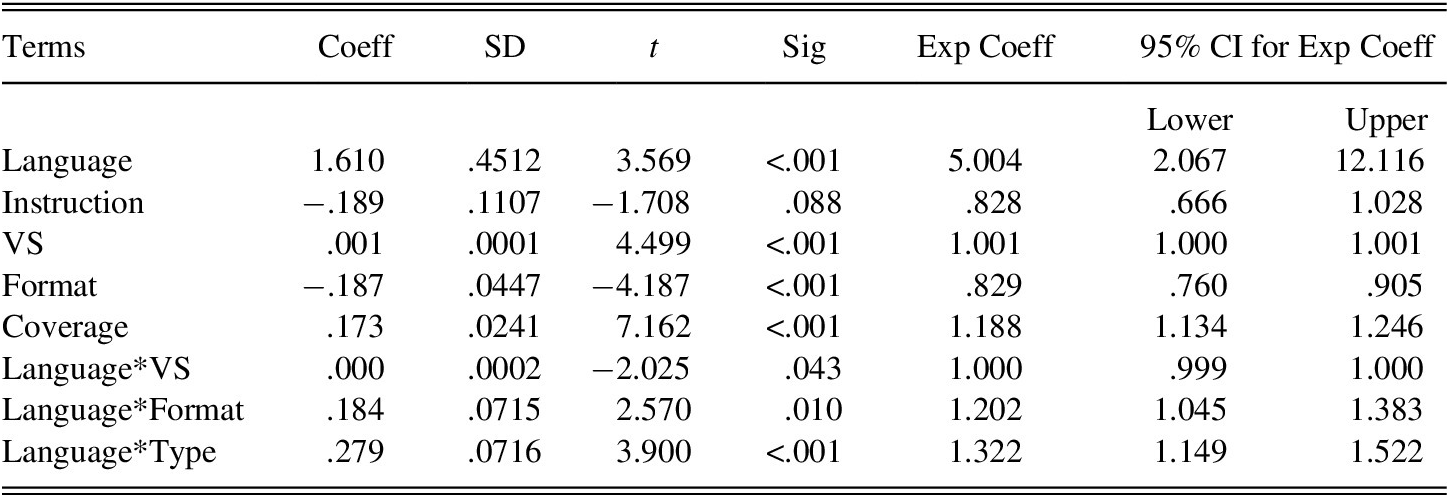
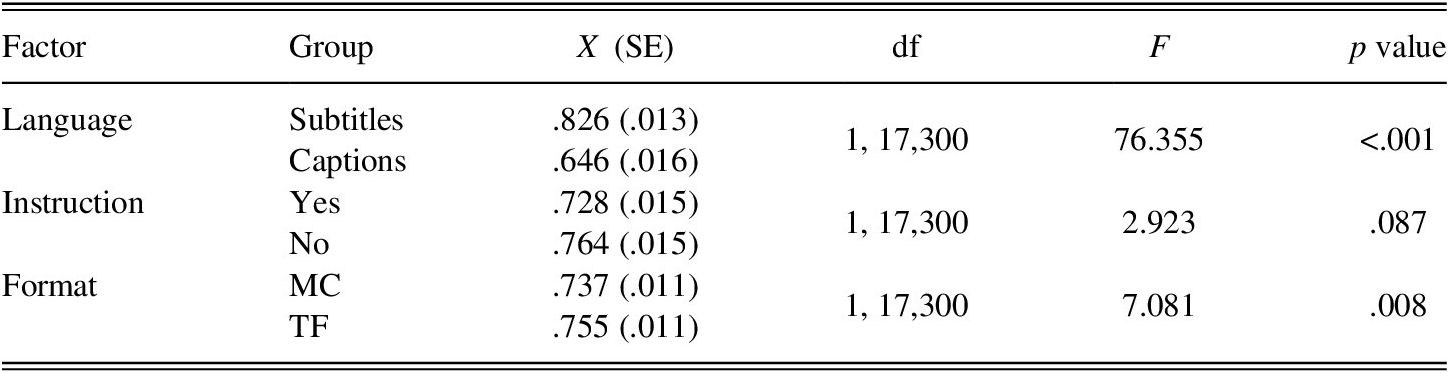
To arrive at the best fitting model, we entered all the explanatory variables in the model and removed one by one all nonsignificant interactions and main effects (p < .10). Table 4 presents the final fitted model, and Table 5 shows the significant main effects for the categorical variables. The model revealed that there were four factors that significantly (p < .05) contributed to the model: language of the on-screen text, vocabulary size, item format, and lexical coverage; and one factor that contributed marginally: type of instruction. Three significant interactions emerged: between language and vocabulary size, between language and item format, and between language and item type.
Results from the GLMM: Influence of intervention-related, learner-related, video-related, and test-related factors on comprehension scores

Note: Language = Language of the on-screen text; Instruction = Type of instruction; VS = vocabulary size; Coverage = Lexical coverage; Format = Item format; Type = Item type.
Results from GLMM: Influence of fixed main effects

Note: MC = multiple choice; TF = true-false; TE = textually explicit; IN = inferential.
Intervention-Related Variables
The GLMM analysis showed that there was a significant main effect of language of the on-screen text (p < .001), indicating that an average learner’s score would be 14% higher if they were in the subtitles groups when all other factors were held constant (see Table 5). There was an interaction effect between language condition and three other parameters—vocabulary size, item format, and item type—which suggested that the effect of these three variables needs to be explained in relation to language (see in the following text). There was a tendency for comprehension scores to depend on type of instruction (p = .088), indicating that the two groups who received explicit instruction on target vocabulary items tended to score lower than the two groups without instruction.
Learner-Related Variables
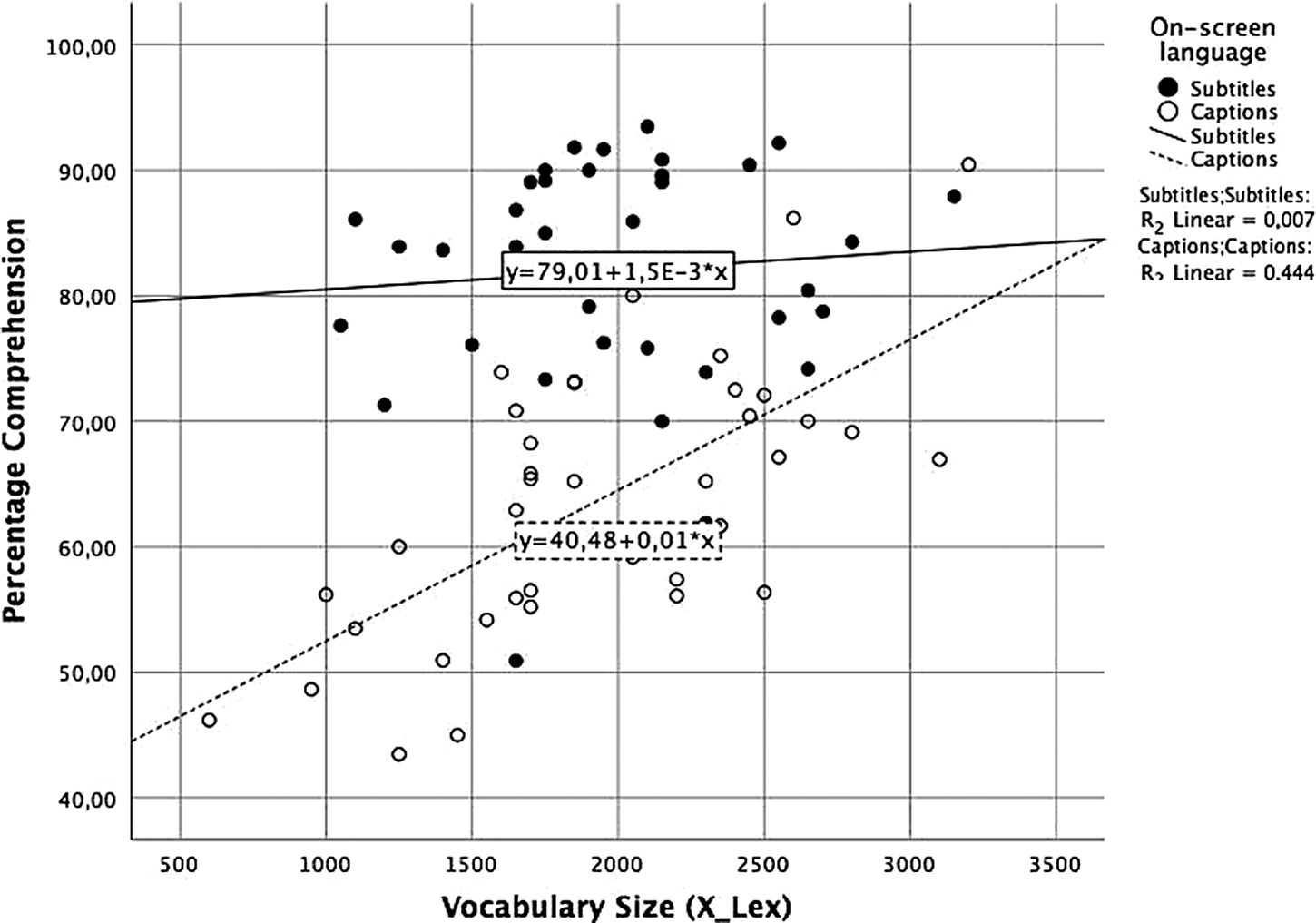
The model showed that vocabulary size was the only learner-related variable in our study that emerged as a predictor of comprehension (p = .004), while general proficiency did not appear to be a significant predictor (although the two variables correlated significantly; r = .334; p < .001). The interaction effect found between language group and vocabulary size (p = .043) indicated that the effect of vocabulary size depended on the language of the on-screen text, and that vocabulary size was only significant for the captions group. Figure 2 illustrates the relationship between these two variables, showing the participants’ average percentage of comprehension per vocabulary size and language condition.
Mean percentage of comprehension per vocabulary size and language group.

Attention and enjoyment did not appear to contribute to the final fitted model, but it was observed that, when introduced in the model individually, they emerged as significant predictors (p < .001 and p = .003, respectively), with higher attention and enjoyment associated with higher comprehension gains. Although no interaction was found with language condition, further exploration showed that attention and enjoyment were significantly higher in the subtitles group compared to the captions group (F (3,82) = 6,581; p < .001 and F (3,82) = 8,753; p < .001, respectively). Familiarity with viewing OV did not contribute to explaining comprehension scores.
Test-Related Variables
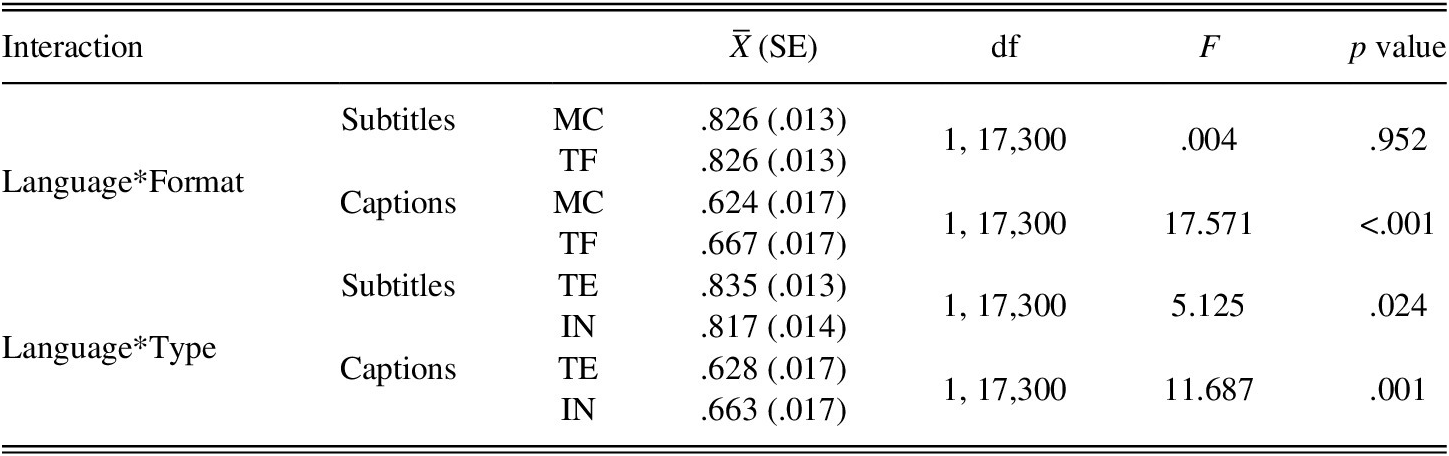
With respect to test-related variables, the GLMM indicated that item format was a strong predictor of comprehension scores while item type was not. Both, however, interacted significantly with language condition although they had a different impact on comprehension depending on the language of the on-screen text. Table 6 presents the mean comprehension scores per item format and item type when divided by language condition.
Results from the GLMM: Interactions. Categorical factors

Note: MC = multiple choice; TF = true-false; TE = textually explicit; IN = inferential.
For item format, learners in the subtitles groups performed equally in both formats, while in the captions groups learners performed significantly better in the true-false items than the multiple-choice items (p < .001). For item type, the subtitles condition performed better in the textually explicit items than in the inferential ones (p = .024), while inversely the captions group performed better in the inferential items (p = .001). In sum, the significant main effect of item format (p < .001) indicates that, independently of the language condition, true-false items had significantly more correct responses than multiple-choice items. However, the interaction between item type and language indicates that correct responses in one type or the other depended on the language of the on-screen text.
Episode-Related Variables
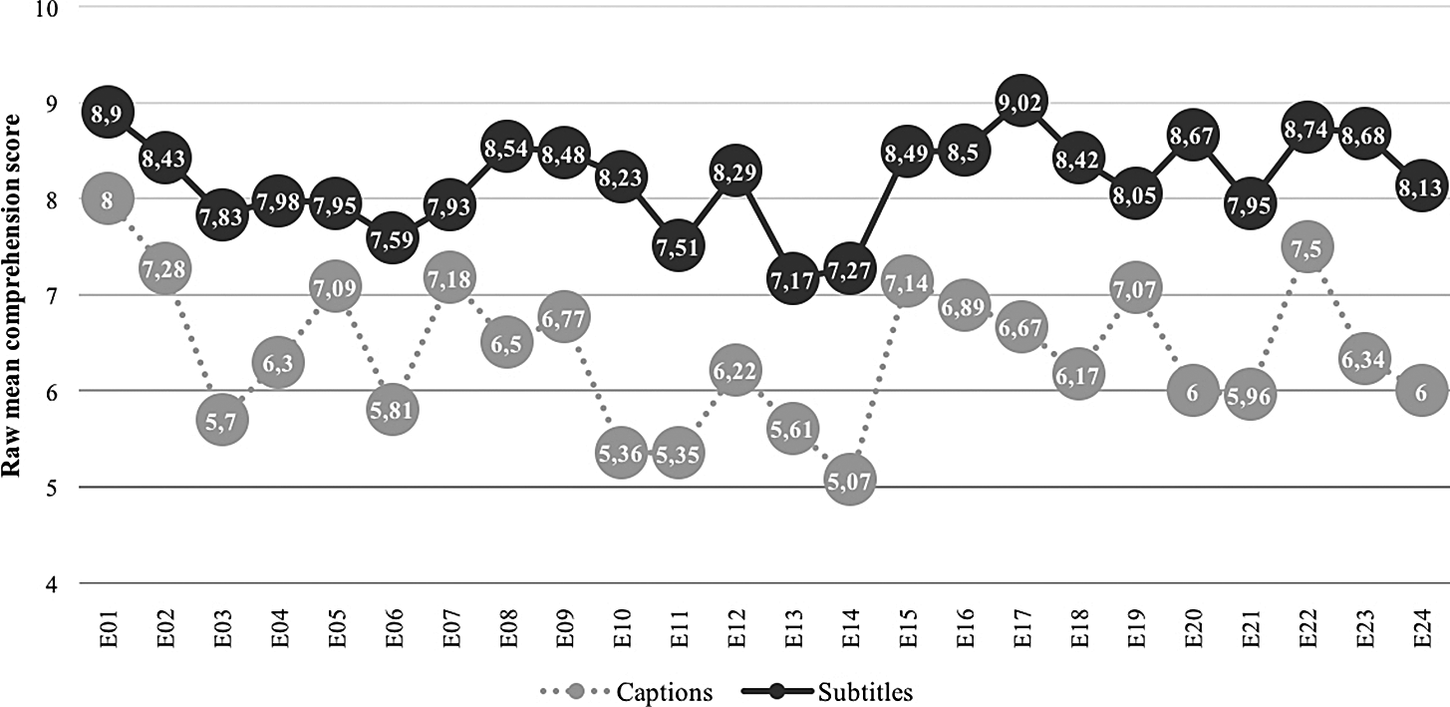
The lexical coverage of the episodes also emerged as a strong predictor of comprehension (p < .001), with no interaction with language of the on-screen text, indicating that episodes with higher lexical coverage received a higher number of correct responses (see Table 4). Figure 3 shows the mean raw score for the 24 episodes by each language group (captions and subtitles). Independent samples t-tests revealed that the subtitles groups significantly outperformed the captions group in all 24 episodes—ranging from p < .001 to p = .021. While comprehension scores vary from episode to episode, no linear progression from the first to the last session can be observed.Footnote 7
Mean raw comprehension score per epsiode and on-screen language group.

DISCUSSION
This study explored TV viewing comprehension by adolescent learners through exposure to 24 episodes over a period of 8 months and, in particular, how comprehension was affected by the use of captions or subtitles, alongside variables related to the instructional focus, the learner, the lexical coverage of the episodes, and the test items.
FACTORS RELATED TO THE INTERVENTION
Results showed that language of the on-screen text was a significant predictor of comprehension scores, with the subtitles group significantly outperforming the captions group, as expected. Previous studies have also showed the advantages of having L1 text for comprehension in audio-visual media (Bianchi & Ciabattoni, Reference Bianchi, Ciabattoni, Baldry, Pavesi and Torsello2008; Birulés-Muntané & Soto-Faraco, Reference Birulés-Muntané and Soto-Faraco2016; Latifi et al., Reference Latifi, Mobalegh and Mohammadi2011; Lwo & Lin, Reference Lwo and Lin2012; Markham et al., Reference Markham, Peter and McCarthy2001; Markham & Peter, Reference Markham and Peter2003).Footnote 8 Results also showed that having explicit instruction on target vocabulary had a small negative effect on overall comprehension—a drawback also found in previous studies (Lee, Reference Lee2007)—indicating that learners at this age and proficiency level may find it hard to split their attention between the two demands (VanPatten, Reference VanPatten2002). This suggests that research assessing comprehension performance when participants are also asked to pay attention to language forms (e.g., vocabulary, grammar) might need to take into account the depleting effects that explicit attention to specific aspects of the language might have on students’ performance. Yet, it has also been found that—in this context—directing learners’ attention toward target vocabulary renders significant improvement in vocabulary recall (Pujadas & Muñoz, Reference Pujadas and Muñoz2019), hence trade-offs between content comprehension and learning specific language aspects, such as vocabulary, deserve further attention and exploration.
FACTORS RELATED TO THE LEARNER
Although general proficiency did not emerge as a predictor in our study, it was found that vocabulary size was positively related to comprehension scores, with larger vocabulary related to higher comprehension. This falls in line with results from other studies that also found that learners’ vocabulary knowledge was a good predictor of comprehension (e.g., Montero-Perez et al., Reference Montero-Perez, Peters, Clarebout and Desmet2014; Rodgers, Reference Rodgers2013; Vulchanova et al., Reference Vulchanova, Aurstad, Kvitnes and Eshuis2015)—which concurs with findings on vocabulary acquisition research (e.g., Peters & Webb, Reference Peters and Webb2018). The interaction between vocabulary size and language indicated, however, that vocabulary size was a significant predictor only in the captions condition. This may suggest that learners in the subtitles condition relied more on reading the L1 text than on listening to the L2 audio (Stewart & Pertusa, Reference Stewart and Pertusa2004; Vandergrift, Reference Vandergrift2007), thus making prior L2 lexical knowledge less relevant for comprehension when having subtitles available. This finding underlines the value of L1 subtitles as a scaffold for lower-proficiency learners to access multimodal authentic input.
Our results partially concur with those of Lwo and Lin (Reference Lwo and Lin2012), who found that Grade 8 learners—of same age as our participants—benefitted better from subtitles than captions. In their study, however, Lwo and Lin acknowledged that the subtitles group was more proficient, a setback not found in the present study, in which both groups were comparable in terms of initial proficiency and vocabulary size. However, these results contrast with results from two previous studies with adolescent learners, in which it was found that there were no significant differences between language conditions (Vulchanova et al., Reference Vulchanova, Aurstad, Kvitnes and Eshuis2015), and that the on-screen text had a distracting effect for more advanced students (Bairstow & Lavaur, Reference Bairstow and Lavaur2011). Yet, participants in those studies were older and, probably, more proficient. It is possible that, with an increase in proficiency and vocabulary size, the difference between our language groups would have been smaller.
The other three learner-related factors—familiarity with viewing OV, attention to the TV series, and enjoyment from the TV series—did not appear to predict comprehension outcomes. It is likely that participants in our sample did not have as much prior experience viewing OV as for this factor to have a significant effect on comprehension scores. Although attention and enjoyment did not emerge as significant predictors, both were significantly higher in the subtitles groups. It might have been the case that language condition overpowered these other two parameters in the analysis, or it might be that higher attention to and enjoyment from the TV series were a result of the language condition—they were higher because learners were viewing the programs with the L1 text.
FACTORS RELATED TO THE EPISODES AND THE TEST ITEMS
Another parameter that had a significant effect on comprehension was the episodes’ lexical coverage, which has been shown to be a strong predictor in past research in listening comprehension (e.g., Hu & Nation, Reference Hu and Nation2000) and video comprehension (e.g., Rodgers, Reference Rodgers2013). Even if the difference between episodes was relatively small, episodes with higher lexical coverage had a higher percentage of correct responses. While the complexity of the plot or the familiarity with the topic of individual episodes (which sometimes included culture-bound references such as Thanksgiving) might have also played a role, episode lexical coverage appears to be a reliable and robust predictor for comprehension, independently of other factors such as on-screen text language or learners’ vocabulary size. The fact that no clear pattern of improvement could be observed over time also suggests that comprehension was indeed episode dependent. However, it is interesting to note that, independently of the language of the on-screen text, 74% of students reported (in the end-of-intervention questionnaire) that they understood the series better by the end of the intervention, suggesting that their comprehension was starting to improve though this was not yet detected by the measures used in the study.
Regarding test characteristics, item format was revealed to predict comprehension scores, with TF items having more correct responses than MC items. Yet, once language of the on-screen text was taken into account, the difference was only significant for the captions groups, suggesting that the availability of the L1 rendered item format unimportant. The language of the on-screen text also mediated responses by item type. While overall comprehension scores were not affected by item type, once language of the on-screen text was taken into account, for the subtitles groups it was found that recalling textually explicit information was easier than recalling inferential information. This falls in line with findings in the listening research literature showing that processing scattered information is harder than recalling information from just one location, and that recalling exact content tends to be easier than recalling the gist or main idea (Buck, Reference Buck2001). However, for the captions group it was the inferential items that received significantly more correct responses. It could be the case that—for the captions group—answering textually explicit items demanded that learners understood details that they might have missed due to the fast speech rate of the series and their low L2 linguistic skills (i.e., they could not use bottom-up processing successfully), whereas for inferential items the fact that they can gather information from different parts compensates for a missed piece of data (i.e., they were more successful at using top-down processing).
CONCLUSIONS
This study contributes to the area of foreign language learning through audio-visual input with results from a unique extensive classroom intervention. It is the first study analyzing learners’ exposure to authentic input over an extensive period of 8 months and to include vocabulary instruction and language of the on-screen text as mediating variables in comprehension. It is also one of the few studies using several full-length TV programs. The results of the present study confirm previous findings in the field regarding the higher efficiency of L1 subtitles over L2 captions for content comprehension at this level of proficiency, while corroborating the importance of vocabulary size when L2 captions are present—more demanding than subtitles for beginner-level learners. The study also suggests that explicit attention to target vocabulary items may have depleting effects on comprehension scores, which underlines the need to align the cognitive demands of tasks to learners’ processing skills. Another valuable finding of the study concerns the interaction between item type and language of the on-screen text, suggesting that learners process textually explicit information and inferential information differently depending on the support they receive from the language available on the screen. The influence of item format and item type on comprehension also highlights the importance of taking into account item-related characteristics in the analysis. Finally, results corroborate the key role of lexical coverage as a strong predictor of comprehension, in line with findings from prior corpus-driven research and the few experimental studies existing in this area (e.g., Rodgers, Reference Rodgers2013).
This study has several pedagogical implications. Firstly, it demonstrates the advantage of subtitles over captions for comprehension in a context with limited exposure to English and for adolescent participants with limited proficiency in the target language (average level between A1 to A2) and limited vocabulary size (around 2,000 words). Only students with larger vocabulary size could cope with captions. In a school classroom setting—where students may have different levels of L2 proficiency—the use of subtitles would engage the weakest students at the beginning while offering all learners the benefits of listening to authentic input and raising their motivation. It might be worth contemplating the possibility of combining both types of on-screen text support, moving gradually from subtitles to captions as learners get used to the characters, the voices, and the overall topic of the TV series. Secondly, findings suggest that teachers also need to be aware of the fact that focusing on vocabulary may have a detrimental effect on content comprehension. However, preteaching vocabulary has been shown to be an effective way of acquiring it (Pujadas & Muñoz, Reference Pujadas and Muñoz2019), and increasing vocabulary is—ultimately—an efficient way of supporting comprehension of audio-visual input. Thirdly, the association of comprehension and input lexical coverage suggests the need to align the vocabulary load of the audio-visual input to learners’ language skills. Finally, findings fit the principles of extensive viewing outlined by Webb (Reference Webb, Nunan and Richards2015) (e.g., listening comprehension was supported by captions, subtitles, and preteaching activities; input was of an appropriate level), and endorse TV viewing in the classroom as a starting point for extensive viewing out of the school.
The study has some limitations that need to be acknowledged. First of all, although there was a considerable number of observations, our sample size was relatively small. Also, the school setting made it not feasible to have a control group. Another shortcoming was that attention to and enjoyment from the TV series were self-reported and only assessed at the end of the intervention. Finally, the study did not take into account other factors that might have had an influence on comprehension, such as learners’ working memory, the topic complexity of the individual episodes, the role of the imagery, or the location of the necessary information within the episode—items tend to be easier when the information is presented at the beginning or when it is repeated (Buck, Reference Buck2001). Further research including these variables, other TV genres, and proficiency levels would provide valuable information and help obtain a more comprehensive picture of the factors involved in TV viewing comprehension.
Appendix
Examples of textually explicit items (TE), in multiple-choice (MC) and true-false (TF) format:
With what does Eddie trip over when he breaks his arm?
a) With a mechanical bull.
b) With a white rug.
c) With a cord.
SCRIPT: “Okay! Hey, boys, we can’t let mom know Eddie tripped over the cord of the mechanical bull and broke his arm. … Now tell these nice people the truth about how you broke your arm. Eddie. You were at Cattleman’s and you tripped … on the cord to the new mechanical bull.”
T/F Neither Jessica nor Louis knew that to be a realtor you needed a license.
SCRIPT: “[Jessica] apparently, you need a license to sell houses! Did you know this?! [Louis] I did know this. I told you this, and you ignored me.”
Examples of inferential items (IN), in MC and TF format:
Why do Jessica and Louis ask Nicole to babysit their children?
a) Because Eddie asked for it to be able to talk to her.
b) Because their gramma is too old to take care of the children.
c) Because Nicole is the cheapest option.
SCRIPT: “[Eddie] Babysitting? Why can’t grandma watch us? [Jessica] Because last time, she charged me $100 an hour. All right, we’ve got to get going. Nicole, some ground rules … no scary movies.”
T/F Evan has a severe gambling problem.
SCRIPT: “[Eddie:] I can’t believe you lied to me. I thought you were getting picked on. [Evan:] I’m addicted, okay? I’m addicted to playing Pogs. I don’t even get what you see in that noise. I love the thrill of taking risks, laying it all on the line.”