Introduction
Tinnitus is the perception of sound in the ear when no external sound is present. Patients with tinnitus usually report hearing a ringing, buzzing or whistling sound. It is estimated that chronic tinnitus affects 5–10 per cent of the population, and that severe tinnitus – which substantially reduces quality of life – affects approximately 1 per cent of the population.Reference Hoffman, Reed and Snow1
Tinnitus can be objective or subjective. Objective tinnitus is caused by sounds generated by an internal biological activity. Subjective tinnitus is much more common and results from abnormal neural activity; it is not caused by sound.Reference Belli, Belli, Oktay and Ural2 In this paper, we will focus on subjective tinnitus and refer to it henceforth simply as tinnitus.
There is a direct correlation between the duration of tinnitus and the severity of stress experienced.Reference Gomaa, Elmagd, Elbadry and Kader3 Blood levels of stress hormones seem to have some diagnostic and clinical value in patients with tinnitus.Reference Kim, Chung, Bae, Park, Yeo and Park4 The total and differential white blood cell (WBC) counts are known to be classic inflammatory markers, especially in cardiovascular diseases.Reference Arruda-Olson, Reeder, Bell, Weston and Roger5 The neutrophil-to-lymphocyte ratio has been proposed as a reliable indicator of the host's inflammatory status, and a potential marker of inflammation in cardiac and non-cardiac disorders.Reference Tamhane, Aneja, Montgomery, Rogers, Eagle and Gurm6–Reference Turkmen, Guney, Yerlikaya and Tonbul10
In the present study, we compared the neutrophil-to-lymphocyte ratio between patients with severe tinnitus and healthy participants. To the best of our knowledge, this is the first study to evaluate the neutrophil-to-lymphocyte ratio in patients with tinnitus.
Materials and methods
This prospective study involved 107 patients (72 women and 35 men; mean age, 38.7 ± 12.7 years) who presented to the Department of Otorhinolaryngology, Dumlupınar University, with tinnitus. All patients had suffered with tinnitus for at least two weeks. The patients underwent a detailed ENT examination and audiometric tests to rule out any related pathological cause of the tinnitus.
The tinnitus handicap inventory, which is a standardised scale, was used to determine the subjective severity of the tinnitus. Patients with tinnitus handicap inventory scale grades of 1 or 2 (with slight or mild tinnitus symptoms, respectively) were excluded from the study because of the less severe stress associated with these grades of tinnitus. Only patients with scale grades of 3, 4 or 5 (with moderate, severe or catastrophic tinnitus symptoms, respectively) were eligible for inclusion in this study.
All patients underwent audiometric tests; those with moderate or severe hearing loss were excluded from the study because the hearing loss would have affected their ability to perceive tinnitus. Tinnitus patients with systemic diseases, malignancy or any inflammatory disease that could alter the neutrophil-to-lymphocyte ratio were also excluded from the study.
In addition to the tinnitus patients, we recruited 107 age- and sex-matched healthy participants for the control group. These individuals had visited the Internal Medicine Department at our hospital for routine check-ups and had not been found to have any diseases. The control group was composed of 83 women and 24 men, with a mean age of 35.8 ± 13.9 years.
The protocol of this study was approved by the ethics committee of Pamukkale University. All individuals included in the study provided written informed consent. Participants were enrolled in the study only after they had agreed to participate in the study and had signed an informed consent form.
Blood samples were routinely drawn from the antecubital vein by careful vein puncture. The samples were collected in ethylenediamine tetra-acetic acid blood collection tubes. These were used for the haemogram and full biochemistry profile analyses, which involved determination of blood glucose level, lipid profile and vitamin status, and included liver function tests, renal function tests and thyroid function tests. The laboratory data were screened using the hospital's computerised database, and comparisons between the patient group and control group were made. The neutrophil-to-lymphocyte ratio was calculated and compared between the two groups.
Statistical analysis was conducted using SPSS software, version 19 (SPSS, Chicago, Illinois, USA). Normality of the data was assessed using the Shapiro–Wilk test. For the descriptive data, the normally distributed values are expressed as mean ± standard deviation. The independent-samples t-test and Kruskal–Wallis test were used to examine differences between the groups. Statistical significance was defined as p < 0.05.
Results
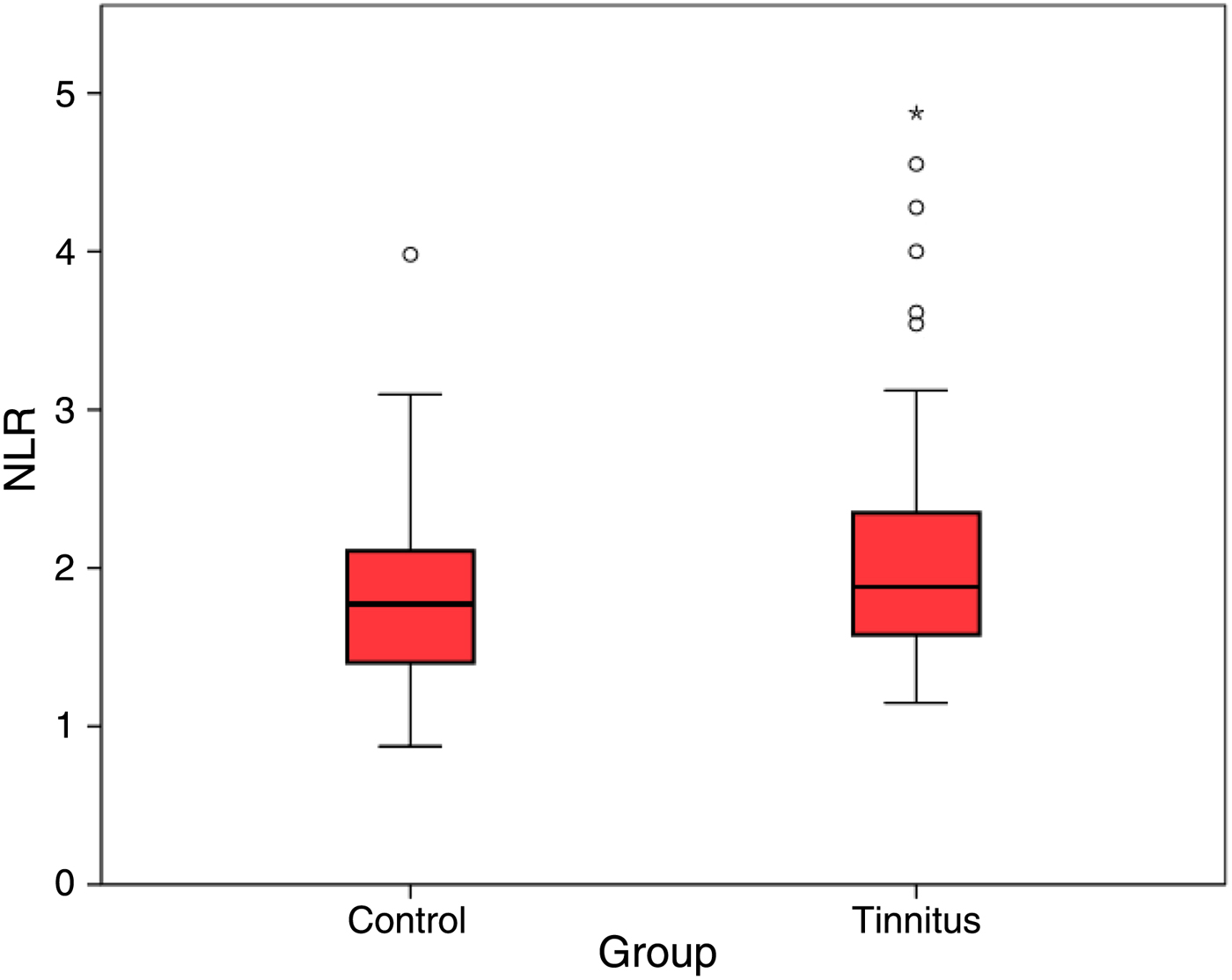
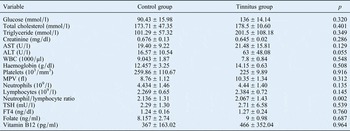
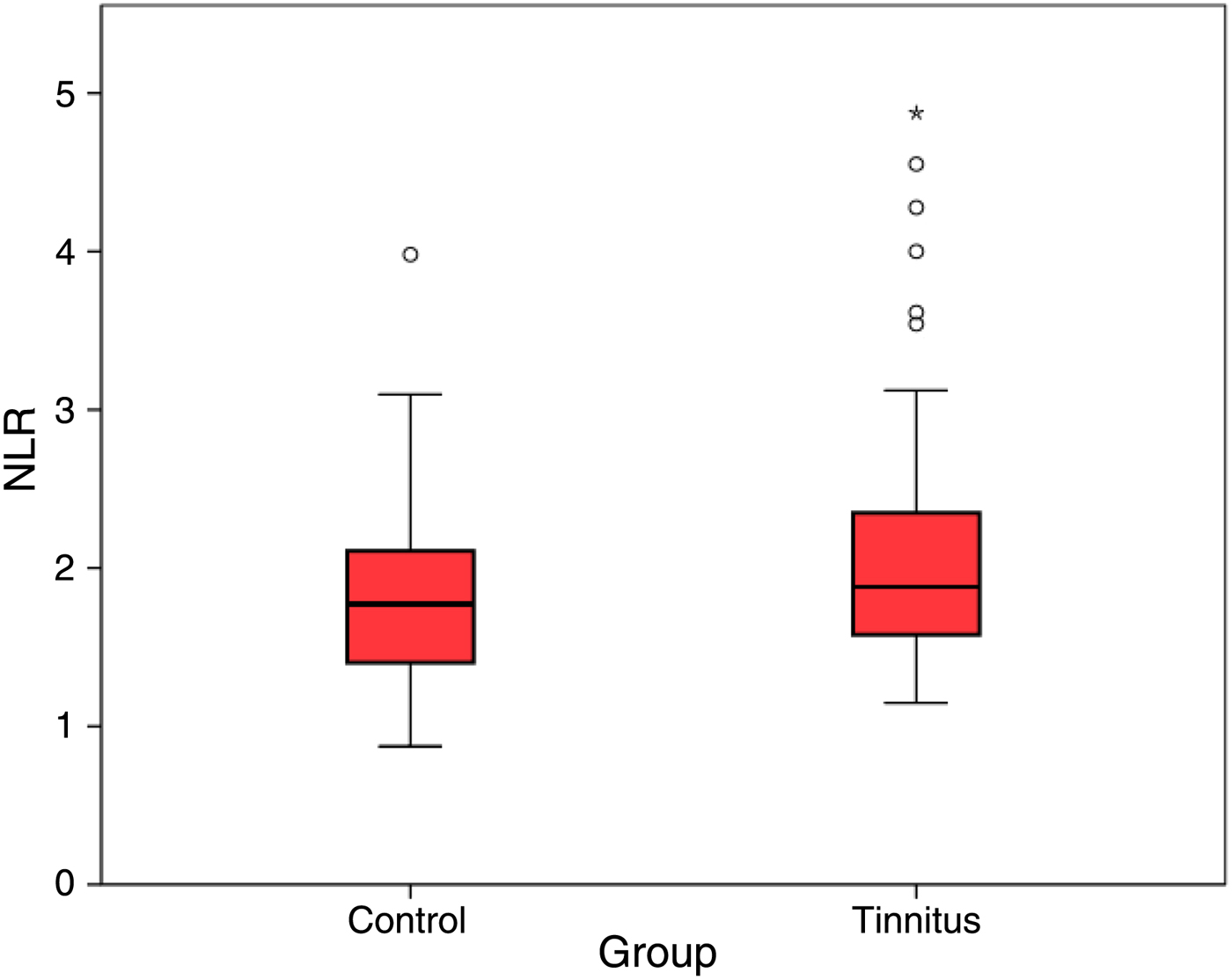
There were no significant differences between the patient and control groups in terms of age or sex. In addition, there were no significant differences between the groups in terms of lipid profile, liver function, WBC count, haemoglobin level, mean platelet volume, or vitamin B12 and folate levels (Table I). However, the mean neutrophil-to-lymphocyte ratio was significantly higher in patients with severe tinnitus than in the control participants (p < 0.05; Figure 1).
Neutrophil-to-lymphocyte ratio (NLR) values in the tinnitus and control groups.
Laboratory test results for tinnitus and control groups

AST = aspartate aminotransferase; ALT = alanine aminotransferase; WBC = white blood cells; MPV = mean platelet volume; TSH = thyroid-stimulating hormone; FT4 = free thyroxine
Discussion
Tinnitus is the subjective perception of sound without external acoustic signals and is caused by inappropriate activation of the auditory cortex. Tinnitus can be induced by a variety of pathological conditions that alter middle- or inner-ear functions, such as otosclerosis, labyrinthitis, ototoxicity and chronic otitis media, or by conditions that directly or indirectly affect neurons in the auditory pathway, such as multiple sclerosis, acoustic neuroma, meningioma, stroke and haemorrhage.Reference Mazurek, Haupt, Olze and Szczepek11
The onset of tinnitus can be associated with emotional factors and stress.Reference Hinton, Chhean, Pich, Hofman and Barlow12 In many cases, the cause of tinnitus is multifactorial. Therefore, any combination of changed auditory and somatosensory inputs, together with abnormal activity in the central nervous system, such as traumatic or ischaemic damage or emotional factors, can be relevant for tinnitus development.Reference Kreuzer, Landgrebe, Schecklmann, Staudinger and Langguth13 Although stress can be the cause of tinnitus, tinnitus can also be the cause of stress; thus, there is a strong link between stress and tinnitus, and the two conditions often co-exist.
Tinnitus has been found to be modulated by stress, and is closely related to an individual's emotional state and to the limbic system. The term ‘stress’ was originally used in physics to define a pressure causing the deformation of a physical body. In biology and medicine, the term ‘stress’ is used to describe the reaction of an organism to a stressor. Stressors can be of a physiological or psychosocial nature.Reference Mazurek, Haupt, Olze and Szczepek11 Kim et al. evaluated the diagnostic and clinical value of several stress hormones in a large number of tinnitus patients.Reference Kim, Chung, Bae, Park, Yeo and Park4 The authors concluded that blood levels of stress hormones seemed to have some diagnostic and clinical value in patients with tinnitus. Gomaa et al. evaluated co-morbid depression, anxiety and stress associated with tinnitus; the authors found a direct correlation between the duration of tinnitus and the severity of stress.Reference Gomaa, Elmagd, Elbadry and Kader3 Furthermore, they recommended that depression, anxiety and stress be taken into consideration during the treatment of tinnitus patients.
It is well known that stress causes inflammation.Reference Tamhane, Aneja, Montgomery, Rogers, Eagle and Gurm6–Reference Friedman, Tekawa, Grimm, Manolio, Shannon and Sidney9 Total and differential WBC counts can act as inflammatory markers in cardiovascular disease. Moreover, the neutrophil-to-lymphocyte ratio, which can easily be calculated from the neutrophil and lymphocyte counts in peripheral blood, is a potential marker of inflammation in cardiac and non-cardiac disorders.Reference Tamhane, Aneja, Montgomery, Rogers, Eagle and Gurm6–Reference Turkmen, Guney, Yerlikaya and Tonbul10 Doğan et al. investigated the relationship between the neutrophil-to-lymphocyte ratio and infarct-related arterial patency in patients with ST-segment elevation myocardial infarction.Reference Doğan, Akyel, Bilgin, Erat, Çimen and Sunman14 They found that the neutrophil-to-lymphocyte ratio was higher in patients with occluded infarct-related arteries than in patients with ST-elevation myocardial infarction.
• This study investigated the relationship between the neutrophil-to-lymphocyte ratio and severe tinnitus
• A significant relationship between the neutrophil-to-lymphocyte ratio and severe tinnitus was found
• The results suggest that the neutrophil-to-lymphocyte ratio should be considered as a potential marker of tinnitus when evaluating tinnitus patients
The neutrophil-to-lymphocyte ratio also seems to be a reliable predictor of adverse clinical outcomes in patients with cancer. Jin et al. investigated the impact of the neutrophil-to-lymphocyte ratio on the survival of patients with metastatic nasopharyngeal carcinoma, and found that the ratio was a prognostic factor in these patients.Reference Jin, Ye, He, Zhang and Zhang15 Seretis et al. investigated the significance of the neutrophil-to-lymphocyte ratio as a possible marker of underlying papillary microcarcinomas in cases of thyroidal goitre. They concluded that the neutrophil-to-lymphocyte ratio was significantly elevated in patients with incidental papillary thyroid microcarcinomas and thyroid cancer.Reference Seretis, Gourgiotis, Gemenetzis, Seretis, Lagoudianakis and Dimitrakopoulos16
Conclusion
In this study, we investigated the relationship between severe tinnitus and inflammation by means of the neutrophil-to-lymphocyte ratio. To the best of our knowledge, this is the first study to evaluate the neutrophil-to-lymphocyte ratio in patients with tinnitus. We found that the neutrophil-to-lymphocyte ratio was significantly higher among patients with severe tinnitus than among healthy controls. However, we did not include patients with slight or mild tinnitus (graded according to the tinnitus handicap inventory scale) in this study. The inclusion of patients with varying degrees of tinnitus might have affected the findings in terms of the reported relationship between stress and tinnitus. We intend to conduct another investigation that will include patients with mild to severe tinnitus. However, on the basis of the present evidence, we conclude that there is a strong correlation between severe tinnitus and the neutrophil-to-lymphocyte ratio.