INTRODUCTION
In 2007, Ashley Baker, a Glamour magazine editor, gave a lecture on corporate fashion to a group of women at a top New York law firm. During her presentation, the editor showed a photo of an African American woman with an afro. To the shock of her racially diverse audience, she stated that afro hair styles as well as dreadlock styles were “a real no-no.” She said it was “shocking” that some people still think it “‘appropriate’ to wear those hairstyles at the office,” and finished this judgment with the statement, “no offense … but those ‘political’ hairstyles really have to go” (Chen Reference Chen2007). The editor echoed what many scholars have long argued: African American hair is political. How African Americans style their hair, and who they pay to style it for them, has long been subject to government attention (Caldwell Reference Caldwell1991; Cornell Reference Cornell1995; Crenshaw Reference Crenshaw1989). This article explores why African American hair is a political matter by examining the little-known role of state occupational licensing of African American hair care, and by focusing on recent legal challenges and legislative battles over state regulation of hair-care provision for African Americans (Bell Reference Bell2007; Turner Reference Turner2001).Footnote 1
For most of the twentieth century, requirements for obtaining a state license to style hair (i.e., to become a cosmetologist or beautician) involved satisfying a mix of training and education requirements. In many states, the specialized training required for the styling and caring of African American hair was a regulatory afterthought. That specialized training primarily focused on techniques that straightened African American hair, rather than on styling and care of unstraightened or “natural” hair. By the late 1980s, a renewed popularity for natural and braided hairstyles was buttressed by the appearance of low cost hairstyling services provided by unlicensed hair braiders, many of them African immigrants from Senegal and Togo (Babou Reference Babou2009; Bond Reference Bond1993; Jones Reference Jones1998; Shellnutt Reference Shellnutt2006). What had been a regulatory afterthought had by 2010 become the subject of intense debate, lobbying, litigation, and policy making. Licensed Black beauticians fearing cheaper competition pressed for greater state enforcement of state occupational laws against unlicensed hairstylists, while advocates for hair braiders and other natural hairstylists pushed for changes in state regulations. As a result, a regulatory patchwork governing African American hair care has emerged across the fifty states and the District of Columbia. In twenty-seven states and the District of Columbia, policy makers have altered state regulations governing African American hair provision. Of these, thirteen states and the District of Columbia have developed special licenses for hair braiders and other natural hair-care stylists (Fig. 1).
State Regulation Choices Governing Hair Braiding, 1990–2010
Source: Colorado (2008, pp. 13–14); Institute of Justice (2010a).
New License States: Florida, Louisiana, New York, Ohio, Oklahoma, Pennsylvania, South Carolina, Tennessee, Texas; plus District of Columbia
Qualified Exemption States: Kansas, Minnesota, Mississippi
Fold-in States: Colorado, Illinois*, Iowa, Missouri, Oregon, South Dakota, Wyoming
Exemption States: Arizona, California, Connecticut, Georgia, Maryland, Michigan, North Carolina
Status Quo States: Alabama, Alaska, Arkansas, Delaware, Hawaii, Idaho, Indiana, Kentucky, Maine, Massachusetts, Montana, Nebraska, Nevada, New Hampshire, New Jersey, New Mexico, North Dakota, Rhode Island, Utah, Vermont, Washington, West Virginia, Wisconsin
*Illinois changed its law as of January 1, 2011. Hair braiders no longer have to obtain a full cosmetologist license; instead, a 300-hour sanitation-methods course satisfies licensing requirements. This action moves Illinois into the “Qualified Exemption” category. The analysis in this article was run with categories as of December 2010.

By contrast, nine states decided to exempt hair braiders and certain other kinds of Black hair providers from regulatory oversight. Meanwhile, seven states, where existing law was vague on whether certain kinds of Black hairstyling provision fell under state regulatory control, amended those laws to explicitly cover these new types of services. Despite changes in these states, twenty-three other states did not change, and kept their existing regulations. The focus of this article is to explain the challenges and choices made by these states. I test whether the struggle over the regulation of Black hairstyling resembles the interest-group politics that many scholars argue drives occupational licensing laws (Becker Reference Becker1983; Stigler Reference Stigler1971) or whether this struggle reflects the influence of racial deference claims, and is thus an example of a broader politics of intersectionality that influences American policy making (Crenshaw Reference Crenshaw1989; Hancock Reference Hancock2007).
Through an analysis of the politics surrounding what Bell (Reference Bell2007) has called “the braiding cases” (p. 125; Cornell Reference Cornell1995), this article will show that occupational licensing laws have also been an important element in the construction and maintenance of class, gender, and racial identities. As market-regulatory structures, occupational licensing laws have been used to create or maintain economic enclaves structured by race, gender, and class identities (Dorsey Reference Dorsey1983; Wingfield Reference Wingfield2008). However, licensing law not only determines who gains entry into a field, it can also determine how that field is practiced. The content of licensing regulation in terms of education, training, and other types of criteria required for licensure involves the sanctioning of some types of approaches, procedures, or methodologies over others (Freidson Reference Freidson1986). While these forms of field-specific knowledge may have been adopted to regulate market competition by imposing increasingly higher barriers to entry, the content of the regulations can also acquire a life of its own (Howard Reference Howard1998). The adoption or incorporation of other alternative forms of practice becomes less likely to occur, as the content of these regulations may become the common knowledge or norms on which other public authorities may base their decisions (White Reference White1987).
The article argues that the content of Black hair care regulations has become a form of common knowledge that has been used to codify appearance norms that have become the basis for several legal cases (Caldwell Reference Caldwell1991; Turner Reference Turner2001), Racial deference claims have been invoked to limit not only the legality of appearance norms but also state regulations that institutionalize these norms through professional practice (Bell Reference Bell2007; White Reference White1987). In contrast to much of the literature on occupational licensing which focuses on the politics of enactment or the income/market entry effects of licensure, the intersectional approach of this article also focuses on the content of state regulation and the support for, as well as challenges to, that content based on racial deference claims.
Nevertheless, in keeping with the literature on the politics of occupational licensing, I assume that state regulation of African American hair care, as is the case in other areas, serves an important market regulatory function: restricting competition and providing limited information about quality of services. This article however tests that assumption with the hypothesis that less advantaged groups (the hair braiders) using arguments based on claims of “racial deference,” and gaining the support of a well-resourced and ideologically focused ally, were able to influence state regulatory policy over the objections of long-standing and politically more advantaged interests: licensed African American beauticians and the Black elected officials who supported them.
The next section traces how state regulation of African American hairstyling can be understood within the context of earlier research on the political economy of occupational licensing. The following section presents a brief case study of Cornwell v. California Board of Barbers and Cosmetology (1997), a “braiding case” that critically influenced the political and regulatory struggle over hair braiding. The third section develops and presents a statistical analysis of this political struggle. The findings of this analysis—that interest-group demands as well as racial-deference arguments influence state regulatory choice—are discussed in more detail. A brief conclusion follows.
THE MULTIPLE ROLES OF OCCUPATIONAL LICENSING
Occupational licensing law is defined as “the granting by some competent authority of a right or permission to carry on a business or do an act which otherwise would be illegal” (Council of State Governments 1952, p. 5). This granting of public authority over private economic activity gives licensing laws conflicting roles in American governance, especially at the intersection of gender, race, and economic interest.
Establishing Market Niches
Occupational licensing laws serve to limit competition; as such, they are derided as “Victorian era” anachronisms that encourage guild-like, rent-seeking behavior on the part of interest groups, and the “capture” of politicians charged with enacting and enforcing these laws (Graddy Reference Graddy1991; Grant Reference Grant1942; Stigler Reference Stigler1971; Teske Reference Teske2003). Scholars have long argued that interest groups have played a powerful role in pressing for entry restrictions on, and regulatory oversight of, selected occupations (Grant Reference Grant1942; Law and Kim, Reference Law and Kim2005). The desire of interest groups to restrict entry into and competition within a certain service area may increase the income potential for holders of licenses.Footnote 2
This pressure for the enactment of state regulations as a means to preserve market share, or to gain new, protected markets can be seen in the struggle between male barbers and female beauticians at the turn of the twentieth century against the backdrop of a growing diffusion of occupational licensing laws across the states (Law and Kim, Reference Law and Kim2005; Walker Reference Walker1969). The emergence of beauticians as a distinct occupational group was facilitated by new norms about women's appearance, the spreading of a new mass market “beauty culture,” and the development of new technological advances in hair care and cosmetology (Grant Reference Grant1942; Peiss Reference Peiss1998; Willett Reference Willett2000, pp. 29–31). Barbers, who had benefited from long-standing state regulatory protection, initially resisted the entrance of women hairstylists, as barbers feared that a lucrative new source of business would be threatened (Buetzner Reference Buetzner1940; Thornton and Weintraub, Reference Thornton and Weintraub1979). To gain a competitive edge, women beauticians invoked claims of gendered expertise and public health to buttress their claims for market autonomy while also utilizing the tactics of interest-group politics. Willett (Reference Willett2000) argues that beauticians, like barbers, used occupational licensing as a means to establish hairstyling as a “semi-respected profession” and as a way to drive “irregular practitioners” out of the market in the name of profit and public health (pp. 5–6). By 1940, beauticians were successful in creating a market niche; almost all states regulated women's hair care. In some states hair care would be covered under broad cosmetology laws, while other states referred to hair care more directly (Buetzner Reference Buetzner1940; Grant Reference Grant1942; Law and Kim, Reference Law and Kim2005).
At first glance, the struggle over state regulation of Black hairstyling is similar to the struggle between barbers and beauticians: it is a struggle over which group gets to practice its trade under government sanction. The struggle over the regulation of Black hairstyling is between two groups: licensed African American hairstylists and unlicensed hair braiders (many of whom are recent immigrants). Standard theories of economic regulation and interest-group politics suggest that less privileged or organized groups that are harmed by the market-restricting aspects of state occupational licensing laws (such as unlicensed hair braiders) will be unable to alter state regulations in their favor. This article tests this claim, with an analysis of the impact of interest-group strength on state regulatory choice.
Indirect Effects of Licensing Law: Market Entry and Income Effects
Analyses of occupational licensing laws have found that the presence of these laws can in some cases make it difficult for women and members of minority groups to enter certain occupations (Dorsey Reference Dorsey1983; Freeman Reference Freeman and Rottenberg1980; Law and Marks, Reference Law and Marks2009). These effects may be deliberate, as occupational laws have been used to create economic niches in response to racial, ethnic, and gender competition (Bernstein Reference Bernstein2001; Foner Reference Foner1964; Law and Marks, Reference Law and Marks2009; Wingfield Reference Wingfield2008). For example, in the South, occupational licensing laws were used to prevent African American male barbers from serving White customers, an occupational niche that they had long dominated (Bernstein Reference Bernstein2001; Foner Reference Foner1964; Freeman Reference Freeman and Rottenberg1980).
Other research has found more indirect though still significant effects of occupational licensing on less privileged groups. Dorsey (Reference Dorsey1983) argues that licensing negatively affects minorities and the poor by systematically excluding them from, or channeling them into, some occupations due to education, training, and/or testing requirements, which may not be relevant for the actual practice of the profession (Federman et al., Reference Federman, Harrington and Krynski2006). For example, through “moral character” clauses, many states currently exclude certain kinds of ex-convicts from entry into a wide variety of occupations including relatively low-skilled occupations such as barbering (May Reference May1995). The result of these exclusionary effects is that those affected are forced to find employment in a lower-paying, less skilled field, or practice without a license. In inner city, minority communities, the latter choice leads to the creation of a segmented market where “unlicensed practice in nonprofessional trades [such as barbers and beauticians] is common” (Dorsey Reference Dorsey1983, p. 177). In this segmented market, unlicensed practitioners work in lower paying “neighborhood shops,” or provide services from their homes (Dorsey Reference Dorsey1983, pp. 177–178).
The beauty industry reflects many characteristics of a segmented market. Compared to other occupations, entry requirements are fairly low, although research has found that beautician licensing does affect pricing and quantity of services (Adams et al., Reference Adams, Jackson and Ekelund2002). A prerequisite to entering the field is the completion of specific training, either via an apprenticeship or provided by a beauty school. A high school degree or any other kind of higher education is not required. Start-up costs can be minimized as women can work out of their homes, rent “chairs” in an already established salon, or, if they are able to acquire the capital, start their own businesses (Walker Reference Walker2008; Wingfield Reference Wingfield2008).
The ease of entry into the field, however, raises the stakes for protecting the privileges of occupational licensing. From the field's beginning, middle-class women (both White and Black) attempted to raise incomes and create an aura of professionalism and respectability by restricting entry, usually through pressing for stricter occupational licensing standards and increased enforcement. According to Walker (Reference Walker2008), these efforts have been periodically challenged by working-class women who desire easier requirements for entry into as well as on-going participation in the field (Erickson Reference Erickson1935; Willett Reference Willett2000). For example, during the Depression of 1930s, incomes for established licensed Black beauticians fell while the number of unlicensed and often cheaper hairstylists increased (Erickson Reference Erickson1935). During the late 1960s and early 1970s, the popularity of the afro style led to increased competition from barbers as well as unlicensed hair cutters (Willett Reference Willett2000). Foreseeing a potential loss in clients, in both instances Black beauticians raised the alarm that unwary consumers faced a host of quality control as well as health and safety issues by going to unlicensed practitioners or other types of service providers (Willett Reference Willett2000). Beauticians also turned to local officials, especially minority politicians with whom they had often developed a close relationship, in getting state regulators to crack down on competition from other groups such as barbers, or from unlicensed providers (Blackwelder Reference Blackwelder2003; Gill Reference Gill2004; Willett Reference Willett2000).
The emergence of the hair braiding industry in the 1990s reflected many of the conflicts seen earlier. Many hair braiders, lacking the education, language, and financial resources needed to become licensed, were employed in the informal part of the segmented labor market described by Dorsey (Reference Dorsey1983): working out of their homes, or in unlicensed stores in inner city neighborhoods (Babou Reference Babou2009). Indeed, the demand for hair braiding and the growth of the informal shops encouraged human traffickers in New Jersey's urban areas to bring in African women to staff these shops (Donohue Reference Donohue2007; Ryan Reference Ryan2009).
Unsurprisingly, this rise in new competition sparked a negative reaction from African American beauticians. Like many other organized and protected groups, licensed Black cosmetologists sought state enforcement of licensing laws in order to restrict competition and to protect consumers from what these cosmetologists argued were potential health issues caused by unsanitary conditions (Paghdiwala Reference Paghdiwala2006; Shellnutt Reference Shellnutt2006; Williams Reference Williams2000). As in earlier instances, Black politicians and other local leaders responded to the demands of the beauticians, an important political constituency in many African American communities (Blackwelder Reference Blackwelder2003; Gill Reference Gill2004).
The hair braiders denounced these calls for regulatory enforcement. Many individual hair braiders made economic arguments: that those most in need of help entering the formal labor market—recent immigrants, the less-skilled, or the unemployed—were blocked from doing so due to costly (in money and time) licensing requirements that had little to do with the simple act of hair braiding (Jones Reference Jones1998; Paghdiwala Reference Paghdiwala2006).
Not surprisingly given the politics and guild-like behavior of occupational licensing beneficiaries, the natural hairstylists/braiders would be represented by a new trade group, the American Hairbraiders and Natural Haircare Association (AHNHA) (2011a) established in 1995 by natural hair salon owners and hair braiders from Washington DC. The AHNHA made slightly different arguments reasoning that since most, if not all, state education and licensing requirements did not cover hair braiding techniques for African Americans (at least in the early 1990s), then hair braiders should be exempt from state regulation as current regulations were irrelevant to them. Requiring hair braiders to have a credential that had nothing to do with the actual practice was pointless and punitive, if not deliberately designed to restrict competition (AHNHA 2011b; Cornwell Reference Cornwell2010b; Institute for Justice 2010b; Sandefur Reference Sandefur2004).
The stance that licensed beauticians were engaging in anticompetitive practices was one that was fully embraced by the Institute for Justice, the primary legal advocate in many of the hair-braiding cases. The Institute's mission is to engage in “ongoing efforts to restore economic liberty—the right to work for an honest living—as a fundamental civil right of the free market” (2010a). The Institute has supported a range of causes, from legal challenges to affirmative action, to battling restrictions on urban van services in order to “free” minorities from the burdens of state regulation, which restricts “entry into trades and professions” (2010a). The Institute argues that [w]hen those regulations exceed legitimate health and safety objectives, they needlessly cut off the bottom rungs of the economic ladder, particularly for people with little capital or few skills” (2010a).
This paper tests whether the demands of licensed Black beauticians for more government regulation and enforcement prevailed over the interests of the unlicensed hair braiders and their conservative legal allies for less state regulation of Black hair care.
Asymmetrical Information, Public Health, and Claims to Knowledge
The politics of occupational licensing may also be driven by the desire to address information asymmetries between consumers and producers, as well as the desire by state authorities to address issues of public safety and health. Both parties—interest groups and governments alike—favor these laws because they can reduce information asymmetries between producers of services and consumers (Akerlof Reference Akerlof1970; Kleiner Reference Kleiner2000; Law Reference Law2003; Leland Reference Leland1979; Teske Reference Teske2003). For consumers, occupational licenses signal that producers are trustworthy, while producers can use licensing as a means of distinguishing their service from similar ones in the marketplace (Akerlof Reference Akerlof1970). For state authorities, occupational licensing laws offer another means to protect public health and safety (Graddy Reference Graddy1991; Law and Kim, Reference Law and Kim2005; White Reference White1987; Zhou Reference Zhou1993).
Like other occupational groups, beauticians would make the case for imposing state licensing requirements as a way to ensure quality control for consumers as well as a means to uphold public-health and safety standards (Buetzner Reference Buetzner1940). Although state authorities can impose regulations in order to uphold public health and safety, those groups covered by regulation are not averse to in turn embracing those regulations as a way to buttress their claims to a “knowledge base” that warrants continued public recognition and protection (Freidson Reference Freidson1986; Zhou Reference Zhou1993, p. 441). In the current struggle for Black hair-care regulation, two types of claims to knowledge have been invoked: (1) a technical claim to knowledge based on specific hair-care practices and styling techniques, and (2) a nontechnical or rather “cultural” claim to knowledge based on gender and/or racial identity.
Technical Claims to Knowledge
In establishing their goal of state regulatory protection, as well as greater professional and economic autonomy, beauticians established a specialized technical claim to knowledge based upon new advances in chemical and heat-based processes for styling hair such as “permanent waves” for White consumers and heat and later chemical straightening processes for Black consumers (Banner Reference Banner1983; Blackwelder Reference Blackwelder2003; Fuchs and Wilburn, Reference Fuchs, Wilburn, Fuchs and Wilburn1967; Peiss Reference Peiss1998; Willett Reference Willett2000). Like the hair braiders of the 1990s, early women beauticians would argue that then current state licensing requirements were irrelevant; that it was “unreasonable to require persons desiring to become beauty culturists practicing on women” to “learn to shave men” (Grant Reference Grant1942, p. 468).
The content of state licensing requirements on paper and in practice reflected differences between African Americans and Whites. In general, Blackwelder (Reference Blackwelder2003) argues that “racial prejudice and discrimination shaped state beauty codes … racial separation reflected differing consumer demands by race” (p. 31). African American involvement in defining the content of state regulatory oversight reflected the demand from many African American consumers for hairstyles that satisfied Black women's own style preferences as well as their needs for respectability, uplift, and status (Cleage Reference Cleage1993; Craig Reference Craig2002; Rooks Reference Rooks1996; Weitz Reference Weitz2001). The second and more indirect demand from African American consumers was for hairstyles which would satisfy White society's need for Black women to display hairstyling that at least attempted to approximate the White female norm. As legal cases including Rogers v. American Airlines (1981) set precedents in the 1980s, straightened Black hair that approximated the appearance of Caucasian hair became the norm for self-presentation to which corporations could hold African American women employees (Caldwell Reference Caldwell1991; Turner Reference Turner2001).
The result of these consumer demands coupled with professional practice led to a gradual codification of a certain practice of Black hairstyling. The specialized “claim to knowledge” used by Black hairstylists rested on the application of certain kinds of hair manipulation involving heat, or later in the twentieth century, chemical processes, in order to straighten the naturally curly hair of many African Americans. As Blackwelder (Reference Blackwelder2003) describes, requirements for Black hairstylists emphasized the use of “heated comb, irons and curlers,” as well as “knowledge of a number of compounds applied to the hair and the scalp” (pp. 29–31).
State licensing requirements for African Americans varied in their accommodation of this specialized claim to knowledge. In some states, like Illinois, African American hairstylists created a separate curriculum requirement for White and Black applicants. Many states were like Texas, where separate curriculums were not developed for African American hairstylists; instead, separate examinations with presumably different standards were conducted for Whites and Blacks (Blackwelder Reference Blackwelder2003, p. 32). For hair braiders, these myriad state regulations posed an exceptional, and in their view, unfair challenge. Many state licensing standards were like California's: the education and styling training required by the state only covered the care of Caucasian hair; thus making that group's hair the regulatory norm (Cornwell Reference Cornwell2010b). Not until the struggle over hair braiding emerged did states change their education and training criteria to address the care and styling of African American hair that was processed with neither heat nor chemicals.
Nontechnical Claims to Knowledge
Women beauticians invoked a claim of “gender deference” as a way to establish themselves in the eyes of regulators as a distinct occupational niche separate from barbers Early female beauticians asserted that they should be “free from the domination of barbers' law” in order to take their rightful place over the care and styling of women and children's hair (Institute for Justice 2010b). Female hair stylists claimed that only women in a separate space could attend to the physical as well as the psychological needs of women, and protect them from the unwholesome atmosphere of the male barber shop, the latter possibly staffed by immigrant or African American men (Grant Reference Grant1942; Willett Reference Willett2000, pp. 41–43). Black women would make a claim for a special space for their female customers as well, although segregation, whether by law or by custom, also mandated that they carve out a separate sphere (Blackwelder Reference Blackwelder2003; Willett Reference Willett2000). Occupational licensing thus served two functions: it provided a gendered and racialized economic enclave based on claims of technical expertise and gender/racial deference, and it regulated competition within that enclave based on different kinds of claims to knowledge (Walker Reference Walker2008; Wingfield Reference Wingfield2008).
Hair braiders and their supporters countered the technical and nontechnical claims to knowledge made by licensed beauticians with claims of their own. First, hair braiders argued that since natural hair care does not involve the use of chemicals or machines, any regulatory oversight should be minimal. State regulatory efforts should largely be concerned with issues of health and hygiene, since, as Bayham (Reference Bayham2008) writes, “This is hairbraiding, not brain surgery. Training is utterly unnecessary to protect the public; safety concerns can easily be addressed by reading a simple pamphlet” (p. 1).
Instead of invoking gender deference, hair braiders invoked “racial deference” arguments that in court would prove to be just as powerful as economic arguments against regulations (Bell Reference Bell2007; Institute for Justice 2010a). Hair braiders claimed that hair braiding was a “natural” practice, according to Bayham (Reference Bayham2008), a “form of cultural expression and an artistic art form—braiding styles differ from braider to braider and region by region. The skills are passed from generation to generation, not through formal education that simply wastes time and money” (p. 1).Footnote 3
As a result of these cultural issues and the lack of relevance of state regulations for the actual practice of hair braiding, hair braiders argued that they did not require any state oversight; indeed state regulatory oversight could be seen as culturally insensitive (Bell Reference Bell2007). This racial deference claim was used in a number of court cases—many of them successful—brought by individual hair braiders with the assistance of the Institute for Justice. According to the Institute for Justice (2010b), the “natural haircare industry is consigned to the status of a subjugated pariah, still fighting against prevailing orthodoxy enforced by the state, just as it was forced to during the Jim Crow era.”
The current struggle over state regulation of Black hairstyling is also a struggle over the content of state regulation and over both technical and nontechnical claims to knowledge. Challengers in the early 1990s would argue that the content of state regulations privileged only one kind of Black hair care/styling, and thus privileged one set of appearance/identity norms over others. Not only was that kind of state-sanctioned hairstyling culturally insensitive and noninclusive, alternative hairstyling practices such as hair braiding were not even included in many state education or training requirements. One set of practitioners and one set of racial/gender norms were privileged over others. Second, challengers based their critique of state regulation on racial/cultural deference claims, which Bell (Reference Bell2007) describes as a “heuristic whereby decision-makers permit actions that would otherwise be impermissible because they are customary for a recognized group” (p. 145). Challengers argued that hair braiding and other natural hair care were African and African American cultural practices, and thus should be exempt from state regulatory oversight, lest the state engage in cultural insensitivity, if not inadvertent racism (Institute for Justice 2010b).
The response of some state authorities to the struggle between beauticians and hair braiders over these conflicting claims to knowledge as well as state authorities' own assessment of public health issues was mixed. For example, in three states—Kansas, Minnesota, and Mississippi—state authorities partially gave in to racial deference claims by exempting hair braiders from the state's cosmetology licensing laws; at the same time, these states required hair braiders to complete a health and sanitation course in order to be registered with the state (Colorado 2008).
Stigler's (Reference Stigler1971) model of regulatory capture assumes that political authorities are “captured” by well-organized groups, and enact occupational laws as a result of this group pressure (Becker Reference Becker1983). The struggle analyzed in this article—between licensed Black beauticians on the one hand, and hair braiders and their ally, the Institute for Justice, on the other—suggests that while politicians may appear to be captured by one group, the tactics and strategies of competing groups as well as the self-interest of public authorities responding to concerns about public health, may also play a role in explaining the adoption of occupational licensing laws.
The next two sections of the article trace the judicial as well as state legislative battles between beauticians and braiders and other so-called “natural hairstylists” over the boundaries of the Black hair care practice. At stake was the influencing of state authorities' decisions in setting parameters for market entry, and how state regulations would affect their professional practice.
SISTERLOCKS: CULTURAL PRACTICE AND/OR PROTECTED CLAIM OF KNOWLEDGE?
The first shot in the battle against state regulation of braiding, and the first of the “braiding cases,” would come from an African American woman entrepreneur, Dr. JoAnne Cornwell (Bell Reference Bell2007). A professor at San Diego State University, Cornwell (Reference Cornwell2010a) created and trademarked a hair braiding technique she called “Sisterlocks;” and, like earlier Black hair-care entrepreneurs such as Madame C. J. Walker, developed a training course and certification system, which offered individual women a path toward economic empowerment.Footnote 4 Cornwell faced two legal challenges. The first legal challenge was with the state of California in the case of Cornwell v. California Board of Barbering and Cosmetology 962 F. Supp. 1260 (1997). The second legal challenge was Cornwell's attempt to protect her hairstyling process from competitors based on her argument that certain aspects of cultural practice could be trademarked, and thus protected by the state (Cornwell v. Belton No. 04-CV-658H U.S. District (S.D. Cal., 2005)).
Cornwell argued in her case against California's State Board of Barbering and Cosmetology (CBBC), that hair braiding was a cultural practice that should not be covered by state regulation. She further argued that the state regulation that did exist was irrelevant for braiders since all of the techniques consisted of techniques appropriate for Caucasian hair, or for chemically/heat-treated hair (Cornwell Reference Cornwell2010b).
The CBBC argued that hair braiding, cultural practice or not, was subject to regulation by the state, even if those regulatory requirements did not include specific provisions that covered African American hair. Cornwell and the Institute for Justice made what they thought was a compelling counterclaim: how could a skill learned as children and practiced throughout a large part of Africa be subject to licensing? How could licensing regulations which emphasized the training of techniques used to approximate Caucasian hair be applied to “natural” hair styling? In her testimony, Cornwell argued that the court had no jurisdiction as
the bases for these [locking] techniques originate[d] many centuries ago in Africa and were brought by Africans into this country where the methods have endured (and have been expanded upon) as a distinct and popular form of hairstyling, primarily done by and for persons of African descent
(Testimony cited in Cornwell v. Belton 2005, p. 14).The court decided for Cornwell in a victory that would change state regulation of Black hair care, finding that California's regulations were not applicable to the practice of natural Black hair care; the court held that there “[is] no rational connection between the CBBC's required curriculum and the practice of of African hair styling” (Cornwell v. California 1997, p. 1273).
This victory, however, undermined Cornwell's second legal case, which attempted to protect her Sisterlocks technique as a trademarked process (Cornwell v. Belton 2005). Cornwell brought the case against Debra Belton, who had been trained by Cornwell's Sisterlocks company, when Belton founded her own hairstyling salon using a procedure she called “nappylocs.” The court ruled against most of Cornwell's claim of trademark violation. Cornwell had claimed in her earlier case against California that hair braiding employed techniques that were “centuries old.” Thus the court in Cornwell v. Belton (2005) ruled that it was “difficult to see” how a technique “with a historical backdrop … for thousands of years and [which] spans at least two continents,” could be protected by law (p. 14). The court ruled that as she had learned from African and African American culture about hairstyling, and had built upon the innovations of others, Cornwell could not “prevent others from building creatively on the skill and training she [taught] as part of her Sisterlocks course” (p. 24).
Despite the setback of the Belton case, the Cornwell case set an important precedent. Over the next fifteen years, hair braiders, with the support of the AHNHA, or with the assistance of the Institute for Justice, or on their own, would try to follow Cornwell's lead to overturn or modify state regulation of hair braiding. The Institute for Justice would provide litigation support in cases filed in Washington DC, Arizona, Georgia, Minnesota, Mississippi, Ohio, and Washington. Other court cases were filed without the Institute's assistance in states including South Carolina and Pennsylvania. In almost all of the successful cases brought by the Institute, state regulators or state courts bowed to the “cultural practice” deference argument and largely exempted hair braiders as well as other natural hairstylists from state regulation (Bayham Reference Bayham2008; Bell Reference Bell2007; Colorado 2008). By 2010, seven states exempted natural hair care or braiding from state regulation.
DETERMINANTS OF A NEW BLACK HAIR-CARE REGULATORY REGIME
The previous discussion provides a rich backdrop for understanding the politics of occupational licensing. In this section, I test whether the struggle over the regulation of Black hairstyling resembles the interest-group politics described by economists such as Stigler (Reference Stigler1971), or whether the struggle to determine state regulatory control of Black hair care reflects the influence of racial deference claims, and is thus an example of a broader politics of intersectionality that influences American policymaking (Hancock Reference Hancock2007). The following section describes the hypotheses to be tested and the data used in the analysis.
Dependent Variable: State Regulatory Choice
The study examines the regulatory choices made by various states and the District of Columbia from 1990 to 2010. The most common choice made by twenty-three states was to do nothing and remain silent on the issue of Black hair care. While some states such as North Dakota may have done nothing because of a lack of demand for change due to low Black population, other states such as New Jersey, which has a Black population of 14%, chose not to change existing hair-care regulation despite the demand for regulatory change. As noted earlier, seven states exempted hair braiding from state regulatory overview. Information on how a state regulated hair braiding was collected and cross-checked from a number of sources including the Institute for Justice, the AHNA Web site, state regulatory review reports (Colorado 2008), and state government Web sites. Some states shifted from one regulatory choice to another over this two-decade period. For all states, the regulatory choice considered in the analysis is the initial choice made by the state after 1990 and before January 2011.
States chose among three other regulatory options during this time period. One type of regulation, chosen by seven states, was to “fold in” hair braiders to the existing regulatory requirements by specifically requiring hair braiders to obtain a standard cosmetology license. Another regulatory choice taken by eleven states was to create a separate, specialized hair-braiding license. For Bell (Reference Bell2007) and other scholars, this regulatory choice was optimal since it recognized hair braiding as a distinctive occupation while also taking concerns about consumer health into account. Finally, three states—Kansas, Minnesota, and Mississippi—attempted to satisfy both racial deference claims and public health concerns; these states granted hair braiders a qualified exemption. Hair braiders would be required to complete some form of cosmetological education that included health and sanitation training.
The dependent variable in the following analysis represents the four choices made by states: (1) to not change existing state regulatory structure; (2) to exempt hair braiders from state regulatory oversight; (3) to explicitly fold in hair braiders to the preexisting regulatory structure; or (4) to create a new specialized license for hair braiders. The qualified exemption choice is added into this last category as the number of states choosing qualified exemption is too small for analysis. Since each state regulatory choice is independent and unranked, a multinomial logistic regression model is used to test the following two broad hypotheses.
Hypothesis One
According to traditional interest-group models of occupational licensing laws, state authorities should respond favorably to well-organized, established interests such as those of licensed Black cosmetologists. As Gill (Reference Gill2004) notes in her research, cosmetologists are a particularly influential constituency group of Black politicians. Conversely, state authorities should be relatively uninfluenced by the interests of hair braiders, since the latter group is smaller and has many members who are socioeconomically disadvantaged due to immigration status and literacy/language barriers. Given this balance of forces:
Hypothesis 1A: Black beauticians should prefer the existing regulatory structure, and be opposed to any changes to that structure. The impact of their preference should reflect the size of the group.
Hypothesis 1B: Black politicians should follow the preferences of licensed beauticians, and thus should be opposed to any change from the current regulatory system. The impact of their preference should reflect the size of the group.
The preferences of these two groups—African American beauticians and Black elected officials—may be visualized in this way:
Status Quo > Incorporation > Fold In > Exemption
Licensed beauticians would prefer not to have new competition; thus their regulatory preference, and that of Black elected officials, would be for the status quo to prevail over any proposed regulatory structure that would support new market competitors. Of the remaining three regulatory preferences, folding in would be the next preferred alternative, as hair braiders would have to satisfy the same entry barriers as cosmetologists. New licenses would be the next preferred alternative, as it would still limit unlicensed competition. The least preferred choice of beauticians and elected officials would be exemption, as it would allow free market entry and thus increase overall competition and lower compensation for licensed beauticians' services.
Hypothesis Two
Hair braiders (especially African immigrant braiders) and the Institute for Justice pressed for changes in state regulation using racial deference claims. These groups will show a strong preference for changes in state regulations that lower or eliminate barriers to market entry. The presence of these groups or the presence of a racial deference claim will prod state regulators into taking action that reflects a racial deference claim. More specifically,
Hypothesis 2A: The more members of a group demand racial deference, the more responsive state regulatory officials will be to that demand. The greater the population of African immigrants in a state, the more likely a racial deference claim will succeed and change state regulatory policy.
Hypothesis 2B: States in which a racial deference legal challenge has been filed are more likely to change the regulatory status quo to an outcome more favorable to racial deference claimants.
The impact of racial deference claims on preferences for state regulations may be visualized in this way:
Exemption > New License > Fold In > Status Quo
For hair braiders, a successful racial deference claim would result in a state's decision to alter the regulatory status quo to lower or remove the formal market barriers of entry. The most preferred option for those making racial deference claims would be a state's decision to exempt hair braiders from occupational licensing standards. Less preferable but still acceptable would be the enactment of new regulations which incorporated hair braiding into a new state regulatory law. New regulations would not only distinguish hair braiders from cosmetologists, but would also provide a lower barrier of entry for existing practitioners. In addition, such regulation would constitute a new entry barrier, thus affording hair braiders a market-regulatory mechanism that was previously available only to cosmetologists. Less preferred would be the folding in option, which would force hair braiders to comply with existing state law. The least preferred option would be for the state to do nothing, as the status quo renders hair braiders vulnerable to an uncertain level of bureaucratic enforcement, which makes leaving the informal economy difficult. The attraction of this option may vary among different groups; some undocumented immigrants especially in urban areas may prefer a semilegal gray area in which to operate.
Demographic and Institutional Sources of Regulatory Change
The politics of occupational licensing occurs in a complex demographic and institutional context. A state's Black population may play a significant role in signaling demand for regulatory change. States with a higher Black population may receive more demands for regulatory change in this area than states where the Black population is small. The urbanization of a state may also affect state regulatory politics. States that are more urbanized may also be states where regulatory politics are more likely to occur as there is more market competition overall. The ability of an interest group to mobilize to protect its interests may also be related to the urbanization of a state. In a struggle over regulation, it is easier for each competitor to mobilize his or her respective supporters in a highly urbanized state. The greater the Black urban population in a state, the greater the demand should be for some type of state regulatory change.
Hypothesis Three
State regulatory changes are more likely to occur in states with higher levels of Black urban population. The location of a state may also play a role in shaping state regulatory choice. Southern states have fewer occupations covered by licensing than other states (Summers Reference Summers2007; Walker Reference Walker1969); thus Southern states may have an overall less favorable environment for embracing any kind of regulatory change. There may also be an issue of regional “taste,” as hair braiding may reflect the style of northern, more urban residents rather than the southern and more rural African Americans. For example, an examination of Cornwell's Sisterlocks' online directory of consultants (Sisterlocks 2011) shows a predominance of hair-braiding salons and/or hair-braiding consultants in the Northeast and Midwest; thus being located in the South may indicate a weaker propensity to regulate, as well as a weaker embrace of hair-braiding stylists.
Hypothesis Four
Southern states will be less likely to enact regulatory change that restricts market entry. The regulatory environment of a state may also play a role in state regulatory policy making. For example, one institutional factor that may influence state licensing decisions is the presence of barriers blocking entry to occupations. Barriers to entry vary, but many researchers agree that higher barriers reflect an interest group's ability to limit competition. Thus states with higher entry barriers (e.g., greater barriers to new competition) may be states that are less likely to enact regulatory changes that satisfy new market entrants. Across all fifty states, the most common requirement for hairstylists was training in a cosmetology school; the average number of hours required was approximately 1500 (Beauty Schools Directory 2011). States requiring the most training hours for licensure have the highest barriers to entry and a political environment which is heavily influenced by pro-regulatory interest groups.
Hypothesis Five
States with high entry barriers will be less likely to enact regulations that make market entry easier.
Independent Variables: Measures of Interest Group Influence and Racial Deference
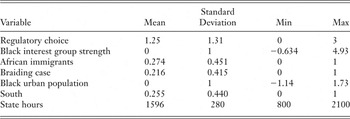
The size of each group is used as a proxy measure of its political influence. For Black beauticians, I use the number of beauticians per 1000 Blacks in each state (McKinnon Reference McKinnon2001). The number for Black elected officials is figured as the percentage of Black officials among all state and local elected officials in a state (Bositis Reference Bositis2001). In any given state, the percentage of Black beauticians is highly correlated with the percentage of Black elected officials as well as correlated with the size of the general Black population. Due to problems of multicollinearity and the resultant presence of large standard errors, these two measures were transformed into a single index variable: Black interest group strength (see Table 1 for a summary of the variables used in the analysis). This variable was in turn standardized to ease interpretation of its impact (Table 1).
Descriptive Statistics of Data

N = 51
Racial deference claims are measured in two ways. The first measure is indirect. The strength of a racial deference claim is calculated as the percentage of a state's population which African immigrants represent (U.S. Census 2000a). Due to problems of multicollinearity as well as the non-normal distribution of the population, this measure was transformed into a dichotomous variable. States with little to no African immigrant population (less than 5%) are coded “0,” while states with a population greater than 5% are coded “1.”
The filing of a braiding case in a state court is used as direct evidence that a racial deference claim has been made. Although the Institute for Justice brought many of these lawsuits, some were initiated without the Institute's assistance. States where braiding cases were filed are coded “1”; states where no cases were filed are coded “0.”
Demographic and Institutional Measures
A single index measure, Black urban population, was created for each state based on the 2000 Census data on Black and urban population (McKinnon Reference McKinnon2001; U.S. Census 2000b). Again, this variable was standardized to ease assessment of its impact. The presence of regional influence is accounted for with the inclusion of South, a dichotomous variable, indicating whether or not a state is located in the traditional eleven-state South. The variable state hours gives the number of training hours each state requires.
FINDINGS
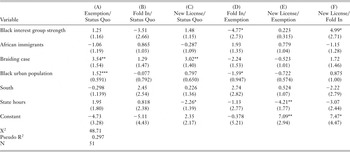
The standardized coefficient estimates from a multinomial logistic regression analysis are presented in Table 2. The six equations in the table are labeled by a regulatory choice group versus a reference group. For the first three equations (A, B, and C), the reference group is the Status Quo category, while the contrasts are Exemption, Fold In, and New License (Table 2). For the second two equations (D and E), the reference group is Exemption, with the contrasts being Fold In, and New License; the reference group for the sixth equation (F) is Fold In and the contrast group is New License. Overall the fit of the model is good; the χ2 of the model shows that there is a significant relationship between the dependent variable (regulatory choice) and the set of independent variables. In order to understand the substantive effects of the variables, the coefficients are exponentiated and converted into odds ratios. The results are presented in Table 3.
The Impact of Interest Group Demand, Demographic and Regulatory Context on State Hair-Care Regulation Choices

The top entries are multinomial logit coefficients. Standard errors in parentheses.
*** p < .01;
** p < .05;
* p < .10 (two-tailed tests)
State Hair Care Regulation Choices: Log Odds Ratios

Overall, the impact of interest-group demand on state regulatory choice supported the first two hypotheses. Black interest-group strength (the index of Black beauticians and Black elected officials) had a positive effect on a state's choice to either exempt hair braiders from existing cosmetological regulations or to establish new licenses, rather than stick with the regulatory status quo. A one-unit change in Black interest-group strength leads to an increase by a factor of 3.51 that a state will choose to exempt hair braiders. There was higher probability (251%) that a state would exempt hair braiders from existing regulations than maintain the status quo. By contrast, interest-group strength had a negative effect on the choice of folding hair braiders into existing state regulation. States were less likely to prefer this option compared to either maintaining the regulatory status quo or exempting hair braiders. These log odds ratios suggest that the distinctiveness of hair braiding—whether due to cultural deference claims or technical claims to knowledge—is recognized by beauticians and elected officials. The choice to fold in hair braiders is the least preferred of all options. There is a positive relationship between interest-group size and the probability that a state will enact legislation requiring new licenses for hair braiders rather than exempt them from regulation. In general, these vested-interest groups prefer some enacting new regulations over maintaining the status quo. Surprisingly, this does not carry over to the choice of exemption, which may be due to the impact of Black urban population.
The impact of Black urban population on state regulatory choice is similar to the impact of the preferences of the beauticians and Black elected official group. As hypothesized, states with a higher Black urban population were more likely to enact some form of regulatory change (exemption or new licensing) than to maintain the status quo, but less likely to fold in hair braiders than to maintain the status quo. States with high Black urban populations were less likely by a factor of 0.485 to choose new licensing regulations than exemption. A one-unit increase in Black urban population decreased by 51% the odds of a state enacting new licensing regulations as opposed to folding in hair braiders to existing regulations. The preference for exemption or new regulation over more moderate reform reveals a dynamic different from the one which obtains in the case of Black interest-group demand. As Dorsey (Reference Dorsey1983) argues, states with large Black urban populations may be more likely to support a large secondary or segmented labor market in Black hair care As a result of the market segmentation in these states, interest groups such as licensed Black beauticians may be limited in their ability to protect their market share through regulation. Alternatively, it could be that these states would rather exempt hair braiders than try to engage in costly regulation of this segmented and underground market, or perhaps in these states Black elected officials must be somewhat responsive to the claims made by hair braiders and their allies that regulation causes economic damage to minority communities.
By contrast, the presence of African immigrants in a state had almost the opposite effect on state regulatory choice from that of Black interest groups. The presence of African immigrants did not lead states to embrace exemption. Instead, states stuck with the status quo, folded in hair braiders, or enacted new licensing. For example, the presence of a significant African immigrant population increased a state's likelihood to fold in hair braiders by a factor of 6.9. the likelihood of requiring a new license for hair braiders rather than exempting them from existing license requirements increased by a factor of 2.18, while the choice to stick with the status quo rather than exempt hair braiders increased by a factor of 2.9. When comparing the choice between enacting new licenses versus folding in, states with a significant African immigrant population were less likely to enact new licensing regulations.
These results suggest two interpretations. Exemption was perhaps largely not preferred by immigrants and by the states. It was hypothesized that African immigrants would prefer no new regulations, and indeed would actively seek exemption, since the enactment and/or enforcement of regulations would put pressure on them to step out of a segmented but largely overlooked market. However, the findings suggest the opposite. For immigrants, exemption would subject them to continued unregulated competition, further depressing their wages, and leading to abuses such as the human trafficking that occurred in New Jersey hair braiding salons. Thus the preferences of African immigrants may have diverged from their allies at the Institute for Justice. Immigrants may have preferred the right kind of regulation rather than no regulation at all. For state regulators, complaints about cultural clashes between braiders and consumers as well as the issue of competition between immigrant braiders and licensed and often native-born beauticians perhaps drove the decision to place the immigrants within some type of regulatory framework.
Racial deference claims in the form of a braiding case provided the strongest and most statistically significant finding of all the demand variables. The presence of a braiding case has a positive effect on a state's decision to adopt any policy other than maintaining the status quo. The effect was largest for exemption; the presence of a case increased a state's probability of adopting exemption by a factor of 34.47. The presence of a braiding case decreased by 89% the probability of a state choosing to fold in hair braiders, and decreased by 40% the probability of a state adopting new licensing regulation. The only exception to this pattern occurred when the choice lay between creating new licensing regulations or folding in hair braiders. In this case, states were far more likely—by a factor of 5.57—to enact new licensing regulations than to fold in hair braiders to the existing regulations. Thus the strategy of the Institute for Justice in filing and/or supporting racial deference claims was somewhat successful. States were more likely to exempt hair braiders from regulation when faced with this kind of pressure. The Institute's approach, however, was not completely successful. Many states chose to enact new regulations, which, while perhaps more sympathetic to the interests of hair braiders, were nonetheless new regulations and thus blocked the Institute's goal for a free market in occupations.
The regional and regulatory environment of states had interesting effects on state policy choices. Southern states were far more likely to enact any policy choice other than exemption. There was a slight preference for choosing new licensing rather than regulatory exemption or the status quo. Southern states were strongest in the likelihood of preferring to fold in hair braiders to existing regulations rather than exempt them or stick with the status quo. Indeed, in the choice between new licensing and folding in, Southern states were 89% less likely to choose new licensing than to incorporate hair braiders into existing regulations. State regulatory context in the form of entry barriers also displayed interesting effects. States with higher barriers (i.e., states requiring more hours of training) were more likely to either exempt hair braiders from or fold them in to current state regulation. Given other choices, these states were less likely to prefer new licensing, This suggests that states with higher barriers to entry were less able to respond to the demands from the new interest groups of hair braiders and immigrants. The choice to exempt, and indeed to resist new licensing, could reflect current licensees' unwillingness to open up the market to new entrants, or the inability of state regulators to oversee another group of market entrants or be flexible enough to design or reform a regulatory system that could accommodate new interests.
DISCUSSION AND CONCLUSION
The results of this analysis show that state regulatory decision-making about African American hair care varied widely. While racial deference claims in the form of legal cases put pressure on states to exempt hair braiders from regulatory oversight, by and large states did not choose this path. For states that did address the demands for market protection or market relief, most chose to enact new regulations rather than incorporate hair braiders under old regulations. Despite the invocation of racial deference claims, African American hair care was not freed from state oversight; rather, responding to concerns for public safety as well as the demands from a variety of interest groups, state regulators became more flexible in their oversight of Black hair care.
For much of the history of state regulatory oversight of African American hair, the content of the regulatory requirements embodied in these statutes reinforced ideas and norms about race and gender identity. This analysis has shown that changes in American society such as increased immigration and the embracing of claims of racial deference by economic conservatives as well as African American activists have affected how states view the role of regulation and ethnic/racial/gender identity. State regulation of Black hair care is no longer a regulatory afterthought; instead, it is now the focus of a highly visible politics in which traditional as well new claims for state protection and/or relief have been invoked. African American hair care continues to be a political matter.
This analysis has also briefly considered, in light of state hair-care regulation, some of the drawbacks of occupational licensing. Certainly occupational licensing has been used by particular groups to limit market competition, and has been rightly criticized as encouraging excessive rent-seeking by some groups. Licensing has also had a disparate and sometimes discriminatory impact on minority groups, the less educated, and on new immigrants. Yet while state regulatory structures have been derided by many researchers, this analysis suggests that the public as well as state authorities still see the state as playing an important role in ensuring public safety and health. In an era of fiscal cutbacks, occupational licensing is a means, however imperfect, of ensuring some agreed-upon level of safety and health standards.
On a broader level, this analysis supports the argument that an intersectional approach can be useful in understanding the hidden effects of policy decisions on women of color. State regulation of Black hair care affects African immigrants and African Americans in multiple ways: as citizen and noncitizen, as native-born and immigrant, as producer and consumer, and as women in a society which valorizes a gendered and racial aesthetic diametrically opposed to the physical appearance of many women of African descent.
While new forms of Black hairstyling and practice have been recognized by the state, it remains to be seen if these new forms will be recognized by other members of American society as not “political hair,” but just hair.