Introduction
Current theoretical accounts of human learning and memory draw a fundamental distinction between explicit and implicit learning (Squire, Reference Squire, Schacter and Tulving1994, Reference Squire2004; Baddelely, Reference Baddelely, Baddelely, Kopelman and Wilson2002). Explicit, or declarative, learning is characterized by the acquisition and retrieval of information accompanied by awareness of the learned information. In contrast, implicit learning has been described as the acquisition of knowledge without intention or awareness. This type of learning is gained from performing a task where the individual typically cannot provide an accurate verbal account of the acquired knowledge, skill or ability (Seger, Reference Seger1994; Shanks et al. Reference Shanks, Rowland and Ranger2005; Perruchet & Pacton, Reference Perruchet and Pacton2006).
The ability to register and implicitly learn patterns of regularities and changes in the environment (e.g. where or when events may occur) is thought to mediate language learning and the acquisition of motor and social skills, thus being a key factor in cognitive development (Lieberman, Reference Lieberman2000; Perruchet & Pacton, Reference Perruchet and Pacton2006; Cleeremans & Dienes, Reference Cleeremans, Dienes and Sun2008). Indeed, implicit and procedural learning may underlie the development of communicative gestures (Bishop, Reference Bishop2002; Alcock, Reference Alcock2006) and, more in general, of language (Ullman, Reference Ullman2001, Reference Ullman2004; Walenski et al. Reference Walenski, Tager-Flusberg, Ullman and Rubenstein2006). Moreover, implicit learning is also relevant for social learning and social understanding (Lieberman, Reference Lieberman2000).
Although learning in a social context is often mediated by explicit processes (e.g. pedagogical practices), implicit processing of others’ behaviour influences social behaviour, and social judgement. For example, from infancy onward, children and adults are unintentionally affected by others’ actions, emotions, facial expressions, gaze direction and tone of voice, even if no explicit attention is directed toward such cues (e.g. Niedenthal, Reference Niedenthal1990; Berridge & Winkielman, Reference Berridge and Winkielman2003). The implicit encoding of environmental cues is modulated by a process defined as ‘contextual cueing’, that is, the ability to detect contingencies, associations, or probabilities that are embedded in a specific environment on the basis of the properties of the context (Chun & Jiang, Reference Chun and Jiang1998).
Researchers have documented that implicit learning is not a unitary construct (Seger, Reference Seger1997, Reference Seger, Stadler and Frensch1998). This evidence is particularly supported by studies on clinical populations, such as cerebellar degeneration or Parkinson's disease, evidencing distinct patterns of deficits on different implicit learning tasks within the same group of patients (Molinari et al. Reference Molinari, Leggio, Solida, Ciorra, Misciagna, Silveri and Petrosini1997; Witt et al. Reference Witt, Nühsman and Deuschl2002; Siegert et al. Reference Siegert, Taylor, Weatherall and Abernethy2006; Smith & McDowall, Reference Smith and McDowall2006; Muslimovic et al. Reference Muslimovic, Post, Speelman and Schmand2007).
A wide variety of experimental paradigms have been developed to study implicit learning. Among these, serial reaction time (SRT), alternating serial reaction time (ASRT) and pursuit rotor (PR) tasks are considered the most reliable measures of motor-linked implicit learning (Knowlton et al. Reference Knowlton, Mangels and Squire1996; Muslimovic et al. Reference Muslimovic, Post, Speelman and Schmand2007). The SRT and ASRT tasks are choice reaction-time tasks developed by Nissen & Bullemer (Reference Nissen and Bullemer1987). In the standard version of the tasks, participants are required to respond as quickly and as accurately as possible to the location of a stimulus that appearing at one of four possible locations on the monitor in a series of trials (repeated or random trials). Participants typically become faster at responding to the stimuli in the repeated trials, where the locations of the stimuli follow a predefined sequence, compared to the random trials, where the stimuli appear randomly. The PR task is another visuo-motor task that is used to examine procedural/motor skill learning in a variety of populations (Eslinger & Damasio, Reference Eslinger and Damasio1986; Heindel et al. Reference Heindel, Salmon, Shults, Walicke and Butters1989; Gabrieli et al. Reference Gabrieli, Stebbins, Singh, Willingham and Goetz1997; Jacobs et al. Reference Jacobs, Adair, Williamson, Na, Gold, Foundas, Shuren, Cibula and Heilman1999; van Gorp et al. Reference van Gorp, Altshuler, Theberge and Mintz1999; Roth et al. Reference Roth, Baribeau, Milovan, O'Conner and Todorov2004), including children (Lord & Hulme, Reference Lord and Hulme1988; Ward et al. Reference Ward, Shum, Wallace and Boon2002). Improving performance on the PR task involves learning a sequence of complex movements that anticipate the motion of a target in a novel pattern (circle or square). Unlike SRT and ASRT tasks, the PR task provides an opportunity to check for differences in motor execution: the speed of the pursuit rotor can be adjusted so that the initial motor performance (time-on-target) is equilibrated across individual subjects. Contextual cueing (CC) is another implicit learning task where participants are instructed to search for a target among distractors whose spatial configuration repeats on some trials and is novel on others (Chun & Jiang, Reference Chun and Jiang1998). In this visual search task the context predicts and facilitates responses to the target stimulus and learning is indexed by faster responding on trials with repeated than novel distractor configurations (Chun & Jiang, Reference Chun and Jiang1998; Jiang & Chun, Reference Jiang and Chun2001).
Individuals with autism spectrum disorders (ASDs) are characterized by social communication difficulties and behavioural rigidity (APA, 2013). Difficulties in learning from others are one of the most devastating features of this group of conditions. Indeed most individuals with ASDs fail to learn the basic tasks that are necessary for managing their daily living without the need for constant assistance (Howlin, Reference Howlin2005). Nevertheless, the nature of learning difficulties in ASDs is still unclear. Given the relevance of implicit learning for social and communicative functioning, a link between ASDs and implicit learning deficit has been hypothesized. According to this notion, individuals with ASDs may have difficulties with the implicit encoding of environmental cues that are relevant for social behaviour and social understanding, thus failing to learn from others’ behaviour, and to adapt their own behaviour according to circumstances. Conversely, their ability to process information and modulate their behaviour might be preserved when learning is mediated by explicit processing. Research has shown greater difficulties in implicit v. explicit tasks in this population (e.g. Nuske et al. Reference Nuske, Vivanti and Dissanayake2013; Vivanti & Hamilton, Reference Vivanti, Hamilton, Volkmar, Paul, Rogers and Pelphrey2014; Vivanti & Rogers, Reference Vivanti and Rogers2014), providing some support for this perspective. Moreover, a propensity to engage in activities mediated by explicit rules/declarative knowledge rather than those requiring implicit understanding, is often reported in ASDs (e.g. Klin et al. Reference Klin, Jones and Schultz2003). Nevertheless, studies that have employed formal testing of implicit learning in ASDs provided mixed results (e.g. Mostofsky et al. Reference Mostofsky, Goldberg, Landa and Denckla2000; Travers et al. Reference Travers, Klinger, Mussey and Klinger2010) and it is still unclear whether all types of implicit learning are impaired in individuals with ASDs. Apparent heterogeneity across studies with respect to study design and sample characteristics often hinders comparisons. This faceted picture highlights the importance of examining implicit learning in ASDs by an alternative approach that integrates the varied literature and findings. The meta-analysis is the main objective technique to summarize results and to reach quantitative insights. To clarify the controversial issue of implicit learning in ASDs, results from studies on motor-linked implicit learning abilities (SRT, ASRT, PR) and CC process were combined into a single meta-analysis.
Method
Literature search
A literature search was conducted to identify published studies in which implicit learning was assessed in individuals with ASDs. PubMed/Medline, PsycINFO, Cochrane Library, ISI's Web of Knowledge, Scopus, and CINHAL, were searched using combinations of the specific MeSH terms (autistic disorder; autism; child development disorders, pervasive; Asperger syndrome) with the key words (procedural learning; implicit learning; implicit memory; implicit cognition; implicit sequence learning; serial reaction time; alternating serial reaction time; contextual cueing; pursuit rotor). No beginning date limit was used and the search was updated until December 2013. We limited our search to all human studies involving individuals without age restrictions that were published in the English language in peer-reviewed journals to enhance the methodological rigour of the studies examined. To expand our search, references of the retrieved articles and reviews were screened for additional studies.
Study selection
Inclusion and exclusion criteria were used to identify articles relevant to the review. Studies had to examine implicit learning in individuals diagnosed with ASDs according to DSM-III, DSM-III-R, or DSM-IV criteria or in individuals who exhibited clinically significant symptoms of ASDs as measured with a validated diagnostic instrument (see supplementary online Appendix). At least one of the comparison groups had to be composed of typically developing individuals. All studies or subsets of studies measuring implicit learning in individuals with ASDs as indexed by SRT, ASRT, CC and PR tasks were eligible for inclusion. For each of the studies, we recorded the following information: age of sample, diagnostic criteria and procedures, control and matching procedures (i.e. full-scale IQ), and instruments used to assess implicit learning. Two researchers (F.D.C., F.F.) independently reviewed in full text the retrieved articles applying the inclusion and exclusion criteria mentioned above. Disagreements were resolved in a consensus meeting.
Outcome measures
In the SRT and ASRT tasks implicit learning was measured by the reduction of response times over blocks of repeating sequence trials. In the PR task, we considered as implicit learning measure the change in time-on-target across the blocks. Finally, in the CC task the change in response time from novel to repeated trials was considered as outcome measure.
Analyses
Consistent with meta-analytic recommendations (Hedges & Olkin, Reference Hedges and Olkin1985; Higgins & Green, Reference Higgins and Green2011), we synthesized and analysed our set of studies. This procedure involved the following steps: describing relevant characteristics of study participants and tasks as well as comparison groups; calculating standardized mean difference (SMD) effect sizes for each comparison with 95% confidence intervals (CI); determining an overall effect size; estimating heterogeneity.
Data for each study were expressed as SMD, since differences between study outcomes used suggested we should consider them as different measurement scales, using the random effects model (DerSimonian & Laird, Reference DerSimonian and Laird1986) which is more conservative than the fixed-effects model (Higgins & Green, Reference Higgins and Green2011). We analysed results using the generic inverse-variance method in RevMan 5.1 software as described in Higgins & Green (Reference Higgins and Green2011). When SMD or standard deviation (s.d.) were not directly reported, we calculated or inferred them following Higgins & Green (Reference Higgins and Green2011). In interpreting SMD values, we considered SMD ‘small’ if <0.4, ‘moderate’ from 0.4 to 0.7 and ‘large’ if >0.7 (Cohen, Reference Cohen1992). Visual inspection of the data was completed using Forest plots, and any potential outliers were identified within each domain.
We conducted heterogeneity tests to measure the degree of variability across studies (Rosenthal & DiMatteo, Reference Rosenthal and DiMatteo2001). Traditionally, Cochrane's Q was reported as a heterogeneity test result; however, a new test referred to as I 2 has gained popularity (Higgins et al. Reference Higgins, Thompson, Deeks and Altman2003). I 2 represents heterogeneity as a dispersion value with percentage units, and the technique evaluates the evidence beyond a statistical chance occurrence (Higgins et al. Reference Higgins, Thompson, Deeks and Altman2003). I 2 values for three typical heterogeneity classifications are low, 25%; moderate, 50%; and high, 75%. In order to address heterogeneity and to estimate outliers, we performed a sensitivity analysis using the jackknife method (Quenouille, Reference Quenouille1949; Tukey, Reference Tukey1958).
The methodological quality and potential sources of bias for each study were assessed by using the Quality Assessment of Diagnostic Accuracy Studies (QUADAS; Whiting et al. Reference Whiting, Rutjes, Reitsma, Bossuyt and Kleijnen2003). Two authors scored independently (F.D.C., F.F.), and differences were resolved by consensus.
Results
Study characteristics
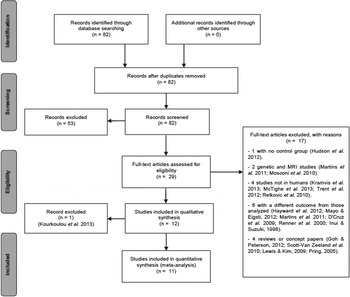
The literature search generated 82 articles. After a first screening step, 29 studies were retrieved. Finally, only nine studies met our inclusion criteria. Three more studies were found screening the references (Müller et al. Reference Müller, Cauich, Rubio, Mizuno and Courchesne2004; Gordon & Stark, Reference Gordon and Stark2007; Limoges et al. Reference Limoges, Bolduc, Berthiaume, Mottron and Godbout2013). Eventually, 11 studies were included in a quantitative analysis (Fig. 1). We found five studies using the SRT task (Mostofsky et al. Reference Mostofsky, Goldberg, Landa and Denckla2000; Müller et al. Reference Müller, Cauich, Rubio, Mizuno and Courchesne2004; Gordon & Stark, Reference Gordon and Stark2007; Brown et al. Reference Brown, Aczél, Jiménez, Kaufman and Plaisted-Grant2010; Travers et al. Reference Travers, Klinger, Mussey and Klinger2010), two studies using the ASRT task (Barnes et al. Reference Barnes, Howard, Howard, Gilotty, Kenworthy, Gaillard and Vaidya2008; Nemeth et al. Reference Nemeth, Janacsek, Balogh, Londe, Mingesz, Fazekas, Jambori, Danyi and Vetro2010), two studies using the PR task (Gidley Larson & Mostofsky, Reference Gidley Larson and Mostofsky2008; Limoges et al. Reference Limoges, Bolduc, Berthiaume, Mottron and Godbout2013) and five studies using the CC task (Barnes et al. Reference Barnes, Howard, Howard, Gilotty, Kenworthy, Gaillard and Vaidya2008; Brown et al. Reference Brown, Aczél, Jiménez, Kaufman and Plaisted-Grant2010; Kourkoulou et al. Reference Kourkoulou, Leekam and Findlay2012, Reference Kourkoulou, Kuhn, Findlay and Leekam2013; Travers et al. Reference Travers, Powell, Mussey, Klinger, Crisler and Klinger2013).
PRISMA flowchart showing the selection of articles included in the meta-analysis.

To support the diagnosis, the Autism Diagnostic Interview (ADI; Lord et al. Reference Lord, Rutter and Le-Couteur1994) and the Autism Diagnostic Observation Schedule (ADOS; Lord et al. Reference Lord, Rutter, Goode, Heemsbergen, Jordan, Mawhood and Schopler1989) were mainly used to confirm DSM-IV criteria. The total number of participants included in the studies amounted to 485, but only data coming from 407 were analysed. In particular, we did not analyse data coming from participants with diagnoses other than ASDs (Gidley Larson & Mostofsky, Reference Gidley Larson and Mostofsky2008), or data not suitable to measure outcomes related to implicit learning (i.e. declarative learning or mean reaction times; see ‘Outcome measures’ section).
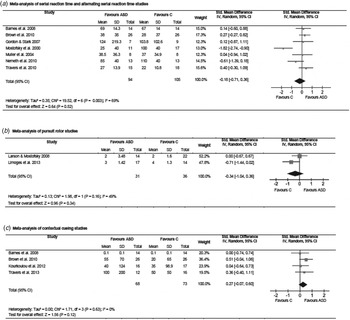
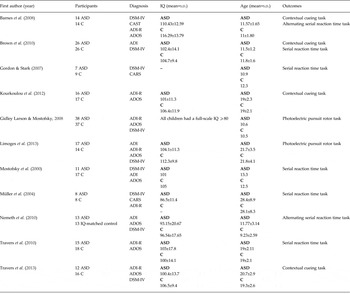
Regarding the CC studies, the study of Kourkoulou et al. (Reference Kourkoulou, Kuhn, Findlay and Leekam2013) was not included in the quantitative analysis because a part of the sample (nine individuals) had already participated in their previous study (Kourkoulou et al. Reference Kourkoulou, Leekam and Findlay2012). This is consistent with the meta-analytic recommendations of Higgins & Green (Reference Higgins and Green2011). Furthermore, only study 2 by Travers et al. (Reference Travers, Powell, Mussey, Klinger, Crisler and Klinger2013) was included in the present meta-analysis since study 1 (Travers et al. Reference Travers, Powell, Mussey, Klinger, Crisler and Klinger2013) did not use the original CC task (Chun & Jiang, Reference Chun and Jiang1998). This choice allows comparisons of the study by Travers et al. (Reference Travers, Powell, Mussey, Klinger, Crisler and Klinger2013) with the other three studies with the CC task (Barnes et al. Reference Barnes, Howard, Howard, Gilotty, Kenworthy, Gaillard and Vaidya2008; Brown et al. Reference Brown, Aczél, Jiménez, Kaufman and Plaisted-Grant2010; Kourkoulou et al. Reference Kourkoulou, Leekam and Findlay2012). Participants’ IQ was in the normal range and did not substantially differ among studies (see Table 1). Effect sizes with 95% confidence intervals for each parameter from each study are shown in Fig. 2.
Meta-analysis of the 11 studies included in the meta-analysis. Forest plot for autism spectrum disorders (ASDs) and comparison participants’ meta-analysis derived from a random effects model. Each line and tick mark represents a study effect size for ASD comparison participants. The diamond shape at the bottom of each Forest plot is the overall effect size for all comparisons. Mean and standard deviations are representative of implicit learning measured by (a) serial reaction time and alternating serial reaction time; (b) pursuit rotor and (c) contextual cueing tasks.

Characteristics of studies included in the meta-analysis

ASD, Autism spectrum disorder; C, Comparison participants; CAST, Childhood Asperger Syndrome test; ADI-R, Autism Diagnosis Interview – Revised; ADOS, Autism Diagnostic Observation Schedule; CARS, Childhood Autism Rating Scale; IQ, Intelligence Quotient; s.d., standard deviation.
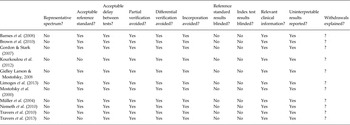
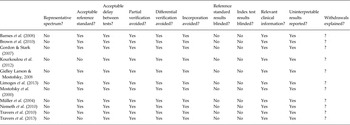
Assessment of methodological quality of included articles according to the QUADAS criteria is reported in Table 2. Six of the criteria were met by all studies. None of the studies had the representative spectrum, the reference standard results blinded and the index test results blinded. Withdrawals were not clearly explained in the studies. Two of the 11 studies did not have the acceptable reference standard.
Chart of study quality assessment with the Quality Assessment of Diagnostic Accuracy Studies (QUADAS) checklist for the studies included in the meta-analysis
?, Unclear.
Serial reaction time and alternating serial reaction time
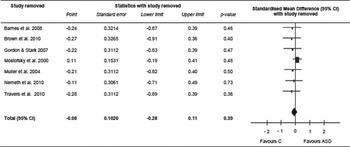
Seven studies were taken into account, with a total of 94 individuals with ASDs and 105 comparison participants. The meta-analysis shows that in SRT and ASRT tasks, individuals with ASDs did not perform differently from comparison participants [values given are SMD (95% CI)] [SMD −0.18 (−0.71 to 0.36)]. The heterogeneity was moderate (I 2 = 69%) (Fig. 2 a). Mostofsky et al. (Reference Mostofsky, Goldberg, Landa and Denckla2000) is the only study in which comparison participants have a higher implicit learning than ASDs [SMD −1.89 (−2.74 to −0.9)] and it is also the reason for the heterogeneity. To examine the influence of Monstofsky et al.'s study on the overall outcome, we applied the jackknife method. The jackknife estimates are consistent, indicating that the effect size estimate is not biased by the influence of Monstofsky et al.'s study or of any other study (Fig. 3). Since the result of Mostofsky et al.'s study cannot be explained by the sample characteristics (e.g. average age or IQ of sample), which are similar to those of other studies (see Table 1), a possible explanation may be found in the task characteristics. Specifically, the long response stimulus interval (RSI) adopted by Mostofsky et al. (Reference Mostofsky, Goldberg, Landa and Denckla2000) raises the possibility of consciously elaborating the sequence of stimuli (Destrebecqz & Cleeremans, Reference Destrebecqz and Cleeremans2001, Reference Destrebecqz, Cleeremans and Jiménez2003) and the use of explicit strategies to perform the task cannot be excluded.
Jackknife estimates eliminating single studies. Jackknife estimates omitting each study are reported [i.e. in this figure Barnes et al. (Reference Barnes, Howard, Howard, Gilotty, Kenworthy, Gaillard and Vaidya2008) is the estimate of the overall effect omitting Barnes et al. (Reference Barnes, Howard, Howard, Gilotty, Kenworthy, Gaillard and Vaidya2008) and similarly for the other lines of the figure].

Further analyses indicated that there were no differences in the findings when subtests were considered separately on SRT [SMD −0.17 (−0.91 to 0.57)] or ASRT [SMD −0.22 (−0.95 to 0.51)] tasks.
Pursuit rotor
Two studies were taken into account, with a total of 31 individuals with ASDs and 36 comparison participants. The meta-analysis shows that in PR task, individuals with ASDs did not perform differently from comparison participants. In fact, the change in time on target does not show any difference between groups [SMD −0.34 (−1.04 to 0.36]). Moreover, no significant difference between the groups was found in each study (Gidley Larson & Mostofsky, Reference Gidley Larson and Mostofsky2008; Limoges et al. Reference Limoges, Bolduc, Berthiaume, Mottron and Godbout2013). The heterogeneity is moderate (I 2 = 49%) (Fig. 2 b).
Contextual cueing
Four studies were taken into account, with a total of 68 individuals with ASDs and 73 comparison participants. The meta-analysis shows that in CC task, individuals with ASDs did not perform differently from comparison participants [SMD 0.27 (−0.07 to 0.60]), supporting the notion that individuals with ASDs can learn contextual consistencies as well as comparison participants. There is no heterogeneity among the results (I 2 = 0%) (Fig. 2 c). As previously described, Kourkoulou et al. (Reference Kourkoulou, Kuhn, Findlay and Leekam2013) was excluded from the analysis since nine individuals participated also to the previous study by Kourkoulou et al. (Reference Kourkoulou, Leekam and Findlay2012). However a sub-analysis which includes Kourkoulou et al. (Reference Kourkoulou, Kuhn, Findlay and Leekam2013) does not show differences in the CC results [SMD 0.11 (−0.24 to 0.46)].
Discussion
Implicit learning in ASDs was examined through a meta-analysis of 11 studies on SRT, ASRT, CC and PR tasks. Results from a total pooled sample of 193 individuals with ASDs v. 214 comparison participants demonstrated implicit learning in ASDs is relatively preserved, as discussed in the following section.
Serial reaction time and alternating serial reaction time
The meta-analysis of the studies examining motor-linked implicit learning by using the SRT or ASRT tasks shows preserved learning in ASDs. Notably, the jackknife analysis shows the consistency of these results.
Examining the neural correlates of implicit motor sequence learning in typically developing population, increased activity was found in the cortico-striatal and cortico-cerebellar circuits (see the recent review by Reber, Reference Reber2013). In particular, repeatedly executing a motor response sequence produces changes in activity in motor cortex and related structures and associated regions of both the basal ganglia and cerebellum (Ungerleider et al. Reference Ungerleider, Doyon and Karni2002). Since the SRT and the ASRT tasks are motor tasks that require learning a sequence of spatial response locations rather than a mere sequence of movements (Willingham et al. Reference Willingham, Wells, Farrell and Stemwedel2000), spatial attention processes are also crucial and the posterior parietal areas specifically engaged.
Concerning ASDs, the hypothesis may be advanced that those brain areas found to be abnormal in ASDs are not fully implicated in implicit learning processes. For example, cerebellar neuropathology is often reported in ASD individuals (Rogers et al. Reference Rogers, McKimm, Dickson, Goldowitz, Blaha and Mittleman2013). However, most cerebellar imaging studies in autism have focused on the measurement of the vermis (Courchesne et al. Reference Courchesne, Yeung-Courchesne, Press, Hesselink and Jernigan1988, Reference Courchesne, Saitoh, Yeung-Courchesne, Press, Lincoln, Haas and Schreibman1994; Hashimoto et al. Reference Hashimoto, Tayama, Miyazaki, Murakawa and Kuroda1993; Kaufmann et al. Reference Kaufmann, Cooper, Mostofsky, Capone, Kates, Newschaffer, Bukelis, Stump, Jann and Lanham2003), which is thought to be involved with affective function through interconnections with the limbic system (Schmahmann & Sherman, Reference Schmahmann and Sherman1998; Schmahmann, Reference Schmahmann2004). Moreover, studies designed specifically to address cerebellar function in ASDs limited the examination to the neural organization of extremely simple motor tasks, i.e. repetitive finger movement (Müller et al. Reference Müller, Pierce, Ambrose, Allen and Courchesne2001, Reference Müller, Kleinhans, Kemmotsu, Pierce and Courchesne2003; Allen et al. Reference Allen, Müller and Courchesne2004). At our knowledge, the only study (Hodge et al. Reference Hodge, Makris, Kennedy, Caviness, Howard, McGrath, Steele, Frazier, Tager-Flusberg and Harris2010) systematically assesses specific implicit learning related regions in the cerebellar hemispheres, as the lobules VI and VII of the posterior lateral cerebellum, documenting no differences between ASD children and comparison participants. This result is in line with the possibility of a relative preserved functionality of brain areas involved in implicit learning processes in individuals with ASDs. Nevertheless, it is should be noticed that the tasks included in the meta-analysis, while measuring implicit learning processes, involved participants’ explicit attention to the relevant stimuli and the use of explicit rules. It is possible that individuals with ASDs can successfully engage in implicit learning when their cognitive resources are explicitly allocated to relevant stimuli in the context of structured tasks, but fail to do so in the context of everyday social life interactions, due to a diminished/abnormal focus on inter-personal cues that mediates learning (see Vivanti et al. Reference Vivanti, Barbaro, Hudry, Dissanayake and Prior2013; Vivanti & Dissanayake, Reference Vivanti and Dissanayake2014; Vivanti & Rogers, Reference Vivanti and Rogers2014).
Future research is still needed to further examine the neural correlates of motor-linked implicit learning in ASDs, for better understanding the relationship between brain activity and implicit learning in this population.
Pursuit rotor
The meta-analysis of PR studies shows no difference between ASD individuals and comparison participants in learning level. Specifically, both groups showed similar rates of change in the time-on-target across the blocks of trials, suggesting individuals with ASDs were able to learn a motor sequence.
However, results on the PR task in individuals with ASDs should be interpreted with caution, as two only studies were included, and thus the pooled sample is reduced compared to that of SRT/ASRT and CC. The small sample size could result in reduced statistical power, thereby limiting our ability to detect deficits in learning.
Contextual cueing
Our results showed proficient implicit CC task in individuals with ASDs as compared to comparison participants. Indeed, both groups became faster at responding to predictable trials compared to unpredictable trials, showing faster detection of a target in a previously seen configuration (repeated) compared to one which was not previously seen (novel). This finding does not support the idea that social abnormalities in ASDs reflect an impairment in implicit processing of contextual cues. However, also in this case it is possible that the difficulties observed in the ASD rather than reflecting the ability to learn implicitly, might be linked to a diminished propensity to attend and process relevant contextual cues (Vivanti et al. Reference Vivanti, Barbaro, Hudry, Dissanayake and Prior2013, Reference Vivanti and Dissanayake2014; Vivanti & Dissanayake, Reference Vivanti and Dissanayake2014; Vivanti & Rogers, Reference Vivanti and Rogers2014). Given previous reports of abnormal brain activation in response to spatial-learning tasks (Sahyoun et al. Reference Sahyoun, Belliveau, Soulières, Schwartz and Mody2010), more research is needed to understand whether these results reflect preserved implicit learning processes or compensatory strategies in the ASD population. However, proficient implicit learning on the CC task may be understood in light of one of the core symptoms of ASDs, the need for sameness and regularity. The preference for repetition in ASDs may promote acquisition of invariant contextual information, leading to a facilitation in learning of spatial relationships. Accordingly, good visual spatial abilities and the preference for visual details found in ASDs (O'Riordan et al. Reference O'Riordan, Plaisted, Driver and Baron-Cohen2001) could help ASD individuals in solving the CC task, in which are required visual search abilities based on the context to predict and facilitate responses.
Conclusions
Based on our synthesis of the existing literature, we conclude that individuals with ASDs can learn implicitly, supporting the hypothesis that implicit learning deficits do not represent a core feature in ASDs. These findings are inconsistent with the notion that a deficit in implicit learning might play a key role in the social, communicative, or motor impairments of this population. However, our results should be considered with caution since the little number of studies included in the meta-analyses reduces the possibility to estimate the between-study variance. Moreover, research on implicit learning in ASDs should involve groups of participants encompassing the spectrum of severity that characterizes ASDs, including lower functioning participants, to examine how levels of symptom severity and cognitive deficits possibly affect implicit learning. Indeed, as learning difficulties are prominent in lower functioning individuals with ASDs (Vivanti et al. Reference Vivanti, Barbaro, Hudry, Dissanayake and Prior2013) it is somewhat paradoxical that the majority of research in the area was conducted on the subgroup of individuals with ASDs with an IQ in the normal range. Moreover, a number of scholars have highlighted the gap between what individuals with ASDs can do in the context of experimental task and what they actually do spontaneously in their everyday life. In this regard, it has been suggested that real-world impairments may result from a greater propensity for individuals with ASDs to use explicit strategies rather than to rely on implicit strategies. In line with this possibility, individuals with ASDs are prone to solving learning tasks more explicitly than controls (Gidley Larson & Mostofsky, Reference Gidley Larson and Mostofsky2008).
Anyway, more effective educational and rehabilitation programmes can be designed by using the present results. Indeed, although explicit learning is found to be preserved in ASDs (see the review by Gras-Vincendon et al. Reference Gras-Vincendon, Bursztejn and Danion2008), studies in ASDs have revealed impairments in episodic memory component of the explicit long-term memory (Boucher & Bowler, Reference Boucher and Bowler2008) but intact performance on semantic memory tasks (Salmond et al. Reference Salmond, Ashburner, Connelly, Friston, Gadian and Vargha-Khadem2005; Bowler et al. Reference Bowler, Gardiner and Gaigg2007; Lind & Bowler, Reference Lind, Bowler, Boucher and Bowler2008). Implicit teaching, which involves teaching without not plainly expressing the objective, may be of help with ASD children. Indeed, the possibility to adopt inductive teaching, with rules inferred from examples presented first, and where children are never taught the actual rules may be useful especially in those cases when explicit teaching fails.
Supplementary material
For supplementary material accompanying this paper visit http://dx.doi.org/10.1017/S0033291714001950.
Acknowledgement
We acknowledge the competent and kind help of Professor Fabio Ferlazzo for statistical suggestions.
Declaration of Interest
None.