Introduction
Vertigo is a common symptom which has a prevalence of 25 per cent in the general population, with benign positional paroxysmal vertigo (BPPV) thought to be the most common cause.Reference Yardley, Owen, Nazareth and Luxon1 It is estimated that more than 25 per cent of patients who present to their primary care physician with vertigo suffer from BPPV.Reference Prokopakis, Chimona, Tsagournisakis, Christodolou, Hirsch and Lachanas2
Despite the obvious public health significance of vertigo, these patients typically have great difficulty accessing good quality health care and are generally perceived by otolaryngologists to represent one of the most frustrating and frustrated group of patients.
Although a simple classification scheme has been reported to facilitate triage of vertiginous patients into diagnostic groups for investigation and management,Reference Kentala and Rauch3 traditional assessment of the vertiginous patient still involves taking a long and thorough case history, as well as conducting complex physical examinations of the otological and nervous systems. Patients with BPPV experience an abnormal sensation of movement triggered by certain critical, provocative positions. They present with symptoms typically characterised by their short latency, limited duration and fatiguability.Reference Parnes, Agrawal and Atlas4
Vestibular rehabilitation, in the form of particle repositioning procedures, has been shown to be a highly effective treatment for vertigo resulting from various conditions, including BPPV. The treatment aims to relocate displaced otoconia from the posterior semicircular canal-cupula into the utricle.Reference Prokopakis, Chimona, Tsagournisakis, Christodolou, Hirsch and Lachanas2, Reference Horak, Jones-Rycewicz, Black and Shumway-Cook5–Reference Steenerson and Cronin7 Most primary care physicians believe that the provision of facilities incorporating investigations and specialist physiotherapy within the same setting of a balance clinic could potentially improve overall patient outcome, in addition to minimising requests for inappropriate investigations and reducing the need for numerous out-patient visits.Reference Jayarajan and Rajenderkumar8
The National Health Service (NHS) modernisation programme has endeavoured to provide the necessary follow up for patients within the right care setting and to reduce waiting times for out-patient appointments in several specialties with previously widespread delayed patient access to their services, including ENT.9 Current government targets aim to ensure that patients do not wait more than 13 weeks for an out-patient appointment. By the end of 2008, there will be a new 18-week target for the wait between general practitioner referral and hospital treatment.10 In addition, a substitution of non-medical for medical personnel might be implemented in order to meet the staffing levels proposed in the NHS plan.11 In particular, it is envisaged that non-medical practitioners with balance expertise, such as audiological scientists, will undertake initial evaluation and management of vertiginous patients, a task traditionally performed by otolaryngologists.
To satisfy these government initiatives, the Action on ENT movement was launched in 2000, leading to the development of the Balance Service Framework as a year-long exercise at 24 pilot sites. This exercise aimed to develop a flexible balance service tailored to meet the needs of the local population.11 Different applications of the framework have been directed by local needs, resources and levels of clinical competence of healthcare professionals. This has resulted in distinctive patient pathways for vertiginous patients in each pilot site.11 As a safeguard, ‘red flag’ symptoms detected via history and examination highlight the need for immediate referral to a consultant specialist.12 The caveat system of red flags has previously been implemented by other medical disciplines to safely and efficiently prioritise those cases warranting urgent specialist referral.Reference Hawkes13, Reference Lamont, Alias and Win14
As part of the Balance Service Framework, the balance clinic at Wexham Park Hospital was designated as a secondary pilot site. The East Berkshire balance clinic, based at Wexham Park Hospital, caters for a catchment population of approximately 460 000.15 From July 2003 onwards, all general practitioner referrals for vertiginous patients were seen initially at the pre-ENT balance clinic. We believe that the current report is the first to present prospective cohort data on vertiginous patients, specifically those with BPPV, undergoing primary vestibular assessment and rehabilitation at a pre-ENT balance clinic.
Materials and methods
Before the pre-ENT balance clinic
From October 2002 to March 2003, all vertiginous patients referred by their general practitioners to ENT clinics at Wexham Park Hospital were audited. They were assessed by an ENT surgeon at their first out-patient appointment and were subsequently allocated a separate appointment at the balance clinic in order to undergo investigations conducted by an audiologist. Following this, they required a further appointment with an ENT surgeon to review the results of the balance test. Patients who were diagnosed with BPPV at this stage would then await yet another appointment to see a specialist physiotherapist for vestibular rehabilitation, in the form of particle repositioning therapy.
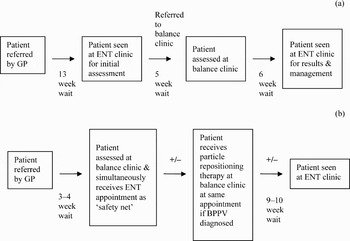
A process map for the ‘patient journey’ for vestibular referrals showed that the waiting time for vertiginous patients could be reduced by carrying out vestibular assessment together with appropriate vestibular rehabilitation using particle repositioning manoeuvres, before patients attended their first ENT appointment i.e. by a pre-ENT balance clinic (Figure 1).
Protocol for management of vertiginous patients (a) before and (b) after change of practice in July 2003.

After the pre-ENT balance clinic
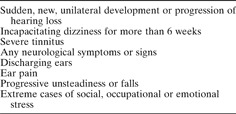
In July 2003, a change in practice was implemented, whereby primary assessment of general practitioner-referred vertiginous patients was carried out at the balance clinic by audiologists. Patients were also given an out-patient appointment for the ENT clinic. The pre-ENT balance clinic did not compromise the timing of the ENT appointment. The vertiginous patients' wait for an ENT appointment was no different to that of other patients referred for routine ENT appointments. Referral letters were screened by a senior audiological scientist to detect red flag warning signs which would warrant immediate referral to a consultant specialist; these patients were excluded from the audit (Table I).12
‘Red flag’ indicators for immediate referral to ent balance consultant specialist12

The balance clinic was conducted on a weekly basis, with six appointment slots. Primary assessment of vertiginous patients consisted of a 45-minute screening appointment, with history-taking, clinical balance function testing and video nystagmography (which has been shown to facilitate diagnosis of vestibular disease).Reference Werner and Laszig16, Reference Bance, O'Driscoll, Patel and Ramsden17 From the second author's previous experience, an appointment of 45 minutes was deemed to be adequate time to assess patients and perform relevant tests.
Patients with a clear diagnosis of BPPV, confirmed on Hallpike testing, underwent rehabilitation in the form of particle repositioning (Epley manoeuvre). They were reviewed a week later and the treatment repeated if necessary. Patients whose symptoms had resolved at this stage then had their pre-booked ENT appointment cancelled. Those who had histories suggestive of BPPV but were asymptomatic at the time of their appointment were asked to still attend their ENT appointments. Hallpike testing was repeated at their ENT appointment and, if the diagnosis of BPPV was confirmed, particle repositioning therapy was then performed. Reports of balance testing were sent to patients' general practitioners, who were notified of the new pre-ENT balance clinic pathway in an accompanying letter.
All patients who were referred to ENT by their general practitioners due to dizziness and who were seen at the pre-ENT balance clinic during the one-year period between October 2003 and September 2004 were audited prospectively to ascertain the impact on the following outcome measures: (Reference Yardley, Owen, Nazareth and Luxon1) the waiting time to effective management for vertiginous patients, specifically the subset diagnosed with BPPV; and (Reference Prokopakis, Chimona, Tsagournisakis, Christodolou, Hirsch and Lachanas2) the number of vertiginous patients who did not subsequently need to be seen at ENT clinics. In April 2006, a random hospital notes audit of the patients discharged from the pre-ENT balance clinic was performed, to determine whether they had re-presented to another clinic with the same complaint.
Results
Before the pre-ENT balance clinic
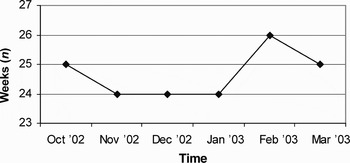
From October 2002 to March 2003, 102 vertiginous patients who were referred by their general practitioners were offered appointments at Wexham Park Hospital ENT clinics. The audit of this time period revealed that, for those with BPPV, the mean waiting time between referral and effective management exceeded 24 weeks (median 24 weeks, range 22 to 27 weeks) (Figure 2). Patients initially waited an average of 13 weeks for an ENT appointment, a further five weeks for vestibular assessment, and another six weeks to be re-reviewed at the ENT clinic with the vestibular testing results, with subsequent referral for vestibular rehabilitation if required (Figure 1). Twenty-seven patients (28 per cent) were diagnosed with BPPV from clinical histories and Hallpike testing, 68 had other causes of vertigo, and seven did not attend their appointments.
Mean monthly waiting times from referral to diagnosis and effective management for vertiginous patients with benign positional paroxysmal vertigo, before the pre-ENT balance clinic was introduced.

After the pre-ENT balance clinic
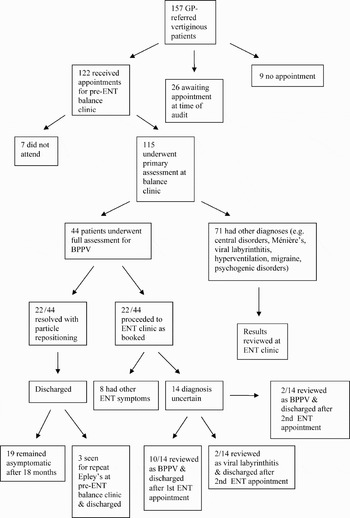
From October 2003 to September 2004, 157 patients complaining of dizziness were referred by their general practitioner to the pre-ENT balance clinic (patients whose referral letters were suggestive of red flag symptoms had already been referred urgently to the ENT clinic and were hence excluded from the audit). There were 58 males and 99 females. One hundred and twenty-two patients were given appointments for the balance clinic, 26 had had their referral letters recently screened and were awaiting allocation of their appointment when the audit period ended, and nine did not receive an appointment (two refused to go to Wexham Park hospital for reasons unknown, two improved clinically after they were referred, three could not be contacted, one chose to be treated privately and one had already been seen at the balance clinic). Out of the 122 patients who received appointments for the pre-ENT balance clinic, seven did not attend (6 per cent), compared with seven out of 102 patients (7 per cent) before the introduction of the pre-ENT balance clinic.
Forty-four patients were felt to have at least an element of BPPV, following vestibular assessment. Twenty-eight had a clear diagnosis of BPPV from their history and clinical testing, whilst the remaining 16 gave histories suggestive of BPPV, with equivocal results from Hallpike testing (Figure 3). Twenty-two of the 44 patients had their subsequent ENT appointments cancelled as they had improved clinically after undergoing particle repositioning at the clinic. A random audit of hospital notes for these 22 patients in April 2006 showed that three patients were treated with repeat Epley manoeuvre at the pre-ENT balance clinic and were eventually discharged (Figure 3). Patients with recurrent symptoms after this treatment would have been referred on to ENT according to the protocol, to double-check their diagnoses, but they did not re-present. The remaining 22 patients kept their ENT appointments, as eight also suffered from other non-BPPV related ENT problems. The other 14 patients had histories suggestive of BPPV but were asked to keep their ENT appointments, according to the agreed protocol. Ten of these 14 patients were subsequently diagnosed with BPPV at the ENT clinic and discharged. Two patients were re-reviewed at a second ENT appointment and diagnosed with BPPV, while the remaining two patients were thought to suffer from viral labyrinthitis and were discharged after a second ENT appointment (Figure 3).
Flowchart for the audited pre-ENT balance clinic system.

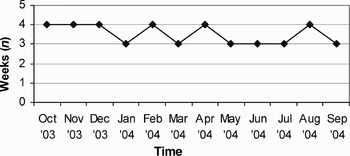
After the introduction of the pre-ENT balance clinic, waiting times for vertiginous patients diagnosed with BPPV and subsequently treated with particle repositioning fell to a mean of three weeks (median three weeks, range two to five weeks) from the date of the general practitioner referral letter (Figure 4). Thirty-two patients in total were diagnosed with BPPV (28 per cent) and received treatment within the 18-week target set by government initiatives.10 This group consisted of 22 patients who were clearly diagnosed with BPPV at the pre-ENT balance clinic and treated at the same appointment, and 10 patients who were reviewed at their ENT appointment, diagnosed with BPPV and discharged (Figure 3). Prior to the change in practice, no patient received appropriate treatment within the 18-week target.
Mean monthly waiting times from referral to diagnosis and effective treatment for patients with benign positional paroxysmal vertigo, at the pre-ENT balance clinic during the period October 2003 to September 2004.

Discussion
In approximately one-third of vertiginous patients, BPPV may be diagnosed and effectively managed by particle repositioning therapy.Reference Horak, Jones-Rycewicz, Black and Shumway-Cook5, Reference Yardley, Donovan-Hall, Smith, Walsh, Mullee and Bronstein18 This made unacceptable our institution's long waiting times from referral to diagnosis and treatment of BPPV.
With this in mind, a change in practice took place in July 2003, such that primary assessment of vertiginous patients was undertaken in the balance clinic, followed by vestibular rehabilitation in the form of particle repositioning therapy when necessary. The prevalence rates of BPPV (28 per cent) before and after the change in practice were similar and comparable with other studies, suggesting that the cohort was fairly typical.Reference Horak, Jones-Rycewicz, Black and Shumway-Cook5, Reference Bath, Walsh, Ranalli, Tyndel, Bance and Mai19, Reference Heaton, Barton, Ranalli, Tyndel, Mai and Rutka20
Completion of the audit cycle showed that mean waiting times for patients with BPPV had been reduced from 24 to three weeks from date of referral (Figure 3). Vertiginous patients suffering from BPPV were thus diagnosed and managed sooner with the pre-ENT balance clinic system in place. Earlier review of patients along their care pathway means that rehabilitation may be less complicated and hence quicker to complete. Twenty-two patients (19 per cent) who were clearly diagnosed with BPPV received vestibular rehabilitation at the balance clinic and did not subsequently need to be reviewed at the ENT clinic. Another 14 patients (12 per cent) were asymptomatic at the time of assessment and were asked to keep their ENT appointments as a precautionary measure, even though their histories were suggestive of BPPV, because vestibular testing did not clearly diagnose BPPV as the cause of their dizziness. Most of these patients were reviewed and discharged from ENT follow up. In essence, 32 (28 per cent) out of the original 115 patients who were seen at the pre-ENT balance clinic did not need ENT review.
We had initially believed that the solution to our waiting time problem would be a ‘one-stop’, multidisciplinary balance clinic with audiologist, vestibular physiotherapist and ENT surgeon.Reference Bath, Walsh, Ranalli, Tyndel, Bance and Mai19 At such a one-stop clinic, the patient would first be evaluated by the ENT consultant, then undergo vestibular assessment with the audiologist, then be seen again by the ENT surgeon for review of results, and finally be seen by the physiotherapist for rehabilitation. The length of time taken for the ENT consultant to initially assess the patient was usually much shorter than that required by the audiologist and the physiotherapist. As a result, the ENT consultant often spent periods of time waiting to re-review patients after vestibular testing had been performed. In addition, not every patient needed to see the physiotherapist, who as a result had an uneven and inefficient workload. Any patient failing to attend their appointment wasted the time of all three clinicians. Most importantly, an effective one-stop clinic would have required an ENT consultant with a subspecialty interest in balance. This is not always practically possible; certainly at our institution, the consultants already had other subspecialty interests that left them little time to concentrate on balance as another subspecialty.
A critical issue in a direct access balance clinic run by non-medical personnel is safety. It is important to emphasise that all general practitioner referral letters were carefully appraised by a senior audiological scientist with special training and expertise in balance, in order to ensure that the pre-ENT balance clinic could be safely conducted without compromising referred patients who might need urgent ENT review. The definition of red flag symptoms, and the protocols guiding the pre-ENT balance clinic, were discussed in detail with the ENT surgeons, audiologists and physiotherapists at our hospital, and were applied only after a consensus had been reached. As a secondary safety measure, only patients with BPPV confirmed by clinical history and Hallpike testing had their ENT appointments cancelled. The remaining patients still proceeded to their ENT appointment, and were not ‘bounced’ back to their referring clinicians without full ENT assessment and diagnosis. In fact, the diagnostic filters of the pre-ENT balance clinic appeared to be relatively specific and sensitive, as the 71 patients referred on to the ENT clinic for non-BPPV causes did not in actual fact suffer from BPPV, while only two of the 44 patients who underwent full assessment for BPPV were diagnosed with vertigo from other causes (Figure 3). None of those who were discharged from the pre-ENT balance clinic with a diagnosis of BPPV re-presented with symptoms due to non-BPPV disorders.
• In approximately one-third of vertiginous patients, benign positional paroxysmal vertigo may be diagnosed and effectively managed by particle repositioning therapy
• This paper reports a change in practice whereby primary assessment of vertiginous patients was undertaken in a balance clinic by non-medical audiological staff, followed by vestibular rehabilitation in the form of particle repositioning therapy when necessary
• This audit show that a significant proportion of vertiginous patients can be directly managed at the pre-ENT balance clinic without onward referral for an ENT opinion, given adequate provision for the identification of patients with ‘red flag’ symptoms requiring medical assessment
Patients who present with vertigo due to peripheral vestibular disorders other than BPPV have also been shown to benefit from particle repositioning therapy; however, these were not included in the audit.Reference Horak, Jones-Rycewicz, Black and Shumway-Cook5, Reference Shepard and Telian6 Such patients were still asked to attend their ENT appointment after assessment at the pre-ENT balance clinic, and they subsequently received particle repositioning therapy, but no data on their outcome were available. It is quite probable that a proportion of those who eventually responded to particle repositioning therapy did not need their ENT appointment to begin with. In light of the findings of this audit loop, the protocols for the pre-ENT balance clinic will be reviewed.
In retrospect, it would also have been useful to review the waiting times from general practitioner referral to treatment for patients who did not have BPPV and to compare these waiting times with those for patients with BPPV. However, the primary aim of this study was to examine the outcome for patients with BPPV, so data for non-BPPV patients were not actively recorded. Knowing the waiting times of both BPPV and non-BPPV patients attending the pre-ENT balance clinic might help to determine if a direct access balance clinic would improve the 18-week wait for all patients presenting with vertigo, or whether other government initiatives would be required.
Our audit showed that a significant proportion of vertiginous patients could be directly managed at the pre-ENT balance clinic without onward referral for an ENT opinion. This fulfils the government initiative of substitution of a medical service with a non-medical model, which was originally implemented in the form of direct access hearing aid clinics.Reference Reeves, Alborz, Hickson, Bamford and Gosden21 In addition, the audit findings imply that these appointment slots may be allocated to other patients. A potential 32 additional new patient appointments may be ‘freed up’ in one year by the change in practice. For patients waiting for an ENT appointment, who may not necessarily have vertigo-related complaints, waiting times may also theoretically be shortened. From this audit cycle, it appears that balance facilities, in the form of pre-ENT balance clinics, are best suited to cater to the needs of the local population in a small but densely populated geographical region such as East Berkshire.