INTRODUCTION
The World Heritage listed the Galápagos Islands as an isolated archipelago within one of the four provinces distributed in the Eastern Tropical Pacific (ETP) biogeographic region described by Hastings (Reference Hastings2000). In the Galápagos Islands, the indigenous shallower ichthyofauna was isolated from mainland tropical fauna by the thermal gradients to the north and south, the wide expanse East Pacific Barrier (EPB) to the west and by the central American landmass to the east. Thus, the Galápagos Archipelago is a conservation hotspot of fish biodiversity and one of the world's top-ranked areas based on the percentage of endemism (Allen, Reference Allen2008). The ichthyofauna was found to be more diverse in the Galápagos Islands than in other ETP islands such as Cocos and Isla Malpelo (Grove & Lavenberg, Reference Grove and Lavenberg1997). In fact, if endemics are excluded, the shallower ichthyofauna in the Galápagos Islands comprises a mosaic of elements from the Panamic, Chilean, western Pacific and Atlantic faunas (McCosker & Rosenblatt, Reference McCosker, Rosenblatt and Perry1984; Robertson & Cramer, Reference Robertson and Cramer2009). McCosker (Reference McCosker1998) updated the list of 444 species described by Grove & Lavenberg (Reference Grove and Lavenberg1997), to include 526 species, 73 of which are endemic and 13 exclusively found at the Galápagos, Cocos and/or Malpelo Islands.
This paper confirmed two new fish records for the Galápagos Archipelago. In addition, physical evidence of a new shark record to the islands was also detailed.
MATERIALS AND METHODS
The existing fish collections made from 1962 to 1995 and held at the Charles Darwin Research Station (CDRS) Museum were examined by V.L.G.T. in 1995. The available material comprised 55 families, 150 species and 296 specimens. The taxonomy was standardized by reference to Eschmeyer (Reference Eschmeyer1998) and Nelson (Reference Nelson1994). Results were compared with the available literature (e.g. Grove et al., Reference Grove, Massay and Garcia1984; Goodson, Reference Goodson1988; Humann, Reference Humann1993; Allen & Robertson, Reference Allen and Robertson1994) and five specimens were thought to be new records for the Galápagos Islands. Thus, they were removed from the CDRS Museum and transported by J.S.G. under licence from the Parque Nacional Galápagos (PNG) to the Los Angeles County Museum of Natural History (LACM). Identification was carried out in the LACM by means of comparative voucher material, a digital linear X-ray scanner (EZ320 NTB GmbH, Germany), scientific keys and unpublished colour notes of the Instituto Nacional de Pesca (INP), Guayaquil, Ecuador. The specimens were then returned by J.S.G. to the CDRS collection.
In addition, an unusual ocean sunfish specimen was photographed and filmed in 2008 in Gardner Bay in the waters off Española Island (1°20′51.94″S 89°39′17.85″W) at about 18 m depth during a tour carried out by the vessel MV ‘National Geographic Polaris’. Thus, species identification of this specimen was based on photographs and video footage.
Finally, a shark tooth was found in 1996 in the supralittoral zone at Urvina Bay, on the west side of Isabela Island (0°17′50.51″S 91°21′29.86″W), lying amongst an assortment of seashells, sea urchin spines and bleached coral fragments. The tooth was brought to the LACM, photographed and identified by direct comparison with catalogued white shark specimens. In addition, the tooth was C14 dated at the Center for Accelerator Mass Spectrometry at Lawrence Livermore National Laboratory, University of California and returned to the PNG.
RESULTS
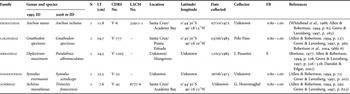
Detailed information regarding the specimens re-identified in 2008 was reported in Table 1. Four of the above-mentioned CDRS specimens were misidentified during the examination carried out in 1995. One further fish record was confirmed, and evidence for another was presented.
List of fish specimens identified in 1995 and 2008 with indication of CDRS and LACM code no., date, location and coordinates of finding.

N, number of specimens; LT, length of specimen; FB, FishBase: likelihood of occurrence in Galápagos; E, endemic.
The CDRS V-6 specimen (Table 1) identified in 1995 as Anchoa nasus (Kner & Steindachner, 1867) (the longnose anchovy), is actually Anchoa ischana (sharpnose anchovy). The CDRS specimen was compared with a LACM A. ischana voucher specimen. Meristics, morphometrics and collection data for the CDRS specimen: dorsal and anal spines absent; anal rays: 22; Anchoa nasus (LACM 32911-1) has 24 anal rays. The pseudobranch is normal (not elongate) in the CDRS specimen; body rather elongate, semi-cylindrical; snout moderate, about 3/4 eye diameter; maxilla moderate, tip narrowly pointed, reaching onto sub-operculum, but not to edge of gill cover; gill cover canals of panamensis-type. Anal fin short, its origin below posterior third of dorsal fin base. A narrow silver stripe along flank, deeper above anal fin (about 3/4 to 2/3 eye diameter) broadening at tail.
An X-ray of this specimen is presented in Figure 1 alongside a LACM 32911-1 voucher specimen of A. nasus.
LACM X-ray no. 1262. (A) LACM voucher of Anchoa nasus; (B) Anchoa ischana (CDRS V-6).

This CDRS V-777 specimen (Table 1) was confirmed Gnathodon speciosus (golden trevally). Meristics, morphometrics and collection data for the CDRS specimen: dorsal spines (total): VIII; dorsal soft rays (total): 19; anal spines: III; anal soft rays: 16; gill rakers on first arch (excluding rudiments) 21 + 29; no teeth; lateral line with moderate arch anteriorly; straight part of lateral line with 21 scales followed by 22 scutes; breast completely scaled; lips thick and fleshy; pectorals falcate; anal fin with two detached spines. Colour: faded in alcohol: silver; broad and narrow black bars alternating; fins yellow; few faint spots visible on sides; bars, faint. This specimen was captured in Puerto Ayora by means of a gill-net targeting mullet.
The CDRS V-1205 specimen (Table 1) identified in 1995 as Diplectrum maximum (Hildebrand, 1946) (greater sand perch), is actually Paralabrax albomaculatus (white-spotted sandbass). The CDRS specimen was compared with a LACM D. maximum voucher specimen. Meristics, morphometrics and collection data for the CDRS specimen: dorsal spines (total): IX; dorsal soft rays (total): 9; anal spines: III; anal soft rays: 7. (LACM voucher specimen of D. maximum dorsal fin continuous; dorsal spines: X, dorsal soft rays 12). The CDRS specimen was further verified by the finely serrated pre-opercular margin and the third elongated spine on the dorsal fin. Colour: faded in alcohol, light brown on upper two-thirds, white below; seven large white spots on upper half of side, and smaller, irregular dark brown spots in surrounding areas, faint pale white line from upper corner of operculum to middle of base of tail fin; caudal fin white basally with dark brown bar across middle portion and broad yellowish rear margin.
The CDRS V-22 specimen (Table 1) identified in 1995 as Synodus evermanni Jordan & Bollman, 1890 (spotted lizardfish), is actually Synodus scituliceps (lance lizardfish). Meristics, morphometrics and collection data for the CDRS specimen: dorsal soft rays: 11; anal soft rays: 13; lateral-line scales: 61. Protrusion at tip of lower jaw (as in S. evermanni). The CDRS specimen was also compared with a LACM S. evermanni voucher specimen. There are no blotches on the sides of the body and the lateral scale count is 57. Note position of the adipose fin where dorsal fin origin closer to adipose fin than snout tip.
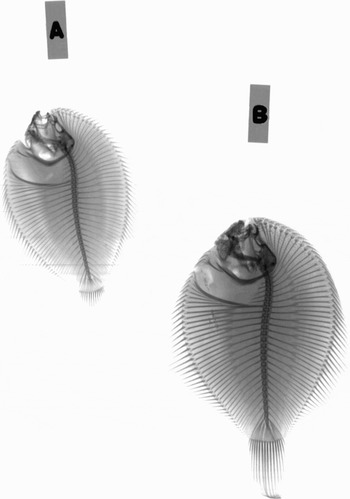
The CDRS V-42 specimen (Table 1) identified in 1995 as Achirus mazatlanus (Steindachner, 1869) (Pacific lined sole), is actually Trinectes fonsecensis (spottedfin sole). The specimen was compared with a LACM A. mazatlanus voucher specimen. Meristics, morphometrics and collection data for the CDRS specimen: dorsal rays: 60 commencing at tip of snout; anal rays: 45; pectoral rays: 2 (also a single small ray); blind side of head with fleshy long tentacles; lower lip of eyed side fringed; front nostril on eye-side without ring of cirri; border of operculum on blind side mostly scaled; pectoral fin present, but reduced to one ray; no hair-like filaments on scales; body oval, elongate. Colour: faded in alcohol, but ten dark brown bars visible; scattered rows of spots between bars faintly visible; median fins with dark brown spots visible. Achirus mazatlanus and T. fonsecensis have virtually identical vertebral and anal-fin ray counts, and there is also a broad overlap for dorsal-fin ray counts (H.J. Walker, personal communication). Achirus mazatlanus, however, has a lower dorsal count of ~52–54; the main distinguishing feature between the two species is the presence (T. fonsecensis) or absence (A. mazatlanus) of the septum between the branchial chambers (see Walker & Bollinger, Reference Walker and Bollinger2001).
An X-ray of this specimen is presented in Figure 2 alongside a LACM 6777-6 voucher specimen of T. fonsecensis.
LACM X-ray no. 1261. (A) Trinectes fonsecensis (CDRS V-42); (B) LACM voucher of T. fonsecensis.

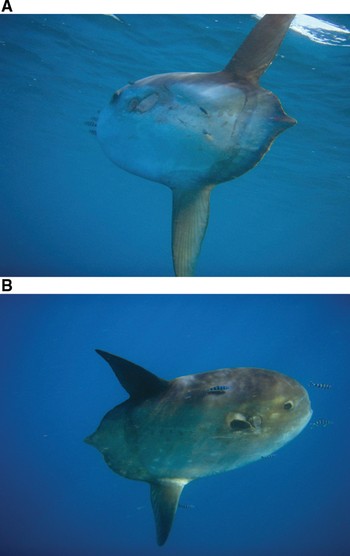
Figure 3 shows two photographs of the same specimen (both sides) of Masturus lanceolatus, the sharp-tail mola. Meristics, morphometrics based on Matsuura (Reference Matsuura and Carpenter2002): dorsal soft rays (total): 15–19; anal soft rays: 15–19. Dorsal and anal fins similar in shape, positioned far back on body. Distinguished from the ocean sunfish (Mola mola Linnaeus, 1758) and the Southern sunfish (Mola ramsayi Giglioli, 1883) by the median projection from the clavus (extensions of the dorsal and anal fin rays). The species has been identified from the pointed medial aspect of the caudal fin. None of the other genera possess this feature. The M. lanceolatus in Figure 3 is accompanied by a number of juvenile pilot fish Naucrates ductor (Linnaeus, 1758). Footage of the sighting can be viewed and downloaded at http://video.google.com/videoplay?docid=-8388366297406835949#.
Masturus lanceolatus obeserved off Española Island.

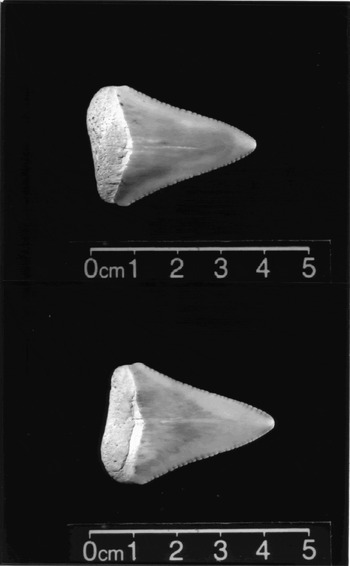
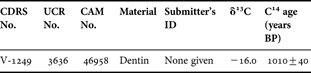
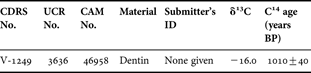
This specimen record of Carcharodon carcharias was based on the CDRS V-1249 large, triangular, saw-edged tooth (enamel height ~34 mm, crown width ~27.5 mm) (Figure 4). White shark tooth was compared to a dried C. carcharias jaw, LACM 38194-1. Results for the C14 dating of the shark tooth was 1010 age before present (BP) (Table 2).
Carcharodon carcharias tooth collected off Isabela Island, Galápagos. Upper photograph: lingual surface; lower photograph: labial surface.

Radiocarbon age determination for Carcharodon carcharias tooth (CDRS V-1249). Radiocarbon age expressed as ‘years before present’.
Randall (Reference Randall1973) noted that approximate total length (TL) may be estimated based on the enamel height of the largest upper jaw tooth in white sharks. Based on Randall (Reference Randall1973), this tooth might come from a ~3.8 m TL white shark; however, there is no way to verify that this is the largest upper tooth.
DISCUSSION
These findings contribute to the ongoing effort to collect baseline data for the Galápagos Archipelago ichthyofauna (Edgar et al., Reference Edgar, Bustamante, Farina, Calvopina, Martinez and Toral-Granda2004). The variability inherent in all biological systems will cause new fish species to move into Galápagos waters and other species decline or disappear. For example, since the 1982/1983 El Niño Southern Oscillation (ENSO) event, the Galapagos damselfish (Azurina eupalama Heller & Snodgrass, 1903) vanished from Galápagos waters and was presumed extinct (Grove & Lavenberg, Reference Grove and Lavenberg1997; Calvopiña & Edgar, Reference Calvopiña and Edgar2009). During other ENSO events, a number of fish species were found to extend their distribution ranges (Victor et al., Reference Victor, Wellington, Robertson and Ruttenberg2001; Bearez & Prado, Reference Bearez and Prado2003). In addition to the emergence of new records from existing collections, new fish species are continually being discovered from sustained sampling within the archipelago (e.g. Cohen & McCosker, Reference Cohen and McCosker1998; Anderson & Baldwin, Reference Anderson and Baldwin2000; Baldwin & McCosker, Reference Baldwin and McCosker2001). Moreover, the World Heritage Committee is developing a plan for a multi-national marine protected area between the islands of Cocos, Malpelo and Galápagos; therefore, ongoing re-appraisal of the existing collections and new acquisitions is essential to record accurately the fauna of this region.
In particular, Anchoa ischana is noted to occur in the Galápagos Islands (Whitehead & Rodriguez-Sánchez in Fischer et al., Reference Fischer, Krupp, Schneider, Sommer, Carpenter and Niem1995). The genus Anchoa is represented in the eastern Pacific by 17 species, most of which are very similar and difficult to distinguish (Allen & Robertson, Reference Allen and Robertson1994). Anchoa ischana is a schooling species occurring in coastal waters over sand, gravel and mud (Peterson, Reference Peterson1956). They feed primarily on planktonic organisms, particularly crustaceans, which are filtered by the gill rakers (Allen & Robertson, Reference Allen and Robertson1994). Listed as moderate vulnerability (38.31) on FishBase.org (Cheung et al., Reference Cheung, Pitcher and Pauly2005); not listed on the International Union for Conservation of Nature and Natural Resources Red List Status (IUCN, 2009).
The CDRS specimen identified in 1995 as Gnathodon speciosus was the first specimen recorded from the Galápagos Archipelago. Grove & Lavenberg (Reference Grove and Lavenberg1997) noted that the species is likely to appear in Galápagos waters but interestingly, no other specimens or photographic records are known from the islands. This species is also found in Hawaii, Johnston Island, the Line and the Marquesas Islands, and is listed as a ‘supposed eastward migrant’ in Robertson et al. (Reference Robertson, Grove and McCosker2004). Gnathodon speciosus is a schooling fish found in deep lagoons and seaward reefs, where they use their protractile mouth to root for crustaceans, invertebrates and small fish in the sand (Allen & Robertson, Reference Allen and Robertson1994). Small juveniles live among the tentacles of jellyfish (Lieske & Myers, Reference Lieske and Myers1996) and the young display piloting behaviour with sharks and other large fish (Allen & Robertson, Reference Allen and Robertson1994). They are also known to follow divers (Jonklaas, Reference Jonklaas1975), presumably to gain protection from predators (Lieske & Myers, Reference Lieske and Myers1996). Listed as moderate to high vulnerability (45.85) on FishBase.org (Cheung et al., Reference Cheung, Pitcher and Pauly2005). The Red List status of G. speciosus has not been evaluated (IUCN, 2009).
Paralabrax albomaculatus is listed as endemic for the Galápagos Islands. Paralabrax albomaculatus is a reef-associated species found at depths of 10–75 m (Thresher & Colin, Reference Thresher and Colin1986) off rocky coasts and nearby sand patches (Allen & Robertson, Reference Allen and Robertson1994). They grow to a maximum size of ~50 cm (Merlen, Reference Merlen1988). Depth distribution varies according to temperature, with preference for cooler water (Reck, Reference Reck1983). They feed on bony fish, mobile benthic crustaceans (shrimps/crabs), cephalopods including octopus, squid and cuttlefish (Robertson & Allen, Reference Robertson and Allen2008). Paralabrax albomaculatus is currently fished in the archipelago. There are currently no minimum catch-size restrictions for this species and anecdotal observations (J.S.G.) suggest that average size-at-landing for P. albomaculatus is decreasing annually. Listed as moderate to high vulnerability (52.66) on FishBase.org (Cheung et al., Reference Cheung, Pitcher and Pauly2005); not listed on the IUCN Red List status (IUCN, 2009).
Synodus scituliceps is listed in Allen & Robertson (Reference Allen and Robertson1994) but not treated in Grove & Lavenberg (Reference Grove and Lavenberg1997). Synodus scituliceps is a tropical species (24°N–5°S) found in the ETP from the Gulf of California, to Peru, Cabo San Lucas, Mazatlán, Mexico down to Chile (Pequeño, Reference Pequeño1989) including the Galápagos Islands (Allen & Robertson, Reference Allen and Robertson1994). Synodus scituliceps was first recorded in the Galápagos as S. jenkensi by Jordan & Evermann (Reference Jordan and Evermann1896), later synonymized by Meek & Hildebrand (Reference Meek and Hildebrand1923). A demersal, fairly common species, it is found in depths of 2–30 m on soft bottoms (Bussing & Lavenberg, Reference Bussing, Lavenberg, Fischer, Krupp, Schneider, Sommer, Carpenter and Niem1995), particularly shallow muddy bottoms of bays (Allen & Robertson, Reference Allen and Robertson1994). It is listed as low vulnerability (52.66) on FishBase.org (Cheung et al., Reference Cheung, Pitcher and Pauly2005) and currently not on the IUCN Red List (IUCN, 2009).
Two genera and at least eight species of achirid, including one undescribed species of Trinectes occur in the ETP, but only T. fonsecensis was previously known from the Galápagos (Grove & Lavenberg, Reference Grove and Lavenberg1997). The species' distribution range extends in the ETP from the Gulf of California to Ecuador where it is found on shallow muddy and sandy bottoms, near estuaries and coastal lagoons (Krupp, Reference Krupp, Fischer, Krupp, Schneider, Sommer, Carpenter and Niem1995). Trinectes fonsecensis feeds on crustaceans, small fish and occasionally on detritus (Krupp, Reference Krupp, Fischer, Krupp, Schneider, Sommer, Carpenter and Niem1995). This species is listed as low to moderate vulnerability (30.01) on FishBase.org (Cheung et al., Reference Cheung, Pitcher and Pauly2005) and is not listed on the IUCN Red List of species (IUCN, 2009).
Masturus lanceolatus was neither listed in Allen & Robertson (Reference Allen and Robertson1994) nor in Grove & Lavenberg (Reference Grove and Lavenberg1997). Masturus lanceolatus is a circumglobal species (37°N–35°S) found in tropical to subtropical waters to depths of 6–700 m (Harbison & Janssen, Reference Harbison and Janssen1987; Figueiredo & Menezes, Reference Figueiredo and Menezes2000; Seitz et al., Reference Seitz, Weng, Boustany and Block2002). This is the first verified sighting of M. lanceolatus for the Galápagos Archipelago, and one of a handful of sightings for the ETP. The species comprised a portion of the by-catch in the long-line, drift-net and gill-net fisheries that target sharks and rays off Peru. Listed as very high vulnerability (86.25) on FishBase.org (Cheung et al., Reference Cheung, Pitcher and Pauly2005); currently not on the IUCN Red List status (IUCN, 2009).
Carcharodon carcharias was never recorded verifiably in the Galapagos Archipelago. Allen & Robertson (Reference Allen and Robertson1994) mentioned that it prefers cooler waters and ranges into the northern and southernmost ETP. The species was listed as a ‘questionable sighting’ in Grove & Lavenberg (Reference Grove and Lavenberg1997) and McCosker (Reference McCosker1998).
The tooth found on Isabela Island may confirm the presence of white sharks in the archipelago, though it is possible that this tooth may have been dropped by a tourist, as shark teeth are routinely worn as necklaces. Nonetheless, this record may support the possibility that a white shark was present in the islands; certainly the geographical and oceanographic characteristics around the Galápagos Islands (Chavez & Brusca, Reference Chavez, Brusca and James1991) provide extraordinary environmental conditions, sustaining large populations of potential white shark prey species such as resident and migratory cetaceans and pinnipeds. In particular, the western part of the Galápagos Islands (where the tooth was found) was characterized by a high primary productivity and upwelling systems (Merlen, Reference Merlen1995; Palacios, Reference Palacios2003) sustaining a high abundance of cetaceans.
Carchardon carcharias is endangered and since 2003 has been listed on the CITES (the United Nations Convention on International Trade in Endangered Species of Wild Fauna and Flora) Appendix III and on CMS (Conservation of Migratory species) Appendices I and II. Considered as very high vulnerability (86.17) on FishBase.org (Cheung et al., Reference Cheung, Pitcher and Pauly2005) and as ‘vulnerable’ on the IUCN Red List status (IUCN, 2009).
ACKNOWLEDGEMENTS
We would like to thank R.J. Lavenberg, J. Seigel and R. Feeney (all LACM) for their assistance in the re-identification of the fish species, organizing and funding the C14 dating, the production of the X-rays and substantial contributions to the white shark section. Thanks also to D. Pauley (Fisheries Centre, University of British Columbia) for overseeing the project and logistical support. Thanks to H.J. Walker (Scripps Institution of Oceanography) for clarification on the distinguishing features between the Achirus mazatlanus and Trinectes fonsecensis. Thanks to S. Hendersen (Conservation International) for originally discovering the white shark tooth and to R. Bustamante of the Australian Commonwealth Scientific and Research Organization (CSIRO) for his full support and supervision in 1995. Thanks to J.E. McCosker (California Academy of Sciences) for his advice at the original time of fish identification and later peer-review comments. Gratitude to the CDRS and PNG for permission to remove the specimens and to R. Bernsted-Smith, L. Roque and D. Ruiz (all CDRS) and E. Cruz and S. Cardenas (both PNG) for dealing with the insurmountable paperwork required to get the specimens out of the country. Thanks to S. Hutchinson (National Oceanography Centre, Southampton) for his considerable input to the original manuscript and to G. Watkins (CDRS), F. Cruz (PNG) and C. Manning (Lindblad Expeditions) for permission to use the Mola picture. Additional thanks go to T. Thys (Ocean Sunfish Research and Tagging Programme, California) for reviewing the manuscript and providing additional information on the sharp-tail mola and to J. Alfaro, from Pro Delphinus Peru, a Peruvian non-profit foundation that has observed sharp-tail mola as by-catch in Peruvian long-line, drift-net and gill-net fisheries.