INTRODUCTION
The perciform sandperch family Pinguipedidae was formally known as the Parapercidae or Mugiloididae (Rosa & Rosa, Reference Rosa and Rosa1987; Randall, Reference Randall, Carpenter and Niem2001). The family includes 79 species in seven genera, Pinguipes, Parapercis, Prolatilus, Pseudopercis, Kochichthys, Simipercis and Ryukyupercis (Ho & Shao, Reference Ho and Shao2010). The genus Parapercis was described by Bleeker, Reference Bleeker1863. It is the largest genus in the family, currently comprising 71 valid species (Johnson, Reference Johnson2006; Randall & Yamakawa, Reference Randall and Yamakawa2006; Randall, Reference Randall2008; Randall et al., Reference Randall, Senou and Yoshino2008; Ho & Shao, Reference Ho and Shao2010). The fish of the genus Parapercis are popularly known as sandperch in the United States, grubfish in Australia and sandsmelt in South Africa. From the central and western Pacific 22 species of Parapercis have been recorded (Randall, Reference Randall, Carpenter and Niem2001). Twenty-seven species including four new species have been recorded from Japan (Shimada, Reference Shimada and Nakabo2002; Randall & Yamakawa, Reference Randall and Yamakawa2006; Randall, Reference Randall2008; Randall et al. Reference Randall, Senou and Yoshino2008). Ho & Shao (Reference Ho and Shao2010) described one new species from Taiwan. Recently one new species has been reported from western Pacific waters (Yun Chio Liao et al., Reference Yun-Chih, Tun-Yuan and Kwang-Tsao2011). More numbers of new species discovered in the genus clearly shows the dearth of up to date information in the literature.
The sandperch family Pinguipedidae comprises seven genera and 78 valid species. Sixteen new species of Parapercis have been described in the past five years (Johnson, Reference Johnson2006; Randall & Yamakawa, Reference Randall and Yamakawa2006; Imamura & Yoshino, Reference Imamura and Yoshino2007; Randall, Reference Randall2008; Randall et al., Reference Randall, Senou and Yoshino2008); P. clathrata grows up to a total length (TL) of 24 cm (Kuiter & Tonozuka, Reference Kuiter and Tonozuka2001). The species occurs in tropical marine waters of the Indo-Pacific from the Andaman Sea north to Japan, throughout Micronesia, south to Australia and east to the Samoa Islands (Randall, Reference Randall, Carpenter and Niem2001). It inhabits both clear lagoon and seaward reefs, in the areas of open sand, rubble as well as on the rocky surfaces between coral heads of 3 m to 50 m (Myers, Reference Myers1991).
RESULTS
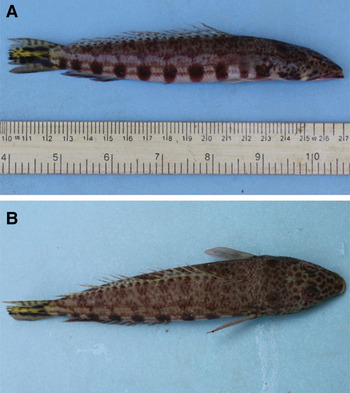
On 14 February 2010, a 163 mm TL male P. clathrata (Figure 1) weighing 50 g was collected from a commercial trawler, which operated at a depth 30 m, 60 km north-west off Tuticorin, south-east coast of India. All the counts and morphometric measurements were taken according to Masuda et al. (Reference Masuda, Amaoka, Araga, Uyeno and Yoshino1984).
Parapercis clathrata caught off Tuticorin, south-east coast of India: (A) lateral view; (B) dorsal view.

Description
The body is moderately elongated and little compressed, except posteriorly. The head is pointed and tapered on the tip. The tip of the snout is flat with large eyes, slightly prominent above the dorsal profile of the head, oriented as much dorsally as laterally. Mouth is large and terminal with lower jaw slightly projecting having recurved canine teeth in an outer row at front of the jaws. The lateral line is simple and complete having 60 pored scales. The dorsal fin has IV spines and 20 soft rays, anal fin with I spine and 17 soft rays, pelvic fin has I spine and 4 soft rays; pectoral fins with 17 soft rays. Gill rakers on the first gill arch range from 17 to 19. The colour of the dorsal surface is reddish-brown, belly whitish, head with brown patches, cheeks with many small black spots and prominent eye spots on the nape (typical of males: Randall et al., Reference Randall, Allen and Steene1990; Myers, Reference Myers1991). Lower side of the body has 12 vertically elongate spots; each spot is black in colour. Two narrow horizontal lines run from the pectoral fin origin, to the caudal fin base. Pectoral and pelvic fins are dusky yellow and posterior half of caudal fin has a large yellow spot, having small brown spots within. Caudal fin is truncate. All counts and measurements are shown in Table 1.
The morphometric characters of Parapercis clathrata caught off Tuticorin.

The morphological characters of the studied specimen agree with the diagnostic features proposed by Randall (Reference Randall, Carpenter and Niem2001) to discriminate P. clathrata from other central-western Pacific species of the genus. According to Randall (Reference Randall, Carpenter and Niem2001), the number of spines and soft rays in the dorsal and anal fins discriminate P. clathrata and P. millepunctata from other species of Parapercis in this area. Whereas, by contrast, gill raker counts and differences in the coloration of the anal fin separate P. clathrata from P. millepunctata.
DISCUSSION
During recent years, greater numbers of fish species have been recorded for the first time in Indian waters (see Akhilesh et al., Reference Akhilesh, Pillai, Ganga, Bineesh, Rajool Shanis and Manjebrayakath2009; Kurup et al., Reference Kurup, Cubelio, Joseph, Venu and Deepu2009). Although some of these are probably residents in these areas that might have remained undetected due to intrinsic rarity or difficulty of access to these specific habitats (e.g. deep sea), some others can be considered ‘vagrant’ (i.e. they have arrived from the other areas). Parapercis clathrata is a reef-associated (Meyers, Reference Myers1991; Kuiter & Tonozuka, Reference Kuiter and Tonozuka2001) benthic fish; the location from which the specimen is captured is also close to a major coral reef off the southern Indian main land—Gulf of Mannar. At this juncture there is much uncertainty about the presence of P. clathrata in Indian waters. More detailed monitoring of fish diversity in the Andaman and Nicobar Islands, the eastward territorial waters of India may spread some light on the westward range extension of this species towards more conducive habitats of the tropical Indian Ocean. For whatever reasons, recent records of this species from a new geographical area are a matter of scientific interest and solicit the need for more comprehensive investigation.
ACKNOWLEDGEMENTS
The authors are grateful to Dr K.K. Joshi, Senior Scientist and P.U. Zacharia, HOD of DFT & Senior Scientist, Central Marine Fisheries Research Institute, Cochin, for offering valuable suggestions, the anonymous referees for their valuable comments and Mr Sajan John (Dakshin Foundation) for suggestions on the manuscript.