Introduction
When work responsibilities negatively interfere with employees’ family lives, it becomes a critical concern for management scholars and practitioners, due to the associated threats to the quality of employees’ organizational functioning (Liao, Lau, Hui, & Kong, Reference Liao, Lau, Hui and Kong2019; Weale, Wells, & Oakman, Reference Weale, Wells and Oakman2019). For example, employees who miss out on family activities because they are ‘stuck’ late at work might experience frustration and stress, which undermines their work motivation, to the extent that they even might develop a desire to leave (Nohe & Sonntag, Reference Nohe and Sonntag2014). Previous studies specify several negative behavioral outcomes of work–family conflict, such as diminished presenteeism (McGregor, Magee, Caputi, & Iverson, Reference McGregor, Magee, Caputi and Iverson2016), organizational citizenship behavior (Bragger, Rodriguez-Srednicki, Kutcher, Indovino, & Rosner, Reference Bragger, Rodriguez-Srednicki, Kutcher, Indovino and Rosner2005), customer-directed extra-role performance (Netemeyer, Maxham, & Pullig, Reference Netemeyer, Maxham and Pullig2005), and compliance with formal performance expectations (Shih, Chiang, & Hsu, Reference Shih, Chiang and Hsu2010).
The focus of this study is on determining why and when the experience of work–family conflict diminishes employees’ in-role job performance. The negative relationship between work–family conflict and job performance itself is well-established, as revealed in previous meta-analyses (Hoobler, Hu, & Wilson, Reference Hoobler, Hu and Wilson2010; Liao et al., Reference Liao, Lau, Hui and Kong2019). This relationship is consistent with the scarcity perspective, as applied to the work–family interface (Burch, Reference Burch2020; Witt & Carlson, Reference Witt and Carlson2006), which predicts that people’s energy resource bases are limited, so they must balance their work and family responsibilities to meet their obligations in both domains (Marks, Reference Marks1977). Notably, work might interfere with family, in the form of work–family conflict, which is different than a scenario in which family negatively interferes with work, which constitutes family–work conflict (Boyar, Maertz, Pearson, & Keough, Reference Boyar, Maertz, Pearson and Keough2003; Clayton, Thomas, Singh, & Winkel, Reference Clayton, Thomas, Singh and Winkel2015). If employees believe their family functioning is compromised by their work responsibilities, they likely lack the energy resources required to fulfill their job duties (Karatepe, Reference Karatepe2013; Westman, Etzion, & Gattenio, Reference Westman, Etzion and Gattenio2008); therefore, this study addresses this particular conflict. Reflecting the so-called ‘matching principle,’ which assigns the consequences of conflicts to the sending domain (Nohe & Sonntag, Reference Nohe and Sonntag2014), this study thus acknowledges explicitly how employees’ work–family conflict diminishes their performance in the work domain.
Extant research reveals that the relationship of work–family conflict with job performance is mediated by factors such as job stress (Netemeyer, Maxham, & Pullig, Reference Netemeyer, Maxham and Pullig2005), emotional exhaustion (Karatepe, Reference Karatepe2013), and job burnout (Singh, Suar, & Leiter, Reference Singh, Suar and Leiter2012). To advance this research stream, the current study addresses another factor, namely, employees’ work engagement (Bakker & Schaufeli, Reference Bakker and Schaufeli2008). The negative interference of work with family might prevent employees from undertaking performance-enhancing activities, because they feel less engaged with their work (Bouckenooghe, Raja, & Abbas, Reference Bouckenooghe, Raja and Abbas2014). Work engagement comprises three related factors (Schaufeli, Bakker, & Salanova, Reference Schaufeli, Bakker and Salanova2006; Sonnentag, Reference Sonnentag2011): vigor, which is employees’ tenacity and motivation to allocate substantial time to work-related issues; dedication, which captures their strong involvement with their work tasks and corresponding excitement when working diligently; and absorption, or their focus on and immersion in their daily work (Alessandri, Consiglio, Luthans, & Borgogni, Reference Alessandri, Consiglio, Luthans and Borgogni2018; Schaufeli & Bakker, Reference Schaufeli, Bakker, Bakker and Leiter2010). Yet, many prior studies conceive of work engagement as a one-dimensional construct (Breevaart, Bakker, Demerouti, & Hetland, Reference Breevaart, Bakker, Demerouti and Hetland2012; Fong & Ho, Reference Fong and Ho2015), a construct that is different than related constructs, such as organizational commitment, job involvement, or job satisfaction (Boon & Kalshoven, Reference Boon and Kalshoven2014; Little & Little, Reference Little and Little2006; Saks, Reference Saks2006).
In addition, this study proposes that the explanatory mechanism of diminished work engagement might be mitigated if employees are happy with the progress they have made in their careers thus far, such as meeting valuable career goals during their organizational employment – a sense that, for this study, is labeled as career satisfaction (Cao, Hirschi, & Deller, Reference Cao, Hirschi and Deller2014; Jawahar & Liu, Reference Jawahar and Liu2016). Employees’ negative responses to adverse, resource-depleting circumstances tend to depend on their perceptions of their job situation (Avanzi, Zaniboni, Balducci, & Fraccaroli, Reference Avanzi, Zaniboni, Balducci and Fraccaroli2014; De Clercq & Belausteguigoitia, Reference De Clercq and Belausteguigoitia2019); their happiness with how their career has progressed since they were hired similarly might limit the threat to their positive work energy resources that arises when work pressures hinder their family lives (Hoobler, Hu, & Wilson, Reference Hoobler, Hu and Wilson2010). That is, being satisfied with their career progress thus far may provide employees with motivation to remain engaged with their daily work, even if they suffer from work–family conflict (Fu, Liu, Huang, Qian, & Wang, Reference Fu, Liu, Huang, Qian, Wang, Wang and Yu2018). Formally, when employees experience career satisfaction, defined as a sense that they have achieved their career goals since joining the organization, the negative effect of work–family conflict on job performance, through diminished work engagement, should be mitigated.
Theoretical grounding
To anchor these conceptual arguments about how work–family conflict interacts with career satisfaction to determine employees’ work engagement and subsequent job performance, this study relies on conservation of resources (COR) theory (Hobfoll, Reference Hobfoll1989). This theory suggests that suffering from unfavorable work circumstances tends to escalate into negative work outcomes, because employees also experience depleted energy resource bases, which makes it more likely that they seek to conserve any remaining energy to ensure their personal well-being, instead of allocating energy to productive work activities from which their organization could reap benefits (Chummar, Singh, & Ezzedeen, Reference Chummar, Singh and Ezzedeen2019; Hobfoll, Reference Hobfoll2001). In a similar vein, work–family conflict might translate into diminished work engagement and job performance because frustrated employees seek to save their personal energy resources, instead of applying them to formal job duties (Hobfoll & Shirom, Reference Hobfoll, Shirom and Golembiewski2000).
Furthermore, COR theory postulates that employees’ negative responses to resource-draining work situations are contingent on individual factors that determine the severity of the resource drainage, such that the negative responses become subdued when employees can draw from pertinent personal features that shield them from excessive frustration with experienced adversity (Abbas, Raja, Darr, & Bouckenooghe, Reference Abbas, Raja, Darr and Bouckenooghe2014; Hobfoll, Reference Hobfoll2001). Employees’ career satisfaction, or the extent to which they are happy with how their career has progressed so far, then should help them experience work–family conflict as less intrusive and threatening, such that they retain some positive work-related energy and work engagement and continue going out of their way to meet their performance obligations (Fu et al., Reference Fu, Liu, Huang, Qian, Wang, Wang and Yu2018; Quinn, Spreitzer, & Lam, Reference Quinn, Spreitzer and Lam2012). Conversely, if they are frustrated with how their career has taken shape thus far, employees might regard the negative interference of work with family as particularly threatening (Liao et al., Reference Liao, Lau, Hui and Kong2019), with harmful repercussions for their work engagement and job performance.
Contributions
In investigating these predictions, this study seeks to contribute to extant management literature in several ways. First, in line with COR theory, it reveals that experienced hardships due to negative spillovers of work stress into the family domain can lead to poorer job performance, resulting from employees’ lower work engagement (Schaufeli, Bakker, & Salanova, Reference Schaufeli, Bakker and Salanova2006). The possession of positive work-related energy, in the form of high work engagement, provides an explanatory mechanism that connects favorable work conditions – such as high-commitment human resource practices (Boon & Kalshoven, Reference Boon and Kalshoven2014), ethical leadership styles (Bormann, Reference Bormann2017), or supervisor support (Fu et al., Reference Fu, Liu, Huang, Qian, Wang, Wang and Yu2018) – with positive work consequences. Yet, no empirical studies have tested a mediating role of work engagement, and particularly its lack, with respect to the tendency of employees to limit or diminish their performance-enhancing activities in response to seemingly incompatible work and family demands. By specifying how the link between work–family conflict and job performance can be explained by diminished work engagement, this study explicitly acknowledges that insufficient positive work-related energy, in response to the negative interference of work with family, represents a critical concern for organizational decision makers (Byrne, Reference Byrne2014; Christian, Garza, & Slaughter, Reference Christian, Garza and Slaughter2011). In particular, it pinpoints the possibility of a counterproductive spiral: The experience of work–family conflict may drain employees’ positive work-related resource bases, as manifest in their lower work engagement, to such an extent that it undermines the completion of their job tasks, which ultimately could compromise their organizational standing and generate even more stress in their personal lives.
Second, prior research notes that the harmful role of work–family conflict in diminishing positive performance outcomes is informed by contingent factors, such as employees’ intrinsic motivation (Riaz, Jamal, & Latif, Reference Riaz, Jamal and Latif2019) or the extent to which they can rely on the social support of supervisors (Zainal, Zawawi, Aziz, & Ali, Reference Zainal, Zawawi, Aziz and Ali2020). The specific focus of this study on the mitigating role of employees’ career satisfaction highlights another factor that organizations might leverage to protect their employees against experienced work–family conflict. That is, they should create circumstances that enhance employees’ satisfaction with their achievement of important career goals, which may lead them to accept such conflict or forgive their organization for its presence (Cao, Hirschi, & Deller, Reference Cao, Hirschi and Deller2014; Ding & Lin, Reference Ding and Lin2006). Consistent with COR theory, employees’ resource bases may be drained by work–family conflict, but their career satisfaction should mitigate the likelihood that this conflict leads to reduced work engagement (Hobfoll & Shirom, Reference Hobfoll, Shirom and Golembiewski2000). Including career satisfaction as a moderator offers a complement to prior research that details how experienced work–family conflict influences employees’ career satisfaction (Karatepe, Kilic, & Isiksel, Reference Karatepe, Kilic and Isiksel2008; Martins, Eddleston, & Veiga, Reference Martins, Eddleston and Veiga2002). For this study, the theoretical focus (and empirical design) pertains particularly to the concurrent interplay of work–family conflict and the satisfaction that employees feel about how their career has evolved thus far, to predict both their work engagement and their subsequent job performance.
Third, this study responds to calls for more research on the negative outcomes of adverse career conditions in non-Western countries (Lin, Chen, & Lai, Reference Lin, Chen and Lai2018; Wickramasinghe & Jayaweera, Reference Wickramasinghe and Jayaweera2010). The empirical context is Pakistan, a country characterized by high levels of uncertainty avoidance (Hofstede, Hofstede, & Minkov, Reference Hofstede, Hofstede and Minkov2010). Due to this cultural feature, employees might experience uncertainty-invoking conditions, such as persistent conflict between the work and family domains, as highly threatening to their positive work energy bases (De Clercq, Rahman, & Haq, Reference De Clercq, Rahman and Haq2019; Riaz, Jamal, & Latif, Reference Riaz, Jamal and Latif2019). By emphasizing work engagement as a mechanism that explains the relationship between work–family conflict and job performance, as well as the buffering role of career satisfaction, this study offers relevant insights for this country context, as well as for other countries with similar cultural profiles.
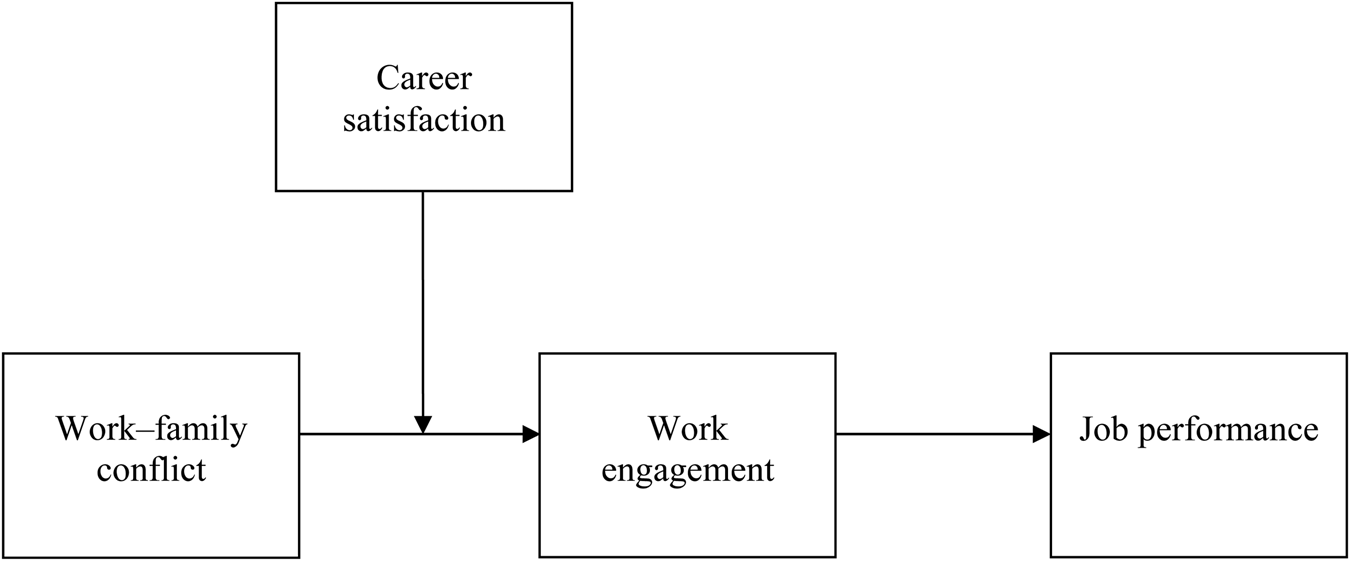
The theoretical framework shown in Figure 1 summarizes these predictions: A lack of positive work-related energy, as manifested in reduced work engagement levels, underpins the escalation of work–family conflict into diminished job performance. Employees’ career satisfaction buffers this indirect relationship.
Conceptual model.

Hypotheses
Mediating role of work engagement
As mentioned earlier, previous research indicates a negative connection between work–family conflict and job performance (Liao et al., Reference Liao, Lau, Hui and Kong2019). This study explicitly examines a hitherto unexplored causal factor that may underpin this connection. Employees’ work engagement captures ‘a positive, fulfilling, work-related state of well-being characterized by a high level of energy’ (Boon & Kalshoven, Reference Boon and Kalshoven2014: 406), so it pertains directly to the positive energy that employees experience toward their employing organization and the work they perform for it, rather than a general sense of the energy at their disposal (Schaufeli, Bakker, & Salanova, Reference Schaufeli, Bakker and Salanova2006). In its theorized mediating role, work engagement features in both a negative relationship with work–family conflict and a positive relationship with job performance, as detailed next.
According to COR theory, the negative interference of work with family is stressful for employees and depletes their positive energy resources, which they otherwise could devote to work tasks (Chummar, Singh, & Ezzedeen, Reference Chummar, Singh and Ezzedeen2019; Hobfoll & Shirom, Reference Hobfoll, Shirom and Golembiewski2000). Employees tend to feel less energized and excited about their work to the extent that they believe that their employer does not care for their personal well-being, as is manifest when work-related pressures prevent them from enjoying their family life to the fullest (Cloninger, Selvarajan, Singh, & Huang, Reference Cloninger, Selvarajan, Singh and Huang2015; Cohen & Liani, Reference Cohen and Liani2009). Thus, the likelihood that employees experience positive work-related energy, in the form of higher work engagement, should be compromised to the extent that they blame their organization for not being able to meet their family commitments as well as they would prefer (Conte, Aasen, Jacobson, O’Loughlin, & Toroslu, Reference Conte, Aasen, Jacobson, O’Loughlin and Toroslu2019). In a similar vein, an organization that causes employees to feel hampered in their ability to enjoy their family lives likely appears disrespectful and ignorant of their valuable work contributions, such that employees become frustrated with how their organization treats them (Nohe & Sonntag, Reference Nohe and Sonntag2014). This interpretation may spur negative feelings about their job situation in general, such that employees become less engaged with daily work activities (Boon & Kalshoven, Reference Boon and Kalshoven2014). Conversely, if employees believe that their employer facilitates their ability to fulfill their family responsibilities, they may perceive strong support for their personal well-being, which then stimulates their positive energy toward their work (Timms, Brough, O’Driscoll, Kalliath, & Siu, Reference Timms, Brough, O’Driscoll, Kalliath, Siu, Sit and Lo2015). Consistent with COR theory, employees should possess more positive energy resources for work, in the form of higher work engagement, to the extent that they believe their organization enables them to combine their work with family obligations successfully (Hobfoll & Shirom, Reference Hobfoll, Shirom and Golembiewski2000; Karatepe & Karadas, Reference Karatepe and Karadas2015). We accordingly hypothesize:
Hypothesis 1: Employees’ perceptions of work-family conflict relate negatively to their work engagement.
Employees’ experience of limited work engagement in turn may diminish their job performance. The depletion of positive work-related energy resources, in the form of reduced vigor, dedication, and absorption, generally means that employees start to worry about the quality of their organizational functioning (Byrne, Reference Byrne2014; Harter, Schmidt, & Hayes, Reference Harter, Schmidt and Hayes2002). According to COR theory, this resource depletion translates into lower job performance, because employees work to avoid further resource losses by conserving their work-related energy, rather than devoting it to productive activities that benefit their employer (Hobfoll & Shirom, Reference Hobfoll, Shirom and Golembiewski2000). A lack of positive work-related energy also may spur negative work attitudes, such as diminished organizational commitment (Boon & Kalshoven, Reference Boon and Kalshoven2014) or enhanced thoughts about leaving (Agarwal & Gupta, Reference Agarwal and Gupta2018), instead of allowing employees to focus on achieving organization-set performance targets (Rich, Lepine, & Crawford, Reference Rich, Lepine and Crawford2010). The energy-conserving tendency that results from a lack of work engagement thus implies that employees may be more passive when they are at work and become indifferent regarding how they might add to organizational effectiveness through their discretionary, performance-enhancing efforts (Baumruk, Reference Baumruk2004; Fu et al., Reference Fu, Liu, Huang, Qian, Wang, Wang and Yu2018). Conversely, the premises underpinning COR theory also suggest that employees are motivated to leverage positive work-related energy, derived from their elevated work engagement, to the pursuit of performance-enhancing work activities, because they expect that this energy allocation can create additional resource gains for them, such as personal satisfaction (Hobfoll & Shirom, Reference Hobfoll, Shirom and Golembiewski2000; Karatepe & Karadas, Reference Karatepe and Karadas2015). Employees who are strongly engaged with their work tend to experience great personal fulfillment from adding to their organization’s success (Sonnentag, Reference Sonnentag2011), as accomplished by completing formal performance obligations (Christian, Garza, & Slaughter, Reference Christian, Garza and Slaughter2011). Together, these arguments suggest:
Hypothesis 2: Employees’ work engagement relates positively to their job performance.
Integrating the preceding arguments suggests a critical mediating role of work engagement; employees’ exposure to work–family conflict diminishes their job performance because they experience a shortage of positive work-related energy. When they feel as if their family commitments are compromised due to work pressures, employees likely reduce their dedication to performing formal job tasks, reflecting their negative feelings about how the organization treats them (Timms et al., Reference Timms, Brough, O’Driscoll, Kalliath, Siu, Sit and Lo2015), which leads to low work engagement levels (Fiksenbaum, Reference Fiksenbaum2014; Schaufeli & Bakker, Reference Schaufeli, Bakker, Bakker and Leiter2010). A critical causal mechanism of the translation of work–family conflict into reduced job performance thus is the limited vigor, dedication, and absorption that employees exhibit in the execution of their work tasks. Previous research similarly proposes a mediating effect of enhanced work engagement on the link between positive work conditions, such as high-commitment human resource management (Boon & Kalshoven, Reference Boon and Kalshoven2014) or ethical leadership (Bormann, Reference Bormann2017), on productive work outcomes. The following prediction extends such research:
Hypothesis 3: Employees’ work engagement mediates the relationship between their perceptions of work–family conflict and their job performance.
Moderating role of career satisfaction
Employees’ career satisfaction, defined in this study as their positive perceptions of how their organization has supported their career thus far, may decrease the likelihood that their experience of work–family conflict curtails their work engagement. Such career satisfaction is an energy-enhancing personal factor, from which employees can draw to overcome the hardships they experience when they perceive incompatibility between their work and family responsibilities (Fleisher, Khapova, & Jansen, Reference Fleisher, Khapova and Jansen2014; Greenhaus, Parasuraman, & Wormley, Reference Greenhaus, Parasuraman and Wormley1990; Hobfoll & Shirom, Reference Hobfoll, Shirom and Golembiewski2000). Employees who feel satisfied with their progress toward their career goals tend to assess their employer as more accommodating of their professional needs (Cao, Hirschi, & Deller, Reference Cao, Hirschi and Deller2014; Jawahar & Liu, Reference Jawahar and Liu2016), so they might be more accepting of the pressures their organization places on them, even if those pressures undermine the quality of their family functioning. That is, their sense of career satisfaction should help counter the likelihood that employees reduce their work engagement following their exposure to work–family conflict, because they demonstrate more understanding or forgiveness related to the experienced conflict (Fehr & Gelfand, Reference Fehr and Gelfand2012).
Satisfaction with career success achieved thus far similarly may redirect employees’ focus away from any family-related challenges they bear due to their work responsibilities (Jawahar & Liu, Reference Jawahar and Liu2016). That is, employees who feel happy with how their career has evolved tend to place less emphasis on the hardships that they experience when their family lives suffer from work-related stress, and they accordingly feel more motivated to remain engaged in their daily work activities (Fleisher, Khapova, & Jansen, Reference Fleisher, Khapova and Jansen2014). Ultimately, their career satisfaction should reduce employees’ propensity to avoid devoting positive energy to execute their work tasks – even in the presence of resource-depleting work–family conflict (Hoobler, Hu, & Wilson, Reference Hoobler, Hu and Wilson2010) – because they accept that family-related sacrifices are needed to fulfill their work obligations. In a sense, they empathize with their employer, which has supported their careers so far (Cao, Hirschi, & Deller, Reference Cao, Hirschi and Deller2014), and remain more engaged with their work, despite the resource-depleting frustration that arises when their work keeps them from meeting certain family commitments (Hobfoll, Reference Hobfoll2001).
Hypothesis 4: The negative relationship between employees’ perceptions of work–family conflict and work engagement is moderated by their career satisfaction, such that this relationship is weaker among employees who express greater career satisfaction.
These arguments also suggest the presence of a moderated mediation effect (Preacher, Rucker, & Hayes, Reference Preacher, Rucker and Hayes2007). In particular, employees’ career satisfaction is a critical contingency factor of the indirect effect of their experience of work–family conflict on job performance, through diminished work engagement. Among employees who are satisfied with how their career has evolved thus far, work engagement is a weaker causal mechanism for explaining the connection between their experience of negative interference of work with family and their job performance. A sense of career satisfaction makes it more likely that employees accept that certain negative family-related repercussions might arise, due to their work responsibilities (Cao, Hirschi, & Deller, Reference Cao, Hirschi and Deller2014; Fleisher, Khapova, & Jansen, Reference Fleisher, Khapova and Jansen2014), which diminishes the likelihood that they reduce their performance-enhancing work activities because they lack sufficient positive work energy (Christian, Garza, & Slaughter, Reference Christian, Garza and Slaughter2011; Rich, Lepine, & Crawford, Reference Rich, Lepine and Crawford2010). Conversely, the tendency to suffer reduced work engagement and withhold performance-enhancing work efforts in the presence of work–family conflict may grow stronger if employees are dissatisfied with how their career has evolved since they were hired (Baumruk, Reference Baumruk2004; Hobfoll & Shirom, Reference Hobfoll, Shirom and Golembiewski2000).
Hypothesis 5: The indirect relationship between employees’ perceptions of work–family conflict and job performance through their reduced work engagement is moderated by their career satisfaction, such that this indirect relationship is weaker among employees who express greater career satisfaction.
Research method
Sample and data collection
The test of the study hypotheses relied on three-wave survey data collected from employees in 25 Pakistani-based organizations that operate in different sectors, such as banking, education, transportation, technology, and real estate. The three-wave design featured time lags of 4 weeks between each round. These time lags diminished the chances of reverse causality (i.e., the possibility that positive energy derived from high levels of work engagement make it less likely that employees perceive negative work–family conflict or that high performers derive positive energy from their work functioning in general), even if they cannot eliminate this issue. Furthermore, the 4-week time gaps are not so long that significant changes were likely to have taken place in the studied organizations during the data collection.
The surveys were written in English, which is the formal language of higher education and business in Pakistan. The research participants received promises of complete confidentiality, along with explanations that the individual data would be accessible solely to the research team, that no personal identifying information would ever be released, and that only aggregated data would be made available in any research reports. Cover letters that accompanied the surveys also highlighted that there were no right or wrong responses, that it would be normal if different participants were to give varied responses to the same questions, and that it was critical that their answers be as honest as possible. These specifications help diminish the likelihood of biases due to acquiescence or social desirability motives (Spector, Reference Spector2006).
The first survey wave assessed employees’ perceptions of work–family conflict and career satisfaction; the second survey gauged their work engagement; and the third survey, completed by the employees’ supervisors to avoid common source bias, measured job performance. The concurrent assessment of work–family conflict and career satisfaction was important, in light of the theoretical focus of this study on how employees’ responses to such conflict might depend on how satisfied they feel about how their career has evolved thus far. Of the 400 surveys administered in the first round, 327 were returned. Then 258 respondents returned the survey in the second round, and 243 surveys about employees’ performance were received from supervisors. Omitting incomplete surveys left 236 completed sets of surveys for the statistical tests. The respondents in this sample consisted of 41% women, their average age was 29 years, 74% had a university degree, 42% were married, and 47% had worked for their organization for 3 or more years.
Measures
The measures of the focal constructs came from previously validated scales and used 7-point Likert scales, ranging from 1 (‘very strongly disagree’) to 7 (‘very strongly agree’).
Work–family conflict
Employees’ beliefs that the quality of their family lives suffered from work pressures were gathered with six items that captured their perceptions of time- or strain-based work interference with family obligations (Carlson, Kacmar, & Williams, Reference Carlson, Kacmar and Williams2000). For example, employees assessed the following statements: ‘The time I must devote to my job keeps me from participating equally in household responsibilities and activities,’ ‘I am often so emotionally drained when I get home from work that it prevents me from contributing to my family,’ and ‘My work keeps me from my family activities more than I would like’ (Cronbach’s alpha = .73).
Career satisfaction
To measure the extent to which employees were happy with how their career had developed since their hiring by the employer, this study applied a 5-item scale of career satisfaction (Cao, Hirschi, & Deller, Reference Cao, Hirschi and Deller2014; Greenhaus, Parasuraman, & Wormley, Reference Greenhaus, Parasuraman and Wormley1990). In line with the conceptual focus, the survey questions were preceded by a statement that asked employees to reflect on how their career had progressed since the moment they had started working for the current organization. Example items were ‘I am satisfied with the success I have achieved so far in my career,’ ‘I am satisfied with the progress I have made so far towards meeting my overall career goals,’ and ‘I am satisfied with the progress I have made so far towards meeting my goals for advancement’ (Cronbach’s alpha = .80).
Work engagement
The measure of employees’ possession of positive work-related energy came from the shortened 9-item version of the Utrecht Work Engagement Scale, which has been shown to have adequate psychometric properties (Schaufeli, Bakker, & Salanova, Reference Schaufeli, Bakker and Salanova2006; Sonnentag, Reference Sonnentag2011). Consistent with previous validity assessments and recommendations (Breevaart et al., Reference Breevaart, Bakker, Demerouti and Hetland2012; Fong & Ho, Reference Fong and Ho2015) and empirical studies that include work engagement as a focal construct (e.g., De Clercq, Bouckenooghe, Raja, & Matsyborska, Reference De Clercq, Bouckenooghe, Raja and Matsyborska2014; Fu et al., Reference Fu, Liu, Huang, Qian, Wang, Wang and Yu2018; Ott, Haun, & Binnewies, Reference Ott, Haun and Binnewies2019), the statistical analyses used the composite score of the 9-item measure. Respondents indicated their agreement with statements such as, ‘At my job, I feel strong and vigorous,’ ‘I am enthusiastic about my job,’ and ‘I am immersed in my work’ (Cronbach’s alpha = .84).
Job performance
To assess employees’ compliance with formal performance duties, this study used a 7-item scale of supervisor-rated job performance (Williams & Anderson, Reference Williams and Anderson1991). The survey items were preceded with a statement that asked supervisors to rate their recent performance on different dimensions. For example, supervisors indicated whether ‘This employee fulfills the responsibilities specified in his or her job description,’ ‘This employee performs the tasks that are expected of him or her,’ and ‘This employee adequately completes assigned duties’ (Cronbach’s alpha = .82).
Control variables
The analyses included five demographic characteristics as controls: gender (1 = female), age (in years), education level (1 = secondary, 2 = college/non-university, 3 = bachelor, 4 = masters, and 5 = doctorate), marital status (1 = married), and organizational tenure (1 = less than 1 year; 2 = 1–2 years; 3 = 3–4 years; 4 = 5–6 years; 5 = 7–10 years, 6 = 11–15 years; 7 = 16–20 years; and 8 = more than 20 years).
Results
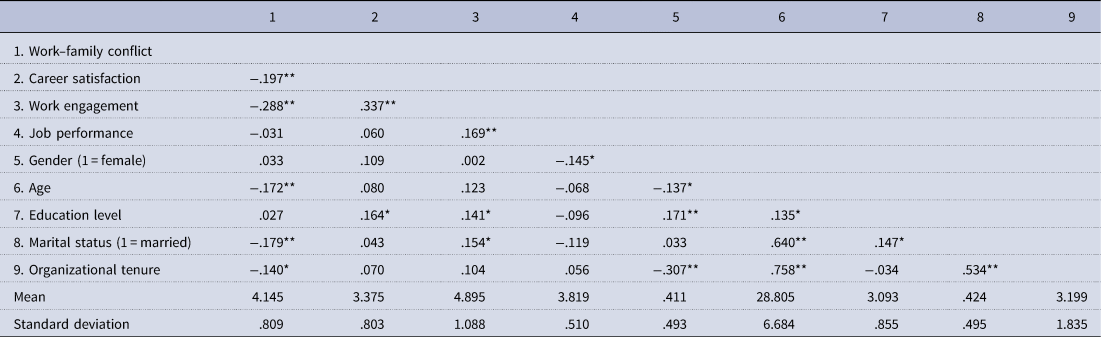
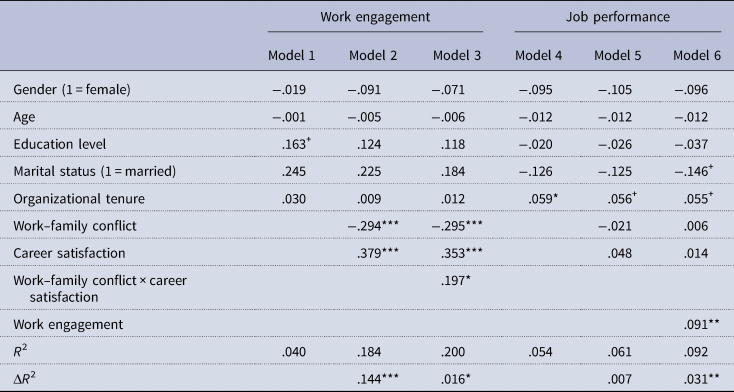
Table 1 reports the zero-order correlations and descriptive statistics, and Table 2 reports the hierarchical regression results. Models 1–3 predicted work engagement, and models 4–6 predicted job performance. The variance inflation factor values for the regression coefficients in each of the models were lower than the conservative value of 5.0 (Studenmund, Reference Studenmund1992), so multicollinearity does not present a concern (Aiken & West, Reference Aiken and West1991).
Correlations and descriptive statistics

Note: n = 236.
*p < .05; **p < .01.
Regression results

Note: n = 236.
+p < .10; *p < .05; **p < .01; ***p < .001.
Hypothesis 1 predicted that employees who believe that the quality of their family life is compromised by their work should exhibit less positive work-related energy during the execution of their job tasks. Consistent with this hypothesis, model 2 revealed a negative relationship between work–family conflict and work engagement (β = −.294, p < .001). Also in support of Hypothesis 2, the depletion in positive work-related energy undermined employees’ performance-enhancing efforts, according to the positive relationship between work engagement and job performance in model 6 (β = .091, p < .01).
The test for the presence of mediation used the bootstrapping method developed by Preacher and Hayes (Reference Preacher and Hayes2004), with Hayes’ (Reference Hayes2013) Process macro. This procedure generated confidence intervals (CIs) for indirect effects, so it avoided the risk of statistical power problems if the sampling distributions of the effects were asymmetric and non-normal (MacKinnon, Lockwood, & Williams, Reference MacKinnon, Lockwood and Williams2004). The CI for the indirect effect of work–family conflict on job performance through work engagement did not include 0 [−.058, −.004], indicating the presence of mediation.
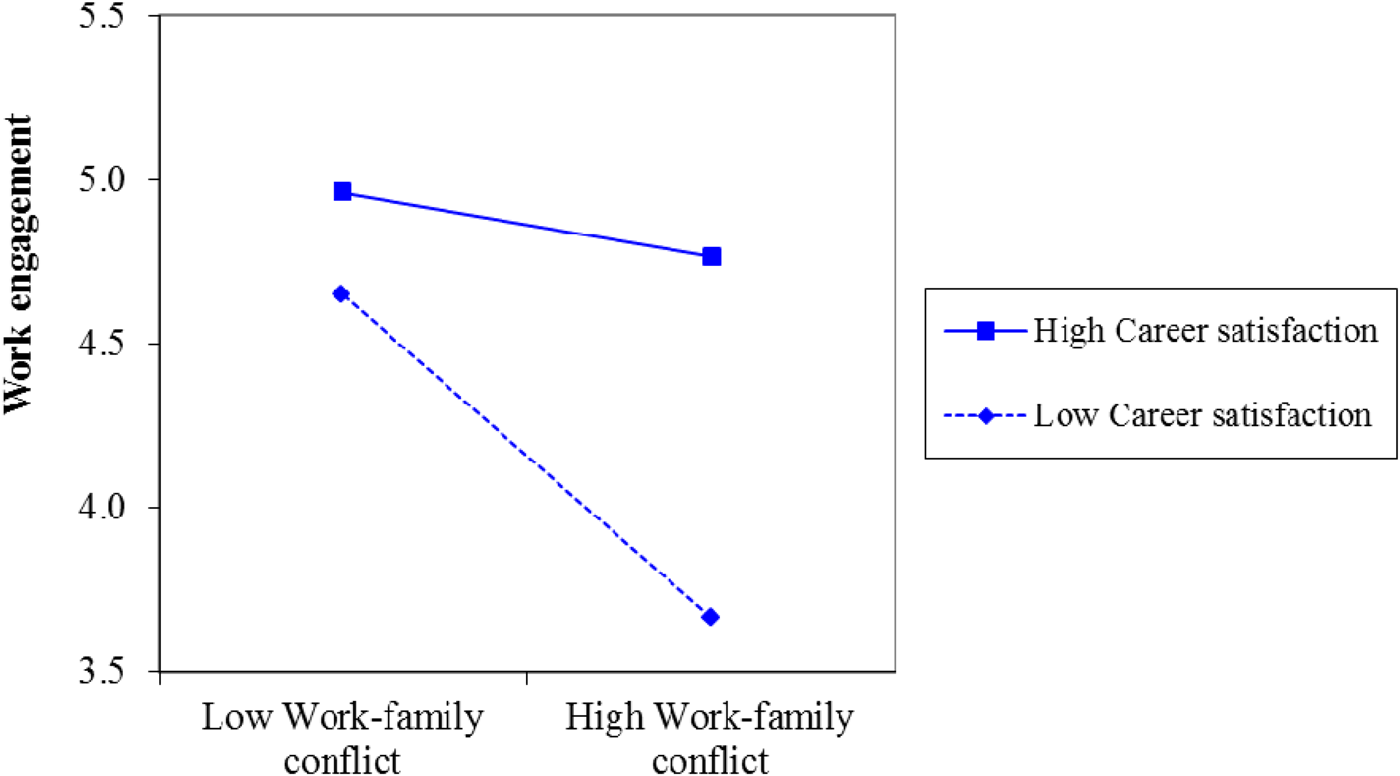
To assess the moderating role of career satisfaction, model 3 featured the interaction term, work–family conflict × career satisfaction, to predict work engagement. The positive and significant interaction term (β = .197, p < .05) provided evidence of a buffering role of career satisfaction. Figure 2 depicts the effect of work–family conflict on work engagement at high and low levels of career satisfaction. The corresponding simple slope analysis (Aiken & West, Reference Aiken and West1991) revealed that the relationship between work–family conflict and work engagement was negative and significant at low levels of career satisfaction (β = −.492, p < .001) but insignificant at high levels (β = −.098, ns), in support of Hypothesis 4.
Moderating effect of career satisfaction on the relationship between work–family conflict and work engagement.

The test of the moderated mediation effect in Hypothesis 5 relied on Preacher, Rucker, and Hayes’ (Reference Preacher, Rucker and Hayes2007) procedure, combined with Hayes’ (Reference Hayes2013) Process macro. Similar to the bootstrapping approach to assess mediation, this procedure generated CIs for the conditional indirect effects (MacKinnon, Lockwood, & Williams, Reference MacKinnon, Lockwood and Williams2004), such that the CIs pertained to different levels of the moderator (i.e., one standard deviation below its mean, at its mean, and one standard deviation above its mean).Footnote 1 The bootstrap 95% CIs for the conditional indirect effect of work–family conflict on job performance at one standard deviation below the mean and at the mean did not contain 0 ([−.090; −.007] and [−.061; −.004], respectively), but the CI contained 0 at one standard deviation above the mean of career satisfaction ([−.048; .006]). The index of moderated mediation (Hayes, Reference Hayes2015) equaled .019, with a CI of [.001; .048]. The lower bound of this interval was close to 0, signaling a relatively weak moderated mediation effect. Yet, it did not include 0 and thus supported the argument that career satisfaction mitigated the negative indirect effect of work–family conflict on job performance, through work engagement, consistent with Hypothesis 5 and the overall theoretical framework.
Although the theoretical focus of this study was the concurrent interplay of work–family conflict and career satisfaction for predicting work engagement and subsequent job performance, two additional tests provided checks of the robustness of the results. First, a path model was estimated in which career satisfaction mediated the relationship between work–family conflict and job performance. The fit of this path model was very poor (adjusted goodness-of-fit index = .48; confirmatory fit index = .11, normed fit index = .12, root mean squared error of approximation = .27).Footnote 2 Second, another path model included the interaction between work–family conflict and career satisfaction and the covariance between these two constructs, to account for potential interdependencies (e.g., employees’ experience of a negative inference of work with their family domain might diminish their career satisfaction). The results were completely consistent with those reported in Table 2: The direct effect of work–family conflict on work engagement, and the associated moderating role of career satisfaction, remained robust, even after accounting for possible causal interdependence between work–family conflict and career satisfaction (De Clercq, Thongpapanl, & Dimov, Reference De Clercq, Thongpapanl and Dimov2009; Sharma, Reference Sharma1996).
Discussion
This paper contributes to extant research by examining hitherto underexplored factors that underpin the connection between work–family conflict and job performance. In particular, it has relied on COR theory (Hobfoll, Reference Hobfoll2001; Hobfoll & Shirom, Reference Hobfoll, Shirom and Golembiewski2000) to propose that (1) a reduced propensity to meet formal job requirements, in response to the negative interference of work with family, might be explained by employees’ reduced engagement with their work, but (2) the satisfaction that they feel with how their career has progressed since the time that they were hired subdues this process. The empirical findings confirm these theoretical predictions.
First, this study provides a deeper understanding of why employees who consider it challenging to meet their family commitments due to their work responsibilities might underperform in the workplace (Liao et al., Reference Liao, Lau, Hui and Kong2019). Their reservoirs of positive work-related energy become depleted, as revealed by their lower levels of work engagement (Boon & Kalshoven, Reference Boon and Kalshoven2014). Research that empirically examines the connection between work–family conflict and job performance reveals mediating roles of other negative factors, such as stress, burnout, or exhaustion (Karatepe, Reference Karatepe2013; Netemeyer, Maxham, & Pullig, Reference Netemeyer, Maxham and Pullig2005; Singh, Suar, & Leiter, Reference Singh, Suar and Leiter2012). This study unveils another critical path by which perceptions of work–family conflict undermine employees’ success in meeting their work requirements, namely, by evoking their motivation to conserve positive, work-related energy (Boon & Kalshoven, Reference Boon and Kalshoven2014; Rich, Lepine, & Crawford, Reference Rich, Lepine and Crawford2010). As indicated in the Introduction, this mediating role of work engagement shows how employees who experience work–family conflict may suffer doubly: They feel frustrated that their organization undermines the quality of their family lives, and the associated drainage of positive work energy reservoirs, in the form of lower work engagement, hinders their fulfillment of organization-set performance targets (Alessandri et al., Reference Alessandri, Consiglio, Luthans and Borgogni2018; Hobfoll, Reference Hobfoll2001) – which ultimately may cause even more hardships in their lives.
Second, this negative spiral can be broken up by employees’ career satisfaction. That is, a depletion of positive work-related energy becomes a less relevant link connecting work–family conflict with diminished job performance for employees who are satisfied with how their career has progressed (Fleisher, Khapova, & Jansen, Reference Fleisher, Khapova and Jansen2014; Greenhaus, Parasuraman, & Wormley, Reference Greenhaus, Parasuraman and Wormley1990). Consistent with COR theory, the resource-draining effect of work–family conflict can be contained more easily to the extent that employees appreciate their organizational career advancement, because they experience the associated hardships as less threatening (Hobfoll & Shirom, Reference Hobfoll, Shirom and Golembiewski2000). Employees who are happier with the ways that their career has evolved during their organizational employment judge the difficulty of combining work with family obligations as less intrusive and are more willing to forgive their employer for this challenge (Fehr & Gelfand, Reference Fehr and Gelfand2012; Jawahar & Liu, Reference Jawahar and Liu2016). As a consequence, they experience less frustration when their work duties might compromise their participation in certain family activities, for example (Fleisher, Khapova, & Jansen, Reference Fleisher, Khapova and Jansen2014), which makes it more likely that they remain engaged with their work and perform their formal duties.
In summary, this research provides management scholars with expanded insights into why negative performance outcomes may arise due to professional circumstances that hinder the achievement of family goals. Specifically, lower work engagement connects resource-draining work–family conflict with underperformance at work; employees’ career satisfaction buffers this process though. In so doing, this study complements prior research that focuses on the direct positive relationship between career satisfaction and positive work outcomes (Cao, Hirschi, & Deller, Reference Cao, Hirschi and Deller2014; Jawahar & Liu, Reference Jawahar and Liu2016) by revealing an indirect beneficial role. In particular, it offers pertinent insights into how employees can avoid becoming hurt twice – by the negative interference of work with their family domain and by negative performance ratings that result from their corresponding lower work engagement – if they acknowledge and leverage positive feelings that they might have developed about how their organization has supported their career.
Limitations and future research
This study has some limitations, which suggest opportunities for continued research. First, work engagement is a critical mechanism that explains the negative performance outcomes of employees’ experience of work–family conflict, beyond previously studied mediators such as exhaustion and burnout. Yet, other factors could explain the link between work–family conflict and job performance too, such as employees’ organizational commitment (Meyer & Allen, Reference Meyer and Allen1991), job involvement (Chiu & Tsai, Reference Chiu and Tsai2006), or perceived person–organization fit (Boon & Biron, Reference Boon and Biron2016). In a similar vein, this study theorizes various reasons that employees might become less engaged in their work in response to adversity (e.g., beliefs that the organization does not care for their personal well-being, or perceived disrespect) and why that attitude might reduce their performance-enhancing efforts (e.g., to conserve energy for personal activities, or due to the personal satisfaction that strongly engaged employees might derive from enhancing their organization’s effectiveness). Future investigations should measure these mechanisms and determine which ones are most influential or prevalent.
Second, some caution is needed in terms of the possibility of reverse causality. The study design sought to minimize that concern, by imposing 1-month time gaps between the assessments of work–family conflict and career satisfaction, then work engagement, and then job performance. However, the specific measures of these constructs may allow for some conceptual overlap across different time points. For example, the evaluation periods for both employees’ self-assessments of work engagement and supervisors’ assessments of the employees’ job performance were somewhat vague, rather than delineating a specific timespan. To address this issue, future research could use more precise measures of time, as well as apply longer time gaps. Another option would be to leverage experimental designs to assess each of the focal constructs at multiple points in time and thereby estimate cross-lagged effects (Antonakis, Bendahan, Jacquart, & Lalive, Reference Antonakis, Bendahan, Jacquart and Lalive2010). A related extension would be to examine whether and how the long-term effect of work–family conflict holds after controlling for the effect of work–family enrichment (Chen & Powell, Reference Chen and Powell2012). These factors constitute two important elements of the work–family interface; it would be insightful to assess their simultaneous performance effects, as well as whether different mechanisms might underpin these effects.
Third, career satisfaction mitigates the translation of work–family conflict into diminished work engagement and subsequent job performance; other contingencies also might buffer this indirect effect. Potentially significant contingencies could include other personal features, such as psychological capital (Sweetman, Luthans, Avey, & Luthans, Reference Sweetman, Luthans, Avey and Luthans2011), passion for work (Baum & Locke, Reference Baum and Locke2004), or political skill (Banister & Meriac, Reference Banister and Meriac2015). Supportive contextual factors also might diminish the chances that beliefs about incompatible work and family demands lead to depleted work energy, such as perceptions of procedural justice (Colquitt, Conlon, Wesson, Porter, & Ng, Reference Colquitt, Conlon, Wesson, Porter and Ng2001), transformational leadership (Dvir, Eden, Avolio, & Shamir, Reference Dvir, Eden, Avolio and Shamir2002), or the availability of a formally appointed ombudsman who addresses employee concerns about challenges at the work–family interface (Harrison, Hopeck, Desrayaud, & Imboden, Reference Harrison, Hopeck, Desrayaud and Imboden2013). Yet, another valuable elaboration would be to investigate whether certain factors might reverse the sign of the relationship between work–family conflict and work engagement. For example, it would be interesting to examine whether employees may in fact become more engaged with their work, in response to experienced interference of work with family, to the extent that they score high on workaholism (Di Stefano & Gaudiino, Reference Di Stefano and Gaudiino2019) or that organizational performance appraisal systems emphasize dedicated work efforts, irrespective of the strain that these efforts might cause in the family domain (Kavanagh, Benson, & Brown, Reference Kavanagh, Benson and Brown2007).
Fourth, the theoretical arguments advanced in this study are not related to a particular country, yet cultural factors might have had some impact. In this regard, it is expected that the strength but not the nature of the hypothesized relationships might vary across countries. As mentioned earlier, the risk aversion that strongly marks Pakistani culture implies that employees in this country context might be particularly upset by the uncertainty created if they need to choose between work and family demands (Hofstede, Hofstede, & Minkov, Reference Hofstede, Hofstede and Minkov2010). In turn, the mitigating role of career satisfaction in buffering the link between work–family conflict and job performance, through work engagement, might be especially forceful. It would be useful to undertake cross-country investigations to investigate whether the nature of the theorized relationships can be replicated across different country settings, as well as explicate how pertinent resources may serve as buffers that subdue the negative consequences of work–family conflict on job performance through work engagement to varying degrees, depending on distinct cultural values.
Practical implications
This study also has important implications for management practice. When employees feel frustrated about their diminished ability to meet family commitments due to work obligations, they are left with insufficient positive work energy to undertake diligent efforts to comply with their formal job duties. Organizations should create work conditions that enable employees to address both work and family demands (McDowall & Kinman, Reference McDowall and Kinman2017). However, some employees might be reluctant to express concerns that the quality of their family life is hurt by their jobs, because this very complaint might threaten their career advancement, if it brands them as a ‘complainer.’ Therefore, organizations should proactively seek out employees whose private lives suffer from the ways their employer requires them to fulfill work duties. For example, they could establish discussion forums and encourage employees to share their concerns, with supervisors but also with like-minded peers, as a means to vent worries and search for solutions. They also could design personalized work–family programs (Valcour & Ladge, Reference Valcour and Ladge2008) to help prevent negative spillover effects of work stress into the family sphere.
Beyond this general recommendation that organizations should do their best to contain the frustration that employees experience if it seems impossible to combine work duties with family commitments, the study findings are especially valuable in scenarios in which work–family conflict may be unavoidable. In particular, employees who are happier about how their career has developed thus far can better deal with the challenge of such conflict (Cao, Hirschi, & Deller, Reference Cao, Hirschi and Deller2014), so the provision of adequate career support represents a critical option that enables organizations to reduce negative feelings and avoid diminished work engagement and job performance over time. For example, in external market contexts marked by stringent competitive pressures, organizations may be forced to demand sacrifices from their employees to survive and thrive (Lahiri, Pérez-Nordtvedt, & Renn, Reference Lahiri, Pérez-Nordtvedt and Renn2008). To the extent that such sacrifices cannot be eliminated, organizations that can create satisfaction among employees with regard to having met some of their career goals might increase their acceptance of the unfavorable interference of work with family – so they still can retain sufficient positive work energy to comply with organizational performance standards.
Conclusion
This research has sought to add to management literature by considering the effect of employees’ experience of work–family conflict on their job performance, as well as the role of their work engagement and career satisfaction in this process. The tendency to become less engaged with work reflects a critical mechanism by which work circumstances that hinder the fulfillment of family obligations limit employees’ performance-enhancing behaviors. The potency of this intermediate mechanism is contingent on how happy employees are about their career progress during their organizational employment. These findings may offer a platform for continued studies of how organizations can encourage employees to fulfill formal job duties, despite the challenges resulting from the need for employees to forgo certain family-related goals due to their work obligations.