Introduction
Superstition is defined as ‘a learned, largely culturally determined belief that manifests in behavior despite being unsupported by scientific evidence’ (Crossman, Reference Crossman2024: 3). Such beliefs are prevalent across cultures and appear in practices like favoring lucky numbers, consulting horoscopes, and attributing supernatural powers (Crossman, Reference Crossman2024; Liu, Tsang, & Shi, Reference Liu, Tsang and Shi2025). Primarily, superstitions aim to attract good fortune and ward off misfortune (Zhang, Risen, & Hosey, Reference Zhang, Risen and Hosey2014), especially in uncertain situations (Liu et al., Reference Liu, Tsang and Shi2025). Consequently, superstitions can substantially influence decision-making, particularly when uncertainty and economic outcomes are involved. For instance, numerical superstitions notably affect trading behaviors, property purchases, and major life decisions such as marriage and childbirth (Antipov & Pokryshevskaya, Reference Antipov and Pokryshevskaya2020; Bhattacharya, Kuo, Lin, & Zhao, Reference Bhattacharya, Kuo, Lin and Zhao2018; Humphreys, Nowak, & Zhou, Reference Humphreys, Nowak and Zhou2019). Overall, the widespread presence of superstition makes it a crucial factor in shaping decisions across diverse domains.
Organizations, as microcosms of society, are often influenced by superstitions (Crossman, Reference Crossman2024). When faced with uncertainty, executives may rely on superstitious heuristics – decision shortcuts derived from culturally ingrained beliefs (Liu et al., Reference Liu, Tsang and Shi2025). Consequently, superstitions continue to shape organizational decisions and their economic outcomes, even in technologically advanced societies (Crossman, Reference Crossman2024; Hirshleifer, Jian, & Zhang, Reference Hirshleifer, Jian and Zhang2018; Liu et al., Reference Liu, Tsang and Shi2025). This phenomenon is particularly pronounced in Eastern cultures, including China (Liu et al., Reference Liu, Tsang and Shi2025; Tsang, Reference Tsang2004a, Reference Tsang2004b). Recent research has focused on China’s distinctive zodiac year belief – a superstition suggesting that one’s birth profile predisposes them to bad luck. The prevailing argument is that executives in their zodiac years tend to avoid risky financial decisions out of fear of bad luck and potential losses (Fisman, Huang, Ning, Pan, Qiu, & Wang, Reference Fisman, Huang, Ning, Pan, Qiu and Wang2023; Li, Guo, Hu, & Tang, Reference Li, Guo, Hu and Tang2021; Zeng, Zhang, Zhou, Zhang, & Zhou, Reference Zeng, Zhang, Zhou, Zhang and Zhou2022). However, while earlier studies have emphasized resource-preserving strategies to mitigate these risks, they often overlook the possibility that executives may also adopt resource-building strategies to cope with increased stress and perceived misfortune.
Resources are essential for managing stress and maintaining well-being (Billings & Moos, Reference Billings and Moos1981; Hobfoll, Reference Hobfoll1989, Reference Hobfoll2001; Hobfoll, Halbesleben, Neveu, & Westman, Reference Hobfoll, Halbesleben, Neveu and Westman2018; Wells, Hobfoll, & Lavin, Reference Wells, Hobfoll and Lavin1997). Under stress, individuals not only strive to preserve their current resources but also to acquire new ones to guard against future losses (Hobfoll, Reference Hobfoll1989). For executives facing uncontrollable uncertainty – such as the risks associated with the zodiac year – building strategic resources becomes a vital response (Allaire & Firsirotu, Reference Allaire and Firsirotu1989). However, accumulating additional resources requires an initial investment of existing resources (Halbesleben & Wheeler, Reference Halbesleben and Wheeler2015; Hobfoll, Reference Hobfoll1989, Reference Hobfoll2001), which entails an immediate resource ‘loss’ in anticipation of future gains. This dynamic is evident in examples such as coworker support, representing a resource investment, and reciprocal helping among employees, resulting in resource gains (Halbesleben & Wheeler, Reference Halbesleben and Wheeler2015). The enduring influence of the zodiac year, combined with the unpredictability of misfortune, may prompt executives to allocate resources toward strategies that safeguard future resources and enhance resilience against potential risks. Consequently, they might favor low-risk approaches that yield net resource gains, with corporate philanthropy serving as one such resource-building strategy by providing insurance-like benefits (Godfrey, Reference Godfrey2005).
Building on literature on stress appraisal, resource-building, and corporate philanthropy, this study examines corporate philanthropy as a resource-building strategy for CEOs coping with psychological stress during the zodiac year. In uncertain environments, psychological stress often reflects perceived resource loss (Lazarus & Folkman, Reference Lazarus and Folkman1984). Research shows that prosocial behaviors, such as philanthropy (Ji, Huang, & Li, Reference Ji, Huang and Li2021), alleviate stress by investing resources (time, money, and effort) that yield returns and enhance resilience to future risks (Hobfoll, Reference Hobfoll1989; Raposa, Laws, & Ansell, Reference Raposa, Laws and Ansell2016; von Dawans, Fischbacher, Kirschbaum, Fehr, & Heinrichs, Reference von Dawans, Fischbacher, Kirschbaum, Fehr and Heinrichs2012). The Chinese zodiac year, linked to bad luck and risks tied to one’s birth year, may be perceived as stressful, prompting caution and the avoidance of taboos (Qu, Reference Qu2012; Yue & Ma, Reference Yue and Ma2023; Zhou, Reference Zhou1994). CEOs, as firm leaders, may fear these risks will spill over to their companies (Love, Lim, & Bednar, Reference Love, Lim and Bednar2017), further amplifying their stress. In response, they may invest in corporate philanthropy to secure insurance-like resources for both themselves and their firms. The intensity of stress during the zodiac year depends on CEOs’ fear of negative outcomes and their belief in the zodiac year superstition. We propose two moderators: CEO overconfidence, which may weaken the relationship between the zodiac year and corporate donations, and negative media coverage of CEOs, which may strengthen it.
To test our hypotheses, this study uses data from Chinese listed companies between 2008 and 2020. We manually collected information on CEOs’ zodiac years and the two moderators. Using fixed effects regression models, we examine our main argument and explore the boundary conditions. We also conduct supplementary analyses to provide deeper insights into our findings.
Our study contributes in several significant ways. First, it expands research on superstitions in management by demonstrating how resource-building strategies can mitigate superstition-induced stress – a perspective that contrasts with the conventional focus on resource preservation (Fisman et al., Reference Fisman, Huang, Ning, Pan, Qiu and Wang2023; Li et al., Reference Li, Guo, Hu and Tang2021; Zeng et al., Reference Zeng, Zhang, Zhou, Zhang and Zhou2022). Second, it deepens our understanding of the non-financial drivers of corporate philanthropy by identifying superstitions, such as zodiac year beliefs, as key antecedents (Ji et al., Reference Ji, Huang and Li2021). Third, it clarifies the boundary conditions of superstitious beliefs by examining how personal attributes and situational cues shape stress appraisal and coping mechanisms. Fourth, it advances the understanding of agency motivations in corporate philanthropy by examining how CEOs’ psychological stress during zodiac years drives increased corporate donations and by demonstrating how the prevalence of this agency issue varies under different boundary conditions.
Theory and Hypotheses
Superstitions and Corporate Decisions in China
Although often deemed irrational, superstitions can significantly influence corporate decisions when used as heuristics to navigate uncertainty (Liu et al., Reference Liu, Tsang and Shi2025; Tsang, Reference Tsang2004a, Reference Tsang2004b). Liu et al. (Reference Liu, Tsang and Shi2025: 849) identify five primary categories of superstitious beliefs that may affect corporate decision-making: (1) Birth Profile, (2) Physical Attributes, (3) Objects/Acts, (4) Surrounding Environment, and (5) Paranormal Revelations. Among these categories, Objects/Acts, Surrounding Environment, and Birth Profile appear to be particularly influential in shaping corporate decisions in China.
First, numerical superstition, a prominent belief within the Objects/Acts category, exerts a significant influence on corporate decisions. In China, the number 8 is considered lucky because its pronunciation resembles the word for prosperity, while the number 4 is seen as unlucky due to its similarity in sound to the word for death (Hirshleifer et al., Reference Hirshleifer, Jian and Zhang2018). As a result, preferences for lucky numbers permeate both corporate decision-making and financial markets in China (Bhattacharya et al., Reference Bhattacharya, Kuo, Lin and Zhao2018; Hirshleifer et al., Reference Hirshleifer, Jian and Zhang2018; Ke, Chen, Lin, & Liu, Reference Ke, Chen, Lin and Liu2017). For example, Chinese firms often prioritize lucky listing codes (Hirshleifer et al., Reference Hirshleifer, Jian and Zhang2018) and integrate lucky numbers into pricing strategies to appeal to superstitious consumers (Simmons & Schindler, Reference Simmons and Schindler2003; Westjohn, Roschk, & Magnusson, Reference Westjohn, Roschk and Magnusson2017).
Second, feng shui, a superstition under the category of Surrounding Environment, profoundly influences corporate decisions in China. It involves arranging physical spaces – such as homes, offices, and gardens – to promote the flow of positive energy, create balance, enhance well-being, and attract good fortune (Huang & Teng, Reference Huang and Teng2009; Tsang, Reference Tsang2004a, Reference Tsang2004b). For executives, consulting feng shui experts can serve as a way to alleviate uncertainty and reduce anxiety when making important decisions (Tsang, Reference Tsang2004a, Reference Tsang2004b).
Third, the zodiac year belief, classified under the category of Birth Profile, has recently garnered significant attention in management research on superstitions. Known as ‘Ben Ming Nian’ in Chinese culture, the zodiac year refers to the year corresponding to an individual’s zodiac sign in the Chinese lunar calendar. Tradition holds that one’s zodiac year brings challenges and misfortune (Zeng et al., Reference Zeng, Zhang, Zhou, Zhang and Zhou2022; Zhou, Reference Zhou1994). Much like Western astrology, this belief is widely embraced in China and functions as an informal institutional guide for decision-making (Zeng et al., Reference Zeng, Zhang, Zhou, Zhang and Zhou2022). Rooted in Taoist tradition, the belief has a long history and is shared across various ethnic groups in China (Cao, Reference Cao1995; Wu, Zhang, & Zhou, Reference Wu, Zhang and Zhou2023; Yue & Ma, Reference Yue and Ma2023; Zhou, Reference Zhou1994). Deeply embedded in the Chinese lunar calendar, it reinforces public adherence to zodiac customs, and over time, zodiac culture has emerged as a prominent social force (Cao, Reference Cao1995; Sun, Lu, & Zhang, Reference Sun, Lu and Zhang2018; Yue & Ma, Reference Yue and Ma2023; Zhou, Reference Zhou1994). Empirical studies reveal that during their zodiac year, executives tend to curtail risk-taking investments, for example, by reducing expenditures on research and development (R&D) and acquisitions (Fisman et al., Reference Fisman, Huang, Ning, Pan, Qiu and Wang2023; Huang, Luo, & Wang, Reference Huang, Luo and Wang2020; Teklay, Yu, & Zhu, Reference Teklay, Yu and Zhu2024). In contrast, these executives are more likely to increase corporate cash holdings (Li et al., Reference Li, Guo, Hu and Tang2021).
The central premise of these studies is that executives rely on superstitions as decision-making heuristics to navigate uncertainty in corporate contexts (Liu et al., Reference Liu, Tsang and Shi2025). Specifically, when faced with the stress induced by superstitions like the zodiac year, they emphasize preserving existing resources to avoid losses. While this resource-preservation stance is valuable, these studies often overlook an alternative approach: resource-building to mitigate potential risks. Resource-building is a crucial component of stress management, enabling individuals to expand their resource pool and better endure future uncertainties (Hobfoll, Reference Hobfoll1989). Although this strategy typically requires an initial resource investment (Hobfoll, Reference Hobfoll1989), executives – generally risk-averse – may find less risky strategies, such as corporate philanthropy, particularly appealing.
Corporate Philanthropy as a Resource-Building Strategy in China
In China, corporate philanthropy is a well-established practice deeply embedded in the country’s cultural, social, and political context, holding greater strategic significance than general CSR practices (Wang & Qian, Reference Wang and Qian2011; Zhang, Xu, & Chen, Reference Zhang, Xu and Chen2022). Chinese firms have long regarded philanthropy as a key aspect of CSR (Du, Jian, Du, Feng, & Zeng, Reference Du, Jian, Du, Feng and Zeng2014; Huang, Shi, Li, Wang, & Jia, Reference Huang, Shi, Li, Wang and Jia2024). By helping firms secure critical resources from stakeholders, corporate philanthropy is recognized as a valuable resource-building strategy with the potential to yield substantial returns.
Corporate philanthropy has the potential to attract resources from a wide range of stakeholders, including the government. First, traditional Chinese philosophies – such as Buddhism, Taoism, and Confucianism – stress values of compassion, harmony, and benevolence (Du, Du, Zeng, Pei, & Chang, Reference Du, Du, Zeng, Pei and Chang2016; Du et al., Reference Du, Jian, Du, Feng and Zeng2014; Ramasamy, Yeung, & Chen, Reference Ramasamy, Yeung and Chen2013; Wang & Qian, Reference Wang and Qian2011). These cultural underpinnings create an expectation among stakeholders for firms to engage in philanthropy, framing it as a tangible demonstration of their commitment to social responsibility. This, in turn, enhances public legitimacy and reputation. Second, the Chinese government, often constrained by resources, relies on corporate philanthropy to support community welfare initiatives (Dickson, Reference Dickson2003), such as poverty alleviation. Given the government’s strict oversight of charitable organizations, corporate donations are highly visible to the government (Feng, Reference Feng2015; Li, Song, & Wu, Reference Li, Song and Wu2015). Thus, corporate philanthropy can yield political benefits, including tax advantages (Chan & Feng, Reference Chan and Feng2019), public recognition (Wang & Qian, Reference Wang and Qian2011), and easier approval for projects (Ma & Parish, Reference Ma and Parish2006). Overall, corporate philanthropy in China is a vital strategy for shaping stakeholder perceptions and fostering government relations, both of which are key resources that not only drive positive outcomes for firms but also equip them to navigate potential risks.
The Role of CEO in Corporate Philanthropy
Corporate philanthropy, a highly discretionary aspect of CSR, typically falls under the decision-making authority of CEOs (Carroll, Reference Carroll1979; Gao & Hafsi, Reference Gao and Hafsi2025; Wernicke, Sajko, & Boone, Reference Wernicke, Sajko and Boone2022). This is because CEOs possess greater latitude of action, a key dimension of managerial discretion (Krause, Li, Ma, & Bruton, Reference Krause, Li, Ma and Bruton2019; Zhang & Zhang, Reference Zhang and Zhang2016) and a firm’s CSR reputation is primarily shaped by relevant behaviors and practices (Parker, Krause, & Devers, Reference Parker, Krause and Devers2019), thereby placing CSR within their discretion. Moreover, because corporate philanthropy often involves agency motivations (Masulis & Reza, Reference Masulis and Reza2015), CEOs, as the firm’s agents, are more inclined to pursue such initiatives.
Managerial Discretion and Corporate Philanthropic Decisions
Managerial discretion research differentiates between two dimensions: latitude of objectives and latitude of actions (Krause et al., Reference Krause, Li, Ma and Bruton2019; Shen & Cho, Reference Shen and Cho2005). Latitude of objectives captures the freedom to set and govern strategic goals – a domain where chairpersons wield greater discretion – whereas latitude of actions refers to control over day-to-day operations and performance, over which CEOs hold more sway (Krause et al., Reference Krause, Li, Ma and Bruton2019). Distinguishing these dimensions is essential for understanding how different executive roles shape pivotal firm decisions (Parker et al., Reference Parker, Krause and Devers2019).
Consequently, when CSR is evaluated more by actual firm actions and behaviors rather than by stated goals (Parker et al., Reference Parker, Krause and Devers2019), CEOs – by virtue of their higher latitude of actions – tend to have a stronger impact on CSR outcomes, particularly in the highly discretionary realm of corporate philanthropy. In contrast, chairpersons influence CSR mainly through strategic, long-term initiatives that reflect their latitude of objectives, and their influence is more indirect, given their limited involvement in daily operations compared to CEOs (Banerjee, Nordqvist, & Hellerstedt, Reference Banerjee, Nordqvist and Hellerstedt2020). Corporate donations tied to specific occasions – such as zodiac years – are often short-term, temporary decisions and thus fall largely under the CEO’s control. Large surveys further show that, in many firms worldwide, CSR is managed directly by CEOs who view it as their responsibility to make their firms more sustainable (United Nations, 2007, 2023).Footnote 1
Given the central role of CEOs in managing CSR, their diverse attributes are often reflected in corporate philanthropic decisions (Wei, Ouyang, & Chen, Reference Wei, Ouyang and Chen2018; Xu, Shi, Qin, Zhang, & Tang, Reference Xu, Shi, Qin, Zhang and Tang2022). Empirical research shows that various CEO characteristics – including demographic features, personality traits, psychological factors, and personal experiences – significantly influence corporate philanthropy in China (Chen, Zhang, & Jia, Reference Chen, Zhang and Jia2021; Gao & Hafsi, Reference Gao and Hafsi2025; Han, Chi, & Zhou, Reference Han, Chi and Zhou2022; Wei et al., Reference Wei, Ouyang and Chen2018; Wu, Guang, Xu, & Wang, Reference Wu, Guang, Xu and Wang2019; Xu et al., Reference Xu, Shi, Qin, Zhang and Tang2022). As the public face of the firm, CEOs frequently benefit from the reputational gains associated with philanthropic initiatives, as stakeholders tend to attribute these decisions directly to them (Ogunfowora, Stackhouse, & Oh, Reference Ogunfowora, Stackhouse and Oh2018; Yang, Huang, Shi, & Jia, Reference Yang, Huang, Shi and Jia2021). Collectively, these findings underscore the substantial discretion that CEOs wield over corporate donation decisions.
Agency Risks in Corporate Philanthropy and the CEO’s Role
Although corporate philanthropy offers strategic benefits and helps build organizational resources, it often sparks debate over agency concerns because distinguishing genuine strategic initiatives from managerial self-interest can be challenging (Masulis & Reza, Reference Masulis and Reza2015, Reference Masulis and Reza2023; Tan & Tang, Reference Tan and Tang2016). Indeed, philanthropy can erode shareholder value and skew investment decisions (Masulis & Reza, Reference Masulis and Reza2023), highlighting these agency risks. In contexts such as zodiac years – where donations aim to bolster reputation and alleviate psychological pressures – the practice vividly illustrates this dilemma. Consequently, pinpointing the executive roles most susceptible to such behavior is crucial for strengthening corporate governance.
CEOs, as the firms’ chief executives, function primarily as agents and are ideally positioned to shape philanthropic initiatives – especially when personal gains are possible – giving rise to agency conflicts (Gao & Hafsi, Reference Gao and Hafsi2025). In contrast, chairpersons – often founders with substantial shareholdings – act more like principals, leading governance and safeguarding long-term corporate interests (Li & Zhang, Reference Li and Zhang2018).Footnote 2 Compared with chairpersons, CEOs face greater career risk and endure heightened stress due to their personal accountability for firm performance (Crossland & Chen, Reference Crossland and Chen2013). Consequently, CEOs may be more inclined to deploy corporate philanthropy during zodiac years as a coping mechanism. Given their agent role and elevated stress, they are the most likely source of agency issues in these contexts.
Although previous studies on the impact of zodiac year beliefs have predominantly focused on chairpersons, they have mainly examined strategic financial decisions – such as R&D – that fall within the chairpersons’ discretion over strategic objectives (Krause et al., Reference Krause, Li, Ma and Bruton2019; Zhang & Zhang, Reference Zhang and Zhang2016). In contrast, corporate donations in zodiac years create a pronounced agency dilemma. CEOs, who wield broader discretion over philanthropic decisions and act as the firm’s agents, are more likely to leverage these donations to satisfy personal interests. For these reasons, CEOs provide the most appropriate lens for investigating how zodiac year beliefs shape corporate giving.
Hypotheses
We draw on insights from the literature on stress appraisal, resource building, and corporate philanthropy to explore the relationship between a CEO’s zodiac year and corporate philanthropy. Research on stress appraisal suggests that when individuals perceive a threat of resource loss, they are likely to experience stress and seek additional resources to manage the situation (Carver, Scheier, & Weintraub, Reference Carver, Scheier and Weintraub1989; Folkman, Reference Folkman1984; Folkman, Lazarus, Dunkel-Schetter, DeLongis, & Gruen, Reference Folkman, Lazarus, Dunkel-Schetter, DeLongis and Gruen1986; Hobfoll, Reference Hobfoll1989; Körner, Debus, Wu, & Kleinmann, Reference Körner, Debus, Wu and Kleinmann2025; Lazarus & Folkman, Reference Lazarus and Folkman1984). Meanwhile, studies on resource building indicate that engaging in prosocial behavior can be an effective strategy to accumulate resources to alleviate psychological stress (Hensel, Rohleder, & Niessen, Reference Hensel, Rohleder and Niessen2022; Lazar & Eisenberger, Reference Lazar and Eisenberger2022; McCarthy, Erdogan, & Bauer, Reference McCarthy, Erdogan and Bauer2019). These resources encompass both emotional assets, including positive affect, empathy, self-efficacy, and a sense of social connectedness and fulfillment (Midlarsky, Reference Midlarsky and Clark1991; Raposa et al., Reference Raposa, Laws and Ansell2016; Varma, Chen, Lin, Aknin, & Hu, Reference Varma, Chen, Lin, Aknin and Hu2023), and social resources, such as supportive networks (Baumeister & Leary, Reference Baumeister and Leary1995; Faber & Häusser, Reference Faber and Häusser2022; von Dawans et al., Reference von Dawans, Fischbacher, Kirschbaum, Fehr and Heinrichs2012). Moreover, corporate philanthropy, owing to its inherently prosocial nature (Ji et al., Reference Ji, Huang and Li2021) and its role in attracting stakeholder support, has emerged as an effective strategy for building resources for both CEOs and their firms. In summary, individuals are motivated to mitigate increased stress by investing their current resources to build additional ones – a dynamic exemplified by the reciprocal nature of coworker support (Halbesleben & Wheeler, Reference Halbesleben and Wheeler2015).
In this study, we argue that when CEOs perceive potential resource loss from threats such as the zodiac year, they experience heightened stress and are compelled to invest current resources to build additional ones – for example, through corporate donations. Traditionally viewed as a transitional period marked by bad luck, elevated risks, and strict cultural taboos (Qu, Reference Qu2012; Yue & Ma, Reference Yue and Ma2023; Zhou, Reference Zhou1994), the zodiac year becomes a significant stressor. Consequently, corporate philanthropy may serve as an effective strategy for resource accumulation in response to the stress induced by the zodiac year.
CEO’s Zodiac Year and Corporate Philanthropy
The current study examines the relationship between CEOs’ zodiac year beliefs and corporate philanthropy. We propose that CEOs’ zodiac year beliefs will positively impact corporate philanthropy, as corporate philanthropy can build resources for both CEOs and firms, making them more resilient to potential negative outcomes.
At the individual level, corporate philanthropy enhances CEOs’ personal resilience against perceived risks through emotional and reputational resources. Culturally, China’s emphasis on Confucian morality and Buddhist karma frames philanthropy as a virtuous act to offset bad luck (Wang & Juslin, Reference Wang and Juslin2009; Yue & Ma, Reference Yue and Ma2023). Meanwhile, corporate philanthropy, as prosocial giving, also fosters positive emotions (Midlarsky, Reference Midlarsky and Clark1991; Raposa et al., Reference Raposa, Laws and Ansell2016; Varma et al., Reference Varma, Chen, Lin, Aknin and Hu2023), strengthening psychological resilience and reducing stress. Additionally, stakeholders often attribute corporate donations to CEOs (Ogunfowora et al., Reference Ogunfowora, Stackhouse and Oh2018; Yang et al., Reference Yang, Huang, Shi and Jia2021), thus boosting their personal reputation (Petrenko, Aime, Ridge, & Hill, Reference Petrenko, Aime, Ridge and Hill2016; Yang et al., Reference Yang, Huang, Shi and Jia2021). A strong reputation, in turn, mitigates turnover risk and secures the institutional support and networks necessary to navigate crises (Yang et al., Reference Yang, Huang, Shi and Jia2021). Thus, corporate philanthropy equips CEOs with both emotional and reputational resources to combat potential adversity, lowering their stress.
At the firm level, CEOs’ personal risks may harm corporate reputation due to their intertwined relationship (Busenbark, Krause, Boivie, & Graffin, Reference Busenbark, Krause, Boivie and Graffin2016; Graffin, Pfarrer, & Hill, Reference Graffin, Pfarrer, Hill, Pollock and Barnett2012; Love et al., Reference Love, Lim and Bednar2017). Corporate philanthropy acts as reputation insurance (Godfrey, Reference Godfrey2005; Luo, Kaul, & Seo, Reference Luo, Kaul and Seo2018), particularly in China’s politically influenced, institutionally underdeveloped economy (Li et al., Reference Li, Song and Wu2015; Marquis & Raynard, Reference Marquis and Raynard2015). By building public goodwill, political legitimacy, and stakeholder support (Wang & Qian, Reference Wang and Qian2011; Zhang et al., Reference Zhang, Xu and Chen2022), corporate philanthropy mitigates risks like stock price crashes (Zhang, Xie, & Xu, Reference Zhang, Xie and Xu2016), lowers capital costs (Zolotoy, O’Sullivan, & Klein, Reference Zolotoy, O’Sullivan and Klein2019), contributes to financial performance (Wang & Qian, Reference Wang and Qian2011) and aids crisis recovery (Filbeck, Robbins, & Zhao, Reference Filbeck, Robbins and Zhao2022; Sun, Wu, & Zhang, Reference Sun, Wu and Zhang2021). Thus, corporate philanthropy creates insurance-like resources, including legitimacy, reputation, political ties, and stakeholder support, which reduce risks, promote positive outcomes, and enhance crisis preparedness. These advantages also likely alleviate CEOs’ concerns about the potential spillover of bad luck, thereby reducing stress.
To summarize, CEOs in their zodiac years are highly motivated to leverage corporate philanthropy to build resources for themselves and their firms, thereby preparing for potential risks and alleviating psychological stress. Hence, we propose the following hypothesis:
Hypothesis 1 (H1): The CEO’s zodiac year has a positive impact on the focal firm’s charitable donations.
The main effect is influenced by the level of stress perceived by CEOs during their zodiac years. The amount of stress affects CEOs’ need for coping resources, which, in turn, influences their motivation to use corporate philanthropy to build resources during this period. CEOs’ stress levels depend on their fear of potential negative outcomes and their belief in zodiac year superstitions. Psychological research shows that both personal and situational factors impact stress appraisal (Folkman & Lazarus, Reference Folkman and Lazarus1980; Lazarus & Folkman, Reference Lazarus and Folkman1984; Zautra, Affleck, Tennen, Reich, & Davis, Reference Zautra, Affleck, Tennen, Reich and Davis2005). Accordingly, we use CEO overconfidence and negative media coverage of CEOs as indicators of these dynamics. Below, we illustrate how CEO overconfidence – reflecting a reduced fear of adverse outcomes and a strong belief in personal control – can weaken the zodiac year’s impact by lowering perceived stress and diminishing the need for additional coping resources. Conversely, negative media coverage during the zodiac year – a potent environmental cue of actual bad luck – may reinforce CEOs’ belief in zodiac year superstitions, thereby increasing both their stress and their need for coping resources, which, in turn, positively moderates the main effect.
Moderating Effects of CEO Overconfidence
CEO overconfidence refers to the tendency of a CEO to have an overly positive and inaccurate perception of their abilities and knowledge (Anderson, Brion, Moore, & Kennedy, Reference Anderson, Brion, Moore and Kennedy2012). This trait influences whether a CEO fears the bad luck traditionally associated with the zodiac year. Overconfident CEOs tend to underestimate the risks involved in strategic decisions during uncertain times while overestimating their ability to overcome challenges and mitigate potential negative outcomes (Burkhard, Sirén, van Essen, Grichnik, & Shepherd, Reference Burkhard, Sirén, van Essen, Grichnik and Shepherd2023; Gul, Krishnamurti, Shams, & Chowdhury, Reference Gul, Krishnamurti, Shams and Chowdhury2020). A key assumption is that these CEOs believe strongly in their capacity to control outcomes even amid uncertainty and external disruptions (Burkhard et al., Reference Burkhard, Sirén, van Essen, Grichnik and Shepherd2023). Consequently, overconfident CEOs are more likely to underestimate both the risks and misfortune associated with zodiac years while overestimating their ability to overcome challenges during uncertain times (Lee, Park, & Chen, Reference Lee, Park and Chen2023). Moreover, psychological literature suggests that the self-esteem enhanced by overconfidence serves as a valuable resource, enabling CEOs to better cope with stress (Pearlin & Schooler, Reference Pearlin and Schooler1978), enabling CEOs to better cope with stress.
Therefore, overconfident CEOs possess abundant psychological resources that enable them to experience less stress related to zodiac year beliefs. Their heightened self-confidence and resilience lead them to underestimate risks and overestimate their abilities, resulting in a diminished fear of zodiac year superstitions compared to their less overconfident peers. With more coping resources and lower psychological stress, overconfident CEOs are less likely to use corporate philanthropy to build resources to address stress related to the zodiac year, thereby weakening the relationship between the zodiac year and corporate donations. As such, we propose the following hypothesis:
Hypothesis 2 (H2): CEO overconfidence moderates the relationship between the CEO’s zodiac year and the focal firm’s charitable donations, such that the relationship will be weaker when the CEO is overconfident.
Moderating Effects of CEO Negative Media Coverage in the Zodiac Year
Negative media coverage of CEOs refers to portrayals that cast these leaders in an unfavorable light, such as highlighting their deficiencies in competence (Park & Berger, Reference Park and Berger2004). Such coverage signals that the zodiac year may bring tangible misfortune to CEOs, thereby reinforcing their belief in superstition. Given their prominent leadership roles, CEOs typically attract significant media attention (Park & Berger, Reference Park and Berger2004), with news reports serving as critical environmental cues that shape how they perceive and respond to stressful events. Negative media coverage can inflict serious damage on both a CEO’s personal reputation and the firm’s image (Love et al., Reference Love, Lim and Bednar2017). Research shows that CEOs are especially sensitive to negative reporting (Bednar, Boivie, & Prince, Reference Bednar, Boivie and Prince2013; Westphal & Deephouse, Reference Westphal and Deephouse2011). Consequently, such coverage not only erodes reputational capital but also compromises the emotional well-being of CEOs, further elevating their stress levels during the zodiac year and heightening the need to build additional coping resources.
Specifically, during their zodiac years, CEOs continuously assess the external environment. Negative media coverage serves as a powerful cue that reinforces their belief in zodiac year superstitions by validating the occurrence of bad outcomes. This, in turn, results in increased losses of primarily reputational and emotional resources and heightened stress. Consequently, CEOs facing more negative coverage during their zodiac year are likely to experience greater resource losses and elevated stress, prompting them to rely more on corporate philanthropy as a coping mechanism, thereby reinforcing the relationship between the zodiac year and corporate philanthropy. Therefore, we propose:
Hypothesis 3 (H3): CEO negative media coverage in a zodiac year moderates the relationship between the CEO’s zodiac year and the focal firm’s charitable donations, such that the relationship will be stronger when the CEO receives more negative media coverage in the zodiac year.
Sample and Data
Our sample consists of A-share firms listed on the Shanghai and Shenzhen stock exchanges from 2008 to 2020. Following prior research (Hirshleifer et al., Reference Hirshleifer, Jian and Zhang2018; Huang et al., Reference Huang, Luo and Wang2020; Zeng, Li, He, & Meng, Reference Zeng, Li, He and Meng2024), we exclude firms established during the sample period, firms with special treatment labels (ST, *ST, PT),Footnote 3 financial sector firms, firms with a net profit rate above 1, asset-liability ratios outside the range of 0–1, or other abnormal financial indicators, and firms with missing data. Our final sample comprises 1,065 firms representing 13,713 observations, with CEO zodiac year data manually collected and financial and governance information obtained from the CSMAR database.Footnote 4 Given that a firm’s life cycle profoundly shapes board structures – such as board size and chair–CEO duality (Li & Zhang, Reference Li and Zhang2018) – we apply stringent screening criteria to focus on mature firms with stable governance structures, thereby ensuring the reliability of the data and the rigor of the sample construction.
Model Construction
Guided by H1, we develop Model (1) to evaluate the impact of a CEO’s zodiac year on charitable donations:
 \begin{equation} {\text{Donatio}}{{\text{n}}_{{\text{i,t}}}}{\text{ = }}{\beta _0}{\text{ + }}{\beta _1}{\text{ \times Zodia}}{{\text{c}}_{{\text{i,t}}}}{\text{ + }}{\beta _2}{\text{ \times Zodia}}{{\text{c}}_{{\text{i,t}}}}{\text{ + }}\mathop \sum \nolimits^ {\text{Control}}{{\text{s}}_{{\text{i,t}}}}{\text{ + Fir}}{{\text{m}}_{\text{i}}}{\text{ + Yea}}{{\text{r}}_{\text{t}}}{\text{ + }}{{ \varepsilon }_{{\text{i,t}}}}\end{equation}
In the model, subscripts i and t denote firm i and year t, respectively. Donationi,t is the dependent variable, representing the level of charitable donations, while Zodiaci,t is the independent variable, indicating whether the CEO of firm i in year t is in a zodiac year. Controlsi,t represents a series of control variables, and εi,t denotes an unobservable factor. We also include firm fixed effects (Firmi) and year fixed effects (Yeart) that remain constant over time, and we employ two-way clustered standard errors (firm and year) (Brunnermeier, Rother, & Schnabel, Reference Brunnermeier, Rother and Schnabel2020; Thompson, Reference Thompson2011).
To test H2 and H3, we specify Model (2), which extends Model (1) by incorporating moderating variables and their interactions with the independent variables.
 \begin{align}{\text{Donatio}}{{\text{n}}_{{\text{i,t}}}} & = {{\beta }}_{\text{0}}^{\text{\unicode{x2018;}}}{ + \beta }_{\text{1}}^{\text{\unicode{x2018;}}}{\text{ \times Zodia}}{{\text{c}}_{{\text{i,t}}}}{ + \beta }_{\text{2}}^{\text{\unicode{x2018;}}}{\text{ \times Moderatio}}{{\text{n}}_{{\text{i,t}}}}{ + \beta }_{\text{3}}^{\text{\unicode{x2018;}}}{\text{ \times Zodia}}{{\text{c}}_{{\text{i,t}}}}{\text{ \times Moderatio}}{{\text{n}}_{{\text{i,t}}}} \nonumber\\
& \quad + \mathop \sum \nolimits^ {\text{Control}}{{\text{s}}_{{\text{i,t}}}}{\text{ + Fir}}{{\text{m}}_{\text{i}}}{\text{ + Yea}}{{\text{r}}_{\text{t}}}{\text{ + }}{{ \varepsilon }_{{\text{i,t}}}}\end{align}
Dependent Variable
Donation
Based on previous research (Brammer & Millington, Reference Brammer and Millington2008; Brown, Helland, & Smith, Reference Brown, Helland and Smith2006; Jia & Zhang, Reference Jia and Zhang2015; Liang & Renneboog, Reference Liang and Renneboog2017), we employ the donations-to-sales ratio in our benchmark regression analysis. This metric is widely used in the literature because it more accurately captures the overall intent of corporate charitable giving (Dong, Gao, Sun, & Ye, Reference Dong, Gao, Sun and Ye2021).
Independent Variable
Zodiac
Drawing on the work of Zeng et al. (Reference Zeng, Zhang, Zhou, Zhang and Zhou2022) and Fisman et al. (Reference Fisman, Huang, Ning, Pan, Qiu and Wang2023), we use a binary variable as the key explanatory factor, coded as 1 if the CEO is in their zodiac year and 0 otherwise. Due to challenges in pinpointing exact CEO birth dates, we adopt the established approach (Fisman et al., Reference Fisman, Huang, Ning, Pan, Qiu and Wang2023; Zeng et al., Reference Zeng, Zhang, Zhou, Zhang and Zhou2022) of approximating zodiac years by adding multiples of 12 to the CEO’s Gregorian birth year. For example, a CEO born in 1968 would have zodiac years in 1980, 1992, 2004, and 2016.
Moderating Variables
Overconfidence
Drawing on prior research (Guo & Ding, Reference Guo and Ding2019; Huang, Jiang, Liu, & Zhang, Reference Huang, Jiang, Liu and Zhang2011; Huang & Kisgen, Reference Huang and Kisgen2013; Lin, Hu, & Chen, Reference Lin, Hu and Chen2005), and available data from Chinese listed companies, we measure CEO overconfidence as the degree to which profit forecasts exceed actual earnings. We use quarterly forecasts and actual earnings from Chinese firms. If the aggregated quarterly forecast for a year exceeds the actual revenue, the CEO is deemed overconfident (coded as 1); otherwise, they are not (coded as 0).
CEO negative media coverage
Drawing on prior studies (Jia, Tong, Viswanath, & Zhang, Reference Jia, Tong, Viswanath and Zhang2016; Luo, Huang, & Zhu, Reference Luo, Huang and Zhu2021), we source data on both print and online media coverage concerning CEOs. For print media, following Jia et al. (Reference Jia, Tong, Viswanath and Zhang2016), we rely on the WISERS news service – the most comprehensive source – to identify news reports on individual CEOs, while for online media, following Luo et al. (Reference Luo, Huang and Zhu2021), we manually collect data using Baidu News Search, the leading Chinese news platform.Footnote 5 We conduct an annual search (January 1 to December 31) for articles with titles containing the CEO’s name alongside the firm’s name (or stock name, code, or abbreviation) and tally the count for each CEO. We also perform a full-text sentiment analysis to detect negative terms – such as ‘scandal,’ ‘shady dealings’, ‘insider activities’, ‘related-party transactions’, ‘violations’, and ‘inappropriate conduct’ – flagging any article that includes them as negative (An, Jin, Liu, & Zheng, Reference An, Jin, Liu and Zheng2022). Finally, we calculate the negative coverage ratio to quantitatively assess negative media sentiment.
 \begin{align}& {\text{ Negative Coverage Ratio}} \nonumber\\
& \quad = \frac{{{\text{The number of negative news about focal CEO from the internet media and newspapers }}}}{{{\text{All coverge of focal ceo from internet media and newspapers}}}}\end{align}
Control Variables
Drawing on prior literature (Biddle, Hilary, & Verdi, Reference Biddle, Hilary and Verdi2009; Huang et al., Reference Huang, Luo and Wang2020; Huang et al., Reference Huang, Roberts and Tan2022; Poursoleyman, Mansourfar, Hassan, & Homayoun, Reference Poursoleyman, Mansourfar, Hassan and Homayoun2024; Richardson, Reference Richardson2006; Ullah, Majeed, & Fang, Reference Ullah, Majeed and Fang2021; Wang, Hu, Zhang, & Miao, Reference Wang, Hu, Zhang and Miao2020), we identify control variables likely to influence a firm’s charitable donations: Firm size, Current assets, Leverage, EPS, Growth, Firm age, Board size, Management size, Tobin’s Q, Penalty, CEO’s age, GDP, Marketization. We also account for year (Year FE) and firm fixed effects (Firm FE). All variables are defined and described in Table 1.
Variable definition

Results
Trend of Corporate Donations Before and After the Zodiac Year
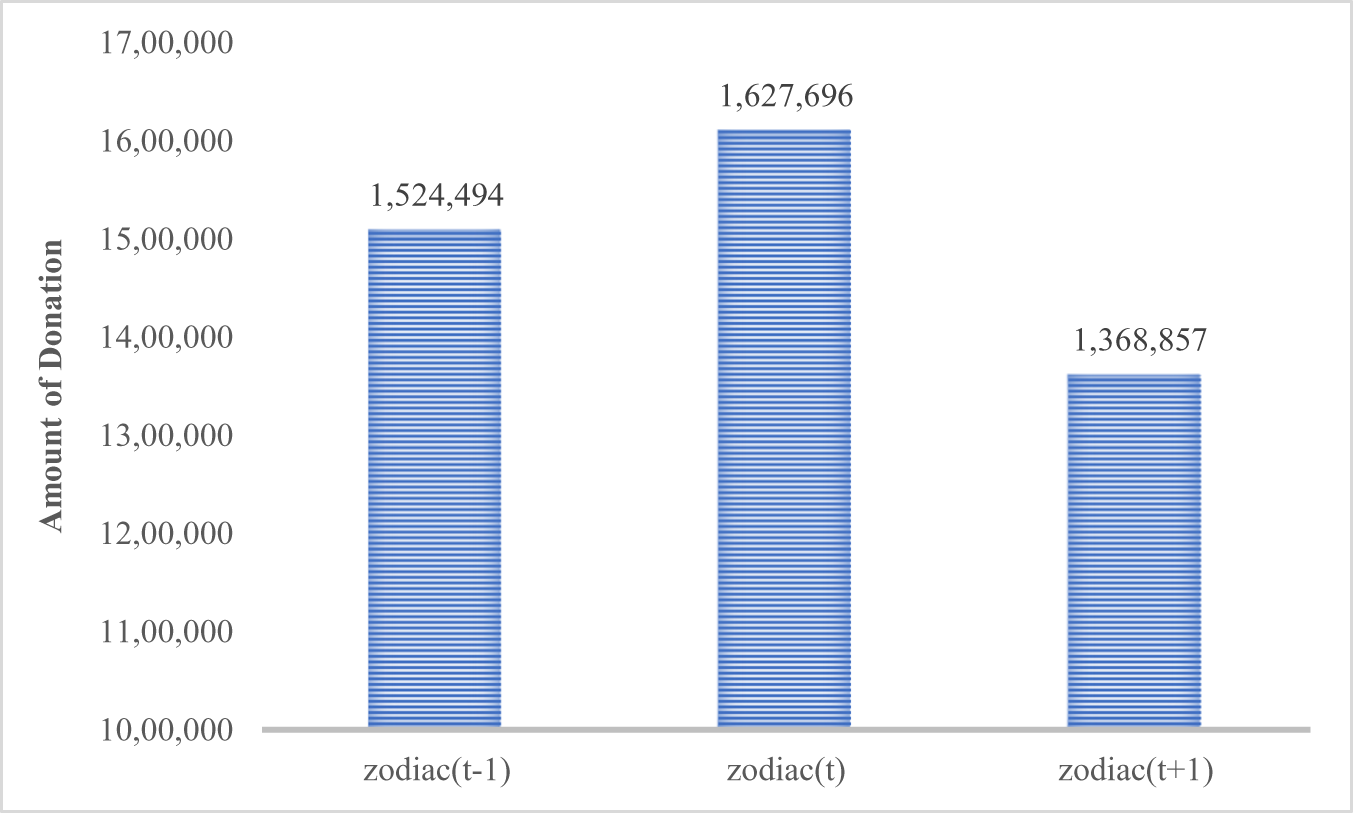
Figure 1 illustrates charitable donations in the years preceding, during, and following the CEO’s zodiac year. The data show that average donations peaked at 1,627,696 RMB during the zodiac year and then sharply declined to 1,368,857 RMB in the subsequent year, indicating a notable impact of the zodiac year on corporate giving. This pattern motivates a regression analysis to more precisely assess the effect.Footnote 6
Trend of corporate donations before and after the zodiac year

Descriptive Statistics and Correlation Test
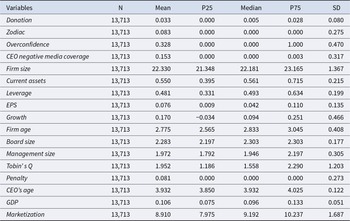
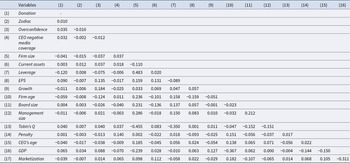
Table 2 summarizes the descriptive statistics. The mean Donation is 0.033, and the median is 0.005, suggesting that over half of the firms dedicate only a small portion of operating income to charitable giving. The average zodiac value of 0.08 indicates that approximately 8% of the firm-year observations in our sample correspond to a CEO being in their zodiac year. Table 3 displays the Pearson correlation coefficients, revealing a positive relationship between Zodiac and Donation, consistent with H1. Additionally, variance inflation factors (VIF) for all variables are below 3 – well under the threshold of 10 (Johnston, Reference Johnston1984) – indicating that multicollinearity is not a concern.Footnote 7
Descriptive statistics

Correlation test

Hypotheses Testing
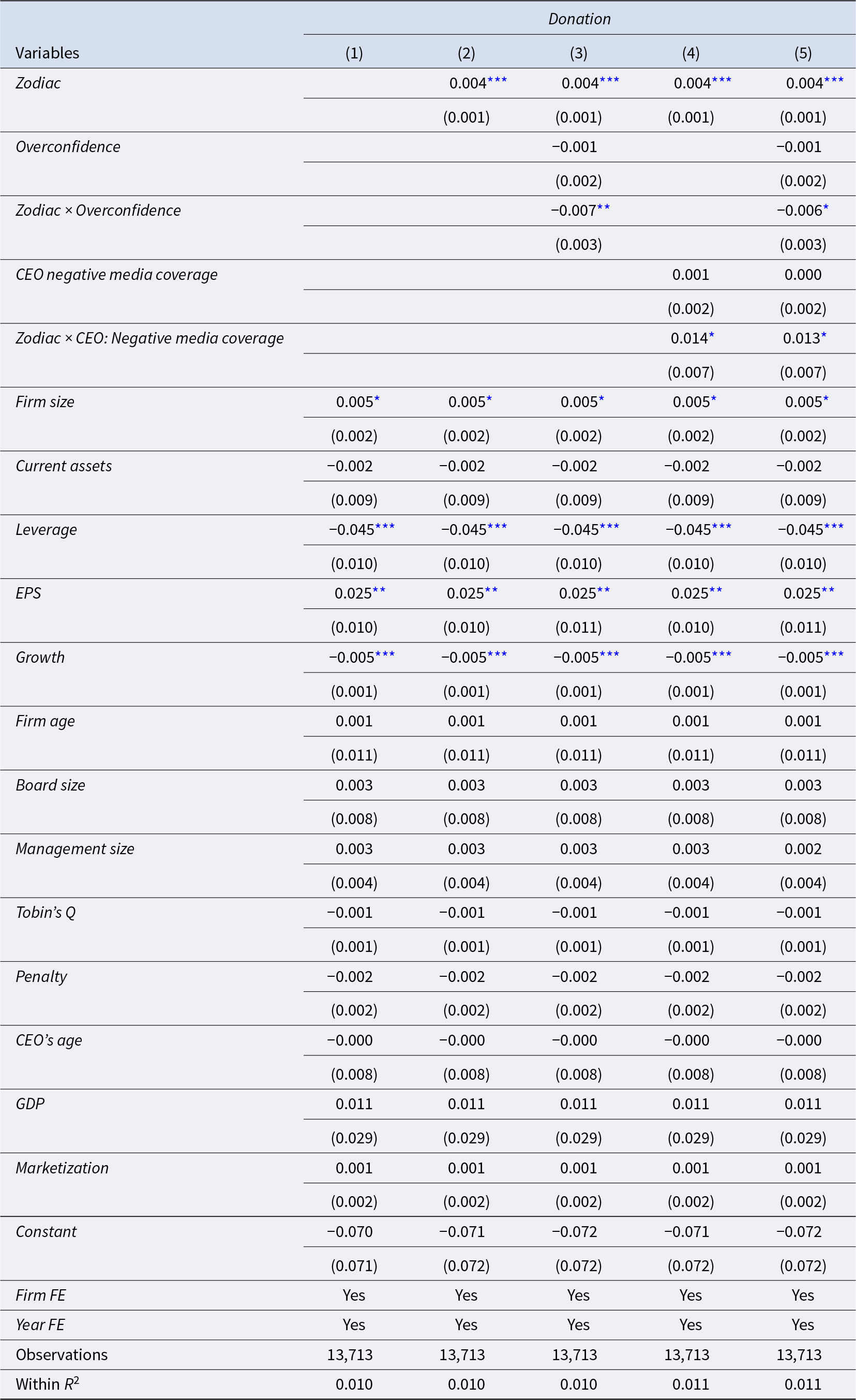
Table 4 presents our regression results on the impact of CEOs’ zodiac years on charitable donations. Column (1) reports the effects of control variables, while Column (2) adds the Zodiac variable with firm and year fixed effects. The Zodiac coefficient is 0.004 (P < 0.01), indicating that donations significantly increase during a CEO’s zodiac year, supporting H1. H2 and H3 suggest that CEO overconfidence and negative media coverage moderate this relationship. In Column (3), the interaction between Overconfidence and Zodiac is −0.007 (P < 0.10), implying that overconfident CEOs tend to reduce the donation-to-sales ratio during their zodiac years, thus supporting H2. Column (4) shows that CEO negative media coverage moderates the effect positively (β = 0.014, P < 0.10), meaning that increased negative media scrutiny corresponds to a rise in the donation-to-sales ratio, supporting H3. Finally, Column (5) features a saturated model incorporating both moderating variables and their interaction terms.
Full-sample regression results

***, **, and * Notes: represent significance levels of 1%, 5%, and 10%, respectively. Standard errors are reported in parentheses, and we use clustered standard errors.
Robustness Test
We conducted several robustness tests to confirm our findings. First, we assess alternative measures of charitable donations. Following prior studies (Chin, Hambrick, & Treviño, Reference Chin, Hambrick and Treviño2013; Liu, Luo, & Cui, Reference Liu, Luo and Cui2018; Luo et al., Reference Luo, Kaul and Seo2018; Zhang, Zhu, Yue, & Zhu, Reference Zhang, Zhu, Yue and Zhu2010), we use the absolute donation amount as an alternative metric. The regression results remain consistent with our benchmark analysis, with the Zodiac coefficient estimated at 151,338 (P < 0.05), indicating that CEOs in their zodiac year increase donations by approximately 150,000 RMB (about 21,000 USD). Additionally, following Jia and Zhang (Reference Jia and Zhang2015), we examine the ratio of donations to assets, which also supports our main findings. Detailed results are provided in Appendix I.
Second, because the Zodiac variable is a binary indicator (1 when the CEO is in their zodiac year, 0 otherwise), including year fixed effects in previous regressions might absorb some of its variation and bias its coefficient. To address this, we re-estimated the model without year fixed effects, recalculating the coefficients for Zodiac and its interactions with Overconfidence and CEO negative media coverage. The results remain consistent, confirming the robustness of our findings.
Furthermore, we performed additional robustness checks on our regression results, including: (1) reassessing the model with supplementary control variables; (2) incorporating CEO-specific and industry fixed effects; (3) employing the LASSO method for variable selection; (4) testing the sensitivity of our findings with robustness of inference to the replacement method; (5) evaluating coefficient stability; and (6) re-examining significance with Driscoll–Kraay standard errors. The results remain consistent across these tests, as summarized in Appendix I.
Control of Endogeneity
We conducted several endogeneity tests to address potential endogeneity. First, treating firms with missing donation data as having made no charitable donations might bias our results if some firms made undisclosed donations. Additionally, excluding firms labeled ST, *ST, or PT in previous regressions may also introduce sample selection issues. To mitigate these concerns, we employed a panel Heckman fixed-effects regression. In the first stage, we estimated two probit models – one with donation behavior (Donation_dummy, where 1 indicates available donation data and 0 indicates missing data) and another with firm status (ST_dummy, where 1 indicates classification as ST, *ST, or PT and 0 otherwise) as the dependent variables – using Firm Size, Current assets, Leverage, EPS, Growth, Firm age, Board size, Management size, Tobin’s Q, Penalty, CEO’s age, GDP, Marketization as independent variables to compute the inverse Mills ratio. In the second stage, we included the inverse Mills ratio in the original regression model. The results remained consistent with our benchmark regression, confirming the robustness of our findings against potential sample self-selection bias.Footnote 8, Footnote 9
Secondly, to address potential endogeneity, we introduce an instrumental variable following Zeng et al. (Reference Zeng, Zhang, Zhou, Zhang and Zhou2022). We use the natural logarithm of the total number of Confucian temples and academies within a 300 km radius of the firm’s headquarters (denoted as Confu).Footnote 10 Following Du (Reference Du2016), we calculate the distance between each firm’s registered address and nearby Confucian temples and academies, then count the institutions within 300 km. Confu meets the criteria for exogeneity because its historical count – largely static over time – is unlikely to directly influence modern corporate philanthropy (Xu, Chen, Li, & Xia, Reference Xu, Chen, Li and Xia2020). Moreover, as Zeng et al. (Reference Zeng, Zhang, Zhou, Zhang and Zhou2022) note, a higher regional concentration of these institutions indicates a stronger traditional cultural influence, which increases the likelihood that CEOs adhere to zodiac year beliefs. As shown in Table 5, the first-stage regression (Column 1) reveals a significantly positive effect of Confu on the likelihood that a CEO is in their zodiac year (P < 0.05). The second-stage regression (Column 2) confirms that the CEOs’ zodiac year has a significantly positive impact on charitable donations, thereby reinforcing the robustness of our findings.
Endogeneity testing

***, **, and * Notes: represent significance levels of 1%, 5%, and 10%, respectively. We use clustered standard errors. For brevity, “Controls” refers to all control variables that are the same as those in Table 4, and only the variables of interest are retained. In the first-stage regression of instrumental variables, R 2 is shown as ‘.’ in Stata. As for the second stage, according to Sribney, Wiggins, and Drukker (Reference Sribney, Wiggins and Drukker2005), R 2 may be negative in 2SLS – that is, RSS > TSS. They proved that negative R 2 exerts no effect on the evaluation of model quality.
Post Hoc Test
We conducted post hoc tests to further examine the relationship between the CEO’s zodiac year and the firm’s charitable donations.
An examination of the anticipatory and lagged effects of zodiac belief
Perceptions of inauspiciousness might also influence the years immediately before and after the zodiac year. Building on recent research (Yang, Jiang, & Pan, Reference Yang, Jiang and Pan2020; Zeng et al., Reference Zeng, Zhang, Zhou, Zhang and Zhou2022), we refined our temporal definitions: L.Zodiac denotes the year immediately preceding the CEO’s zodiac year, and F.Zodiac denotes the following year. Our regression analysis found that neither the lagged nor the leading zodiac variables are statistically significant, indicating that the effect of zodiac beliefs is confined to the zodiac year itself. This result is consistent with previous research (Fisman et al., Reference Fisman, Huang, Ning, Pan, Qiu and Wang2023; Wu et al., Reference Wu, Zhang and Zhou2023; Zeng et al., Reference Zeng, Zhang, Zhou, Zhang and Zhou2022). Detailed results are available in Appendix I.
Charitable donations and financial performance in the zodiac year
CEOs may increase charitable donations during their zodiac year to counter perceived misfortune – suggesting these actions are driven by personal interests. However, reallocating corporate resources for such donations might incur agency costs, deplete assets, and harm financial performance. Accordingly, we evaluate the impact of donations on performance – measured by Tobin’s Q (Elsayed & Paton, Reference Elsayed and Paton2005; Hart & Ahuja, Reference Hart and Ahuja1996; Hasan, Kobeissi, Liu, & Wang, Reference Hasan, Kobeissi, Liu and Wang2018; Rassier & Earnhart, Reference Rassier and Earnhart2010) – during zodiac years and compare it with adjacent periods. Table 6 shows a statistically significant negative effect during zodiac years (β = –1.588, P < 0.1), but not in adjacent years. These findings imply that personal interests driving increased donations during zodiac years may misallocate resources and detrimentally affect corporate performance.
The impact of donations on financial performance

***, **, and * Notes: represent significance levels of 1%, 5%, and 10%, respectively. Standard errors are reported in parentheses, and we use clustered standard errors.
Heterogeneity analysis of the zodiac year
We examined how a CEO’s zodiac year influences corporate philanthropy across factors such as STEM (science, technology, engineering, and mathematics) background, ownership structure, industry risk, and geographical location (Lewis & Carlos, Reference Lewis and Carlos2022; Li et al., Reference Li, Song and Wu2015; Zeng et al., Reference Zeng, Zhang, Zhou, Zhang and Zhou2022). Table 7 presents the findings.
Differences in corporate property rights/risk level/region

***, **, and * Notes: represent significance levels of 1%, 5%, and 10%, respectively. Standard errors are reported in parentheses. We use clustered standard errors. For brevity, Controls refers to all control variables that are the same as those in Table 4, and only the variables of interest are retained.
Differences in CEO background
CEOs with STEM backgrounds – defined by relevant education or work experience (Haislip & Richardson, Reference Haislip and Richardson2018; Liu et al., Reference Liu, Tsang and Shi2025) – develop strong analytical skills and a scientific mindset (Chonkaew, Sukhummek, & Faikhamta, Reference Chonkaew, Sukhummek and Faikhamta2016). Such training can reduce superstitious beliefs (Tosyali & Aktas, Reference Tosyali and Aktas2021) and increase skepticism toward religious notions (Gervais & Norenzayan, Reference Gervais and Norenzayan2012), suggesting that these CEOs are less inclined to connect their zodiac year with misfortune. We identify a STEM background by reviewing CEOs’ educational and work histories from the CSMAR database (Boritz, Efendi, & Lim, Reference Boritz, Efendi and Lim2018; Enns, Huff, & Golden, Reference Enns, Huff and Golden2003; Lim, Stratopoulos, & Wirjanto, Reference Lim, Stratopoulos and Wirjanto2013; Manner, Reference Manner2010). Our regression analysis reveals a significantly negative interaction term, indicating that a STEM background substantially diminishes the impact of the zodiac year on corporate charitable donations. Detailed results are presented in Appendix I.
Differences in corporate property rights
China’s emerging economy uniquely blends socialism with market dynamics, assigning distinct roles to state-owned enterprises (SOEs) and private enterprises (PEs). These differing operational objectives and managerial assessments may influence how CEOs’ zodiac year beliefs affect charitable giving. Our analysis (Table 7, columns 1 and 2) indicates a pronounced impact of the zodiac year on SOEs’ donations. This effect likely arises because SOE CEOs, who face less pressure to meet profit targets (Bai & Xu, Reference Bai and Xu2005; Chang & Wong, Reference Chang and Wong2009) and prioritize stability (Li, Sun, Tao, Ye, & Zhan, Reference Li, Sun, Tao, Ye and Zhan2023; Lin, Li, Chen, & Chen, Reference Lin, Li, Chen and Chen2023; Wang, Chen, & Huang, Reference Wang, Chen and Huang2014), are more sensitive to risk. Consequently, the inauspicious perception of the zodiac year may heighten their stress, leading them to increase donations to safeguard corporate stability.
Differences in industry risk level
Risk levels vary across sectors (Luo et al., Reference Luo, Kaul and Seo2018; Vasi & King, Reference Vasi and King2012). China’s regulatory framework classifies nine sectors – coal mining, non-coal mining, construction, hazardous chemicals, fireworks and firecrackers, civil blasting, metallurgy, machinery manufacturing, and defense manufacturing – as high-risk due to elevated accident rates. We hypothesized that CEOs in these sectors, being more risk-averse, would increase charitable donations during their zodiac years relative to those in other industries. However, regression analyses (Table 7, columns 3 and 4) reveal that firms in general sectors donate more during their CEOs’ zodiac years. This discrepancy may result from a substitution effect, where the inherent industry risk overshadows the impact of zodiac beliefs on CEO behavior.
Differences in regions
China’s vast geography and diverse ethnic mosaic foster significant regional variations in traditional customs that influence decision-making. Using the government’s regional classification, we divided our sample into southern and northern areas.Footnote 11 Regression analysis (Table 7, columns 7 and 8) reveals that CEOs in southern China are more likely to hold zodiac year beliefs, which correlate with increased charitable giving during these periods. Historically, coastal communities – facing the perils of maritime life – developed deep-seated superstitions for protection. To explore this, we further segmented our sample into coastal and non-coastal areas.Footnote 12 However, as Table 7 (columns 7 and 8) indicates, the impact of zodiac year beliefs on CEO behavior is less distinct between these segments. This may be due to the widespread prevalence of superstition throughout China, exemplified by regions like the Tujia ethnic area in Hunan, where practices such as Earth God worship and omen interpretation are common.
Taking the chairperson’s zodiac year into consideration
To empirically assess the relative influence of different executive roles on corporate philanthropy, we employed hierarchical linear modeling (HLM), a standard method for variance decomposition in strategic leadership research (e.g., Krause et al., Reference Krause, Li, Ma and Bruton2019). This approach allows us to partition the total variance in corporate philanthropy into components attributable to different organizational levels, such as industry, firm, and individual executives (CEOs and chairpersons), thereby quantifying their respective explanatory power. Our HLM analysis, detailed in Appendix I, indicates that the CEO level consistently explains a higher proportion of variance in corporate philanthropy than the chairman level in our rigorous sample (approximately 12.24% vs. 11.23%). This finding is consistent with recent research showing that CEOs exert substantial influence on overall CSR (Wernicke et al., Reference Wernicke, Sajko and Boone2022).
Consistent with this, our primary analysis (Table 4) finds that the CEO’s zodiac year has a statistically significant positive effect on corporate donations. In contrast, when we first examined whether the chairperson’s zodiac year affects charitable donations, we found an individually insignificant effect (β = 0.002, P > 0.1). However, when combined with the CEO’s zodiac year, the joint effect became significant (β = 0.003, P < 0.05), indicating that including the chairperson’s zodiac year does not alter our overall conclusions.
We believe that the limited impact of chairpersons can be attributed to their comparatively weaker latitude of action relative to CEOs. Chairpersons’ influence on firm decisions is largely confined to setting strategic objectives (Krause et al., Reference Krause, Li, Ma and Bruton2019), while the implementation of CSR initiatives – especially the highly discretionary corporate donations – is primarily determined by CEOs (Buchholtz, Amason, & Rutherford, Reference Buchholtz, Amason and Rutherford1999; Gao & Hafsi, Reference Gao and Hafsi2025). This distinction in dimensions of managerial discretion is crucial for understanding executives’ varying decision-making power over different firm activities (Krause et al., Reference Krause, Li, Ma and Bruton2019; Shen & Cho, Reference Shen and Cho2005). Moreover, because a firm’s CSR reputation is often based on behaviors and practices rather than on predefined objectives (Parker, Krause, & Devers, Reference Parker, Krause and Devers2019), it falls directly within the purview of CEOs, who enjoy a higher latitude of action. Furthermore, because zodiac-year philanthropy primarily embodies agency concerns, chairpersons – as the firm’s principals – have little incentive to pursue such initiatives. This discrepancy may also reflect the differing donation preferences of chairpersons and CEOs under stress. Chairpersons, often firm founders and large shareholders with greater personal resources, are likely to donate their own funds, while CEOs may be limited in this regard. This argument may be supported by the Hurun China Philanthropy List, where most listed executives are chairpersons (e.g., the 2024 list).Footnote 13 Collectively, these factors explain why the chairperson’s zodiac year, despite their overall strategic role, does not show a statistically significant effect on corporate philanthropy in our study, as these donations fall more squarely within the CEO’s domain of action and discretion. Due to space constraints, detailed results are exhibited in Appendix I.
Discussion
This study examines how a CEO’s zodiac year influences a firm’s charitable donations, revealing a positive effect. Notably, CEO overconfidence dampens this impact, while negative media coverage of the CEO during the zodiac year reinforces it. Post hoc tests further show that the effect varies based on CEOs’ backgrounds, firm characteristics, industry, and region.
CEOs with STEM backgrounds exhibit less trust in zodiac year beliefs due to their reliance on science and analytical thinking. In contrast, SOE CEOs, being more risk-sensitive, take these beliefs more seriously. Firms in general industries are more inclined to donate during a CEO’s zodiac year than those in high-risk sectors, perhaps because industry risks in high-risk sectors overshadow the additional perceived risk from the zodiac year. Regionally, CEOs in southern China display stronger superstitions, leading to higher donation levels during their zodiac years. Notably, our findings also show that corporate donations during zodiac years negatively impact financial performance in the same year, suggesting a potential agency cost.
Theoretical Implications
Our study makes several key contributions to the literature. First, we advance the understanding of superstition in organizational contexts by clarifying the psychological mechanism through which beliefs about bad luck heighten stress and by highlighting how resource-building strategies can mitigate that stress. Drawing on the stress-appraisal, resource-building, and corporate-philanthropy literatures, we show that CEOs respond to stressful events – such as the zodiac year – by actively accumulating resources. Prior research on zodiac-year beliefs has largely adopted a resource-preservation perspective, examining how executives (primarily chairpersons) avoid risky financial decisions to guard against losses (Fisman et al., Reference Fisman, Huang, Ning, Pan, Qiu and Wang2023; Li et al., Reference Li, Guo, Hu and Tang2021; Zeng et al., Reference Zeng, Zhang, Zhou, Zhang and Zhou2022). Although these studies offer valuable insights, they neglect how different executive roles entail distinct stressors and coping mechanisms. CEOs, who bear personal accountability for firm performance and face elevated dismissal risk (Crossland & Chen, Reference Crossland and Chen2013), experience particularly intense stress during ‘bad luck’ periods, making them more sensitive to shifts in their psychological state. While avoidance strategies may reduce perceived risk, they fail to alleviate negative emotions (Lazarus & Folkman, Reference Lazarus and Folkman1984), leaving CEOs’ emotional well-being and vital resources depleted. Consequently, CEOs often supplement avoidance with resource-building tactics – most notably corporate philanthropy – to replenish reputational capital and achieve psychological relief. In this light, philanthropic actions become less about pure strategy and more about emotional regulation.
Drawing on stress-appraisal and resource-building frameworks (Faber & Häusser, Reference Faber and Häusser2022; Folkman, Reference Folkman1984; Hobfoll, Reference Hobfoll1989; Körner et al., Reference Körner, Debus, Wu and Kleinmann2025; Lazarus & Folkman, Reference Lazarus and Folkman1984), resource accumulation is vital for managing stress, and prosocial behaviors offer a powerful means to achieve it. Thus, our study extends prior research by presenting corporate philanthropy as a valuable resource-building strategy for CEOs and their firms, enhancing resilience to risks and alleviating psychological stress. Additionally, we show that superstitious beliefs – as cognitive heuristics – affect not only risky decisions under uncertainty (Liu et al., Reference Liu, Tsang and Shi2025) but also less risky decisions, such as corporate philanthropy, which generally secure net resource gains.
Second, we advance the corporate-philanthropy literature by uncovering a culturally specific superstition as a meaningful antecedent. In emerging markets like China, corporate philanthropy plays a critical role in bolstering firm resources (Wang & Qian, Reference Wang and Qian2011; Zhang et al., Reference Zhang, Xu, Chen and Jing2020), yet its non-financial drivers remain underexplored (Ji et al., Reference Ji, Huang and Li2021). Addressing recent calls to probe these influences (Ji et al., Reference Ji, Huang and Li2021), we demonstrate that zodiac-year superstition – a cognitive bias (Li et al., Reference Li, Guo, Hu and Tang2021) – can prompt non-strategic giving and, as our post hoc tests indicate, even erode financial performance. Because we show that superstition-induced stress fuels philanthropic activity, our insights likely extend to other cultural contexts where superstitious beliefs likewise provoke stress and drive corporate giving.
Third, we clarify the boundary conditions shaping how CEOs’ superstitious beliefs translate into action by examining the personal and situational factors that modulate stress appraisal and resource needs. When individuals assess their psychological stress, this process is shaped by personal factors, such as beliefs about control, and situational factors, like environmental cues (Lazarus & Folkman, Reference Lazarus and Folkman1984). Building on this framework, we show that CEO overconfidence attenuates stress and dampens the drive for additional resources, whereas intense negative media coverage amplifies stress and heightens resource-seeking. Our moderation analyses support the main argument that the level of psychological stress and the need for coping resources influence CEOs’ motivation to use corporate philanthropy in response to zodiac year beliefs. These boundary conditions are both relevant and illuminating, as they align closely with our theoretical emphasis on the psychological processes driving CEOs’ stress perception, thereby enhancing the framework’s rigor and coherence.
Fourth, we clarify the agency motives underpinning corporate philanthropy by focusing on CEOs – whose discretionary authority and heightened personal risks make them prime agents in principal-agent dynamics. Corporate philanthropy frequently generates ambiguity over whether charitable contributions arise from self-serving managerial motives or deliberately serve strategic firm objectives (Liang & Vansteenkiste, Reference Liang and Vansteenkiste2025; Masulis & Reza, Reference Masulis and Reza2015; Tan & Tang, Reference Tan and Tang2016), underscoring the critical need to scrutinize executives’ distinct roles. Whereas prior research has linked chairpersons’ zodiac years to opportunistic giving (Cai, Liao, Pan, & Wang, Reference Cai, Liao, Pan and Wang2025), this approach may not fully capture the underlying agency issues, as chairs often serve as principals (founders or major shareholders) with aligned interests. In contrast, CEOs wield greater discretion over philanthropic decisions and confront higher agency risks, making them a more appropriate lens for examining agency motives driving corporate philanthropy.
Compared with chairpersons, CEOs enjoy greater latitude of actions (Krause et al., Reference Krause, Li, Ma and Bruton2019; Zhang & Zhang, Reference Zhang and Zhang2016). CSR – which encompasses various behaviors and practices – and corporate philanthropy – a highly discretionary element of CSR – fall squarely within CEOs’ authority (Gao & Hafsi, Reference Gao and Hafsi2025; Parker et al., Reference Parker, Krause and Devers2019). CEOs also hold much smaller equity stakes than chairpersons, positioning them as agents while chairpersons serve as principals, thereby exposing CEOs to more pronounced agency problems (Masulis & Reza, Reference Masulis and Reza2015, Reference Masulis and Reza2023). Moreover, CEOs face more direct career and reputational risks because they are personally accountable for firm performance (Crossland & Chen, Reference Crossland and Chen2013; Gao & Hafsi, Reference Gao and Hafsi2025). Unlike chairpersons – who are often founders and large shareholders with the means for personal giving – CEOs are more likely to divert corporate funds for private gain. Focusing on CEOs thus offers a clearer test of principal–agent concerns. Consistent with this, we find that donations during CEOs’ zodiac years harm subsequent financial performance, underscoring their agency-driven nature.
By centering on CEOs – who are likely the primary source of agency issues – our study precisely captures the motivations behind corporate philanthropy, especially the type I (principal–agent) problem in which managers exploit corporate funds for personal benefit at shareholders’ expense. During zodiac years, heightened psychological sensitivity drives CEOs to increase donations, deviating from shareholder-value maximization. This finding enriches agency theory by revealing how psychological factors distort managerial motivations. Our moderation analysis further clarifies how personal and environmental factors influence this agency problem. Overall, our study underscores that assessing the discretion associated with different executive roles in firm actions is essential for uncovering the underlying mechanisms and outcomes.
Practical Implications
CEOs with cognitive biases can trigger significant agency problems. Studies show that narcissistic CEOs often leverage CSR initiatives to enhance their reputations, ultimately harming financial performance (Petrenko et al., Reference Petrenko, Aime, Ridge and Hill2016). Our research reveals that during their zodiac years, CEOs increase corporate donations – likely as a response to heightened psychological stress – suggesting irregular, bias-driven decision-making. Consequently, investors and stakeholders should view a sudden, unplanned surge in charitable giving as a potential warning signal. Our post hoc tests confirm that increased donations during zodiac years adversely affect financial performance (β = − 1.588, P < 0.1), while donations in the surrounding years yield no significant effect. This implies that the motivation behind such philanthropy is biased rather than strategic. Accordingly, board directors and other stakeholders should enhance oversight of CEOs’ donation decisions during these periods. More broadly, our findings caution policymakers about the immaturity of formal institutions in transitional markets like China, where superstitious beliefs can skew CSR decision-making.
Limitations and Future Research Directions
This study is a preliminary exploration of the effect of CEOs’ zodiac year beliefs on corporate donations and has yielded valuable results. Admittedly, there are some shortcomings in this study, which provide fruitful directions for further research. First, although zodiac year beliefs are not commonly held in other countries, our study indicates a link between superstition-induced stress and corporate philanthropy. Future studies could explore the role of superstition in corporate philanthropy or CSR in other cultures that also cause stress. Second, our study mainly explored boundary conditions from the perspective of personal and situational factors. As CEOs’ decisions are likely to be monitored, future research could investigate moderating effects regarding team and firm attributes, such as the role of independent directors. Third, as mentioned by Zeng et al. (Reference Zeng, Zhang, Zhou, Zhang and Zhou2022), Chinese zodiac year beliefs are essentially correlated with individuals’ lunar birth year, while our measurement of CEOs’ zodiac year is based on the Gregorian calendar. Therefore, further studies may find better ways to accurately detect the lunar birth year of CEOs to ensure higher reliability of the findings. Fourth, our study did not find a significant impact of a chairperson’s zodiac year on corporate donations (β = 0.002, P > 0.1). One possible way chairpersons might combat bad luck in zodiac years is by donating personal resources, given their abundant personal resources and motivation to earn a reputation as benevolent entrepreneurs. Future studies could explore the possibility that chairpersons donate personal resources in zodiac years and further examine how various executives may respond differently to stress induced by superstitious beliefs, considering their varying levels of managerial discretion over different firm actions. Lastly, our findings are based on a 13-year panel dataset, where each firm in our sample contributes at least 12 years of observations. As a result, our findings may only be applicable to mature firms with stable governance structures and might not generalize to other companies, such as startups or firms with abnormal financial status.
Conclusion
Based on data from listed firms in China from 2008 to 2020, we find that CEOs’ zodiac year beliefs positively influence their firms’ charitable donations. However, this effect diminishes when CEOs are overconfident and strengthens when they receive more negative media coverage. Our study contributes to the literature on the outcomes of superstitions in management contexts, the antecedents of corporate philanthropy, the boundary conditions of stress appraisal, and the agency motivations of corporate philanthropy.
Supplementary material
The supplementary material for this article can be found at https://doi.org/10.1017/mor.2025.10085
Acknowledgements
The authors thank Ms. Minrui Tang and Mr. Shaojie Wu from the International Department at the Affiliated High School of South China Normal University for their assistance with data collection and analysis.
Funding
This work was supported by the National Natural Science Foundation of China (grant number 71902063).
Lin Zhang (zhanglin6@scut.edu.cn) is an associate professor of management at the School of Business Administration at South China University of Technology, China. He received his PhD from Sun Yat-sen University, China. His research interests include corporate social responsibility and business ethics. His works have appeared in the Journal of Business Ethics, Long Range Planning, Management and Organization Review, European Journal of Marketing, among others.
Guo Zhang (2465309147@qq.com) is a PhD candidate at the School of Business Administration, South China University of Technology. His research interests include corporate social responsibility and business ethics.
Chenlv Zeng (chenlvzeng@163.com) is a PhD candidate at the School of Business Administration, South China University of Technology. His research interests include corporate social responsibility and business ethics, machine learning, and natural language processing.
Honghui Chen (Lnschh@mail.sysu.edu.cn) is a professor of management at the School of Business at Sun Yat-sen University, China. His research interests include corporate social responsibility and business ethics. His works have appeared in the Journal of Business Ethics, Long Range Planning, Organizational Behavior and Human Decision Processes, Management and Organization Review, European Journal of Marketing, among others.