Implications
Broiler mortality during transport to the slaughterhouse represents a production loss at the cornerstone of modern poultry production economical realities and ethical preoccupations. Animals dead on arrival (DoA) are jointly an indicator of animal health and welfare and an economic loss that should be minimized in the interests of the farmers and slaughterhouses. Better knowledge of the factors influencing the DoA rate is therefore of utmost importance for all professionals, to determine the respective roles and responsibilities and identify ways of improvement.
Introduction
Death of birds during transport represents a production loss for the broiler industry, with economic consequences for the professionals involved. It also indicates that the birds concerned might have experienced poor welfare, and dead on arrival (DoA) shall be recorded in the European Union according to Council Directive 2007/43/EC (2007). Moreover, it has recently been shown that DoAs are related to subsequent sanitary condemnation (Lupo et al., Reference Lupo, Le Bouquin, Balaine, Michel, Peraste, Petetin, Colin and Chauvin2009). Both DoA and carcass rejection can result from all primary production steps (Lupo et al., Reference Lupo, Le Bouquin, Balaine, Michel, Peraste, Petetin, Colin and Chauvin2009). In an integrated ‘from farm to fork’ approach to food animal production, all these primary production steps should be considered as related to poultry production quality (Terlouw et al., Reference Terlouw, Arnould, Auperin, Berri, Le Bihan-Duval, Deiss, Lefevre, Lensink and Mounier2008). Estimation of DoA percentage and variation is therefore of great importance in order to evaluate the current situation, set up alert criteria and establish progress targets. The key parameters influencing DoAs also have to be determined in order to anticipate and reduce losses. No such data were available in France. A descriptive and analytical epidemiological survey, presented hereafter, was therefore carried out at flock level to obtain descriptive references and to identify risk factors for DoA at all primary production steps.
Material and methods
Study population and sampling design
The study population consisted of broiler flocks slaughtered at all European Union licensed slaughterhouses located in the main producing regions of France (Bretagne and Pays de la Loire), these abattoirs slaughtering more than 50% of the national broiler production. The survey was limited to confined production types as these are governed by Council Directive 2007/43/EC (2007) and are the major production types in France.
The epidemiological unit was the flock slaughtered, that is, a group of birds reared on the same floor and sent together on the same day to the processing plant.
A two-stage sampling process was implemented monthly to ensure random selection of the flocks to be included for each slaughterhouse. First, a slaughter day and, second, a sequence number within the schedule of the flocks to be slaughtered on this day were randomly selected using the SURVEYSELECT procedure of the SAS software (SAS Institute Inc., USA). The number of flocks included monthly at each slaughterhouse depended on the veterinary services available. The overall number of flocks to be included was defined according to statistical considerations described elsewhere (Lupo et al., Reference Lupo, Chauvin, Balaine, Petetin, Peraste, Colin and Le Bouquin2008).
Data collection
The veterinary meat inspectors at the slaughterhouse had to fill in a questionnaire for each randomly selected flock. Details were noted of transportation, unloading and lairage (number of trucks, whether trucks were covered or not, arrival and unloading time at the slaughterhouse, number of animals per crates, crate dimensions, lairage area characteristics, temperature measured in lairage, weather characteristics and time spent in lairage before slaughtering). As is the usual routine, the number of DoA birds was recorded when the birds were removed from the containers at the slaughterhouse. The number of live birds slaughtered and their weights were also recorded. All data were directly measured or checked from official documents and routine slaughterhouse records.
The second step involved retrospective on-farm data collection, implemented by in-person interviews with the farmer and consultation of official documents, by trained specialized investigators from our laboratory. Data were collected about the farm characteristics (geographical location, subscription to a quality charter or program, natural or artificial light in the facilities), flock characteristics (genetic strain, production type, size, rearing density, occurrence of thinning), health history (mortality during the whole rearing period and final weeks, occurrence of health disorders and particular stress such as heat stress) and characteristics of the slaughtered animals (age, weight). The catching step was thoroughly described. This comprised duration of the feed withdrawal period, the catching method used (manual or mechanical) and in case of manual catching the number of animals caught by hand and the handling technique (by one or two legs or by wings), the time and duration of catching, the number and characteristics of the persons involved (farmer, professionals and family), the number of broilers placed in crates, and an appreciation of the catching step by the farmer (normal or problematic, whether it happened as usual or if a particular incident was recorded, such as broilers’ major fear reactions with smothering or especially high temperatures).
Statistical analysis
The mortality rate was calculated by dividing the number of animals DoAs in a flock by the total number of animals in that flock, loaded in crates: mortality rate = number of DoAs/ (the number of broilers passed on the slaughter line + the number of DoAs).
As the inclusion probability differed between the flocks, the average mortality rate was calculated taking into account the sampling design, using the SURVEYMEANS procedure (SAS Institute Inc.), as described elsewhere (Lupo et al., Reference Lupo, Chauvin, Balaine, Petetin, Peraste, Colin and Le Bouquin2008).
From the variables collected in the questionnaires, additional information was first calculated, such as rearing and transport densities or space allowances, respectively, pick-up rate per hour and person, time spent without feed in crates and in trucks. Frequencies were then calculated for the categorical variables and the usual descriptive parameters were computed for continuous variables. When interpretation criteria or requirement thresholds existed, continuous variables were then categorized (e.g. space allowances in crates were compared with existing recommendations).
The association between mortality rate and putative explanatory variables was investigated by negative binomial regression, using the GENMOD procedure of the SAS software (SAS Institute Inc.). Flocks slaughtered in the same slaughterhouse were considered to be correlated, as they often belonged to the same production organization, and were transported by the same set of drivers. This clustering was taken into account in a generalized estimating equation (GEE) model in which the slaughterhouse was mentioned in a repeated statement.
First, relationships between mortality rate and putative explanatory variables were checked in a univariate step. For continuous explanatory variables, the linearity assumption of the effect was tested and categories were made according to regular or logical thresholds when necessary. A minimal category frequency of 10% was ensured. Variables with a P-value ⩽0.20 passed this screening step.
Colinearity between retained variables was then checked by χ 2 or Fisher’s exact test between categorical variables, Kruskal–Wallis test for a pair of a continuous and a categorical variable, and correlation coefficients between continuous variables. Colinearity was assumed with a P-value ⩽0.05. In such a case, the variables that were most related to the DoA rate were selected and offered to the multivariate step. A manual backward selection procedure was then applied to obtain a final model including significant variables (P < 0.05), in which one two-way interaction term was tested. Exponentiated regression estimates were interpreted as estimated risk ratios, representing the proportional increase in the DoA rate for a unit or category change in the explanatory variable.
Results
On average, 34 flocks from the 15 slaughterhouses located in participating regions were included monthly from January to December 2005, with 11 to 43 flocks included per slaughterhouse during the year, giving a total of 404 flocks. On average, the on-farm visit took place 3 weeks after flock slaughter.
Mortality rate
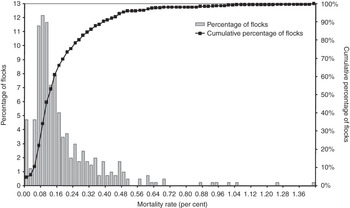
One of the 404 chicken broiler flocks included in the study experienced a documented truck breakdown, which led to an exceptional mortality rate during transport of 3.9%. This incidental extreme value, related to an unusual but explained event, was therefore discarded from the study sample. Finally, 403 flocks were considered, representing 5 830 183 chickens transported to slaughterhouses, of which the reported total of DoAs was 11 388. No DoA was recorded for 19 flocks. The mortality rates varied from 0% to 1.4%, with a skewed distribution (Figure 1) and an average mortality rate of 0.18% (95% CI 0.16 to 0.20).
Frequency distribution of the mortality rate in 403 broiler flocks processed in western France in 2005.

Transport conditions
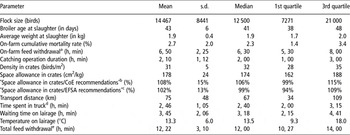
The main characteristics of the flocks and of the corresponding catching and transport operations are reported in Tables 1 and 2.
Characteristics of the flocks, catching and transport operations recorded on 403 chicken broiler flocks (France)

CoE = Council of Europe; EFSA = European food safety agency.
aFrom the withdrawal of the feeding material to the beginning of the catching operation.
bCalculated as a ratio (expressed in %) between space in crates observed and the CoE recommendations to apply (Council of Europe, 1990).
cCalculated as a ratio (expressed in %) between space in crates observed and the EFSA recommendations (EFSA, 2004) taking into account both the animals live weight (area in m2 = 0.021 × live weight0.67) and the temperature (10% increase when temperature ⩾20°C).
dFrom the loading phase on farm to the unloading phase on lairage at slaughterhouse.
eFrom the withdrawal of the feeding material on farm to the slaughtering operation.
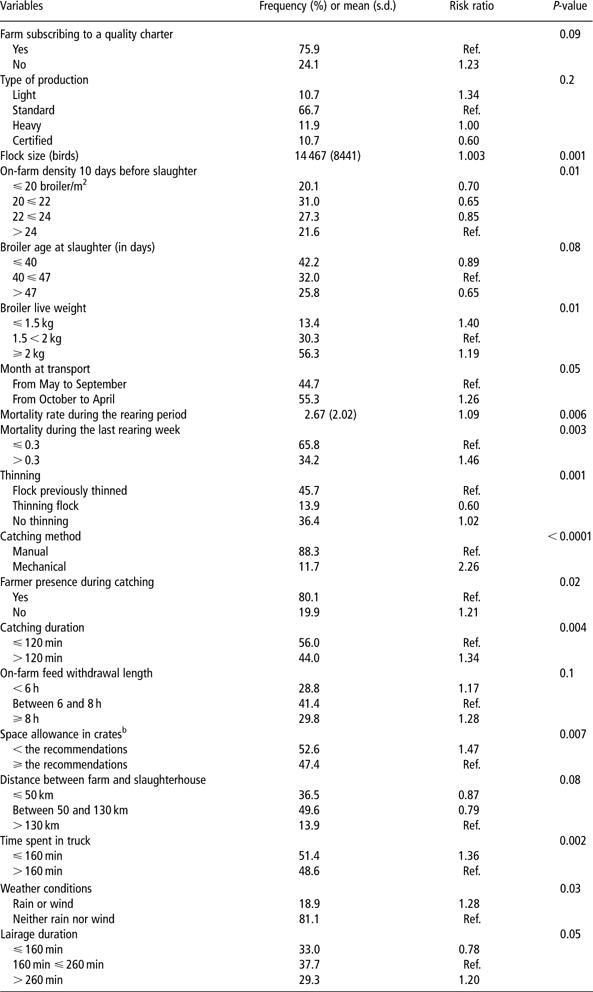
Explanatory variables for transport mortality percentage, retained at the first screening step (using univariable negative binomial models of the dead-on-arrival rateFootnote a; 403 chicken broiler flocks, France)

a The slaughterhouse cluster effect was taken into account using a generalised estimating equation model.
Factors influencing mortality
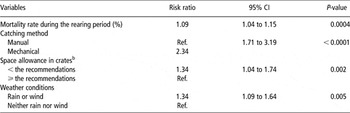
Factors related to on-farm flock mortality, the catching operation, transportation and the weather were found to be significantly associated (P < 0.05) with DoA rate in univariable models (Table 2). No significant relationship (P > 0.05) was found between DoA rate and among others: the facilities light type, flock genetic strain, health disorders recorded during rearing, stress occurrence during rearing, catching period (night or day), the use of specific truck equipment (i.e. curtains) even combined with weather conditions, lairage characteristics and temperature on lairage. Some parameters could not be explored due to an all too rare occurrence (e.g. only 19 flocks experienced a problematic catching step according to the farmer) or due to an observed lack of variability in the study sample: the number of chickens caught by hand (three) and the way the birds were handled (more than 95% being caught by one leg). Close relationships (P < 0.01) were found between flock size, animal weight and thinning and between mortality during the last week and the whole on-farm mortality. The flock size and the whole on-farm mortality were privileged. The final model (Table 3) included four variables related to all the primary production steps: the mortality rate during the rearing period was positively related to the DoA rate; mechanical catching was associated with a higher risk than a manual one; in the same way, space allowances in crates were lower than the recommendations and presence of rain or wind during transportation was found to be a risk.
Final multivariable negative binomial regression modelFootnote a for the risk of birds dead on arrival at the slaughter plant (403 chicken broiler flocks, France)

a The slaughterhouse cluster effect was taken into account using a generalised estimating equation model. Scaled deviance statistic = 1.1, scaled Pearson χ 2 statistic = 1.5.
b See Table 2.
Discussion
Study design
A representative sample of flocks was obtained by using the two-stage sampling design. Whenever inclusion probabilities differed between slaughterhouses, this difference was taken into account calculating the average DoA rate, whereas the clustering effect was considered by GEE modeling. Selection and memorization biases were limited as much as possible by the study design, which allowed detailed data collection at the flock level. The sampling period was extended over a full year to account for potential seasonal fluctuations in mortality. As a result, detailed data from a large number of observations were available to explore factors associated with transport mortality at the flock level.
Mortality rate recorded
The average mortality rate during transportation to slaughterhouse was within the range of the 0.12% recently reported in the United Kingdom (Haslam et al., Reference Haslam, Knowles, Brown, Wilkins, Kestin, Warriss and Nicol2008), and 0.25% in the Czech Republic (Vecerek et al., Reference Vecerek, Grbalova, Voslarova, Janackova and Malena2006), but less than the 0.35% reported in Italy (Petracci et al., Reference Petracci, Bianchi, Cavani, Gaspari and Lavazza2006), 0.38% in Manitoba (Drain et al., Reference Drain, Whiting, Rasali and D’Angiolo2007) and 0.46% in the Netherlands (Nijdam et al., Reference Nijdam, Arens, Lambooij, Decuypere and Stegeman2004).
The differences in DoA rates observed between countries may be partly attributed to weather differences. Very high and very low temperatures were recorded in Italy (Petracci et al., Reference Petracci, Bianchi, Cavani, Gaspari and Lavazza2006) and the Netherlands, respectively (Nijdam et al., Reference Nijdam, Arens, Lambooij, Decuypere and Stegeman2004), whereas medium temperatures were recorded in France, and the study carried out in the United Kingdom did not include period with hot weather (Haslam et al., Reference Haslam, Knowles, Brown, Wilkins, Kestin, Warriss and Nicol2008). However, the influence of other differences in genetics, rearing, catching or transport cannot be excluded, since the on-farm mortality rates reported in Manitoba with medium temperatures were also greater than those observed in France (Drain et al., Reference Drain, Whiting, Rasali and D’Angiolo2007).
However, the DoA rate distribution was markedly skewed, as reported in the United Kingdom (Haslam et al., Reference Haslam, Knowles, Brown, Wilkins, Kestin, Warriss and Nicol2008), and a negative binomial model had to be used for the analysis.
Factors influencing mortality
Although studies of DoA and related factors have already been published, very few were carried out at the flock level in an epidemiological setting (Drain et al., Reference Drain, Whiting, Rasali and D’Angiolo2007; Haslam et al., Reference Haslam, Knowles, Brown, Wilkins, Kestin, Warriss and Nicol2008). Most studies focused on the effect of one particular processing step, such as catching (Knierim and Gocke, Reference Knierim and Gocke2003; Nijdam et al., Reference Nijdam, Delezie, Lambooij, Nabuurs, Decuypere and Stegeman2005), transport (Nijdam et al., Reference Nijdam, Arens, Lambooij, Decuypere and Stegeman2004; Vecerek et al., Reference Vecerek, Grbalova, Voslarova, Janackova and Malena2006), on-farm characteristics (Drain et al., Reference Drain, Whiting, Rasali and D’Angiolo2007; Haslam et al., Reference Haslam, Knowles, Brown, Wilkins, Kestin, Warriss and Nicol2008) or even the effect of the season (Petracci et al., Reference Petracci, Bianchi, Cavani, Gaspari and Lavazza2006). To determine the risk markers for mortality during transport, it seemed important that all data regarding the rearing, catching and transport phases should be collected and examined at the flock level. A strong relationship between on-farm mortality and DoAs percentage was in fact apparent from the on-farm flock history. A similar correlation was also reported in 150 flocks in the United Kingdom (Haslam et al., Reference Haslam, Knowles, Brown, Wilkins, Kestin, Warriss and Nicol2008) and 94 flocks from Manitoba (Drain et al., Reference Drain, Whiting, Rasali and D’Angiolo2007). DoA was therefore dependent not only on the pre-slaughter steps but on the rearing conditions as a whole, which also led to losses before loading. Adjustment on flock health status indicators, such as on-farm mortality, should therefore be performed in a multivariate integrative approach.
Taking this characteristic into account, the pre-slaughtering catching and transport steps were also found to be associated with DoA. Following the pre-slaughter process, another parameter of utmost importance identified was the catching method, the mechanical method being associated with a higher rate of DoAs than the manual method. This was an unexpected result in view of recent recommendations (EFSA, 2004). However, notwithstanding the advantages of automatic catching machines, a higher frequency of DoA birds in flocks that were caught mechanically rather than manually was consistent with some of the results of previous studies (Ekstrand, Reference Ekstrand1998; Knierim and Gocke, Reference Knierim and Gocke2003; Nijdam et al., Reference Nijdam, Delezie, Lambooij, Nabuurs, Decuypere and Stegeman2005; Anonymous, 2006; Vizzier-Thaxton et al., Reference Vizzier-Thaxton, Thaxton and Shilling2006). From the data set, a thorough exploration of the mechanical harvesting effect could not be efficiently performed due to a limited category frequency of 12%. However, in the study sample, no difference could be observed in the DoA rates between the two different harvesters encountered. Even if difficulties to count broilers at the crating step were reported by a farmer and already suspected as an explanation of the mechanical catching impact (Anonymous, 2006), no correlation could be observed in this study between density in crates and catching type.
Density within the crates during transport was another critical factor found to be related to the DoA rate. This relationship was also investigated on the basis of Dutch slaughterhouse data (Nijdam et al., Reference Nijdam, Arens, Lambooij, Decuypere and Stegeman2004), and in Manitoba (Whiting et al., Reference Whiting, Drain and Rasali2007), high crating densities during transport were reported to be a stressor of highest importance for broilers (Delezie et al., Reference Delezie, Swennen, Buyse and Decuypere2007) resulting in avoidable economic losses to farmers. It has been hypothesized that thermal stress (hyperthermia) is involved through increased environmental humidity and insufficient ventilation rate (Nijdam et al., Reference Nijdam, Arens, Lambooij, Decuypere and Stegeman2004). Nevertheless, a detrimental effect of low densities on injuries, which was not explored in this study, cannot be excluded.
Finally, the climatic conditions experienced by flocks during the pre-slaughter process were found to influence broiler mortality. Rain and wind can affect the thermal comfort of the birds during transport or lairage, maybe due to wetting and the low temperatures experienced (EFSA, 2004).
The temperatures recorded varied less than those reported in other studies (Nijdam et al., Reference Nijdam, Arens, Lambooij, Decuypere and Stegeman2004). Consequently, the temperature and seasonal effects might have been less marked than suggested elsewhere (Petracci et al., Reference Petracci, Bianchi, Cavani, Gaspari and Lavazza2006; Vecerek et al., Reference Vecerek, Grbalova, Voslarova, Janackova and Malena2006). The main French production regions, on which this study was focused, are characterized by moderate temperatures (with only rare elevated or low temperatures, and moderate seasonal differences) and the occurrence of rain and wind, which could therefore be identified as detrimental factors. The specific climatic and transport conditions in production regions need to be taken into consideration when assessing factors associated with mortality. Similarly, only moderate transport distances were recorded. No effect of transport distance was observed, conversely to a previous study (Vecerek et al., Reference Vecerek, Grbalova, Voslarova, Janackova and Malena2006), which however reported higher distances than those measured in France.
The results obtained show that DoA may be jointly related to the (i) on-farm health status of the flock (ii) potential injuries related to catching and crating steps (iii) climatic conditions experienced; three main origins suspected from reported examinations of DoA birds’ macroscopic lesions by Ritz et al. (Reference Ritz, Webster and Czarick2005). In coherence with a ‘farm to fork’ approach, all poultry production steps have therefore to be considered in order to reduce losses from DoA and improve animal welfare. Attention should be paid to all parameters leading to on-farm mortality. Catching machine usage may be improved, and specific risk factors associated with such catching practice should therefore be further explored. Crating practices should follow space allowance recommendations. Ways of improvements depend on all professionals involved in poultry production and seem to be linked to giving constant, attentive care to the birds rather than to applying particular solutions or rules.
Acknowledgments
The authors thank the French Ministry of Agriculture and Fisheries and France AgriMer – Office de l’Elevage for funding this research project, the Official Veterinary Services for extensive data collection and the farmers and slaughterhouses for their participation in the survey.