Introduction
It is estimated that, annually, almost one million people die from suicide. In the last 45 years, suicide rates have increased by 60% globally (World Health Organization (WHO) 2013). Suicide is among the three leading causes of death among those aged 15–44 years. Mental disorders are a major risk factor for suicide; nevertheless, suicide is a multifarious phenomenon with psychosocial, biological, cultural and environmental factors implicated (WHO 2013).
The suicide rate for the world as a whole is estimated at 11.6 per 100 000 inhabitants. The country with the highest rate of suicide currently is Lithuania, with a suicide rate of 34.1 per 100 000 inhabitants. Also among males, the suicide rate is the highest in Lithuania at 61.2. Among females, South Korea with 22.1 is at the top of world suicide rates (Värnik Reference Värnik2012).
In the United Kingdom, the number of suicides in people aged 15 years and over has gradually decreased since 2000. Figures increased sharply by 329 in 2008 to 5706, but fell by 31 in 2009 to 5675. There are more suicides among males than females. During the 2000–2009 period, the male suicide rate was highest in 2000 at 19.9 per 100 000. The rate continually declined to 16.8 per 100 000 in 2007 but increased to 17.7 per 100 000 in 2008. In 2009, the rate was similar to the previous year at 17.5 per 100 000. Suicide rates for women have been consistently much lower than rates for men, and have shown a steadily downward trend. The rate was lowest in 2007 at 5.0 per 100 000, yet increased to 5.4 per 100 000 in 2008 and remained similar in 2009 at 5.2 per 100 000. During the past decade, the highest suicide rates in the United Kingdom were among men aged 15–44 years. The rate for this age group in 2009 was 18.0 per 100 000. Since 2000, suicide rates for males have tended to be highest in the northern regions and lowest in the East of England and London. In 2009, rates were highest in the North West, North East and South West at 19.8, 19.2 and 18.9 per 100 000, respectively. The regions with the lowest rates were London and the East of England at 13.6 and 13.7 per 100 000, respectively. The largest decrease in rates for men occurred in the North East between 2004 and 2005, where the rate dropped from 21.8 to 17.6 per 100 000. There was no clear pattern in regional suicide rates among women (Office for National Statistics (ONS) 2011).
A number of studies show an increase in the number of incidents of suicide in spring and early summer (Preti & Miotto Reference Preti and Miotto1998; Preti Reference Preti2000), and that suicide by violent means has stronger seasonal fluctuation than non-violent suicide (Rasanen et al. Reference Rasanen, Hakko and Jokelainen2002; Rock et al. Reference Rock, Greenberg and Hallmeyer2003). In contrast, studies that used ONS data for England and Wales between 1982 and 1999 found no – or very little – evidence of a seasonal effect (Simkin et al. Reference Simkin, Hawton and Yip2003).
People with psychiatric disorders, particularly depressive disorders, are at much greater risk of dying because of suicide than those in the general population (Gunnell & Lewis Reference Gunnell and Lewis2005). A number of social and economic factors including unemployment (Gunnell et al. Reference Gunnell, Lopatatzidis and Dorling1999), divorce, serious medical illness (Stenager & Stenager Reference Stenager and Stenager2000) and substance misuse are commonly associated with suicide (Qin et al. Reference Qin, Agerbo and Mortensen2003).
The present study focuses specifically on the Isle of Wight. The Isle of Wight is a small island (380 km2) 4 miles off the British South coast, separated from the mainland by the Solent. The only connections with the mainland are maintained through ferries from Portsmouth, Southampton and Lymington. The Isle of Wight has a resident population of 138 265, of whom 70 841 (51.2%) are female and 67 423 (48.8%) are male (ONS 2011). The largest industry on the Isle of Wight is tourism, but the Island has a strong agricultural heritage (258 km2 is farmland), including sheep and dairy farming and the growing of arable crops.
Aims and methods
The aim of this study was to find socio-demographic, clinical and service delivery risk factors in a sample of service users in comparison to non-service users; as well as gender-related characteristics of suicidal behaviour; in a definite geographic region.
A service user is defined as an individual who is currently receiving treatment or has been receiving mental health services within the past 2 years.
A non-service user is defined as an individual who has not received services within the 2 years before their suicide.
Inclusion criteria
1. All individuals were residents of the Isle of Wight at the time of their suicide.
2. The service users were receiving active treatment within the 2 years before their death.
3. Death resulted from ‘intentional self-harm’ using the ICD-10 classification codes X60-X84 (WHO 1992), as well as being confirmed by the coroner’s verdict of suicide or an ‘open verdict’, where the circumstances of death indicated probable suicide.
Exclusion criteria
1. Death resulted from ‘accidental death’, ‘misadventure’ or ‘self-neglect’ (according to the coroner’s inquest).
Data collection
Data were collected from medical case records (including post-mortem examination reports), coroners’ reports and the suicide notes of deceased individuals, and were recorded under the following headings:
1. Demographic and socio-economic characteristics, as gender, age, marital status; education; and employment.
2. Clinical characteristics, including attendance at accident and emergency (A&E) within a year before suicide; previous suicide attempts, contact with health services before their death; and psychiatric diagnosis, using the ICD-10 (WHO 1992).
3. Adverse life events (ALEs) that have been taken from the audited files, and grouped in nine coherent categories.
4. Circumstances of suicide (method, day, month and season of suicide).
Statistical analysis
For all significance tests starting from a contingency table, Pearson’s χ 2 test (the χ 2 test of independence) was used. For 2×2 contingency tables, Yates’ continuity correction was used. The χ 2 test for goodness-of-fit was used in those tests where the expected probabilities of gender, days of the week and seasons were estimated from external sources. All the tests were performed using the R computer language for statistical computing (Verzani Reference Verzani2005).
Results
There were 68 suicides (16 women and 52 men) of Isle of Wight residents. Of these, 53 were service users, with an average age of 44.4 years (15 women, with an average age of 48.2 years, age range 17–87 years and 38 men, with an average age of 43 years, age range 21–76 years). Of these 53 service users, 13 (two women, 11 men) died in 2006; 10 (three women, and seven men) in 2007; 18 (six women, 12 men) in 2008; and 12 (four women, eight men) in 2009, respectively. Non-service users consisted of 15 individuals with an average age of 45.9 years (one woman of 83 years; and 14 men, with an average age of 43.2 years, age range 21–59 years). Of these non-service users, two persons died in 2006, one in 2007, eight in 2008 and four in 2009, respectively.
Demographic variables
Of 68 individuals who died, 30 suicides (44.2%) and 38 open verdicts (55.8%) were returned. There was a significant difference (p=0.0006) with regard to gender variation of all index cases; the male/female ratio was 3:1.
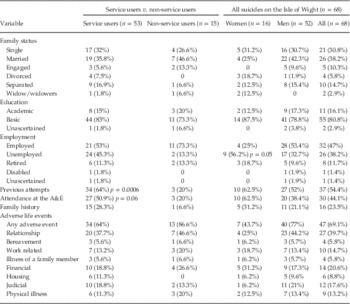
Twenty-one individuals were single (30.8%), 26 married (38.2%); five living in a co-habiting relationship (10.3%); four were divorced (5.8%); 10 separated (14.7%); and two widowed (2.9%).
Eleven people had academic education (16.1%), 55 compulsory (leaving school at 16 years of age) education (80.8%), and it was impossible to ascertain the education level of two persons (2.9%).
Relatively (p=0.07) more women (56.2%) than men (32.7%), as well relatively more (p=0.05) service users (45.3%) than non-service users (13.3%), were unemployed.
Clinical variables
Thirty-seven people (54.4% of all suicides), but significantly more (p=0.0006) service users (64%) than non-service users (20%), had a history of a previous suicide attempt. In addition, relatively (p=0.06) more (50.9%) service users than non-service users (20%) had attended A&E within the year before their death.
Sixteen individuals (23.5%) had a positive family history of mental disorder. Forty-seven people (69%) had an ALE in the year before their suicide. Relationship, financial, judicial or work-related difficulties were the most common ALEs (Table 1).
Socio-demographic variable

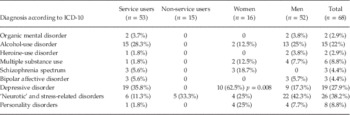
Depressive disorders as the most common Axis-I disorder was diagnosed in almost 36% of service users, but significantly (p=0.008) more in female service users (66.6%) than in men (23.7%). Fifteen service users (28.3%) were suffering from alcohol-related disorders and six (13.3%) from stress-related disorders. Equally, three service users (5.6%) fulfilled the criteria for schizophrenia-spectrum disorder and bipolar affective disorder, respectively. One-third of non-service users (33.3%) fulfilled the criteria for stress-related disorders (Table 2).
Psychiatric diagnoses of the service users

Circumstances of suicide
Methods of death
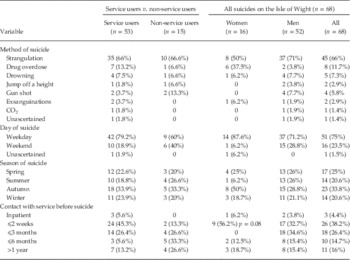
Suicide by hanging or strangulation was the most common cause, accounting for the deaths of 45 individuals (66%). There was no difference between service users and non-service users; nevertheless, there was an evident gender difference. Thirty-seven men (71%), but eight women (50%) died as a result of hanging. Relatively more service users (13.2%) than non-service users (6.6%), as well as evidently more women (37.5%) than men (3.8%), died by self-poisoning.
Time of death
Fifty-one deaths (75%) occurred on weekdays, 16 on weekends (23.5%) and the time of death of one patient was unascertained. Relatively more service users (42, 79.2%) died on weekdays compared with non-service users (nine, 60%). In contrast, evidently more non-service users (six, 40%) died on a weekend, in particular on a Sunday, when five of them (33.3%) took their lives. However, when comparing the groups by gender, only one woman (6.2%) but 15 men (28.9%) died on a weekend. On the other hand, 15 women (93.8%) and 37 men (71.1%) died during weekdays.
Relatively more individuals died in autumn, when 23 (33.8%) of all deaths occurred. There was no difference between service users and non-service users; however, there was an evident difference between women, 50% of whom died in autumn, compared with 28.8% of men.
Inpatient deaths
There were three (one woman and two men) inpatient deaths (4.4%), during the 4-year period.
Last contact with service before death
Relatively (p=0.08) more women (56.2%) than men (32.7%), as well as more service users (45.3%) than non-service users (13.3%), have contacted services in the 2 weeks before their deaths (Table 3).
Circumstances of suicide

Discussion
During the review period, there were 68 suicides by Isle of Wight residents, with the mean annual suicide rates over the period being 5.65 per 100 000 for women and 19.28 for men, 12.3 overall. Of those suicides, 80% (53 individuals, 15 women and 38 men) were mental health service users. This is in complete contrast with the National Confidential Inquiry into Suicides and Homicides (NCISH, 2012), which identified that 27% of all suicides in England and Wales during the period 2000–2010 were patient suicides, i.e. the person had been in contact with mental health services in the 12 months before death. Our results are supported by those indicating that up to 90% of successful suicides have an underlying psychiatric disorder (Wasserman et al. Reference Wasserman, Rihmer, Rujescu, Sarchiapone, Sokolowski, Titelman, Zalsman, Zemishlany and Carli2012).
During the 4-year period from 2006 to 2009, the number of suicides of Isle of Wight residents fluctuated; 15 persons died in 2006; however, figures decreased by four to 11 in 2007, but sharply increased by 15 in 2008 to 26; and yet again rather sharply decreased by 10 in 2009 to 16, respectively. These results are relatively similar to the overall suicide trend in England (NCISH 2012); however, the dramatic increase in suicides on the Isle of Wight in 2008 is remarkable. This sharp increase in the suicide mortality could be associated with the economic crisis and its impact mainly on unemployment. Unemployment is an independent risk factor for both suicide and depression (Duleba et al. Reference Duleba, Gonda, Rihmer and Dome2012). Employment and suicide trends are negatively correlated in most countries (Yur’yev et al. Reference Yur’yev, Värnik, Värnik, Sisask and Leppik2012). Chang et al. (Reference Chang, Gunnell, Sterne, Lu and Cheng2009) investigated the impact of the Asian economic crisis (1997–1998) on suicide in Japan, Hong Kong, South Korea, Taiwan, Singapore and Thailand. Compared with 1997, male suicide rates in 1998 rose by 39% in Japan, 44% in Hong Kong and 45% in Korea; rises in female rates were less marked. The economic crisis was associated with 10 400 more suicides in 1998 compared with 1997 in Japan, Hong Kong and Korea, most closely related with rises in unemployment. Since the economic crisis in 2007, studies from Hungary (Duleba et al. Reference Duleba, Gonda, Rihmer and Dome2012), Spain (Alvaro-Mecca et al. Reference Alvaro-Meca, Kneib, Gil-Prieto and Gil de Miguel2013) and Greece (Giotakos et al. Reference Giotakos, Tsouvelas and Kontaxakis2012) confirm a direct association between the rise in unemployment and the increase in the suicide rate. Besides, it is suggested that suicidal behaviour is more strongly related to attitudes linked to the employment status among males than females (Yur’yev et al. Reference Yur’yev, Värnik, Värnik, Sisask and Leppik2012).
The average age of cases in this study was 44.8 years, which supports the previous local data (Department of Health (DoH) 2002) as well as the WHO findings reporting that most suicides are committed by the age group of 35–44 years old (WHO 2013). As far as ethnicity is concerned, all cases were of white British origin, which is in disagreement with the local (King et al. Reference King, Baldwin, Sinclair, Baker, Campbell and Thompson2001a, 2001Reference King, Baldwin, Sinclair and Campbellb), national (Crawford et al. Reference Crawford, Nur, McKenzie and Tyrer2005) and international (Joe et al. Reference Joe, Marcus and Kaplan2007) studies indicating higher suicide rates in ethnic minorities. The Isle of Wight population consists mainly of white British residents and, with a non-white population of only 1.3% (ONS 2007), nonetheless, there has been no suicide amongst any ethnic minorities during the 4-year period, which appears remarkable.
There was a significant difference (p=0.0006) with regard to gender variation of all index cases, the male/female ratio was 3:1; 76.5% of all suicides were carried out by men. The male/female ratio for non-service users was even bigger; 9:1. This is practically identical to previous data on suicide on the Isle of Wight and Hampshire (DoH 2002) and relatively similar to the national inquiry into suicide (Avoidable Deaths Report Reference Brooks and Watson2006), which found 66% of suicides were conducted by men. Furthermore, our findings support the data of international authors reporting that the risk ratio for men compared with women is 3:1 (Burgess et al. Reference Burgess, Pirkis, Morton and Croke2000).
More than half of the persons (54.4%) were either single, divorced or separated, which is in line with the studies (Qin et al. Reference Qin, Agerbo and Mortensen2003), indicating that living alone and being single are associated with a higher risk of suicide.
In terms of education, almost 81% of individuals had only basic education, which supports statements that those with lower education are at higher risk of carrying out suicide (Fergusson et al. Reference Fergusson, Beautrais and Harwood2003).
With regard to employment status, relatively more (p=0.0503) service users (45.7%) than non-service users (13.3%), as well as more women (56.2%) than men (32.2%), were unemployed. These findings are consistent with the previous studies, which found important links between unemployment and suicide (Mortensen et al. Reference Mortensen, Agerbo and Erikson2000).
More service users (28.3%) than non-service users (6.6%) had a positive family history, which would be in parallel to those indicating that people with a positive family history of suicide are at a higher risk of suicide (Van Heeringen Reference Van Heeringen2003).
In terms of diagnoses, significantly (p=0.008) more female service users (66.6%) than male service users (24%) suffered from depressive disorders. This is in line with previous findings suggesting two-thirds of those who die by suicide suffer from depression at the time of their death (Coryell & Young Reference Coryell and Young2005; Rihmer & Gonda Reference Rihmer and Gonda2012). Furthermore, the majority of individuals (almost 70%) had experienced ALEs, and around 38% of all persons in this study also fulfilled criteria for stress-related disorders. These findings are in line with studies demonstrating a positive correlation between ALEs and suicide (King et al. Reference King, Baldwin, Sinclair, Baker, Campbell and Thompson2001a, 2001Reference King, Baldwin, Sinclair and Campbellb; Gunnell & Lewis Reference Gunnell and Lewis2005; Sareen et al. Reference Sareen, Houlahan, Cox and Asmundson2005).
Alcohol-related mental disorders were diagnosed in 34.2% of male service users and 13.3% of female, which is consistent with studies that found alcoholism in one-third (Beglund & Ojehagen Reference Beglund and Ojehagen1998) to 54% (Lönnqvist Reference Lönnqvist2000) of people who died due to suicide. On the other hand, alcohol-use disorders (in our study) were more frequent compared with the NCISH (2006), which found this condition in 8% of people with mental illnesses. Personality disorders were found in 15% of all service users, which is in line with the findings of Lönnqvist (Reference Lönnqvist2000) who diagnosed personality disorders in 5–44% of suicide victims.
In our study, schizophrenia-spectrum disorders and bipolar affective disorder were equally diagnosed in 5.6% of cases, which supports studies, estimating a lifetime suicide risk of ~5% in people with schizophrenia (Hor & Taylor Reference Hor and Taylor2010). Nevertheless, our findings stand out against the NCISH (2006), which found suicide in 19% of people suffering from schizophrenia-spectrum disorder, and the Australian study of suicide (Burgess et al. Reference Burgess, Pirkis, Morton and Croke2000), which found schizophrenia and schizoaffective disorders were the most common diagnoses among people who died as a result of suicide. In addition, our data are in contrast to the North Staffordshire suicide study (Boardman et al. Reference Boardman, Grimbaldeston, Handley, Jones and Willmott1999), which associated the increased risk of suicide with a diagnosis of bipolar affective disorder.
Hanging was the most common method, accounting for death of 71% of men and 50% of women, which is also in concordance with literature (Brooks & Watson Reference Brooks and Watson2006). Nevertheless, while drug self-poisoning was the second common cause of death for service users (13.2%), gunshot was the second most common cause of death for non-service users (13.3%). Previous data of suicides on the Isle of Wight, compiled in the 5-year period from 1999 to 2003 (DoH 2003) found that hanging was also the most common method (42% of male deaths, 17% of female deaths). Strikingly, our study shows that the number of both men and women who died by hanging has doubled. Furthermore, the number of women who died from self-poisoning has also increased (from 33% to the current of 50%). In contrast to this, the number of male suicides by self-poisoning has radically reduced from 19% to 3.8%.
With regard to seasonal fluctuation of suicide, 45.6% of men died during the spring and summer; however, 50% of women died in autumn. This is relatively in agreement with studies showing an increase in the number of incidents of suicide in spring and early summer (Chew & McCleary Reference Chew and McCleary1995; Petridou et al. Reference Petridou, Papadopoulos and Frangakis2002). Although the majority of previous European studies have shown a spring or summer peak in suicide, studies from the United Kingdom in the recent past have not. In particular, two studies (Yip et al. Reference Yip, Callanan and Yuen2000; Simkin et al. Reference Simkin, Hawton and Yip2003) that used ONS data for England and Wales between 1982 and 1999 found no – or very little – evidence of a seasonal effect. Moreover, our findings, nonetheless support previous research suggesting that suicide by violent means has stronger seasonal fluctuation than non-violent suicide (Rasanen et al. Reference Rasanen, Hakko and Jokelainen2002), and the fact that men are more likely to use more violent methods than women (Maes et al. Reference Maes, Cosyns and Meltzer1993), which is again in line with our findings – almost 65% of men in our study died by violent methods.
We found that relatively (p=0.08) more women (56%) than men (33%) as well as service users (45.3%) than non-service users (13.3%) contacted services within the 14 days before their death. These findings are in line with a number of national (King Reference King2001; Bessant et al. Reference Bessant, King and Peveler2008) and international studies (Rihmer & Gonda Reference Rihmer and Gonda2012), indicating that over half of all suicide victims contact their primary services within 4 weeks before their death, and the fact that women are more likely than men to contact services preceding their death.
According to our results, significantly (p=0.0006) more service users (60%) than non-service users (20%) had a previous history of suicide and self-harm as well as relatively (p=0.06) high attendance of the A&E department within a year before their death. These results support previous findings (Isometsä & Lönnqvist Reference Isometsä and Lönnqvist1998; Gairin et al. Reference Gairin, House and Owens2003), demonstrating that most suicides are preceded by non-fatal self-harm in the previous year.
With regard to the day on which suicides took place, 75% of all suicides (almost 94% of women and 71% of men) occurred on weekdays. However, relatively more (40%) non-service users than service users (18.8%), also more men (29%) than women (6.2%), died on weekends. These results are contrary to studies reporting that public holidays were associated with higher suicide (Johnson et al. Reference Johnson, Brock and Griffiths2005).
During the given period of 4 years, there were only three (4.4%) suicides in inpatient services. This is in full contrast with the Wessex suicide studies (King Reference King2001), which studied 373 patients of whom 20% died while in hospital. Moreover, our findings differ from NCISH (2012), which reported 12% (1.556) inpatient deaths during the period 2000–2010. According to the same report, there was a 62% fall in the number of inpatients dying by suicide.
Conclusion
Undeniably, people with mental health problems are at a greater risk of suicide. An underlying psychiatric disorder was present in up to 90% of people who completed suicide (Wasserman et al. Reference Wasserman, Rihmer, Rujescu, Sarchiapone, Sokolowski, Titelman, Zalsman, Zemishlany and Carli2012). More than two-thirds of completed suicides had a severe depressive episode at the time of the suicide (Rihmer & Gonda Reference Rihmer and Gonda2012); however, this is not always recognized and, if recognized, is not treated effectively (DoH 2002).
Suicide prevention programmes therefore should focus on the treatment of psychiatric disorders, namely depression. Furthermore, early recognition and adequate treatment of depression and co-morbid conditions are essential for suicide prevention (Rutz et al. Reference Rutz, von Knorring and Walinder1989; Nordentoft Reference Nordentoft2007). Moreover, identifying high-risk group and assertive follow-up contact with those who have attempted suicide as young men, and those with previous history of self-harm, have proved to be effective. Restriction of access to common methods of suicide such as firearms or toxic substances, as well as safer prescribing of psychotropics (antidepressants and analgesics), has been shown to reduce suicide rates.
The suicide prevention programme should also focus on improving training in suicide risk assessment among primary care professionals (DoH 2012; WHO 2013). Large-scale community studies demonstrate that the education of general practitioners and other medical professionals on the diagnosis and appropriate pharmacotherapy of depression, particularly in combination with psychosocial interventions and public education, improves the identification and treatment of depression and reduces the rate of suicide (Rihmer & Gonda Reference Rihmer and Gonda2012).
Factors such as gender, social isolation, polymorbidity and recent ALEs can strongly contribute to the decision-making process of people who take their lives (Foster et al. Reference Foster, Gillespie and McClelland1997). Furthermore, particularly from the geographical point of view, it seems that lack of opportunities, lower education and mainly unemployment are relatively common in rural areas and play an important role in suicidal behaviour worldwide (Yip et al. Reference Yip, Callanan and Yuen2000). Hence, promotion of mental health well-being in the wider population as a measure to address social issues, i.e. unemployment and housing, as well as community, social and policy interventions, will be essential in suicide prevention Schwartz-Lifshitz et al. 2012).
Limitations
This is a relatively small study in a limited geographic area.
Moreover, as the Isle of Wight population is not as diverse as the rest of the United Kingdom, its results may be difficult to apply to the general UK population.
Furthermore, non-service users were not necessarily assessed by qualified mental health professionals; clinical impressions have been made based on their medical records.
Acknowledgement
The authors acknowledge the help of health authorities; in particular the Isle of Wight NHS Trust; the Crown Court contacts, and the colleagues who have assisted us in completing the research.
Conflicts of Interest
None.