Introduction
Efficient business decision making is a complex and dynamic process that involves not only economic factors, but also social, technical, technological and environmental factors of specific alternatives. This is particularly evident in modern agriculture, which primary goal is not to maximize producer's profit, but to ensure sustainability of production units while meeting consumers’ needs for safe quality food as discussed by Hadelan et al. (Reference HADELAN, PAR and NJAVRO2009). In order to meet all criteria, it is of great importance to choose solutions that will reach the best possible consensus between mutually conflicting goals.
Pažek and Rozman (Reference PAŽEK and ROZMAN2005) showed that multiple criteria decision making enables realisation of a business goal by choosing one of several possible alternatives that involve many criteria and conflicting priorities. Kopal and Korkut (Reference KOPAL and KORKUT2011) concluded that objectives, i.e. alternatives are mutually evaluated, and that the relevant importance of goals is mutually assessed.
Investment is necessary for the development of any economic entity or society as a whole. This paper explains multiple criteria analysis for determination of investments into the system for table egg production by AHP.
Until recently, production of table eggs in Croatia was focused on the keeping of laying hens in conventional cages. Some producers have adjusted or still are in the process of changing their production to meet the laws and regulations that define conditions for keeping laying hens. These include the Animal Protection Act (2006), regulations on minimum requirements for protection of laying hens (2010), regulations on protection of animals in the production process (2010) and regulations on registration of farms that keep laying hens (2010). Some producers opted for production in enriched cages, and others for alternative systems (outdoor/free range, deep litter and avian housing system). The aim of this paper is to assess the advantages and disadvantages of both systems and to determine which is optimal by means of ranking the analysed systems. Taking into account the experiences of five European countries that prohibit keeping hens in enriched cages, as well as considering higher production costs within alternative systems, there is a question as to whether investment in the latter would be justified. Based on the answers obtained from producers, and by applying AHP, criteria were defined according to relative importance. After selecting the optimal production system and identifying the most important criteria for further business, sensitivity analysis was performed to show to what extent they were sensitive to changes.
Analytic hierarchy process and sensitivity analysis in table egg production
AHP is structured according to goals, criteria and alternatives, and determination of their relative importance. This is based on pair-wise comparisons of all alternatives, by expressing the intensity of one alternative over another within important criteria. The criteria are mutually compared according to their preferences and intensity. The Saaty's scale of five major semantic grades and four intermediate grades for the description of intensity and corresponding numerical values from 1 – 9 was used. The sensitivity analysis of critical production parameters was applied in order to examine how a change in one parameter affects the net present value of an investment. Input data for establishing the model were obtained within in-depth interviews with three out of ten big Croatian table egg producers, who farm 70,000-250,000 hens.
The first alternative (Alt 1) applied was investment in enriched cages for the purpose of producing table eggs. The advantages of the enriched system are high productivity, better relation between investment and profit, lower requirements for human labour and better hygiene of eggs. Shortcomings are evident in lower economic effectiveness and high initial investment costs, as well as in the possibility of prohibiting of production in such cages, since in Austria, Germany, the Netherlands, Belgium and Luxembourg production in enriched cages is already prohibited.
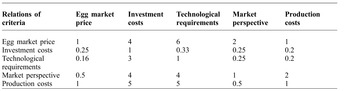
The second alternative (Alt 2) applied was production of eggs from alternative systems. From the technological point of view, advantages of such production include greater mass of eggs, thicker shell, more intensive colour of yolk and animals welfare. An additional advantage is being able to label packaging indicating which production systems used. The best label is deemed to be organically produced eggs, while those from enriched cages carry no registered label. In this way, potential buyers are encouraged to consume products that originate from producers who take care of animal welfare and food safety. Disadvantages of such systems include lower production efficiency, fewer eggs and poorer egg hygiene. Production costs are higher because these systems require more human labour and greater production area. Criteria for calculation of the optimal choice are shown in Table 1.
Table of decision making.

The final assessment of the defined criteria required prior determination of the relationship between them, in order to define which criterion was more important in relation to the others. The value of the relationship between criteria shown in Table 1 was assessed by the Saaty's scale. Producers’ answers were assessed by the scale and interpreted as judgments of how many times one criterion was considered more important than another (Table 2).
Relations of criteria evaluation.

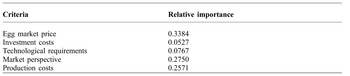
As presented in Table 2, producers estimated that the market price was the most important factor for successful future business. The market price was more significant than the market perspective by 2:1 (equally to medium importance) and more significant than the investment costs by a factor of 4:1 (medium to strongly importance). The relative importance of criteria is displayed in Table 3 on the basis of stated producers’ preferences.
Relative importance of criteria.

Index of consistency = 0.08
According to the results, it was concluded that producers believed that the market price of eggs was the most important factor in their business activity. The relative importance of this criterion was 34%, followed by market perspective at 27% being second in importance for business success of producers. The ranking was followed by production costs at 26%, then technological requirements of production at 7.7%, and investment costs by 5.3% were assessed as the least important factor for business success. Regarding the priorities based on the Saaty's scale presented in Table 4, the alternatives were ranked according to the value of each criterion.
Priorities of alternatives as of the set criteria.

Index of consistency = 0.00
Overall priorities for individual alternatives were calculated from the sum of their local priorities pondered with the relative importance of criteria, as shown in Table 5.
Structure of alternatives and criteria according to the relative importance.

Index of consistency = 0.08
Investment in alternative systems for table egg production, i.e. the resulting vector of other alternatives, has a higher value (0.8024) which was largely influenced by higher relative criteria of the importance of egg market price. It was concluded that this alternative was better than the first alternative of investing into enriched cages, which had a value of 0.1975.
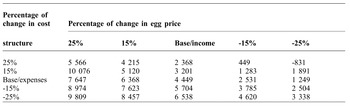
Fisher and Bowles (Reference FISHER and BOWLES2002), Van Horn and Bondt (Reference VAN HORN and BONDT2003), Van Horn (Reference VAN HORN2007) and Elson (Reference ELSON2008) reported that the production of table eggs within alternative systems results in significant increases of production costs that negatively influence profitability. Consequently, measures needed to increase profitability of table egg production are either to reduce costs or to increase market price. In order to interpret the importance of the above statement, sensitivity analysis (Table 6) was applied in the calculation of the percentage increase and decrease in costs and income from production, with assumed changes of ± 25%. The net present value of investment into the production facility was taken as a basis for the sensitivity analysis, assuming a discount rate of 6%, economic life of investment being ten years, and the net present value of investment amounting to 4,449,945.50 €, as discussed by Crnčan et al. (Reference CRNČAN, RANOGAJEC, DEŽE and KRISTIĆ2011).
Sensitivity analysis for the net present value (in 000 €).

Sensitivity analysis proved that the net present value significantly changed by altering observed parameters. Business success was significantly affected by changes in prices of eggs, while changes in input costs had less impact, which confirms the relative importance of criteria shown in Table 3. Producers are not able to directly influence egg market price, as it is formed under the influence of supply and demand. However, in order to achieve a higher price, producers can opt for production of eggs within alternative systems. Such systems require greater financial investment in production, but eggs can be sold for more compared with the price of eggs produced in enriched cages. Besides the decision regarding which egg laying system to use, producers can manage their production costs by assuring the highest possible long-term benefits. As Beierlein et al. (Reference BEIERLEIN, SCHNEEBERGER and OSBURN2008) concluded, cost management is a part of overall business success management.
Conclusions
The multiple criteria decision making method AHP was used to select a system for production of table eggs that will be in line with the strategy for advancement of business results and maintenance of competitive advantages. The defined ranking model consisted of five criteria; the egg market price, investment costs, technological requirements, market perspective, and production costs. The second possibility, i.e. investing in alternative production systems was assessed as a better option, which resulted from the dominance of the egg market price over other criteria. Since production of table eggs in alternative systems is accompanied by a significant increase in costs, sensitivity analysis examined to what extent egg prices and costs were sensitive to change. The results showed that changes in egg market price significantly affected business success, which confirmed the relative importance of that criterion, while changes in input costs had less impact on the business.