Introduction
In the last year, the coronavirus disease 2019 (Covid-19) pandemic has affected our social and professional lives at all levels and scales, bringing the entire world to a standstill. While healthcare workers across the globe have struggled to come to terms with increased demands on their skill-set, time and energy, the role of otorhinolaryngologists in particular has been under the radar.
It has been shown that the virus gains entry through the nose; its load is highest in the upper respiratory mucosa, and its presence results in loss of smell in many affected patients.Reference Workman, Jafari, Xiao and Bleier1 Further, highly aerosol-generating procedures have placed the already thin specialised healthcare force at further risk of exposure to infection. This not only brings otorhinolaryngologists into focus for their unique diagnostic ability, but also puts them directly into the line of fire, posing a significant risk while they are performing simple examinations and procedures.Reference Campbell2 The impact of the viral infection on the practice of ophthalmologists and otorhinolaryngologists was recognised and discussed early in the course of the pandemic.Reference Fishman and Fisher3–Reference Herzog, Beule, Lüers, Guntinas-Lichius, Grafmans and Deitmer5
In addition to healthcare delivery to patients and changes in the practice of otorhinolaryngologists, there has been a definite impact on the training of residents and young specialists. In India, nearly 20 in 1000 post-graduate seats are available for training in otorhinolaryngology out of a total of nearly 42 000 seats.6
The present article discusses the impact of the pandemic on ENT practice and healthcare seekers, and describes the unique challenges faced by doctors in training and in the resumption of routine services.
Impact on healthcare practice
The interruption of ENT practice may persist far beyond the pandemic itself as healthcare providers understand droplet and airborne infections transmitted through the respiratory tract in a new light. Several aspects of the care of Covid-19 patients uniquely involve otorhinolaryngologists, including specimen collection, intensive care and upper airway procedures.
Collection of coronavirus testing swabs
Detection of severe acute respiratory syndrome coronavirus-2 (SARS-CoV-2) requires samples from mucosal surfaces and their secretions. The most accessible sites with acceptable accuracy are the nasopharynx and oropharynx.Reference Böger, Fachi, Vilhena, Cobre, Tonin and Pontarolo7 Although swab collection is generally safe, with an approximately 0.026 per cent incidence of adverse events, preparation for complications was considered necessary, as nearly 5.1 million tests are conducted worldwide on a daily basis.Reference Föh, Borsche, Balck, Taube, Rupp and Klein8 The complications ranged from minor epistaxis to the broken-off tip of the swab as a nasal foreign body and cerebrospinal fluid leaks. Otorhinolaryngologists, being the most familiar with this region of the human anatomy, were uniquely placed to train other healthcare workers in the collection of specimens.
Intensive care procedures
The pandemic has seen a manifold rise in the need for airway procedures as the number of intubations and tracheostomies has increased dramatically. In addition to performing these procedures, otorhinolaryngologists are expected to render services in the critical care setting, which is not their area of expertise.
Upper aero-digestive tract procedures
Many authors have evaluated the risk of virus transmission to the carer during upper airway procedures, and have suggested tips and guidelines.Reference Choi, Shin, Park, Choi, Kim and Choi9–Reference Spinato, Gaudioso, Boscolo Rizzo, Fabbris, Menegaldo and Mularoni13 Hand hygiene and full personal protective equipment (PPE), including mask, gloves, eye or face shield, and gown, are recommended while performing airway procedures in all patients.
The pandemic has affected the normal functioning of out-patient departments, and the number of endoscopies has been reduced to the minimum. Reports suggest a decrease of up to 91 per cent in out-patient endoscopic procedures.Reference Di Maio, Traverso, Iocca, De Virgilio, Spriano and Giudice14 The highest viral load has been shown to be harboured by the upper respiratory tract, and even though ENT endoscopies are not aerosol-generating procedures in themselves, they can induce sneezing, coughing and gagging, resulting in aerosolisation.Reference Valika and Billings15–17
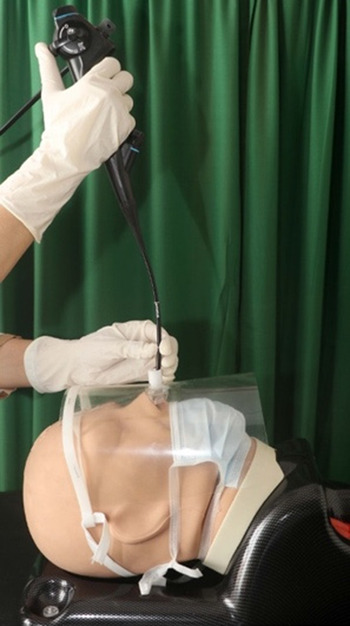
Although different protocols during fibre-optic laryngoscopy have been proposed, no definitive measures to reduce infection have been found. Ramavat et al. have proposed a safe fibre-optic laryngoscopy technique using a novel, reusable and inexpensive modified face shield, created in-house, as shown in Figure 1.Reference Ramavat, Hage, Muraleedharan and Panda18
Modified face shield for fibre-optic laryngoscopy.

The Foundation for Head and Neck Oncology, a national society for head and neck cancer in India, has issued recommendations for diagnostic procedures and treatment modalities.19 Similarly, the Association of Otorhinolaryngologists of India has also issued advisories for upper aero-digestive tract procedures.20,21 Rhinologists have been advised to rely on imaging rather than frequent endoscopies for evaluation, and to use a special ‘microscope drape method’ to reduce aerosolisation when performing nose and anterior skull base surgical procedures.Reference Setzen, Svider and Pollock22,Reference Tsagkovits, Ioannidis and Rokade23
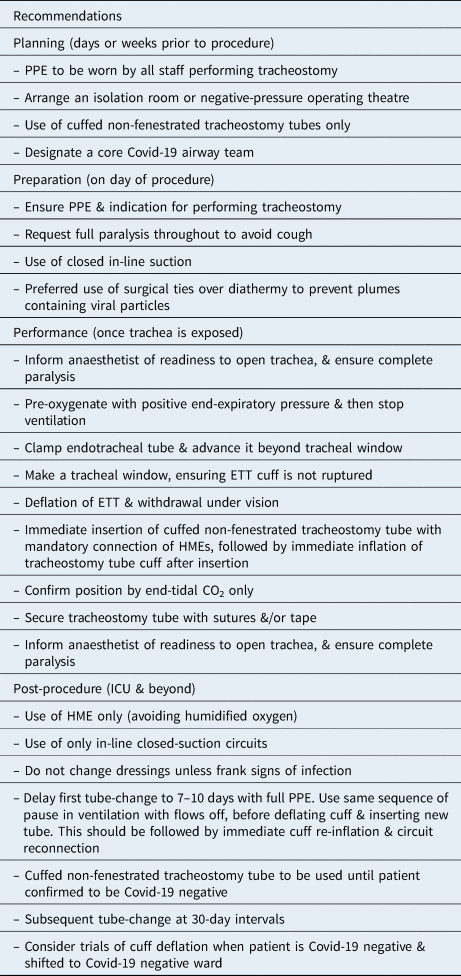
Tracheostomy is a highly aerosol-generating mode, which exposes the surgeons performing the procedure as well as the healthcare workers involved in its care. The procedure for performing a tracheostomy and the indications for an elective tracheostomy have been revised. The recommendations by ENT UK for tracheostomy in Covid-19 patients are summarised in Table 1.Reference Jacob, Walker, Mantelakis, Gibbins and Keane24 Open tracheostomy or percutaneous tracheostomy procedures were recommended, as per institutional resources, as Zhang et al. found no severe post-operative complications and no infection in healthcare workers associated with these procedures.Reference Zhang, Huang, Niu, Zhou, Xie and Zhong25
Tracheostomy in Covid-19: ENT UK recommendations

Covid-19 = coronavirus disease 2019; PPE = personal protective equipment; ETT = endotracheal tube; HME = heat & moisture exchanger; CO2 = carbon dioxide; ICU = intensive care unit
Telemedicine for consultation and communication
Recommendations for telemedicine consultation have been put forward by the Government of India in order to reduce the risk of contact and spread of the virus, as well as ensuring easy access to care.21,26
Pre-operative coronavirus testing
Pre-operative testing for Covid-19 was recommended in all patients, especially surgical patients.Reference Herzog, Beule, Lüers, Guntinas-Lichius, Grafmans and Deitmer5 Urgent cases where testing could not be carried out were treated as high-risk procedures.Reference Fishman and Fisher3
Olfactory dysfunction as disease symptom
Olfactory dysfunction is a characteristic symptom of Covid-19, which can occur independently or in combination with other symptoms.Reference Abalo-Lojo, Pouso-Diz and Gonzalez27–Reference Bilinska and Butowt29 Physicians managing patients should be aware that anosmia is an important symptom for early recognition of active disease as well as an important post-Covid-19 complication. Nearly 12 per cent of patients are reported to have persisting olfactory dysfunction even after six months of recovery from Covid-19.Reference Stavem, Ghanima, Olsen, Gilboe and Einvik30
Risk of mucormycosis
An increased risk of mucormycosis in patients with Covid-19 infection has resulted in an epidemic, particularly in India.Reference Ahmadikia, Hashemi, Khodavaisy, Getso, Alijani and Badali31–Reference Verma and Bali33 Pre-existing diabetes mellitus and use of systemic corticosteroids have been identified in the majority of cases of mucormycosis.Reference Singh, Singh, Joshi and Misra34 Mucormycosis has significantly added to the healthcare burden of the population and the burden on otorhinolaryngologists. Co-existing acute respiratory distress syndrome and multi-organ dysfunction may prevent timely diagnostic imaging and testing.
Virus in unexpected tissues
It has been proposed that the expression of angiotensin converting enzyme-2, transmembrane serine protease-2 and furin in the middle ear, mastoid tissues and Eustachian tube, as observed in mice, could well allow seeding of the SARS-CoV-2 virus in these tissues.Reference Uranaka, Kashio, Ueha, Sato, Bing and Ying35 This suggests that otorhinolaryngologists also need to be cautious while performing ear procedures such as myringoplasty, as well as mastoidectomy, which involves the use of drills known to produce aerosols in high quantities.Reference Dharmarajan, Freiser, Sim, Boorgu, Corcoran and Wang36
Impact on residents’ training
Limited clinical material
Medical training revolves largely around the practical acquisition of skills on the background of a knowledge base. During the current pandemic, with reduced patient interactions, young trainees have been put at a disadvantage. While they have learned how to manage the pandemic, they have not been able to satisfactorily acquire the requisite diagnostic and surgical skills in ENT examination and management. In order to accommodate the restrictions of the pandemic against a background of panic, only emergency surgical procedures and consultations have been considered. The need to maintain social distancing and the least possible exposure to the virus from carriers or asymptomatic patients meant the absence of regular ENT patients in hospitals and a decrease in routine examinations. This invariably led to a decrease in potential learning opportunities for students.
Limited exposure to available patients
In order to minimise contact and to use limited resources efficiently, the time spent on procedures was reduced, and these were often performed by more experienced specialists. As a result, students missed out on hands-on learning and observing procedures in person. A decrease in supervised examinations and less frequent bedside teaching also affected learning. This has resulted in lower confidence in the students, a greater possibility of errors in judgement, the loss of experience-driven techniques, and limited patient care. In addition, it was felt that incorrect sampling techniques for Covid-19 would pose a higher risk for iatrogenic injury and that accidents could result in cerebrospinal fluid leak in healthy patients. This prompted the posting of ENT residents to supervise or assist in sample collection in India and probably across the world.
Restricted surgical procedures
All elective surgical procedures had to be rescheduled or postponed because of the pandemic. While the postponing of procedures did not affect the survival outcomes of benign disorders, patients with locally aggressive and malignant diseases of the ear, nose, throat, head and neck regions have suffered a setback in terms of poor survival outcomes. There was widespread disruption of surgical procedures because of restricted patient movements during periods of lockdown. The consequent delay in surgical management is a clear cause for concern, especially regarding early stages of oral malignancies, potentially leading to an increase in the severity of disease stage, resulting in inoperability or poor surgical outcomes.
Even paediatric emergency procedures such as foreign bodies in the ear, nose or oesophagus were difficult. The result was that a simple case of a child who had swallowed a coin had to travel a much longer distance for a procedure such as emergency oesophagoscopy, because hospitals were not in a suitable condition to accept such patients, as per protocol. Life-threatening emergencies requiring urgent interventions, such as foreign body obstructions of the bronchus, tracheostomy procedures for malignancies, head injuries, or bronchoscopy for airway foreign bodies, also presented an unforeseen dilemma. It was a struggle to find facilities providing emergency services for patients with unknown Covid-19 status. In addition, elective procedures such as paediatric difficult airway management and tracheostomies for prolonged intubation became difficult, and patients had to wait longer.
Resumption of services
As the pandemic settles, it will become important to formulate guidelines in order to resume services. Staff will need to be redeployed to their normal roles, making sure there is adequate staff to cover emergency stations. Triaging services will become important, and wearing masks and protective equipment will become the norm.
Preventive measures taken during this period are broadly centred on the use of PPE. A face shield is one such PPE item that provides barrier protection to the facial area and related mucous membranes (eyes, nose and lips). Coupling it with a surgical or N95 mask, along with goggles, provides sufficient protection to carry out an out-patient procedure such as fibre-optic laryngoscopy. It has been recommended that video-nasal endoscopes be used to increase the distance between patient and clinician, and video recordings of findings can be used to minimise repetition. Prioritising surgical waiting lists in line with the national guidelines, as recommended in the UK, and use of the Medically Necessary, Time-Sensitive scoring system for procedures, as proposed by the American College of Surgeons, will also become important.37
Physical consultations may need to be avoided unless the doctor feels that examining the patient is a must. In such a case, pre-booking of appointments is required to make sure a limited number of patients are seen with appropriate social distancing. Adequate electrical and internet services are required in hospitals to provide the facility for teleconsultation. Further, it may become important to reduce the length of hospital stay and limit the number of admissions to healthcare facilities. We will have to wait and see what course the pandemic takes and what is in store in the coming weeks.
Conclusion
While the disruption to human life and activity brought about by the Covid-19 pandemic is no longer a surprise, healthcare service delivery continues to bear the brunt. The impact on ENT practice requires special attention regarding practice guideline modifications; patients await elective procedures, while surgeons are hesitant, being particularly vulnerable in terms of exposure to upper airway secretions.
Otorhinolaryngologists occupy a unique role in the management of the current pandemic because of the pathophysiology and transmission of the virus, as young trainees struggle to find the balance between developing a sound theoretical base and acquiring a skilful surgical hand.
Competing interests
None declared