In natural languages, sentences are often underspecified, sometimes conveying more than they encode lexically. The overall meaning of a sentence typically consists of multiple layers of meaning. While some are literally encoded, others are simply inferences that the hearer must derive by reasoning from the context. Consider (1), which presents a noncanonical French word order known as a c'est-cleft. To many French native speakers (NSs), (1) not only presupposes that there is a person who ate a sandwich and asserts that this person is Jean but also conveys exhaustivity; the clefted constituent is interpreted as if under the scope of an exclusive (e.g., “only”; see [2]). Listeners are thus justified in deriving the intended meaning that Jean, and no other individual in the relevant contextual domain, ate a sandwich.
-
(1) C'est Jean qui a mangé un sandwich.
-
“It's John who ate a sandwich.”
-
(2) Seul Jean a mangé un sandwich.
-
“Only John ate a sandwich.”
One important difference between (1) and (2) is that nonliteral meanings can be suspended or canceled (Levinson, Reference Levinson2000). Adding information like “. . .and so did Paul” to (1) does not create an overt contradiction (as would be the case in [2]), but would instead simply signal disagreement or discontent. Crucially, adding such information to (1) does not result in ungrammaticality. Thus, clefts and exclusives behave differently with respect to the exhaustive effects they convey, suggesting that they do not possess identical underlying semantics.Footnote 1 Whereas “only” lexically encodes exhaustivity (i.e., exhaustivity is part of the truth-conditional meaning), in cleft sentences exhaustivity is simply inferred, and has been argued to be pragmatically derived. Consequently, and following Lambrecht (Reference Lambrecht1994), we take clefts to be semantically equivalent to their canonical counterpart.
Theoretical work has examined how inferences arise and are processed in online comprehension (Bott & Noveck, Reference Bott and Noveck2004; Levinson, Reference Levinson2000). Other work has focused on how children acquire and process these aspects of meaning (especially with respect to scalar implicatures; Chierchia, Crain, Guasti, Gualmini, & Meroni, Reference Chierchia, Crain, Guasti, Gualmini, Meroni, Do, Domínguez and Johansen2001; Noveck, Reference Noveck2001). Less research exists on second language (L2) data. For the French c'est-cleft, most previous studies have examined production and use (Donaldson, Reference Donaldson2012; Katz, Reference Katz1997; Reichle, Reference Reichle2008), and Dekydtspotter and Farmer (Reference Dekydtspotter, Farmer, Guijarro-Fuentes, Schmitz and Müller2016) recently examined effects of structural priming. Yet, no L2 study to our knowledge has examined the exhaustive inference of c'est-clefts. The first contribution this paper makes is thus empirical: it provides novel data on an aspect of French clefts that remains understudied in the L2 literature. Using offline data, the main goal of this paper is to examine the following overarching question: after acquiring the syntax of the c'est-cleft, at what point do L2 learners acquire the associated pragmatic inference of exhaustivity? We rely on data from two control groups (English NSs and French NSs) as a baseline.
Because deriving the exhaustive inference involves both syntax and discourse pragmatics, examining the acquisition of this inference constitutes an appropriate testing ground for the interface hypothesis (IH; Sorace Reference Sorace2011, Reference Sorace2012; Sorace & Filiaci, Reference Sorace and Filiaci2006), which posits that syntax–discourse interface phenomena pose unique and potentially insurmountable difficulties in L2 acquisition. Accordingly, the second contribution of this paper is theoretical, contributing to the debate on the L2 acquisition of interface properties.
BASIC PROPERTIES OF THE FRENCH C'EST-CLEFT
The underlying syntax of the c'est-cleft has been widely debated.Footnote 2 Most scholars agree that the cleft is biclausal, containing a matrix clause followed by a relative-like clause, both of which share a common referent (Lambrecht, Reference Lambrecht1994). Some accounts generate clefts via movement (Belletti, Reference Belletti, Brugè, Giusti, Munaro, Schweikert and Turano2005; Gross, Reference Gross1968), whereas others argue for base-generation and adjunction (Clech-Darbon, Rebuschi, & Rialland, Reference Clech-Darbon, Rebuschi, Rialland, Rebuschi and Tuller1999; Hamlaoui, Reference Hamlaoui and Radišić2007; Reeve, Reference Reeve2010, offer a comprehensive review).
Functionally, clefts arise in focus contexts. Following Lambrecht (Reference Lambrecht1994, Reference Lambrecht2001), the cleft sentence in (1) functions as follows: it presupposes the existence of an individual who satisfies the backgrounded predicate in the relative-like clause, and it marks this individual as the focus, that is, the part of the sentence that evokes a set of relevant alternatives, which assists the hearer in updating the common ground (Krifka, Reference Krifka2008; Rooth, Reference Rooth1992). This is represented in (3).Footnote 3
-
(3) Utterance: It's Jean who is eating a sandwich.
-
Presupposition: X is eating a sandwich
-
Focus: Jean
-
Assertion: X = Jean
While this analysis also holds for the English it-cleft, there are subtle, but crucial differences that distinguish it from the French c'est-cleft. First, in terms of construction frequency, the French c'est-cleft is used much more commonly than its English counterpart (Bourns, Reference Bourns, Bourns and Myers2014; Carter-Thomas, Reference Carter-Thomas, Banks, Eason and Ormrod2009). This is primarily due to constraints on French prosody: whereas English can shift prosodic prominence to match the location of the focus constituent, French is more rigid, placing prosodic stress only at the right edge of an intonation phrase. The c'est-cleft, despite adding syntactic complexity, circumvents this prosodic restriction by creating an extra intonation boundary that can align with the focus constituent (Hamlaoui, Reference Hamlaoui and Radišić2007; Lambrecht, Reference Lambrecht1994). Consequently, this construction is the default strategy used to mark the simpler focus known as information focus, instantiated in answers to wh-questions, especially when the focused element is a subject (Destruel, Reference Destruel2013; Féry, Reference Féry2013; Hamlaoui, Reference Hamlaoui and Radišić2007; Lambrecht, Reference Lambrecht1994; Skopeteas & Fanselow, Reference Skopeteas, Fanselow, Breul and Göbbel2010). Compared to the English it-cleft, which typically constitutes a marked construction (the use of which requires additional pragmatic justification, signaling a stronger type of focus known as “identificational,” “contrastive,” or “corrective” as argued by Kiss, Reference Kiss1998), the French cleft is regularly present in the language, and therefore in the L2 input.Footnote 4 We elaborate on this point and its relation to L2 acquisition in the discussion section.
Second, in terms of discourse function, the c'est-cleft occurs in contexts where the it-cleft does not. It is used for explicative all-focus in cases where the information in the relative clause is also part of the focus (i.e., no content is presupposed; all the information is new and unknown to the hearer). All-focus follows a generic question (e.g., “What happened?”) or can arise out of the blue, as in (4).
-
(4)


In addition, French has other constructions that, although resembling the c'est-cleft on the surface, are not clefts per se in that they cannot be unclefted; that is, they do not have canonical equivalents (for detailed discussion of different c'est-cleft sentences, see, for instance, Clech Darbon et al., Reference Clech-Darbon, Rebuschi, Rialland, Rebuschi and Tuller1999; De Cat, Reference DeCat2007; Katz, Reference Katz1997).
All in all, although similar structurally, English and French clefts differ in their function. The variety of contexts in which the c'est-cleft can occur, compared to the it-cleft, makes for a potentially misleading input, which the L2 learners of French will have to overcome in order to express themselves felicitously.
THE EXHAUSTIVE INFERENCE
Despite functional differences in marking focus, c'est- and it-clefts have been noted to convey an exhaustive inference such that the clefted element is interpreted as the only relevant referent in the contextual domain. For example, hearing (5), a speaker justifiably infers (5c).
-
(5) C'est Martin qui a cuisiné des lasagnes.
-
“It's Martin who cooked the lasagna.”
-
a. Assertion: x is Martin.
-
b. Presupposition: There is an x such that P(x).
-
c. Inference: No one other than Martin cooked lasagna.
-
What is the nature of this inference? Some research (see Kiss, Reference Kiss1998, for English; Clech-Darbon et al., Reference Clech-Darbon, Rebuschi, Rialland, Rebuschi and Tuller1999, for French) treats exhaustivity in clefts as a purely semantic phenomenon. Under this view, exhaustivity is part of the truth conditions of the cleft sentence, and it arises whenever a cleft occurs. A contrasting view, following Horn (Reference Horn, Burke and Pustejovsky1981), considers that the exhaustive inference is pragmatic, arising through context. As a result, the inference is weaker than predicted by semantic approaches, and it can be canceled. Following this approach, the cleft is semantically parallel to its canonical counterpart (Lambrecht, Reference Lambrecht2001, p. 467) but differs pragmatically by conveying a stronger exhaustive inference.
Recent experimental work has supported the pragmatic account and has challenged strict semantic accounts. Onea and Beaver (Reference Onea, Beaver, Cormany, Ito and Lutz2011) investigated preverbal focus in Hungarian to probe the nature of exhaustivity in clefts. They compared the strength of the exhaustive inference derived by speakers in three sentence types: clefts, those with an exclusive particle, and canonicals. Exclusives and canonicals served as controls against which to measure the exhaustive inference in clefts: exclusives semantically encode exhaustivity and therefore convey this meaning regardless of context. In contrast, canonical sentences (at most) implicate exhaustivity, but do not require it; the exhaustive inference in canonicals is thus much weaker (if present at all).
In designing their instrument, Onea and Beaver (Reference Onea, Beaver, Cormany, Ito and Lutz2011) assumed, following Levinson (Reference Levinson2000), that pragmatic inferences, unlike lexically encoded meanings, can be canceled without changing the truth-value of the sentence. Knowing that speakers’ judgments of truth-value take into account real-world and contextual knowledge, Onea and Beaver designed their discourse-contextualized experimental task based on the following reasoning: if speakers overtly disagree with a sentence, some kind of inherent incompatibility must exist between the truth-value of the sentence and the situation in which it appears. For example, because the exhaustivity of exclusives such as seulement (only) is lexical and thereby asserted (rather than inferred), it is not optional and cannot be canceled. Thus, when viewing an exclusive sentence whose exhaustive reading is incompatible with the discourse context, speakers should express disagreement by overtly contradicting the assertion. In contrast, because exhaustivity in canonicals is weak and not lexically asserted, speakers should react differently to canonicals whose truth-value (with respect to exhaustivity) differs from the discourse context.
Against this backdrop, Onea and Beaver (Reference Onea, Beaver, Cormany, Ito and Lutz2011) designed an offline forced-choice task in which participants viewed pictures that violated the exhaustive inference of the three sentence types described above (i.e., exclusive, cleft, and canonical sentences). Participants selected from three possible continuations, each of which contained further information and corrected the exhaustive inference with varying degrees of strength, as in (6). The degree of exhaustivity that speakers associate with each sentence type should modulate the continuation they select. If speakers continue the target sentence with “no,. . .,” they view the additional information as overtly contradicting the preceding discourse, suggesting that the target sentence is interpreted as strictly exhaustive, which can be taken to suggest that exhaustivity is semantic in nature. If speakers choose a more moderate continuation, such as “yes, and. . .” or “yes, but. . .,” they are interpreting exhaustivity as less categorical or less robust, such that it can be weakened or overruled without an overt contradiction with “no.”
-
(6)

Onea and Beaver's (Reference Onea, Beaver, Cormany, Ito and Lutz2011) results confirmed that clefts and exclusives pattern differently. Following sentences with exclusive particles (e.g., “Only John was chasing butterflies”), speakers reacted to violations of the exhaustive inference by selecting “no,. . .” By contrast, when the exhaustiveness of preverbal focus or clefts (as in [6]) was violated, participants preferentially chose the weaker continuations with “yes, and” or “yes, but.” These findings led the authors to conclude that the exhaustive effects associated with Hungarian preverbal focus are weaker than predicted by a semantic account: they are pragmatically inferred rather than semantically encoded. Onea and Beaver's (Reference Onea, Beaver, Cormany, Ito and Lutz2011) results have been replicated for other languages, including German (Xue & Onea, Reference Xue, Onea and Kierstead2011), Greek (Pavlou, Reference Pavlou2014), and English (Destruel et al., Reference Destruel, Velleman, Onea, Bumford, Xue, Beaver and Schwarz2015). For French, Destruel's (Reference Destruel2013) results also uphold a pragmatic account, and the author analyzes exhaustivity in clefts as a scalar implicature: speakers encode the strongest exhaustivity via an exclusive, understanding that exhaustivity in clefts is implied rather than asserted and is thereby weaker (i.e., cancellable).
Online data exist to corroborate the findings from offline studies. Drenhaus, Zimmermann, and Vasishth (Reference Drenhaus, Zimmermann and Vasishth2011) examined exhaustive interpretation of clefts via event-related potential (ERP) data. Their findings support the pragmatic account: responses to violations of exhaustiveness with it-clefts were associated with a globally distributed negative signature (N400), whereas violations of exhaustiveness in exclusives triggered a centroparietal positivity (P600). These signatures suggest that exhaustivity is of a different nature in clefts versus exclusives. In sum, recent offline and online results are consistent in showing that exhaustivity is weaker in clefts than in exclusives.
Adapting the design from Onea and Beaver (Reference Onea, Beaver, Cormany, Ito and Lutz2011), the study presented hereafter extends the analysis of exhaustivity to the development of L2 French grammars.
L2 ACQUISITION OF INTERFACE PHENOMENA
The L2 acquisition of the c'est-cleft implicates linguistic interface phenomena, and more specifically the syntax–discourse interface, an area of considerable interest since Sorace (Reference Sorace, Long and Doughty2003) proposed the IH. The IH implicates perennial topics in L2 theory, including first language (L1) transfer, the importance of input, the nature of bilingual cognition, and the degree to which L2 mental representations and performance can be nativelike (Sorace & Filiaci, Reference Sorace and Filiaci2006, p. 340). Although “any linguistic phenomenon involves multiple interfaces” (White, Reference White2011a, p. 586), an interface phenomenon is generally understood as a situation in which the felicitous use of (a) certain linguistic form(s) depends on “pragmatic and contextual variables” (Sorace, Reference Sorace2011, p. 1) and “require(s) the integration of contextual factors” (Sorace, Reference Sorace2011, p. 9) that in turn implicate other cognitive domains. As White (Reference White2011a, p. 578) points out, the notion of an interface relies crucially on a modular view of grammar, in which syntax, or narrow syntax, is represented separately from the organization of discourse, with its attendant notions like topic, focus, chains of anaphoric reference across clauses, or pragmatics generally. Assuming this view, Slabakova (Reference Slabakova2015) writes that “interfaces are points of interaction between modules or systems, where output representations of one module or system must be interpreted by another” (p. 671). In other words, certain syntactic structures are “sensitive to” (Sorace, Reference Sorace2011, p. 6) or “influenced by” (Bohnacker, Reference Bohnacker2010, p. 107) conditions outside of syntax proper, such as information structure. In French, speakers employ the c'est-cleft, as opposed to other available word orders, to signal the pragmatic function of focus. Similarly, how the speaker and interlocutors construe the exhaustivity of the c'est-cleft depends on awareness of the larger discourse context.
The most recent version of the IH proposes a principled distinction between internal interfaces, those between narrow syntax and the other linguistic modules (e.g., semantics and phonology), and external interfaces where the grammar interacts with “nonlinguistic cognitive system” (Slabakova, Reference Slabakova2015, p. 672). Researchers examining the IH contend that it is those phenomena located within external interfaces that give rise to enduring difficulties in L2 acquisition that remain insurmountable at even the highest levels of attainment. One commonly studied example of an external interface is the syntax–discourse interface. The IH predicts that external interfaces will be characterized by permanent impairment in one of these forms: (a) persistent residual L1 transfer effects; (b) incomplete, underspecified, or otherwise nontargetlike representations and form–function mappings; (c) optionality or indeterminacy; or (d) reliance on pragmatically neutralized default forms (Sorace, Reference Sorace2011, Reference Sorace2012; Sorace & Filiaci, Reference Sorace and Filiaci2006).
The IH was conceived to apply to only the very highest levels of L2 attainment (Sorace, Reference Sorace2011, p. 9; Reference Sorace2012, p. 213), and this restriction to the highest levels of L2 attainment is central to the core prediction of the IH that external interfaces, unlike other areas of L2 development, are uniquely unacquirable. As Sorace (Reference Sorace2012) emphasizes, “the point of the IH is that unlike many of the developmental problems that are reduced or eliminated as L2 proficiency grows, performance at the syntax–pragmatics interface may remain permanently unstable” (p. 213). Although White (Reference White2011b, pp. 109–110) and Lardiere (Reference Lardiere2011, p. 52) both challenge the theoretical validity of restricting the predictions of the IH to a specific level of L2 attainment, most of the relevant research to date has focused on very advanced, purportedly near-native L2 populations.
Numerous studies of syntax–discourse phenomena uphold the IH (see Sorace, Reference Sorace2011; White, Reference White2011a). Valenzuela (Reference Valenzuela, Slabakova, Montrul and Prévost2006) studied interpretations of clitic left-dislocation (CLLD) and (clitic-less) topicalization by near-native L1 English/L2 Spanish speakers. Although the L2 speakers mastered the formal syntactic properties of these structures, they demonstrated incomplete knowledge of the pragmatic constraints concerning the role of specificity. Sorace and Filiaci (Reference Sorace and Filiaci2006) arrived at similar conclusions in a study of intrasentential anaphor resolution by near-native L2 Italian speakers (with L1 English). Although the L2 learners resolved ambiguous anaphora involving null subject pronouns in a nativelike fashion, they differed from NSs in how they determined anaphora for overt subject pronouns, relying on L1 strategies, perhaps to compensate for insufficient cognitive resources. Belletti, Bennati, and Sorace (Reference Belletti, Bennati and Sorace2007) investigated how NSs of English with near-native L2 Italian mapped the pragmatic notion of focus and the preverbal versus postverbal placement of subject pronouns. These L2 learners deviated from native norms in a way that suggested continued reliance on an infelicitious strategy, in this case, transferred from their L1 English.
In contrast, other studies have reported nativelike performance by L2 speakers on external interface phenomena, challenging the IH. Rothman (Reference Rothman2009) examined null and overt pronominal subjects in L2 Spanish. The most advanced learners performed identically to the NS controls, prompting Rothman to conclude that “the syntax–pragmatics interface is not an inevitable locus of fossilization” (p. 969). Slabakova, Kempchinsky, and Rothman (Reference Slabakova, Kempchinsky and Rothman2012) investigated the contrast between focus fronting and CLLD in the L2 Spanish of intermediate, advanced, and near-native speakers. Nativelike performance was reported not only for the near-natives but also for some intermediate learners. Slavakova et al. (Reference Slabakova, Kempchinsky and Rothman2012) contended that syntax–discourse phenomena are acquirable in L2, although they are learned late compared to narrow syntax and the syntax–semantics interface (p. 339). Evidence for nativelike acquisition of syntax–discourse phenomena in near-native French comes from Donaldson (Reference Donaldson2011a, Reference Donaldson2011b; Reference Donaldson2012), who examined several interface phenomena (CLLD, clitic right dislocation, c'est-clefts, and avoir-clefts) in spontaneous informal conversational data between NSs and near-native speakers. Taken together, these studies suggest that although external interface phenomena may be learned late, they can be acquired to nativelike levels, at least after sufficient authentic exposure to the target.
Researchers investigating the IH ask why external interfaces are uniquely challenging to L2 learners. What property or properties of interfaces preclude nativelike acquisition, representation, and performance? For scholars who maintain that interface phenomena are ultimately acquirable in L2, the question boils down to examining why interfaces are acquired late. L1 transfer effects are frequently cited in cases where the L1 and the L2 target share a form whose pragmatic properties nonetheless differ (Belletti et al., Reference Belletti, Bennati and Sorace2007, p. 665; Sorace & Filiaci, Reference Sorace and Filiaci2006, p. 359; Valenzuela, Reference Valenzuela, Slabakova, Montrul and Prévost2006, p. 301). For Bohnacker (Reference Bohnacker2010), “it is not the involvement of an ‘interface’ as such. . .but rather the fact that language-specific possibilities and constraints can have subtle consequences for information distribution in discourse, and these are often gradual in nature” (p. 134).
Yet, in its most recent form (Sorace, Reference Sorace2011), the IH is blind as to whether the property studied is instantiated in the L1 or not. Sorace rules out L1/L2 pairings as constituting the only deterministic factor in L2 learner’ potential for convergence, and highlights instead the cognitive processing difficulties that external interfaces impose on bilingual (including L2) speakers; Sorace (Reference Sorace2011) hypothesizes that “bilinguals are less efficient than monolinguals in the integration of multiple sources of information and that bilingualism itself, rather than (only) the particular language combination spoken, may be the underlying cause of the observed differences with monolinguals” (p. 14). Thus, any phenomena found at an external interface, regardless of L1/L2 pairing, is predicted, under the IH, to yield some kind of residual optionality or other manifestation of nonnativeness.
Finally, it is important to note that other factors have been evoked as playing a role in the successful acquisition of the syntax–discourse interface. Slabakova (Reference Slabakova2015) discusses two crucial ones, namely, L1 transfer and input frequency, suggesting that L2 learners’ failure to master external interface phenomena may in some cases result from the paucity of input for the relevant form–function mapping. Although our study sets out to test the empirical validity of the IH, given that both c'est- and it-clefts convey exhaustivity, it will be relevant to discuss our results in light of predictions made by L1 transfer. In addition, because the two constructions exhibit differences in their discourse-function and frequency, our results will also be pertinent for connectionist and usage-based theories, which argue that input frequency is central in explaining patterns of L2 development (e.g., Ellis, Reference Ellis2006).
L2 ACQUISITION OF THE FRENCH C'EST-CLEFT
Although previous studies have examined the c'est-cleft in L2 French, none to our knowledge have investigated the pragmatic implicature that is our concern here. Rather, the work reviewed in this section has looked more broadly at the intersection of the c'est-cleft and focus marking.
Trévise (Reference Trévise, Kellerman and Smith1986) noted that copular c'est (not in a cleft structure) is one of the earliest syntactic forms to emerge in L2 French. Despite its early emergence, use of copular c'est remains infelicitous in some respects even at high levels of L2 French, and the c'est-cleft in particular appears to be acquired late (Bartning & Hammarberg, Reference Bartning and Hammarberg2007). Watorek (Reference Watorek2004) cites infelicitous cases of c'est as an existential (where the avoir-cleft would be appropriate; see Lambrecht, Reference Lambrecht, Farley, Farley and McCullough1986) in early L2 French. Strikingly, Bartning (Reference Bartning1997) finds these same infelicities in classroom learners with as many 6 years of instruction. In Sleeman's (Reference Sleeman2004) study of Dutch advanced instructed learners of French, only one instance of a c'est-cleft was produced. In contrast, two recent studies reveal apparently nativelike use of the c'est-cleft in high-proficiency L2 populations. In Donaldson's (Reference Donaldson2012) spontaneous conversational data, no statistically significant differences were found between the near-native speakers’ use of c'est-clefts and that of their NS interlocutors; the near-native speakers felicitously used c'est-clefts to mark focus. Reichle and Birdsong (Reference Reichle and Birdsong2014) examined ERP signatures for two groups of L2 French speakers at different proficiency levels via a discourse task with contrastive and informational focus. The ERP signatures of the high-proficiency group appeared entirely nativelike. Such results suggest that the c'est-cleft can be fully acquired at sufficiently advanced proficiency levels. However, both Donaldson (Reference Donaldson2012) and Reichle and Birdsong (Reference Reichle and Birdsong2014) limited their investigations to the mapping of the cleft with focus.
STUDY
The present study moves beyond the use of clefts as focus-marking devices to investigate the interpretative property of exhaustivity in L2 French. As discussed earlier, the English it-cleft is more marked than the French corresponding structure because English prefers marking focus via prosody within a simpler, canonical word order. Yet, the exhaustive inference is present with both structures. Therefore, what is involved in the learning of French clefts for L2 learners? We argue that the learning task involves understanding how the purportedly shared property is interpreted in the L2. In other words, after L2 speakers acquire the words and the syntactic computation of the French c'est-cleft, the task remains to learn what pragmatic inference listeners can justifiably draw from this specific word order when it occurs in discourse. Contrasting the exhaustivity encoded lexically in exclusives with that derived pragmatically in clefts, our principal objective is to ascertain whether L2 learners develop a nativelike sensitivity to the exhaustivity in c'est-clefts. Necessarily, we also examine how exclusives and canonical sentences pattern. The study addresses the following questions:
-
1. Do the type of sentence and the grammatical function of the focus element significantly affect the interpretation of exhaustivity?
-
2. Do L2 speakers’ inferential patterns differ from those of French NS controls, especially with respect to the c'est-cleft?
-
3. Does L2 proficiency modulate the interpretation of exhaustivity?
-
4. Do L2 inferential patterns reflect L1 transfer from English?
METHODOLOGY
Participants
Participants included (a) L2 French speakers (n = 40), (b) a NS French control group (n = 24), and (c) a NS English control group (n = 24). The L2 learners were all L1 English speakers who began learning French as adults, following Johnson and Newport (Reference Johnson and Newport1989), Marinova-Todd (Reference Marinova-Todd2003), and Abrahamsson and Hyltenstam (Reference Abrahamsson and Hyltenstam2009). Our recruitment strategy was designed to tap a variety of proficiency levels. First, we recruited 18 undergraduate French majors and minors (15 females, 3 males) in two American universities. Aged between 18 and 24 years (mdn = 20), all had studied French for at least 2 years and at most 4. Only 2 had lived or studied in a French-speaking country, in both cases having participated in a 2-month summer program in France. None reported spending time outside of class listening to, reading, or watching authentic material on a daily or weekly basis. All reported speaking only English at home, with friends, and at work. Next, we recruited 10 graduate students in a French MA program at an American university (4 females, 6 males). Their ages ranged between 25 and 29 (median = 27), all had studied French for 6 to 10 years (median = 7), and 7 had spent time in a French-speaking country (average = 2 year, 4 months [2;4 years]). Six reported using “mostly English with occasional French” with their friends and at work, while 4 reported using “about half English and half French.” All reported using only English with family members. Finally, we recruited a total of 8 L1 English expatriates living in France, including 6 American (4 males, 2 females) and 2 British (2 males), plus 4 individuals residing in the United States but who reported using French regularly in their professions (4 males). Ages ranged between 41 and 67 (mdn = 55). The expatriates had spent between 10 and 18 years (average = 16;3) in France or a French-speaking country; the speakers residing in the United States reported having spent between 1 and 4 years in France (average = 3;4).
The French control group consisted of monolingual undergraduate students at a French university (data reported in Destruel, Reference Destruel2013). The English control group consisted of monolingual students at an American university. These participants were all first- or second-year undergraduate who were enrolled in a first-year Spanish language course and had a variety of majors, including English, economics, international studies, and microbiology (but none were language majors). They received extra credit for taking part in the study. All participants had normal or corrected-to-normal vision and were naive regarding the purpose of the study.
Test instruments
Proficiency measure
To avoid conflating experience or institutional level with L2 proficiency (see Tracy-Ventura, McManus, Norris, & Ortega, Reference Tracy-Ventura, McManus, Norris, Ortega, Leclercq, Edmonds and Hilton2014), we administered Tremblay's (Reference Tremblay2011) cloze test to the L2 participants as an independent measure of proficiency. In this test, 45 of 314 words from a nontechnical French newspaper article were replaced with a blank; the maximum score was therefore 45/45. We followed Tremblay's scoring protocol in conjunction with judgments from a French NS.Footnote 5
Using the cloze test scores, we categorized the L2 participants into three proficiency groups. The low group included learners (n = 15) who scored 26/45 or lower (the lowest score was 14/45). Participants in the intermediate group (n = 14) scored between 27/45 and 36/45, and participants with scores of 37/45 and above were placed in the high group (n = 11). Uniform cutoff points for Tremblay's (Reference Tremblay2011) cloze test have not yet been established and agreed upon in the literature (Tremblay, personal communication, 2015), although Tremblay (Reference Tremblay2011) proposed cutoff points for a sample of (primarily) classroom learners. Our cutoff points differ from those proposed by Tremblay for several reasons. First, on average, our learners possess higher proficiency levels than those in Tremblay (an intended result of the L2 populations we targeted): the highest score in Tremblay's lowest group was 13/45, whereas our lowest score was 14/45. Second, and more important, we sought to distinguish between advanced and highly advanced or near-native levels, given that numerous studies have now concluded that certain subtle linguistic properties are acquired in L2 only beyond advanced proficiency; that is, at the near-native level (Hopp, Reference Hopp2009; Slabakova et al., Reference Slabakova, Kempchinsky and Rothman2012). As shown subsequently, our results indicate that we distinguished three distinct acquisitional stages.
Main task
The experimental design is based on that of Onea and Beaver (Reference Onea, Beaver, Cormany, Ito and Lutz2011), as adapted to French by Destruel (Reference Destruel2013). The stimuli consisted of a short dialogue in the form of a question–answer pair, followed by three continuations in which the argument corresponding to the focus argument (the element answering the question in the dialogue) in the preceding answer was replaced, thus adding (potentially conflicting) information to the discourse. We manipulated two factors. First, we varied the sentence type that appeared in the response to the dialogue. Sentence types included (a) a c'est-cleft, (b) a canonical, and (c) the exclusive seul/seulement. All sentences had the same structure: animate subject + transitive verb + animate direct object. Second, we varied the grammatical role of the focused element (subject or direct object). Subject-focus items were always triggered by a who-question, as in (7), and object-focus items by a what-question, as in (8). The French controls and L2 participants were given instructions and saw the experimental items in the main task in French. For the English controls, all materials were in English; the experimental task items were translated into English by an English native speaker and the second author.
The three possible continuations differed solely in the way they were introduced: by (a) oui, et. . .“yes, and”; (b) oui, mais “yes, but”; or (c) non “no.” Participants always saw all three continuations, whose order of presentation randomly varied.
-
(7)
-
(8)


We created seven lexicalizations for each experimental condition using common nouns and verbs. A counterbalanced 3 × 2 design (3 levels of sentence types and 2 levels of grammatical function) yielded a total of 42 experimental items. These items were distributed across six presentation lists following a Latin square procedure, arranged in pseudorandomized order interspersed with 21 fillers, such that each participant only saw one version of each item but had an equal number of trials per condition. All questions appeared in the form of wh-word followed by the interrogative sequence est-ce que “is it that,” followed by subject–verb ordering. Given the complexity of the French interrogative system, we selected this interrogative form because it is relatively neutral with respect to register (Valdman, Reference Valdman1988) and because it does not prime a cleft answer, such that a canonical sentence would be a felicitous response.Footnote 6 Appendix A contains sample stimuli.
Predictions
Previous results for this type of task (Onea & Beaver, Reference Onea, Beaver, Cormany, Ito and Lutz2011) suggest that exhaustivity in clefts is not truth-conditionally exhaustive, but rather is pragmatically derived. We expected similar results for the French and English NS control groups: with clefts, we expected that the controls would choose the “yes, but” continuation, which conveys a medium degree of disagreement, neither overtly contradicting the answer (like the “no” continuation) nor entirely ratifying the change to the focused argument in the answer (like “yes, and”). For exclusives, we predicted a strong preference for the “no” continuation, and for canonicals, we anticipated a preference for the “yes, and” continuation.
Among the L2 participants, the IH predicts difficulties specifically for the syntax–pragmatics interface, but not for lexical meanings. Accordingly, we anticipated little difficulty with (lexical) exclusives, but nonnativelike performance on cleft items (and potentially on canonicals, as the exhaustive inference is not semantically encoded with this structure either). Although performance may be modulated by proficiency, the IH predicts measurable residual nonnativeness even in the highest proficiency learners. Finally, if learners simply transfer pragmatic inferences about exhaustivity in c'est-clefts from their L1 knowledge of it-clefts, we anticipated minimal effects of proficiency; even at the initial stage of acquisition, learners should reliably select the “yes, but” continuation with clefts.
Procedure
All participants were tested individually in a quiet laboratory. Participants first completed an online biographical questionnaire designed using Qualtrics software (in French for L1 French speakers and English for L1 English speakers). They then completed the cloze test (Tremblay, Reference Tremblay2011) on paper. Finally, they completed the forced-choice task, administered online via the website Qualtrics. The test included an initial practice session (5 items). Participants were randomly assigned to a presentation list, and the presentation order of items was randomly assigned per participant. On each trial, a dialogue and three continuations appeared on the screen. Participants were instructed to read each question–answer pair carefully and then to select the most natural continuation. Once the choice was made, the next item appeared. No time limits were imposed. Most participants took between 35 and 40 min to complete the entire procedure (20–25 min for the experimental task).
Statistical analysis
We analyzed the data using mixed-effects logistic regression models to test the effect of four predictors on the continuation selected by participants: sentence type (cleft or canonical), grammatical function of the focus (subject or object), language group (English control, French control, or L2 French) and proficiency for the French data (native controls, low, intermediate, or advanced). Prior to analysis, the two predictors sentence type and grammatical function were effect coded (i.e., sum-coding with values –1 for cleft and +1 for canonical/–1 for object and +1 for subject). The three-level predictor language group was effect coded with values –1, 0, and +1. The four-level predictor proficiency was sum-coded with values –2 (low), –1 (intermediate), +1 (advanced) and +2 (natives).Footnote 7 All analyses were implemented using the lmer function in R (Bates, Reference Bates2005; R Development Core Team, 2007). Following the recommendations in Barr, Levy, Scheepers, and Tily (Reference Barr, Levy, Scheepers and Tily2013), all models reported below include the maximal random-effect structure (RES) that would converge, with a random intercept for both participant and items, as well as random-effect slopes for each predictor and the interaction where applicable. To assess that the inclusion of a given factor significantly improved the fit of the overall model, likelihood-ratio tests were performed to compare two minimally different models, one with the fixed effects factor in question and one without, while keeping the RES identical. We report estimates, standard errors, and t values for all models. Any t value exceeding |1.96| was considered statistically significant at p < .05.
RESULTS
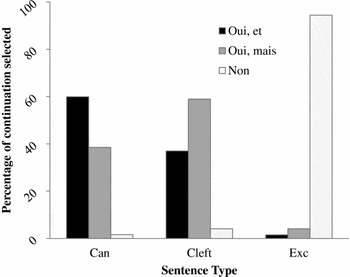
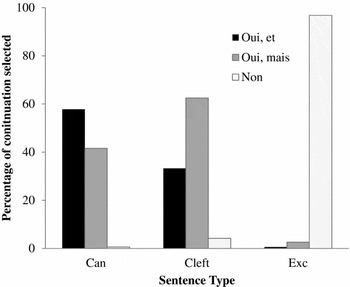
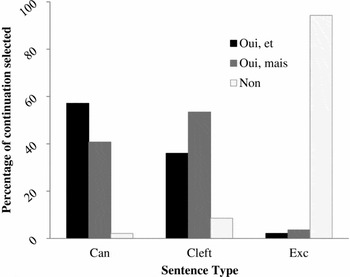
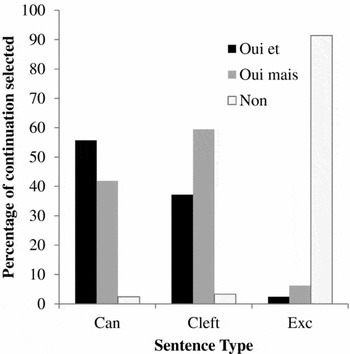
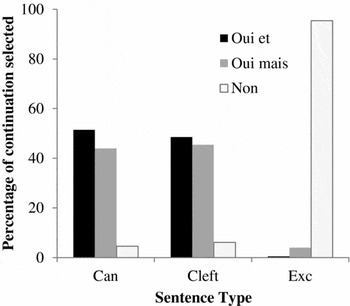
We first present a descriptive summary of the data. The continuations selected in each condition are reported for the French controls (from Destruel, Reference Destruel2013) in Figure 1. The English controls’ data appear in Figure 2, and the L2 French data (all proficiency levels combined for the moment) in Figure 3.
French native speaker responses.

English native speaker responses.

Second language responses (collapsed for proficiency).

The results from all three groups are remarkably similar. In particular, after exclusive sentences, all groups overwhelmingly chose the “no” continuation (English controls = 0.968, SD = 0.13; French controls = 0.944, SD = 0.11; L2 = 0.943, SD = 0.21), suggesting that all speakers perceive an inherent incompatibility between the truth-value of the exclusive sentence and the additional information. The L2 speakers, collapsed across proficiency levels, align with both NS norms, accurately interpreting the exclusive seul(ement) “only” as encoding exhaustivity in the semantics. From this we deduce first that L2 learners have acquired the lexical meaning of exclusives, showing that when the exhaustive inference is lexically encoded, it is unproblematic. Although this finding is important because it shows that when the exhaustive meaning is found at the syntax–semantic interface, it is acquired early on, it is also expected, as exclusive “only” and seulement overlap in meaning. In contrast, as we show subsequently, this is not the case when exhaustivity is pragmatically derived. Second, we deduce that all speakers understand the experimental task and do not respond at chance (i.e., responses distributed evenly across the three possible continuations). Note further that for all groups, the “no” continuation was used almost entirely to continue a discourse with an exclusive sentence and was rarely selected after clefts or canonicals. Thus, we excluded both the exclusive sentence condition and the “no” continuation from our statistical analyses, concentrating instead on the cleft versus canonical condition and on the “yes, and” versus “yes, but” continuations.Footnote 8 Consequently, our outcome measure (i.e., the type of continuation selected) is now binary (i.e., has two levels, “yes, and,” and “yes, but,” which were coded for the analysis as 0 and 1, respectively)
Before considering our research questions, we start by exploring the baseline data, looking at whether or not the two control groups exhibited significant differences with respect to their inferential behavior. We fit a model with sentence type and language group as the two fixed-effect predictors to the subset of the data for the English and French native groups. Language group was effect coded with –1 for English and +1 for French. Results revealed a main effect of sentence type (â = –0.94, SE = 0.30, t = –3.12, p < .001) but not of language group (â = 0.007, SE = 0.01, t = 0.61, p = .33), and no interaction between these two factors (â = 0.50, SE = 0.19, t = 1.55, p = .15). This indicates that both native control groups behave similarly in that they treat canonicals and clefts in a different fashion (i.e., they systematically select a different continuation for each sentence type).
To examine our first research question, which asked whether sentence type and grammatical function affected the type of continuation selected, we fit a model on the entire data set with these two variables as fixed effects. The results revealed a main effect of sentence type (â = –0.66, SE = 0.3, t = –2.22, p = .028), but not of grammatical function (â = 0.63, SE = 0.14, t = 0.78, p = .49). A model with sentence type as a factor gave a significantly better fit than a model without it (χ2 = 250.98, p < .001); the same did not hold true for grammatical function (χ2 = 9.37, p = .31). Furthermore, a model that included sentence type as the sole factor performed better than a model involving the interaction of the two factors (χ2 = 10.534, p = .034). On this basis, we excluded the factor grammatical function from all following analyses.
Our second research question looked at the L2 French speakers, asking whether, as a group collapsed for proficiency, their inferential patterns differ from those of the French native controls. Accordingly, the statistical model was run on the subset of data that included the native French and the L2 participants. Language group was effect coded as +1 for native controls and –1 for L2 learners. The model included the two fixed effects sentence type and language group, as well as their interaction. The results revealed a main effect for sentence type (â = –0.33, SE = 0.251, t = –2.26, p = .021), but no effect of language group (â = 0.13, SE = 0.26, t = 1.26, p = .18), nor an interaction of these two factors (â = 0.62, SE = 0.38, t = 1.8, p = .12). This suggests that L2 learners globally pattern with the native norm in their treatment of clefts versus canonicals.
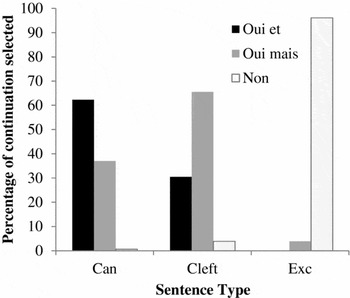
Our third research question examined the effect of L2 proficiency on the interpretation of the exhaustive inference. Analyzing our data by proficiency level was central in testing the IH as the hypothesis makes predictions specifically for the highest levels of L2 attainment. We thus sought to determine if the derivation of the exhaustive inference in French clefts remains subject to vulnerability in L2 speakers, especially in the most advanced group. Visual inspection of the data reveals that the response patterns for the high-proficiency learners (Figure 4) and for the intermediate group (Figure 5) do not seem to differ substantially from the French native norm (modulo some differences with canonicals for intermediates), but that a significant difference is likely for the speakers with lower proficiency (Figure 6).
High-proficiency group (≥37 points).

Intermediate-proficiency group (27–36 points).

Low-proficiency group (<26 points).

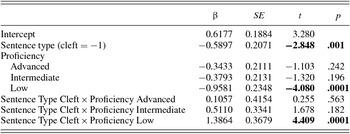
To confirm these observations, we ran a model on all of the French data (L2 learners and natives), predicting the likelihood of a “yes, and” responses from the fixed-effect predictors sentence type, proficiency, and their interaction. The native level was set as the reference group. Results, reported on in Table 1, reveal a main effect of sentence type, and an effect of proficiency only for the low-proficiency L2 group. There was no interaction of the two predictors for the advanced group or for the intermediate group, suggesting that these speakers, at these two proficiency levels, pattern with the native norm. There was, however, a significant interaction for the low group.
Full model predicting “yes, and” responses from sentence type, proficiency, and their interaction for second language learners

Note: The intercept is for native French speakers. Significant effects are in bold.
Concentrating on the data for the L2 learners only, we ran three additional models to compare the three proficiency-level groups to each other, thus further examining how the three groups differed with respect to sentence type, proficiency, and their interaction, which were included as fixed-effect predictors in all models. Here, proficiency was sum coded with three levels, and the reference category was set to each level in turn. The models did not converge with the maximal RES, so we ran them again with the interaction of the two predictors as random slopes for the subject term, and main effects for both predictors on the item term. In all three models, we found a significant effect of sentence type (t = –7.51; t = –5.34; t = –6.76, p < .001). We found no significant effect of proficiency between the high group and the intermediate group (â = –0.78, SE = 0.18, t = –1.69, p = .19), but we did find a main effect of proficiency between the high and low groups (â = –2.04, SE = 0.27, t = –6.68, p < .001), as well as between the intermediate and low groups (â = –1.23, SE = 0.19, t = –2.35, p = .03). Finally, we found a significant interaction between sentence type and proficiency between the high and intermediate groups (â = –1.38, SE = 0.28, t = –3.87, p < .001), as well as an interaction between the low and high groups (â = –2.95, SE = 0.26, t = –11.36, p < .001), and between the low and intermediate groups (â = –1.57, SE = 0.23, t = –6.78, p < .001). These results suggest that the effect of sentence type on the continuation chosen in the task is significantly different at different levels of proficiency.
To conclude the analyses, we focused on the effect of sentence type within each proficiency group. Here, we ran three models on the relevant subsets of data, one for each L2 proficiency group, with sentence type as the sole fixed effect. Reporting first on the high-proficiency group, we found a significant effect of sentence type (â = 0.883, SE = 0.458, t = 2.91, p = .19) in the nativelike direction. Turning to the intermediate group, we found a main effect for sentence type (â = 0.543, SE = 0.353, t = 2.02, p = .32), suggesting that, much like the native norm and the high-proficiency group, these speakers selected a different continuation for clefts versus canonicals. However, given that we found an interaction between sentence type and proficiency when comparing the high and intermediate groups, we further investigated the source of this interaction. Figure 5 suggests that the intermediate group treats canonical sentences differently than the high-proficiency group (and the NSs). When comparing the high-proficiency and intermediate-proficiency learners’ responses to canonicals, a main effect arose for proficiency (â = 0.81, SE = 0.26, t = 2.38, p = .027), revealing that the intermediate learners do not (yet) possess as strong of a preference for “yes, and” versus “yes, but” continuations after canonicals as the learners in the high group. Performing the same analysis for clefts, however, we found no effect for proficiency (â = 0.09, SE = 0.32, t = 0.77, p = 45). Thus, the intermediate learners have acquired the nativelike exhaustive inference for the cleft (like the high-proficiency learners), although their interpretation of exhaustivity in canonicals is not yet targetlike. Finally, the performance of the low-proficiency group revealed no effect of sentence type (â = 0.88, SE = 0.29, t = 1.07, p = .24); these learners did not vary their response preferences according to whether the sentence contained a c'est-cleft or a canonical.
DISCUSSION
Motivated by the observation that the exhaustive inference associated with clefts is an external interface property, a domain where the IH predicts residual difficulties even in advanced L2 acquisition, and that the c'est-cleft is thought to be learned relatively late in L2 French, we set out to test the validity of the IH with a task where speakers had to make a forced choice between three possible continuations of target sentences that corrected the exhaustiveness inference with various degrees of strength. In this section, we summarize the results before discussing the most important implications of our findings for L2 acquisition.
The results that emerge from the study are as follows:
-
1. In a global sense, L2 speakers exhibit similar inferential patterns to the English and French controls across the three sentence types. It is notable that exclusive sentences are consistently interpreted as semantically exhaustive.
-
2. Clefts are interpreted as more strongly exhaustive than canonicals (except by the low-proficiency L2 group), yet less exhaustive than exclusives, such that no group interprets the cleft as lexically exhaustive.
-
3. The most important point is that L2 proficiency modulates inferential patterns, with the data revealing a clear developmental sequence across the three proficiency groups.
Developing on this last point, we found specifically that, whereas the low-proficiency learners interpreted exclusives like all of the other speakers (both native controls included) did, their interpretation of c'est-clefts and canonical sentences was nontargetlike. In terms of L2 development, these results suggest that low-proficiency speakers already understand that the interpretation of exclusives differs from that of clefts and canonicals, although the details of this (pragmatic) relationship are not yet acquired. As Figure 6 revealed, in the cleft condition, these speakers selected “yes, and” in 48.5% of the cases and “yes, but” 45.4% of the time. This response pattern, although nontargetlike, does not represent at-chance behavior, in that very few “no” responses are selected. Rather, we contend that these results reflect optionality in the L2 grammar: these learners interpret the c'est-cleft without reference to discourse pragmatics. That is, in their grammars, the c'est-cleft represents a pragmatically neutral structure, either because they have no representation of its pragmatic properties or because they are unable to cope with the cognitive demands of integrating syntactic and discourse–pragmatic information (Sorace, Reference Sorace2011, p. 14), effectively voiding the structure of any pragmatic values. Consequently, at this stage of proficiency, L2 learners frequently attribute a weaker (or even absent) level of exhaustivity to clefts, as revealed by their higher rates of the “yes, and” response compared to speakers in the other groups.
In the intermediate group, the interpretation of exclusives remains (predictably) nativelike, and c'est-cleft sentences are now interpreted in a nativelike way as well. With respect to canonicals, these speakers evinced a more targetlike preference, but one that nevertheless differs statistically from that of the NS controls. Although emergent, the intermediate speakers’ mastery of exhaustivity in canonicals is not yet fully acquired. Finally, the performance of the high-proficiency group appears nativelike in all three target sentence conditions. Performance in the exclusive and c'est-cleft conditions remains stable from the previous developmental stage, and the response patterns for canonicals are now indistinguishable from those of the NSs as well. Like many syntax–discourse phenomena (Bohnacker, Reference Bohnacker2010; Donaldson, Reference Donaldson2011a, Reference Donaldson2011b; Sorace & Filiaci, Reference Sorace and Filiaci2006), a nativelike interpretation of exhaustivity involves preferences rather than absolute constraints, subtleties that are unlikely to be taught and that must be noticed and acquired uniquely from exposure to authentic language. In such input, the L2 learners’ target for both the c'est-cleft and canonicals is a set of NS preferences that show roughly a 40% preference for one interpretation and a 60% preference for another. That the highest proficiency learners acquired this (far from categorical) preference suggests not only that they are sensitive to NS interpretive patterns but also that they are able to integrate discourse–pragmatic and syntactic information in nativelike ways.
Let us now consider implications of our findings for L2 theory. As mentioned earlier, the present study was designed to test the empirical validity of the IH (Sorace & Filiaci, Reference Sorace and Filiaci2006) on the L2 acquirability of an external interface phenomenon. As noted previously, the interpretation of the exhaustive inference requires the integration of syntactic form and discourse–pragmatic knowledge drawn from context. The finding that only the high-proficiency group evinced nativelike behavior on both c'est-clefts and canonicals confirms that interpretive properties involving syntax and pragmatics are acquired later than semantic relations (Tsimpli & Sorace, Reference Tsimpli, Sorace, Bamman, Magnitskaia and Zeller2006; White, Reference White2011a). Yet, the fact that we find this group (i.e., all adult learners of L2 French) to pattern with the NS norm poses a challenge to the IH, which predicts that L2 performance at external interfaces will be characterized by optionality, indeterminacy, pragmatically neutralized default forms, or other evidence of nonnativeness, specifically at near-native levels of proficiency (Sorace, Reference Sorace2011, Reference Sorace2012; Sorace & Filiaci, Reference Sorace and Filiaci2006). In the present data, such effects arise but characterize only the low- and intermediate-proficiency groups. Crucially, our results show that these difficulties can be overcome at sufficiently high levels of L2 attainment, contrary to the IH. We note that these findings parallel those of several previous studies, on other aspects of the c'est-cleft among highly advanced or near-native speakers of L2 French, which have revealed similarly nativelike behavior. For instance, Donaldson (Reference Donaldson2012) reported nativelike use of the c'est-cleft to mark focus in a corpus of spontaneous conversations, and Reichle and Birdsong (Reference Reichle and Birdsong2014) reported nativelike ERP signatures in the processing of two types of focus encoded via the c'est-cleft.
Although many studies that test the IH examine language pairings that differ with respect to the feature in question (e.g., Belletti et al., Reference Belletti, Bennati and Sorace2007), the IH predicts residual difficulty even when the property in question is similar in the L1 and L2 (Sorace Reference Sorace2011). French c'est-clefts and English it-clefts fall into this category, as they pattern similarly with respect to the interpretation of exhaustivity (although they present subtle differences in discourse functions). The present findings and conclusions, which challenge the predictions of the IH, are corroborated by data from Slabakova (Reference Slabakova2010), who used offline data (like the present study) to investigate the scalar implicature “some but not all,” which functions similarly in English and Korean, in Korean L2 learners of English. At the intermediate and the advanced level, learners were more than 90% accurate in deriving the implicature in a pragmatically felicitous manner. Studies on subject-related properties in speakers of two null subject languages provide more such evidence of L2 convergence on L1 performance, at least at advanced proficiency levels (Lozano, Reference Lozano2002; Rothman, Reference Rothman2009). Taken together, results from these studies suggest, counter to the IH, that residual difficulties are not an inevitable outcome for interface phenomena, regardless of whether the L1 and L2 share the property in question.
One finding in the present study that remains to be explained is that low-proficiency learners pattern neither with the native French norm nor the native English norm. Schwartz and Sprouse (Reference Schwartz and Sprouse1996) posit massive L1 transfer in early L2 interlanguage, and initial states of the L2 grammar generally closely mirror the L1 grammar (White, Reference White1989). The similarity of English and French with respect to the exhaustivity of the it-cleft and the c'est-cleft leads to predictions of L1 pragmatic transfer. If learners transferred their L1 pragmatic preferences to the L2, we should observe a significant preference for “yes, but” continuations with clefts (and “yes, and” for canonicals), beginning with our lowest proficiency group. However, as discussed earlier, our results reveal a different situation, in which sensitivity to the exhaustive inference is absent in the lowest proficiency learners, developing progressively as proficiency increases.
Furthermore, this progressive development is unlikely to reflect the process of restructuring (as typified by a U-shaped curve), in which an initially targetlike interlanguage grammar experiences a period of divergence before once again moving toward convergence with the target. Rather, there is every reason to believe that our lowest proficiency learners (generally second- or third-year classroom university learners) are using c'est-clefts (and other noncanonical orders such as dislocations) for the first time, rather than restructuring a feature present from an earlier developmental stage. Although unclefted copular c'est emerges robustly in the first stages of French interlanguage, Bartning and Hammarberg (Reference Bartning and Hammarberg2007) find no tokens of the c'est-cleft until higher levels of proficiency (see also Ferdinand, Reference Ferdinand, Broekhuis and Fikkert2002; Sleeman, Reference Sleeman2004).
The degree of frequency of c'est-clefts in the input could explain the developmental cline that our data show. Usage-based theories of L2 acquisition, for example, relate development to input frequency (e.g., Ellis, Reference Ellis2006). However, as O'Grady, Lee, and Kwak (Reference O'Grady, Lee, Kwak, Ritchie and Bhatia2009) warn, “what counts is not how many times learners hear a particular form—it is how many times they encounter mappings between a form and its meaning” (p. 72). This observation is pertinent for the French c'est-cleft, given that, as discussed previously, the c'est-cleft is very common but can map onto multiple meanings (e.g., both nonexhaustive as well as exhaustive contexts), unlike in English. Thus, at a macrolevel, the input is conflicting with respect to pragmatic inferencing; learners will not consistently encounter clear one-to-one mappings between form and function. This property of the input could explain why the low-proficiency speakers do not converge on the native norms. Furthermore, if L1 transfer alone yielded a nativelike pragmatic interpretation of the cleft, and substantial exposure to authentic French was not necessary, we would anticipate no effect of proficiency. However, the results reveal that proficiency does modulate the interpretation of exhaustivity: increased exposure to and experience with authentic French outside the classroom leads these learners to an increasingly nativelike pragmatic interpretation of exhaustivity.
The question of cognitive resources also comes into play, especially because the IH identifies cognitive burden as one explanation for interface effects. Evidence exists that clefts incur higher processing costs compared to canonicals (Birch & Rayner, Reference Birch and Rayner1997; Hofmseiter, Reference Hofmeister2009), which for Drenhaus et al. (Reference Drenhaus, Zimmermann and Vasishth2011) is due to the extra processing step required to generate the exhaustive inference and associate the clefted element with it. Research on the processing of the exhaustive inference per se is scarce (but see Destruel & Farmer, Reference Destruel and Farmer2015), but if this argument is correct, the pragmatic derivation of exhaustivity comes at a cost.Footnote 9 L2 learners at early stages of proficiency may simply not possess sufficient processing resources to derive the inference. Thus, although there is no detrimental influence of L1 (because the inference arises with both English and French clefts), processing limitations (which may occur even in the absence of L1 transfer; Slabakova Reference Slabakova2010) might explain the low-proficiency speakers’ performance, an interpretation compatible with the IH (see Sorace Reference Sorace2011, Reference Sorace2012).
We further note that the L2 development in our data parallels child L1 development. Heizmann's (Reference Heizmann, Caunt-Nulton, Kulatilake and Woo2007, Reference Heizmann2012) investigations of the acquisition of cleft structures by English and German children are informative: the author finds that the cleft lacks an exhaustive interpretation in early stages of L1 acquisition but that children progressively develop this preference, as in the present L2 data. In both L1 and L2, a form (here, a cleft sentence) is acquired before its attendant pragmatic properties, a point that has received considerable discussion in the L2 literature (Bardovi-Harlig, Reference Bardovi-Harlig, Martínez, Juan and Guerra2003; Rothman, Reference Rothman2009; Trévise, Reference Trévise, Kellerman and Smith1986).
Finally, although the main focus of the paper is the c'est-cleft, we conclude this discussion by briefly examining one question raised by our findings, namely, the late acquisition of exhaustivity in canonical sentences. Only the highest proficiency learners evinced the nativelike preference for the nonexhaustive “yes, and” continuation. Although canonicals are frequent in written French, they are infrequent, and pragmatically marked, in informal conversation (Lambrecht, Reference Lambrecht and Tomlin1987). Nonetheless, in the NS portion of Donaldson's (Reference Donaldson2012) corpus of spontaneous conversations, canonicals are between two and three times more frequent than c'est-clefts. Given that the interpretation of c'est-clefts was acquired earlier than that of canonicals in the present study, the role of frequency is not straightforward. Although Slabakova (Reference Slabakova2015) argues that incomplete acquisition of interpretative (interface) properties may be due to a structure's rarity in the input, this explanation cannot explain why exhaustivity in canonicals proved more difficult than in c'est-clefts. One possibility is that canonicals, unlike lexical exclusives and c'est-clefts, lack any type of lexical trigger that could provide clues to their interpretation. We also speculate that in typical classroom input, proportions of canonicals are higher than in authentic discourse, and that their pragmatic properties are perhaps neutralized, such that canonicals are used in a wider range of pragmatic contexts in the classroom than in authentic spoken French. If so, sufficient exposure to authentic spoken French may be a prerequisite for acquiring nativelike preferences concerning the exhaustivity of canonicals. In our data, only the speakers in the highest proficiency group report that the majority of their exposure to French came from authentic sources. Notably, all of these participants had long since completed their instructed learning of French.
Conclusion
Moving beyond the mapping of c'est-clefts and pragmatic focus (Donaldson, Reference Donaldson2012; Reichle, 2010), the study in this paper investigated a more subtle pragmatic property: how L2 learners interpreted exhaustivity in c'est-clefted sentences. This property, which we also examined in sentences with lexical exclusives and canonical subject–verb–object sentences, has not to our knowledge been investigated previously in L2. Because exhaustivity in c'est-clefted sentences is not lexically encoded as part of the semantic meaning of clefts, it involves the coordination of syntactic and discourse–pragmatic information, for which the IH (Sorace & Filiaci, Reference Sorace and Filiaci2006) predicts residual difficulties at high levels of L2 proficiency. Although such difficulties arose in the low group, they did not persist among the intermediate- and high-proficiency learners, thus diverging from predictions made by the IH.
The present findings invite further investigation, for example, in the spirit of Reichle and Birdsong (Reference Reichle and Birdsong2014), who examined ERP signatures generated during online processing of c'est-clefts, or Dekydtspotter and Farmer (Reference Dekydtspotter, Farmer, Guijarro-Fuentes, Schmitz and Müller2016), who studied the effects of structural priming in the processing of clefts. One limitation of this study is that our data do not let us directly judge whether the L2 speakers process c'est-clefts the same way as NSs. As an anonymous reviewer remarked, one possibility is that, on this fairly metalinguistic task, the L2 speakers simply improve in their metalinguistic decisions. An online study (like Drenhaus et al., Reference Drenhaus, Zimmermann and Vasishth2011) would address this concern. The results also point to the interest of examining the acquisition of canonical subject–verb–object in L2 French. Although canonicals are considered a basic word order in French, our results show that L2 learners master the interpretation of exhaustivity later in this context than for c'est-clefts.
In sum, this study revealed a progressive acquisition cline in how L2 learners of French interpret exhaustivity in c'est-clefts. This L2 development culminates, in these data, in entirely nativelike performance, with no evidence of permanent residual impairment at this area of the syntax–pragmatics interface, contra the predictions of the IH.
APPENDIX A SAMPLE EXPERIMENTAL STIMULI
Subject condition
-
1. Qui est-ce qui a accueilli les élèves?
Canonical condition: Le prof a accueilli les élèves.
Cleft condition: C'est le prof qui a accueilli les élèves.
Exclusive condition: Seul le prof a accueilli les élèves.
-
Oui, et le directeur aussi a accueilli les élèves.
Oui, mais le directeur aussi a accueilli les élèves.
Non, le directeur aussi a accueilli les élèves.
Who welcomed the students?
Canonical condition: The professor welcomed the students.
Cleft condition: It's the professor who welcomed the students.
Exclusive condition: Only the professor welcomed the students.
-
Yes, and the director also welcomed the students.
Yes, but the director also welcomed the students.
No, the director also welcomed the students.
-
-
2. Qui est-ce qui a goûté la soupe?
Canonical condition: Le chef a goûté la soupe.
Cleft condition: C'est le chef qui a goûté la soupe.
Exclusive condition: Seul le chef a goûté la soupe.
-
Oui, et le serveur aussi a goûté la soupe.
Oui, mais le serveur aussi a goûté la soupe.
Non, le serveur aussi a goûté la soupe.
Who tasted the soup?
Canonical condition: The chef tasted the soup.
Cleft condition: It's the chef who tasted the soup.
Exclusive condition: Only the chef tested the soup.
-
Yes, and the waiter also tasted the soup.
Yes, but the waiter also tasted the soup.
No, the waiter also tasted the soup.
-
Object focus
-
1. Qui est-ce que le prof a accueilli?
Canonical condition: Le prof a accueilli les élèves.
Cleft condition: C'est les élèves que le prof a accueilli.
Exclusive condition: Le prof a accueilli seulement les élèves.
-
Oui, et le prof a aussi accueilli les parents.
Oui, mais le prof a aussi accueilli les parents.
Non, le prof a aussi accueilli les parents.
Who did the professor welcome?
Canonical condition: The professor welcomed the students.
Cleft condition: It's the students who the professor welcomed.
Exclusive condition: The professor welcomed only the students.
-
Yes, and the professor also welcomed the parents.
Yes, but the professor also welcomed the parents.
No, the professor also welcomed the parents.
-
-
2. Qu'est-ce que le chef a goûté?
Canonical condition: Le chef a goûté la soupe.
Cleft condition: C'est la soupe que le chef a goûté.
Exclusive condition: Le chef a goûté seulement la soupe.
-
Oui, et le chef aussi a goûté la salade.
Oui, mais le chef a aussi goûté la salade.
Non, le serveur a aussi goûté la salade.
What did the chef taste?
Canonical condition: The chef tasted the soup.
Cleft condition: It's the soup that the chef tasted.
Exclusive condition: The chef only tasted the soup.
-
Yes, and the chef also tasted the salad.
Yes, but the chef also tasted the salad.
No, the chef also tasted the salad.
-
ACKNOWLEDGMENTS
We thank Bob McMurray for his help and advice on the statistical analyses included in this paper. The analyses have also greatly benefited from the insightful comments from the associate editor. We are grateful to the two anonymous reviewers for their constructive criticisms, as well as to the participants at AAAL 2013 for discussion on a preliminary version of the study. All remaining errors are entirely our own.