I. INTRODUCTION
The design of novel synthetic protocols for nanostructured materials with tunable physicochemical properties is an important requirement in nanotechnology. Amongst the numerous nanostructured materials, gold nanoparticles (AuNPs), in particular, have received considerable attention because of their unique applications as diagnostic assays and imaging, thermal ablation, and radiotherapy. Reference Zhang, Gu, Chan, Wang, Langer and Farokhzad1–Reference Gindy and Prud'homme4 Small size and large surface area of the nanoparticles (NPs) allow them to readily pass into the targeted cells and transport big payloads of therapeutics, including DNA and specific drugs inside the targeted cell/organ. Reference Kumar, Hellermann, Lockeyand and Mohapatra5–Reference Ghosh, Kim, Han, Forbes and Rotello10 The effectiveness of these biomedical applications of NPs more specifically AuNPs requires to retain their inherent properties inside the targeted cell/organ where pH and electrolyte play an important role. Accordingly the synthetic protocols yielding the formation of monometallic NPs specifically AuNPs having salt and pH resistance ability may add innovations in biomedical applications of the noble metal NPs.
Apart from monometallic NPs, there is a need for making stabilized functional bimetallic NPs (BMNPs) under ambient conditions which remained a challenge from following aspects: (i) functional ability and biocompatibility for specific applications; (ii) stability and processability for nanocomposite formation. The synthesis of BMNPs by chemical reduction methods is therefore often performed in the presence of various functionalized stabilizers to prevent unwanted agglomeration of the colloidal BMNPs. Accordingly, there is a requirement of suitable reagents that not only act as reducing agent but also efficiently stabilize the BMNPs. The role of 3-Aminopropyltrimethoxysilane (3-APTMS) has further been explored in the synthesis of gold and silver BMNPs.
Heterometallic NPs composed of two or more metal elements with various nanostructures via different synthesis approaches have presented improved physical and chemical properties compared to their monometallic NPs in many fields, especially in catalysis. For this purpose, mono, bi, tri, and multimetallic NPs in solutions are prepared with appreciable stability using a variety of capping agents such as surfactant micelles, functional polymers, dendrimers, and so forth. For the synthesis of trimetallic NPs, a suitable synthetic single protocol is needed that can reduce all the three metal ions while complementing each other. The choice of formaldehyde and 3-APTMS seems quite reasonable for such conversion and fortunately interesting findings on the synthesis of trimetallic NP is recorded.
The role of organic amine during the formation of NPs has been extensively demonstrated in our laboratory. Reference Pandey and Chauhan11–Reference Pandey, Pandey, Jamal and Pandey17 We have demonstrated that 3-aminopropyltrimethoxysilane capped gold ions are precisely converted into respective NPs in the presence of wide range of reducing agents differing in the polarity index (3-glycidoxypropyltrimethoxysilane (3-GPTMS), cyclohexanone, tetrahydrofuran hydroperoxide (THF-HPO), acetaldehyde, formaldehyde, acetone, t-butyl methyl ketone). Our initial finding demonstrated the synthesis of functional AuNPs involving the active participation of 3-APTMS and 3-GPTMS. Reference Pandey and Chauhan11 The ratio of 3-GPTMS/3-APTMS controlled the dispersibility of as-synthesized AuNPs in desired solvent of known polarity index. Reference Pandey, Pandey and Pandey12 The use of two functional alkoxysilanes enabled auto hydrolysis, condensation, and polycondensation of resulting AuNPs accordingly we tried to replace one of them by other organic reducing agents. Accordingly, the use of THF-HPO, and cyclohexanone are demonstrated replacing the requirement of 3-GPTMS Reference Pandey, Pandey and Pandey13,Reference Pandey and Pandey14 as 3-APTMS may contribute other functional ability for yielding stabilized NPs. Depending upon the organic moiety used during the synthesis, as-generated NPs differ in properties. Reference Pandey and Pandey14 The micellar nature of 3-APTMS and choice of polar organic reducing agent may allow the salt and pH tolerance ability of as-made AuNPs. Further, some of organic reducing agents containing carbonyl group may allow the formation of imine derivative, along with AuNP formation, which may further control pH tolerance ability of as-made NPs. In addition to that, we have recently demonstrated the role of polyelectrolyte like polyethylenimine in the synthesis of AuNPs. Reference Pandey, Pandey and Narayan15,Reference Pandey and Pandey16 The cationic polymer may further manifest the pH and salt tolerance ability of as-made AuNPs. Accordingly, we have made a comparative investigation on the salt and pH resistance ability of gold NPs for biomedical applications and reported herein.
II. EXPERIMENTAL SECTION
A. Materials
Tetrachloroauric acid hydrate was purchased from HiMedia Laboratories (Mumbai, India); formaldehyde, is obtained from Merck (Mumbai, India); 3-aminopropyltrimethoxysilane was obtained from Aldrich Chem. Co. (Milwaukee, Wisconsin). Polyethylenimine (50 wt% in H2O, average M n 1200,60,000, 25,000) was obtained from Sigma Aldrich (Milwaukee, Wisconsin). All other chemicals used were of analytical grade. Aqueous solutions were prepared by using doubly distilled-deionized water (Alga water purification system). Unless mentioned otherwise, all the experiments were performed at room temperature. The absorption spectra of NPs were recorded using a Hitachi U-2900 spectrophotometer (Hitachi Corporation, Tokyo, Japan). Transmission electron microscopy (TEM) images were recorded using Morgagni 268D (FEI Electron Optics, Hillsboro, Oregon) operating at 200 kV.
B. 3-APTMS and formaldehyde mediated synthesis of AuNPs
3-APTMS stabilized AuNPs were synthesized according to the procedure described earlier. Reference Pandey, Pandey and Pandey12,Reference Pandey, Pandey and Pandey13 In a typical procedure, 1 mL of solution was prepared by mixing 0.3 mL solutions of 0.025 M of HAuCl4 to 0.3 mL solutions of 3-APTMS (1 M). The resulting yellow solution was stirred vigorously over a vertex cyclo mixer for 2 min. The solution was then subjected to reduction by adding a 0.4 mL of formaldehyde. The resulting mixture was stirred over a vertex cyclo mixer for 2 min. The mixture was left to stand in the dark for 2 h. After this, the color of the solutions turned to red indicating the formation of AuNPs. The properties of as-made AuNPs may be further controlled by varying the concentration of 3-APTMS.
C. Synthesis of bimetallic Pd–Au/Au–Pd made through THF-HPO and 3-APTMS
The preparation of BMNPs involves both simultaneous and sequential reduction of known ratio of metal salts. Pd–Au is made using K2PdCl4 and HAuCl4 in 4:1 ratio whereas Au–Pd is made using 1:4 ratios of the same. In simultaneous process for Pd–Au synthesis involves the mixing of 80 μL aqueous solution of K2PdCl4 (0.003 M) and 20 μL aqueous solution of HAuCl4 (0.01 M) under stirred condition followed by the addition of 10 μL of 3-APTMS (0.5 M) and 10 μL of THF-HPO. The reaction mixture turned into blackish-red within 2 h. Whereas the Au–Pd under simultaneous process was made as follows: 80 μL aqueous solution of HAuCl4 (0.01 M) was mixed with 20 μL aqueous solution of K2PdCl4 (0.003 M) under stirring condition, followed by the addition of 10 μL of 3-APTMS (0.5 M) and 10 μL of THF-HPO. After this, the color of NPs turned to reddish-black, indicating the formation of Au–Pd. In sequential method, the synthesis of Pd–Au involves the mixing of 80 μL aqueous solution of K2PdCl4 (0.003 M) and 10 μL of 3-APTMS (0.5 M) followed by addition of 10 μL of THF-HPO under stirred condition. The reaction mixture turned to black color after 1 h. To this 20 μL of 3-APTMS capped HAuCl4 (0.01 M) was added that enabled the formation of blackish-red color of Pd–Au within 2 h. Similarly, the sequential formation of Au–Pd involves the mixing of 80 μL aqueous solution of HAuCl4 (0.01 M) and 10 μL of 3-APTMS (0.5 M) under stirred condition followed by the addition of 10 μL of THF-HPO. The reaction mixture turned to red color after 1 h which was followed by the addition of 20 μL of 3-APTMS capped K2PdCl4 resulting the formation of reddish-black color of Au–Pd within 2 h. All the synthesis was performed at room temperature.
D. Cyclohexanone and 3-APTMS mediated synthesis of Ag–Au/Au–Ag BMNPs
The preparation of BMNPs of Ag–Au/Au–Ag involves the reduction of a known ratio of metal salts by 3-APTMS and another reducing agent like cyclohexanone. The ratio of gold and silver ions may either be chosen to be 4/1 or 1/4 that allow the formation of Au–Ag and Ag–Au respectively. For Ag–Au synthesis 12 μL methanolic solution of AgNO3 (0.025 M) and 12 μL methanolic solution of HAuCl4 (0.0025 M) are mixed under stirred condition followed by the addition of 06 μL of 3-APTMS (0.5 M) and 10 μL of cyclohexanone. The reaction mixture turned dark yellow within 2 h. Whereas Au–Ag is made using HAuCl4 and AgNO3 in 4/1 ratio and the synthesis involves the mixing of 12 μL methanolic solution of HAuCl4 (0.025 M) and 12 μL of methanolic solution of AgNO3 (0.0025 M) under stirred condition followed by the addition of 06 μL of 3-APTMS (0.5 M) and 10 μL of cyclohexanone. The reaction mixture turned purple within 1 h.
E. Formaldehyde and 3-APTMS mediated synthesis of PdNPs, (PdAu)NPs, and Ag@(AuPd)NPs trimetallic NPs
In a typical process, 3-APTMS was added into a yellow colored methanolic solution of PdCl2 followed by stirring over cyclomixer resulting into a colorless solution. The addition of formaldehyde into this resulted in black colored suspension of PdNPs in less than 30 s. Similarly, for BMNPs salts of Pd2+ and Au3+ were simultaneously reduced and stabilized using 3-APTMS and formaldehyde. Finally, for the synthesis of trimetallic Ag@(PdAu) NPs Ag+ was sequentially added to simultaneously synthesized (PdAu) BMNPs followed by stirring.
F. Polyethylenimine and formaldehyde mediated synthesis of AuNPs
Polyethylenimine (PEI) mediated synthesis of AuNPs was similar as described earlier. Reference Pandey and Pandey16 PEI (50 wt% in H2O, average M n 1.2 kDa) was diluted to 8% in methanol. 10 μL of tetrachloroauric acid (10 mM) was mixed with 10 μL of methanolic solution of polyethylenimine followed by the addition of 10 μL of formaldehyde. The mixture was homogenized on vertex mixture and allowed to stand at room temperature. The formation of AuNPs is triggered within 2 min after the addition of formaldehyde. The surface plasmon resonance wavelengths of AuNPs were controlled by increasing the amount of 10 mM methanolic solution of tetrachloroauric acid between 10 and 300 μL. Acetaldehyde/acetone/acetyl acetone/tert-butyl dimethyl ketone/cyclohexanone, THF-HPO can also be used in place of formaldehyde.
III. RESULTS AND DISCUSSION
A. Functional alkoxysilane mediated synthesis of AuNPs
The role of organic primary amine has received closer attention during the synthesis of noble metal NPs. Reference Pandey and Chauhan11–Reference Pandey and Pandey18 We have been able to demonstrate the controlled synthesis of noble metal NPs involving the role of functional alkoxysilanes for the first time. Reference Pandey and Chauhan11 It has been found that 3-APTMS treated noble metal ions can be very precisely converted into respective NPs in the presence of another functional alkoxysilanes like 3-GPTMS. Reference Pandey and Chauhan11 The role of both 3-APTMS and 3-GPTMS has been very well studied that precisely control the nanogeometry and dispersibility in various polar and nonpolar solvents, which are key points governing the practical applications of metal NPs. Reference Pandey, Pandey and Pandey13 The studies conducted further again demonstrated that 3-GPTMS can be replaced by variety of other organic reducing agents cyclohexanone, THF-HPO. Reference Pandey and Chauhan11–Reference Pandey and Pandey14 It has been found that the presence of such organic reducing agents along with 3-APTMS profoundly affects the properties of as-formed NPs. Specifically, the AuNPs made through 3-APTMS and 3-GPTMS are mostly dispersible in organic solvent with limited dispersibility in water under specific ratio of 3-APTMS/3-GPTMS whereas THF-HPO and 3-APTMS mediated NPs are mostly dispersible in relatively more polar solvent and are not dispersible in nonpolar media.
B. Role of organic amine linked to alkoxy group during the synthesis of AuNPs
The findings that involve the participation of two organically functionalized alkoxysilanes (3-APTMS and 3-GPTMS), at first instance, are directed to understand the need of two functional alkoxysilanes during the synthesis of noble metal NPs from respective metal ions. The synthesis of AuNPs utilizing active role of amines as capping and reducing agent containing trimethoxysilane moiety has been reported by Zhu et al. Reference Zhu, Pan, Hagaman, Liang, Overbury and Dai19 They used 3-(trimethoxysilylpropyl) diethylenetriamine (TMSP diene) for AuNP synthesis and found that the ratio of TMSP/Au3+ control the nanogeometry of resulting AuNPs. Time required for AuNP formation varied from 2 h to 23 h depending on the ratio of TMSP/Au3+. The unique structure of the TMSP dien–gold complex has shown key point to the rapid autoreduction. They also observed very slow conversion to NPs when TMSP is replaced with 3-APTMS since prolonged autoreduction tenure enable the hydrolysis and polycondensation of silanol residue. These findings reveal that reducing and stabilizing ability of 3-APTMS however predict the essential requirement of additional reducing agent for real time and controlled NP synthesis. Accordingly the need of 3-GPTMS, as evidenced from our previous findings, justifying the reduction of palladium chloride Reference Pandey, Upadhyay, Tiwari and Sharma20 is sought along with 3-APTMS for the conversion of Ag+ into AgNPs and gold ions into AuNPs. Further, to have deeper insight, the mechanistic role of 3-APTMS and GPTMS mediated synthesis of AuNPs needs to be precisely evaluated. 3-APTMS and GPTMS are hydrophilic and hydrophobic in nature, respectively. It is found that GPTMS on mixing with water generates two separate layers whereas a homogeneous single layer is observed in methanolic medium. In this process, methanol is acting as a reactant converting hydrophobic GPTMS to hydrophilic methanolic solution. The addition of 3-APTMS to GPTMS and vice versa, drastically affects the interaction dynamics which has been one of the findings of the present investigation.
C. Variation in the dynamics of functional alkoxysilanes mediated synthesis of NPs as a function of nature of noble metal ions
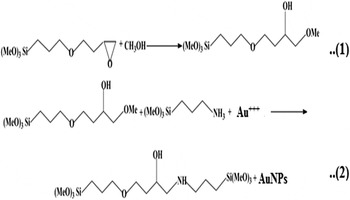
The results based on these lines reveal significant role of Ag+/Au+++ and clearly demonstrate the following: (i) the addition of GPTMS to 3-APTMS present in reaction system enable faster interaction between glymo- and amino-residue as compared to that of 3-APTMS to GPTMS, justifying the requirement of necessary APTMS molecules per GPTMS molecule. (ii) The addition of 3-APTMS to HAuCl4 treated GPTMS allows the slow interaction as justified from relatively small variations in absorbance at 280 nm as compared to that of the same when GPTMS is added to 3-APTMS treated gold ion again justifying the role of available number of 3-APTMS molecules per GPTMS at the site of glymo- and amino-residue interaction and does not enable the synthesis of AuNPs. (iii) When GPTMS is added to 3-APTMS in the presence of AgNO3, the new absorbance peak at 280 and 420 nm is more facilitated than that of the same without gold cations, validating that Au+++ is catalyzing the reaction between glymo- and amino-residues and enable the synthesis of AgNPs/AuNPs. The findings discussed above provided valuable information related to the synthesis of AgNPs/AuNPs and confirmed that only 3-APTMS capped gold cations undergo 3-GPTMS mediated reduction into AuNPs. It is again necessary here to understand the reactivity of functional constituents to study the mechanism of such process. The investigation on the specific interaction of 3-APTMS and [2-(3,4-epoxycyclohexyl)ethyl]trimethoxysilane resulted into the formation of solid-state network of organically modified silicate thin film. Reference Pandey, Upadhyay, Tiwari and Sharma21,Reference Pandey, Upadhyay and Pathak22 These observations also predict that 3-APTMS may facilitate the reducing ability of 3-APTMS compatible reducing agent which is a key point during GPTMS mediated synthesis of metal NPs. The epoxide linkage of GPTMS may open in the presence of methanol as evidence from the homogeneous layer in water after the addition of methanol and such epoxide ring opening leads to hydroxy and methoxy derivatives of the same. The interaction of 3-APTMS with metal ions due to their lewis acid character also justifies the reducing ability of 3-APTMS. A mechanism of GPTMS mediated synthesis of AgNPs in the presence of 3-APTMS is hypothesized. The proposed mechanism of 3-APTMS and GPTMS mediated synthesis of AgNPs based on the above observations is shown in Scheme 1:
Mechanism of GPTMS and 3-APTMS assisted formation of AuNPs.

The mechanistic approach on the interaction of 3-APTMS and GPTMS may be better explained from the report on the formation of inorganic–organic hybrid. Reference Pandey, Upadhyay, Pathak, Tiwari and Tripathi23,Reference Wight and Davis24 The role of nitrogen containing compound as base catalyst has been demonstrated and reviewed. It has been shown that 3-APTMS interact with small organic molecule containing aldehyde group, forming imine linkage whereas GPTMS undergoes interaction with nitrogen containing organic molecule like imidazole/1,5,7-triazabicyclo[4.4.0] dec-5-ene, forming tertiary amine derivative of glymo-residue. When small organic molecule is replaced by another alkoxysilane (GPTMS/3-APTMS) and allowed the interaction of the same, out of which the first one is hydrophobic whereas the second one being hydrophilic controlled interaction, is recorded. The results recorded on these reveal that when 3-APTMS is added in excess of GPTMS, there has been negligible extent of interaction between two functional alkoxysilanes due to partial homogeneity of the reacting system whereas when GPTMS is added in controlled way into excess of 3-APTMS, homogeneity in the system is availed that allowed the interaction of the same since 3-APTMS behaves as a micelle. In addition to that, such functional interaction is facilitated in the presence of Au3+ ion resulting in the formation of AuNPs during such process and justifies the originality of the reported process. In absence of either 3-APTMS or GPTMS, the synthesis of metal NPs is not observed.
Accordingly, a comparative study was made on the conversion of silver ions and gold ions into AgNPs and AuNPs, respectively, in the presence of 3-APTMS and GPTMS and to resolve the differences in NPs formation. The findings reported earlier Reference Pandey, Pandey and Pandey13 clearly demonstrated two important steps recorded during 3-APTMS and GPTMS mediated synthesis of NPs: (i) interaction of noble metal ions with 3-APTMS and (ii) interaction of 3-APTMS capped noble metal ions with GPTMS. The results recorded on these lines justify the faster interaction of 3-APTMS with gold ions whereas the same is slow with silver ions. Reference Pandey, Pandey and Pandey13 Further the GPTMS undergoes faster interaction with 3-APTMS capped silver ions whereas the same is slow in case of gold ions under similar conditions. Reference Pandey, Pandey and Pandey13 In addition to that, the interaction of palladium ions with 3-APTMS and GPTMS is quite different since palladium ions specifically react with glymo-residue of GPTMS followed by reduction of the same together with the formation of Pd–C linkage in absence of 3-APTMS as reported earlier. Reference Pandey, Upadhyay, Tiwari and Sharma20,Reference Pandey, Upadhyay, Tiwari and Sharma21
D. Role of small organic reducing agents during 3-APTMS mediated synthesis of AuNPs
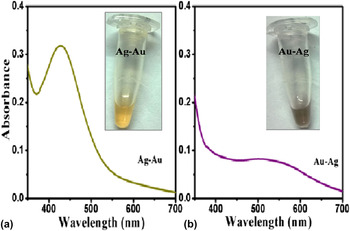
The functional ability of alkoxide group associated to the use of two organically functionalized alkoxysilanes during the synthesis of noble metal NPs may introduce auto hydrolysis, condensation, and polycondensation enabling the formation of –Si–O–Si linkage. Accordingly, an attempt has been made to replace one of the alkoxysilanes by other suitable organic reducing agents as a function of polarity index that may add to the dispersibility of as-generated NPs in targeted solvent. The first choice is the use of cyclohexanone that has been found to enable the synthesis of NPs even in the absence of 3-APTMS. However, in the presence of 3-APTMS, the process precisely controls the conversion of metal cations into respective NPs and further manifests the synthesis of BMNPs. 3-APTMS and cyclohexanone enable the synthesis of AgNPs. The similar reducing agents may also enable the synthesis of BMNPs of silver and gold. The results based on UV–Vis spectroscopy on Ag–Au formation at two different ratios of Ag/Au i.e., 1/4 and 4/1 are shown in Fig. 1 and reveals the formation of BMNPs, and the insets of Fig. 1 show visual images of the same. The TEM image of Ag–Au (1/4) NPs with an average particle size of 10.3 nm justifies the polycrystalline pattern of BMNPs. When silver salt:gold salt ratio is 4:1, it has been found that cyclohexanone on mixing with 3-APTMS capped Ag+:Au3+ ions immediately converted into a yellow solution. which subsequently leads into Ag–Au BMNPs. While silver salt:gold salt ratio is 1:4, cyclohexanone on mixing with 3-APTMS capped metal ions immediately converted into a magenta color which subsequently leads into Au–Ag BMNPs. The observations based on UV–Vis spectroscopy and imaging photography justify the conversion of silver nitrate and auric chloride into bimetallic Ag–Au/Au–Ag NPs. The morphology of bimetallic Au–Ag reveals circular morphology and well-monodisperse average particle size of 10.3 nm. The electron diffraction pattern exhibiting six rings assigned to (111), (200), (220), (311), (222), and (331) lattice planes with spacing 0.220, 0.191, 0.134, 0.114, 0.110, and 0.087 nm are observed which may be indexed based on the fcc lattice of silver and gold.
The UV–Vis spectra of the Ag–Au and Au–Ag and the insets show visual photographs of the same.

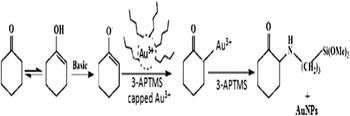
The role of 3-APTMS and cyclohexanone has not been limited to noble metal NP synthesis but also precisely enabled the synthesis of polycrystalline Prussian blue NPs, revealing the potentiality of these NPs in the formation of nanocomposite. The use of cyclohexanone shows biphasic behavior in aqueous medium; accordingly, the choice of hydrophilic organic reducing agent like formaldehyde has been sought. Exchange of formaldehyde by cyclohexanone under similar condition again causes variation in the dynamics of NP synthesis. The micellar behavior of 3-APTMS controls the requirement of organic reducing agent during NP synthesis. An increase in micellar activity always facilitates the AuNP formation whereas, relatively lower concentration retards the same. The proposed mechanism for the 3-APTMS and cyclohexanone mediated synthesis is shown in Scheme 2.
Mechanism of cyclohexanone and 3-APTMS assisted formation of AuNPs.

The use of cyclohexanone enables the dispersibility of AuNPs in both organic and aqueous medium. Reference Pandey and Pandey14 These finding are mainly limited to the dispersibility of as-made NPs in pure solvents and directed to study the significance of suitable organic reducing agent along with 3-APTMS in polar solvent and the choice of THF-HPO is demonstrated. The use of THF-HPO along with 3-APTMS enables the synthesis of monometallic NPs dispersible in polar solvents. The same process also enables the synthesis of BMNPs of Pd–Au and Au–Pd under two different conditions; (i) simultaneous and (ii) sequential. Reference Pandey, Singh and Pandey25–Reference Pandey, Singh and Pandey27 In simultaneous synthesis, both palladium and gold salts are mixed together with reducing agents (3-APTMS and THF-HPO) whereas in sequential method either PdNPs or AuNPs are synthesized first with reducing agents followed by allowing the formation of AuNPs or PdNPs thereafter on core–shell. A comparative study was made on the synthesis of BMNPs through simultaneous and sequentially. The major findings recorded during the simultaneous and sequential synthesis of NPs are as follows: (i) Pd–Au NPs made through simultaneous method show disappearance of absorption at 530 nm which is characteristics of AuNPs for 80:20 ratios of Pd and Au. (ii) Au–Pd NPs made through simultaneous method show intense absorption at 530 nm for 20:80 ratio of Pd and Au salt. (iii) Pd–Au made through sequentially method shows a plateau justifying sign of AuNPs for 80:20 ratio of Pd and Au. (iv) Au–Pd made through sequentially under similar condition as in (ii) shows less intense sign of AuNPs for 20:80 ratios of Pd and Au salt.
E. 3-APTMS mediated synthesis of bimetallic and trimetallic NPs
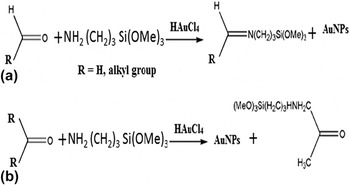
The finding discussed above reveals major role of suitable organic reducing agent along with 3-APTMS that govern the usability of NPs in targeted solvent and directed us to investigate the role suitable reagent that enables pH and salt resistance ability of the same. Accordingly, at first instance, the use of formaldehyde has been demonstrated. The use of formaldehyde along with 3-APTMS allows the conversion of both monometallic and BMNPs as observed either through the participation of 3-APTMS and 3-GPTMS or 3-APTMS and cyclohexanone. In addition to that, 3-APTMS and formaldehyde also allow the rapid synthesis of trimetallic NPs. These findings revealed the reducing and stabilizing ability of 3-APTMS and also predict the essential requirement of additional reducing agent for real time and controlled NP synthesis. Accordingly, our previous findings have evidenced the need of suitable organic reducing agent along with 3-APTMS for the conversion of Au, Ag, and Pd to their respective NPs. Reference Pandey and Chauhan11 Accordingly, attempt has been made to synthesize trimetallic NPs of Pd, Au, and Ag involving the role of 3-APTMS and formaldehyde leading to the formation of Pd, (PdAu), and Ag@(PdAu) trimetallic NPs. Reference Pandey and Pandey18 The disappearance of peak at 415 nm for Pd2+ concomitant with the appearance of black color, together with evidences from other characterizations discussed vide infra in the paper establishes the PdNP synthesis from Pd2+. Reference Pandey and Pandey18 The trimetallic is synthesized via bimetallic Pd/Au NPs and the bimetallic used for trimetallic NPs can be made by two routes: (i) Au@Pd, the first route is sequential that witnesses the sequential reduction of Pd2+ and Au3+, respectively, using 3-APTMS and formaldehyde. Reference Pandey and Pandey18 The second one is simultaneous route where both Au3+ and Pd2+ salts are simultaneously reduced in the presence of 3-APTMS and formaldehyde yielding the formation of PdAu. The formation of BMNPs under both condition have been evidenced spectrophotometrically. Reference Pandey and Pandey18 The concentration of the Pd2+, Au3+, Ag+, 3-APTMS, and formaldehyde control the dynamics of the NP synthesis. The electron diffraction pattern for PdAu and Au@Pd exhibited four rings assigned to (111), (200), (220), and (311) lattice planes. The values of d-spacing for the ring indexed 220 corresponded to Au while others matched with PdNPs. The presence of rings corresponding to both Au and Pd rules out the possibility of alloying in both cases. PdAu BMNPs when made simultaneously take core shell structure. Owing to atomic weight difference in Pd (106.42) and Au (196), there is a contrast difference in their imaging. Reference Pandey and Pandey18 Also during simultaneous synthesis, reddish appearance of sol is followed by blackening of the same thus proving the AuNP synthesis ahead of PdNPs and hence core shell structure. In case of sequential Au@PdNPs, aggregates remain as such without any segregation of PdNPs on addition of AuNPs displaying uniform gradation as in PdNPs. Besides AuNPs can also be seen in spherical shapes in the TEM images far separated from PdNPs clusters Thus we conclude that simultaneously made (PdAu) take core–shell structure while Au@Pd take no specific design. TEM images of the NPs with corresponding diffraction pattern show the aggregates of very small structures leading to cluster (nearly 2–4 nm) displaying a flower like arrangement. Reference Pandey and Pandey18 Aggregate formation is due to the self assembling nature of 3-APTMS. The self assembling nature also confirms the capping ability of 3-APTMS on palladium surface. The TEM images of (PdAu) BMNPs also display aggregates of small units but they are more dispersed and less aggregated than PdNPs making more surface area available for any catalytic reaction. Reference Pandey and Pandey18 The TEM images of Ag@(PdAu) trimetallic NPs show discrete pear shaped AgNPs attached to (PdAu) BMNPs, further enhancing the surface area. Diffraction pattern reveals a ring pattern for PdNPs, (PdAu)NPs, and Ag@(PdAu)NPs. Reference Pandey and Pandey18 Such investigation again required the use of suitable organic reducing agent with control in their alkyl chain for precise understanding on the salt and pH resistant behavior of AuNPs and the role of formaldehyde, acetaldehyde, acetone, and t-butyl methyl ketone are demonstrated during the conversion of 3-APTMS capped gold ions into AuNPs. Reference Pandey, Pandey, Jamal and Pandey17 Fortunately we found that all these organic reducing agents enable the synthesis of AuNPs within less than 1 h under ambient condition. Such finding revealed specific interaction between organic carbonyl moiety and 3-APTMS that may govern the pH sensitivity of the resulting AuNPs. The mechanism of 3-APTMS and carbonyl group containing organic reducing agents mediated conversion of noble metal cations into respective NPs is shown in Scheme 3.
Proposed mechanism for 3-APTMS interaction with aldehydes (a) and ketones (b) during AuNP synthesis.

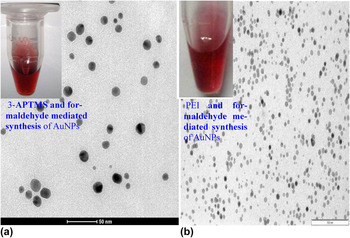
Subsequently, we extended out finding on the exchange of 3-APTMS by other organic amine containing polyelectrolyte along with such aliphatic aldehyde and many other and indeed interesting finding on the synthesis of AuNPS mediated by polyethylenimine and formaldehyde was recorded. The use of these organic functionalities during the synthesis of AuNPS has been examined toward the pH and salt tolerance ability of AuNPs. Figure 2 shows the TEM images of AuNPs made from 3-APTMS and formaldehyde (a) and PEI and formaldehyde (b). The finding based on TEM observation reveals that AuNPs are well dispersed when PEI and formaldehyde are used as reagent whereas the same allow the dispersion of AuNPs as a function of 3-aminopropyltrimethoxysilane concentrations when PEI is replaced by 3-APTMS. The micellar behavior of 3-APTMS controls the dispersibility of as-made AuNPs.
TEM images of AuNPs made through 3-APTMS and formaldehyde (a) and polyethylenimine and formaldehyde (b). The inset shows the visual image of respective AuNPs.

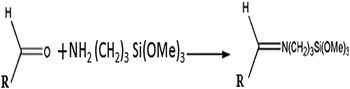
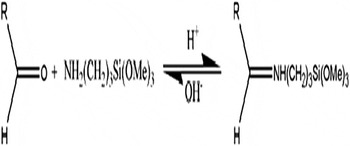
The chemistry of 3-APTMS and formaldehyde has been examined on the pH tolerance ability of AuNPs. These findings predict that the role of specific reaction between formaldehyde during 3-APTMS. Such interaction enables the formation of imine derivative of 3-APTMS and formaldehyde as shown in Scheme 1 and reveals the following conclusions: (i) Imines are typically formed by the condensation of primary amines and aldehydes. (ii) Imines are formed less readily with ketones than with aldehydes. (iii) A solution of 3-APTMS and formaldehyde or 3-APTMS and acetaldehyde is catalytic in nature. (iv) A solution of 3-APTMS and acetone or 3-APTMS and t-butyl methyl ketone is noncatalytic in nature. (v) Imines are catalytic in nature.
F. pH and salt resistance ability of functional AuNPs
The AuNPs made with sodium citrate are very stable due to charge stabilization associated with electrostatic repulsion. Reference Pandey and Chauhan11 However, the addition of small amount of salt into such AuNP suspension results agglomeration because of charge screening and NPs approach each other because of London attractive forces. Reference Pandey, Pandey and Pandey12,Reference Pandey, Pandey and Pandey13 However, the therapeutics and diagnostics applications of AuNPs preferably require insensitivity of the nanogeometry to the working medium including complex biological systems. Therefore, control over salt and pH sensitivity of AuNPs requires a precise investigation. The use of 3-APTMS along with several other reducing agents specifically aldehyde group can provide an impeccable control over such properties forming imine derivative as shown in Scheme 4. Earlier finding about the AuNPs made through cyclohexanone and 3-APTMS can be dispersible in both aqueous and nonaqueous medium. Reference Sokolova and Epple7 The finding demonstrated the decrease in dispersibility of AuNPs on increasing the ionic strength of the aqueous solution attributed to the micellar behavior of 3-APTMS that precisely control the miscibility of organic reducing agent as a function of their critical micellar concentration. Water-loving organic reducing agent, besides imparting water dispersibility to AuNPs, also plays important role in salt and pH resistant properties of AuNPs. Stability of AuNPs made using 3-APTMS and formaldehyde, acetaldehyde, acetone in water, and four different buffering medium of pH 8, 7, 6, and 5 is examined. AuNPs made using aldehydic reducing agents are more pH-resistant compared to AuNPs made using ketonic reducing agents. Similarly, the effect of 3-APTMS concentration on pH resistant properties of AuNPs has also been examined. The results justify the following: (i) The imine formation between 3-APTMS and organic reducing agent enable pH tolerance of as-synthesized AuNPs. (ii) AuNPs made with aldehyde and 3-APTMS are relatively better pH resistant than that made from ketone and 3-APTMS. These findings are in accordance to earlier reports on the dependence of λmax as a function of nanogeometry revealing red shift in absorbance maxima with an increase in size of AuNPs. Reference Pandey and Pandey16,Reference Pandey, Pandey, Jamal and Pandey17
Formation of imine derivative of formaldehyde and 3-APTMS.

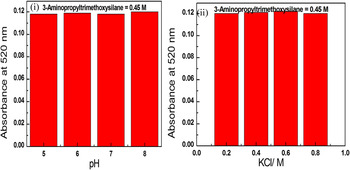
The concentrations of 3-APTMS play important role in determining the pH tolerance ability of AuNPs. It has been found that decrease in 3-APTMS concentration while making the AuNPs causes poor pH tolerance ability whereas an increase in 3-APTMS concentrations subsequently enhances the pH tolerance ability of AuNPs. The use relatively high 3-APTMS concentration during the conversion of gold cations enables the formation of AuNPs apparently insensitive to pH as evidence from the measurement of absorbance maxima at 520 nm in 0.1 M phosphate buffer of pH 5, 6, 7, and 8 as shown in Fig. 3 The insensitivity of AuNPs to variable pH is attributed to the following: (i) an increase in micellar behavior of the system and (ii) an increase in imine derivative in the suspension medium that promote the stability of AuNPs against pH change. Scheme 2 shows the equilibrium involved during imine formation from 3-APTMS and aldehydes. As can be seen from Scheme 2, there exists an equilibrium between imine formed and the reactants involved, forward step being catalyzed by H+ while the backward step by OH−. This itself explains why a small change in pH does not affect the stability of AuNPs. With an increase in concentration of the 3-APTMS, there is increased formation of imine thus imparting greater stability toward change of pH. In addition to that, an increase in 3-APTMS concentration causes increase in micellar activity that allows high salt tolerance during specific application. Therefore, enhancement in the micellar activity of AuNPs suspension results in high salt tolerance ability of AuNPs as shown in Fig. 3.
Dependence of absorbance maxima at 520 nm of AuNPs as function of pH and salt.

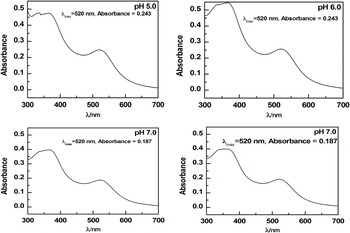
The use 3-APTMS introduces the functional ability of alkoxide which may be explored for hydrolysis and condensation of alkoxy group leading to the formation of organically modified silicate. An attempt has also been made to exchange 3-APTMS by other organic amines that allow the formation of AuNPs in the presence of formaldehyde and indeed polyethylenimine had been investigated as an alternative choice. The water-loving organic reducing agent like polyethylenimine besides imparting water dispersibility to AuNPs, also plays important role in introducing salt and pH stability of AuNPs that facilitate the use of noble metal NPs in biomedical applications. Stability of AuNPs made using PEI and formaldehyde in water and four different buffering mediums of pH 8, 7, 6, and 5 is examined. PEI-stabilized AuNPs have excellent pH-stability as shown in Fig. 4. The results justifying the potential usability of AuNPs in 0.5 M KCl is shown in Fig. 5. The use of alcoholic medium during PEI and formaldehyde mediated conversion of AuNPs allows relatively better salt tolerance ability. The pH and salt tolerance ability is found as a function of micellar activity of 3-APTMS which increases with an increase in the concentration of the same keeping the concentration of formaldehyde constant in each case. However, the replacement of formaldehyde by other water-loving reducing agents like THF-HPO facilitate the pH and salt tolerance ability of as-made AuNPs whereas the use of cyclohexanone of t-dibutyl ketone results decrease in pH and salt tolerance ability of AuNPs. The use of PEI and formaldehyde provides additional advantage in making AuNPs having better pH and salt tolerance ability. These reagents allow the synthesis of AuNPs even in the desired medium thus facilitating the pH tolerance ability of AuNPs of desired pH. PEI and formaldehyde mediated conversion has been observed even in 0.1 M phosphate buffer, of desired pH (5, 6, 7, and 8). Further, these reagents also enable the synthesis of AuNPs even in high salt concentration. However, the viscosity of the solution need to be adjusted for practical application. The polycationic nature of PEI allows its stabilization in desired salt concentration and the use of formaldehyde enables the conversion of gold cations into AuNPs in targeted medium (Scheme 5).
Absorbance spectra of AuNPs made from the participation of PEI and formaldehyde as a function of pH.

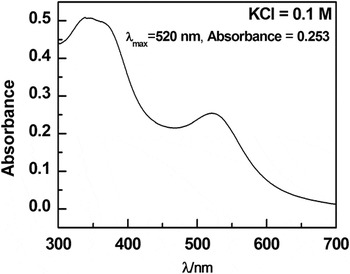
Absorbance spectra of AuNPs made from the participation of PEI and formaldehyde in 0.5 M KCl.

Acid-base equilibrium involving the participation of imine derivative.

IV. CONCLUSION
In summary, the synthesis of AuNPs having salt and pH tolerance ability has been investigated. Organic amine like 3-aminopropyltrimethoxysilane or polyethylenimine allows controlled conversion of gold cations into AuNPs in the presence of formaldehyde. It has been found that an increase in 3-APTMS concentrations allows the formation of AuNPs, which are relatively least sensitive to variable pH. In addition to that, the AuNPs made at high 3-APTMS concentrations facilitate the salt tolerance ability of AuNPs. Similarly, the AuNPs made through the participation of PEI and formaldehyde also results into AuNPs having excellent pH and salt tolerance ability. PEI and formaldehyde allow the conversion of gold cations into AuNPs even in targeted pH and salt concentrations providing novel approach for the synthesis of AuNPs for biomedical applications. In addition to that, 3-APTMS along with suitable organic reducing agent provide a novel way for synthesizing monometallic, bimetallic, and trimetallic NPs with control over nanogeometry and dispersibility in targeted solvents.
ACKNOWLEDGMENT
Thanks to UGC for one time grant.