Introduction
Imaging studies have consistently demonstrated differences in brain morphology in people with schizophrenia compared with healthy controls (Haijma et al. Reference Haijma, Van Haren, Cahn, Koolschijn, Hulshoff Pol and Kahn2013). The evolution of these abnormalities over the course of illness has been a subject of interest. Smaller grey matter volumes are apparent in the prodrome, and additional reductions have been reported in the months immediately after onset of first psychotic symptoms (Pantelis et al. Reference Pantelis, Velakoulis, McGorry, Wood, Suckling, Phillips, Yung, Bullmore, Brewer, Soulsby, Desmond and McGuire2003). Furthermore, longer term studies indicate that progressive reductions in brain volume continue to occur (Hulshoff Pol & Kahn, Reference Hulshoff Pol and Kahn2008; Smieskova et al. Reference Smieskova, Fusar-Poli, Allen, Bendfeldt, Stieglitz, Drewe, Radue, McGuire, Riecher-Rossler and Borgwardt2009; Kempton et al. Reference Kempton, Stahl, Williams and DeLisi2010; Olabi et al. Reference Olabi, Ellison-Wright, McIntosh, Wood, Bullmore and Lawrie2011). While these progressive changes have been thought to reflect disease progression (Lieberman et al. Reference Lieberman, Chakos, Wu, Alvir, Hoffman, Robinson and Bilder2001), recent attention has focused on the possibility that they may, at least in part, be related to antipsychotic treatment. Attention was drawn to this possibility when it was reported that macaque monkeys exposed to haloperidol or olanzapine over 17–27 months showed substantial brain volume reductions (Dorph-Petersen et al. Reference Dorph-Petersen, Pierri, Perel, Sun, Sampson and Lewis2005). A few studies have directly investigated this possibility. In a study in patients with schizophrenia who underwent repeated neuroimaging for up to 14 years, greater intensity of antipsychotic treatment was associated with smaller grey matter volumes and progressive reductions in white matter volume, while illness severity had relatively modest correlations with volume reductions. These authors concluded that antipsychotics have a subtle but measurable influence on brain tissue loss over time (Ho et al. Reference Ho, Andreasen, Ziebell, Pierson and Magnotta2011). In a study of 33 patients with schizophrenia and 71 controls selected from the Northern Finland Birth Cohort 1966 who underwent a magnetic resonance imaging (MRI) brain scan at the age of 33–35 years and a follow-up scan 9 years later the mean annual whole-brain volume reduction was 0.69% in schizophrenia, and 0.49% in controls (p = 0.003). The volume reductions were not associated with symptom severity, functionality or cognitive decline, but the estimated amount of antipsychotic medication prescribed over the follow-up period predicted brain volume loss (p = 0.003) (Veijola et al. Reference Veijola, Guo, Moilanen, Jaaskelainen, Miettunen, Kyllonen, Haapea, Huhtaniska, Alaraisanen, Maki, Kiviniemi, Nikkinen, Starck, Remes, Tanskanen, Tervonen, Wink, Kehagia, Suckling, Kobayashi, Barnett, Barnes, Koponen, Jones, Isohanni and Murray2014). Finally, a subsequent voxel-wise analyses of the same Northern Finland Birth Cohort sample found that, compared with controls, patients exhibited greater progressive brain reductions, and that ventricular enlargement was predicted by greater exposure to antipsychotic medication (Guo et al. Reference Guo, Huhtaniska, Miettunen, Jaaskelainen, Kiviniemi, Nikkinen, Moilanen, Haapea, Maki, Jones, Veijola, Isohanni and Murray2015).
The relationship between brain volume changes and antipsychotic treatment in schizophrenia has also been addressed retrospectively, in several systematic reviews and meta-analyses. An earlier review of structural MRI studies reported that first-generation antipsychotics (FGAs) were associated with increased basal ganglia volume and second-generation antipsychotics (SGAs) with decreased volume of the thalamus. Results also suggested an effect on the cortex with FGAs being associated with volume reductions, possibly with a dose-dependent effect, and SGAs with retention or increase in grey matter volumes (Navari & Dazzan, Reference Navari and Dazzan2009). A systematic review and meta-analysis conducted in over 18 000 patients reported that, compared with healthy controls, brain volume was significantly smaller in patients with schizophrenia. Differences were most pronounced for grey matter and were associated with a higher prescribed dose of antipsychotic medication (Haijma et al. Reference Haijma, Van Haren, Cahn, Koolschijn, Hulshoff Pol and Kahn2013). In a meta-analysis specifically investigating the relationship between longitudinal brain changes and antipsychotic treatment, progressive grey matter volume reductions and lateral ventricular enlargements were found in patients but not in controls. Grey matter volume changes were inversely correlated with estimated cumulative exposure to antipsychotics (Fusar-Poli et al. Reference Fusar-Poli, Smieskova, Kempton, Ho, Andreasen and Borgwardt2013). A recent meta-analysis assessing the association between loss of cortical grey matter volume and cumulative antipsychotic intake found that the effect was more marked in patients who had been treated with at least one FGA (Vita et al. Reference Vita, De Peri, Deste, Barlati and Sacchetti2015). Findings to date need to be interpreted with caution due to important methodological limitations (Fusar-Poli et al. Reference Fusar-Poli, Smieskova, Kempton, Ho, Andreasen and Borgwardt2013; Guo et al. Reference Guo, Huhtaniska, Miettunen, Jaaskelainen, Kiviniemi, Nikkinen, Moilanen, Haapea, Maki, Jones, Veijola, Isohanni and Murray2015). Most studies were retrospective and conducted in naturalistic settings; estimates of treatment exposure were based on chart reviews; patients had been exposed to varying amounts of antipsychotic medication prior to baseline assessments; they received different antipsychotics over varying follow-up periods; the actual amount of medication received was not systematically documented and adherence was not effectively assessed. An additional potential confound is illness severity, although one study found only weak correlations (Ho et al. Reference Ho, Andreasen, Ziebell, Pierson and Magnotta2011) between symptom severity and brain volume change and another failed to find a relationship (Veijola et al. Reference Veijola, Guo, Moilanen, Jaaskelainen, Miettunen, Kyllonen, Haapea, Huhtaniska, Alaraisanen, Maki, Kiviniemi, Nikkinen, Starck, Remes, Tanskanen, Tervonen, Wink, Kehagia, Suckling, Kobayashi, Barnett, Barnes, Koponen, Jones, Isohanni and Murray2014). Patients with more severe illness are likely to receive higher doses of antipsychotics, so that an association between dose and brain volume reduction may actually reflect illness severity rather than an effect of the medication.
Finally, not all studies have reported progressive brain volume reductions. Indeed, it has been argued that deterioration in outcome over time does not equate with neuroprogression, but may rather be a consequence of secondary factors such as poor access or adherence to treatment, the effects of concurrent conditions and social and financial impoverishments (Zipursky et al. Reference Zipursky, Reilly and Murray2013). In a recent 1-year follow-up study, patients with first-episode psychosis did not differ significantly from controls in annual percentage change in cortical thickness or subcortical structures, and antipsychotic use was not related to longitudinal brain change (Haukvik et al. Reference Haukvik, Hartberg, Nerland, Jorgensen, Lange, Simonsen, Nesvag, Dale, Andreassen, Melle and Agartz2016). Also, another systematic review of longitudinal MRI studies did not find a consistent relationship between antipsychotic treatment exposure and brain changes over time (Roiz-Santianez et al. Reference Roiz-Santianez, Suarez-Pinilla and Crespo-Facorro2015).
In this study, we investigated brain volume changes during the first 12 months of standardised treatment in a carefully selected sample of previously never-treated individuals with schizophrenia. We also assessed the relationship between brain volume changes and antipsychotic treatment in some detail. Antipsychotic treatment effect was considered in terms of treatment response (changes in psychopathology and functionality), total antipsychotic dose and treatment-related adverse effects (weight gain and extrapyramidal symptoms). We were able to address many of the potentially confounding factors from previous studies. By including only antipsychotic naïve patients we eliminated potential effects of the previous treatment. This may be important, given that onset of antipsychotic action is rapid (Kapur et al. Reference Kapur, Arenovich, Agid, Zipursky, Lindborg and Jones2005), and striatal grey matter volume reductions were demonstrated in healthy volunteers within hours after a single dose of haloperidol (Tost et al. Reference Tost, Braus, Hakimi, Ruf, Vollmert, Hohn and Meyer-Lindenberg2010). Also, by selecting first-episode patients, we avoided effects of disease chronicity. Further, because our patients were treated according to a standard protocol, largely with a single antipsychotic and as a long acting injectable formulation, we were able to calculate precisely the total 12-month antipsychotic dose that each individual received. Regular follow-up assessments during the 12-month treatment period allowed us to assess changes in psychopathology, functionality and treatment-related adverse effects of weight-gain and extrapyramidal symptoms. The aims of the study were to determine whether changes in cerebral grey and white matter volume occur during the first year of antipsychotic treatment, and if so, whether such changes are related to antipsychotic treatment. We hypothesised that, compared with controls, patients would exhibit excessive grey matter volume reductions, and that these reductions would be associated with greater cumulative antipsychotic dose, poorer treatment response, emergent extrapyramidal symptoms and weight gain.
Methods and materials
This was an open-label, longitudinal study in which patients were treated for 12 months with flupenthixol decanoate and clinical and biological correlates of outcome assessed. We obtained ethics approval from the Human Research Ethics Committee of Stellenbosch University. The study was conducted according to the International Conference on Harmonization good clinical practice guidelines (International Conference on Harmonization, 1996).
Participants
Patients were recruited from psychiatric hospitals and clinics in Cape Town and surrounds between April 2007 and March 2011. They were all voluntary patients, and provided written, informed consent to participate in the study. In the case of minors, we obtained consent from the legal guardian. Inclusion criteria for the parent study were men and women, aged 16–45 years, experiencing a first psychotic episode meeting Diagnostic and Statistical Manual of Mental Diseases, Fourth Edition, Text Revisions (DSM-IV TR) (American Psychiatric Association, 1994) diagnostic criteria for schizophrenia or schizophreniform disorder. Exclusion criteria were serious or unstable general medical condition, current substance abuse and an educational level <Grade 7. For the present study we only included patients who had never been exposed to antipsychotic medication and who had both baseline and month 12 scans. Of 93 patients who underwent baseline scans, 70 were excluded [no month 12 scans due to study discontinuation or non-availability of the scanner (n = 44), previous antipsychotic exposure (n = 16) and poor scan quality (n = 11)]. Thus, 23 antipsychotic-naïve patients with baseline and 12-month scans who had adhered to the treatment protocol were included. The included patients did not differ significantly from the excluded patients regarding age, gender, ethnicity, highest level of schooling, DSM-IV TR diagnosis and baseline the Positive and Negative Syndrome Scale (PANSS) total scores, but the included patients had significantly higher baseline Social and Occupational Functioning Assessment Scale (SOFAS) scores [50(14) v. 43(10), p = 0.006]. Healthy controls, matched (not individually) in the parent study by age, sex, ethnicity and educational status were solicited through personal contacts and advertisements from non-medical hospital staff, relatives, acquaintances and from independent sources in the community. They were excluded if they reported a history of mental illness, previous treatment with psychotropic medication or substance abuse. Of 104 controls 51 were excluded [no month 12 scans (n = 41), poor quality scans (n = 10)], leaving a healthy control group of 53.
Treatment
Patients were treated according to a fixed protocol, with depot antipsychotic. Depot formulation provides assured medication delivery and is increasingly considered as an early treatment option where the benefits of improved adherence may be greatest (Brissos et al. Reference Brissos, Veguilla, Taylor and Balanza-Martinez2014). We chose flupenthixol decanoate as it is widely available, affordable and remains a popular choice of psychiatrists for treating psychosis (Shen et al. Reference Shen, Xia and Adams2012). Flupenthixol is a high potency thioxanthene, whose receptor binding profile of D1–5 dopamine, 5-HT2, H1 histamine and α−1 adrenergic-antagonism is not dissimilar to several SGAs (de Wit, Reference de Wit and Stolerman2010). There was a week lead-in with oral flupenthixol 1–3 mg/day followed by flupenthixol decanoate intramuscular injections 2-weekly for the study duration. The initiation dose was 10 mg 2-weekly. Additional oral flupenthixol was permitted, but seldom prescribed. Flupenthixol decanoate was maintained at the lowest possible dose, only increased when insufficient response persisted. For initial agitation lorazepam was prescribed, rather than increasing the antipsychotic dose. Permitted concomitant medications included lorazepam, anticholinergics, propranolol, antidepressants and medications for general medical conditions. No benzodiazepines, propranolol or anticholinergics were permitted in the 12 h before assessments. Prohibited medications included other antipsychotics, mood stabilisers and psychostimulants. Six participants were treated with long-acting risperidone injection for the first 12 weeks of the study, before being switched to flupenthixol decanoate. For these patients there was a week lead-in of oral risperidone, continued for 3 weeks. The starting dose for long-acting risperidone was 25 mg IMI 2-weekly. Using depot antipsychotic meant that the potentially confounding effect of covert non-adherence was removed. It also allowed us to accurately calculate the total dose of antipsychotic that each patient received over the 12 months of treatment. We calculated dose equivalencies according to consensus-derived guidelines (Gardner et al. Reference Gardner, Murphy, O'Donnell, Centorrino and Baldessarini2010) and the total study antipsychotic dose was expressed as flupenthixol decanoate mg equivalents.
Assessments
Patients and controls were assessed with the SCID (Structured Clinical Interview for DSM-IV) (First et al. Reference First, Spitzer and Williams1994). Patients were assessed three-monthly with the PANSS (Kay et al. Reference Kay, Fizbein and Opler1987), the SOFAS (American Psychiatric Association, 1994) and the Extrapyramidal Symptom Rating Scale (ESRS) (Chouinard & Margolese, Reference Chouinard and Margolese2005). Investigators underwent training and inter-rater reliability (IRR) testing. The IRR was >75% for all scales. For body-mass measurements patients removed surplus clothing and were weighed on a calibrated electronic scale. Height was measured with a prefixed, wall-mounted measuring tape.
Imaging methods
Patients underwent baseline scans before receiving any antipsychotic medication. We acquired high-resolution T1-weighted data on a 3 T Siemens Allegra MRI scanner (Erlangen, Germany) with the following acquisition parameters: MPRAGE sequence, 2080 ms repetition time; 4.88 ms echo-time, Field of view: 230 mm, 176 slices, 0.9 × 0.9 × 1 mm3 voxel size. All scans were screened for intracranial pathology and motion artefacts. Scans were processed using Freesurfer version 5.1. (http://surfer.nmr.mgh.harvard.edu/) (Dale et al. Reference Dale, Fischl and Sereno1999; Fischl et al. Reference Fischl, Sereno and Dale1999). Slices were resampled to a three-dimensional image with 1 mm isotropic voxels. Non-uniform intensity normalisation was performed and images registered to the Montreal Neurological Institute space. A second normalisation step was performed with control points automatically identified and normalised to a standard intensity value, followed by an automated skull strip procedure. Gross brain anatomy was delineated into cortical and subcortical labels. Reconstructions were performed with custom batching scripts, on the Centre for High Performance Computing, Cape Town, Sun Intel Nehalem cluster (http://www.chpc.ac.za/). All data were visually inspected for errors in Talairach transformation, skull strip, final segmentations and within subject-registrations. Errors were corrected manually and re-inspected.
Measures of brain volume
We selected the following global measures of brain volume: (1) Cortical volume – a surface-based volume calculation, comprising the volume inside the pial surface minus the volume inside the white surface minus tissue inside the ribbon that is not part of cortex. (2) Subcortical grey matter volume – a voxel count of the thalamus, caudate, hippocampus, amygdala, accumbens, ventral diencephalon and substantia nigra. (3) White matter volume – using surface-based volume computation for part of the calculation and voxel counts to subtract anything that is not white matter.
Statistical methods
Normality of data distribution was assessed by histograms and differences in demographic and clinical characteristics between patients and controls compared by two-sample t-tests and χ2 tests for continuous and categorical variables, respectively. All tests were two-tailed. We used analysis of covariance to compare groups for percentage volume change for the three brain volumetric measures, with intracranial volume as covariate. Bonferroni corrections were applied for multiple comparisons and the adjusted significance level was set at 0.017. To investigate whether significant brain volume changes were predicted by changes in clinical and treatment-related variables we used linear regression with percentage brain volume change as the dependent variable, gender as a factor and the following continuous predictors: Change from baseline to month 12 in PANSS total score, SOFAS and body mass index (BMI); change from baseline to maximum score for ESRS total; total calculated 12-month antipsychotic dose; age and duration of untreated psychosis (DUP). In view of the small sample, we used best subsets regression and restricted the number of variables in the model to four. Analyses were performed using Statistica 13 software (Dell).
Results
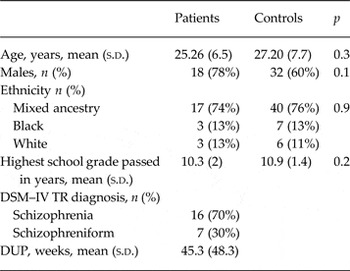
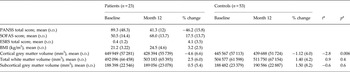
Baseline characteristics for the patients and controls are provided in Table 1. Baseline, month 12 and % change values for clinical and brain volumetric measures are provided in Table 2. The mean (s.d.) total 12-month dose of flupenthixol decanoate equivalents was 312.4 (100.6) mg. The minimum dose was 130.1 mg and the maximum dose was 495.3 mg. Ten (43%) of the patients received anticholinergics for a mean (s.d.) of 7.7 (13.0) weeks; 7 (30%) received antidepressants for 7.1 (13.8) weeks; and 13 (57%) received benzodiazepines for 4.3 (10.1) weeks. Patients and controls did not differ significantly regarding age, sex, ethnicity and highest school grade passed and there were no group differences for the brain volumetric measures at baseline.
Baseline characteristics for the 23 patients and 53 controls

Baseline and month 12 values for the clinical and brain volume measures

*t-tests for % change in volume, patients v. controls.
MRI volumetric changes
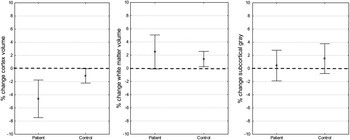
Percentage change from baseline to month 12 for the three brain volume measurements is provided in Fig. 1. After co-varying for intracranial volume there were significantly greater reductions in cortical volume in patients v. controls (F 7.3, p = 0.009), but no significant differences for changes in subcortical grey matter (F = 0.4, p = 0.5) and white matter volume (F = 1.0, p = 0.3).
Percentage change in brain volumes from baseline to month 12 for the patients and controls (means and 95% confidence intervals).

Predictors of volume changes
For the regression analysis with % change in cortical volume as the dependent variable a model, including age, total antipsychotic dose, SOFAS change score and ESRS change score explained 31% of the variance (F = 2.0, p = 0.1) and the only variable to significantly predict cortical volume change was total antipsychotic dose received (F = 5, p = 0.04). Change in cortical volume was not significantly associated with age, gender, DUP or changes in PANSS total score, SOFAS score, BMI and ESRS.
Discussion
This study indicates that, compared with healthy controls, previously unmedicated patients with schizophrenia displayed excessive reductions in cortical grey matter volume after 12 months of antipsychotic treatment. Reductions were predicted by total antipsychotic dose but not by treatment response or treatment-related adverse effects. Specifically, we found no significant associations between cortical volume reduction and changes in psychopathology, functionality, extrapyramidal symptoms and BMI, or age, gender and DUP. These findings are remarkable insofar as the volume reductions occurred in patients who had generally responded favourably to treatment [19 (83%) achieved operationally defined remission (Andreasen et al. Reference Andreasen, Carpenter, Kane, Lasser, Marder and Weinberger2005)] and had received the lowest effective dose of antipsychotic [mean endpoint dose flupenthixol decanoate 11.1(6.1) mg 2-weekly]. While these findings are in contrast to the reported association between brain volume reductions and poorer outcome (Lieberman et al. Reference Lieberman, Chakos, Wu, Alvir, Hoffman, Robinson and Bilder2001), our sample was different in that we only included patients who completed 12 months of treatment, and excluded non-responders. It could be that even greater volume reductions occur in non-responders. In any event, our findings suggest that brain volume reductions are not restricted to those patients with a poor treatment outcome. It is important to keep in mind, however, that the previous study reporting an association between brain volume reduction and poor outcome (Lieberman et al. Reference Lieberman, Chakos, Wu, Alvir, Hoffman, Robinson and Bilder2001) did not control for antipsychotic exposure, and the current study adds to evidence suggesting that the findings of that study were confounded by this factor.
The −4.6% cortical volume reduction is considerable, given the relatively brief treatment period of 12 months. While this reduction appears at first sight to be greater than the mean estimated annual whole-brain volume reduction of −0.69% in schizophrenia (Veijola et al. Reference Veijola, Guo, Moilanen, Jaaskelainen, Miettunen, Kyllonen, Haapea, Huhtaniska, Alaraisanen, Maki, Kiviniemi, Nikkinen, Starck, Remes, Tanskanen, Tervonen, Wink, Kehagia, Suckling, Kobayashi, Barnett, Barnes, Koponen, Jones, Isohanni and Murray2014) and the −2.6% total brain volume reduction reported in a meta-analysis of medicated patients with schizophrenia, the former analysis was not conducted on first-episode patients and the latter analysis actually found a reduction in total grey matter of −4.3%, with no significant white matter reductions (Haijma et al. Reference Haijma, Van Haren, Cahn, Koolschijn, Hulshoff Pol and Kahn2013) – i.e. results that are similar to ours. The pronounced volume reduction in our sample is consistent with a more marked effect in the early course of illness (Andreasen et al. Reference Andreasen, Nopoulos, Magnotta, Pierson, Ziebell and Ho2011), and suggests that critical brain structural changes may take place in the period immediately following the first-onset of psychosis (Pantelis et al. Reference Pantelis, Velakoulis, McGorry, Wood, Suckling, Phillips, Yung, Bullmore, Brewer, Soulsby, Desmond and McGuire2003). The volume reduction that we found is however less than the 8–11% brain-weight and volume reduction reported in macaque monkeys over 17–27 months of antipsychotic treatment at plasma drug levels similar to those in treated humans (Dorph-Petersen et al. Reference Dorph-Petersen, Pierri, Perel, Sun, Sampson and Lewis2005). Also, the absence of significant white matter reductions in our study differs from the findings in that study where both grey and white matter reductions were reported (Dorph-Petersen et al. Reference Dorph-Petersen, Pierri, Perel, Sun, Sampson and Lewis2005). Conversely, others have found, as in our study, that volume reductions associated with antipsychotic treatment to be restricted to grey matter (Fusar-Poli et al. Reference Fusar-Poli, Smieskova, Kempton, Ho, Andreasen and Borgwardt2013). Furthermore, while Ho et al. (Reference Ho, Andreasen, Ziebell, Pierson and Magnotta2011) reported progressive volume reductions in both grey and white matter that were most evident in patients who received more antipsychotic treatment, an earlier study of theirs found that antipsychotic dose was related to the rate of loss of frontal grey matter, but only in patients who were medication naïve at baseline (Ho et al. Reference Ho, Andreasen, Dawson and Wassink2007). Therefore, it may be that antipsychotics contribute to grey matter loss in the early course of treatment, and later to white matter loss (Goff, Reference Goff2011).
Our failure to find significantly different changes in subcortical grey matter volume in patients v. controls differs from previous reports of increased basal ganglia volume associated with FGAs and increased thalamic volume associated with SGAs (Dazzan et al. Reference Dazzan, Morgan, Orr, Hutchinson, Chitnis, Suckling, Fearon, McGuire, Mallett, Jones, Leff and Murray2005). On the other hand, our findings are consistent with a later systematic review of volumetric changes in basal ganglia after antipsychotic monotherapy that found no support for basal ganglia volume increases with FGAs, and both volumetric increases and decreases being reported with SGAs (Ebdrup et al. Reference Ebdrup, Norbak, Borgwardt and Glenthoj2013).
Nature of the relationship between brain volume reduction and antipsychotic treatment:
Antipsychotic treatment may be related to brain volume changes in several ways. First, it may be linked to efficacy – or the lack thereof – of medication. Regarding the former, the possibility has been raised that brain volume reductions are related to the same mechanism that provides the therapeutic effect of antipsychotics (Lewis, Reference Lewis2011). If that were the case, an association between brain volume reduction and symptom improvement would be expected. Our study failed to demonstrate any such relationship, thereby counting against brain volume changes being linked to the mechanism responsible for antipsychotic efficacy. Similarly, if the brain volume reductions are associated with antipsychotic neurotoxicity and poor treatment response (Lieberman et al. Reference Lieberman, Chakos, Wu, Alvir, Hoffman, Robinson and Bilder2001) a negative correlation between brain volume reduction and symptom reduction would be anticipated. Again, our findings do not support this possibility. It remains feasible, however, that antipsychotics are effective in treating symptoms of psychosis in the short term, but are responsible for neuroprogressive changes in the longer term.
Another possibility is that the association between brain volume change and antipsychotic treatment is linked to treatment-related side-effects. Indeed, acute treatment with haloperidol has been associated with striatal volume reductions, which strongly predicted the development of extrapyramidal symptoms (Tost et al. Reference Tost, Braus, Hakimi, Ruf, Vollmert, Hohn and Meyer-Lindenberg2010), and in people with schizophrenia more pronounced brain volume reductions have been reported in those with tardive dyskinesia compared with those without tardive dyskinesia (Sarro et al. Reference Sarro, Pomarol-Clotet, Canales-Rodriguez, Salvador, Gomar, Ortiz-Gil, Landin-Romero, Vila-Rodriguez, Blanch and McKenna2013). We found no evidence of an association between brain volume changes and extrapyramidal symptoms. However, an association cannot be ruled out as extrapyramidal symptoms were generally very mild in our sample and none of our patients developed persistent dyskinesia. Another possibility is that brain volume loss is related to the adipogenic effects of antipsychotics. It is well recognised that obesity is associated with cortical thinning (Medic et al. Reference Medic, Ziauddeen, Ersche, Farooqi, Bullmore, Nathan, Ronan and Fletcher2016) and treatment-naïve first-episode patients are particularly susceptible to the weight-gain effects of antipsychotics (Strassnig et al. Reference Strassnig, Miewald, Keshavan and Ganguli2007). Furthermore, we previously reported ventral diencephalon volume reductions, which were significantly correlated with BMI increase during the first 12 weeks of antipsychotic treatment in never-treated first-episode schizophrenia patients (Emsley et al. Reference Emsley, Asmal, Chiliza, du Plessis, Carr, Kidd, Malhotra, Vink and Kahn2015). However, while the mean increase in BMI of 3.2 kg/m2 over 12 months in our cohort was substantial, we were unable to demonstrate a link between brain volume changes and weight-gain.
Regarding the underlying neurobiology, there are several possible explanations for the observed cortical volume reductions in our study. Besides the possibility of neuronal damage they could reflect structural plasticity involving remodelling of neuronal processes, changes in water content, or a decrease in the number of non-neuronal cells (Zatorre et al. Reference Zatorre, Fields and Johansen-Berg2012). Also, cortical volume reduction could be related to the reported anti-inflammatory effect of antipsychotics (Al-Amin et al. Reference Al-Amin, Nasir Uddin and Mahmud2013). Neuroinflammation increases local blood flow and vascular permeability, cytokine production, activation of microglia and infiltration of mobile cells of the immune system (Graeber et al. Reference Graeber, Li and Rodriguez2011). An anti-inflammatory effect of antipsychotics would be expected to reverse these changes, which may result in volume reductions.
Dose–response relationship
An important aspect of this study is that we were able to accurately calculate the total dose of antipsychotic that each patient received. Patients had never been exposed to any antipsychotic previously; they received a single antipsychotic (except for six patients who received long-acting risperidone for the first 12 weeks); and using a depot formulation meant that the amount prescribed was the amount received. This enabled us to avoid shortcomings of previous studies where multiple antipsychotics were prescribed, and where covert partial and non-adherence are likely to have played a role. The role of non-adherence as a potential confounder should not be underestimated, particularly for first-episode schizophrenia, where non- and partial-adherence rates are very high (Coldham et al. Reference Coldham, Addington and Addington2002). Patients who are not fully adherent do not respond optimally, and clinicians are likely to respond by increasing the antipsychotic dose. Thus, a dose–response effect could alternatively reflect volume reductions associated with persistence of psychotic symptoms due to non-adherence rather than a direct effect of treatment. Thus, the finding of a significant relationship between antipsychotic dose and cortical volume reduction in this study strongly suggests causality.
Strengths and limitations
Strengths of the study include the careful selection of the sample (antipsychotic naïve, first-episode); standardisation of treatment with a single antipsychotic and a low-dosing strategy; using depot formulation, which allowed precise calculation of the total antipsychotic dose and avoided confounding effects of covert non-adherence; regular assessment of treatment response in terms of psychopathology and functionality and adverse effects in terms of weight change and emergent extrapyramidal symptoms. The study is limited by the small sample and was not sufficiently powered to explore regional differences in brain volume change. Also, the inclusion age range of 16–45 years was arguably too wide for such a small sample. Further, the limited follow-up period of 12 months precludes any inferences on possible longer term effects of antipsychotics on brain volume. Finally, our findings cannot necessarily be generalised to other antipsychotics, particularly in the light of reports of class differences in brain volume changes (Navari & Dazzan, Reference Navari and Dazzan2009; Vita et al. Reference Vita, De Peri, Deste, Barlati and Sacchetti2015). However, we consider it unlikely that our findings are restricted to treatment with FGAs, for the following reasons: FGAs and SGAs are not homogeneous classes and it has been recommended that this distinction be abandoned (Leucht et al. Reference Leucht, Corves, Arbter, Engel, Li and Davis2009); early studies with FGAs may have been biased by the use of excessively high doses (Geddes et al. Reference Geddes, Freemantle, Harrison and Bebbington2000); brain-weight and volume reductions reported in antipsychotic-treated macaque monkeys were of similar magnitude for a SGA (olanzapine) and FGA (haloperidol) (Dorph-Petersen et al. Reference Dorph-Petersen, Pierri, Perel, Sun, Sampson and Lewis2005); and flupenthixol is considered a ‘partially atypical’ antipsychotic (Gattaz et al. Reference Gattaz, Diehl, Geuppert, Hubrich, Schmitt, Linde, Maras and Dittmann2004), sharing receptor binding characteristics of several SGAs (de Wit, Reference de Wit and Stolerman2010).
Conclusion
Morphological brain changes associated with antipsychotic treatment are not restricted to patients with a poor treatment outcome, and occur even with the lowest effective dose. Cortical volume reductions do not appear to be associated with illness progression or adverse effects that may reflect neurotoxicity, at least in the short term. At the same time we found no evidence to link volume reductions with the therapeutic benefits of antipsychotics.
Acknowledgements
This study was funded by a grant from New Africa Partnership Developments (NEPAD) through the Department of Science and Technology, South Africa (Grant ref. ABGR; 86243).
Declaration of Interest
Robin Emsley has received honoraria from Janssen, Lundbeck, Servier and Otsuka for participating in advisory boards and speaking at educational meetings, and has received research funding from Janssen and Lundbeck. Bonginkosi Chiliza has received honoraria from Lundbeck and Janssen for speaking at educational meetings. All of the other authors have declared that there are no conflicts of interest in relation to the subject of this study.