John Sutherland was vacationing with his family at Jenny Lake Ranch in Moran, Wyoming, on July 16, 1948, but the letter forwarded to him from his Hollywood animation studio that day demanded an immediate response. It was bad news. Arnold J. Zurcher, Executive Director of the Alfred P. Sloan Foundation, had written to convey his trustees’ disappointment that Metro-Goldwyn-Mayer (MGM) had rejected Going Places, Sutherland’s latest animated cartoon film, from consideration for distribution in theaters. Going Places was the second of Sutherland’s Fun and Facts about American Business series of educational animated shorts about the benefits of free enterprise. MGM’s rejection of the film, Zurcher explained, had caused considerable disappointment in the Sloan Foundation office. The foundation had awarded Harding College, its academic partner on the film project, $50,000 to contract with Sutherland for an eight-minute cartoon; having the film relegated to showings in seminars, schools, and churches was apparently an unacceptable return on investment for Zurcher. Worse yet, MGM had rejected the film on the grounds that it had insufficient entertainment value, and “by entertainment value they mean[t] specifically humor.” Zurcher’s faith in Sutherland’s eleven years of experience in the cartoon business was damaged by the rejection—so damaged, in fact, that he wanted Sutherland to take future storyboards to the cartoon people at MGM’s parent company Loew’s for advice on how the stories’ entertainment value might be “improved” before the cartoons were committed to celluloid.Footnote 1
Sutherland bristled at the suggestion. “It is quite possible,” he typed from the ranch, “that the MGM cartoon department would have little understanding of our problem of writing educational films on the fundamentals of the American economic system.” From Sutherland’s perspective, the gag men writing “Tom and Jerry” cartoons were all joke and no substance. The project with the Sloan Foundation called for more than just slapstick; it had to premise its sight gags on complex economic concepts.
Over the course of the Fun and Facts project, Sutherland and other parties involved in the films’ production struggled to craft a highly persuasive media product with wide popular appeal, one that balanced education and political indoctrination against entertainment and humor. However, the hazy and porous boundaries among education, entertainment, and propaganda made the task of setting them in equal balance almost impossible. As archived correspondence between the films’ creators demonstrates, each involved party enacted its own vision of an effective balance, and Sutherland’s vision did not include MGM cartoonists. “I appreciate Loew’s offer of cooperation to help me determine theatrical release quality or subject matter,” Sutherland responded, “but I do not think that production of the finest cat and mouse cartoons necessarily means their boys would be of any help creatively or intellectualy [sic] to our organization.” If MGM wanted to help, Sutherland continued, perhaps it could donate the $55,000 of profit it stood to make from the first film (Make Mine Freedom) to Harding College to aid the development of future films.Footnote 2 Sutherland signed off with an apology for his poor typing skills, removed the letter to Zurcher from the typewriter, and cranked a fresh sheet of John Sutherland Productions, Inc. letterhead into the device.
Sutherland’s next letter was to Dr. George S. Benson, President of Harding College. To Benson, Sutherland spoke more freely, warning that an excess of humor might so confuse members of the audience that they could miss the educational point altogether. Sutherland wondered whether, given the importance of reaching schools and employee groups with the film’s message, it might be wiser to give up on theatrical distribution than to sacrifice education for the sake of humor. He asked for Benson’s guidance on how to continue, given that the support of the Sloan Foundation lay at stake. “It is my job to use my craftsmanship,” Sutherland pledged, “to help you attain your objectives [because] to my knowledge you are the only capable man in the United States doing a completely unselfish job in educating the American people on the imperative necessity of maintaining political and economic freedom.”Footnote 3
Ephemeral Film and Economic Education
The Fun and Facts case engages two intersecting themes in recent historical scholarship: ephemeral film and economic education. Recent works by business historians, notably Kim Phillips-Fein’s Invisible Hands and Benjamin Waterhouse’s Lobbying America, point to increased scholarly interest in public relations campaigns meant to curry favor for the American economic system in general and corporate power within that system most particularly. Media artifacts played key roles in these campaigns. Historians, archivists, and media scholars are increasingly turning their attention to the thousands of short non-theatrical films made for purposes of education, promotion, and persuasion in the mid-century period. For example, the recent anthologies Useful Cinema, edited by Charles Acland and Haidee Wasson, and Learning with the Lights Off, edited by Devin Orgeron, Marsha Orgeron, and Dan Streible, address respectively the wide category of non-theatrical film and the subcategory of educational film. Employing terms such as sponsored, ephemeral, educational, institutional, and non-theatrical to describe the films they study, these scholarly investigations describe the aesthetic impact, ideological significance, and political economy of a vast body of film works funded and distributed by diverse organizations, from educational institutions and nonprofit organizations to corporations and governmental bodies. In the years immediately following World War II, tensions between industrial management and organized labor spurred the emergence of a genre of sponsored educational films (along with comic books, traveling exhibits, and other cultural ephemera) that used the techniques of public relations to foster both knowledge of and allegiance to the practices and guiding principles of American industrial capitalism. These efforts proceeded under the name of “economic education.”Footnote 4
Corporate-sponsored economic education materials were sometimes bankrolled by individual corporations, but more often were funded indirectly through business interest groups. Throughout the twentieth century, organizations such as the Chamber of Commerce of the United States and the National Association of Manufacturers (NAM) offered corporations an alternative to direct public relations efforts by pooling individual corporations’ donations to advance the interest of “business” as a whole. Similarly, economic education organizations took corporate donations for the specific purpose of building public support for the practices and principles of American capitalism. In their moment, economic education materials were often conceived and regarded as little more than public relations exercises by another name. The extensive involvement of corporate public relations and advertising agents in the creation and distribution of economic education materials has informed the adoption of this approach to economic education by historians and media scholars alike.
However, although the Fun and Facts case sometimes suggests this characterization to be true, it also suggests that adopting the label of economic education had important consequences. The project’s collaborators drew upon the ideal of educational value as a conceptual resource both to rationalize their claims for control over the project and to justify the project’s successes and failures. Benson, Sutherland, and representatives of the Sloan Foundation generated more than 400 pages of correspondence over the six-year lifespan of the Fun and Facts cartoon project. Those pages of correspondence provide a record of the production and distribution of Fun and Facts that illuminates some of the complications the economic education approach introduced. The Fun and Facts case suggests, then, that propaganda is not a monolithic category. Rather, it implies that the claims propagandists make about the cultural legitimacy of their creations affect the process of creation itself.Footnote 5
Economic education efforts persisted throughout the latter half of the twentieth century, yet each campaign was shaped by the domestic and global politics of its moment. As a conceptual frame, economic education bestowed at least some public legitimacy on efforts to strengthen public support for American business conservatism in the early Cold War period. The fledgling economic education movement took shape just as the Truman administration’s developing orientation toward containment of Soviet expansionism, along with its increasing support for governmental management of overseas information about the United States, foreshadowed the Cold War to come. In the domestic realm, the Smith-Mundt Act of 1948 prohibited the dissemination of state-produced propagandistic messages about the United States on home soil, yet media companies’ institutional interests fostered a collaborative relationship with government information offices that resulted in a consumer-oriented anti-communist broadcast media culture. For industrial manufacturers, too, opposition to the Soviet Union offered the proponents of free enterprise a set of conceptual resources for aligning business conservatism with American identity.Footnote 6
Framing public relations activities as economic education was nothing new. Since the early 1900s, NAM had been characterizing its public relations efforts either as “selling the American way of life” or as a type of educational public service. In the 1940s, the widespread impression that businessmen knew little to nothing about economics spurred the development of economic education organizations that targeted the managerial class. For example, the Foundation for Economic Education (FEE) solicited corporate donations to instill in American businessmen, whom its founder Leonard Read perceived as economically illiterate because of their acceptance of New Deal policies, an appreciation of free enterprise. Economic education was not solely the province of conservatives in the business world, however. FEE’s progressive counterpart, the Committee for Economic Development (CED), was led by the Studebaker Corporation’s Paul Hoffman and supported by top management from firms like Eastman Kodak Company. Organizations such as FEE and CED developed a shared paradigm of corporate-sponsored economic education, each creating academically informed programs that sought to raise businessmen’s awareness of their favored macroeconomic models. However, in a postwar business environment seemingly acculturated to New Deal programs, economically conservative industrialists responded to the perceived threat of government intervention in commerce with a particular sense of urgency. Further, the massive wave of industrial strike actions in 1945 and 1946 raised some managers’ and executives’ concerns about the power of organized labor as manufacturing reconverted from wartime to peacetime production.Footnote 7
Conservative economic education organizations made an effort to reach not only businessmen but also the public at large, especially students in high schools and universities. Henry C. Link of the Psychological Corporation, a market research group, exemplified the thinking that drove the development of ideologically conservative economic education materials in a 1948 article for the trade journal Business Screen. The article praised the conservative American Heritage Foundation’s “Year of Rededication” campaign as an exemplary solution to a pressing problem. Link implored, “The surplus wealth of the American system supports the largest, I will not say the greatest, educational system in history, but its lack of adequately formulated ideology encourages that system to turn out more and more Socialists who would destroy the very values that made their education possible. And let us not blame the educators. Let us blame ourselves, for though we have supported education with our dollars, we have neglected to guide it with our historical principles.” Link’s sentiment was not uncommon. In the late 1940s, many Americans—from politicians to historians—were calling for an “ideological offensive” that could meet and exceed communism’s perceived capacity to capture the imagination. In his celebration of the American Heritage Foundation, however, Link neglected to acknowledge that among many other efforts, the Alfred P. Sloan Foundation’s academic outreach had already been quietly under way for a decade.Footnote 8
The Fun and Facts project was but one facet of a wide-reaching program of institutional funding by the Alfred P. Sloan Foundation, itself founded in 1934 with a focus on increasing public understanding of economics. In 1938, Foundation Director Dr. Harold S. Sloan (brother of the organization’s founder) announced the initiation of “a bombardment of the American mind with elementary economic principles” through the foundation’s partnering colleges and universities. Dr. Sloan assured the public that the foundation “has no particular economic philosophy to promulgate” but rather wished to help accredited colleges and universities to “disseminate the facts.” However, as film historian Dan Streible argues, the program was anything but neutral. Streible’s account of the Sloan Foundation’s failed live-action film project at New York University (NYU) in 1939 and 1940 demonstrates the foundation’s intent to foster support for the conservative beliefs of its founder, Alfred P. Sloan. At NYU, administrators’ hesitance to imply favoritism toward any specific school of economic thought almost prevented the project’s launch, but in 1939 they established the Educational Film Institute (EFI) with Sloan Foundation funding. Even the Sloan brothers privately expressed their doubts as the program was getting under way, with Alfred noting that the Sloan Foundation’s efforts were to persuade rather than to “set up an educational debate” and that he had little appreciation for the “‘education’ approach.” Funding for the Educational Film Institute was abruptly yanked one year later, when the EFI’s three live-action films about labor and industry failed to meet with Alfred P. Sloan’s ideological or aesthetic approval. Streible’s account closes by noting that in his postmortem report, Harold Sloan advocated for “pure documentary” films as the best hope for educational films that could serve the foundation’s goals. Six years later, however, Alfred P. Sloan partnered with Benson and Sutherland on the Fun and Facts series, a collection of humorous cartoons that could not have been further from the pure documentary, live-action style his brother Harold had recommended. Footnote 9
George S. Benson proved an ideal academic partner for Sloan’s experiment in mass production of public opinion: a college president who would have none of the qualms about economic partisanship that Sloan had encountered at NYU. A former missionary to China with the evangelical Church of Christ, Benson had taken a job in 1936 as president of the nearly bankrupt Harding College, a small Bible college in rural Searcy, Arkansas. Benson was a staunch anti-communist and a canny fundraiser. Theological fractures in the Church of Christ had threatened the stream of donations as he assumed leadership of the college, so Benson turned increasingly to wealthy businessmen to fill Harding’s coffers. Like many other evangelical college leaders in the postwar era, Benson adopted a strategy that would elevate him to national prominence while guaranteeing Harding’s solvency: combining Christian education with advocacy for constitutional government and private ownership of industry. Thanks to wealthy congregants like insurance salesman Clinton Davidson, Benson had extended his fundraising efforts beyond the Church of Christ to the national power networks of corporate managers and Washington lobbyists. Benson had nurtured these relationships with the 1939 initiation of a lecture series at Harding College that featured regionally and nationally prominent industrialists.
Benson’s alliances with Washington power brokers had led to a widely influential 1941 testimony before the U.S. Congress. At that moment, the House Ways and Means Committee was facing a $6 billion budget deficit and desperately seeking a strategy for pruning nondefense expenditures. Benson’s forcefully stated criticism of New Deal programs had posed a sharp contrast to the numerous witnesses defending continued funding for their own programs. The New York Times’ decision to reprint the speech in its entirety had brought Benson national attention, which he parlayed into a continued presence in national policy debates both during and after the war. Amid the flurry of speaking engagements following his first appearance before Congress, Benson’s speech at the National Tax Foundation in December 1941 had facilitated his introduction to Alfred P. Sloan. Sloan’s choice of Benson—already a divisive figure for his polemic speeches in the name of economic education and patriotism—foreshadowed the complex relationship between education and politics that would come to characterize the Fun and Facts project.Footnote 10
By the end of World War II, Benson presided over a small newspaper and radio syndication empire complemented by a strong personal network of industrialists and businessmen across the United States who attended his talks and seminars. Ever seeking new opportunities to disseminate his message, Benson approached Walt Disney at the close of the war about the possibility of producing short animated films on the topic of free enterprise. Disney turned down the job, citing his lack of background in economics—but encouraged Benson to contact his former employee, John Sutherland.Footnote 11
Sutherland’s political and intellectual background was well suited for the task. After earning an undergraduate degree in accounting and business from UCLA in 1937, Sutherland worked for Walt Disney first as a writer and director on the feature film Bambi, and subsequently as the film’s business and production manager. Following a brief stint as a contract writer at Twentieth Century Fox in 1941, Sutherland developed a freelance business. For the duration of World War II, he produced animated and live-action instructional shorts for the U.S. Signal Corps. Following the war, Sutherland’s animation business flourished. Sutherland shared the anti-communist politics of his former boss, Walt Disney, a fact that likely protected Sutherland’s Hollywood studio from the eventual House Un-American Activity Committee (HUAC) pressure exerted on the progressive animators at the rival animation studio, United Productions of America. By 1946, Sutherland’s Daffy Ditties cartoons (designed to compete with the better-known Merrie Melodies and Looney Tunes shorts issuing from the Warner Brothers studio) were being distributed to theaters by United Artists. It was in the midst of the Daffy Ditties project that Benson contacted Sutherland.Footnote 12
Benson was the linchpin that held the Fun and Facts project together. Sutherland and Benson developed the film concepts together; if the Sloan Foundation liked a pitch, it would send Benson a (preapproved) grant application for the funds. Harding College would then disburse the funds, given in the name of public education about economics, to Sutherland. The resulting cartoons would be billed as John Sutherland Productions films, presented by Harding College. The film’s credits would make no mention of the Sloan Foundation.
The project’s benefactor, General Motors chairman Alfred P. Sloan, considered the Fun and Facts project an experiment in the mass production of economic ideology. “Having spent all my life in pursuit of mass production techniques,” Sloan wrote in one of his initial letters to Benson, “I have always felt that a technique must be found” to “tell the simple economic truths to the masses of people.” Sloan had intuited that Disney-style animated shorts laden with visual humor might provide a technique for the kind of social manufacturing he had in mind. He found willing collaborators in Benson and Sutherland. Anti-communist activist Benson’s enthusiasm for contracting with animator John Sutherland to produce educational cartoons about free enterprise had been limited only by the burden of Sutherland’s $50,000-per-film price tag. The Sloan Foundation offered a solution to that problem.Footnote 13
At the start of the project in 1946, Sloan expressed to Benson his hopes that “the Disney technique” could be a suitable vehicle for the Sloan Foundation’s economic message. Since the 1930s, industrial firms had been using cartoons as vehicles for advertising and instructional purposes, with animation studios like Detroit’s Jam Handy Organization devoting studios to industrial animation. Although Sloan gave no indication to Benson of the rationale for his hopes, the practices and intellectual currents around cartoons at the time may have influenced his thinking. Sloan’s letters to Benson indicate that he intended the films to be in circulation for many years; the long exhibition life of cartoons, whose simplified images retained the appearance of freshness as the fashions, cars, and interiors of live-action films fell out of vogue, was a common selling point that may have mitigated the high price of the animated shorts. Sloan’s thinking may have anticipated that of DuPont’s market researchers, who found in 1958 that animation was a particularly promising vehicle for abstract concepts of free-market ideology. Finally, Sloan may have been influenced by the success of cartoons as a pedagogical tool with troops during the war. Sutherland himself had been extensively involved in that effort. Cartoons, as armed forces administrators had demonstrated during the war, had the persuasive benefit of allowing their creators total control over the world on the screen. Any visual aspect that failed to correspond with the propagandistic thrust of a message could simply be left out. Cartoons remade the world from scratch.Footnote 14
Although a truly neutral treatment of economics in the United States would have acknowledged disagreements between Austrian and Keynesian schools of economic thought, Fun and Facts sought deliberately to promote a free-enterprise perspective that pushed back against the increased economic role of the state during the New Deal. Fun and Facts, then, was propaganda, by the definition of communication historian Philip M. Taylor: a deliberate and methodical attempt to persuade people to hold an attitude that benefits those doing the persuading. As Taylor explains, education differs from propaganda because the purpose of “the imparting of information and ideas for educational purposes is to enable the recipient to make up his or her own mind on any given issue.” Propaganda, however, aims to make up the audience’s minds for them by presenting one position as correct. For Alfred P. Sloan and many other mid-century industrialists, the decades-long tradition of framing industrial conflict in terms of education provided a means of bestowing social legitimacy on essentially propagandistic public relations activities.Footnote 15
Sloan’s correspondence with Benson indicates that despite his misgivings to his brother Harold about the educational approach, by 1946 he had adopted its rhetoric. Lamenting businessmen’s lack of economic knowledge, Sloan cited “the fact that you can’t raise wages without raising prices” as “an economic fact that almost anybody with any level of intelligence has known for decades.” In light of labor unions’ critical response that year to anticipated rises in the cost of living following the removal of wartime price and wage controls, Sloan’s complaint showed the influence an economic education framing could exert on industrial politics—it recategorized union leaders’ position on the issue from that of a conflicting viewpoint to that of an untruth.Footnote 16
Producing Fun and Facts
Fun and Facts not only combined sponsored film with economic education to advance the cause of business conservatism, but it also outpaced both in the occlusion of its funding source. The films reflected a practice of influence laundering that exchanged the possible stigma of corporate sponsorship for a sheen of academic impartiality (at least to those unfamiliar with Benson’s anti-communist activism). Sloan and Benson agreed on the correctness (and thus the factuality) of free-enterprise economic ideology, but neither man was under the illusion that the public would accept a lecture on the social benefit of free enterprise from a managerial source. The conceptual frame of economic education helped Sloan and Benson justify their concealment of the Sloan Foundation’s role in the creation of Fun and Facts. Early in the project, Sloan declared his motivations for downplaying his involvement: “I have, as a matter of deliberate policy, kept our name out of everything that we are doing,” he explained. “I do this because I believe my personal position, as an industrialist, rather prejudices what I am trying to do in the economic area because so many people look upon it as a selfish move, whereas of course it is nothing of the kind. But it is what people think that counts.” Benson’s thinking ran along similar lines: He was willing to lend Harding College’s name to the Fun and Facts project because he thought the films could be “much more effective when produced by an educational institution than if produced by an industrial organization.” In essence, funding for the film came from Alfred P. Sloan’s considerable personal fortune, itself partially the result of early purchases of GM stock. The funding path for Fun and Facts, however, wended from Sloan’s personal fortune to his philanthropic organization, to Harding College’s National Education Program, and finally to Sutherland. Both Sloan and Benson described this roundabout flow of funds not as public deception, but as a strategic move for delivering truthful and important information to the American public.Footnote 17
The Fun and Facts cartoons were designed for persuasive impact on a wide audience. As Executive Director Arnold J. Zurcher later reiterated, the Sloan Foundation wanted the films to take a positive, persuasive tone that did not ridicule detractors of free enterprise. Rather, Zurcher wanted the films to cultivate a public understanding of economics that was more amenable to the operations of big business. Sloan aspired to secure release for Make Mine Freedom in theaters, because a theatrical release would provide “tremendous distribution at practically no cost.” Although many sponsored films were made especially for use in classrooms and other non-theatrical settings, such films, given names like “cinemadvertising,” were shown in movie houses as far back as 1930. Historian Steve J. Wurtzler recounts how sponsored theatrical short films, like similar productions for radio, aimed to build goodwill for a company by presenting an entertaining feature that contained notices of corporate sponsorship in the film’s opening or closing credits, but featured the product or company itself as subtly as possible in the plot. The Fun and Facts series kept some elements of this model and inverted others. The series retained the notion of entertainment as a means of delivering a persuasive message. However, it inverted the standard model of an entertaining story that would, it was hoped, generate goodwill for the sponsoring company. Sloan and Benson hoped that Harding College’s sponsorship of the Fun and Facts series would generate goodwill for the entertaining message, thus making audience members more likely to accept its persuasive message. Assuming that the film was of high enough quality to win theatrical distribution through one of the major studios, the Sloan Foundation planned a 35-millimeter theatrical run, followed by so-called secondary distribution on 16-millimeter film to high schools and colleges, churches, civic groups, and industrial clients.Footnote 18
Adults were the intended audience for the films. Although cartoons are now chiefly considered children’s entertainment, mid-century theatergoing adults often watched humorous cartoon shorts as preludes or postludes to feature films. The Sloan Foundation and Benson identified multiple target sectors within the public at large. Members of labor unions, whom Benson characterized as having been “confused” by “a steady stream of invectives by union leaders against big business” were top priority, as were the high school and college students who would soon join the ranks of labor and business. Businesspeople, whose lack of economic knowledge Sloan and Benson had decried, were also intended audience members (but of a lower priority). Benson and Sloan had little interest in influencing American Communist Party members and other leftists, whom they seemed to consider beyond redemption. Overall, the Sloan Foundation and Benson sought to gain an audience for their message among people who they saw as benefiting from the fruits of capitalism, but whose perceived lack of loyalty to the principles of free enterprise made a democratic nation more vulnerable to the threat of communist propaganda.Footnote 19
Make Mine Freedom
Make Mine Freedom, the first film in the series, featured a zoot-suited, mustachioed traveling salesman who disrupts the calm of a small-town park with his attempts to sell a patent medicine called -ISM to the town’s farmers, laborers, and businessmen, only to have his attempts thwarted by astute citizen John Q. Public’s warnings about the dangers of the authoritarian state (Figure 1).
Character sketch of “the Pitchman” (with his patent medicine, -ISM) for Make Mine Freedom. Copyright © by Oklahoma Christian University, all rights reserved; digitized with permission from Oklahoma Christian University, by Ann Cowan Dixon Archives & Special Collections, Harding University.

The film went into production in September 1946. In keeping with Sloan’s characterization of the film as an experiment, production proceeded in an ad hoc fashion. Zurcher, Benson, and Sutherland, unsure of whether a major studio would accept the film, vacillated on whether to print it on theatrical-quality 35-millimeter film or the 16-millimeter film more commonly used for exhibitions on the secondary film circuit. Delays stacked up. Sutherland was late in delivering the finished animation work to Technicolor for processing. Even after the work was delivered to Technicolor, it stalled when sales manager George Cave briefly refused to process the animation on the basis that it was propaganda.Footnote 20
In his explanation of this last delay, Sutherland seemed to demonstrate his concord with Benson and Sloan’s framing of the films as education rather than propaganda. Cave was “not a positive character,” Sutherland wrote, who had suggested that “we may be doing propaganda films rather than strictly public educational films on our economic and political structure as it operates under our system of free enterprise.” However, nine months later, Sutherland defended the choice to use animation over live action on the basis of its propagandistic power: His extensive experience making films for the armed forces had taught him that “live action in propaganda [was] not particularly satisfactory in the short film” if the goal was “to educate and motivate thought.” Sutherland’s final comment is telling of the logic that seems to characterize the project as a whole: Sutherland acknowledged that the films were persuasive (and thus propagandistic), but his recourse to the essential correctness of the message permitted Sutherland to privately equate propaganda with education, and to describe the films to Cave as strictly educational.Footnote 21
In January 1948, Harding College sold the rights for Make Mine Freedom to MGM for one dollar, making good on the hoped-for plan of obtaining free distribution through the theaters. By March 1948, MGM was conducting test screenings of the film. MGM Executive Producer Fred Quimby reported back to Benson that audience response to a March 12 screening at the Loyola Theater in Los Angeles was “excellent,” but audience comments suggest a mixed response. Many patrons described the film as timely and “good for the American public.” One patron declared that “it pays to advertise the truth,” seeming to adopt the filmmakers’ claims about the educational value of the film. Others, however, called Make Mine Freedom “lousy” or “hogwash,” or decreed that “it stinks.” Many patrons described the film as propaganda, some approving of the film’s potential to counterbalance other views coming out of Hollywood. “Very good,” one patron wrote, “we need more of same. Stop propaganda with propaganda.” Another commented that “this sort of thing can do more good than the complete absence of propaganda.” These comments reflected a common understanding of propaganda as persuasive, but not necessarily sinister. Other comments, however, used the term to criticize the film. For example, one patron called Make Mine Freedom “New Line B. S. Propaganda,” and another commented that it was “very poor—propaganda—Fascistic implemented”; a third declared it “a shame that the theaters are becoming a method of propaganda instead of entertainment as they were originally intended to be.” Another response perhaps relayed the unease of the local entertainment industry, shaken by the Hollywood Ten’s recent refusal to testify before HUAC about their political beliefs and their subsequent conviction for contempt of Congress. That patron demanded, “What are you afraid of? Is someone going to fire, discharge, arrest, put on trial Metro-Goldwyn-Mayer if you don’t put out stuff like that? Get genuine. Get sincere!” These complaints were relatively few in number, however, and Quimby dismissed the negative comments, reasoning that they must have come from “people who are a little on the red side.” MGM planned a wide distribution, with a projected audience of approximately thirty-five million.Footnote 22
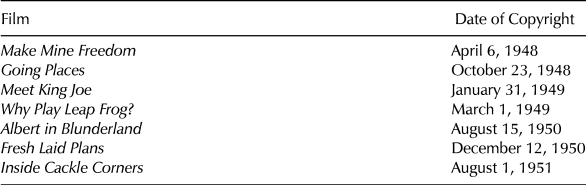
In the spring of 1948, MGM was preparing to roll Make Mine Freedom out to theaters, and several additional cartoons were in the works (see Table 1). The second film, Going Places, was almost complete. It dramatized the importance of the profit motive through the story of Freddy Fudsey, whose hard work, research, and fair business practices transform his Fudso Soap company from home business to manufacturing empire. Further, in April 1948, the Sloan Foundation had approved grant funding for two more films. The third in the series, Meet King Joe, justified American manufacturers’ planned obsolescence strategies as technological advances that transformed Joe the American worker into the “king of the workers of the world.” The fourth, Why Play Leap Frog, featured Joe the worker’s frustration over being unable to afford a doll made in his own workplace to dramatize the relation between prices and wages. In June 1948, Sutherland screened a print of Going Places at the Sloan Foundation’s Rockefeller Center office in Manhattan. Zurcher responded to Benson with recommended changes to the script (also sending a carbon copy to Sutherland).Footnote 23
Films in the Fun and Facts Series
In the correspondence that ensued, Sutherland wrestled with the contradiction between the historical truth of industrial practice and the ideological “truth” of the economic education approach. Zurcher had warned, “The monopoly sequence … involves an effort to show that competition is self-regulating and prevents against the abuses of monopoly. This is followed, however, by a few scenes in which the thought is conveyed that if competition does not do the job automatically, the government steps in and promotes fair competition. The sequence has been criticized quite severely as being dramatically weighted in favor of governmental policing.”Footnote 24
“I do not agree with the observation in Dr. Zurcher’s letter,” Sutherland protested in a response to Benson. “Only one person at the meeting criticized this sequence as being weighted in favor of governmental policing.” Sutherland proposed a substitute segment, in which Fudso loses market share after a failed attempt to fix prices, in place of the segment on government regulation of monopolies. The omission of industrial monopoly practices and the state’s role in preventing them bothered Sutherland, however. “I assume,” he continued, “that we are at liberty to take this dramatic license even though individual cases such as Borax, U.S. Steel, the major motion picture companies, the glass industry, the tire industry, and various other combinations in restraint of trade which escape my mind, would indicate that free men must make laws to protect their freedom from combinations of more powerful free men.” In this passage, Sutherland stated with startling clarity the problem he faced. The vision of a self-regulating economy represented the way things ought to be, according to the collaborators’ shared viewpoint. That vision was, for them, an ideal—a philosophical truth. In order to portray this ideal, though, Sutherland and Benson had to minimize or outright ignore the actual practices of industrial corporations that clashed with the vision of an economy free of excessive “governmental policing.”Footnote 25
Benson took a diplomatic approach in his response to Zurcher a few days later. “I have always been a little uneasy about this scene,” Benson acknowledged. “Yet,” he warned Zurcher, “it does picture a condition that actually exists in our country and that I believe the critics would feel ought to be represented. Just how to represent it is naturally extremely difficult.” Unable to think of a better solution, Benson signaled to Zurcher his willingness to follow the suggested changes. The exchange marked a moment of fracture in the seeming ideological concord between Benson and Sutherland. Although Benson’s focus on ideological consistency and the possibility of public criticism suggests more concern with public acceptance than with factual accuracy, Sutherland’s characterization of the script change as dramatic license suggests that Sutherland’s understanding of the project as a “strictly public educational” affair was acquiring a tinge of industrial ventriloquism. A few days later, Zurcher’s letter bearing the bad news of Going Places’ rejection by MGM began its journey to Jenny Lake Ranch and the vacationing Sutherland.Footnote 26
Primary and Secondary Distribution
Despite the disappointment of Going Places’ rejection from the theatrical market, development, production and distribution work on Fun and Facts continued. By the autumn of 1948, the theatrical run of Make Mine Freedom was in full swing, meeting with “a splendid flow of favorable opinion” from theater managers. Meet King Joe was nearing completion. Again, Sutherland traveled to the Sloan Foundation offices in New York City with a preview print. Again, unnamed persons at the Sloan Foundation office requested script changes and appropriated to Benson the requisite funds to pay Sutherland for the changes. MGM ordered 250 prints of Meet King Joe for theatrical release in early October 1948 before the dialogue changes could be made, suggesting that the changes were, as with those to Going Places, driven by ideological concerns rather than entertainment value. The dialogue changes were made in late October. Meanwhile, production on a fourth film, Why Play Leap Frog, was well under way. Further, Sutherland was preparing a treatment for a fifth cartoon, Albert in Blunderland, dramatizing workers’ loss of autonomy under a planned economy.Footnote 27
Going Places had been turned down for theatrical distribution, but Sloan suggested that a small run of the film could be printed to test the market for secondary distribution to schools and other institutional markets through Harding College. Benson agreed, emphasizing that high school students who had a “very, very meager conception of our economic system and how it functions” were “an awfully important audience” for the films. Benson also set the terms for distribution going forward: Any films not accepted by MGM would move directly to the secondary market, and films accepted by MGM would join secondary distribution at the close of their theatrical runs. Sloan agreed, but cautioned that the higher costs of secondary distribution could limit the project’s capacity to reach a wide audience if MGM did not accept future films. The films were distributed through dual routes: Harding College handled rentals in-house and contracted with an external film distributor, Motion Talking Pictures, to manage sales to the secondary market. This arrangement continued until 1952, at which point Harding took over sales as well.Footnote 28
Even as production ramped up and as Benson established distribution paths for the films, the alliances among Benson, Sutherland, and Zurcher were beginning to fray. Disputes over costs, expertise, and production timing were all points of friction in increasingly fraught working relationships. For both Going Places and Meet King Joe, ideological fine tuning from the Sloan Foundation had resulted in increased costs and production times. Sutherland seemed to be losing patience with what looked to be an ongoing production pattern of criticism and requests for last-minute changes from the Sloan Foundation. Sutherland, asserting his expertise, reminded Benson and Zurcher in late 1948 that he was the only writer in Hollywood who could develop, plan, and create humorous cartoon treatments that reflected “authentic” economic thinking. He warned that he would charge more for subsequent films if they continued to be subject to lengthy review processes and last-minute changes. Negotiations with Zurcher had resulted in the payments for Albert in Blunderland and subsequent films being increased to $75,000 per film. Although Zurcher’s approval of the higher cost per film settled the matter, it apparently fostered some distrust of Sutherland on Benson’s part. Benson turned to Carl Nater, a former Disney distribution manager he had hired to manage the administrative details of the Fun and Facts project, for his appraisal of the situation. Although Nater acknowledged that economic education films were “just about the toughest type of educational films that could be picked to do,” he confided to Benson, “If I were a producer, I would suggest the same thing John is now suggesting. If I were responsible for buying the film, I would not accept the deal.” Still, the largely successful distribution results for the first three films—two in theaters and one on the secondary circuit—evidently justified the continued investment for Zurcher, Sloan, and their treasurer, James F. Kenney, from whom grant paperwork continued to flow to Benson.Footnote 29
Despite the price increases from Sutherland, development and distribution of the cartoons through primary and secondary channels continued apace over the next two years. Three more films won theatrical distribution. MGM accepted Why Play Leap Frog in May 1949 (Figure 2). The mood at the Sloan Foundation was “exceedingly happy”; Zurcher took the acceptance as a sign “that we are really succeeding in carrying out the objective which was stipulated when this project was originally undertaken.” In November of that year, MGM accepted Albert in Blunderland for theatrical distribution; Fresh Laid Plans, a parody of agricultural price controls, was also accepted and slated for release in the spring of 1951. On the secondary market, Going Places went into educational and industrial distribution in January 1949, with a positive reception from high school students and industrial managers; Make Mine Freedom joined it in June 1949. By that time, Harding College had sold 63 copies of Going Places to school districts, universities, and industrial corporations through Motion Talking Pictures, and rentals of the film numbered 629 with an estimated audience of 137,421 people. Production of cartoons slowed during this period, as Zurcher, Benson, and Sutherland developed—but ultimately abandoned—plans for a live-action series to exploit the rising medium of television. Still, Sutherland continued with development work for Inside Cackle Corners, a barnyard dramatization of the effect of taxes on capital reinvestment that was accepted for release by MGM in 1951.Footnote 30
Advertisement to theater owners for Why Play Leap Frog. Copyright © by Oklahoma Christian University, all rights reserved; digitized with permission from Oklahoma Christian University, by Ann Cowan Dixon Archives & Special Collections, Harding University.
Propaganda in Fresh Laid Plans: The Chickens Come Home to Roost
The issue of propaganda arose relatively rarely during the early years of the project. Despite the protestations of the audience members at the initial test screening of Make Mine Freedom and Sutherland’s discomfort with the liberties he was asked to take with the monopoly scene in Going Places, propaganda was not a major issue of discussion in correspondence among the collaborators. One notable exception, however, came late in 1949, when Sloan sent a congratulatory letter to Benson on MGM’s acceptance of Albert in Blunderland. Sloan’s comment provides perhaps the clearest indication of how porous the boundary between education and propaganda was for Sloan. “I rather felt they would turn it down,” Sloan mused, “as it certainly is supercharged with propaganda and shorter on comedy than some of our other pictures. … I rather think that even if it was supercharged with propaganda, the propaganda is along the lines of what we all believe in and therefore perhaps it is educational rather than propaganda.” Finally, it was not until the March 1951 theatrical release of Fresh Laid Plans that the propaganda issue became unavoidable. By the summer of 1951, tensions among education, politics, humor, propaganda, and the bottom line severely strained the network of institutional alliances on which the Fun and Facts project depended.Footnote 31
Fresh Laid Plans featured a town of chickens whose egg manufacturing business is disrupted when a professiorial owl introduces controls on manufacturing, farm subsidies, payments to consumers, and higher taxes as a means of paying for this tightly controlled system. Within short order, all of the town’s citizen-fowl are imprisoned in the town jail for buying corn on the black market. Only once the town’s stalled economy fails to generate a paycheck for the local police officer does he open the jailhouse doors, and the townschickens chase the professor out of town. The response from agricultural circles was immediate and severe. Furor from some Plains states farmers at the thought that a Hollywood cartoon could cast them as gullible chickens was so widespread that even the New York Times covered the controversy. The article featured a Minneapolis farm editor’s comment that Fresh Laid Plans was a “use of the movies as a political weapon” to attack the Brannan Plan and its recommendations for direct farm subsidies. The article quoted Benson and Sutherland, who both claimed that the film was a general statement on the principles of planning rather than a specific attack on the Brannan Plan.Footnote 32
The article evidently rattled Zurcher. The day after the New York Times piece on the controversy, Zurcher contacted Sutherland with a list of changes to The Devil and John Q, a recently storyboarded cartoon about inflation. “The current misinterpretation of some of the cartoons has caused several of us to look more closely at the storyboard,” Zurcher wrote. For example, regarding a sketch of a “pork barrel,” Zurcher warned that the expenditures listed in the scene “are not normally classed as ‘pork-barrel’ expenditures and that various groups, like farmers and others, might again interpret what you are doing as prejudicial propaganda.” Sutherland, in contrast, was sanguine: “It is interesting to note that Fresh Laid Plans is receiving some attention from the farmers. However, I don’t know how we could be satirizing the Brannan plan when I wrote the story before the Brannan plan came into existence. I don’t suppose the publicity will do us any harm.” Benson, too, seemed unperturbed, noting that he had received several letters of support in the wake of the article and concluding that the article had “not worked against us at any rate.” Zurcher responded that he was “inclined to agree” that the outcome would be “satisfactory,” yet he admitted that he was “surprised” at the negative response.Footnote 33
The release of Albert in Blunderland and Fresh Laid Plans to the secondary market met with similar levels of disapproval. For example, the May 1951 issue of the trade magazine Educational Screen featured an editorial titled “Educators, Be Wary!” The piece warned that the Fun and Facts films’ unnamed sponsor should raise the suspicions of educators seeking classroom films, as the film would undoubtedly argue in favor of its sponsors’ interests. The Educational Screen piece encapsulated a point of view that Benson apparently took seriously, perhaps because it threatened the secondary distribution from which Harding College drew both prestige and a small income—Harding financial reports recorded $1500 of income per year from all Harding College films, which included not only the Sutherland cartoons but also filmed lectures by Harding faculty and live-action short films. “[W]e cannot please the leftwingers and the critics but there are a lot of good Americans in the field of education whose advice is valuable,” Benson wrote to Sutherland. “The opposition from those in visual education expressed with regards to Albert in Blunderland and Fresh Laid Plans is pretty severe. If it is representative of the attitude of others we may find 16mm distribution of these quite limited and we may find it almost nil in the field of education. Of course, they will have their appeal to industrialists but that is a relatively small field whereas the educational field is a tremendous one.” The best course of action, Benson urged, was to increase the educational content, without reducing the theatrical appeal.Footnote 34
In a letter to Zurcher, however, Benson blamed Sutherland. Educators’ views of the Fun and Facts films were mixed, Benson wrote. Whereas they saw “considerable educational value” in Make Mine Freedom, Going Places and Why Play Leap Frog, they classified Meet King Joe as “a picture with a message which means propaganda,” and held similar opinions about Albert in Blunderland and Fresh Laid Plans. The films that Harding College had been heavily involved in writing had a good reception from educators, Benson argued, and Harding’s limited involvement in later films may have contributed to their reduced “educational appeal.” In a separate letter to Sutherland dated the same day, Benson confronted Sutherland on another issue that was souring their working relationship: costs.
Following a discussion of Harding College taking over the entirety of secondary distribution instead of sharing it with Motion Talking Pictures, Benson turned to the matter of the cost of Fun and Facts cartoons. Although Benson congratulated Sutherland on his successful negotiation of an $83,000-per-cartoon price tag, he also mentioned a recent conversation with representatives at MGM, who had been “astonished” to learn that Sutherland was charging more than twice what their own studio charged for production of a cartoon short. Benson chided Sutherland, pointing out that Sutherland had repeatedly used increasing production costs as a rationale for raising the cost per cartoon. Even if the costs at MGM did not include plot development, Benson argued, the pay for the cartoons was “not too bad.” Benson evidently thought better of even this characteristically understated confrontation; this paragraph, typed and then crossed out in red pencil, apparently was omitted from Benson’s final letter to Sutherland.Footnote 35
Sutherland’s seeming profit-seeking may have been particularly poorly received by Benson at a moment when both he and Zurcher were taking pains to distance Sutherland’s taxable commercial activities from their own tax-free nonprofit organizations’ projects. Benson’s censored comments to Sutherland reprised an episode from the previous month, when he had overruled Sutherland’s assertion of ownership of the characters from Fun and Facts in a discussion of developing comic books based on the cartoons. Benson’s associate Bud Green at Harding College had advised, in that case, that Harding College should retain ownership because Sutherland’s name on the comic books might impart a “make-money” flavor to the project, whereas Harding’s name would reduce the impression of commercialism.Footnote 36
The commercial nature of John Sutherland Productions provided a rationale for allowing Sutherland less control of the project’s evolving activities. In anticipation of the planned transition from joint secondary distribution with Motion Talking Pictures to sole secondary distribution through Harding College, Zurcher and Benson had long discussed establishing a separate nonprofit corporation to handle sales and rentals of the Fun and Facts films. Zurcher argued in October 1951 that the foundation’s trustees would support such a plan, as it could permit the foundation to make grants or loans “without jeopardizing its own status as a tax-exempt educational agency.” Sutherland, Zurcher added, should not be a director or member, nor should the new corporation use Sutherland’s office (as Sutherland had suggested) lest the new operation become “actively identified” with Sutherland’s “buying and selling agencies.” The emerging pattern of secondary educational distribution bore out Zurcher and Benson’s logic for emphasizing the importance of nonprofit status for secondary distribution. In February 1952, Benson reported to Zurcher his observance of a variance in industrial versus educational orders for films in secondary distribution. Industrial clients had the necessary funds to purchase prints for in-house use as soon as the films were released; thus, industrial purchases started strong but quickly tapered off. The limited financial resources of educational institutions, by contrast, yielded a lower but more constant rate of sales over time. For educational institutions already wary of accepting “films with a message” such as Fresh Laid Plans and Albert in Blunderland, a nonprofit distribution organization might have facilitated secondary distribution by helping to quiet some concerns about corporate propaganda in the schools.Footnote 37
Ultimately, though, problems with primary distribution halted the production of the Fun and Facts series. Throughout the series, MGM screenings had rested on the decision of sales manager W. F. Rodgers, whose personal politics informed his position as a supporter and ally of the Fun and Facts project. In 1952, however (and perhaps in the wake of the debacle over Fresh Laid Plans), MGM replaced Rogers with a new sales manager, Charles M. Reagan. Following a screening in February 1952, the latest cartoons Dear Uncle and The Devil and John Q met with rejection from MGM, which cited insufficient humor and the political cast of the films’ portrayals of farmers and laborers. To Benson, though, Zurcher suggested that Reagan’s personal politics biased him against the films. Sutherland screened an edited version of Dear Uncle for Reagan in May 1952, but to no avail; the film was again rejected for insufficient entertainment value. In June 1952, Benson again laid the blame on Sutherland, declaring to him that Harding College’s minimal involvement in Albert in Blunderland and Fresh Laid Plans had resulted in cartoons that were more political than educational. “As you know,” Benson fumed, “I have felt for two years that we should make a stronger effort to incorporate educational merit into these pictures. As you and Dr. Zurcher know I reached the point a good many months ago that I was hardly willing to continue to have the pictures made under the name of Harding College unless a stronger effort were made to incorporate more educational merit into them.” Negotiations between Zurcher and Sutherland over the cost of future films continued for another month, but ended in a stalemate. No further films were made under the Fun and Facts name.Footnote 38
Conclusions
Even though Sloan’s experiment in mass-producing economic ideology may have ended up doing more to confirm the already-held opinions of free enterprise advocates than it did to convert the supposedly uninformed, the Fun and Facts project was not, however, an unqualified failure. The films reached many millions of Americans in movie theaters, on the secondary film circuits, and, in the years beyond this study, through the burgeoning medium of television. Even if the films did not result in drastic changes to public opinion, they contributed a distinctly pro-managerial vision of economics and public policy to popular culture. Further, as business historian Benjamin Waterhouse argues, economic education campaigns’ success may have laid less in mass attitude change than in strengthened philosophical positions and institutional alliances. The Fun and Facts series established a genre for Sutherland, which he developed further in the ensuing years: John Sutherland Productions films sponsored by DuPont, U.S. Steel, the New York Stock Exchange, and many other films won wide distribution through secondary channels and on television throughout the 1950s. Although Fun and Facts was Benson’s only foray into animation, the series established a presence in educational film that Harding maintained in the decade to come. Harding College continued to distribute the cartoon firms throughout the 1950s and 1960s, adding from the 1950s forward a series of live-action productions produced by other industrial film houses as well as by Harding College’s internal production unit.Footnote 39
Throughout the project, those involved in the production and distribution of Fun and Facts about American Business drew on the concept of education to advance their own interests in the project. For Alfred P. Sloan and also, seemingly, for his employee Arnold J. Zurcher, economic education was not much more than a useful framing for delivering the Sloan Foundation’s free-enterprise message, but endorsing the economic education approach helped to attract and retain George S. Benson as an academic partner. John Sutherland, too, played to Benson’s educational orientation by presenting his own personal politics and training in economics as attributes that made him the only man in Hollywood for the job. This self-promotional strategy provided cover for production delays. For his part, Benson had much to gain from adopting the economic education approach: Building alliances with industry led to tremendous (and tax-free) financial windfalls for Harding College. Further, as the foregoing case has made clear, Benson leveraged his public identity as an educator during the Fun and Facts project to not only exclude Sutherland from secondary distribution structures, but also to shift culpability for criticisms and rejections of the later cartoons from himself to Sutherland. As Fun and Facts shows, mid-century economic education was more than simply a euphemism for public relations: It introduced a particular constellation of social constructs that bestowed social legitimacy, yet also engendered contingency and conflict.