INTRODUCTION
Each year in the USA approximately 2·5 million individuals incur injuries so severe that they require acute care hospital admissions (Bonnie et al. Reference Bonnie, Fulco and Liverman1999). From a global perspective, approximately 16% of the world's burden of disease is attributable to traumatic injury (Krug et al. Reference Krug, Sharma and Lozano2000). Trauma-exposed patients who are seriously injured and require extended in-patient hospital admission may be at highest risk for the development of post-traumatic stress disorder (PTSD) (Verger et al. Reference Verger, Dab, Lamping, Loze, Deschaseaux-Voinet, Abenhaim and Rouillon2004). After injury, PTSD is independently associated with a broad profile of functional impairments and diminished quality of life, above and beyond the impact of injury severity and other medical co-morbidities (Holbrook et al. Reference Holbrook, Anderson, Sieber, Browner and Hoyt1999; Zatzick et al. Reference Zatzick, Jurkovich, Gentilello, Wisner and Rivara2002a; O'Donnell et al. Reference O'Donnell, Creamer, Elliott, Atkin and Kossmann2005).
Previous investigation in adults demonstrates marked variability in 12-month PTSD rates across acute care hospital sites (O'Donnell et al. Reference O'Donnell, Creamer, Bryant, Schnyder and Shalev2003). Schnyder et al. (Reference Schnyder, Moergeli, Klaghofer and Buddeberg2001) reported that only 1·9% of seriously injured Swiss patients were diagnosed with PTSD 12 months after their in-patient hospital admission. In a cohort of Australian injury survivors, O'Donnell et al. (Reference O'Donnell, Creamer and Pattison2004) found a 12-month PTSD prevalence of 10·4%. Ehlers et al. (Reference Ehlers, Mayou and Bryant1998) documented that 16·5% of hospitalized British motor vehicle crash victims had symptoms consistent with a diagnosis of PTSD. Zatzick et al. (Reference Zatzick, Kang, Muller, Russo, Rivara, Katon, Jurkovich and Roy-Byrne2002b) found that symptoms consistent with a diagnosis of PTSD occurred in 30% of a representative sample of injured trauma survivors after admission to a US level I trauma center. Koren et al. (Reference Koren, Arnon and Klein1999) reported that 32% of Israeli motor vehicle crash survivors had a PTSD diagnosis, and Blanchard et al. (Reference Blanchard, Hickling, Taylor and Loos1995) found that 36% of US motor vehicle crash-injury survivors had a PTSD diagnosis 12 months post-injury. A number of explanations for these variations have been suggested, including differences in the clustering of PTSD risk factors across acute care hospital sites, disparate sampling methods, and variations in PTSD assessment procedures (O'Donnell et al. Reference O'Donnell, Creamer, Bryant, Schnyder and Shalev2003).
Prior investigation has identified multiple risk factors for the development of PTSD in injured adults (Mayou et al. Reference Mayou, Bryant and Duthie1993, Reference Mayou, Tyndel and Bryant1997; Ehlers et al. Reference Ehlers, Mayou and Bryant1998; Shalev et al. Reference Shalev, Freedman, Peri, Brandes, Sahar, Orr and Pitman1998; Michaels et al. Reference Michaels, Michaels, Zimmerman, Smith, Moon and Peterson1999; Holbrook et al. Reference Holbrook, Anderson, Sieber, Browner and Hoyt1999; Bryant et al. Reference Bryant, Harvey, Guthrie and Moulds2000; Mellman et al. Reference Mellman, David, Bustamante, Fins and Esposito2001; Marshall & Schell, Reference Marshall and Schell2002; Zatzick et al. Reference Zatzick, Kang, Muller, Russo, Rivara, Katon, Jurkovich and Roy-Byrne2002b; O'Donnell et al. Reference O'Donnell, Creamer and Pattison2004; Grieger et al. Reference Grieger, Cozza, Ursano, Hoge, Martinez, Engel and Wain2006; Koren et al. Reference Koren, Hemel and Klein2006). Greater levels of early post-traumatic emotional distress, including PTSD, depressive and peri-traumatic dissociative symptoms, have been consistently identified as risk factors for the subsequent development of PTSD (Shalev et al. Reference Shalev, Peri, Canetti and Schreiber1996; Bryant et al. Reference Bryant, Harvey, Guthrie and Moulds2000; Zatzick et al. Reference Zatzick, Kang, Muller, Russo, Rivara, Katon, Jurkovich and Roy-Byrne2002b; Marshall & Schell, Reference Marshall and Schell2002; O'Donnell et al. Reference O'Donnell, Creamer and Pattison2004). Two prospective investigations that examined early post-injury PTSD, depressive and peri-traumatic dissociative symptom levels found greater levels of early PTSD symptoms to be the strongest predictor of greater PTSD symptom levels over the course of the year after injury (Marshall & Schell, Reference Marshall and Schell2002; Zatzick et al. Reference Zatzick, Kang, Muller, Russo, Rivara, Katon, Jurkovich and Roy-Byrne2002b).
Studies in other trauma-exposed populations have implicated racial-ethnic minority heritage and low socio-economic status (SES) as PTSD risk factors (Kulka et al. Reference Kulka, Schlenger, Fairbank, Hough, Jordan, Marmar and Weiss1990; Brewin et al. Reference Brewin, Andrews and Valentine2000; Galea et al. Reference Galea, Vlahov, Tracy, Hoover, Resnick and Kilpatrick2004). One preliminary report identified significantly greater post-traumatic stress symptom levels in African American, American Indian, Asian and Hispanic injury survivors compared to white injury survivors in the days and weeks immediately following traumatic injury (Santos et al. Reference Santos, Russo and Zatzick2003). Literature review, however, revealed few injury investigations that have systematically examined interactions between racial-ethnic minority status and SES in the prediction of PTSD (Breslau et al. Reference Breslau, Kendler, Su, Gaxiola-Aguilar and Kessler2005).
Substances of abuse and exogenously administered pharmacological agents have also been suggested as both causative and protective factors in PTSD symptom development after trauma (Chilcoat & Breslau, Reference Chilcoat and Breslau1998). One study has implicated stimulant intoxication at the time of the injury in the development of later PTSD symptoms (Zatzick et al. Reference Zatzick, Kang, Muller, Russo, Rivara, Katon, Jurkovich and Roy-Byrne2002b). Other investigations suggest that adequate opiate pain control (Saxe et al. Reference Saxe, Stoddard, Courtney, Cunningham, Chawla, Sheridan, King and King2001) and alcohol intoxication at the time of the injury may be protective factors (Mellman et al. Reference Mellman, Ramos, David, Williams and Augenstein1998; Maes et al. Reference Maes, Delmeire, Mylle and Altamura2001).
Acute care clinical and service delivery characteristics may also impact PTSD after injury. Previous investigations suggest that acute care patients requiring intensive care unit (ICU) admission, intubation and mechanical ventilation are at risk for the development of PTSD (Shaw et al. Reference Shaw, Robinson and Steiner2002; Cuthbertson et al. Reference Cuthbertson, Hull, Strachan and Scott2004; Kapfhammer et al. Reference Kapfhammer, Rothenhausler, Krauseneck, Stoll and Schelling2004; Schelling et al. Reference Schelling, Kilger, Roozendaal, de Quervain, Briegel, Dagge, Rothenhausler, Krauseneck, Nollert and Kapfhammer2004). Of note, across multiple investigations, increasing injury severity has not been identified as a PTSD risk factor (Michaels et al. Reference Michaels, Michaels, Zimmerman, Smith, Moon and Peterson1999; Holbrook et al. Reference Holbrook, Hoyt, Stein and Sieber2001; Zatzick et al. Reference Zatzick, Kang, Muller, Russo, Rivara, Katon, Jurkovich and Roy-Byrne2002b).
A substantial proportion of patients with mental disorders receive treatment in general medical settings (Wang et al. Reference Wang, Lane, Olfson, Pincus, Wells and Kessler2005). A comprehensive literature that includes numerous multisite investigations exists on the detection and treatment of depressive and anxiety disordered patients in primary care medical settings (Katon et al. Reference Katon, Von Korff, Lin, Walker, Simon, Bush, Robinson and Russo1995; Simon et al. Reference Simon, Von Korff, Piccinelli, Fullerton and Ormel1999; Wells et al. Reference Wells, Sherbourne, Schoenbaum, Duan, Meredith, Unutzer, Miranda, Carney and Rubenstein2000; Taubman-Ben-Ari et al. Reference Taubman-Ben-Ari, Rabinowitz, Feldman and Vaturi2001; Unutzer et al. Reference Unutzer, Katon, Callahan, Williams, Hunkeler, Harpole, Hoffing, Della Penna, Noel, Lin, Arean, Hegel, Tang, Belin, Oishi and Langston2002; Roy-Byrne et al. Reference Roy-Byrne, Craske, Stein, Sullivan, Bystritsky, Katon, Golinelli and Sherbourne2005). Although US acute care settings have been targeted for improvements in the detection and treatment of patients with psychiatric disorders (New Freedom Commission on Mental Health, 2003), a literature review revealed no multisite studies that have prospectively assessed clinical, demographic and service delivery characteristics as risk factors for the development of PTSD after injury.
The National Study on the Costs and Outcomes of Trauma (NSCOT) (MacKenzie et al. Reference MacKenzie, Rivara, Jurkovich, Nathens, Frey, Egleston, Salkever and Scharfstein2006) is the largest US investigation to date to follow PTSD symptom development after injury. The current investigation used the multisite NSCOT study to ascertain the prevalence of patients endorsing symptoms consistent with a diagnosis of PTSD 12 months after injury. The conceptual framework informing the analysis combined approaches derived from prior explorations of PTSD risk factors (Kessler et al. Reference Kessler, Sonnega, Bromet, Hughs and Nelson1995; Brewin et al. Reference Brewin, Andrews and Valentine2000; Ozer et al. Reference Ozer, Best, Lipsey and Weiss2003; Breslau et al. Reference Breslau, Peterson, Poisson, Schultz and Lucia2004; Parslow et al. Reference Parslow, Jorm and Christensen2006), elements of multisite injury outcome studies (Nathens et al. Reference Nathens, Jurkovich, Cummings, Rivara and Maier2000; Birkmeyer et al. Reference Birkmeyer, Stukel, Siewers, Goodney, Wennberg and Lucas2003), and mental health services research studies targeting acute care policy initiatives (Katon et al. Reference Katon, Zatzick, Bond and Williams2006). Previous PTSD-focused investigations have broadly categorized demographic, pre-trauma and post-trauma risk factors (Kessler et al. Reference Kessler, Sonnega, Bromet, Hughs and Nelson1995; Brewin et al. Reference Brewin, Andrews and Valentine2000; Ozer et al. Reference Ozer, Best, Lipsey and Weiss2003; Breslau et al. Reference Breslau, Peterson, Poisson, Schultz and Lucia2004; Parslow et al. Reference Parslow, Jorm and Christensen2006). Large-scale injury outcome investigations necessarily account for the clustering of individual patient outcomes within acute care hospital sites (Nathens et al. Reference Nathens, Jurkovich, Cummings, Rivara and Maier2000; Birkmeyer et al. Reference Birkmeyer, Stukel, Siewers, Goodney, Wennberg and Lucas2003). Prior mental health services research in acute care settings has emphasized the importance of policy-relevant investigations that carefully document the independent contribution of psychiatric factors over and above the contribution of injury/medical co-morbidities on post-injury symptomatic and functional outcomes (Zatzick et al. Reference Zatzick, Jurkovich, Gentilello, Wisner and Rivara2002a; ACS/COT, 2006). The current investigative framework blended these prior approaches by accounting for the clustering of patient outcomes across hospital sites and by categorizing PTSD risk factors into demographic, injury/medical, acute care service delivery, and pre- and post-event psychiatric characteristics.
The investigation aimed to both inform acute care screening and early intervention procedures and influence acute care mental health services policy. The investigation sought to first document nationwide the prevalence of patients with symptoms consistent with a diagnosis of PTSD 12 months after injury hospitalization in the US. The study also sought to answer the question, what clinical and demographic characteristics are independently associated with symptoms consistent with a diagnosis of PTSD 12 months after injury hospitalization? It was hypothesized that variables previously associated with the development of PTSD (e.g. greater levels of early post-traumatic emotional distress) would again be associated with the development of PTSD. The multisite design and large NSCOT sample afforded the opportunity to assess previously unexamined PTSD predictors of particular relevance to acute care medical settings, such as ICU admission, and trauma center versus non-trauma center hospital status. The large sample also allowed for the examination of race-ethnicity and SES indicators as PTSD predictors after injury.
METHOD
Setting
The NSCOT was a multicenter prospective cohort study designed to compare the long-term outcomes of trauma center care to care at non-trauma center acute care hospitals (MacKenzie et al. Reference MacKenzie, Rivara, Jurkovich, Nathens, Frey, Egleston, Salkever and Scharfstein2006). All level I trauma centers and large non-trauma center hospitals within US Metropolitan Statistical Areas were identified. Each metropolitan statistical area has at least one urbanized area of 50 000 or more inhabitants. States included were California, Florida, Illinois, Indiana, Maryland, Massachusetts, Michigan, New Jersey, New York, North Carolina, Pennsylvania and Washington. Patients were enrolled from 69 hospitals. Eighteen of 27 (66·7%) level I trauma centers and 51 of 124 (40·8%) non-trauma center hospitals agreed to participate. Level I trauma centers were, on average, larger than non-trauma centers, were more likely to be members of the Council on Teaching Hospitals, and treated more patients with major trauma. The study was approved by the institutional review boards of each of the participating hospitals. Informed consent was obtained from all subjects prior to the conduct of NSCOT patient assessments.
Patient population
The recruitment and sampling procedures have been described previously (MacKenzie et al. Reference MacKenzie, Rivara, Jurkovich, Nathens, Frey, Egleston, Salkever and Scharfstein2006). Patient recruitment occurred between July 2001 and November 2002. English- and Spanish-speaking patients aged 18 to 84 were eligible for the study if they arrived alive at participating hospitals and were treated for moderate to severe injuries, as defined by at least one injury with an Abbreviated Injury Scale (AIS) score ⩾3. Both intentionally (e.g. injury events associated with malice, such as physical assault) and unintentionally (e.g. motor vehicle crashes, injuries on the job) injured patients were eligible. The current investigation exclusively focused on the weighted subsample of trauma survivors who were assessed for PTSD 12 months after injury. The NSCOT used a quota sampling strategy to ensure that there was adequate representation of injuries and age strata across centers. As a result, not all eligible subjects were enrolled. Subjects were not eligible for enrollment if they were ⩾65 years of age and had a first listed diagnosis of hip fracture, had a major burn, had treatment delays in excess of 24 hours, or were incarcerated at the time of injury.
Measures
Data regarding the episode of acute care were obtained by medical record review by trained nurse abstractors. Information on acute care service delivery characteristics [i.e. ICU admission, intubation, mechanical ventilation, hospital length of stay (LOS)] were obtained during these hospital record reviews. Data on emergency department heart rate were also obtained through medical record abstraction. Admission alcohol and drug toxicology results were similarly obtained through chart review, as were data pertaining to medical co-morbidities and pre-injury medication use. Severity of injury by body region was coded using the AIS, and the Injury Severity Score (ISS) was derived from the region-specific AIS scores (The Johns Hopkins Health Services Research and Development Center, 1989).
Telephone assessments at 3 and 12 months after discharge were conducted by trained survey interviewers. Standardized instruments assessing PTSD symptoms and functional status were administered during the telephone interviews. A series of investigations supported the equivalence of in-person and telephone assessments across a spectrum of anxiety and depressive disorders including PTSD (Wells et al. Reference Wells, Burnam, Leake and Robbins1988; Dansky et al. Reference Dansky, Saladin, Brady, Kilpatrick and Resnick1995). Information on race-ethnicity, sociodemographic characteristics (e.g. income, education, insurance status) and medical co-morbidities derived from medical record abstraction were supplemented by patient-reported data at the 3-month telephone interview. The 3-month interview was also used to obtain self-report information on pre-injury health status, psychiatric (i.e. depression) and substance-related (i.e. alcohol and drug abuse/dependence) disorders, as well as tobacco use. Alcohol consumption in the year prior to the index injury was assessed with the Alcohol Use Disorders Identification Test (AUDIT), a 10-item self-report screening measure used in the acute care setting for early identification of problem drinking (Babor & Grant, Reference Babor and Grant1989).
PTSD symptoms
Symptoms consistent with a diagnosis of PTSD were assessed at the 12-month post-injury telephone interview with the civilian version of the PTSD Checklist (PCL; Weathers et al. Reference Weathers, Huska and Keane1991). The PCL is a 17-item self-report Likert response (1–5) questionnaire that assesses the intrusive, avoidant and arousal PTSD symptom clusters. The measure has established reliability and validity across trauma-exposed populations (Blanchard et al. Reference Blanchard, Jones-Alexander, Buckley and Forneris1996; Hoge et al. Reference Hoge, Castro, Messer, McGurk, Cotting and Koffman2004) and has been used extensively to assess PTSD in the acute care setting (Marshall & Schell, Reference Marshall and Schell2002; Zatzick et al. Reference Zatzick, Kang, Muller, Russo, Rivara, Katon, Jurkovich and Roy-Byrne2002b). In a study of motor vehicle crash survivors, Blanchard et al. (Reference Blanchard, Jones-Alexander, Buckley and Forneris1996) reported that the PCL has a correlation of 0·93 with continuous scores on the Clinician-Administered PTSD Scale (CAPS; Blake et al. Reference Blake, Weathers, Nagy, Kaloupek, Klauminzer, Charney and Keane1990). The PCL can be used to create an algorithm consistent with a diagnosis of PTSD by rating 1 intrusive, 3 avoidant, and 2 arousal symptoms with a score ⩾3 as a symptom consistent with the diagnostic criteria. This algorithm was used to derive PCL symptoms consistent with a diagnosis of PTSD 12 months after injury.
Symptomatic distress and pain
The Medical Outcomes Study Short Form 36 (SF-36) was administered during the telephone interview 3 months post-injury. The SF-36 has established reliability and validity (Ware et al. Reference Ware, Snow and Kosinski1993) and has been used extensively to assess functioning and quality-of-life outcomes in injured patients (MacKenzie, Reference MacKenzie, Rivara, Cummings, Koepsell, Grossman and Maier2001; Zatzick et al. Reference Zatzick, Jurkovich, Gentilello, Wisner and Rivara2002a). The SF-36 contains eight subscales that assess a broad profile of outcomes; subscales are scored from 0 to 100 with 100 equal to the best possible health state. The mental health subscale evaluates global symptomatic distress and includes items that assess hopelessness, lack of energy, nervousness, insomnia, and difficulty concentrating. The current investigation used the mental health subscale to assess global psychological distress within 3 months after the injury. The investigation also used the SF-36 bodily pain subscale to assess self-reports of physical pain 3 months post-injury.
Statistical analysis
As in previously published NSCOT reports, we used 10 multiply-imputed data sets for all statistical analyses (MacKenzie et al. Reference MacKenzie, Rivara, Jurkovich, Nathens, Frey, Egleston, Salkever and Scharfstein2006). Sampling weights were formed based on the following procedure. First, each individual subject was weighted to the population of eligible patients admitted (for further details see MacKenzie et al. Reference MacKenzie, Rivara, Jurkovich, Nathens, Frey, Egleston, Salkever and Scharfstein2006). Second, weights were created to adjust for observable differences between trauma center and non-trauma center patients (MacKenzie et al. Reference MacKenzie, Rivara, Jurkovich, Nathens, Frey, Egleston, Salkever and Scharfstein2006; D'Agostino & D'Agostino, Reference D'Agostino and D'Agostino2007).
We next compared the demographic and clinical characteristics of patients who did and did not complete the 12-month telephone interview, using χ2 analyses and t tests for categorical and continuous variables respectively. Because of differences between those who were and were not followed at 12 months, in addition to sampling weights, non-response propensity weights were developed using logistic regression techniques, with the outcome being those who completed the 12-month follow-up in comparison to those lost to 12-month follow-up (the variables used to develop the propensity weights are detailed in Table 1). Propensity scores were calculated separately for each of the 10 imputed data sets. The propensity weights, which equaled the reciprocal of the propensity scores, were then multiplied by the sample weights to construct the new sample weights within each imputed data set. All the analyses were first performed on each imputed data set. We then combined the 10 analysis results according to Rubin's rule to yield the final result (Rubin, Reference Rubin1987).
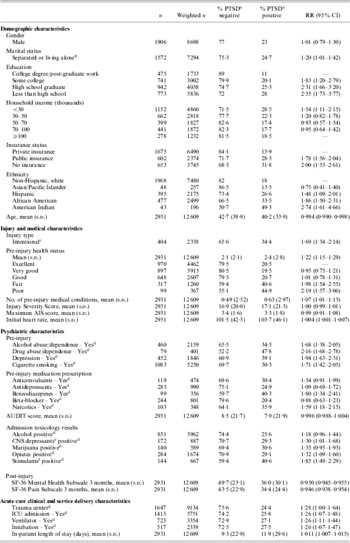
Demographic, clinical and service delivery characteristics of NSCOT patients

NSCOT, National Study on the Costs and Outcomes of Trauma; PTSD, post-traumatic stress disorder; RR, relative risk; CI, confidence interval; AIS, Abbreviated Injury Scale; AUDIT, Alcohol Use Disorders Identification Test; CNS, central nervous system; ICU, intensive care unit; s.d., standard deviation.
a Symptoms consistent with a diagnosis of PTSD as assessed with the PTSD Checklist (Weathers et al. Reference Weathers, Huska and Keane1991): the 12-month prevalence of symptoms consistent with a diagnosis of PTSD was 22·9%.
b Comparison group was married or living with partner.
c Comparison group was those unintentionally injured.
d Comparison group was absence of those with condition or medication.
e CNS depressants were barbiturates and benzodiazepines.
f Stimulants were cocaine and amphetamines.
g Comparison group was admission to non-trauma center.
We next calculated the frequency of patients who had symptoms consistent with a diagnosis of PTSD on the PCL at the 12-month post-injury assessment. We determined the association between PCL PTSD status and each demographic, injury/medical, psychiatric, and acute care clinical and service delivery characteristic (Table 1). We used weighted Poisson regression with robust error variance to estimate unadjusted relative risks (RRs) and 95% confidence intervals (CIs) (Zou, Reference Zou2004).
To determine which characteristics were independently associated with PTSD symptoms, we developed an adjusted Poisson regression model using the robust error variance procedure. All demographic, injury/medical, psychiatric and service delivery characteristics that were statistically significant at p⩽0·15 (Hosmer & Lemeshow, Reference Hosmer and Lemeshow1989) in the unadjusted analyses were entered together into the model. Backwards elimination was then used to individually remove the most non-significant characteristic. After the elimination of each non-significant (p>0·05) characteristic, the model was refit. This adjusted model contained only statistically significant variables, although age, gender and ISS were retained because of the importance of these variables in injury research (Zatzick et al. Reference Zatzick, Kang, Muller, Russo, Rivara, Katon, Jurkovich and Roy-Byrne2002b). All variables that were significant in the unadjusted regressions, but not included in the final model, were tested again for statistical significance in this adjusted model. No other characteristics were found to be statistically significant.
In this adjusted model, African American, American Indian, and Hispanic injury survivors had significantly elevated risks of developing 12-month symptoms consistent with a diagnosis of PTSD, relative to white injury survivors; this observation, when combined with prior investigation documenting racial-ethnic minority status as a significant PTSD predictor after injury (Santos et al. Reference Santos, Russo and Zatzick2003), informed the decision to further explore the associations between race-ethnicity, SES indicators, and PTSD. In the adjusted model we tested the interactions of race-ethnicity by (1) educational attainment, (2) insurance status, and (3) income. To increase the power of our tests we dichotomized educational attainment into greater than or less than high school (Breslau et al. Reference Breslau, Kendler, Su, Gaxiola-Aguilar and Kessler2005). The final adjusted model included all significant effects and interaction terms. Observations in all Poisson regressions were clustered within hospitals. Analyses were performed with the Stata statistical software program (Stata Corporation, College Station, TX, USA).
RESULTS
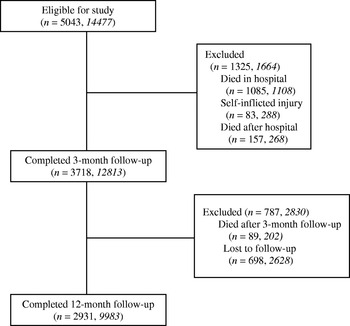
The 12-month NSCOT telephone assessment was completed by 2931 injury survivors. Using the NSCOT sampling and weighting approach, the reference population to which inferences could be made consisted of 9983 patients (Fig. 1). The investigation attained 81% 12-month follow-up of eligible injury survivors. Gender did not significantly differ between patients lost to follow-up and those completing the 12-month assessment. Patients lost to follow-up at 12 months were more likely to be African American (26% missing versus 18% not missing, χ2(1)=7·9, p<0·01) and Hispanic (24·7% v. 15·4, χ2(1)=71·6, p<0·001), when compared to non-Hispanic whites (48·5% v. 62·6%), were more likely to be intentionally injured (29·9% v. 15·5%, χ2(1)=329, p<0·001), were significantly younger [mean age=40·6 (36·4) v. 43·0 (34·2), t(3716)=4·8, p<0·01], and were less severely injured [ISS=16·4 (s.d.=18·4) v. 17·2 (s.d.=18·2), t(3627)=1·9 p<0·05].
Patient flow through the National Study on Costs and Outcomes of Trauma (NSCOT) (n=unweighted and weighted).

Twelve months after the injury admission 22·9% of injured survivors endorsed symptoms consistent with a diagnosis of PTSD on the PCL. The frequency of patients with symptoms consistent with a diagnosis of PTSD on the PCL varied across individual acute care hospital sites, ranging from 0% to 44·3% (median=17·2%). Unadjusted analyses revealed that multiple demographic, injury/medical, psychiatric, and service delivery characteristics were associated with symptoms consistent with a diagnosis of PTSD (Table 1).
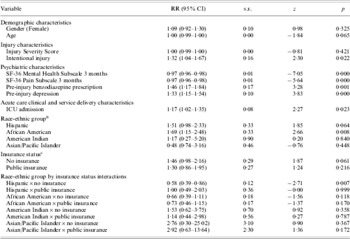
Poisson regression identified demographic, injury, psychiatric and service delivery characteristics that were independently associated with an elevated risk of symptoms consistent with a diagnosis of PTSD 12 months after the injury (Table 2). Greater levels of global symptomatic distress and pain, as indicated by lower SF-36 mental health and pain subscale scores, were associated with a significantly increased risk of symptoms consistent with a diagnosis of PTSD. Pre-injury benzodiazepine prescription, pre-injury depression, ICU admission and intentional injury were associated with elevated risks of PTSD symptoms ranging from 1·17 to 1·46. White injury survivors without insurance demonstrated approximately twice the rate of symptoms consistent with a diagnosis of PTSD 12 months after the injury when compared to white individuals with private insurance. By contrast, for Hispanic injury survivors rates of symptoms consistent with a diagnosis of PTSD were approximately equal between uninsured and privately insured groups. No other insurance status by race-ethnicity interactions were statistically significant (Table 2).
Demographic, clinical and service delivery characteristics associated with 12-month PTSDFootnote a

PTSD, Post-traumatic stress disorder; RR, relative risk; CI, confidence interval; ICU, intensive care unit; s.e., standard error.
a Symptoms consistent with a diagnosis of PTSD as assessed with the PTSD Checklist (Weathers et al. Reference Weathers, Huska and Keane1991).
b In comparison to non-Hispanic white.
c In comparison to private insurance.
DISCUSSION
This investigation documents that across US acute care hospitals, over 20% of moderately to severely injured adults had symptoms consistent with a diagnosis of PTSD 12 months after their injury admission. The 69-site investigation yields insight into previously observed variability in 12-month PTSD prevalences reported in single-site investigations. Using a standardized sampling and assessment procedure, the investigation documented a 0–44% range in the frequency of symptoms consistent with PTSD across individual acute care hospital sites. Literature review demonstrates that all previous single-site acute care investigations fall within this range (Blanchard et al. Reference Blanchard, Hickling, Taylor and Loos1995; Ehlers et al. Reference Ehlers, Mayou and Bryant1998; Koren et al. Reference Koren, Arnon and Klein1999; Michaels et al. Reference Michaels, Michaels, Zimmerman, Smith, Moon and Peterson1999; Holbrook et al. Reference Holbrook, Hoyt, Stein and Sieber2001; Schnyder et al. Reference Schnyder, Moergeli, Klaghofer and Buddeberg2001; Zatzick et al. Reference Zatzick, Kang, Muller, Russo, Rivara, Katon, Jurkovich and Roy-Byrne2002b; O'Donnell et al. Reference O'Donnell, Creamer and Pattison2004). The elucidation of demographic, clinical and service delivery characteristics independently associated with an increased risk of 12-month symptoms consistent with a diagnosis of PTSD across sites suggests factors that may explain some of the reported variability in PTSD prevalences (O'Donnell et al. Reference O'Donnell, Creamer, Bryant, Schnyder and Shalev2003).
This is the first investigation to suggest that ICU admission during the in-patient injury hospitalization is independently associated with an increased risk of symptoms consistent with a diagnosis of PTSD. Other acute care clinical and service delivery characteristics, including mechanical ventilation, intubation, level I trauma center hospital admission, increasing hospital length of stay, and increasing injury severity, were not independently associated with the development of PTSD. There are a number of characteristics associated with ICU admission, such as multiple, prolonged procedures, that may constitute secondary traumatic stressors, and exogenous administration of catecholamines, that may explain the independent contribution of ICU stays on the later development of PTSD (Shaw et al. Reference Shaw, Robinson and Steiner2002; Cuthbertson et al. Reference Cuthbertson, Hull, Strachan and Scott2004; Kapfhammer et al. Reference Kapfhammer, Rothenhausler, Krauseneck, Stoll and Schelling2004; Schelling et al. Reference Schelling, Kilger, Roozendaal, de Quervain, Briegel, Dagge, Rothenhausler, Krauseneck, Nollert and Kapfhammer2004). Future investigation could elucidate which ICU characteristics are most strongly related to the development of post-hospitalization PTSD and whether ICU-based preventive interventions can curb the development of PTSD (Schelling et al. Reference Schelling, Kilger, Roozendaal, de Quervain, Briegel, Dagge, Rothenhausler, Krauseneck, Nollert and Kapfhammer2004).
The investigation found that greater global psychological distress after injury is strongly and independently associated with an increased risk for the later development of symptoms consistent with a diagnosis of PTSD. In addition to mental health symptoms, greater physical pain at 3 months after the injury was also independently associated with an increased risk for symptoms consistent with a diagnosis of PTSD 12 months post-injury. These findings corroborate and extend previous investigations by suggesting that a constellation of post-injury psychological distress including PTSD, anxiety, depressive, peri-traumatic dissociative and pain symptoms may be associated with the development of enduring PTSD (Shalev et al. Reference Shalev, Peri, Canetti and Schreiber1996; Bryant et al. Reference Bryant, Harvey, Guthrie and Moulds2000; Marshall & Schell, Reference Marshall and Schell2002; Zatzick et al. Reference Zatzick, Kang, Muller, Russo, Rivara, Katon, Jurkovich and Roy-Byrne2002b; O'Donnell et al. Reference O'Donnell, Creamer, Bryant, Schnyder and Shalev2003; Ozer et al. Reference Ozer, Best, Lipsey and Weiss2003). One prior investigation in burn-injured children suggests that adequate opiate pain control is associated with diminished PTSD symptoms 3 months post-injury (Saxe et al. Reference Saxe, Stoddard, Courtney, Cunningham, Chawla, Sheridan, King and King2001). These findings, when considered in conjunction with clinical epidemiological data demonstrating the ubiquitous use of analgesic medication in acute care settings, might suggest the exploration of interventions targeting pain control in the secondary prevention of PTSD (Zatzick & Roy-Byrne, Reference Zatzick and Roy-Byrne2006). To our knowledge, this is the first investigation to identify an association between pre-injury benzodiazepine prescription and the development of PTSD. Of note, pre-injury benzodiazepine prescription could be serving as a proxy for pre-injury anxiety disorders.
The investigation assessed interactions between race-ethnicity and SES indicators as post-injury PTSD predictors. Of interest, for Hispanic injury survivors, rates of symptoms consistent with a diagnosis of PTSD were approximately equal for uninsured and privately insured individuals. By contrast, uninsured white injury survivors demonstrated elevated rates of PTSD when compared to white injury survivors with private insurance. Prior research and commentary suggest that trauma-exposed Hispanic individuals may be particularly vulnerable to the development of PTSD (Ruef et al. Reference Ruef, Litz and Schlenger2000; Galea et al. Reference Galea, Vlahov, Tracy, Hoover, Resnick and Kilpatrick2004; Pole et al. Reference Pole, Best, Metzler and Marmar2005). In the current post-injury context this vulnerability may be serving to equalize other sociodemographic factors, such as being uninsured. One limitation of the NSCOT investigation was the lack of an assessment of Hispanic subgroups and acculturation levels; future investigation could productively explore these factors in the development of post-injury PTSD (Marshall & Orlando, Reference Marshall and Orlando2002; Galea et al. Reference Galea, Vlahov, Tracy, Hoover, Resnick and Kilpatrick2004; Breslau et al. Reference Breslau, Aguilar-Gaxiola, Borges, Castilla-Puentes, Kendler, Medina-Mora, Su and Kessler2007).
The investigation has other limitations. One limitation is that many pre-trauma attributes (e.g. pre-injury health status) were assessed by patient self-report at the 3-month post-injury interview; these retrospective reports can be biased by current levels of distress and impairment. The health services research approach used global symptom screens rather than structured diagnostic assessments in a large sample of injured patients across acute care hospital sites. Using symptom screens to assess PTSD may inflate PTSD symptom endorsements (e.g. patients with organic amnesia secondary to traumatic brain injury endorsing screen items assessing psychogenic amnesia). In addition, single-site trauma-focused clinical investigations have used early in-depth assessments of specific symptom clusters including PTSD, depressive and peri-traumatic dissociative symptoms (Shalev et al. Reference Shalev, Peri, Canetti and Schreiber1996; Ursano et al. Reference Ursano, Fullerton, Epstein, Crowley, Kao, Vance, Craig, Dougall and Baum1999; Marshall & Schell, Reference Marshall and Schell2002; O'Donnell et al. Reference O'Donnell, Creamer and Pattison2004). We acknowledge that in the NSCOT, SF-36 mental health subscale scores may be serving as a proxy for early post-injury PTSD. The exclusion of important subgroups of injured trauma survivors (e.g. burn injury) may also impact PTSD prevalence estimates and the generalizability of study results. Finally, the multiple imputation method has limitations, as do all methods for handling missing data. The multiple imputation approach is the optimal method for data that are missing at random (MAR; Rubin, Reference Rubin1987). If data are not Missing Completely at Random (MCAR), or if missing values are associated with unobserved covariates, then the multiple imputation method is likely to introduce bias. As other alternatives (e.g. complete case analysis or single imputation method) have been demonstrated to yield less satisfactory results than the multiple imputation method, we believe that the multiple imputation method is the optimal approach for handling missing data in the current investigation.
The investigative findings have important implications for US acute care policy. Nationwide, more than 20% of hospitalized patients had symptoms consistent with a diagnosis of PTSD 12 months after injury, and readily identifiable clinical risk factors were documented. In the National Comorbidity Survey (NCS) the survival curve for PTSD after trauma exposure decreased most rapidly in the first 12 months (Kessler et al. Reference Kessler, Sonnega, Bromet, Hughs and Nelson1995). The NCS data suggest that more than 50% of individuals who are symptomatic at 12 months will remain symptomatic at the 5-year post-trauma time point. Thus, early PTSD screening and intervention may have the potential to mitigate chronic PTSD after injury.
The American College of Surgeons (ACS) has mandated that level I trauma centers must have on-site alcohol screening and brief intervention services as a requisite for trauma center accreditation (ACS/COT, 2006). This policy mandate derives from a series of acute care screening and intervention studies documenting improved outcomes for patients receiving clinical interventions targeting post-injury alcohol consumption (ACS/COT, 2006). Thus, investigations that refine early PTSD screening and intervention procedures have the potential to improve the quality of mental health care for injured survivors of individual and mass trauma (Zatzick et al. Reference Zatzick, Roy-Byrne, Russo, Rivara, Droesch, Wagner, Dunn, Jurkovich, Uehara and Katon2004), as they may inform future ACS policy mandates for sustainable mental health services in acute care medical settings. Policy efforts targeting early post-injury screening and intervention have the potential to substantially decrease the individual and societal burden of chronic PTSD.
ACKNOWLEDGMENTS
This work was funded by grant R49/CCR316840 from the National Center for Injury Prevention and Control and the Centers for Disease Control and Prevention, grant R01/AG20361 from the National Institute of Aging, and grant R01/MH073613 from the National Institute of Mental Health.
DECLARATION OF INTEREST
None.