Introduction
The high rates of mental health problems in Northern Ireland (NI) have been well documented. O’Reilly and Stevenson (Reference O’Reilly and Stevenson2003) analysed data from the NI Health and Wellbeing Survey, which was based on a random sample of households and stratified by health board, and reported that 27.6% of the 1694 participants met the criteria for ‘significant psychological morbidity’ based on the General Health Questionnaire. Results from the Northern Ireland Study of Health and Stress, a nationally representative face-to-face household survey of 4340 participants aged 18 years and older conducted from 2004 to 2008 indicated that the lifetime prevalence of any DSM-IV (Diagnostic and Statistical Manual of Mental Disorders, 4th ed.: American Psychiatric Association, 2000). anxiety, mood, impulse-control or substance disorder was 39.1% and the prevalence of any mood disorder was 18.8% and major depressive disorder was 16.3% (Bunting et al. Reference Bunting, Murphy, O’Neill and Ferry2012). Lifetime prevalence estimates do not appear to be a legacy of the recent political violence (the troubles) as the estimate of the prevalence of any 12-month DSM-IV anxiety, mood, impulse-control and substance disorders was 23.1% and the 12-month prevalence of any mood disorder was 9.6% and major depressive disorder was 7.9% (Bunting et al. Reference Bunting, Murphy, O’Neill and Ferry2013). In an international comparison, NI had the second highest rates of mental health disorders globally (Kessler et al. Reference Kessler, Aguilar-Gaxiola, Alonso, Chatterji, Lee, Ormel, Üstün and Wang2009.
The high rates of mental ill health in NI appear to be associated with high, and increasing, levels of psychopharmacological treatment, in particular, the use of anti-depressants. For example, Kelly et al. (Reference Kelly, Ansari, Rafferty and Stevenson2003) used administrative data from the Regional Prescribing Information Unit (NI) to get details of all anti-depressants prescribed annually from 1989 to 1999 using the Defined Daily Dose (DDD) System. They reported an increase in anti-depressant DDD from 4962 in 1989 to 28 182 in 1999. More recently, anti-depressant medication use was studied over the entire NI population of women of childbearing age (15–45 years) in 2009 using administrative data from the Enhanced Prescribing Database (EPD) (Wemakor et al. Reference Wemakor, Casson and Dolk2014): they reported that 66.5% of the prescriptions prescribed were for anti-depressants and 43 770 women redeemed at least one prescription for an anti-depressant, giving an anti-depressant prescription prevalence of 16.3%. The ‘Script Report’ (2014) – an analysis of 36 million prescription records from GP practices across the UK, including 3.5 million from NI for the period April–September 2013, showed that NI (1) prescribed proportionately more anti-depressants than 23 countries examined in a major international study, (2) consumed more than 2.5 times the anti-depressants as similarly defined socio-economic areas in England and (3) anti-depressant use is higher among women than men and highest for 35–64 year olds. The high rates of anti-depressant prescribing may be explained by the relatively poor physical health in NI (Newton et al. Reference Newton, Briggs, Murray, Dicker, Foreman, Wang, Naghavi, Forouzanfar, Ohno, Barber and Vos2015), the high rates of post-traumatic stress disorder, most likely associated with decades of political violence (Koenen et al. Reference Koenen, Ratanatharathorn, Ng, McLaughlin, Bromet, Stein, Karam, Ruscio, Benjet, Scott and Kessler2017) and NI having the highest levels of social and economic deprivation in the UK (Abel et al. Reference Abel, Barclay and Payne2016).
The extant evidence indicates that NI has high levels of depression and the primary treatment is anti-depressant medication. The study uses data-linkage techniques to derive: (i) comprehensive population-based estimates of anti-depressant prescribing in NI and (ii) an examination of the personal, socio-demographic and socio-economic factors associated with anti-depressant prescribing.
Method
Data for this study were provided through the Administrative Data Research Centre – Northern Ireland (ADRC-NI) (https://adrn.ac.uk/about/network/n-ireland/), part of a recent UK-wide initiative funded by the Economic and Social Research Council (ESRC) to increase the use of administrative data sources and linkages for research purposes. The main data sources linked for analysis comprised the 2011 NI Census returns and the EPD, an electronic database of all primary care prescriptions dispensed in NI and submitted to the Business Services Organisation for payment. Deaths occurring subsequent to the Census (until the end of 2015; data provided by Business Services Organisation) and data on rateable values of households (from the Land and Property Services) (ref) were also included and linked through the Census record. Much of the detailed architecture of the data and linkage processes are based on the Northern Ireland Longitudinal Study (NILS), a precursor to ADRC-NI that is representative of 28% of the population, and are described in detail elsewhere (O’Reilly et al. Reference O’Reilly, Rosato, Catney, Johnston and Brolly2011). The final data set was linked at Northern Ireland Statistics and Research Agency (NISRA) (using a one-way encryption methodology), tested for potential disclosure problems, de-identified and, lastly, made available to the research team in a secure setting at NISRA headquarters in Belfast. Ethical approval for this study was obtained from the Ulster University Research Ethics Committee and the Office for Research Ethics Committee Northern Ireland. Successful linkage of 92.58% of the 2011 NI Census cases with the EPD was achieved, resulting in a sample of 1 588 355 individuals with 4 065 959 EPD file records. No unlinked data were provided for analysis.
Study measures
The population for analysis comprises the whole enumerated NI 2011 Census population, normally resident in NI and living in private households. All indicators were derived from the Census returns and were selected for analysis because of their utility in the extant literature on anti-depressant use.
Demographic characteristics
Age was classified in five broadbands reflecting life stage and anti-depressant use (0–15, 16–34, 35–54, 55–74 and 75+ years). Gender was coded as male/female (0/1). Family structure was derived from household data and summarised as: a couple-based household; lone parent-based household; and living alone. Because religious denomination was derived from two Census questions which records either current religious denomination or, for those who did not answer the question, the denomination they were brought up in. It is essentially a specification of identity rather than religiosity and for this analysis was summarised as four categories: Catholic; Protestant/other Christian; other faith/philosophy; and none reported.
Health characteristics
General health in the 12 months prior to Census was taken directly from the Census question (a five-point Likert-type scale ranging from very good health to very bad). Respondents were also asked a series of questions ascertaining more specific health information: this had the form ‘Do you have any of the following conditions which have lasted, or are expected to last, at least 12 months?’ and included a category for ‘Emotional, psychological or mental health conditions’ with responses as no/yes (0/1). This was also included for analysis.
Socio-economic characteristics
The economic activity of respondents aged 16+ was summarised as seven categories: employed full-time; employed part-time; unemployed; retired; homemaker; permanently sick; and other. Housing tenure and rateable property value were summarised as one indicator: tenure was derived from the Census record (and coded as owner occupied, private renting, and social renting); rateable value of property was derived from data derived initially for local taxation purposes in 2005 and provided by Land and Property Services (Department of Finance and Personnel for NI); this latter was summarised and combined with tenure – producing eight categories, five defining owner-occupation (owner-occupied houses valued for local taxation purposes as £160 000+, £115 000–<£160 000, £90 000–<£115 000, £70 000–<£90 000 and <£70 000, and one for owner-occupied properties with no assigned rateable value) and two renting categories (private renting and social renting).
Area-level characteristics
Area-level deprivation was measured using Northern Ireland Multiple Deprivation Measure (NIMDM, 2010) – a ranked index of deprivation of 890 relatively homogeneous Super Output Areas (NISRA, 2010). Deprivation is measured on seven domains (health, income, employment, education skills and training, proximity to services, living environment, and crime and disorder, with an additional summary ranking of the seven). For this analysis, the summary ranking was specified as deciles, from most to least deprived.
Settlement band is a measure of locale that places all settlements in NI on an urban–rural spectrum according to population size, population density and service provision (NISRA, 2005). NISRA defines eight settlement bands: (A) Belfast metropolitan urban area; (B) Derry urban area; (C) large towns; (D) medium-sized towns; (E) small towns; (F) intermediate settlements; (G) village; and lastly (H) small villages, hamlets or open countryside. For analysis purposes, these were summarised as three categories: urban (Bands A–B), intermediate (C–G) and rural (H).
Anti-depressant prescribing measures
The analysis utilised records of prescriptions for anti-depressant medications in each quarter from 2011 to 2015. Anti-depressant medications were identified using three British National Formulary (BNF) codes: BNF 4.3.1 (Tricyclics), 4.3.2 (MAOIs) and 4.3.3 (SSRIs). There were approximately 3.62 million prescriptions in the specified period, of which 3.55 million were viable for linkage. The data were (a) coded (0/1) to indicate prescription of one or more anti-depressants for each calendar year (2011–2015) and (b) aggregated over the whole 5 years indicating a prescription issued at any time during the 5-year study period.
Analysis strategy
First, deaths were considered. Death at any point during year (2011–2014) resulted in removal from calculations for subsequent years. Death accounted for 3% of sample attrition over the 5-year study period (effective sample sizes 2011 N = 1 588 355; 2012 N = 1 579 424; 2013 N = 1 566 525; 2014 N = 1 553 402; 2015 N = 1 540 475; all years N = 1 540 475). Next, the percentages of individuals redeeming one or more prescriptions during the given time periods (individually for each year between 2011 and 2015, and all years combined) were calculated. Logistic regression analyses were conducted using Stata 15 to assess the impact of predictor variables on the likelihood that respondents prescribed an anti-depressant, firstly in univariate analyses and then in a model fully adjusted for all included variables.
Results
For each year from 2011 to 2015, the proportions of the population in NI aged 16 or more receiving anti-depressant prescriptions were 12.3%, 12.9%, 13.4%, 13.9% and 14.3%, respectively, and over the whole 5-year period was 24.3%. From the 2011 NI Census, 5.9% endorsed the item relating to experiencing ‘Emotional, psychological or mental health conditions,’ and of these 71.2% had a record of an anti-depressant prescription anytime between 2011 and 2015. Counts and percentages of anti-depressant prescribing for each year, stratified by all predictor variables, and chi-squared tests are available at https://tinyurl.com/ADRCreport.
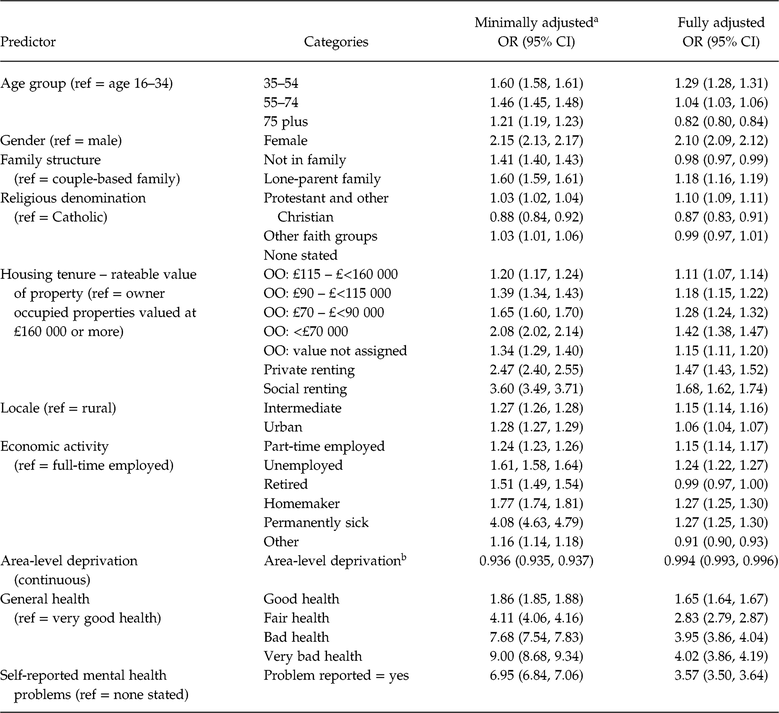
Table 1 records the associations between the socio-demographic, socio-economic and health indicators and 5-year anti-depressant prescribing uptake for those aged 15 or more at the 2011 Census, firstly in minimally adjusted then in fully adjusted models.
Socio-demographic, socio-economic and health characteristics for those aged 16 or more and prescribed anti-depressant medication in Northern Ireland (2011–2015)

OR, Odds Ratios; OO, owner occupation.
Data represent OR (95% CIs) derived from logistic regression model.
a (a) Age and sex mutually adjusted;
b Continuous variable – 10 categories from most to least deprived.
Socio-demographic characteristics: Females were twice as likely than males to receive a prescription (at a level remaining stable from the minimally adjusted to the fully adjusted models); those aged 35–54 were more likely than other age groups and those aged 75 or more were less likely (OR = 1.29: 95% CI = 1.28, 1.31 and OR = 0.82: 0.80, 0.84, respectively); those living as part of a one-parent households were more likely than persons living a couple-based households to receive prescriptions (OR = 1.18: 1.16, 1.19); Protestants were more likely than Catholics to be in receipt of anti-depressants (OR = 1.10: 1.09, 1.11); and finally, those from rural areas were less likely to receive prescription than other locale types (OR = 1.06: 1.04, 1.07 and 1.15: 1.14, 1.16 for urban and intermediate locales, respectively) .
Socio-economic characteristics: Housing tenure/rateable property value shows an increasing gradient in relation to housing status – for example, compared to those living in the most expensive housing those in social rented housing recorded an excess likelihood (OR = 1.68: 95 %CI = 1.62, 1.74); area-level deprivation recorded a 0.05% decline (by decile) in receipt of prescriptions (dropping from a 0.6% decline in the minimally adjusted model; and finally, when compared with those in employment, those unemployed were more likely (OR = 1.24: 1.22, 1.27).
Self-reported health: Those in poorer health were also more likely to be in receipt of anti-depressants – compared to the very healthy those in poor or very poor health were more likely (OR = 3.95: 95% CI = 3.86, 4.04 and OR = 4.02: 3.86, 4.19, respectively); and those reporting mental ill health when compared to persons not reporting such conditions (OR = 3.57: 3.50, 3.64).
Discussion
The primary aim of this study was to use data linkage techniques to develop the most comprehensive population-based estimates of the prevalence of anti-depressant prescribing in NI. Based on the population from the 2011 NI Census, rates of prescribing were 12.449% in 2011 and 14.925% in 2015, and over the 5-year period, the prevalence was 24.121%. Direct comparison with other countries is difficult as this is the first full population-based assessment of anti-depressant prescribing. However, evidence points to the prescribing rates in NI being higher than other parts of the UK. For example, nationally representative survey data from England, the Adult Psychiatric Morbidity Survey (APMS), estimated the annual 2007 prevalence of anti-depressant prescribing to be 6.6% (Spiers et al. Reference Spiers, Qassem, Bebbington, McManus, King, Jenkins, Meltzer and Brugha2016), and NI has recorded the highest anti-depressant prescribing costs per capita compared to other parts of the UK (Donnelly, Reference Donnelly2014).
The most recent estimate of 12-month prevalence of major depressive disorder in NI was 7.9% (Bunting et al. Reference Bunting, Ferry, Murphy, O’Neill and Bolton2013), and this is lower than any of the annual rates of anti-depressant prescribing from 2011 to 2015. It may be the case that some people are prescribed an anti-depressant when their symptoms do not meet the full diagnostic criteria for depression; this has previously been observed by Spiers et al. (Reference Spiers, Qassem, Bebbington, McManus, King, Jenkins, Meltzer and Brugha2016) who reported 45.4% of the APMS participants who reported currently using anti-depressants did not meet the diagnostic criteria for depression. It may also be the case that anti-depressants have been prescribed for problems other than depression, such as anxiety, insomnia and pain (Wong et al. Reference Wong, Motulsky, Eguale, Buckeridge, Abrahamowicz and Tamblyn2016). Also, the comparison between 12-month prevalence rates of depression and rates of anti-depressant prescribing is not directly comparable as treatment for depression may continue for more than 1 year after diagnosis. There is also evidence that anti-depressants may be prescribed due to the lack of alternative treatment options. The Mental Health Foundation (2005) surveyed 200 UK general practitioners and found that 78% had prescribed an anti-depressant in the previous 3 years, despite believing that an alternative treatment might have been more appropriate. It also found that 66% had done so because a suitable alternative was not available, 62% because there was a waiting list for the suitable alternative and 33% because the patient requested anti-depressants. Of the GPs surveyed, 60% said they would prescribe anti-depressants less frequently if other options were available to them.
It is likely that factors other than depression are associated with anti-depressant prescribing as the results of the multivariate regression analysis that showed that all the demographic, health, socio-economic and area-level variables remained significantly associated with anti-depressant prescribing after controlling for self-reported emotional, psychological or mental health condition. The findings are consistent with the extant research that has shown that socio-economic disadvantage is associated with increased anti-depressant use (Butterworth et al. Reference Butterworth, Olesen and Leach2013): all forms of economic activity compared to full-time employment were associated with an increased risk, as were lower levels of rateable property value and area-level deprivation. Other risk factors were associated with anti-depression prescribing in line with existing epidemiological evidence. Increased risk of anti-depressant prescribing in middle and late adulthood reflects the pattern of the lifetime prevalence of depression (Kessler et al. Reference Andrade, Caraveo-Anduaga, Berglund, Bijl, Graaf, Vollebergh, Dragomirecka, Kohn, Keller, Kessler and Kawakami2003) and the increased risk for being female (OR = 2.07) was within the range of ORs reported in an analysis of data from 10 countries (ORs 1.9–2.5: Andrade et al. Reference Andrade, Caraveo-Anduaga, Berglund, Bijl, Graaf, Vollebergh, Dragomirecka, Kohn, Keller, Kessler and Kawakami2003). The results showed an increased risk of anti-depressant prescribing in urban (OR = 1.06) and intermediate (OR = 1.15) areas compared to rural areas. These effects are similar to those reported by Weich et al. (Reference Weich, Twigg and Lewis2006) who found increased rates of common mental disorders in non-rural areas of the UK. The increased rates of anti-depressant prescribing may reflect the availability and easier access to general practitioners in non-rural areas. Compared to the Protestant/other Christian group, the Catholic (OR = 0.91), other faith/philosophy (OR = 0.78) and no faith/philosophy (OR = 0.90) groups had significantly lower risk of anti-depressant prescribing. This is in contrast to the findings of O’Reilly and Stevenson (Reference O’Reilly and Stevenson2003), who reported no significant difference between Catholics and Protestants on scores on the General Health Questionnaire, and Bosqui et al. (Reference Bosqui, Maguire, Kouvonen, Wright, Donnelly and O’Reilly2017), who found that self-reported poor mental health was higher for Catholics (8.69%) than Protestants (7.06%), although the effect was moderated by the own-group religious neighbourhood density. It would appear, even if there are no differences in prevalence of depression, that the Protestant/other Christian group are more likely to be in receipt of anti-depressants.
There are some limitations of this study. First, not all anti-depressants were included in the analysis; the anti-depressants from the ‘Other Antidepressant Drugs’ (BNF section 4.3.4) were not included in the analysis. This is problematic as the research evidence shows that this category has seen significant increases in prescribing rates in England 1993–2004, and more recently, National Health Service data from Scotland showed that this category accounted for 16.71% of the total number of dispensed anti-depressants in 2011 (isdscotland, 2018). This means that the rates reported in this study will be underestimated. Second, the percentage of successful data linkage was high, but a small percentage (7.42%) was not successfully linked. Third, anti-depressant use was coded as ‘any use’ in each calendar year. Further research will analyse the dosage and frequency of prescribing and the type of anti-depressant. Fourth, we did not have an assessment of depression, so the rates of anti-depressant prescribing were compared to independent prevalence estimates.
In conclusion, this study found that rates of anti-depressant prescribing were 12.449% in 2011 and 14.925% in 2015, and over the 5-year period the prevalence was 24.121%. These rates are likely to be higher than the prevalence of depressive disorders, and this suggests that alternative non-pharmacological forms of help and support for people with problems associated with low mood are needed.
Acknowledgements
The Administrative Data Research Network takes privacy protection very seriously. All information that directly identifies individuals is removed from the data sets by trusted third parties before researchers get to see it. All researchers using the network are trained and accredited to use sensitive data safely and ethically. They access data only through a secure environment and all findings are vetted to ensure that they adhere to the strictest confidentiality standards. The help provided by the staff of the ADRC-NI and the NISRA Research Support Unit is acknowledged. The ADRC-NI is funded by the ESRC. The authors alone are responsible for the interpretation of the data and any views or opinions presented are solely those of the authors and do not necessarily represent those of the ADRC-NI. All data have been supplied for the sole purpose of this project.
Financial support
This work was supported by the ESRC’s Secondary Data Analysis Initiative (Grant number: ES/N012216/1).
Ethical standards
The authors assert that all procedures contributing to this work comply with the ethical standards of the relevant national and institutional committee on human experimentation with the Helsinki Declaration of 1975, as revised in 2008.
The study protocol was approved by the Ulster University Research Ethics Committee and the Office for Research Ethics Committee Northern Ireland.
Conflict of interest
Authors [MS, MR, SB, DB, JM] have no conflicts of interest to disclose.