Introduction
Pulse crops are growing in importance and prevalence in Canada. In 2011, the value of exported dry peas alone was valued at CAD$1.1 billion (Statistics Canada 2015). In 2018, approximately 1.46 million hectares (3.6 million acres) of farmland was dedicated to growing pulse crops (Statistics Canada 2018). Pulse crops are economically valuable, are used as food and forage, and contribute to soil health (via nitrogen fixation) when included in crop rotations (Corre-Hellou and Crozat Reference Corre-Hellou and Crozat2005). One of the only insect pests of field pea (Pisum sativum Linnaeus; Fabaceae) and faba bean (Vicia faba Linnaeus; Fabaceae) in Canada is the pea leaf weevil, Sitona lineatus (Linnaeus) (Coleoptera: Curculionidae) (Vankosky et al. Reference Vankosky, Dosdall and Carcamo2009). Sitona lineatus are distributed throughout Europe, Africa, and North America (Hoebeke and Wheeler Reference Hoebeke and Wheeler1985). In Canada, S. lineatus is invasive (Vankosky et al. Reference Vankosky, Dosdall and Carcamo2009) and is established and frequently abundant in the parts of Alberta and Saskatchewan (Prairie Pest Monitoring Network 2018).
Adult S. lineatus can cause severe defoliation (up to 50%) and destroy root nodules below the soil surface by feeding on nitrogen-fixing bacteria (Johnson and O’Keeffe Reference Johnson and O’Keeffe1981; Williams et al. Reference Williams, Schotzko and O’Keeffe1995). Adult and larval feeding damage can cause yield reductions of 28% or greater and reduce seed protein content (Nielsen Reference Nielsen1990). Larvae also impair nitrogen fixation and reduce nitrogen enrichment of the soil generally associated with legumes in crop rotation (Corre-Hellou and Crozat Reference Corre-Hellou and Crozat2005). Sitona lineatus populations need to be managed to prevent yield loss, but they are difficult to control using chemical insecticides. Because S. lineatus larvae are concealed inside root nodules, adults must be killed before they lay eggs in the spring, which requires application of costly systemic insecticides (Rotrekl and Cejtchaml Reference Rotrekl and Cejtchaml2008; Vankosky et al. Reference Vankosky, Carcamo, McKenzie and Dosdall2011b) or timely intervention using foliar insecticides (Seidenglanz et al. Reference Seidenglanz, Rotrekl, Smykalova, Poslusna and Kolarik2010), which are largely ineffective (e.g., cyhalothrin-lambda only slightly reduces the foliar damage caused by adult weevils; Seidenglanz et al. Reference Seidenglanz, Rotrekl, Smykalova, Poslusna and Kolarik2010).
Forecasts that accurately predict S. lineatus population densities between growing seasons coupled with timely monitoring will help to guide insecticide application for management of S. lineatus populations. At present, entomologists in Alberta and Saskatchewan, Canada conduct an annual survey to estimate the distribution and density of S. lineatus populations in spring (Prairie Pest Monitoring Network 2018). In this survey, the total number of feeding notches per plant, and the presence or absence of increasing temperaturenotches on the clam leaf is assessed (Vankosky Reference Vankosky2017). Survey results are compiled into distribution maps that report the mean level of feeding damage observed in the field (Prairie Pest Monitoring Network 2018). Work conducted in Europe has shown that the amount of feeding damage to field pea seedlings can estimate adult populations (Cantot Reference Cantot1986; Nielsen Reference Nielsen1990), although the relationships between adult and larval density, and of weevil density and yield loss are not clear (Vankosky et al. Reference Vankosky, Carcamo and Dosdall2011a). The effect of abiotic factors such as temperature on the relationship between damage and adult population density is also unknown. For these reasons, and others, distribution maps for S. lineatus cannot be used to forecast weevil populations and are of limited use in making decisions related to pest management.
Ambient temperature may have positive or negative impacts on the rate at which S. lineatus consume field pea foliage in early spring, leading to overestimates or underestimates of population densities. Temperature is known to effect S. lineatus egg development, egg mortality (Lerin Reference Lerin2004), and adult dispersal activities (e.g., the temperature threshold for migration is estimated to be 12 °C; Hans Reference Hans1959). Temperature also affects the consumption rate of other insect species, including beetles such as Popillia japonica Newman (Coleoptera: Scarabaeidae) and Chrysochus auratus Fabricius (Coleoptera: Chrysomelidae) (Niziolek et al. Reference Niziolek, Berenbaum and DeLucia2013; Lemoine et al. Reference Lemoine, Burkepile and Parker2014). The feeding rate of both of these beetle species increased with increasing temperature, then decreased as temperatures continued to increase above specific threshold temperatures (Niziolek et al. Reference Niziolek, Berenbaum and DeLucia2013; Lemoine et al. Reference Lemoine, Burkepile and Parker2014).
Host plant consumption by S. lineatus might also depend on the sex of the weevil, and this could affect estimates of weevil density based on plant damage assessments. Sex is known to influence host plant selection by Lamponius portoricensis Rehn (Phasmatodea: Phasmatidae) (Sandlin and Willig Reference Sandlin and Willig1993). It also affects the weight of food consumed by developing Schistocerca gregariai Forsskal (Othoptera: Acrididae), where females eat more per unit of body weight than males (Davey Reference Davey1954). The feeding habits of male and female insects may vary in relation to their roles in reproduction, where females consume additional food (at least during some life stages) to support egg production. Cochran (Reference Cochran1983), for example, noted that food intake by female cockroaches was highest when egg cases were being produced. Spring feeding by female weevils on field pea and faba bean may exceed that of males to support production of over 1000 eggs (on average) by individual female S. lineatus (Jackson Reference Jackson1920).
The objective of the present study was to investigate the effects of temperature, population density, and sex on foliar feeding damage caused by S. lineatus. We were particularly interested in the combined effects of temperature and population density on feeding damage. Experiments were designed such that the effects of temperature and density were tested when the temperature was (1) constant, and (2) fluctuated around a daily mean temperature. This design allowed us to compare the effects of temperature and density on S. lineatus feeding damage to field peas between: (1) the two temperature regimes (constant and fluctuating), and (2) the different temperatures included in each regime. We predicted that temperature, density, and the interaction of those factors would affect the rate of S. lineatus feeding observed in 24 hours. A significant interaction effect will occur if S. lineatus feed more as both temperature and density increase. The effect of sex was tested across all temperature treatments when field pea plants were exposed to only one adult weevil, with the expectation that females consume more foliage than males.
Methods
Insect collection and plant propagation
Adult S. lineatus were collected by hand from faba bean and field pea plots near Lacombe, Alberta, Canada in mid-May as seedlings were emerging and females were preparing to lay eggs. All weevils overwintered in field conditions. Weevils collected in Lacombe were housed in 500-mL plastic containers with soil, moistened paper towels, and faba bean leaves as a food source and were shipped overnight to Saskatoon, Saskatchewan, Canada. At the Agriculture and Agri-Food Canada Saskatoon Research and Development Centre, adult S. lineatus were kept in cages in the laboratory (20 ± 5 °C, 14:10 light-dark photoperiod). The cages were 31 cm × 15.2 cm × 15.2 cm in size and had eight circular mesh screens (two on each side panel), 10 cm in diameter, to allow airflow into the cages. Weevils were fed cut alfalfa (harvested from the Saskatoon Research and Development Centre research farm or nearby ditches) until they were required for experiments.
Field pea seeds were germinated between moist sheets of filter paper in petri dishes inside temperature-controlled cells of a thermally controlled multi-cell instrument in the Thermal Gradient Plate Facility at the Saskatoon Research and Development Centre. The multi-cell instrument used for this experiment consisted of 96 independently controlled cells (10 cm diameter by 12 cm deep) that were programmed to operate at constant or fluctuating temperatures for specific time intervals over a specified duration. For the purposes of seedling germination and plant growth, cells were held constant at 20 °C with 16:8 light-dark photoperiod. Water was added to the dishes as needed to maintain sufficient moisture levels. Upon germination, sprouted seeds were transplanted into petri dishes (four seedlings per dish) containing soilless mix. The petri dishes were returned to the cells in the multi-cell instrument and watered as needed. Prior to starting the experiment, field pea plants were thinned to one plant per petri dish. Only plants with three to six pairs of unfurled leaves (nodes) were used in the experiment, during which plants were exposed to adult S. lineatus for feeding for 24 hours.
Experimental design and procedure
The experimental design consisted of two main factors: five levels of temperature and four levels of weevil density, resulting in blocks of 20 treatment combinations that were replicated 11 times (five replicates in 2017 and six replicates in 2018). The temperature was held constant at 10, 15, or 20 °C for 24 hours in three temperature treatments. In the fourth and fifth treatments, temperatures fluctuated around a daily mean temperature of 10 and 15 °C, respectively, following a sine wave of incremental temperature increase during daylight hours and decrease during hours of darkness. In cells with a daily mean of 10 °C, the daily minimum temperature was 4 °C and the daily maximum was 18 °C. Where the daily mean was 15 °C, the daily minimum was 8 °C and the daily maximum was 22 °C. The four levels of weevil density included in the experiment were one, two, four, and eight weevils per plant.
Full replicates (all 20 treatment combinations) of the experiment were conducted sequentially or simultaneously depending on the availability of field pea plants at the appropriate growth stage. For each replicate, 20 cells in the multi-cell instrument were used (one cell = one experimental unit), with treatments randomly assigned to the cells. At hour zero, the appropriate number of weevils was transferred to the appropriate cells, which each held one field pea plant. The cells were sealed with 11.4 cm diameter watch glasses to prevent weevils from escaping. A second watch glass (15 cm diameter) was placed over each cell as a fail-safe against weevil escape and to help maintain temperatures within the cells. Adult S. lineatus weevils were allowed to feed on field pea plants for 24 hours (leaving U-shaped notches). The photoperiod for the experiment was 16:8 light-dark hours. Weevils were placed into the cells in darkness, at the minimum daily temperature, such that weevils in cells with fluctuating temperatures fed in warming and then cooling temperatures, as in field conditions. After 24 hours, the temperature in all cells dropped to 4 °C to stop feeding activity and the amount of weevil feeding (per node and on the clam leaves) was recorded. All weevils were recovered and removed from the cells and sexed using a dissecting microscope. In both years, weevils were only used once in the experiments. At the conclusion of the study, voucher specimens were preserved in the insect collection housed at the Saskatoon Research and Development Centre (Saskatoon, Saskatchewan, Canada).
Statistical analysis
The data failed to meet the assumptions of normality and equal variance for both factors (temperature and density). Before proceeding with analyses to test the effects of temperature and density, we used the Kruskal–Wallis test (α = 0.05; SAS Institute 2009) to determine if year (2017 or 2018) affected the results. As year had a significant effect across all temperature and density treatments (χ 2 = 11.7735, df = 1, P = 0.0006), we separated the replicates from the two years for further analysis.
The effects of temperature and weevil density on the amount of weevil feeding in 24 hours, based on the number of feeding notches, were tested for four scenarios defined a priori: (1) at three constant temperatures (10, 15, and 20 °C); (2) at two fluctuating temperatures (with a daily mean of 10 and 15 °C); (3) at constant 10 °C versus fluctuating 10 °C; and (4) at constant 15 °C versus fluctuating 15 °C. For all temperature scenarios, four weevil densities were tested (one, two, four, and eight weevils per plant). Thus, all comparisons were treated as two-factor experiments and were analysed using the Scheirer–Ray–Hare extension of the Kruskal–Wallis test (Sokal and Rohlf Reference Sokal and Rohlf1995). The Scheirer–Ray–Hare extension allows for non-parametric testing of experiments designed for two-factor analysis of variance when data fail to meet the assumptions (Sokal and Rohlf Reference Sokal and Rohlf1995). The Scheirer–Ray–Hare extension requires that all treatment groups have equal replication and at least five replicates (Sokal and Rohlf Reference Sokal and Rohlf1995). Significance of main (and interaction) effects was determined by comparing H-values calculated by the Scheirer–Ray–Hare extension to H critical values from the χ 2 table in Zar (Reference Zar2010), for the appropriate numerator degrees of freedom (Sokal and Rohlf Reference Sokal and Rohlf1995). Where significant effects of density or temperature were observed, treatment means were compared using the Mann–Whitney U test, with α = 0.05 adjusted using the Bonferroni correction where more than two treatment groups were compared (SAS Institute 2009).
The effect of sex on feeding damage by adult S. lineatus was tested (a) for density treatments with only one adult per plant, and (b) for all other density treatments for three defined sex ratios (< 50% female, 50:50, and > 50% female). Data from both 2017 and 2018 were used in these analyses, across all temperature treatments. Both datasets used to test for sex effects were parametric, thus both were analysed using one-factor analysis of variance to determine the effect of sex on feeding damage using the general linear model procedure (SAS Institute 2009), where α = 0.05. We did not test for effects of sex using models that included temperature or year as factors due to the overall complexity of the full dataset when these factors were considered.
Results
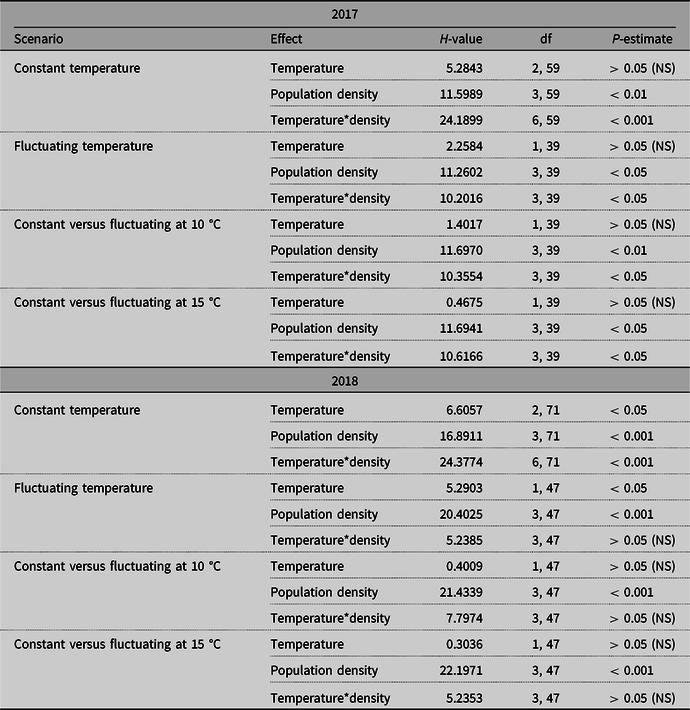
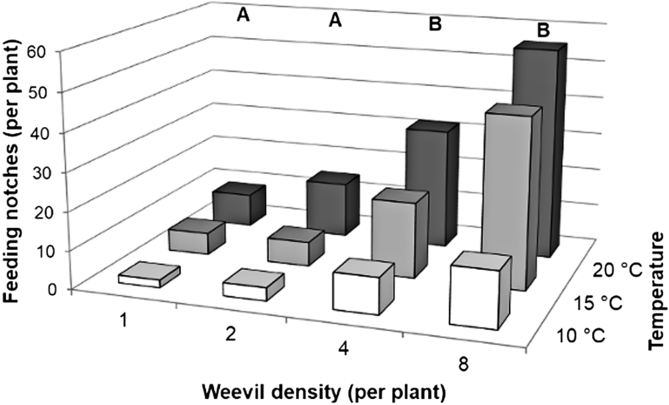
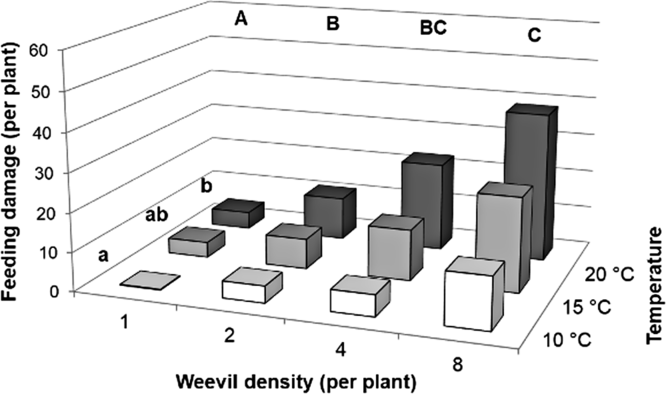
In both the 2017 and 2018 experiments that tested the effects of constant temperature regimes (10, 15, and 20 °C) and weevil density on feeding damage, a significant interaction of the main factors was observed (Table 1). The interaction effect in both years was driven by a significant increase in feeding damage as both temperature and density increased (Figs. 1–2). Feeding damage by adult S. lineatus in 2017 was affected by weevil density but did not differ statistically between the three constant temperature regimes (Table 1, Fig. 1). In 2018, both temperature regime and weevil density affected the amount of feeding damage observed in 24 hours (Table 1).
Kruskal–Wallis Scheirer–Ray–Hare analysis results for main effects and the interaction effect of temperature and population density on feeding damage to field pea plants by Sitona lineatus in 2017 and 2018.

NS, not significant.
Effect of the interaction of temperature and density (significant increase in mean feeding damage as both factors increased) and of population density on mean feeding damage per plant caused by Sitona lineatus in 2017 under constant temperature regimes (means with the same letters are not significantly different, P > 0.05).

Effect of the interaction of temperature and density (significant increase in mean feeding damage as both factors increased) and of population density (upper case letters) and temperature regime (lower case letters) on mean feeding damage per plant caused by Sitona lineatus in 2018 under constant temperature regimes (means with the same letters are not significantly different, P > 0.05).

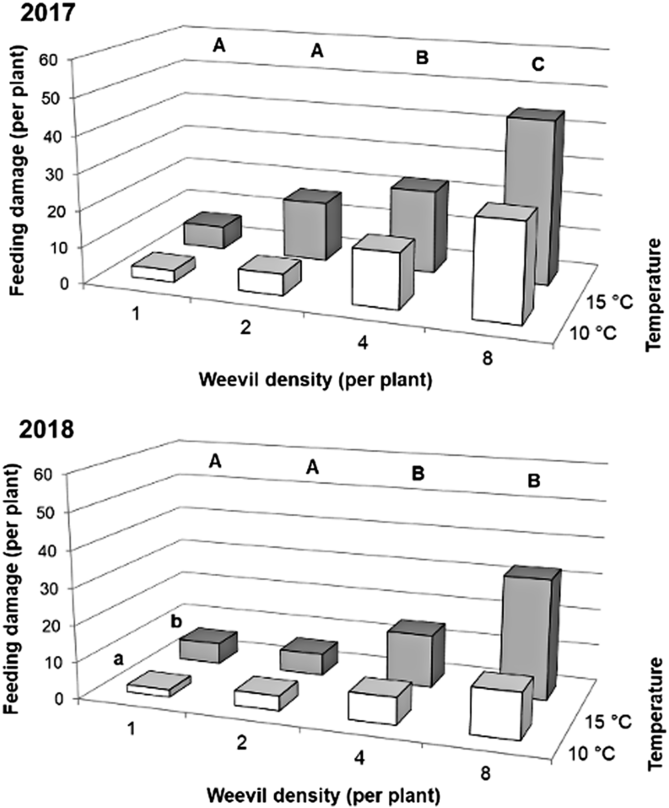
In 2017, a similar interaction effect was observed on feeding damage incurred when S. lineatus fed on field pea seedlings for 24 hours at temperatures that fluctuated around a daily mean temperature (Table 1, Fig. 3). Again, the interaction was driven by a significant increase in feeding damage as temperature and density increased. No interaction of main effects was observed in 2018 (Table 1). In both 2017 and 2018, feeding damage was affected by weevil density (Fig. 3), and in 2018, more damage was observed when the daily mean was 15 °C than when the daily mean temperature was 10 °C (Fig. 3).
Effect of the interaction of temperature and density, of population density (upper case letters), and of temperature (lower case letters) on mean feeding damage per plant caused by Sitona lineatus in 2017 (top panel) and 2018 (bottom panel) when the temperature fluctuated around a daily mean (treatment means with the same letters are not significantly different, P > 0.05).

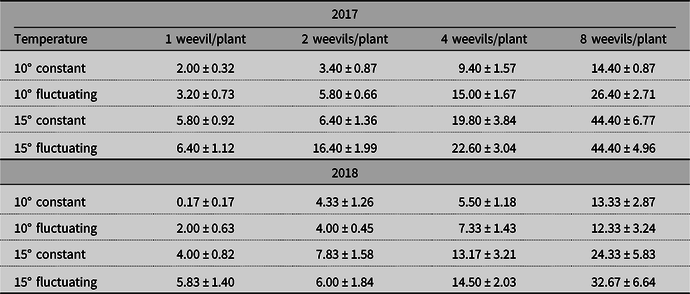
For the purpose of developing predictive models for weevil density based on weevil feeding damage observed in the field, we compared feeding damage after 24 hours between the constant and fluctuating daily temperature regimes with equal mean daily temperatures (i.e., 10 °C constant versus 10 °C fluctuating, and 15 °C constant versus 15 °C fluctuating). In 2017, we observed an interaction effect when fluctuating and constant temperature regimes were compared (Table 1) that was again driven by a significant increase in feeding damage as weevil density increased. There was a significant main effect of weevil density on feeding damage when the daily mean temperature was 10 °C (Table 1), such that: 1 weevil/plant = 2 weevils/plant < 4 weevils/plant = 8 weevils/plant. A similar effect of weevil density was observed when the mean daily temperature was 15 °C (Table 1): 1 weevil/plant = 2 weevils/plant < 4 weevils/plant < 8 weevils/plant. Feeding damage caused by adult S. lineatus was not different between constant and fluctuating daily temperature regimes at either 10 or 15 °C in 2017 (Table 1). Mean (± standard error) feeding damage under constant and fluctuating temperature regimes for all population density treatments in 2017 are given in Table 2.
Mean (± SD) feeding damage per plant caused by adult Sitona lineatus when the mean daily temperature (10 and 15 °C) was constant or fluctuated around the daily mean in 2017 and 2018.

In the experiments conducted in 2018, there was no interaction effect or effect of temperature regime (constant versus fluctuating) when the mean daily temperature was 10 or 15 °C (Table 1). Weevil density did affect the amount of feeding damage observed after 24 hours (Table 1); mean (± standard error) feeding damage is given in Table 2. This result indicates that feeding damage incurred when the temperature was constantly 10 °C was equal to that incurred when the daily temperature fluctuated around a daily mean of 10 °C. The same could be said for the two temperature regimes with a daily mean of 15 °C.
Sex affected feeding damage caused by adult S. lineatus (F 1, 53 = 4.88, P = 0.0316) when host plants were exposed to individual male or female weevils. Female weevils caused more feeding damage in 24 hours (4.29 ± 0.53 notches per plant) than males did (2.71 ± 0.61 notches per plant). Sex also affected feeding damage when field pea plants were exposed to two or more weevils (F 2, 162 = 7.16, P = 0.0011). Feeding damage was greater when less than 50% of the population was female (26.96 ± 3.65 notches per plant) compared to when the sex ratio was 50:50 (13.71 ± 1.62 notches per plant) or dominated by females (18.83 ± 1.72 notches per plant).
Discussion
The field survey of S. lineatus conducted annually in Alberta and Saskatchewan, Canada, assumes a relationship between S. lineatus population density and foliar damage levels (Prairie Pest Monitoring Network 2018). This assumption is based on results from the literature. For example, Cantot (Reference Cantot1986) found that there was a correlation between the number of adults and foliar damage. Landon et al. (Reference Landon, Levieux, Huignard, Rougan and Taupin1995), Murray and Clements (Reference Murray and Clements1992), Nielsen (Reference Nielsen1990), and Vankosky et al. (Reference Vankosky, Carcamo and Dosdall2011a) reached similar conclusions in studies using field pea and other host plants. The results of our experiment confirm that S. lineatus population density affects the amount of feeding damage observed on field pea plants. Greater levels of feeding damage were observed on plants exposed to increasing densities of S. lineatus.
The influence of temperature on S. lineatus feeding damage had not been tested before. On the Canadian prairies, daily mean temperatures can fluctuate considerably, which might cause densities to be overestimated or underestimated. In all scenarios tested in 2017 and one scenario in 2018 (constant daily mean temperature), we observed a significant interaction between temperature and density, such that feeding damage increased significantly as both temperature and density increased. In 2018, increasing temperature (as a main effect in the model), statistically affected S. lineatus feeding damage, with increasing damage observed as temperature increased under constant and fluctuating daily temperature regimes.
The strength and the consistency of the interaction in comparisons of constant and of fluctuating temperatures indicate that temperature is an important abiotic factor influencing feeding activity by S. lineatus. An exponential or multiple regression model might be appropriate to predict population density using measures of feeding damage. However, the data collected in this experiment suffered from highly unequal variances and had to be analysed using non-parametric methods; thus, we did not conduct regression analyses. Further experimentation in the laboratory and the field is needed to develop and validate a robust model. The model, once developed, should be tested using capture-mark-recapture methods to estimate population density and not using the abundance indices traditionally used to estimate S. lineatus populations (i.e., pheromone trapping or soil sampling).
Importantly, the amount of S. lineatus feeding damage that occurred in 24 hours was not affected by temperature regime (i.e., constant or fluctuating around a daily mean), at 10 °C or at 15 °C, indicating that feeding activity of S. lineatus is not dependent on daily temperature profiles. A study by Walgenbach et al. (Reference Walgenbach, Elliott and Kieckhefer1988) investigating the effects of temperature observed that the degree days required for complete development of Schizaphis graminum (Rondani) (Hemiptera: Aphididae) was similar under constant and fluctuating temperatures profiles. Walgenbach et al. (Reference Walgenbach, Elliott and Kieckhefer1988) suggested that predictions based on work conducted in the laboratory under constant temperatures could be applied to populations exposed to fluctuating temperatures in the field. The results of our study indicate that daily mean temperatures, obtained from weather stations or Environment and Climate Change Canada, can be used to estimate population density and potentially model S. lineatus population dynamics, thus simplifying efforts to develop models.
Several factors complicated our interpretation of the experimental results. First, the data collected were non-parametric, complicating the analysis and limiting the number of factors and interactions that could be tested. Second, year (2017, 2018) affected feeding damage, but it is not clear why. The experimental replicates between years only varied by one (n = 5 and 6 in 2017 and 2018, respectively). The adult S. lineatus specimens used in the experiment were collected from the same site and handled using the same protocol in both years. Third, sex affected feeding damage by S. lineatus. Females that foraged alone caused more damage than males. By contrast, when the sexes were mixed, male-dominated populations caused more damage than female-dominated populations. This was unexpected, as females tend to be larger and should be driven to consume more food to support their size (similar to female locust; Davey Reference Davey1954) and fecundity. Males may have disrupted feeding by females for the purposes of mating and oviposition. This possibility requires additional scrutiny as sex ratio in the field, like temperature, might also need to be factored into models to predict S. lineatus population density based on feeding damage.
This experiment confirmed our assumption that feeding damage caused by S. lineatus increases as population density increases. Therefore, methods currently used to estimate population density based on the spring damage survey in field peas (Prairie Pest Monitoring Network 2018) do provide an estimate of relative weevil abundance across Saskatchewan and Alberta. This research also revealed that daily mean temperature impacts S. lineatus feeding activity, as does weevil gender. Due to the strong and consistent interaction of temperature and density, a simple model is unlikely to accurately predict population density based on feeding damage. Fortunately, daily mean temperatures can be used to predict the rate of S. lineatus feeding activity, facilitating future research efforts related to model development.
Acknowledgements
We are grateful to Ross Weiss for programming the thermally controlled multi-cell instrument and providing useful input regarding experimental design. We recognise the hard work of numerous summer students: Jessa Drury, Annelise Jahnke, Jacqueline Nokusis, and Victoria Penner. Funding support was provided by the Saskatchewan Pulse Growers Association (project 20160215) and the Government of Saskatchewan Agriculture Development Fund (project 20160215).