Acute rheumatic fever and its sequel, rheumatic heart disease, remain major unsolved preventable health problems in New Zealand, particularly among the disadvantaged indigenous Māori and Pacific peoples. In New Zealand, acute rheumatic fever hospitalisation rates have remained essentially unchanged for the last 20 yearsReference Craig and Han1 with recent data indicating widening ethnic disparities.Reference Jaine, Baker and Venugopal2 To date, acute rheumatic fever/rheumatic heart disease control efforts have centred around the provision of government-funded benzathine penicillin secondary prophylaxis, with high adherenceReference Grayson, Horsburgh and Lennon3 and correspondingly low acute rheumatic fever recurrence rates.Reference Spinetto4 The consequences of acute rheumatic fever remain significant: approximately 80% of patients have cardiac involvement with clinical or subclinical carditis during their acute episode and 20% go on to develop moderate or severe rheumatic heart disease.Reference Lennon, Stewart, Farrell, Palmer and Mason5 Rheumatic mitral stenosis is common in such adults, usually without a history of rheumatic fever in childhood. Rheumatic heart disease results in considerable expense to the health system and personal cost to patients whose career choices, quality of life, and fertility are adversely affected.Reference Sadler, McCowan, White, Stewart, Bracken and North6, Reference North, Heynes, Lennon and Neutze7
The role of echocardiography in the diagnosis of acute rheumatic carditis was established over the last 20 years.Reference Figueroa, Fernandez and Valdes8–Reference Jaffe, Roche, Coverdale, McAlister, Ormiston and Greene11 Echocardiography detects clinically inaudible yet haemodynamically significant valve lesions, and can exclude pathology in those with an innocent cardiac murmur. In New Zealand and Australia, subclinical carditis was incorporated as a major diagnostic criterion in recently published acute rheumatic fever guidelinesReference Atatoa-Carr, Lennon and Wilson12, Reference Carapetis, Brown, Wilson and Edwards13 and echocardiography is recommended for all suspected acute rheumatic fever cases in order to confirm the presence of carditis.
The World Health Organization recommends screening for rheumatic heart disease in high-risk populations.14 The recent availability of compact portable echocardiography has led to the growing use of this technology for rheumatic heart disease screening in a number of low-income countries where it is shown to detect significantly more rheumatic heart disease than cardiac auscultation, with prevalence varying between 21.5 per 1000 in CambodiaReference Marijon, Ou and Celermajer15 and 42.6 per 1000 in Tonga.Reference Carapetis, Hardy and Fakakovikaetau16
To our knowledge, population-based echocardiographic screening for rheumatic heart disease was not previously performed in a developed country such as New Zealand, with well-established specialist paediatric cardiology services and secondary penicillin prophylaxis.
We aimed to determine rheumatic heart disease prevalence in high-risk groups of children in New Zealand using portable echocardiography. We sought to compare the sensitivity and specificity of cardiac auscultation to echocardiography and to determine the feasibility of school-based echocardiographic screening in this setting.
Materials and methods
Study design and participants
This study was conducted in an urban population in South Auckland with a high incidence of acute rheumatic fever of 70 per 100,000 children per year in the age group 5–15 years.Reference Lennon, Stewart, Farrell, Palmer and Mason5 The population is characterised by high levels of socio-economic deprivation and household crowding.17 Indigenous Māori and Pacific Islanders make up over 50% of children aged under 15 years in South Auckland.18
Ethics approval was obtained from the regional Health Ethics Committee, and consultation was undertaken with Māori and Pacific advisors. In New Zealand, the decile one and two schools represent 20% of the schools with the highest proportion of children living in deprived conditions.19 In sum, 7 of 30 potentially eligible decile one and two schools were selected according to a stratified randomisation process. A total of 471 children in strata 1 – primary schools – and 1288 children in strata 2 – intermediate schools – were selected. Acute rheumatic fever peaks in middle childhoodReference Lennon, Stewart, Farrell, Palmer and Mason5 and all children aged 10–13 years attending the seven selected schools were approached.
A minimum sample size of 1100 was determined based on results obtained from 393 children in the first two schools screened, where 6 of 393 – 15 per 1000 – were classified as having definite or probable rheumatic heart disease as per the study's diagnostic criteria. The sample size was derived using an estimated response rate of 70% and precision of 0.02 (2%) with adjustment for design effect due to potential clustering in the sample. The design effect was estimated to be 1.2.Reference Ganninger and Gader20
Standardised recruitment and consenting procedures were used across the seven study schools. The project team liaised with school staff and families and made educational presentations to schoolchildren. Written parental consent was obtained for each student. Community workers assisted with this process by conducting home visits and informing parents over the telephone. A history of acute rheumatic fever was sought by conducting a short questionnaire.
To determine the population-based prevalence of rheumatic heart disease, the Auckland Regional Rheumatic Fever Register records were checked to identify any additional children with rheumatic heart disease in the study population.
School screening procedures
Cardiac auscultation followed by echocardiography was performed in a blinded manner. Auscultation was performed by a paediatrician with children lying supine, on the left side, and sitting up in expiration. Echocardiography was performed by experienced cardiac sonographers using a standardised protocol. Vivid™e (GE Healthcare, Freiburg, Germany) portable cardiac ultrasound machines were used. Gain settings were optimised by the sonographers as the large variation in body habitus precluded the use of standardised settings; two-dimensional and colour Doppler images were obtained in parasternal and apical four-chamber views, with careful attention to record colour sweeps across any mitral or aortic regurgitant jets. Pulse-wave Doppler interrogation of regurgitant jets was undertaken to assess velocity, spectral envelope, and duration through the cardiac cycle. Valve leaflet morphology was assessed in parasternal long- and short-axis views. A probe with a variable range from 2.5 to 5.0 megahertz was used for all studies. On average, 20 scans were performed per 3-hour session per sonographer, averaging 9 minutes per scan. Height and weight were measured. When indicated, echocardiographic measurements were interpreted according to the body surface area.
Screening echocardiograms were reported by one of three investigators. Parents of children with normal results were notified by letter, a copy of which was sent to the family doctor. Those with abnormal results were informed over the telephone and by a home visit.
Paediatric cardiology assessment
Children with suspected rheumatic heart disease were referred to hospital for clinical evaluation by a paediatric cardiologist and detailed echocardiography was performed using a Phillips iE33 machine (Bothewell, WA, USA). There was a low threshold for referral of children with borderline regurgitant jets to enable comparison of colour Doppler images from the Vivid™e and Phillips iE33 machines. After auscultation, hospital echocardiograms were blind reported by a panel of paediatric cardiologists; two cardiologists assessed each echocardiogram. If their opinion differed, a third independent assessment was sought, and the majority opinion determined case classification and clinical management.
Criteria for diagnosis of rheumatic heart disease
The criteria used to report school screening echocardiograms were the same as those used to classify cases seen at the hospital. Study patients were classified as definite, probable, or possible rheumatic heart disease, congenital cardiac disease, or normal according to the combination of their clinical and echocardiographic findings. Rheumatic heart disease classification was developed during a 2005 World Health Organization expert consultationReference Carapetis, Parr and Cherian21 and modified as follows:
Definite rheumatic heart disease:
• Pathological murmur of mitral and/or aortic regurgitation.
• Echocardiographic features of rheumatic heart disease:
o Pathological grade mitral and/or aortic regurgitation; and
o valve morphological changes of mitral and/or aortic valve consistent with rheumatic heart disease; or
o mitral stenosis – mean gradient of 4 or more millimetres of mercury.
• Acute rheumatic fever with echocardiographic features of rheumatic heart disease.
Probable rheumatic heart disease:
• No murmur*
• Echocardiographic features of rheumatic heart disease:
o Pathological grade mitral and/or aortic regurgitation; and
o morphological changes of mitral and/or aortic valve consistent with rheumatic heart disease.
Possible rheumatic heart disease:
• No murmur.
• Echocardiographic features of rheumatic heart disease:
o Pathological grade mitral and/or aortic regurgitation without morphological changes of rheumatic heart disease; or
o morphological changes of mitral and/or aortic valve consistent with rheumatic heart disease without pathological grade mitral or aortic regurgitation.
Pathological grade regurgitation was defined as a colour Doppler jet meeting all the minimum criteria below.Reference Figueroa, Fernandez and Valdes8, Reference Jaffe, Roche, Coverdale, McAlister, Ormiston and Greene11
Mitral regurgitation:
• Substantial colour jet seen in two or more planes.
• Extending more than 2 centimetres beyond mitral valve leaflets in at least one plane.
• Holosystolic with well-defined spectral envelope on pulse wave/continuous wave Doppler.
• High velocity more than 3.5 metres per second.
Aortic regurgitation:
• Substantial colour jet seen in two or more planes.
• Extending more than 1 centimetre beyond aortic valve leaflets in at least one plane.
• Holodiastolic with well-defined spectral envelope on pulse wave or continuous wave Doppler.
• High velocity more than 3.5 metres per second.
Care was taken to exclude congenital valve pathology such as bicuspid aortic valve, dilated aortic sinuses, and congenital mitral valve prolapse. To fulfil a diagnosis of rheumatic heart disease, at least one of the following morphological features of rheumatic heart disease was required.
Mitral valve morphological features:
• Thickening** of anterior mitral valve leaflet mid-point or tip.
• Fixed elbow – dog leg – deformity of anterior mitral valve leaflet mid-point or tip.
• Prolapse of anterior mitral valve leaflet – in the absence of clinical features of congenital mitral valve prolapse.
• Thickening** or retraction of posterior mitral valve leaflet.
• Thickening, tethering, retraction, or rupture to chordae of anterior mitral valve leaflet.
Aortic valve morphological features:
• Thickening of aortic valve leaflets or closure line in parasternal short-axis views.
• Rolled aortic valve leaflet edges.
• Overt prolapse of aortic valve leaflets.
• Coaptation defect of aortic valve leaflets.
Clinical management
Children categorised as having definite and probable rheumatic heart disease were referred for benzathine penicillin secondary prophylaxis, education, and clinical follow-up. Those with possible rheumatic heart disease were counselled with arrangements made for 2-year follow-up to check for progression or resolution of changes. This group was not commenced on penicillin prophylaxis. Parents and the family doctor were informed about the importance of primary prevention of acute rheumatic fever through appropriate recognition and antibiotic treatment of group A streptococcal pharyngitis.
Statistical methods
Results were entered in an ACCESS database. Statistical analysis was performed using SAS software version 9.1. The sensitivity and specificity of auscultation compared with echocardiography for the diagnosis of pathological mitral regurgitation during school screening were calculated. Prevalence and the confidence interval for different rheumatic heart disease classifications were calculated by SURVEYFREQ procedure. Survey logistic procedures were applied to investigate associations of multiple risk factors for rheumatic heart disease, with stratified weight and a finite population correction factor.Reference Lumley22
Results
Out of 1759 children, 1158 (66%) consented. There were 16 consenting children who were not screened; 14 were repeatedly absent from school and two withdrew on the day of screening. Of the 1142 children who were screened, 504 (44%) were female, 56% were of Pacific Island ethnicity, and 29% were New Zealand Māori, similar to the overall demographic make-up of the seven study schools, which comprised 32% Māori, 56.5% Pacific Islanders, and 59% male children.
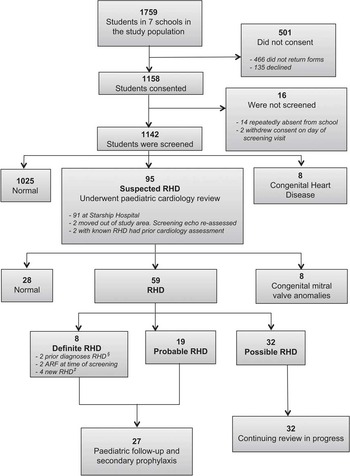
An algorithm of results is shown in Figure 1. Out of the 1142 children, 1025 (90%) had a normal screening assessment and exited the study; 95 (8.3%) had changes suggestive of rheumatic heart disease; and 91 of these underwent paediatric cardiology assessment. Owing to our inability to contact two children, their final interpretation was based on their screening echocardiograms. There were two children with pre-existing rheumatic heart disease who took part in the screening programme.
Rheumatic heart disease detected by echocardiographic screening. § At the time of screening, one had a murmur and one had no murmur, though murmur was previously documented. † Both cases met the New Zealand Diagnostic 2006 criteria for acute rheumatic fever.Reference Atatoa-Carr, Lennon and Wilson12 Both had echocardiographic features of rheumatic heart disease, morphology and pathological regurgitation, but no murmur. ‡ There were two children who had murmurs heard at school, and two who had murmurs heard at hospital cardiology assessment.

The classification and valve involvement of the 59 screened children with a diagnosis of rheumatic heart disease are detailed in Table 1. Rheumatic mitral valve pathology was observed in the majority of cases. No cases of rheumatic mitral stenosis were found. Definite rheumatic heart disease was detected in eight children, including two who met diagnostic criteria for acute rheumatic fever at the time of school screening and two pre-existing rheumatic heart disease cases already receiving secondary prophylaxis. We found 19 cases of probable rheumatic heart disease. Penicillin prophylaxis was recommended for definite and probable cases.
Diagnostic criteria and prevalence of RHD in 1142 children screened by auscultation and echocardiography.

CI = confidence interval; RHD = rheumatic heart disease
*Prevalence expressed per 1000
**Adjusted minimum prevalence of definite RHD in the study population of 1759 children – accounting for four children with definite RHD who were not screened – was 9.3 per 1000; 95% CI was 5.7–14.9
The prevalence of definite and probable rheumatic heart disease among the 1142 children screened was 26.0 per 1000, with a 95% confidence interval ranging from 12.6 to 39.4. There were four additional children with pre-existing definite rheumatic heart disease who had not undergone screening, and who were identified from the Auckland Regional Rheumatic Fever Register. When included, the adjusted minimum prevalence of definite rheumatic heart disease in the overall study population of 1759 increased from 7.6 to 9.3 per 1000 children, with a 95% confidence interval ranging from 5.7 to 14.9. A total of 32 possible rheumatic heart disease cases were found (Table 1). Follow-up of this group is progressing. Only two of those with a final diagnosis of rheumatic heart disease had a history of swollen joints. After the hospital assessment, 28 children with a range from 1 to 2 centimetres mitral regurgitation jet or less than 1 centimetre aortic regurgitation jet were confirmed to have physiological regurgitation and were not considered to have rheumatic heart disease, giving a false-positive screening rate of 2.4%.
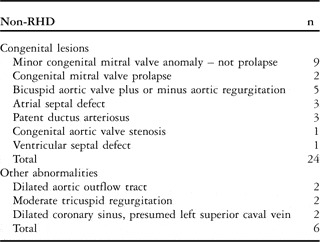
Non-rheumatic cardiac anomalies were found in 30 children (Table 2). Structural congenital cardiac anomalies were found in 2.1% of screened children. Of these, 11 had mitral valve prolapse or other minor congenital mitral valve anomalies. The latter included accessory leaflets, as well as hypermobility of chordae tendinae and of scallops or portions of the anterior mitral leaflet. These abnormalities were associated with trivial or mild mitral valve regurgitation.
Non-RHD identified during screening.

RHD = rheumatic heart disease
There were no cases of rheumatic heart disease among non-Māori and non-Pacific children. Pacific children were 1.6 times more likely to have rheumatic heart disease than Māori children – 95% confidence interval for odds ratio was with a range from 0.93 to 2.92, with a p-value of 0.09 – concordant with acute rheumatic fever ethnicity data.Reference Jaine, Baker and Venugopal2 There was no difference between males and females – odds ratio was 1.39; 95% confidence interval was 0.69–2.56; and p-value was 0.39.
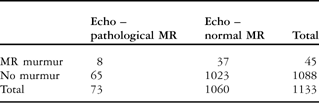
Cardiac auscultation findings were documented for 1133 of 1142 screened children. Only 4 of 27 (15%) definite and probable rheumatic heart disease cases had a pathological murmur detected at school. The paediatrician suspected that 45 children had a mitral regurgitation murmur. On the echocardiogram, 37 of 45 children were normal and eight had pathological mitral regurgitation. A total of 65 additional children had echocardiographic evidence of pathological mitral regurgitation, which was not audible at school. (Table 3) The sensitivity of auscultation compared with echocardiography for the detection of mitral regurgitation in the school setting was only 11%, with a range from 4.5% to 20.5%. The positive predictive value was 18%, with a range from 8% to 32%. Out of 1060 children, 1023 with a normal echocardiogram did not have a mitral murmur. The specificity of normal examination for the exclusion of pathological mitral regurgitation was 97%, with a range from 95% to 98%, and the negative predictive value was 94%, with a range from 92% to 95%.
Auscultation compared with echocardiography for detection of pathological MR during school screening.
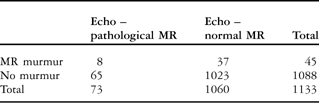
MR = mitral regurgitation
Discussion
This study shows a high prevalence of rheumatic heart disease in a socio-economically disadvantaged population within New Zealand. The screening prevalence of 26.0 per 1000 – definite and probable rheumatic heart disease – is within the range observed in low-income countries such as Cambodia and Tonga.Reference Marijon, Ou and Celermajer15, Reference Carapetis, Hardy and Fakakovikaetau16 It is known that rheumatic heart disease prevalence increases cumulatively with ageReference Carapetis, Hardy and Fakakovikaetau16 and this study was conducted in the age group 10–13 years.
We confirmed that echocardiography is more sensitive and specific than cardiac auscultation for the detection of pathological mitral regurgitation.Reference Marijon, Ou and Celermajer15, Reference Carapetis, Hardy and Fakakovikaetau16 The majority of children with pathological grade regurgitation in this study did not have a cardiac murmur. Echocardiography also excludes those with false-positive pathological cardiac murmurs, preventing children with innocent murmurs from being misclassified as rheumatic heart disease.
Echocardiographic screening for rheumatic heart disease can overdiagnose rheumatic heart disease unless physiological valve regurgitation and congenital valve anomalies are recognised. Congenital mitral valve prolapse may be present in up to 2.4% of adults.Reference Freed, Levy and Levine23 Connective tissue disorders causing valve regurgitation can be excluded by clinical consultation. We diagnosed two children with classic congenital mitral valve prolapse and nine with minor congenital mitral valve anomalies, representing 1% of all children screened. Congenital mitral valve variations were largely unrecognised in previous rheumatic heart disease-screening studies.Reference Marijon, Ou and Celermajer15, Reference Carapetis, Hardy and Fakakovikaetau16, Reference Marijon, Celermajer and Tafflet24, Reference Steer, Kado and Wilson25 This study suggests that they may not be rare. Their importance is that they may have associated mitral valve regurgitation and hence be labelled rheumatic inappropriately.
There is a continuum between the upper limit of physiological and pathological regurgitations, usually easily graded by a cardiologist. In this study, 28 of 95 such children were found to be normal after hospital assessment (Fig 1). Many of these had borderline 1–2 centimetres mitral regurgitant jets but did not meet defined pathological Doppler criteria.Reference Figueroa, Fernandez and Valdes8 In future, fewer individuals with borderline regurgitation would need cardiology referral, having observed a close correlation between the portable Vivid™e and hospital Phillips iE33 machines.
The absence of universally accepted diagnostic criteria for rheumatic heart disease, in particular the morphological features, presents challenges for clinicians involved with rheumatic heart disease screening and diagnosis. There is some agreement that both morphological features and pathological grade regurgitation need to be present for echocardiographic diagnosis of rheumatic heart disease,Reference Carapetis, Hardy and Fakakovikaetau16, Reference Marijon, Celermajer and Tafflet24, Reference Paar, Berrios and Rose26 but our analysis supports the use of more stringent Doppler criteria than were used in earlier studies.14, Reference Marijon, Celermajer and Tafflet24 Further studies to achieve international standardisation are required.
Detection of rheumatic heart disease through screening indicates that some acute rheumatic fever episodes are unrecognised. The finding of two children with previously undiagnosed severe rheumatic heart disease highlights the failure of existing primary health-care services. The possible contributing factors include barriers to accessing primary health care, underdiagnosis by clinicians, and lack of public awareness about rheumatic fever. Only two of the children with rheumatic heart disease in this study gave a history of painful swollen joints and met acute rheumatic fever criteria, challenging the traditional understanding that children with acute rheumatic fever usually have significant signs and symptoms. The 1992 revision of the Jones Criteria supports the concept that acute rheumatic fever can occur without recognised joint or systemic manifestations by the inclusion of the entity ‘indolent carditis’ as a sole manifestation of acute rheumatic fever.27
We found similar rates of congenital cardiac defects in screened children as compared with a large population-based cardiac screening study.Reference Ferencz, Rubin and McCarter28 The majority of these congenital lesions required active management or follow-up (Table 2). Previously published rheumatic heart disease-screening studies have not emphasised the spectrum of congenital pathology that echocardiographic screening will inevitably detect. Our findings highlight the importance of specialist cardiology input to facilitate the correct diagnosis of congenital cardiac defects.
We commenced study patients with definite and probable rheumatic heart disease on benzathine penicillin prophylaxis on the rationale that non-rheumatic aetiology was excluded by the combination of the specialist paediatric cardiology consultation and echocardiogram. We consider probable and definite rheumatic heart disease to be of equal importance. The key differentiating factor between the two categories is the presence or absence of a murmur, and auscultation is shown to be unreliable in both acute rheumatic fever and rheumatic heart disease.Reference Jaffe, Roche, Coverdale, McAlister, Ormiston and Greene11, Reference Marijon, Ou and Celermajer15, Reference Carapetis, Hardy and Fakakovikaetau16 In classifying definite and probable rheumatic heart disease, it is also important to remember that the severity of initial cardiac involvement does not always predict the extent of cardiac involvement in recurrences.Reference Newman, Lennon and Wong-Toi29, Reference Bland and Duckett Jones30 Penicillin prophylaxis should be offered based on the certainty of rheumatic heart disease diagnosis. However, we acknowledge that currently echocardiographic diagnosis of rheumatic heart disease is based on expert opinion.
The aetiology, prognosis, and optimal management of possible or borderline rheumatic heart disease are not yet defined. The majority of possible rheumatic heart disease cases had mild pathological mitral regurgitation without morphological changes. Despite the likelihood of this being part of acute rheumatic fever in a child with acute symptoms from a high incidence of acute rheumatic fever population,Reference Figueroa, Fernandez and Valdes8, Reference Jaffe, Roche, Coverdale, McAlister, Ormiston and Greene11more data are needed before attributing all such valves to the spectrum of rheumatic heart disease. Longitudinal follow-up of children with isolated mild pathological regurgitation is required to determine whether these children are at increased risk of acute rheumatic fever/rheumatic heart disease in the future, a scenario which may take decades to occur.Reference Bland and Duckett Jones30
In well-resourced countries, such as New Zealand, we believe that the optimal rheumatic heart disease-screening programme involves a two-step model, with school-based portable echocardiography followed by specialist referral for those with abnormalities. Screening using auscultation to select candidates for subsequent echocardiography may be more appropriate in resource-limited settings,Reference Steer, Kado and Wilson25 but will invariably underestimate the prevalence. Similarly, echocardiographic screening undertaken in resource-limited areas without trained cardiology interpretation may lead to overdiagnosis of rheumatic heart disease.
Acknowledgements
This study was supported by the National Heart Foundation of New Zealand (to Nigel Wilson: Grant numbers 1253 and 1276), the Green Lane Research and Education Fund (to Nigel Wilson: Grant no. 07/03/4046), the Auckland District Health Board Charitable Trust (to Nigel Wilson: Grant no. PG/08/001), and the Starship Foundation (Vivid e echocardiogram). Rachel Webb received the Joan Mary Reynolds Fellowship in 2007 and 2008. The authors have no conflict of interest to declare. They thank the staff of the KidzFirst Public Health Nursing Service at Counties Manukau District Health Board (Natalie Dawson, Heather Kellas, Brenda Luey, Logo Wilson, Ingi Tusini-Rex, and Susan Douglas), together with the study echocardiographers (Rachel Gatland, Sandy Long, Fiona Roberts, Fiona Lean, and Susan Perkins), and Lisa Davies who assisted with data management. They also thank Elizabeth Farrell, Charissa McBride, Maika Veikune, and Henare Mason at Counties Manukau District Health Board who contributed to the development of the study protocol. The authors are grateful to the staff and families of the seven study schools.