I. INTRODUCTION
The problem of carbon dioxide (CO2) capture is considered as one of the grand challenges of the 21st century. Reference Jacobson1,Reference D'Alessandro, Smit and Long2 CO2 Capture and Storage (CCS) scheme is regarded as one of the most practical option to reduce CO2 emissions. Reference Liang, Marshall and Chaffee3–Reference Granite and Pennline6
The current technology for the removal of CO2 from flue gas is based on the capture of CO2 by aqueous amines. Reference Markewitz, Kuckshinrichs, Leitner, Linssen, Zapp, Bongartz, Schreiber and Muller7–Reference Hunt, Sin, Marriott and Clark9 This technology is an energy-intensive process and environmentally not feasible because of water and solvent recycling issues, as well as because of the corrosive interaction of oxygen and acidic components of the combustion gas with amines. Reference Liang, Marshall and Chaffee3,Reference Sayari and Belmabkhout10 The alternative technology for the CO2 capture is based on the storage of CO2 in light-weight solid materials, involving two mechanisms: (i) chemisorption, hereby, CO2 molecules interact chemically with functional groups (e.g., open-metal sites or amines) forming strong bonds, (ii) physisorption, CO2 molecules adsorb in the pores. Reference Liang, Marshall and Chaffee3,Reference Morris and Wheatley4
Materials with chemisorption mechanism adsorb CO2 selectively even in the presence of other gases and can operate at high temperatures, indicating advantages over solid materials, which operate by physisorption mechanism. Reference Yang, Khan, Yuan and Tsang11–Reference Caskey, Wong-Foy and Matzger13 These materials include amine-modified solid sorbents, Reference Jadhav, Chatti, Biniwale, Labhsetwar, Devotta and Rayalu12,Reference Khatri, Chuang, Soong and Gray14,Reference Satyapal, Filburn, Trela and Strange15 inorganic-based materials such as hydrotalcites, Reference Hutson, Speakman and Payzant16 lithium zirconates, Reference Ochoa-Fernández, Rønning, Grande and Chen17 and partially, porous materials with unsaturated metal centers (UMCs). Reference Caskey, Wong-Foy and Matzger13 Because of the rigid network of UMCs, the accessibility of CO2 to the adsorption sites is restricted and thus, CO2 is not adsorbed through a pure chemisorption mechanism. However, the increased ionic character of metal-oxygen bonds contained in UMCs forms adsorption sites with higher heats of adsorption than those characteristics normally for physisorption, which in turn are responsible for the additional uptake of CO2. The values of heats of adsorption fall slightly, as the sites with the highest affinity to CO2 are filled.
The advantages of materials, which interact chemically with CO2, are counteracted by high-energy costs associated with the activation, regeneration, and recycling of the sorbent. In addition, the selectivity of chemisorption tends to monotonically decrease with increased loading of sorbate. Reference Nugent, Belmabkhout, Burd, Cairns, Luebke, Forrest, Pham, Ma, Space, Wojtas, Eddaoudi and Zaworotko18
Furthermore, recent studies have shown that the pressure/vacuum swing adsorption (PSA/VSA) technology is competitive for CO2 capture because the energy consumptions are lower than those of amine processes. Reference Merel, Clausse and Meunier19 The majority of investigations on CO2 recovery based on VSA technology use adsorbents, which operate by physisorption mechanism (i.e., zeolites). Reference Plaza, Pevida, Arenillas, Rubiera and Pis20 In addition, coal-fired power plants, which are the largest source of CO2 emission, produce flue gas at 1 bar with a CO2 concentration of less than 15%. Reference Granite and Pennline6,Reference Kintisch21 Consequently, there is a need to develop thermally stable solid material characterized by a high-adsorption value and moderate heat of adsorption. These features could allow efficient CO2 capture by physisorption in the low pressure region up to 1 bar suitable for postcombustion capture. Reference Caskey, Wong-Foy and Matzger13
In this regard, zeolites, activated carbons (ACs), and metal-organic materials (MOMs) have been commonly used for CO2 capture by physisorption. Excellent CO2 capture capacities at low temperatures or/and high pressures have been obtained for instance, by Maxsorb, an AC material and Zeolite 13X adsorbing approximately 13 mmol g−1 at 298 K and 10 bars Reference Himeno, Komatsu and Fujita22 and 3.9 mmol g−1 at 298 K and 1 bar, respectively. Reference Hyun and Danner23
Materials with high CO2 capture capacity can be produced by the introduction of nitrogen-containing basic groups that interact with a weak acidic gas such as CO2. In this regard, the reaction with nitrogen-containing reagents, such as ammonia (NH3) and amines, is a common technique to create solid sorbents with high CO2 capture capacity. For example, the functionalization of AC by nitrogen-containing basic groups has been extensively reported in the literature. Reference Plaza, Pevida, Arenillas, Rubiera and Pis20,Reference Thote, Iyer, Chatti, Labhsetwar, Biniwale and Rayalu24–Reference Jalilov, Ruan, Hwang, Schipper, Tour, Li, Fei, Samuel and Tour26 The incorporation of nitrogen-containing basic groups could create additional sites for the adsorption of CO2. Reference Thote, Iyer, Chatti, Labhsetwar, Biniwale and Rayalu24
However, in some cases, the functionalization of AC by amino/nitro groups has resulted in the decrease of Brunauer–Emmett–Teller (BET) surface area and micropore volume, leading to the drop of CO2 capture capacity of nitrogen-modified adsorbent compared to that of the pristine sample. Reference Plaza, Pevida, Arenillas, Rubiera and Pis20
Recently, Zhao et al. has reported a facile synthesis of porous carbon nitride spheres with hierarchical three-dimensional mesostructures and nitrogen-containing groups for CO2 capture. Reference Li, Yang, Feng, Wu, Wu, Park, Ha and Zhao25 The hierarchical porous spheres with BET surface area of ∼550 m2 g−1 possess at 1 bar CO2 capture capacity of 2.90 and 0.97 mmol g−1 at 298 and 348 K, respectively. In comparison, the pristine-AC has a CO2 capture capacity of 2.50 and 0.30 mmol g−1 at 298 and 348 K, respectively. The enhanced CO2 capture capacity is because of the presence of nitrogen-containing basic groups, together with hierarchical mesostructures, which include relatively high BET surface, stable framework, and the presence of a large number of micropores as well as small mesopores. However, the mechanism of CO2 adsorption is not further described.
In analogy to the carbon nitride materials, silicon nitride, silicon diimide, and intermediate silicon imidonitride compositions are of great interest for CO2 capture, especially at high temperature where carbonaceous materials fail to operate. However, the creation of nitrogen-containing silicon-based materials with high porosity is challenging.
Recently, a mesoporous silicon diimide with high CO2 capture capacity was synthesized by the reaction of SiCl4 and NH3. Reference Yang, Khan, Yuan and Tsang11 The production of latter material requires vacuum and ammonia (NH3) with careful temperature-programed treatment, which are costly for the large-scale applications.
High surface area materials derived from polymer-derived ceramics, including silicon nitrides are obtained when low pyrolysis temperatures are used. This is, during the polymer-to-ceramic transformation, the decomposition of organic groups, and the release of gaseous species, e.g., H2, CH4, occurs mainly at temperatures around 500–700 °C. Reference Seifollahi Bazarjani, Kleebe, Müller, Fasel, Baghaie Yazdi, Gurlo and Riedel27–Reference Colombo29 Hence, the evolution of these gaseous species creates an intrinsic microporosity in as-formed products. Stopping the pyrolysis at this conversion stage leads to microporous materials in a hybrid state called ceramers, i.e., the as-formed ceramic product contains reactive sites from the unconverted polymer. Reference Schmidt, Koch, Grathwohl and Colombo30,Reference Wilhelm, Soltmann, Koch and Grathwohl31 Due to their microporosity and reactive sites, these materials are suited for applications, such as gas adsorption, Reference Wilhelm, Soltmann, Koch and Grathwohl31 catalysis, Reference Bradley, Vollmer, Rovai, Specht and Lefebvre32 or gas separation membranes. Reference Miyajima, Eda, Ohta, Ando, Nagaya, Ohba and Iwamoto33
Here, we report the high CO2 capture capacity of microporous silicon nitride materials, which are produced by a facile one-step NH3-assisted thermolysis from a preceramic polymer.
The ideal material for CO2 capture based on physisorption mechanism should (i) be thermally stable, (ii) have high-adsorption capacity in the low-pressure region (up to 1 bar), and (iii) possess moderate heat of adsorption over a wide temperature range and loading of sorbate.
However, the development of a high-capacity CO2 storage system with above-mentioned properties is hindered because of the poor understanding of the pore size and specific surface area (SSA) requirements in correlations with CO2 uptake. Furthermore, it is assumed that the adsorption capacity of a material, which operates by physisorption, can be enhanced only by increasing the BET SSA. Here, we demonstrate that the pore size could play a crucial role in elevating the CO2 adsorption capacity surpassing the effect of BET SSA.
In this article, we report high CO2 storage capacity over a wide range of applied CO2 pressures for a silicon nitride material, which is ultramicroporous. On the contrary to other CO2 capture systems, this silicon nitride material has a low surface area (BET surface area of 230 m2 g−1 as measured by N2 physisorption).
II. EXPERIMENTAL SECTION
A. Materials
For the synthesis of ultramicroporous silicon nitride material, the commercially available polysilazane HTT-1800 (KiON Specialty Polymers) has been applied as starting material. The polymer is handled under an inert atmosphere using Schlenk techniques. Polymer pyrolysis is carried out in a horizontal tube furnace, by placing the sample in a quartz crucible inside a quartz tube. The ultramicroporous silicon nitride material, labeled HTT600NH, is produced by thermolysis under an NH3 atmosphere at 600 °C for 1 h with a heating rate of 100 °C h−1.
B. Structural characterization and elemental analysis
X-ray diffraction (XRD) was carried out using a STOE x-ray diffractometer (Darmstadt, Germany) equipped with a MoKα radiation. Attenuated total reflection Fourier transform infrared spectroscopy (ATR-FTIR) spectrum was recorded on a Varian 670-IR (Agilent Technologies) using 0.5 of powdered sample. The sample preparation was performed in glovebox under an inert atmosphere to avoid the contact with moisture.
The carbon content was determined in a carbon analyzer CS-800 (ELTRA GmbH, Haan, Germany), the nitrogen and oxygen content in an N/O analyzer Leco TC-436 (Leco Corporation, St. Joseph, MI). The hydrogen content was determined by the Mikroanalytisches Labor Pascher (Remagen, Germany) using the coupled plasma atomic emission spectroscopy (Thermo Instruments, iCAP 6500, Waltham, MA) and element analyzer (Pascher). The silicon content was calculated from the sum of constituting elements.
C. Gas adsorption
N2 adsorption was performed at 77 K using an Autosorb-3B (Quantachrome Instruments, Boynton Beach, FL). The sample was preheated at 423 K for 24 h under vacuum before the measurements. The N2 physisorption isotherm at 77 K was used to calculate the SSA from the linear BET plots over the range of 0.05 < p/p o < 0.3. The total pore volume (V T) was determined from the amount of vapor adsorbed at the relative pressure of p/p o ∼ 1. The micropore volume (V micro) was calculated using the deBoer's t-plot analysis.
CO2 adsorption analysis was performed at 273 K by an ASAP-2000 automated volumetric analyzer (Micromeritics Instrument Corporation, Norcross, GA) using the same outgassing procedure mentioned for N2 adsorption. Ultramicropore volume (V ultra) was calculated by applying the Dubinin–Astakhov (D–A) equation to the CO2 adsorption isotherm at 273 K. Mean pore size (d) was estimated by the equation of Stoeckli for the characteristic adsorption potential between 20 and 42 kJ mol−1, the latter being determined as well by D–A equation from the CO2 isotherm at 273 K. For more details, please refer to our previous work. Reference Schitco, Bazarjani, Riedel and Gurlo34
High pressure CO2 adsorption isotherms were recorded with an automated high-pressure volumetric sorption analyzer iSorb (Quantachrome Instruments, Boynton Beach, FL). Prior to the adsorption run, the void volume of the sample cell was determined in a blank cell measurement under given analyses conditions. The sample was degassed at 100 °C for 12 h. The measured adsorption data were corrected by the blank cell measurement. The contact of the sample with ambient air was reduced to a minimum <10 min.
1. Calculation of isosteric heat of adsorption (Q st)
High pressure CO2 adsorption isotherms of HTT600NH were fitted by the Tóth equation [Eq. (1)] at 273 K [Fig. S1(a) in Supplementary Material] and 373 K [Fig. S1(b) in Supplementary Material] up to 15 bars. Only part of the isotherm showing the characteristics of type I isotherm, which corresponds to micropore filling was fitted by the Tóth equation. The part corresponding to micropore filling region was found for both isotherms (recorded at 273 and 373 K, respectively) to be up to 15 bars. Beyond this pressure, the isotherms showed a steep rise, evidence that the CO2 molecules were filling the interparticle distances or the macropores of the silicon nitride material (Fig. S1 in Supplementary Material). Prior to the fitting procedure, the isotherm recorded at 373 K [Fig. 3(a)] was interpolated by using b-cubic spline method.
The Tóth equation Reference Toth35 has been originally proposed for monolayer adsorption by Tóth, providing a more extensive range of fit compared to that of the Langmuir or Freundlich equation when applied to type I isotherms. The Tóth equation has the advantage to satisfy both limits of the isotherm, at p → 0 and p → ∞. The expression is given by:
 $$n = n_{\rm{m}} \left( {{{\left( {kp} \right)^m } \over {1 + \left( {kp} \right)^m }}} \right)^{{1 \mathord{\left/ {\vphantom {1 m}} \right. \kern-\nulldelimiterspace} m}} \quad ,$$
where n and n m are the number of mole adsorbed at a given pressure and the number of moles adsorbed at saturation, respectively. p is the pressure, and k and m are the constants.
The parameters are specific for adsorbent–adsorbate pairs, and m is less than 1 for heterogenous adsorbents. When m is equal to 1, the Tóth equation reduces to the Langmuir equation. The Tóth equation is used to fit the CO2 adsorption isotherm of HTT600NH because of its simplicity and correct behavior at both low and high pressure ranges of the adsorption isotherm. Many isotherm data of ACs and zeolites are well fitted and represented by the Tóth equation.
The Q st as a function of fractional surface coverage is determined by fitting the isotherm of HTT600NH at 273 and 373 K with the Tóth equation and by using the Clausius–Clayperon equation (CC). Q st is a key parameter in determining the difference between chemical and physical adsorption. The magnitude of Q st determines the strength of the bond formed between the adsorbate and the adsorbent. Q st could be a function of the amount of the adsorbed species, so-called fractional surface coverage (θ).
Different behaviors are observed for various systems. Q st remains either constant with θ or it decreases linearly or exponentially with θ. The latter behavior is because of the heterogeneity of energy distributions, that is, the molecules tend to adsorb first on sites with the maximum free energy change (maximum heat of adsorption). So a gradual decrease of Q st with θ indicates that the higher energy sites are becoming occupied.
The heat of adsorption (∆H) from the adsorption isotherms can be estimated with the help of CC equation. The CC equation is used extensively in vapor–liquid equilibrium and is based on the assumption of an ideal gas. Here, the specific volume of the liquid is very small compared to the volume of gas, and the equation can be written as:
 $${{{\rm{d}}\ln p} \over {{\rm{d}}T}} = {{\Delta H} \over {R{T^2}}}\quad ,$$
where R is the gas constant, and T is the temperature.
In adsorption equilibrium, the equilibrium pressure is a function of the amount of adsorbed species. Consequently, the isosteric heat of adsorption (Q st) at a specified level of surface coverage is a function of the fractional surface coverage (θ). Thus, Q st could be estimated by the integration of Eq. (2):
 $$\ln {\left( {{{{p_1}} \over {{p_2}}}} \right)_{{\theta _1}}} = {{{Q_{{\rm{st}}}}} \over R}\left( {{1 \over {{T_2}}} - {1 \over {{T_1}}}} \right)\quad .$$
The Q st calculated from the Eq. (3) corresponds to the fractional surface coverage of θ 1. The variation of Q st with θ is determined by applying Eq. (3) for different levels of fractional surface coverage.
III. RESULTS AND DISCUSSION
A. Structure and composition
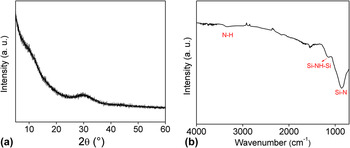
The XRD pattern [Fig. 1(a)] of HTT600NH specimen indicates the formation of an amorphous material. The results of the elemental analysis show the following atomic (weight) composition for HTT600NH: Si 36.9 (68.7), C 4.4 (3.6), N 23.2 (21.5), O 3.7 (4.1), and H 31.7 (2.1), corresponding to SiN0.63C0.12O0.10H0.86 formula. The ATR-FTIR spectra [Fig. 1(b)] confirm the formation of a silicon imidonitride structure in the HTT600NH specimen: ν = 3387 [w; ν (NH)], 1185 [m; γ (NH)], and 1000–900 (s; SiNSi).
(a) XRD pattern (the data were shown in Fig. 2 in Ref. Reference Schitco, Bazarjani, Riedel and Gurlo34) and (b) ATR-FTIR spectrum of HTT600NH specimen.

B. Porosity characterization as revealed by gas adsorption
We have recently investigated the HTT600NH sample by gas adsorption techniques using N2 and CO2 as probe molecules, which reveal that the micropore volume contributes to 93% of the V T of the sample, thus the HTT600NH sample is mainly microporous. Reference Schitco, Bazarjani, Riedel and Gurlo34
HTT600NH specimen has a BET SSA of 230 m2 g−1, far lower than that of 1009 m2 g−1, found by Tsang et al. for a mesoporous silicon nitride, Reference Yang, Khan, Yuan and Tsang11 and the extra-large SSA values up to 7000 m2 g−1, reported for MOFs, zeolites or ACs. Reference Nugent, Belmabkhout, Burd, Cairns, Luebke, Forrest, Pham, Ma, Space, Wojtas, Eddaoudi and Zaworotko18
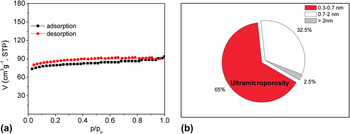
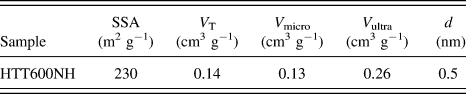
The V T, determined from the N2 adsorption isotherm [Fig. 2(a)] at the relative pressure of p/p o ≈ 1.0, has a value of 0.14 cm3 g−1. In comparison, the deBoer's t-plot analysis of the N2 physisorption isotherm indicates the micropore volume (V micro) of 0.13 cm3 g−1. Reference Schitco, Bazarjani, Riedel and Gurlo34 The D–A analysis of CO2 adsorption isotherm for HTT600NH at subatmospheric pressures shows V ultra and micropore size (d) of 0.26 cm3 g−1 and 0.5 nm, respectively. Reference Schitco, Bazarjani, Riedel and Gurlo34 The porosity characteristics of HTT600NH are mentioned in Table I. In addition, micropores can be divided to ultramicropores (pores below 0.7 nm) and supermicropores (pores between 0.7 and 2 nm). Reference Kaneko36 The recent analyses of aforementioned gas adsorption studies of the HTT600NH sample reveal that the ultramicropores are accounted approximately for a micropore volume of 0.26 cm3 g−1, which is twice the micropore volume associated with supermicropores (0.13 cm3 g−1). This indicates that ultramicroporosity contributes to about 65% of the total micropore volume in the HTT600NH specimen [Fig. 2(b)]. Reference Schitco, Bazarjani, Riedel and Gurlo34
(a) N2 physisorption isotherm (the data were shown in Fig. 3(b) in Ref. Reference Schitco, Bazarjani, Riedel and Gurlo34) and (b) the pore fractions as determined by CO2 and N2 physisorption methods of HTT600NH specimen (the data were shown in Table 3 and Fig. 5 in Ref. Reference Schitco, Bazarjani, Riedel and Gurlo34).

The porosity characteristics of HTT600NH specimen.

C. High pressure CO2 adsorption
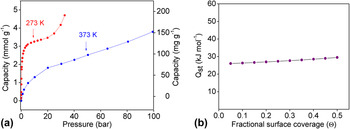
The CO2 adsorption capacity of HTT600NH is measured at 273 and 373 K up to ∼30 and 100 bars, respectively. The adsorption isotherm of HTT600NH at 273 K is similar to a typical type I profile up to 15 bars [Fig. 3(a)] found in microporous solids. The CO2 adsorption isotherm of HTT600NH at 273 K has a saturation value of 3.26 mmol g−1 at around 10 bars inferring that micropores are filled completely with CO2. The isotherm of HTT600NH at 273 K rises rapidly at pressures higher than 15 bars, which indicates that CO2 fills the interparticle macropores, and micropores are already completely filled.
(a) CO2 adsorption isotherm of HTT600NH at 273 K (red) and at 373 K (blue), the primary and secondary Y-axes indicate CO2 adsorption capacity of HTT600NH with units of mmol g−1 and mg g−1, respectively and (b) isosteric heats of adsorption (Q st) of HTT600NH as a function of fractional surface coverage (θ).

As HTT600NH specimen is mainly microporous, it is expected that the CO2 uptake becomes saturated at relatively low pressures as a result of the saturation of micropores. Indeed, HTT600NH shows a CO2 uptake of 2.35 mmol g−1 at 273 K and 1 bar, a value which is twice as high as the minimum value needed for an effective CO2 capture material. Reference Khatri, Chuang, Soong and Gray14 The CO2 uptake of HTT600NH (2.35 mmol g−1 at 273 K and 1 bar) is comparable to that of typical CO2 solid adsorbents with much larger SSA measured at 1 bar but at a slightly higher temperature of 298 K. For example, at 1 bar and 298 K, the CO2 uptakes for Zeolite 13X, MSIN-673, and AC are 3.9, 2.6, and 2.1 mmol g−1, respectively. Reference Yang, Khan, Yuan and Tsang11 The highest gravimetric CO2 uptake of 5.41 mmol g−1 at 1 bar and 298 K is reported for SIFSIX-2-Cu-i. Reference Nugent, Belmabkhout, Burd, Cairns, Luebke, Forrest, Pham, Ma, Space, Wojtas, Eddaoudi and Zaworotko18 An interesting ultramicroporous MOM SIFSIX-3Zn with porosity characteristics similar to that of HTT600NH has been reported by Uemura et al. in 2009. Reference Uemura, Maeda, Maji, Kanoo and Kita37 Although the latter material exhibits a pore size and a BET surface area of only 3.84 Å and 250 m2 g−1, respectively, as determined by CO2 adsorption method, it possesses a high CO2 uptake at 298 K and 1 bar of 2.54 mmol g−1. Reference Nugent, Belmabkhout, Burd, Cairns, Luebke, Forrest, Pham, Ma, Space, Wojtas, Eddaoudi and Zaworotko18
At 373 K, the CO2 adsorption isotherm recorded up to 100 bars [Fig. 3(a)] indicates a drastic reduction of the CO2 uptake, which is less than 0.5 and 1.2 mmol g−1 at 1 bar and 10 bars, respectively, that is, a typical characteristic of physisorption. The dominance of physisorption mechanism is confirmed further by the isosteric heat of adsorption (Q st) of this material [Fig. 3(b)]. Figure 3(b) represents the Q st as a function of different levels of fractional surface coverage (θ) for the CO2 adsorption of HTT600NH calculated from adsorption isotherms at 273 and 373 K.
The low value of Q st, which is 27.6 kJ mol−1, confirms the dominant role of physisorption during the CO2 uptake in HTT600NH. The relatively constant Q st over the complete range of CO2 uptake infers homogeneous adsorption sites (see Experimental section). These Q st values are in the favorable range for an efficient reversible adsorption-desorption process. Reference Nugent, Belmabkhout, Burd, Cairns, Luebke, Forrest, Pham, Ma, Space, Wojtas, Eddaoudi and Zaworotko18 By contrast, the mesoporous silicon nitride MSIN-673, which is reported by Tsang et al., Reference Yang, Khan, Yuan and Tsang11 exhibits chemisorption characteristics inferred from the exponential reduction of Q st with fractional surface coverage (θ). In addition, for MSIN-673, the highest Q st value that is estimated at the lowest CO2 surface coverage is 68.1 kJ mol−1, while at higher surface coverages, the Q st converges to a value of 40–50 kJ mol−1.
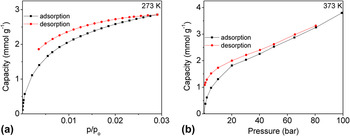
The high reversibility of CO2 adsorption for HTT600NH at 273 and 373 K and pressure ranges are demonstrated in Fig. 4. However, the desorption isotherm does not exactly follow the adsorption isotherm, which could be caused by imide sites with high affinity toward CO2 (chemisorption) or the entrapment of CO2 in the pores. Whatsoever, the amount of CO2 trapped in the material after desorption decreases with increasing temperature, a strong evidence that physisorption mechanism is dominant.
(a) CO2 isotherms of HTT600NH at 273 K and up to 1 bar (the data were shown in Fig. 3(d) in Ref. Reference Schitco, Bazarjani, Riedel and Gurlo34) and (b) CO2 adsorption–desorption isotherms of HTT600NH at 373 K and up to 100 bar.

The open-metal sites or amine functional groups interact chemically with CO2, promoting chemisorption, which is associated with high heats of adsorption (>45 kJ mol−1), leading to high energy costs for the regeneration of the material. Reference Forrest, Pham, Hogan, McLaughlin, Tudor, Nugent, Burd, Mullen, Cioce, Wojtas, Zaworotko and Space38 In our study, although the HTT600NH contains residual imide groups, it possesses a low Q st. This provides further evidence that in the HTT600NH, micropores play a major role for CO2 adsorption by physisorption mechanism as a result of the presence of homogenous adsorption sites, i.e., ultramicropores. Although the adsorption occurs by physisorption, the appearance of hysteresis loop is because of the similar kinetic diameter of CO2 and the pore dimension, reducing the complete desorption of CO2 during the measurement time. However, such a hysteresis may be not always a problem and can point out to an interesting storage material. Reference Morris and Wheatley4
D. Correlation of CO2 storage capacity with the pore size
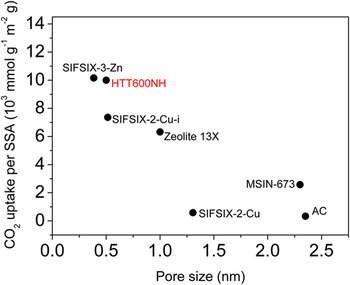
The aforementioned role of micropores on the adsorption of CO2 can be better realized by the correlation of storage capacity with pore size. This is demonstrated by normalizing the CO2 uptake of a material with its SSA and plotting it as a function of pore size. This correlation is found by using the CO2 uptake for HTT600NH at 273 K and 1 bar, as well as for representative selected materials, e.g., MOFs, Zeolite, AC, and nitrides from literature (Fig. 5 and Table SI from Supplementary Material). Figure 5 reveals unambiguously that HTT600NH has nearly the highest CO2 uptake per BET SSA. Therefore, the ultramicropores provide the greatest contribution to total capacity for CO2 uptake, which is not directly connected to the BET SSA of material as represented in Fig. 6. This is explained as follows. It is known that BET SSA as determined by N2 physisorption at 77 K does not necessarily account for narrow microporosity, i.e., ultramicroporosity. This may be caused by three factors:
-
(i) N2 molecules are adsorbed in macropores, mesopores, and micropores by three different mechanisms—multilayer adsorption, capillary condensation, and micropore filling, respectively. Reference Kaneko36 The calculation of SSA by the BET method assumes that N2 molecules are adsorbed by the capillary condensation mechanism. Hence, the validity of BET SSA is restricted mostly to mesoporous materials. It is generally agreed that BET SSA does not reflect the true values of microporous materials or micro-/mesoporous materials, but it is widely accepted to be used for comparison purposes. Reference Sing, Everett, Haul, Moscou, Pierotti, Rouquerol and Siemieniewska39,Reference Williams, Dawson, Barnes, Rand, Brydson and Brough40
-
(ii) The maximum size of ultramicropores corresponds to the bilayer thickness of nitrogen molecules Reference Kaneko36 ; therefore, the adsorbed N2 molecules near the entrance to the pore may bock further adsorption, as it has been already evidenced in the work of Uemura et al., Reference Uemura, Maeda, Maji, Kanoo and Kita37 leading to the underestimation of the real value of SSA of the microporous material. It is generally agreed that N2 molecule does not reflect well the ultramicroporosity, and for this purpose, other probe molecules such as H2, Ar, or CO2 are preferred. Reference Cazorla-Amorós, Alcañiz-Monge and Linares-Solano41–Reference Jagiello and Thommes43
-
(iii) Variation in the polarity and/or nature of pore surfaces may lead to wrong SSA values (either overestimated or underestimated). For instance, the interaction of N2 with polar surfaces leads to smaller cross-sectional area of N2, if compared to the standard value of 0.135 versus 0.165 nm2, respectively. Reference Thommes42
CO2 uptake normalized by SSA versus average pore size for HTT600NH (273 K, 1 bar) and representative examples from literature, MOMs Reference Nugent, Belmabkhout, Burd, Cairns, Luebke, Forrest, Pham, Ma, Space, Wojtas, Eddaoudi and Zaworotko18 : SIFSIX-3Zn, SIFSIX-2-Cu-i, SIFSIX-2-Cu (293 K, 1 bar); Zeolites Reference Liang, Marshall and Chaffee3,Reference Jadhav, Chatti, Biniwale, Labhsetwar, Devotta and Rayalu12 : Zeolite 13X (293 K, 1 bar); Nitrides Reference Yang, Khan, Yuan and Tsang11 : MSIN-673 (293 K, 1 bar); ACs Reference Zhang, Song, Sun, Xie, Wang, Li, Sun, Liu, Snape and Drage44 : AC (293 K, 1 bar), for details see Table S1.

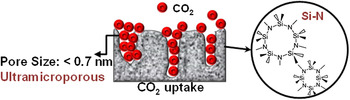
Schematic representation of CO2 capture on ultramicroporous silicon nitride.

IV. CONCLUSION
A silicon nitride material has been successfully synthesized by a facile NH3-assisted thermolysis technique. We have shown that ultramicroporous HTT600NH has a high capacity for CO2 adsorption. At 273 K and 1 bar, the CO2 uptake corresponds to a value of 2.35 mmol g−1 and is associated with the low isosteric heat of adsorption of 27.6 kJ mol−1. In addition, we believe that the CO2 uptake is strongly correlated with the pore size rather than the BET SSA of a material. We propose that high CO2 storage capacities by physisorption at 273 K and up to 1 bar can be achieved in materials with high amount of ultramicropore volume. Therefore, to achieve an enhanced CO2 uptake at low temperatures, e.g., 273–298 K, and pressures up to 1 bar, the material development should follow the direction of maximizing the SSA and pore volume of the pores in ultramicroporous range. On the other hand, high CO2 uptake capacities at high pressures could be achieved in large SSA materials due to the contribution of supermicropores and mesopores.
Supplementary Material
To view supplementary material for this article, please visit http://dx.doi.org/jmr.2015.165.
ACKNOWLEDGMENTS
The research leading to these results has received funding from the European Union Seventh Framework Program (FP7/2007-2013) under grant agreement no 264873 (FUNEA – Functional Nitrides for Energy Applications). The authors would like to acknowledge Duan Li and Professor James Shen for their assistance in CO2 adsorption measurements.