Implications
Similar to other local breeds, Krškopolje pig is believed to possess good aptitude for the processing to high-quality meat products, although there is little scientifically supported evidence, especially not in relation to rearing conditions, known to vary substantially for this breed. Our study suggests that manufacturing dry-fermented sausages from Krškopolje pigs reared in two different systems, despite similar diets, resulted in different texture and aromatic profile of dry-fermented sausages, which may affect their acceptance by the consumers.
Introduction
Traditional local breeds represent an important agrobiodiversity value, and with few exceptions they are often poorly investigated. Available studies indicate their specific metabolic characteristics, lower growth potential, lower protein deposition ability and higher fatness. However, they present an important basis for production of high-quality meat products which modern breeds cannot provide (Bonneau and Lebret, Reference Bonneau and Lebret2010). In Slovenia, there is only one preserved autochthonous local pig breed, the Krškopolje pig. Pigs of this breed are reared in very diverse conditions, ranging from intensive to extensive; often the combination of indoor and outdoor systems is practiced. The interest for this breed has been revived in the last years and the public aid for conservation of this breed contributes to its wider use. Rearing of Krškopolje pig is often practiced on organic farms (respecting Commission regulation (EC) 889/Reference Čandek-Potokar, Žlender, Kramar, Šegula, Fazarinc and Uršič2008 on organic production and labelling of organic products), which recommends the use of robust genotypes and prescribes roughage supplementation and access to outdoor area. Among breeders, the Krškopolje pig is appreciated for its high-quality meat which is due to higher fat content especially suitable for processing into traditional dry-cured meat products. The breed, however, remains poorly explored, rare available studies (from intensive rearing mainly) show increased fat deposition (Batorek Lukač et al., Reference Batorek Lukač, Tomažin, Prevolnik Povše, Škrlep and Čandek-Potokar2017b), some advantages in meat quality (i.e. intensive colour, high intramuscular fat content) and good aptitude for dry meat processing (Čandek-Potokar et al., Reference Corral, Salvador and Flores2003). However, scientifically substantiated information on quality of products from Krškopolje pig is lacking.
In the case of dry-fermented sausages, the physico-chemical changes involved in the process of ripening are very intense and highly complex and depend on numerous factors. Traditional manufacturing (in which no starter cultures are used) is characterized by a natural fermentation of the meat batter through the autochthonous microflora (Toldrá and Flores, Reference Toldrá and Flores2014).The raw material properties (proteins, lipids, moisture, pH, endogenous enzymes), additives (spices, condiments, preservation agents) and processing conditions affect dehydration, oxidation processes and microbial growth which, together with the activity of meat endogenous enzymes, determine the development of final sensory characteristics (Toldrá and Flores, Reference Toldrá and Flores2014; Flores and Olivares, Reference Flores and Olivares2015). Contrary to studies addressing the effect of rearing factors on dry-cured ham properties, the studies that would directly address the effect of rearing system on properties of dry-fermented sausages are scarce. This can be related to the complexity of the process, as besides the raw material, the overall conditions for microbial fermentation and further biochemical reactions are important for the formation of the aromatic profile of dry-cured sausages. Several effects of organic rearing practice on meat quality that could influence dry-fermented sausage processing were reported (as related to increased exercise and/or forage supplementation), including that on muscle pH, water holding capacity, fatness (Bonneau and Lebret, Reference Bonneau and Lebret2010) and fatty acid profile (Nilzén et al., Reference Nilzén, Babol, Dutta, Lundeheim, Enfält and Lundström2001; Hansen et al., Reference Hansen, Claudi-Magnussen, Jensen and Andersen2006).
In order to study the effect of rearing conditions (conventional v. organic) on dry-fermented sausages from Krškopolje pigs, the present study was designed using the same processing conditions (temperature and humidity regime), testing the outcome on the physico-chemical properties, rheology, sensory traits and volatile profile.
Material and methods
Animals, fattening trial and dry-fermented sausage processing
The raw material for sausages originated from the experiment conducted on Krškopolje pigs (for details see Batorek Lukač et al., Reference Batorek Lukač, Tomažin, Škrlep, Prevolnik Povše and Čandek-Potokar2017a). Shortly, 24 Krškopolje barrows were assigned within litter (n=12) to either conventional indoor (CON) or organic (ECO) rearing system (respecting Commission regulation (EC) 889/Reference Čandek-Potokar, Žlender, Kramar, Šegula, Fazarinc and Uršič2008 on organic production and labelling of organic products). In the experimental phase (which started at an average age of 157 days and weight of 68 kg) pigs were fed barley-based conventional and organic feed mixture, with equivalent energy and protein content (for detailed information on composition see Supplementary Material Table S1). Organic group of pigs was additionally supplemented with alfalfa hay on ad libitum basis and had an access to outdoor area of 100 m2. At the average age of 230 days and live weight of 122 kg, pigs were slaughtered in a commercial abattoir according to standard procedure. On the warm carcasses, backfat thickness was measured at the level of last rib using a digital calliper. After chilling overnight, hard backfat and deboned front legs were delivered to a commercial salami producer. Meat and fat (5:1 weight ratio) were ground using a 10 mm diameter mincing plate. Sodium nitrite (120 ppm), salt (25 g/kg), dextrose (2.6 g/kg), sugar (5.0 g/kg), ascorbic acid (225 mg/kg) and spices (0.6 g/kg garlic and 1.0 g/kg pepper) were added in equal amounts to both batters. Meat mixture was stuffed into collagen casings (5.5 cm in diameter) and submitted to drying for 67 days (first 7 days at 18°C and relative humidity (RH) of 82% to 88%, thereafter at 12°C to 14°C, RH 78% to 85%). The ECO and CON sausages were processed together, in the same fermentation and drying chamber. At the end of processing 12 sausages from each treatment group were randomly selected and weighed to assess processing losses, while half of them (n=6 per treatment) were vacuum packed and stored at −80°C until further analyses.
Chemical analysis
Before chemical analyses samples (n=6 per treatment) were cut into small pieces and ground to fine dust in liquid nitrogen. Measurement of pH was performed using MP120 pH meter (Mettler-Toledo GmbH, Schwarzenbach, Switzerland) by dissolving 1 g of pulverized sample in 4 ml of distilled water. The determination of sodium chloride (NaCl), moisture, protein and fat content, proteolysis index and water activity (aw) was performed as described in Škrlep et al. (Reference Škrlep, Čandek-Potokar, Batorek Lukač, Prevolnik Povše, Pugliese, Labussière and Flores2016). Protein oxidation (i.e. protein carbonyl content) was measured as described in Traore et al. (Reference Toldrá2012) and expressed in nmol/mg proteins. Lipid autooxidation was assessed by determining thiobarbituric acid reactive substances (TBARS) according to the method described by Lynch and Frei (Reference Lynch and Frei1993) and the results expressed as the concentration of malonaldehyde (mg/kg sample). Residual nitrite and nitrate was determined using enzyme kit (Cat No. 10905658035, 2r-Biopharm; Roche, Darmstadt, Germany) according to the manufacturer instructions.
Total fatty acid and free fatty acid profile was determined by the ISO 17025 (2005) in accredited laboratory (Nutricontrol, Veghel, the Netherlands) according to the ISO/TS 17764 (2002) method. In short, after saponification of the fat, the fatty acids were converted to methyl esters with the aid of boron trifluoride (BF3) and methanol. The methyl esters were analysed by capillary gas chromatography and detected by flame ionization. Samples were first analysed on total fatty acid composition. In the second run (same procedure as before, but without BF3) the fatty acid methyl esters of the bound fatty acids were analysed and the free fatty acids profile obtained from the difference between both runs.
Rheological measurements
Instrumental texture was measured in four repetitions per sample (n=6 per treatment) on parallelepipeds (2×2×1.5 cm for length, width and height, respectively) accurately carved from the centre of the sausage. Texture profile analysis (TPA) and stress relaxation test (SR) were conducted according to the description of Pugliese et al. (Reference Pugliese, Sirtori, Škrlep, Piasentier, Calamai, Franci and Čandek-Potokar2015) and the use of TA Plus texture analyser (Ametek Lloyd Instruments Ltd., Bognor Regis, UK). Shortly, for TPA the samples underwent two compressing cycles, being compressed each time to 50% of their original height. The parameters hardness, adhesiveness, cohesiveness, springiness, gumminess and chewiness were calculated from the force-time curves recorded. In case of SR test, a force decay coefficient calculated as (F0−F90)/F0, with F0 being the initial force recorded when compressing the sample for 25% and F90 the force after 90 s of compression. For both, TPA and SR test, mean value of four repetitions per sample was used for statistical analysis.
Sensory analysis
A quantitative descriptive analysis was performed by a trained panel, consisting of six women and six men, aged from 23 to 57 years, all employees of Agricultural Institute of Slovenia. All panellists were non-smokers. To train the panellists, several commercially available dry-fermented sausages of different quality and origin, with different levels of dryness, saltiness, maturation and also quality defects were given to the panel in order to introduce them with variations of sensory traits as wide as possible. Three 2 h training sessions were performed and 15 individual sensory descriptors were defined (as in Pugliese et al., Reference Pugliese, Sirtori, Škrlep, Piasentier, Calamai, Franci and Čandek-Potokar2015) for colour (vividness, intensity), odour (intensity, typical matured odour), taste (bitterness, spiciness, sweetness, saltiness, sourness, rancidity, off-taste presence) and texture (softness, pastiness, crumbliness and juiciness). Each of the descriptors was scored on a non-structured 9 cm intensity scale anchored at both extremes (i.e. ‘very intensive’ on the right and ‘not detected’ on the left). Panellists were not given any information on the samples to be tasted. They were instructed not to eat and drink (except water) for 2 h before each sensory analysis session. Panellists evaluated two sausages per session (one per treatment group). There were overall 12 tasting sessions. Two slices (3 mm thick) of each sausage were served to panellists on a white plate. Each sausage was evaluated twice by each panellist (i.e. evaluation repeated in two different sessions).
Volatile compounds analysis
Volatiles compounds were analysed as described in Škrlep et al. (Reference Škrlep, Čandek-Potokar, Batorek Lukač, Prevolnik Povše, Pugliese, Labussière and Flores2016) using solid phase microextraction (SPME) and gas chromatography and mass spectrometry. Five grams of each minced salami were weighted into a 20 ml HS vial sealed with a polytetrafluoroethylene-faced silicone septum, 0.75 mg of dibuthylhydroxytoluene and 0.25 µg of 2-methyl-3-heptanone (internal standard) were added. Before extraction, the vial was equilibrated at 37°C for 30 min and then, SPME fibre (85 µm Carboxen/Polydimethylsiloxane CAR/PDMS) was exposed to the headspace during 1 h at 37°C. The identification and quantification of HS volatile compounds was performed in an Agilent HP 7890 series II GC (Hewlett-Packard, Palo Alto, CA, USA) with an HP 5975C mass selective detector (Hewlett-Packard) equipped with Gerstel MPS2 multipurpose sampler (Gerstel GmbH, Mülheim and der Ruhr, Germany). The compounds adsorbed by the SPME fibre were desorbed in the injection port of the GC-MS for 5 min at 240°C with purge valve off (splitless mode). The analysis of volatile compounds in the GC-MS was done as described Olivares et al. (Reference Olivares, Navarro and Flores2011) using a DB-624 capillary column J &W Scientific (Agilent Technologies, Santa Clara, California, USA) (60 m, 0.32 mm i.d., film thickness 1.8 μm). Retention indices (linear retention index (LRI)) of the volatile compounds were calculated using the series of n-alkanes (Sigma-Aldrich Chemie GmbH, Munich, Germany). Compounds were identified by first comparing their mass spectra with those contained in the NIST/EPA/NIH Mass Spectral Database (NIST‘05), Linear retention index (Kovats, Reference Kovats1965) and by comparison with those published in literature (Olivares et al., Reference Olivares, Navarro and Flores2011; Corral et al., 2013) or using authentic standards. Authentic samples of the compounds were obtained and analysed under the same GC–MS conditions to provide LRI values. The quantification of the volatile components in the headspace was carried out by comparing their peak areas (in SCAN mode using either total or extracted ion current) with that of the internal standard and values expressed in normalized area.
Statistical analysis
One-way ANOVA with treatment group as main effect was performed (GLM; SAS Institute Inc., Cary, NC, USA) to compare physical, chemical and rheological traits of CON and ECO sausages. For sensory traits, repeated measures analysis (within sample) was performed with MIXED model of SAS (using panellist as the repetition).
Results
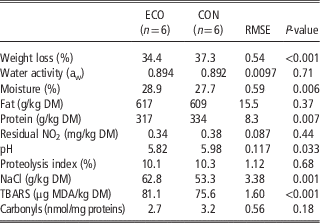
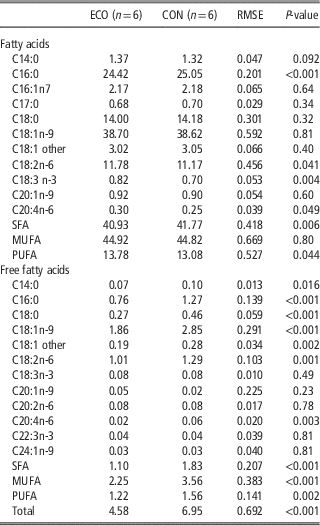
No difficulties were encountered either during the fattening of pigs or dry-fermented sausage processing. As indicated in the Supplementary Material Table S1, experimental pigs in both treatment groups were similar with respect to final live weight, average daily gain and carcass fatness (i.e. backfat thickness). However, average daily gain of ECO pigs tended to be higher than in CON pigs (792 v. 700 g/day, P=0.097). Physical and chemical traits of dry-fermented sausages are presented in Table 1 and show that dry-fermented sausages produced from ECO pigs had higher moisture percentage which can be associated with their lower weight loss during processing. In addition, dry-fermented sausages from ECO pigs exhibited higher protein, higher NaCl content and lower pH than CON dry-fermented sausages. Higher oxidation of lipids (TBARS) was also noted for ECO dry-fermented sausages, consistent with their fatty acids composition (Table 2). Compared with CON, dry-fermented sausages from ECO group had slightly more polyunsaturated fatty acids (PUFA) and less saturated fatty acids (SFA), the differences mainly governed by the concentrations of C18:2n-6 and C16:0, respectively. Dry-fermented sausages from ECO pigs had also less free fatty acids (Table 2) due to lower concentration in all three subgroups (SFA, monounsaturated fatty acids (MUFA), PUFA).
Physical and chemical traits of dry-fermented sausages produced from meat of pigs raised in organic (ECO) and conventional (CON) production system

TBARS=thiobarbituric acid reactive substances; MDA=malonaldehyde.
Fatty acids and free fatty acids composition (g/100 g fat) of dry-fermented sausages produced from meat of pigs raised in organic (ECO) and conventional (CON) production system

SFA=saturated fatty acids; MUFA=monounsaturated fatty acids; PUFA=polyunsaturated fatty acids.
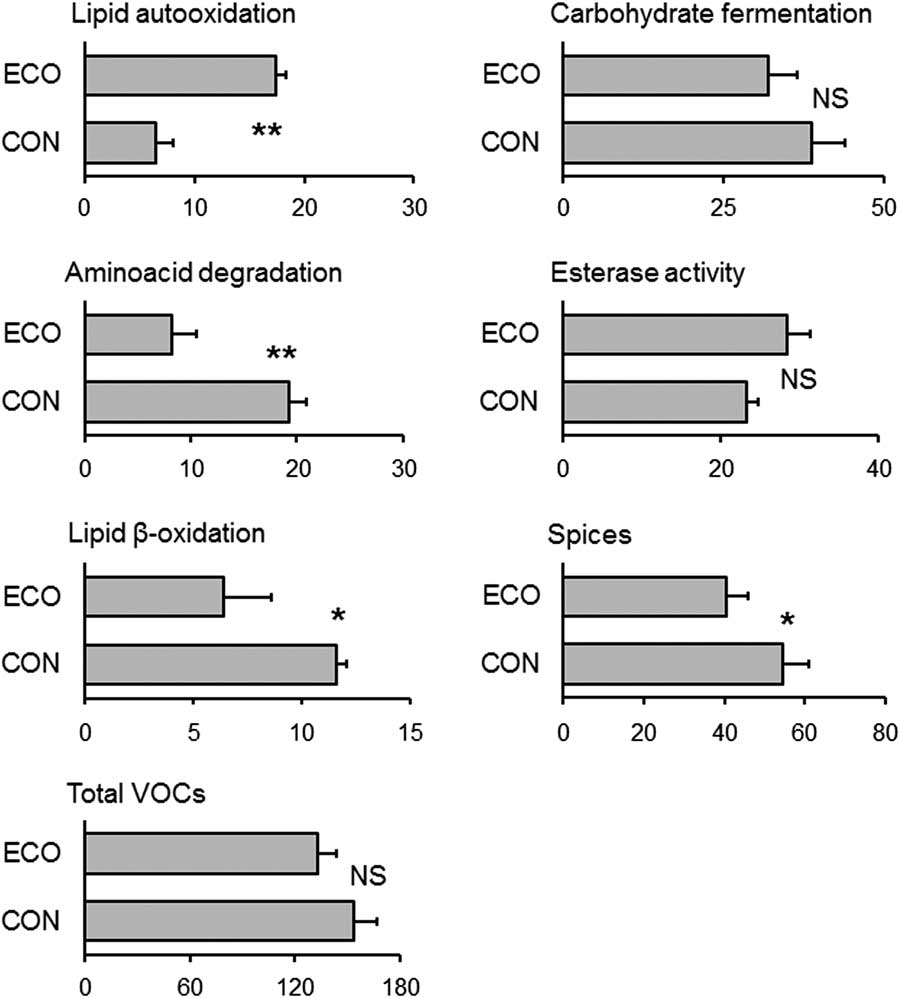
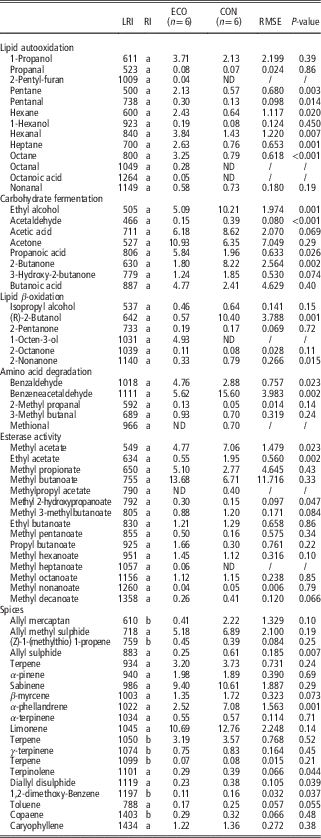
In the present study, 68 volatile compounds were identified (Table 3) in dry-fermented sausages, seven of them were identified tentatively. When classified according to the most probable origin (Ordoñez et al., Reference Ordoñez, Hierro, Bruna and de la Hoz1999), the volatiles originating from spices (33% of the total area) and carbohydrate fermentation (25%) were the most abundant compounds, followed by the groups originating from esterase activity (18%), amino acid degradation (10%), lipid autooxidation (8%) and lipid β-oxidation (6%). As shown in Figure 1, rearing practice of pigs was not associated with the amount of total volatiles of dry-fermented sausages. There were, however, differences in individual volatile groups. Compared with CON, ECO dry-fermented sausages had higher amounts of volatiles from lipid autooxidation due to the differences in individual alkanes (pentane, hexane, heptane and octane) and aldehydes (pentanal, hexanal). On the other hand, ECO sausages exhibited lower levels of volatiles from microbial lipid β-oxidation (most notably (R)-2-butanol), amino acid degradation (characterized largely by benzenacetaldehyde) and spices (mainly due to the differences in α-phellandrene, but also allyl sulphide, terpinolene, diallyl disulphide and toluene).
Relative abundance of major volatile groups in dry-fermented sausages produced from meat of pigs raised in organic (ECO) and conventional (CON) production system. Total VOCs=total volatile organic compounds.

Volatile compoundsFootnote 1 of dry-fermented sausages produced from meat of pigs raised in organic (ECO) and conventional (CON) production system

LRI=linear retention index for DB-624 column; RI=reliability of identification; a=identification by mass spectrum and by coincidence with the LRI of an authentic standard; b=tentative identification by mass spectrum, ND=not detected.
1 Values are expressed as normalized area (Area Comp/Area IS); IS=2-methyl-3-heptanone.
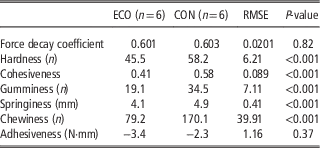
Results on rheological parameters indicative of the texture demonstrated a strong effect of treatment group on the majority of measured traits (Table 4). Dry-fermented sausages from ECO pigs were softer, and exhibited lower values of cohesiveness, gumminess, springiness and chewiness than sausages from CON pigs.
Rheological parameters of dry-fermented sausages produced from meat of pigs raised in organic (ECO) and conventional (CON) production system

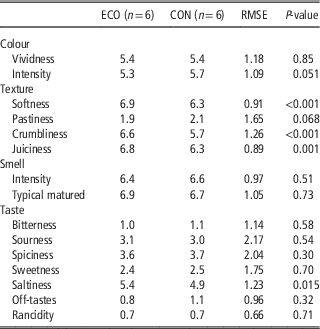
Consistent with the differences in chemical and physical traits, sensory evaluation of dry-fermented sausages also showed strong effect of treatment group (Table 5). Dry-fermented sausages from ECO pigs were perceived as softer, more crumbly and juicy than sausages from CON pigs. They were also noted as less salty than sausages from ECO pigs. A tendency of less intensive colour and lower pastiness was also noted for the sausages from ECO pigs (P<0.10).
Sensory propertiesFootnote 1 of dry-fermented sausages produced from meat of pigs raised in organic (ECO) or conventional (CON) production system

1 Assessed by a trained panel (scale 0 – not detected to 9 – very intense).
Discussion
Despite equal feed disappearance noted for ECO and CON group, pigs in ECO group had 13% higher daily gain than CON pigs. Although this difference was not statistically significant, it shows that ECO pigs consumed and retained more energy and nutrients, denoting important alfalfa hay consumption. Moreover, pigs in ECO group were physically more active (higher energy expenditure) due to the free access to outdoor area where alfalfa hay was constantly available to them. Substantial alfalfa consumption and the fact that ECO and CON pigs were similar with respect to final live weight and subcutaneous fat thickness is important for the raw material properties, which shall be discussed below. Dry-fermented sausages made of meat from pigs raised according to ecological standards or in conventional production system differed quite notably. ECO sausages exhibited lower weight losses during processing than CON which resulted in differences of their basic chemical composition (ECO sausages exhibiting higher moisture and salt content). As NaCl is dissolved in water, its higher content in ECO sausages at the end of the processing could be explained with more intensive initial drainage in CON sausages and higher moisture loss (salt recrystallizing on the casing). The reason for lower moisture loss in ECO sausages may be due to the different fatty acids composition of ECO and CON that is higher fat unsaturation of sausages from ECO pigs. Meat products with more unsaturated fats are prone to exhibit excessive softness and surface oiliness thus preventing the product from drying (Gandemer, Reference Gandemer2002). Differences in final pH value are difficult to comment as no microbial studies were performed but they might be a result of the natural fermentation of the meat batter through the autochthonous flora (Toldrá and Flores, Reference Toldrá and Flores2014) as the same sugar concentration was used together with other factors like initial pH or amino acid degradation (Toldrá, Reference Traore, Aubry, Gatellier, Przybylski, Jaworska, Kajak-Siemaszko and Santé-Lhoutellier2002). However, it may be noted that pH value was already lower in ECO than CON meat mixture at the start (6.09 v. 6.36, results not shown). Higher oxidation level (values of TBARS) determined for ECO dry-fermented sausages is consistent with their higher fat unsaturation as demonstrated previously (Morrissey and Techivangana, Reference Morrissey and Techivangana1985). Besides, ECO dry-fermented sausages had also less free fatty acids than those of CON group. As free fatty acids may be further degraded during the ripening process, it is difficult to discern whether the differences come from increased oxidative degradation (indicated by higher TBARS values and higher amount of volatiles generated by the lipid autooxidation) or lower lipolysis. According to Gandemer (Reference Gandemer2002), the processes of lypolysis and lipid oxidation are not interrelated, and although the exact mechanism is unknown, indications exist that lipolysis might even protect free fatty acids from oxidation, which may additionally explain higher amount of free fatty acids in CON sausages. In dry-fermented sausages the lypolysis is mostly ascribed to endogenous lipases, whereas the contribution of bacteria is less significant as the medium conditions are not optimal for bacterial lipases (Molly et al., Reference Molly, Demeyer, Johansson, Raemaekers, Ghistelinck and Geenen1997). Testing different formulations, Zanardi et al. (Reference Zanardi, Ghidini, Battaglia and Chizzolini2004) concluded that lypolysis in fermented sausages was not affected by the formulation (including additives and pH) but more likely to inherent variations in the lean and fat tissue used. Two circumstances corroborate with lower amounts of free fatty acids in dry-fermented sausages from ECO pigs; moderate exercise which was shown to decrease the activity of neutral lipase (Daza et al., Reference Daza, Rey, Olivares, Cordero, Toldrá and López-Bote2009), and higher level of NaCl which inhibits lysosomal acid lipase (Ripollés et al., Reference Ripollés, Bastaianello Campagnol, Armenteros, Aristoy and Toldrá2011).
There’s a general agreement between the volatiles and sensory profile of dry-fermented sausages indicating no differences in smell and taste between CON and ECO sausages. However, there were some differences between CON and ECO sausages observed for individual volatile groups. Higher amounts of volatiles arising from lipid oxidation in ECO sausages, agrees with higher TBARS and more unsaturated fat (Gandemer, Reference Gandemer2002). The differences are governed mostly by several straight chain aliphatic alkanes and by hexanal, the most abundant compound in this group, which is also considered as one of the markers of oxidation. Moreover, lipid oxidation in dry-fermented sausages can be promoted by a range of other factors (Ordoñez et al., Reference Ordoñez, Hierro, Bruna and de la Hoz1999) including low pH (lower in ECO than in CON sausages) and NaCl concentration (higher in ECO sausages), additionally promoting oxidative processes in ECO sausages. It is most likely, that both factors (i.e. pH and NaCl) affected also other volatile groups that may be dependent on either microbial metabolism or endogenous enzymes. As no examination of main microbial populations was performed, the differences in volatiles resulting from microbial fermentation cannot be explained directly. However, higher amounts of volatiles originating from microbial lipid β-oxidation, amino acid degradation and numerous individual compounds related to esterase activity and carbohydrate fermentation observed in CON sausages, corroborates with the fact that either microbial growth and/or enzymes were stimulated by higher pH values and lower salt content (Flores and Olivares, Reference Flores and Olivares2015). Lower volatiles originating from amino acid degradation in ECO sausages do not agree with proteolysis index (no effect observed). The differences may, however, be due to more specific proteolytic products of either microbial or endogenous enzymes origin. As shown by Lopez-Bote et al. (Reference Lopez-Bote, Toldrá, Daza, Ferrer, Menoyo, Silió and Rodríguez2008) comparing m. psoas major of exercised and sedentary Iberian pigs, no effects on total free amino acids but lower activities of several proteolytic enzymes were noted in the exercised pigs, along with decreased concentration of branched chain amino acids (precursors of many Strecker aldehydes, important for flavour development in dry-cured products). Benzenacetaldehyde, the most abundant compound in this group observed in the present study arises from Strecker degradation of amino acid phenylalanine (Belitz and Grosch, Reference Belitz and Grosch1997). The reaction itself is favoured by the increase in free amino acids, generation of which depends on the aminopeptidases, being less active at lower pH (Toldrá and Flores, Reference Toldrá and Flores2014). In the present study lower levels of volatiles originating from spices were observed in ECO than CON sausages. The reason may be related to their stability as many flavour compounds are known to be highly unstable and prone to oxidative degradation (Turek and Stintzing, Reference Turek and Stintzing2013). Lee et al. (Reference Lee, Kim and Kyung2014), for instance, reported a decreased stability of garlic-derived thiosulphinates in the presence of increased amount of unsaturated fatty acids. This is in line with higher levels of PUFA and oxidation markers (TBARS) observed in the present study for ECO sausages.
Following the differences in chemical traits, instrumentally determined texture of ECO dry-fermented sausages was softer which is explicable by fat unsaturation effect on dehydration (resulting in higher moisture) and softer consistency of less saturated fat (Davenel et al., Reference Davenel, Riaublanc, Marchal and Gandemer1999). The same is valid for sensory analysis where lower colour intensity, softer texture, higher crumbliness and juiciness of ECO sausages can be explained with chemical traits that is the higher moisture. Higher saltiness perception was also consistent with chemically determined NaCl content (higher in ECO sausages).
The differences between ECO and CON dry-fermented sausages (produced in parallel using the same processing conditions) turned out to be quite important and originate from raw material differences. As fat thickness (factor associated with fatty acids composition) in both groups was equal, the differences may be related to the supplementation of ECO pigs with alfalfa hay, rich in polyunsaturated fats (accounting for more than 60% of the fatty acids in this plant species; Boufaïed et al., Reference Boufaïed, Chouinard, Tremblay, Petit, Michaid and Bélanger2003) but also physical activity of ECO pigs may have added to lower fat saturation. As shown by Daza et al. (Reference Daza, Rey, Olivares, Cordero, Toldrá and López-Bote2009) on Iberian breed, exercised pigs had higher C18:2, C18:3 and total PUFA in neutral fat from m. psoas major when compared with sedentary ones, despite receiving the same feed.
In conclusion, the results indicate a notable effect of pig rearing on dry-fermented sausage quality. Due to the differences associated with organic pig rearing practice (alfalfa hay supplementation and physical activity), raw material from organically raised pigs had lower meat pH, more unsaturated fat tissue leading to lower weight processing losses and more retained moisture in dry-fermented sausages finally resulting in different aromatic profile (more lipid autooxidation, less lipid β-oxidation, less amino acid degradation, less volatiles from spices), softer texture, less intensive colour and also higher saltiness.
Acknowledgements
The research has received funding from the European Union’s Horizon 2020 research and innovation programme under grant agreement No 634476 (Project acronym TREASURE). The content of this paper reflects only the authors’ view and Research Executive Agency is not responsible for any use that may be made of the information it contains. Authors also acknowledge the financial support of the Slovenian Research Agency (grants P4-0133 and V4-1417) and the Ministry of Agriculture, Food and Forestry (V4-1417), from AGL2015-64673-R (MINEICO, Spain) and FEDER funds. The authors would also like to thank the partner from the industry (KZ Tolmin z.o.o. Salamerija Alpija) for their help in conducting the experiment.
Supplementary material
To view supplementary material for this article, please visit https://doi.org/10.1017/S1751731117002713