Implications
An increasing amount of broiler breast meat is sold in self-service packages. Considering this, alterations like colour differences between the meat pieces or higher drip loss are more obvious for consumers are one reason for increasing complaints. The muscle-to-meat transition is accompanied with a decrease in pH and a change of the oxidative status, for example, by the production of reactive oxidative substances (e.g. superoxides) by the mitochondria, and in contrast by the activation of antioxidative enzymes. The aim of this study was to clarify the influence of broiler gender and age on these oxidative processes after slaughter of the animals in relation to (altered) meat quality.
Introduction
Within the last years, the poultry market increased possibly due to problems in the beef sector and the trend to consumption of low-caloric food (Petracci et al., Reference Petracci, Bianchi and Cavani2009). Many of the poultry carcasses are cut up and sold in portions (e.g. breast muscles and wings) in modified atmosphere packages (MAPs; Barbut, Reference Barbut2009). However, breast muscles in MAP frequently show different colouration of the cuts (Werner and Wicke, Reference Werner and Wicke2008). Although this variation of the meat colour is to a certain degree physiologically explicable (Berri et al., Reference Berri, Wacrenier, Millet and Le Bihan-Duval2001), consumers begin to be concerned (Barbut, Reference Barbut2009), especially if poultry meat characterised by paler colour, heterogeneous appearance, poorer texture and cohesiveness and a higher drip loss was sold in MAP. This meat is referred to as pale, soft and exudative (PSE)-like meat to stress the similarity to the PSE syndrome in pork (Barbut, Reference Barbut2009; Petracci et al., Reference Petracci, Bianchi and Cavani2009). The colour of fresh meat is related to the proportions of the three myoglobin (Mb) variants deoxy-Mb, oxy-Mb and met-Mb. The bright red colour of oxy-Mb is responsible for the consumer-preferred colour of the meat (Tang et al., Reference Tang, Faustman, Hoagland, Mancini, Seyfert and Hunt2005a). The total Mb content of the muscle is influenced by factors like species, gender, age or feed. The proportion of the different Mb variants is influenced by the oxidative status of the tissue, like the oxygen (O2) consumption and the antioxidative capacity of the tissue (Mancini and Hunt, Reference Mancini and Hunt2005; Figueiredo et al., Reference Figueiredo, Mota, Appell and Duarte2008). The electron transport chain (ETC) of mitochondria is not only responsible for the O2 consumption of the tissue but is also a significant source of reactive oxygen species (ROS). Under physiological conditions, up to 5% of the O2 reacts to superoxide (O2−) anions. O2− is either converted within the matrix or the intermembrane space of the mitochondria spontaneously or it is catalysed by the superoxide dismutase (SOD) to hydrogen peroxide (H2O2), which is broken down by the glutathione peroxidase (GPx) or catalase to H2O or H2O and O2 (Figueiredo et al., Reference Figueiredo, Mota, Appell and Duarte2008). Considering the impact of the mitochondria and the antioxidative enzymes like SOD or GPx on the proportion of Mb variants, an influence on the meat quality could be suggested. Therefore, in this study the mitochondrial respiratory and antioxidative enzyme activities of muscle samples were investigated. The samples were collected from hens and cocks of a commercial broiler line, slaughtered after 28 and 41 days. The aim of this investigation was to analyse functional properties of mitochondria and antioxidative enzyme activities as well as carcass and meat quality characteristics in relation to the gender and age of the broiler.
Material and methods
Animals, husbandry and sample collections
Cocks and hens (n = 60 per gender) of a fast-growing commercial broiler line (Aviagen Ltd, Midlothian, UK) were reared according to the animal welfare recommendations in an experimental barn that provided good husbandry conditions (e.g. stocking density, litter and ventilation). The animals were raised under similar conditions in the same barn that was equipped with two compartments (60 birds) separated by a wire fence. The size of each compartment was approximately 6 m2. The animals had no access to the outdoor environment to minimise any disturbing influences. In the beginning, the temperature was 24°C and the light intensity 22 lux, at the end of the growth period gradually being reduced to 18°C and 4 lux. The daily dark period was increased from 0 h up to 8 h within the first week remaining at 8 h until the end of the trial. The litter (chipped wood) was controlled daily (e.g. dirt and wetness), and additional material was added in case the animals were slightly dirty. At the end of the growth period the stocking density did not exceed 25 kg/m2. Until 3 days before slaughter, the animals were fed a diet with Narasin/Nicarbacin (1 to 10 days: 12.6 MJ ME (metabolizable energy)/21.5 CP/kg; 11 to 20 days: 13.0 MJ ME/20.5 CP/kg; 21 days until 3 days before slaughter: 13.0 MJ ME/20.5 CP/kg) and for the last 3 days they received a diet (without Narasin/Nicarbacin) with 13.2 MJ ME/19.5 CP/kg feed. On day 28, half of the cocks and hens (n = 30 per gender) were carefully caught in the compartments and transported to a commercial abattoir within 1 h. The remaining birds (n = 30 per gender) were transported and slaughtered on day 41. Immediately after stunning (1.2 A, 5 s) the exsanguation was initialised by mechanical cutting of the Arteria carotis communis. After scalding (51°C to 53°C, 4.5 min) the carcasses were defeathered and automatically eviscerated, then the veterinary meat inspection was carried out. Before entering the chilling room, 25 carcasses per gender and age were randomly removed from the slaughter chain and weighed. Then both breast muscles and both legs were carefully excised from the carcass by a trained person and weighed after removal of the skin. The breast muscles were investigated as described in ‘Methods’ section. Between the investigations the meat samples were stored and individually packed in plastic bags in a chilling room. The determination of the mitochondrial respiratory activities was performed with breast muscle samples collected 20 min after slaughter and stored on ice in a specific storage buffer (SB, 15 mM phosphocreatine, 49 mM potassium morpholino-ethanesulfonic acid, 20 mM taurine, 20 mM imidazol, 5.2 mM ATP, 9.5 mM MgCl2, 3 mM potassium hydrogen phosphate and 0.5 mM dithiothreitol, pH 7.1) until analysis. For the analysis of the activities of the antioxidative enzymes, meat samples were collected 20 min and 48 h after slaughter from the breast muscles, frozen in liquid nitrogen and stored at −70°C until analysis.
Methods
pH
The pH was measured 20 min and 24 h after slaughter (post mortem, p.m.) with a portable pH meter (pH-Star, Matthäus GmbH, Poettmes, Germany) equipped with a glass electrode (InLab 427, Mettler-Toledo, Urdorf, Switzerland). For the determination of pH the electrode was inserted in the centre of the left breast muscle waiting at least for 30 s until the pH values were nearly stable.
Colour
The meat lightness (L*), redness (a*) and yellowness (b*) values were determined with a colorimeter (Minolta CR 400, Minolta GmbH, Langenhagen, Germany) 20 min and 48 h p.m. on the medial surface (bone side) of the left breast muscle. Each value was an average of at least six measurements.
Drip loss
The right breast muscle was weighed 11 h and 72 h p.m. and the drip loss was calculated as the loss of weight and expressed in percent. Between the measurements the muscle was stored at 4°C in an individual plastic container.
Mitochondrial respiratory activity (MRA)
The MRA of the meat samples collected 20 min p.m. was determined as soon as possible within 12 h after sample collection using an Oxygraph (Oroboros, Innsbruck, Austria) equipped with a Clark electrode (Kuznetsov et al., Reference Kuznetsov, Kunz, Saks, Usson, Mazat, Letellier, Gellerich and Margreiter2003). All steps were performed on ice with cold buffers, unless otherwise indicated. The samples were dissected in SB using two pairs of small cannulae. After dissection the muscle fibres were permeabilised for 20 min in SB with saponin (50 μg/ml) and subsequently washed in incubation buffer (IB, 75 mM mannitol, 25 mM sucrose, 0.1 M KCl, 0.5 mM EDTA, 20 mM Tris, 5 mM MgCl2 × 6H2O, 10 mM KH2PO4 and 0.5 mM DTT, pH 7.4) freshly supplemented with fatty acid free bovine serum albumin (BSA, 1 mg/ml). The fibres were carefully removed from the IB + BSA, dried on filter paper and weighed before transfer to the incubation chamber of the Oxygraph. The respiration measurement was done at a temperature of 30°C in IB + BSA. MRA was analysed with the substrates pyruvate/malate (Pyr 10 mM/Mal 2 mM) or succinate/rotenone (Succ 10 μM/Rot 10 mM). State-3 respiration was initiated with 5 mM ADP (adenosine 5′-diphosphate) and state-4 respiration with 28 μM carboxy-atractyloside (Calbiochem GmbH, München, Germany). The weight-specific O2 consumption (pmol O2/min × mg sample weight) was calculated as the time derivative of the O2 concentration using the software Datlab 4.1 (Oroboros). The respiratory control index (RCI) was calculated by dividing the state-3-respiration Pyr/Mal and the state-4-respiration rates.
Antioxidative enzyme activities
The frozen muscle samples were diluted 1 : 10 in phosphate buffered saline (2.68 mM KCl; 141.74 mM NaCl; 10.14 mM Na2HPO4; 1.76 mM KH2PO4) and homogenised on ice for 5 min at 1200 U/min with a Potter-Homogenisator (B. Braun Biotech International, Melsungen, Germany). Subsequently the protein concentration was determined (Bradford, Reference Bradford1976), and the homogenate was adjusted to a protein concentration of 6 mg/ml for further enzyme activity analysis. The activities of the enzymes SOD, GPx and glutathione reductase (GR) were analysed photometrically at an incubation temperature of 30°C and a pH of 7.4. To prevent storage-related effects the homogenate was kept on ice between investigations, and the activity determinations were completed within 2 h after initial dilution of the frozen muscle samples. The enzyme activity analysis was performed at least in triplicates and the results were stated in U/g protein. The SOD activity was determined according to Simonovicova et al. (Reference Simonovicova, Tamas, Huttova, Siroka and Mistrik2004). In brief, the enzyme xanthin oxidase (1 U/ml) catalyses the oxidation of xanthine (50 mM) to uric acid accompanied with the reduction of O2 to O2−. Within the assay the O2− spontaneously reduces methylthiazolyldiphenyl-tetrazolium bromide (MTT, 70 mM) to MTT formazan, a reaction product with an absorbance maximum at 560 nm. As the SOD catalyses the dismutation of two O2− molecules to O2 and H2O2, the reduction to MTT formazan decreases with an increasing SOD activity. Therefore, SOD activity is calculated from the time-dependent difference between the MTT assay containing and not containing the homogenate. GPx was analysed using a modification of the coupled enzyme assay by Otto-Knapp et al. (Reference Otto-Knapp, Jurgovsky, Schierhorn and Kunkel2003). GPx catalyses the oxidation of reduced glutathione (GSH, 0.1 mM) to oxidised glutathione (GSSG) accompanied with the reduction of H2O2 (0.05%) to H2O. The GPx activity was finally determined by following the oxidation of NADPH (0.15 mM) to NADP at 340 nm within the GR (1 U/ml) catalysed reduction of GSSG to GSH. GR was analysed according to Otto-Knapp et al. (Reference Otto-Knapp, Jurgovsky, Schierhorn and Kunkel2003) by following the oxidation of NADPH (0.3 mM) to NADP at 340 nm within the GR catalysed reduction of GSSG (2 mM) to GSH.
Thiobarbituric acid-reactive substances (TBARS)
The concentration of TBARS was determined according to Du et al. (Reference Du, Nam, Hur, Ismail and Ahn2002). In brief, 500 mg of the frozen muscle samples were diluted 1 : 10 in deionised water and homogenised on ice for 2 min at 1500 U/min with a Potter-Homogenisator (B. Braun Melsungen). After addition of TBA (final concentration 0.28%), trichloroacetic acid (1.8%) and butylhydroxytoluene (0.07%) the solution was heated for 15 min at 100°C. After cooling down and centrifugation for 5 min at 2000×g the supernatant was analysed photometrically at 521 nm. The TBARS concentration was expressed as nanogram malondialdyde per gram tissue.
Chemicals
All chemicals were purchased from Sigma-Aldrich GmbH, Taufkirchen, Germany, unless otherwise indicated.
Statistical analysis
The data were analysed with the software Statistica 7.1 (StatSoft, Germany) using the GLM procedure. The statistical model included the factors gender, age and the interaction of gender and age. Significance was analysed with the Tukey test considering P < 0.05.
Differences between the enzyme activities and TBARS concentrations at the different collection times (20 min p.m. and 48 h p.m.) were analysed with the Student's t-test of dependent measures considering P < 0.05.
Results
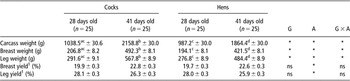
The 28-day-old cocks and hens had similar carcass, breast and leg weight as well as breast and leg yields. With increasing age all carcass characteristics increased significantly in the broiler cocks and hens except for the leg yield that decreased (P < 0.05). Considering the gender, the 41-day-old cocks had significantly higher carcass, breast and leg weight as well as leg yields but similar breast yields in comparison to the 41-day-old hens (Table 1).
Mean values (LSM) and s.e. of the carcass characteristics depending on the A and G of the investigated birds

LSM = least square mean; A = age; G = gender.
1Breast and leg yields are related to the carcass weight.
a,b,c,dLSM with different letters within a row differ significantly (P < 0.05).
Effects of A, G and its interaction (G × A) are significant (*P < 0.05) or ns.
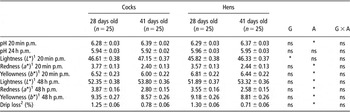
In Table 2, the meat quality characteristics are shown. With regard to the pH values determined 20 min after slaughter, a significant impact of the age could be determined showing higher pH values in the 41-day-old cocks and hens. The pH24 h p.m. values were comparable (P > 0.05) between the birds ranging from 5.92 to 5.96. Considering the L*20 min p.m. values a significant influence of the gender could be observed showing higher lightness results in the 28- and 41-day-old cocks than the hens. In all other colour values determined, a significant influence of the age of the broiler was found. The 41-day-old cocks and hens had significantly lower redness (a*) values than the younger broiler. With regard to the b* values 20 min p.m. as well as 48 h p.m., the results for the 28-day-old cocks and hens were significantly higher than the values of the older cocks and hens. The drip loss was significantly higher in the young cocks and hens than in the 41-day-old birds.
Mean values (LSM) and s.e. of the meat quality parameters of the breast muscles depending on the A and G of the investigated birds

LSM = least square mean; A = age; G = gender; p.m. = post mortem.
1L*, a*and b* values were determined on the bone side of the breast muscles.
2Drip loss was determined between 11 and 72 h p.m.
Effects of A, G and its interaction (G × A) are significant (*P < 0.05) or ns.
The MRA of the permeabilised muscle fibres from the breast muscles either using the substrates Pyr/Mal or Succ/Rot were comparable (P > 0.05) between the birds independent of age or gender. Using Pyr/Mal, the state-3-respiration rates ranged between 10.22 and 13.17 pmol O2/min × mg sample weight and were higher than those of the Succ/Rot dependent results with values between 6.32 and 7.15 pmol O2/min × mg sample weight. The RCI values did not differ between the investigated birds either (Table 3).
Mean values (LSM) and s.e. of the mitochondrial respiratory activities of permeabilised muscle fibres collected from the breast muscles 20 min after slaughter depending on the A and G of the investigated birds

LSM = least square mean; A = age; G = gender; RCI = respiratory control index.
1The state-3-respiration Pyr/Mal was determined with the substrate combination pyruvate/malate.
2The state-3-respiration Succ/Rot was determined with the substrate combination succinate/rotenone.
3The RCI Pyr/Mal was calculated by dividing the state-3-respiration Pyr/Mal and the state-4-respiration rates (data not shown).
Effects of A, G and its interaction (G × A) are significant (*P < 0.05) or ns.
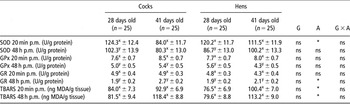
The activities of nearly all antioxidative enzymes did not show any differences between the 28- and 41-day-old hens and cocks. The SOD activities in the 20 min p.m. meat samples were significantly higher in the young cocks and hens than in the 41-day-old animals. In contrast to this, the GR48 h p.m. activities were significantly higher in the older birds in comparison to the 28-day-old cocks and hens. With regard to the differences of the enzyme activities between the 20 min p.m. and 48 h p.m. samples, a significant decrease of the GPx and GR activities could be observed in all birds, whereas the significant decrease of the SOD activity could only be found in the 28-day-old cocks and hens (Table 4).
Mean values (LSM) and s.e. of the enzyme activities of the SOD, GPx, GR and TBARS concentration in breast muscles collected 20 min and 48 h after slaughter (p.m.) depending on the A and G of the investigated birds

LSM = least square mean; SOD = superoxide dismutase; GPx = glutathione peroxidase; GR = glutathione reductase; TBARS = thiobarbituric acid-reactive substances; p.m. = post mortem; A = age; G = gender; MDA = malondialdehyde.
x,yLSM with different letters within a row differ significantly between 20 min and 48 h p.m. values (P < 0.05).
Effects of A, G and its interaction (G × A) are significant (*P < 0.05) or ns.
As shown in Table 4, the concentrations of TBARS were comparable (P > 0.05) in the 20 min p.m. and 48 h p.m. meat samples, but an impact of the age could be observed as significantly higher TBARS concentrations were determined in the 41-day-old birds 20 min as well as 48 h p.m. in comparison to the younger animals.
As shown in Table 5 the data sets were assorted by the pH20 min p.m. considering either those with pH values > or <6.34, the least square mean of the pH20 min p.m. values. Significant lower drip loss and yellowness (b*) values as well as GPx activities could be found in the samples with higher pH values, whereas the RCI values were lower in the other group. The redness values and the SOD and GR activities were tendentially lower in the samples with higher pH20 min p.m. values.
Mean values (LSM) and s.d. of the drip loss and colour (L*a*b*) values, state-3-respiration rates, RCI and enzyme activities of the SOD, GPx and GR in breast muscles collected 20 min after slaughter (p.m.) after assorting the data sets considering the LSM of all pH values determined 20 min p.m.

LSM = least square mean; RCI = respiratory control index; SOD = superoxide dismutase; GPx = glutathione peroxidase; GR = glutathione reductase; p.m. = post mortem; s.w. = sample weight.
1Drip loss (%) was determined between 11 h and 72 h p.m.
2L*, a*and b* values were determined on the bone side of the breast muscles.
3The state-3-respiration Pyr/Mal (pmol O2/min × mg s.w.) was determined with the substrate combination pyruvate/malate.
4The state-3-respiration Succ/Rot (pmol O2/min × mg s.w.) was determined with the substrate combination succinate/rotenone.
5The respiratory control index (RCI) Pyr/Mal was calculated by dividing the state-3-respiration Pyr/Mal and the state-4-respiration rates (data not shown).
6Enzyme activities in U/g protein.
P-value <0.05 (marked bold) was considered significant.
Discussion
In this study the influence of gender and age of broilers on the carcass characteristics, meat quality and parameters of the (anti)oxidative metabolism was investigated.
Comparing the presented carcass characteristic data with already published results is difficult because factors like diet, husbandry, slaughter age or preparation of the breasts and legs before weighing differ. However, considering the performance data of commercial broiler lines presented by Aviagen (2008), the presented results are within the range of the data presented in that study. Commercial fast-growing broiler lines are specially bred for higher amounts of breast and leg meat in comparison to layer or traditional chickens (Sandercock et al., Reference Sandercock, Nute and Hocking2009).
The absolute values of the meat quality parameters of the breast muscles, presented in this study, could not be related to results of other publications due to differences in the genetics, diets and ages, and especially in the sample preparation, instruments and measurement conditions (Bianchi and Fletcher, Reference Bianchi and Fletcher2002), but the values are ‘in the range’ of already published data (Nissen and Young, Reference Nissen and Young2006; Berri et al., Reference Berri, Le Bihan-Duval, Debut, Sante-Lhoutellier, Baeza, Gigaud, Jego and Duclos2007; Werner et al., Reference Werner, Janisch, Kuembet and Wicke2009). Important results of this study are the higher pH20 min p.m. and the reduced drip loss values as well as lighter and less red colour of the breast muscles from the older broiler in comparison to the younger animals. As publications showing results for meat quality of different aged broiler but similar growth rates are rare, studies on birds differing in the carcass characteristics and/or muscle fibre cross-sectional areas (CSA) are mainly considered in the following. This study is supported by Debut et al. (Reference Debut, Berri, Baeza, Sellier, Arnould, Guemene, Jehl, Boutten, Jego, Beaumont and Le Bihan-Duval2003) who presented the same results for meat quality in heavier but younger broiler. Berri et al. (Reference Berri, Le Bihan-Duval, Debut, Sante-Lhoutellier, Baeza, Gigaud, Jego and Duclos2007) showed higher pH15 min p.m. and lower drip loss values in heavier broilers of the same age, whereas these birds had higher pH24 h p.m. and lower lightness values and comparable redness results. Berri et al. (Reference Berri, Le Bihan-Duval, Debut, Sante-Lhoutellier, Baeza, Gigaud, Jego and Duclos2007) suggested that the higher pH24 h p.m. in these heavier birds were due to the lower glycogen content and the accompanied reduced acidification of the meat. In another publication by Berri et al. (Reference Berri, Debut, Sante-Lhoutellier, Arnould, Boutten, Sellier, Baeza, Jehl, Jego, Duclos and Le Bihan-Duval2005a) heavier broiler, that were also younger than the lighter slow-growing birds, had higher pH15 min p.m. and L* as well as lower a* values but higher drip loss and pH24 h p.m. results. Nearly similar results were presented by Berri et al. (Reference Berri, Wacrenier, Millet and Le Bihan-Duval2001) except for comparable drip loss values. In the latter study the ages also differed slightly. Heavy broiler with larger CSA and comparable breast weight also had higher pH15 min p.m. and L* as well as lower a* values and drip loss values (Berri et al., Reference Berri, Le Bihan-Duval, Baeza, Chartrin, Picgirard, Jehl, Quentin, Picard and Duclos2005b). The results in this study agree with the investigations of Nissen and Young (Reference Nissen and Young2006) except for the lower L* values in the heavier birds. Considering the inconsistency of the already published results it could be suggested that the effect of the increasing age is not only related to the higher breast development and larger muscle CSA but also to other muscle characteristics (e.g. chemical composition and oxidative status) that influenced the water-holding capacity (WHC), pH and colour of the meat. The major part of the water in the muscle tissue is bound to the myofibrils or located to the extracellular proteins (e.g. collagen). During muscle-to-meat transition the fluid expels from these muscle proteins due to changes like the reduction of the pH, shrinkage of the myofibrils and proteolysis of the costameres (Huff-Lonergan and Lonergan, Reference Huff-Lonergan and Lonergan2005). Therefore, it could be suggested that the better WHC of the older broiler breast muscles is related to higher (extra)cellular protein concentrations. This assumption is supported by Berri et al. (Reference Berri, Wacrenier, Millet and Le Bihan-Duval2001) who showed that broiler having higher breast weight (selected line) had higher protein and dry matter contents in the breast muscles. Grey et al. (Reference Grey, Robinson, Jones, Stock and Thomas1983) presented that the breast meat protein content increased and the moisture decreased with the age of the broiler, and Nakamura et al. (Reference Nakamura, Iwamoto, Shiba, Miyachi, Tabata and Nishimura2004) showed that with increasing age of broiler the perimysial space of the breast muscle thickened thereby increasing the WHC of the connective tissue components (collagen and proteoglycans). With regard to the meat colour, especially the lower redness values of the older animals, a difference of the oxidative status between the young and old broiler could be considered. This assumption is supported by the presented TBARS results and partly by the antioxidative enzyme activities.
The determination of the MRA is a method to investigate O2 consumption of the tissue and has been analysed in muscle/meat samples from pigs (Brooks and Cassens, Reference Brooks and Cassens1973; Campion et al., Reference Campion, Olson, Topel, Christian and Kuhlers1975; Wicke et al., Reference Wicke, Gellerich, Greb, von Lengerken and Zierz2000; Werner et al., Reference Werner, Natter, Schellander and Wicke2010), cattle (Ashmore et al., Reference Ashmore, Parker and Doerr1972; Bendall, Reference Bendall1972; Lanari and Cassens, Reference Lanari and Cassens1991; Tang et al., Reference Tang, Faustman, Hoagland, Mancini, Seyfert and Hunt2005b; Ramanathan et al., Reference Ramanathan, Mancini and Konda2009) or poultry (Tang et al., Reference Tang, Iqbal, Cawthon and Bottje2002; Opalka et al., Reference Opalka, Wicke, Gellerich, Schmidt, Rosner, Zierz and von Lengerken2004; Bottje and Carstens, Reference Bottje and Carstens2009), also in relation to the muscle-to-meat transition after slaughter of the animals. Many of these studies were carried out with mitochondria isolated from the muscle/meat samples before and after slaughter. However, the analysis of isolated mitochondria requires relatively large amounts of tissue and therefore is less suitable for the investigation of biopsies. Permeabilised muscle (‘skinned’) fibres could be studied in situ using small sample amounts (biopsies) without the isolation of the mitochondria and possible isolation artefacts (Kuznetsov et al., Reference Kuznetsov, Kunz, Saks, Usson, Mazat, Letellier, Gellerich and Margreiter2003). Therefore, in this study the ‘skinned fibre technique’ was used for the analysis of the MRA. No data about the MRA in broiler breast muscles depending on the age have been published until now. Investigations in other species did not show any influence of the age on the MRAs in pigs (Wicke et al., Reference Wicke, Gellerich, Greb, von Lengerken and Zierz2000), cattle (Lanari and Cassens, Reference Lanari and Cassens1991) or rats (Komrakova et al., Reference Komrakova, Werner, Wicke, Nguyen, Sehmisch, Tezval, Stuermer and Stuermer2009). However, Opalka et al. (Reference Opalka, Wicke, Gellerich, Schmidt, Rosner, Zierz and von Lengerken2004) presented significantly lower MRAs in 20-week-old turkeys in comparison to 10-week-old birds. As increasing age is accompanied with higher body weight (BW), other studies investigating broiler having different BW should also be considered. Bottje et al. (Reference Bottje, Tang, Iqbal, Cawthon, Okimoto, Wing and Cooper2002) and Tang et al. (Reference Tang, Iqbal, Cawthon and Bottje2002) showed that broiler having lower BW due to different feeding or health status also had comparable MRAs.
In many studies, the activities of antioxidative enzymes or the oxidative status in poultry meat were investigated in relation to stress/health status or feed, but investigations depending on the age and gender of the birds have not been published until now. Ojano-Dirain et al. (Reference Ojano-Dirain, Iqbal, Wing, Cooper and Bottje2005) showed that broiler having different BW had comparable GPx and GR activities in duodenal mitochondria. This is in agreement with most of the results presented. However, the age-dependent differences of some of the antioxidative enzymes (e.g. SOD20 min p.m.) are difficult to explain, but could be related to the higher TBARS concentrations in the samples of the 41-day-old broiler. This age-related difference is supported by Castellini et al. (Reference Castellini, Dal Bosco, Mugnai and Pedrazzoli2006) who found higher TBARS concentrations in breast muscles of broiler having higher BW. TBARS are an indicator for the concentration of ROS within the tissue, and therefore an increasing TBARS concentration might activate the antioxidative enzymes. Nevertheless, this effect is less pronounced in this study. The reduction of the activities of most of the antioxidative enzymes between 20 min and 48 h p.m. seems to be related to proteolysis in combination with missing resynthesis of the different enzymes. This assumption is supported by Werner et al. (Reference Werner, Natter, Schellander and Wicke2010), also presenting a reduction of the activities of enzymes of the energy metabolism during post-mortem ageing. The comparable TBARS concentrations in the breast meat collected 20 min and 48 h p.m. agree with investigations of Ryu et al. (Reference Ryu, Rhee, Lee and Kim2005), Jang et al. (Reference Jang, Liu, Shin, Lee, Lee, Lee and Jo2008) and Lin et al. (Reference Lin, Gao, Song and Jiao2009).
The pH has an important impact on the processes during muscle-to-meat transition after slaughter. The effects presented in Table 5 – partly only tendentially – are quite difficult to discuss, especially with regard to the question whether the pH influenced the other investigated traits or vice versa. The reduced MRAs and RCI results in samples with a lower pH20 min p.m. indicate an impact of the pH on these parameters, probably by changing proteins/enzymes within the ETC of the mitochondria. Opalka et al. (Reference Opalka, Wicke, Gellerich, Schmidt, Rosner, Zierz and von Lengerken2004) also found a negative impact of the pH on the mitochondrial respiration. As the ETC of the mitochondria is the main source of ROS (Figueiredo et al., Reference Figueiredo, Mota, Appell and Duarte2008), a reduced oxidative phosphorylation, due to the lower pH, increases the ROS production (Stark and Roden, Reference Stark and Roden2007) accompanied with the activation of the antioxidative enzymes like SOD, GPx and GR. These assumptions seem to explain the negative relation between the MRAs, RCI and the activities of the antioxidative enzymes in the samples with faster reduction of the pH20 min p.m.. However, it might also be possible that the reduced MRA is due to the reduced pH (circulus vitiosus), or other reasons accelerate the ROS production accompanied with pH reduction in the meat samples. This assumption is supported by Loh et al. (Reference Loh, Tsai, Tsai, Chen, Hong, Wei, Cheng and Lin2002). The authors showed that the pH decreases with increasing concentrations of H2O2, an important ROS.
In conclusion, this study showed that weight and yield characteristics were influenced by age and gender of the broiler, whereas the age had an impact on the meat quality of the animals. The breast muscles of the older broiler exhibited higher pH values and lower drip loss values, whereas the redness and yellowness results of these breast muscles were generally lower. The MRA and activities of the antioxidative enzymes were not affected by gender and age of the broiler except for the SOD of the 20 min p.m. and the GR of the 48 h p.m. samples, but a clear impact of the age on the TBARS concentrations of the breast muscles could be found. Breast muscles with a low pH had higher MRA and drip loss values, and lower activities of the antioxidative enzymes indicating an impact of the pH on the oxidative status within the meat or vice versa.
Acknowledgements
The authors thank the Ministry of Science and Culture of Lower Saxony and the Volkswagen-Foundation for the financial support of the investigation.