I. INTRODUCTION
Nowotny chimney–ladder compounds (NCLs), MmXn, consist of transition metals M and group 13–15 elements X, where m and n denote positive integers.Reference Nowotny, Eyring and O'Keeffe1 This compound family ranges from simple stoichiometric phases, e.g., RuAl2 and Ir3Ga5, to more complicated ones with formulas like Cr11Ge19 and V17Ge31. Such a variety of X-rich structural formulas are governed by a simple valence electron counting rule. When the valence electron count (VEC) per transition metal, VEC, equals 14, the valence bands (VBs) are totally filled and the NCLs become intrinsic narrow-band semiconductors with a band gap of E g ∼ 0.5–0.8 eV. Most NCLs, including RuAl2,Reference Springborg and Fischer2 are reported to be such semiconductors with VEC = 14. On the basis of the band-filling picture within the simple rigid band model, p-type conduction should occur for VEC < 14, whereas n-type conduction would be expected for VEC > 14.Reference Miyazaki, Saito, Hayashi, Yubuta and Kajitani3 The VEC of Mn11Si19 [higher manganese silicide (HMS)] is calculated to be 13.93, and the phase is in fact a p-type degenerate semiconductor. A typical HMS sample exhibits reasonable thermoelectric (TE) properties with a dimensionless figure-of-merit ZT = S 2σT/κ ∼ 0.3 at around 800 K, where S, σ, κ, and T are the Seebeck coefficient, electrical conductivity, thermal conductivity, and absolute temperature, respectively.Reference Fedorov, Zaitsev and Rowe4,Reference Miyazaki, Kikuchi, Koumoto and Mori5
In contrast to the vast majority of NCLs with VEC ≤ 14, the VEC of Rh17Ge22 is calculated to be 14.18.Reference Jeitschko and Parthé6 As the phase can be expected to be a moderately electron-doped degenerate semiconductor, reasonable n-type TE properties should be observed. Moreover, the crystal structure of such a complicated formula can be described excellently by using the superspace group approach as in the case of HMSs.Reference Miyazaki, Igarashi, Hayashi, Kajitani and Yubuta7 In the present study, we reveal the modulated crystal structure and TE properties of Rh17Ge22.
II. EXPERIMENTAL PROCEDURE
Polycrystalline alloy buttons were prepared in an arc-melting furnace (G.E.S., GMAC-1100) under an argon atmosphere using a tungsten electrode and a water-cooled copper hearth. Appropriate amounts of Rh (99.9%, powder) and Ge (99.99%, grain size: 2–5 mm) were melted four times and were turned over between each run to obtain full homogeneity. The sample buttons were pulverized into fine powders using a planetary-type ball mill (Nagao system, Planet M2-3) at 400 rpm for 2 h. The ground powders were densified by spark plasma sintering (SPS; Fuji Electronic Industrial, SPS-520S, Japan) at 1123 K under 60 MPa for 0.5 h. X-ray diffraction (XRD) measurements were carried out on the powdered samples after the SPS process using Cu Kα radiation (Bruker AXS, D8 ADVANCE, Germany). The XRD patterns were recorded at 293 K in the range of 20° ≤ 2θ ≤ 100°. Rietveld refinement was performed on the XRD patterns obtained, on the basis of the (3 + 1)-dimensional superspace group I41/amd(00γ)00ss and using the JANA2006 software package.Reference Petricek, Dusek and Palatinus8 Crystal structures were drawn using the VESTA software.Reference Momma and Izumi9
The Seebeck coefficient and electrical conductivity of the samples were measured simultaneously in vacuum from 300 to 984 K using an ULVAC ZEM-3 instrument (Japan). The thermal conductivity was measured in vacuum by a standard laser flash thermal constant analyzer (ULVAC TC-7000H, Japan). The carrier concentration and mobility were determined by using the AC transport option on a physical properties measurement system (PPMS) measurement system (Quantum Design).
The band structure and density of states (DOS) for the samples were calculated through a commensurate approximation of the modulated structure, using the WIEN2k software package based on the full potential linearized augmented plane wave method.Reference Blaha, Schwarz, Madsen, Kvasnicka and Luitz10 We applied exchange and correlation potentials using the generalized gradient approximation of Perdew–Burke–Ernzerhof.Reference Perdew, Burke and Ernzerhof11 For the atomic spheres, the muffin-tin radii (R MT) were chosen to be 2.26 and 2.00 a.u. for Rh and Ge, respectively. The number of plane waves was limited by a cutoff constant R MTK max = 7.0, and the self-consistent calculation was carried out on a k-mesh of 41 k-points in the irreducible Brillouin zone.
III. RESULTS AND DISCUSSION
A. Structure refinement
All the observed XRD peaks were successfully indexed with an incommensurate composite crystal structure model similar to that for HMSs.Reference Miyazaki, Igarashi, Hayashi, Kajitani and Yubuta7Figure 1 illustrates the adopted structure model. The Rh17Ge22 phase consists of two tetragonal subsystems of [Rh] and [Ge] with a common a-axis but c-axes of different length. The [Rh] subsystem has a β-Sn-type arrangement of Rh atoms and exhibits the three-dimensional (3D) space group I41/amd with cell dimensions of a ∼ 5.6 Å and c Rh ∼ 4.6 Å [Fig. 1(a)]. The [Ge] subsystem originally had 3D unit cell dimensions of a Ge = a/√2 ∼ 3.9 Å and c Ge ∼ 3.6 Å, with Ge atoms at the origin (2a sites) of the P4/nnc space group. The unit vectors aGe and bGe in the [Ge] subsystem were suitably transformed into a = aGe + bGe and b = −aGe + bGe. Simultaneously, the origin in the [Ge] subsystem was shifted to (1/4, 1/4, 0) as shown in Fig. 1(b), to treat the composite crystal with a [Rh] subsystem-based superspace group notation. Using the incommensurate c-axis ratio γ = c Rh/c Ge, the compound can be expressed as RhGeγ. The incommensurate structure model for the present compound showing the Rh and Ge atoms in the range of a × a × 4c Rh is depicted in Fig. 1(c). The reason why the compound is called a NCL phase can easily be recognized, as the Rh atoms form a rigid rectangular chimney, and pairs of Ge atoms at the same height are located to build helically rotating ladders between the Rh atoms.
(a) Unit cells of the [Rh] subsystem and (b) the [Ge] subsystem. (c) Incommensurate crystal structure model of RhGeγ showing the Rh and Ge atoms in the range a × a × 4c Rh.

We adopted the (3 + 1)-dimensional superspace group I41/amd(00γ)00ss, in which the [Rh] subsystem has the 3D space group I41/amd, and the modulation vector k = (00γ) exists between the subsystems. The 00ss term indicates that the +1/2 translation should be added to the symmetry operations related to the terms 2/m and 2/d. A more detailed representation of the translation parts and symmetry operation can be found elsewhere.Reference Miyazaki and Khidirov12
Figure 2 shows the observed, calculated, and difference profiles of the XRD data for RhGeγ measured at 293 K. The short vertical lines below the patterns indicate the peak positions of possible Bragg reflections. The peaks denoted as hkl0 and hk0m are the fundamental reflections derived from the [Rh] and [Ge] subsystems, respectively, whereas the hklm peaks are satellite reflections. The final R factors were R wp = 7.6% and R p = 5.9%, with a goodness-of-fit factor of R wp/R E = 2.2. The lattice parameters were refined to be a = 5.6043(3) Å, c Rh = 4.6161(2) Å and γ = 1.2927(1), viz., c Ge = 3.5709(3) Å. The numbers in parentheses represent the estimated standard deviations of the last significant digit. The resulting c-axis ratio was slightly different from that of the commensurate Rh17Ge22 phase of 22/17 = 1.2941; the VEC value of the present sample is estimated to be 14.17.
Observed, calculated, and difference profiles of powder XRD patterns for RhGeγ recorded at 293 K. The peaks denoted as hkl0 and hk0m are the fundamental reflections derived from the [Rh] and [Ge] subsystems, respectively, whereas the hklm peaks are satellite reflections.
B. Detailed description of the modulated structure
For most incommensurate composite crystals, positional (displacive) modulation of the atomic sites is commonly observed, owing to the potential interactions between atoms arising from the different periodicity of the two subsystems. In the present study, we introduced up to fourth-order cosine and sine components of the Fourier terms, A ij and B ij (i = 1–4, j = x, y, z). The positional modulation function u j(ν) of an atom then becomes:
 $${u_j}\left( \nu \right) = \mathop\sum\limits_{i = 1}^4 {\left[ {{A_{ij}}\cos \left( {2\pi i\nu } \right) + {B_{ij}}\cos \left( {2\pi i\nu } \right)} \right]} \quad ,$$
where ν represents the fourth superspace coordinate without modulation in the [Rh] or [Ge] subsystem. For the [Rh] subsystem, ν is defined as γz Rh, whereas ν equals (1/γ)(z Ge + t) for the [Ge] subsystem; the notation z stands for the z-coordinate without modulation. The parameter t is defined as the distance from 3D space and, therefore, corresponds to another expression of the (3 + 1)-dimensional superspace coordinate.
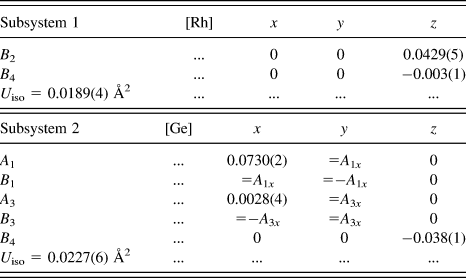
Table I summarizes the refined Fourier amplitudes for the positional modulations and the isotropic displacement parameters, U iso, for each atom. Owing to the superspace group symmetry, the number of refinable parameters for the Fourier terms is limited via A 1x = A 1y = B 1x = −B 1y and A 3x = A 3y = −B 3x = B 3y. Only the even terms of the sine wave along the z direction are allowed for the Rh atoms. In contrast, the odd terms of the sine and cosine waves are allowed for both the x and y components for the Ge atoms, along with the B 4z term (see details, Refs. Reference Miyazaki, Igarashi, Hayashi, Kajitani and Yubuta7 and Reference Miyazaki and Khidirov12).
Refined positional modulation wave components and isotropic displacement parameters, U iso, for RhGeγ at 293 K.
Figure 3 shows the positional modulations obtained for the x, y, and z coordinates of each atom, plotted against the fourth superspace coordinate, ν. The right vertical axes are rescaled to represent the displacement (in angstroms) for each atom. All the displacements are periodic in the interval 0 ≤ ν ≤ 1.0. For Rh atoms, positional modulation is only allowed in the z direction, and the maximum displacement (∼0.20 Å) from z = 0 is observed at ν ∼ 0.14, 0.36, 0.64, and 0.86. The displacement of the Ge atoms along z is slightly smaller than that of the Rh atoms, and a maximum displacement of (∼0.13 Å) from z = 1/4 is seen at ν ∼ 0.06, 0.19, 0.31, 0.44, etc. On the basis of the large sine and cosine components, the rotational modulation in the x and y directions is significant for the Ge atoms. The modulation waves in the x and y directions are identical to the phase-shift Δν = 1/4. A maximum displacement of ∼0.56 Å from x = 1/4, equivalent to Δx ∼ 0.1, occurs at ν ∼ 0.13 and 0.63, and from the y = 1/4 position at ν ∼ 0.37 and 0.87. A similar rotational modulation, i.e., Δx ∼ 0.1, is reported for most incommensurate NCLs, such as (Mo1−xRhx)Geγ,Reference Rohrer, Lind, Eriksson, Larsson and Lidin13 (Cr1−xMox)Geγ,Reference Rohrer, Lind, Eriksson, Larsson and Lidin14 and HMSs.Reference Miyazaki, Igarashi, Hayashi, Kajitani and Yubuta7
Positional modulations obtained for the Rh and Ge atoms plotted as a function of the fourth superspace coordinate, ν. The right vertical axes are rescaled to represent the displacement for each atom.
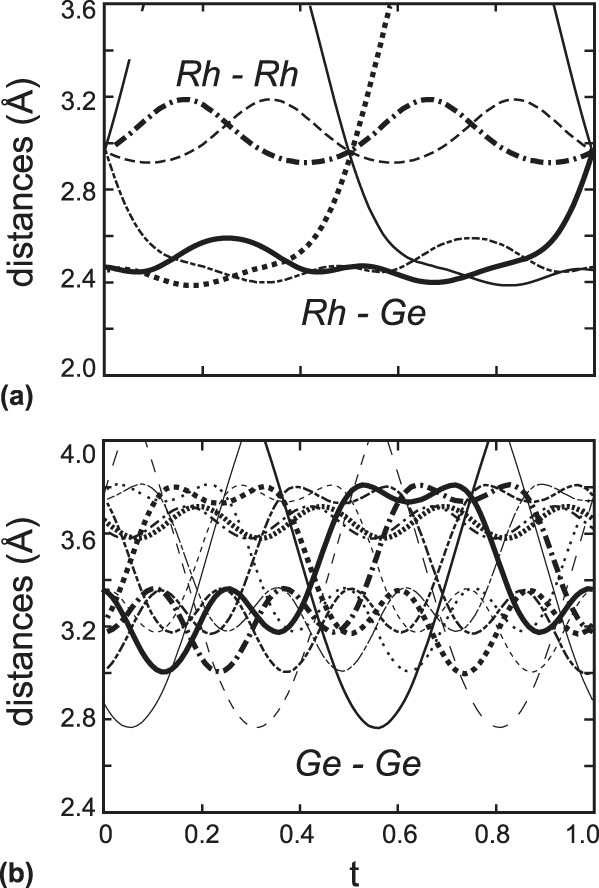
Figures 4(a) and 4(b) show interatomic distances plotted against the internal coordinate, t. The two periodic curves around 3.0 Å in Fig. 4(a) represent the four nearest-neighbor Rh–Rh distances, where each curve is actually made up of two overlapping curves associated with bonds of equal length. The Rh–Rh distances of 2.92 and 3.19 Å are longer than would be expected on the basis of the atomic radius of Rh, r Rh = 1.345 Å.Reference Inoue, Chikazumi, Nagasaki and Tanuma15 However, such long distances are characteristics of the β-Sn-type coordination of the M atoms in incommensurate NCLs. In contrast to the eight coordination of the Mn atoms with Si in HMSs, each Rh atom is usually coordinated to six Ge atoms in the present germanide. The eight coordination of Rh–Ge bonds can be exceptionally observed at t ∼ 0 and 1/2, around which a pair of bonds with lengths of ∼3.0 Å, and another pair with lengths of ∼2.4 Å are formed. The nearest-neighbor Ge–Ge distances show a periodic variation as a function of t, as shown in Fig. 4(b). The minimum distance of 2.76 Å is slightly longer than that expected from the 2 × r Ge value of 2.45 Å. The longer observed interatomic distances than those determined from a simple summation of atomic radii may be due to the large number of electron carriers introduced into the anti-bonding bands, as described in Sec. III. C.
Interatomic distances for (a) Rh–Rh and Rh–Ge, and (b) Ge–Ge as a function of the fourth superspace coordinate t for RhGeγ at 293 K.
C. Electronic structure
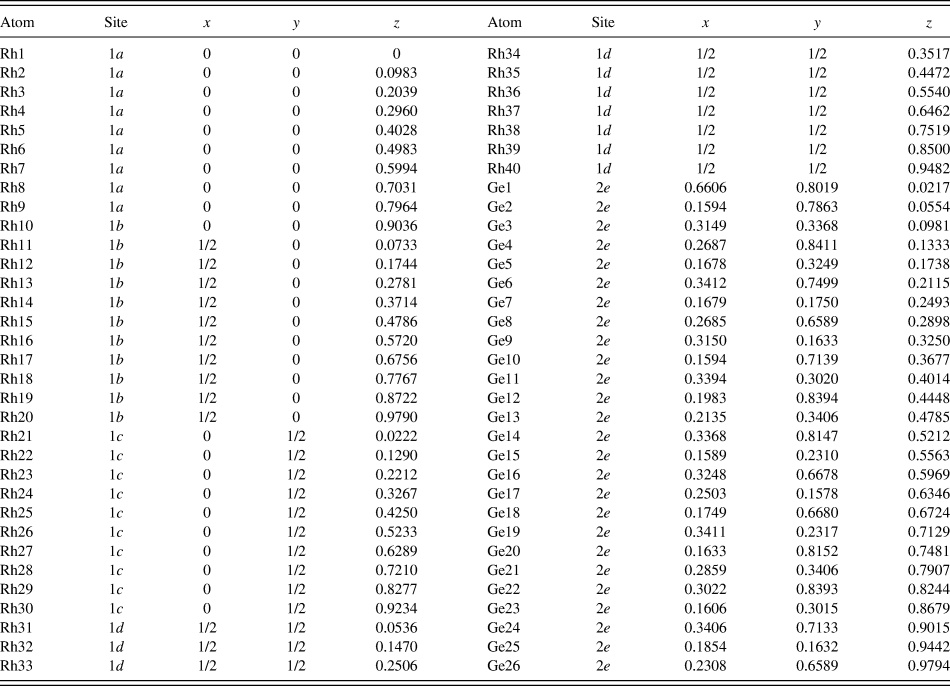
To determine the electronic structures of incommensurate compounds having a dimensional symmetry higher than 3, a commensurate 3D structure must be approximated. Through the superspace approach, any approximated structure can be constructed as long as the relationship mc Rh ≈ nc Ge is satisfied. In the present study, we adopted an approximate unit cell of a × a × 10c Rh, in which 10c Rh = 46.161 Å roughly equals 13c Ge = 46.422 Å. The space group and fractional coordinates of the Rh and Ge atoms, derived from the StructGen™ and Initialize calc processes in the calculation,Reference Blaha, Schwarz, Madsen, Kvasnicka and Luitz10 are summarized in Table II. The approximated structure contains 40 Rh sites (1a–1d) and 26 Ge sites (2e), with the monoclinic P2 space group (α = β = γ = 90°) whose unique axis passes through (1/2, 1/2, 0) and is parallel to the c-axis.
Commensurate structure model used to calculate the electronic structure for RhGeγ. Space group: P2 (No. 2, unique axis c), a = b = 5.604 Å, c = 10c Rh = 46.161 Å, and α = β = γ = 90°.
In Fig. 5, we show the energy dependence of the total DOS and the contributions of the Rh-d and Ge-s + p bands of RhGeγ with γ = 1.2927(1), on the basis of the commensurate approximation of the incommensurate structure. The overall features of these results are quite similar to those obtained from the structural data for Rh17Ge22 having a body-centered tetragonal unit cell with lattice parameters a = 5.604 Å and c = 78.45 Å, and comprising 9 Rh and 6 Ge sites.Reference Jeitschko and Parthé6 The broad VB ranging from −5 to −1 eV has a predominantly Rh-d character, while the p and s-character of Ge dominates the band between −12 and −8 eV. As expected, the compound can be regarded as a metal or more precisely a heavily electron-doped degenerated semiconductor. For such a case, the Seebeck coefficient can be represented as the well-known Mott equation mentioned below:
 $$S \approx {{{\pi ^2}} \over 3}{{k_{\rm{B}}^2} \over e}{1 \over {N\left( E \right)}}{\left( {{{\partial N\left( E \right)} \over {\partial E}}} \right)_{E = {E_{\rm{F}}}}}\quad ,$$
where k B, e, and N(E) are the Boltzmann's constant, elementary charge, and DOS at a particular energy E, respectively. Hence, negative S values would be expected for the present sample, as the Fermi level E F (E = 0) is located near the bottom of the conduction band (CB), only slightly above the narrow pseudo gap of ∼0.5 eV between it and the VB. However, the absolute value of |S| would be smaller because the energy derivative of the DOS at E F is not steep. Instead, high σ values should be observed as the electrical conductivity is roughly proportional to N(E). A partial substitution of Rh with group 6–8 elements, such as Fe, would be expected to shift E F toward the CB bottom, and the solid solution would show a larger negative |S|. If the E F level is further shifted toward the VB top with VEC < 14, one may obtain p-type samples as well in the RhGeγ-based solid solution.
Total DOS and the contribution of Rh-d and Ge-s + p bands of RhGeγ with γ = 1.2927(1) on the basis of the commensurate approximation of the incommensurate structure.
D. TE properties
Figure 6 plots the temperature dependence of S, σ, and the power factor P = S 2σ for a polycrystalline sample of RhGeγ. For the simultaneous measurements of S and σ, an SPS-processed pellet with a thickness of 1 mm was used. The pellet was cut into a rectangular shape, and both the electrical current and temperature gradient were applied perpendicular to the pressing direction. Samples for Hall measurement were cut from the remaining portion of the pellet. The sintered density was above 98% of the theoretical density of 9.01 g/cm3. Since samples as thick as 10 mm could not be obtained with a reasonable sintered density, we prepared another pellet with a thickness of 1 mm. The temperature gradient was applied parallel to the pressing direction to measure κ. As expected from the previous sections, a negative Seebeck coefficient of S = −25 μV was observed at 333 K. The absolute value of S was not as high as that for HMSs (∼130 μV) at around room temperature, but it gradually increased with T, reaching S = −53 μV at 984 K. The temperature dependence of the electrical conductivity also exhibited metallic behavior; σ was 7.3 × 10³ S/cm at 333 K, and decreased steadily to 4.8 × 10³ S/cm at 984 K. A lower |S| and higher σ imply that the RhGeγ phase has a higher carrier concentration than HMSs. The carrier (electron) concentration, n e, of RhGeγ was 6.8 × 1021 cm−3 at 300 K, which is more than twice the hole concentration, n h, for MnSi1.7361, i.e., 2.5 × 1021 cm−3 at room temperature. The measured carrier mobility of μ = 6.7 cm2/Vs at room temperature, compared to the value of 1.7 cm2/Vs for MnSi1.7361, should also lead to a higher electrical conductivity. Although the |S| values were smaller than 100 μV over the whole temperature range, the TE power factor was determined to be a reasonable value (0.47 mW/K2 m at 333 K) and increased steadily exceeding 1 mW/K2 m above 600 K; the highest value of 1.4 mW/K2 m was recorded at 984 K.
Temperature dependence of the Seebeck coefficient S, electrical conductivity σ, and power factor P = S 2σ for a polycrystalline sample of RhGeγ.
Reflecting the higher σ values, κ shows even higher values among NCLs. The total thermal conductivity was κ = 5.1 W/K m at 302 K and increased at a constant rate to 11.3 W/K m at 1000 K. As the measurement directions for σ and κ were different, pellets, to some extent, necessarily exhibited a preferred orientation. Nevertheless, the XRD pattern recorded from the pellet surface showed negligibly little difference to that for randomly oriented powder samples. Owing to the difference in measurement direction, we refrain from describing precise ZT values. However, a qualitative discussion is possible, and the maximum ZT of ∼0.1 at 900 K is presumably the best performance for the present germanide system. The compatibility factorReference Snyder and Ursell16 of RhGeγ,  $\Sigma = {{\left( {\sqrt {1 + ZT} - 1} \right)} \mathord{\left/ {\vphantom {{\left( {\sqrt {1 + ZT} - 1} \right)} {ST}}} \right. \kern-\nulldelimiterspace} {ST}}$, is evaluated to be Σ = 6.87 at 333 K and Σ = 0.28 at 984 K, based on the present ZT values, revealing that the germanide is not a good partner of the p-type analog HMS, Σ = 1.50 at 290 K and Σ = 0.62 at 1000 K.Reference Miyazaki, Kikuchi, Koumoto and Mori5
IV. CONCLUSIONS
A (3 + 1)-dimensional superspace approach has revealed that the present rhodium germanide has a modulated crystal structure similar to that of other NCLs, and can thus be represented as RhGeγ. The phase is identified as an n-type compound with a TE power factor exceeding 1 mW/K2 m above 600 K. As deduced from the VEC value, the present germanide is in fact a heavily electron-doped degenerate semiconductor with an electron carrier concentration of 6.8 × 1021 cm−3 at 300 K. To further optimize the power factor, the Rh atoms should be partially substituted by the atoms with lower VEC values, such as Fe and Ru.
ACKNOWLEDGMENTS
This work was supported by a Grant-in-Aid for JSPS Fellowship (No. 25-5741) and a JSPS Grant-in-Aid for Scientific Research (B) (No. 25289222).