





No CrossRef data available.
Article contents
Putting the cart before the horse? The origin of information donation
Published online by Cambridge University Press: 17 February 2023
Abstract
Heintz & Scott-Phillips propose that the partner choice ecology of our ancestors required Gricean cognitive pragmatics for reputation management, which caused a tendency toward showing and expecting prosociality that subsequently scaffolded language evolution. Here, we suggest a cognitively leaner explanation that is more consistent with comparative data and posits that prosociality and eventually language evolved along with cooperative breeding.
Information
- Type
- Open Peer Commentary
- Information
- Copyright
- Copyright © The Author(s), 2023. Published by Cambridge University Press
References
Adriaense, J. E. C., Koski, S. E., Huber, L., & Lamm, C. (2020). Challenges in the comparative study of empathy and related phenomena in animals. Neuroscience & Biobehavioral Reviews, 112, 62–82.CrossRefGoogle ScholarPubMed
Brown, G. R., Almond, R. E. A., & van Bergen, Y. (2004). Begging, stealing and offering: Food transfer in non-human primates. Advances in the Study of Behaviour, 34, 265–295.CrossRefGoogle Scholar
Brügger, R. K., Kappeler-Schmalzriedt, T., & Burkart, J. M. (2018). Reverse audience effects on helping in cooperatively breeding marmoset monkeys. Biology Letters, 14(3), 20180030.CrossRefGoogle ScholarPubMed
Brügger, R. K., Willems, E. P., & Burkart, J. M. (2021). Do marmosets understand others’ conversations? A thermography approach. Science Advances, 7(6), eabc8790. doi:10.1126/sciadv.abc8790CrossRefGoogle ScholarPubMed
Burkart, J. M., Adriaense, J., Brügger, R. K., Miss, F. M., Wierucka, K., & van Schaik, C. P. (2022). A convergent interaction engine: Vocal communication among marmoset monkeys. Philosophical Transactions of the Royal Society. doi:10.1098/rstb.2021.0098CrossRefGoogle ScholarPubMed
Burkart, J. M., Allon, A., Amici, F., Fichtel, C., Finkenwirth, C., Heschl, A., … van Schaik, C. P. (2014). The evolutionary origin of human hyper-cooperation. Nature Communications, 5, 4747.CrossRefGoogle ScholarPubMed
Burkart, J. M., Guerreiro Martins, E., Miss, F., & Zürcher, Y. (2018). From sharing food to sharing information: Cooperative breeding and the roots of language. Interaction Studies, 19, 136–150.CrossRefGoogle Scholar
Burkart, J. M., Hrdy, S. B., & van Schaik, C. P. (2009). Cooperative breeding and human cognitive evolution. Evolutionary Anthropology, 18(59), 175–186.CrossRefGoogle Scholar
Burkart, J. M., & van Schaik, C. P. (2020). Marmoset prosociality is intentional. Animal Cognition, 23, 581–594. https://doi.org/10.1007/s10071-020-01363-6CrossRefGoogle ScholarPubMed
Chow, C. P., Mitchell, J. F., & Miller, C. T. (2015). Vocal turn-taking in a non-human primate is learned during ontogeny. Proceedings of the Royal Society B: Biological Sciences, 282(1807), 20150069. doi:10.1098/rspb.2015.0069CrossRefGoogle Scholar
Dell'Mour, V., Range, F, & Huber, L. (2009). Social learning and mother's behavior in manipulative tasks in infant marmosets. American Journal of Primatology, 71, 503–509.CrossRefGoogle ScholarPubMed
De Oliveira Terciero, F. E., Willems, E., Arruda, M. d. F., Burkart, J. M., & Araujo, A. (2022). Food sharing under fluctuating food availability: Long-term data from wild common marmosets (Callithrix jacchus). EFP-GfP, Arnhem, Netherlands, June 1–3.Google Scholar
Engelmann, J. M., Herrmann, E., & Tomasello, M. (2012). Five-year olds, but not chimpanzees, attempt to manage their reputations. PLoS One, 7(10), e48433.CrossRefGoogle Scholar
Hrdy, S. B. (2009). Mothers and others: The evolutionary origins of mutual understanding. Harvard University Press.Google Scholar
Hrdy, S. B., & Burkart, J. M. (2020). The emergence of emotionally modern humans: Implications for language and learning. Philosophical Transactions of the Royal Society B, 375(1803), 20190499.CrossRefGoogle ScholarPubMed
Humle, T., & Snowdon, C. T. (2008). Socially biased learning in the acquisition of a complex foraging task in juvenile cottontop tamarins (Saguinus oedipus). Animal Behaviour, 27(1), 267–277.CrossRefGoogle Scholar
Levinson, S. C. (2006). On the human “interactional engine.” In Enfield, N. J. & Levinson, S. C. (Eds.), Roots of human sociality: Cognition, culture, and interaction (pp. 39–69). Berg.Google Scholar
Miss, F., & Burkart, J. M. (2018). Co-representation during joint action in marmoset monkeys (Callithrix jacchus). Psychological Science, 29(6), 984–995. https://doi.org/10.1177/0956797618772046CrossRefGoogle Scholar
Miss, F. M., Meunier, H., & Burkart, J. M. (2022). Primate origins of corepresentation and cooperative flexibility: A comparative study with common marmosets (Callithrix jacchus), brown capuchins (Sapajus apella), and Tonkean macaques (Macaca tonkeana). Journal of Comparative Psychology, 136(3), 199–212.CrossRefGoogle ScholarPubMed
Moura, A. C., Nunes, H. G., & Langguth, A. (2010). Food sharing in lion tamarins (Leontopithecus chrysomelas): Does foraging difficulty affect investment in young by breeders and helpers? International Journal of Primatology, 31(5), 848–862.CrossRefGoogle Scholar
Rapaport, L. G. (2011). Progressive parenting behavior in wild golden lion tamarins. Behavioral Ecology, 22(4), 745–754.CrossRefGoogle ScholarPubMed
Schino, G., & Aureli, F. (2009). Reciprocal altruism in primates: Partner choice, cognition, and emotions. Advances in the Study of Behavior, 39, 45–69.CrossRefGoogle Scholar
Sehner, S., Van Schaik, C. P., & Burkart, J. M. (2022). The evolutionary origin of information donation: a targeted comparison between marmosets and squirrel monkeys. Paper presented at the Joint Conference of the European Federation for Primatology and the Gesellschaft für Primatologie, Arnhem, NL.Google Scholar
Snowdon, C. T., & Roskos, T. R. (2017). Stick-weaving: Innovative behavior in tamarins (Saguinus oedipus). Journal of Comparative Psychology, 131(2), 174.CrossRefGoogle ScholarPubMed
Takahashi, D. Y., Fenley, A. R., Teramoto, Y., Narayanan, D. Z., Borjon, J. I., Holmes, P., & Ghazanfar, A. A. (2015). The developmental dynamics of marmoset monkey vocal production. Science (New York, N.Y.), 349(6249), 734–738.CrossRefGoogle ScholarPubMed
Takahashi, D. Y., Liao, D. A., & Ghazanfar, A. A. (2017). Vocal learning via social reinforcement by infant marmoset monkeys. Current Biology, 27(12), 1844–1852.CrossRefGoogle ScholarPubMed
Townsend, S. W., Koski, S. E., Byrne, R. W., Slocombe, K. E., Bickel, B., Böckle, M., … Manser, M. B. (2017). Exorcising Grice's ghost: An empirical approach to studying intentional communication in animals. Biological Reviews, 92(3), 1427–1433. doi:10.1111/brv.12289CrossRefGoogle ScholarPubMed
Troisi, C. A., Hoppitt, W. J., Ruiz-Miranda, C. R., & Laland, K. N. (2018). Food-offering calls in wild golden lion tamarins (Leontopithecus rosalia): Evidence for teaching behavior? International Journal of Primatology, 39(6), 1105–1123.CrossRefGoogle ScholarPubMed
Verspeek, J., van Leeuwen, E. J., Laméris, D. W., Staes, N., & Stevens, J. M. (2022). Adult bonobos show no prosociality in both prosocial choice task and group service paradigm. PeerJ, 10, e12849.CrossRefGoogle ScholarPubMed
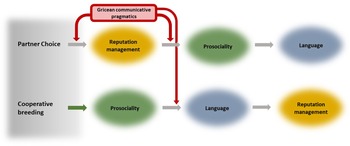
Figure 1. Sequence of events proposed by H&S-P (top row) and in the current commentary (bottom row). The gray shading represents the socio-ecological background of our ancestors. Both proposals agree that language could only emerge once fundamental prosociality was established, but H&S-P argue it is the result of cognitively demanding Gricean communicative pragmatics (red arrow) whereas the bottom row points at comparative evidence (green arrow) that shows high allomaternal care and cooperative breeding directly facilitate the emergence of prosociality without Gricean communicative pragmatics as a precondition.
Target article
Related commentaries (18)
On the murky dissociation between expression and communication
Putting the cart before the horse? The origin of information donation
Structuring unleashed expression: Developmental foundations of human communication
 You have
Access
That language is stable despite the incentive to deceive proves that humans have solved the “central problem” for the evolution of communication (Maynard Smith & Harper, Reference Maynard Smith and Harper2003). We humans indeed show a cooperative attitude, which includes the a priori mutual expectation of cooperative intent between communicators (Grice, Reference Grice1989), and, as Heintz & Scott-Phillips (H&S-P) rightly emphasize, extends well beyond communication: It is also reflected in teaching, and in fact permeates almost all our social behavior and cognition (see also Burkart, Hrdy, & van Schaik, Reference Burkart, Hrdy and van Schaik2009).
According to H&S-P, our partner choice ecology can explain these developments (Fig. 1, top row) because the strong ecological reliance on cooperation makes it vital to be chosen by others as a cooperation partner. The latter can be maximized by engaging in reputation management, that is, advertising one's own cooperativeness or prosociality to potential partners, which according to H&S-P is the result of a highly complex cognitive mechanism, that is, Gricean communicative pragmatics. Once evolved in the context of partner choice, this mechanism then would have become available in all the contexts where it is conspicuous today, including language.
Sequence of events proposed by H&S-P (top row) and in the current commentary (bottom row). The gray shading represents the socio-ecological background of our ancestors. Both proposals agree that language could only emerge once fundamental prosociality was established, but H&S-P argue it is the result of cognitively demanding Gricean communicative pragmatics (red arrow) whereas the bottom row points at comparative evidence (green arrow) that shows high allomaternal care and cooperative breeding directly facilitate the emergence of prosociality without Gricean communicative pragmatics as a precondition.
Among nonhuman primates, partner choice is likewise widespread but tellingly, it is not based on cognitive book-keeping mechanisms (Schino & Aureli, Reference Schino and Aureli2009) or reputation management (e.g., in chimpanzees: Engelmann, Herrmann, & Tomasello, Reference Engelmann, Herrmann and Tomasello2012), most likely because they lack language (van Schaik, Reference van Schaik2016). In fact, reputation management is strikingly absent even in marmoset monkeys, who are renowned for their high levels of cooperation and intentional prosociality (Burkart & van Schaik, Reference Burkart and van Schaik2020; sensu Townsend et al., Reference Townsend, Koski, Byrne, Slocombe, Bickel, Böckle and Manser2017) and do engage in partner choice (Brügger, Willems, & Burkart, Reference Brügger, Willems and Burkart2021). When adult marmoset helpers were alone with immatures from their group who were not their own, they would not stop helping but even increased their food sharing tendency (Brügger, Kappeler-Schmalzriedt, & Burkart, Reference Brügger, Kappeler-Schmalzriedt and Burkart2018). This clearly confirmed that their motives were genuine and strong proactively prosocial rather than instrumental and serving to manage their reputation.
The high prosociality of marmoset monkeys is thus clearly not a consequence of partner choice, pace H&S-P. Comparative data directly comparing prosociality in a group-service paradigm among a large number of primate species (Burkart et al., Reference Burkart, Allon, Amici, Fichtel, Finkenwirth, Heschl and van Schaik2014; Verspeek, van Leeuwen, Laméris, Staes, & Stevens, Reference Verspeek, van Leeuwen, Laméris, Staes and Stevens2022) show that prosociality is best explained by reliance on allomaternal care, or cooperative breeding (when individuals other than the parents significantly help rearing offspring). Humans are cooperative breeders too (Hrdy, Reference Hrdy2009), and when directly comparing them with the same group-service paradigm, they fall right on the nonhuman primate regression line (Burkart et al., Reference Burkart, Allon, Amici, Fichtel, Finkenwirth, Heschl and van Schaik2014). Prosociality in humans thus does not require a uniquely human mechanism, and the claim of a cognitively demanding explanation as in H&S-P appears unwarranted (which is a more widespread problem; Adriaense, Koski, Huber, & Lamm, Reference Adriaense, Koski, Huber and Lamm2020).
Based on this primate background, we therefore propose a more parsimonious sequence than advocated by H&S-P (Fig. 1, bottom row). When our ancestors started to engage in cooperative breeding, this was accompanied by an increase in proactive prosociality, consistent with the general primate pattern (Burkart et al., Reference Burkart, Allon, Amici, Fichtel, Finkenwirth, Heschl and van Schaik2014). This general prosocial attitude allowed the emergence of low-cost, honest cooperative signaling and thus paved the way for language evolution in our great apelike ancestors (Burkart et al., Reference Burkart, Hrdy and van Schaik2009, Reference Burkart, Guerreiro Martins, Miss and Zürcher2018, Reference Burkart, Adriaense, Brügger, Miss, Wierucka and van Schaik2022). Only once language was in place, however, did reputation management become necessary on a grand scale because without, only those directly involved will know that a specific partner was non-cooperative in the past. Crucially, reputation management is only needed when one's reputation of being a good or bad collaborator can actually spread widely across a large and loose social network. Language can provide exactly this, and only when there exists a risk that deceptive behavior can be broadly advertised through gossip to everyone will it reinforce a strong concern for reputation in all group members (see also van Schaik, Reference van Schaik2016, p. 331). In sum, only with language could a concern for reputation become strong enough to install a general prosocial attitude as suggested by H&S-P. However, because language per se requires such an attitude, which moreover can easily emerge in the context of cooperative breeding, this is unlikely.
Among cooperatively breeding monkeys (marmosets and tamarins), prosociality is most evident in their propensity to provide and offer food to others. However, and particularly important for the proposal above and language evolution in general, this propensity also extends toward sharing information (reviewed in Burkart, Guerreiro Martins, Miss, & Zürcher, Reference Burkart, Guerreiro Martins, Miss and Zürcher2018, Burkart et al., Reference Burkart, Adriaense, Brügger, Miss, Wierucka and van Schaik2022). For instance, frequent vocalizations function to provide information useful to others, in particular about predators and food (Brown, Almond, & van Bergen, Reference Brown, Almond and van Bergen2004), thus satisfying the definition of “expression” by H&S-P (target article, sect. 2, para. 1). Food-offering calls in tamarins are given for young immatures to offer food to them, but to older immatures only to indicate the location where the immatures can learn to extract food, thus engaging in teaching-like behavior (Rapaport, Reference Rapaport2011; Troisi, Hoppitt, Ruiz-Miranda, & Laland, Reference Troisi, Hoppitt, Ruiz-Miranda and Laland2018). In fact, several marmoset and tamarin species show remarkable sensitivity to the skill level of immatures when deciding whether to advertise the presence of food and share it with them (Dell'Mour, Range, & Huber, Reference Dell'Mour, Range and Huber2009; Humle & Snowdon, Reference Humle and Snowdon2008; Moura, Nunes, & Langguth, Reference Moura, Nunes and Langguth2010; Sehner, van Schaik, & Burkart, Reference Sehner, Van Schaik and Burkart2022; Snowdon & Roskos, Reference Snowdon and Roskos2017). Critically, such teaching-like scaffolding was also reported during the vocal development of immatures (Chow, Mitchell, & Miller, Reference Chow, Mitchell and Miller2015; Takahashi et al., Reference Takahashi, Fenley, Teramoto, Narayanan, Borjon, Holmes and Ghazanfar2015, Reference Takahashi, Liao and Ghazanfar2017).
Among adults, the cooperatively breeding marmosets are more likely than independently breeding primates such as capuchin monkeys or macaques to use gaze as coordination smoothers when engaged in joint action with a partner (Miss & Burkart, Reference Miss and Burkart2018; Miss, Meunier, & Burkart, Reference Miss, Meunier and Burkart2022). Although cooperatively breeding groups are closely related on average, immigration and emigration events are frequent and group membership, rather than mere relatedness, determines helping (De Oliveira Terciero, Willems, Arruda, Burkart, & Araujo, Reference De Oliveira Terciero, Willems, Arruda, Burkart and Araujo2022). Overall, it thus very much seems that to thrive in their socio-ecological niche of cooperative breeding, marmosets and tamarins have evolved a convergent interaction engine (Levinson, Reference Levinson, Enfield and Levinson2006) that resembles the one of humans in many relevant respects (Burkart et al., Reference Burkart, Adriaense, Brügger, Miss, Wierucka and van Schaik2022).
Our complementary account does not argue that partner choice and reputation management are not crucial in the human social ecology. However, the cooperative breeding of our ancestors offers a more plausible point of departure: Great ape-like organisms who were more prosocial than extant great apes and had a greater inclination toward information donation. Immatures growing up in such an interdependent ecology would have acquired much of the cognitive infrastructure described by H&S-P (Hrdy & Burkart, Reference Hrdy and Burkart2020) before reputation management evolved.
Financial support
This project has received funding from the European Research Council (ERC) under the European Union's Horizon 2020 research and innovation program grant agreement no. 101001295, as well as the NCCR Evolving Language, Swiss National Science Foundation Agreement no. 51NF40_180888 and the SNF projects 31003A_172979 and 310030_197884.
Conflict of interest
None.