The causes of the decline in mortality rates experienced by Europe in the nineteenth and twentieth centuries are still debated.Footnote 1 One understudied cause that contributed to the decline in mortality is the expansion of sickness insurance. C. R. Winegarden and John E. Murray have studied the role of sickness insurance on overall mortality, but the effect of sickness insurance on infant outcomes has largely been ignored and thought to have been a second-order effect.Footnote 2 Many European countries passed sickness insurance legislation between 1878 and 1913. Sickness insurance provided women with confinement (maternity) benefits which improved access to medical care, provided supplemental income to new mothers, and promoted proper infant care practices. The empirical analysis in this article shows that the expansion of sickness insurance coverage in European nations by 1 percent was related to a decline of nearly one infant death per 1000 infants at the margin. This decline in the infant death rate accounts for 18 to 35 percent of the entire decline in the crude death rate attributed to sickness insurance.
SICKNESS INSURANCE, CONFINEMENT BENEFITS, AND WOMENFootnote 3
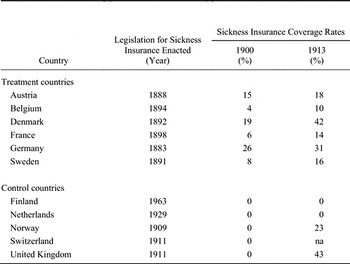
Throughout the nineteenth century, unregulated mutual aid societies established sickness insurance programs that provided monetary assistance and medical care to restore the capacity of people to return to work. By the late nineteenth century, European countries started to regulate these organizations either through establishment of compulsory insurance mandates or through subsidization of voluntary mutual aid sickness insurance plans.Footnote 4Table 1 provides a summary of the year national sickness insurance legislation was enacted and the rates of coverage in 1900 and 1911 in the 11 countries used in the analysis.
SICKNESS INSURANCE COVERAGE

Notes:
Although Switzerland enacted sickness insurance legislation in 1911, the coverage rate was not reported until 1915. The sickness insurance coverage rate is the percentage of the population over the age of 15 that participated in a compulsory or subsidized voluntary sickness insurance scheme that was supported through national legislation.
Source:
Coverage rates are obtained from Flora, State, Vol. 1.
Germany was the first European country to pass sickness insurance legislation in 1883. The legislation required compulsory sickness insurance for workers in manufacturing and mining. Subsequent legislation expanded the industries covered and allowed coverage of family members. By 1900 nearly four million dependents were covered.Footnote 5 Under the initial legislation in return for the premiums paid, the insured received sick pay of 50 percent of ordinary wages after the third day of illness for up to 13 weeks. The insured also had access to free medical treatment and medicine. Women received the additional benefit of confinement pay after birth, which allowed them to delay reentry into the workforce and prolong natural feeding. Women who were enrolled for at least six months prior to giving birth received at least four weeks of confinement pay. The number of weeks expanded to six in 1903 and eight weeks with possible extensions to 12 weeks when breastfeeding in 1911.
Female enrollment in German sickness insurance schemes grew rapidly. The female share of insured members rose from 16.8 percent in 1885 to 24.2 percent in 1906. Meanwhile, the average child birth benefit rose from 26 cents to 51 cents when translated to U.S. dollars.Footnote 6 In 1909/10, 5 to 6.4 percent of female members in the seven largest urban sickness insurance schemes received confinement benefits.Footnote 7 Based on 1908 enrollment levels, if 5 percent of all women enrolled in sickness insurance received confinement benefits, then 7.1 percent of all live births in Germany were covered by confinement benefits.
Austria enacted legislation for compulsory sickness insurance similar to Germanys in 1888. Workers were given 60 percent of ordinary income if ill for more than three days, free medicine and medical treatment through fund contract physicians, a death benefit at least 20 times the rate of wage, and a maternity benefits of at least four months of sick-pay benefits for normal childbirth. The confinement benefits in Austria were not as generous as in Germany, but women accounted for roughly 25 percent of enrollees in the early 1890s. Roughly 5 percent of all births were aided by sickness insurance coverage in Austria circa 1907.
In the 1890s Sweden, Denmark, Belgium, and France began offering subsidies for voluntary insurance provided by mutual aid societies, which covered a smaller percentage of the population than compulsory insurance (see Table 1). Although governments did not mandate confinement benefits for these subsidized plans, most funds provided aid for childbirth. In Italy, there were mutual aid societies that only provided benefits for childbirth.Footnote 8 In Denmark, 31 percent of females and 30 percent of males had sickness insurance by 1907, while Table 1 shows that Belgium had the lowest coverage rates. Other Western European and Scandinavian countries did not pass sickness insurance legislation until after 1909.
INFANT DEATH AND THE ROLE OF SICKNESS INSURANCE
Sickness insurance contributed to declines in infant mortality through several paths. The U.S. Commissioner of Labor reported: In addition to the granting of aid and medical attendance, many of the societies and federations of societies are engaging, by education and otherwise, in combating tuberculosis and infant mortality, and are encouraging the building of sanitary homes, disinfection, and other protective measures against disease.Footnote 9 The sickness insurance programs joined physicians and governments in educating people about the benefit of clean houses, not reusing dirty bath water, washing hands, and isolation of sick family members from the rest of the household.Footnote 10 Women with sickness insurance particularly benefited from readier access to the advice of physicians and nurses.
By providing confinement benefits after the birth of a child, sickness insurance offered women the opportunity to stay home and breastfeed.Footnote 11 Even though some cities required factories to provide rooms for breastfeeding, the regulations were often ignored, and working women tended to stop breastfeeding early or forego it entirely.Footnote 12 The sickness payments allowed them to stay home longer and continue breastfeeding, which was only beneficial if the mother carried it out. The switch to artificial feeding raised the risks of infant deaths from gastrointestinal diseases because many families cleaned bottles with unfiltered and unclean water and watered down the milk when preparing it for the infant.Footnote 13 A variety of studies performed on European cities between 1899 through 1911 found infants that were bottle fed had infant mortality rates that were two to five times higher than infants that were breastfed only and that 40 to 88.5 percent of all infant deaths from diarrhea occurred in infants that were being bottle fed.Footnote 14 Finally, sickness insurance gave women easier access to physicians. Supplemental income paid by confinement benefits decreased the cost of missed work and could increase the proportion of infants and the length of time that infants were breastfed.
EMPIRICAL MODEL AND DATA
To determine the role of government-sponsored sickness insurance in the decline of death rates in the late nineteenth century, a panel of annual country-years is constructed from 11 European countries for the period of 1878 to 1913. This period is used because it was one of the longest periods of European peace and starts long enough after the Franco-Prussian War to eliminate any distorting effects caused by the war. As seen in Table 1, roughly half the countries in the sample mandated or subsidized sickness insurance, while the remaining countries provided no aid until just before or after 1913.Footnote 15
The empirical model is estimated with three measures of mortality: the infant, non-infant, and crude death rates.Footnote 16 The infant death rate, the number of deaths of infants under one year of age per 1000 live births, is used to determine the impact of expanded sickness insurance coverage on infant deaths. The two other death rates, measured as deaths per 1000 people, are used to quantify how large the effect of sickness insurance on infant deaths is relative to non-infants deaths and all deaths.
An approach using the lagged dependent variable and country fixed effects is used to determine the effect of sickness insurance on the three death rate measures. Variation in when state-supported sickness insurance was initiated and the level of coverage is used to identify the impact of sickness insurance on each death rate. For each of the death rate measures, the empirical model estimated for county i in year t is

where f is a linear function, DR is one of the death rate measures, S is a measure for sickness insurance, X is a vector of observable factors that affect the mortality rate, T is a linear time trend, δ is a vector of factors that remain the same over time but vary across countries, and ε is an error term. The lag of the dependent variable is included to capture the persistence in the death rate and any unobserved stochastic trend, such as, improvements in sanitation or nutrition. The inclusion of δ controls for various factors that do not vary across time but vary across countries, including long-run factors like lifestyle differences attributed to religion, diet, breastfeeding habits, and institutional traditions that are both observable and unobservable.Footnote 17
The explanatory variable of interest is the sickness insurance variable, S. The measure for sickness insurance is the percentage of the population over the age of 15 that participated in government mandated or subsidized voluntary sickness insurance scheme which was used by Winegarden and Murray to measure the impact of sickness insurance on the crude death rate.Footnote 18 The variable does not capture insurance provided by unsubsidized mutual aid societies due to lack of annual data. Failure to include this unregistered coverage likely biases the coefficient estimate for state-sponsored sickness insurance toward finding no effect or a positive effect. Unmeasured private sickness insurance would be negatively correlated with death rates. Meanwhile, to the extent that mandates and subsidies crowded out private programs, private sickness insurance would be negatively correlated with the government-backed coverage. The omitted variable bias, which is a multiplicative function of the two negative correlations, would lead toward a positive bias in the coefficient of government-supported sickness insurance; therefore, the coefficients will be biased against finding the predicted negative coefficient.
The estimation procedure must deal with three issues, controlling for time-invariant differences across countries, the endogeneity of the lagged dependent variable, and endogeneity of the sickness insurance measure that might arise if countries chose to enact sickness insurance legislation in response to increases in death rates. Manuel Arellano and Stephen Bond suggest a generalized method-of-moments estimator for dealing with all three issues.Footnote 19 They first difference all variables to account for the unobserved heterogeneity and then use lagged levels of the variables as instruments for the first differenced version of the endogenous variables. The estimating equation is a first-differenced version of equation 1.

where Δ represents the first difference of the variable. Equation 2 was estimated by instrumental variables where the lagged dependent variable and sickness insurance coverage was treated as endogenous. For the first difference of the lagged death rate, three lags of the level of the death rate variable were used as instruments. A Sargan test for over-identifying restrictions which account for heteroscedasticity was used to test the appropriateness of the instruments and found the instruments to be uncorrelated with the estimated error term. In addition, tests for weak instruments suggested by James Stock and Motohiro Yogo rejected the null hypothesis of weak instruments using the 5 percent relative bias criteria.Footnote 20 Specification tests suggest that the use of a lagged dependent variable is more appropriate than assuming the time dependence in death rates is due to serial correlation in the error term. This means that there is no second order autocorrelation in the first differenced error term. Also, an Arellano and Bond test was used to determine if the coefficient estimate of average second order autocovariance in the error term was different from zero. For both tests and all regressions, the Arellano and Bond procedure assumptions were found to be valid. Finally, a robust estimator of the variance-covariance matrix was used to adjust for heteroscedasticity. Although the Arellano and Bond procedure was found to be the best fit for the data, additional specifications were estimated and the results were found to be robust.
RESULTS
The raw correlations in Figure 1 for the countries where governments were involved in sickness insurance suggest a negative relationship between sickness insurance and infant death rates. The econometric exercise is necessary because infant death rates also fell sharply in countries without government-sponsored sickness insurance. From 1878 to 1913 the countries with state-influenced insurance experienced declines of 31.5 percent in the infant death rate, while the countries with no state influence saw a decline of 33.9 percent.
INFANT DEATH RATES AND SICKNESS INSURANCE FOR TREATMENT COUNTRIES

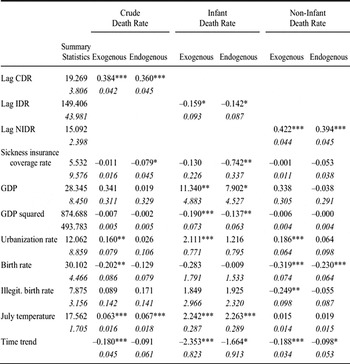
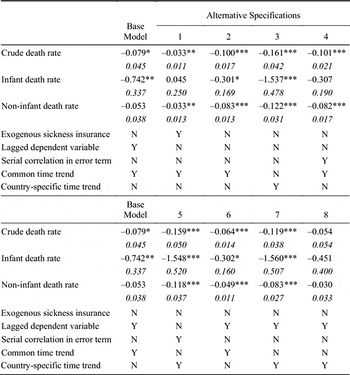
The summary statistics and regression results for all three death rate measures are reported in Table 2. The first column for each death measure shows the estimation of the Arellano and Bond procedure that treats the sickness insurance coverage rate as exogenous, while the second column shows the same estimation while controlling for endogeneity. As predicted by the earlier discussion of the potential for a positive bias in the coefficients, controlling for endogeneity leads to more negative sickness insurance coefficients for each death rate. In particular, the sickness coefficient for the infant death rate rises in absolute magnitude from a statistically insignificant −0.13 to a statistically significant −0.74. Although I will focus on the results controlling for endogeneity in Table 2, I include a set of results in Table 3 for a variety of other specifications of the model. In specifications 1 through 3, sickness insurance is treated as exogenous and endogenous with an error term assumed to be independent across time; specifications 4 and 5 treat sickness insurance as endogenous but control for serial correlation in the error; specifications 6 and 7 treat sickness insurance as endogenous but treat the lagged dependent variable as exogenous; and 8 reestimates the base model from Table 3 using country specific time trends. In all but one case, the sickness coefficient is negative. The base case estimate for infant mortality of −0.74 lies in the middle of the range of 0.04 to −1.56. From here forward, the discussion focuses on the results when sickness insurance is treated as endogenous.
MULTIVARIATE REGRESSION RESULTS

* p-value < 10 percent.
** p-value < 5 percent.
*** p-value < 1 percent.
Notes:
The dependent variable for each regression is the mortality rate named in the header of each column using data from 1878 to 1913. In the columns labeled exogenous, the sickness insurance coverage rate is treated as exogenous, while in the columns labeled endogenous, the sickness insurance coverage rate is treated as endogenous. CDR, IDR, and NIDR stand for crude, infant, and non-infant death rates. GDP is measured in per capita 1990 international Geary-Khamis dollars while temperature is in Celsius. Additional notes are available at http://www.fsb.muohio.edu/directory/bowblijr.
Sources:
Flora, State, Vol. 1 and Vol. 2; Maddison, World Economy; Mitchell, International Historical Statistics; and Vose et al., Global Historical Climatology.
COEFFICIENT ESTIMATES FOR SICKNESS INSURANCE COVERAGE RATE FOR ALTERNATIVE SPECIFICATIONS

* p-value < 10 percent.
** p-value < 5 percent.
*** p-value < 1 percent.
Notes:
Standard errors are in italics. The dependent variable for each regression is the mortality rate named in the first three rows. The base model reports the results from Table 2 for when sickness insurance is treated as endogenous. The Y and N indicate if the model was estimated under different assumptions. For example, the exogenous sickness insurance of Y indicates the model was estimated with the assumption that the sickness insurance variable was exogenous. All models account for fixed effects and standard errors are corrected for heteroscedasticity. Standard errors were also adjusted for clustering at the country level when appropriate. Specifications 2–7 use instrumental variables for the sickness insurance coverage rate with lags of the sickness insurance coverage rate as instruments. Specifications 6 and 7 do not correct for the endogeneity caused by using a lagged dependent variable. Specification 8 is estimated using the Arellano and Bond procedure. Data is the period of 1878 to 1913 except for Switzerland, in which 1912 and 1913 are not used because sickness insurance coverage rates are not available.
Sources:
Flora, State Vol. 1 and Vol. 2; Maddison, World Economy; Mitchell, International Historical Statistics; and Vose et al., Global Historical Climatology.
The negative coefficient of sickness insurance coverage for all three variables indicates that the implementation and growth in coverage of sickness insurance contributed to the decline in the death rate. A 1 percentage point increase in the proportion of the adult population covered by sickness insurance lowered the crude death rate by 0.079 deaths per 1,000 persons and the infant death rate by 0.742 infant deaths per 1,000 infants. Both results are statistically significant. However, the death rate for non-infants only decreased by 0.053 deaths per 1,000 and the result was not statistically significant (p-value = 0.166). The relative results suggest that sickness insurance had the most impact on reducing infant deaths.
When sickness insurance coverage expands, the contribution of the decline in death rates as a share of the decline in overall deaths will vary across countries, even though we are using the same coefficient in each country, because of differences in the share of infants in the population and differences in the level of non-infant and infant deaths in the population before the sickness insurance change. For example, in 1910 a 10 percentage point increase in the proportion of adult population covered by sickness insurance would have reduced the total number of deaths by 17,299, of which 30.8 percent were infants. In comparison, a similar increase in France would result in 31,237 fewer deaths, but 18.4 percent were among infants. Depending on the year and country, between 18 to 35 percent of the reduced mortality caused by the expansion of sickness insurance would have occurred among infants in the first year of their lives. Therefore, the health impact of sickness insurance among infants was nontrivial and is consistent with the role of sickness insurance as means to spread knowledge of proper infant care practices and reduce the cost of prolonged breastfeeding.
CONCLUDING REMARKS
Although the majority of the benefits paid out by sickness insurance plans were not for infant care, the confinement benefits provided to mothers significantly reduced the infant mortality rate of countries that instituted sickness insurance programs. This reduction in the infant mortality rate was a major contributor to the declines in overall death rates associated with sickness insurance. Thus, aid to mothers that helped educate them about how best to care for their child and freed them to breast-feed and care for the infant in the first few weeks after birth played a significant role at reducing infant mortality. It is clear that policy makers understood the impact of sickness insurance on infant health by the statement in the U. S. Commission of Labor report on sickness insurance programs in 1911: The purpose of maternity insurance is not only that of assistance to the mother, but also the reduction of infant mortality.Footnote 21