Introduction
The issue of whether bilinguals have cognitive advantages over monolinguals has received ongoing research attention. One area of focus has been the multifactorial executive control system, which involves processes such as inhibition, flexible switching between tasks, working memory and monitoring (Costa & Sebastián-Gallés, Reference Costa and Sebastián-Gallés2014). As early as the middle of the twentieth century, a study by Peal and Lambert (Reference Peal and Lambert1962) found that bilingual children outperformed monolingual children on a series of tests, especially those requiring symbol manipulation and reorganization (Bialystok, Craik & Luk, Reference Bialystok, Craik and Luk2012). Later studies showed that bilingual children had a significant advantage over monolingual children in their ability to solve linguistic problems requiring an understanding of the difference between form and meaning, that is, metalinguistic awareness (Ben-Zeev, Reference Ben-Zeev1977; Bialystok, Reference Bialystok1986) and non-verbal problems requiring participants to ignore misleading information (Bialystok & Majumder, Reference Bialystok and Majumder1998; Mezzacappa, Reference Mezzacappa2004). In addition, Bialystok and Martin (Reference Bialystok and Martin2004) found a bilingual advantage for bilingual preschool children in solving the dimensional change card sort task.
After that, several different cognitive control tasks have been designed to investigate the executive function of bilinguals. Bialystok, Craik, Klein and Viswanathan (Reference Bialystok, Craik, Klein and Viswanathan2004) compared the performance of monolingual and bilingual middle-aged and older adults on the Simon task, which was based on stimulus-response compatibility and assessed how participants’ response to task relevant nonspatial information was affected by irrelevant spatial information. The results showed that bilingualism was associated with smaller Simon effect costs for both age groups, and bilingual participants also responded more rapidly to conditions that placed greater demands on working memory. In three of their studies, the bilingual advantage was greater for older participants. Bialystok et al. (Reference Bialystok, Craik, Klein and Viswanathan2004) concluded that controlled processing was carried out more effectively by bilinguals and that bilingualism helped to offset age-related losses in certain executive processes.
In another study that found a bilingual advantage on executive function, researchers compared the performance of young adult bilinguals and monolinguals on the attentional network task (ANT task) (Costa, Hernández & Sebastián-Gallés, Reference Costa, Hernández and Sebastián-Gallés2008). This task was designed to tap into three different attentional networks: alerting, orienting and executive control. The results revealed that bilingual participants were not only faster in performing the task, but also more efficient in the alerting and executive control networks. In particular, bilinguals were aided more by the presentation of an alerting cue, and were also better at resolving conflicting information. Furthermore, bilinguals experienced a reduced switching cost between the different types of trials compared to monolinguals. These results show that bilingualism facilitates the efficient use of attentional mechanisms in young adults.
In addition, bilingual advantage has been found by researchers in other types of executive control tasks, such as the Stroop Color Naming Task (Bialystok, Craik & Luk, Reference Bialystok, Craik and Luk2008), the Switching Task (Prior & MacWhinney, Reference Prior and MacWhinney2010), and Theory of Mind tasks (Kovacs, Reference Kovacs2009; Goetz, Reference Goetz2003; Rubio-Fernandez & Glucksberg, Reference Rubio-Fernández and Glucksberg2012).
However, other studies have not found consistent evidence of a bilingual advantage. For example, in a study of young adults and older adults, researchers examined the effects of bilingualism on inhibitory control using Simon tasks with samples of Spanish–English bilinguals and English monolinguals. Results revealed a bilingual advantage in older adults but not in younger adults (Lee & Rosselli, 2010). In another study of young adults, monolinguals and bilinguals did not differ on the Stop Signal Task (Colzato, Bajo, Wildenberg, Paolieri, Nieuwenhuis, Heij & Hommel, Reference Colzato, Bajo, van den Wildenberg, Paolieri, Nieuwenhuis, La Heij and Hommel2008).
Paap and Greenberg (Reference Paap and Greenberg2013) argued that to prove the stability and consistency of a bilingual advantage, researchers should specify the component(s) of executive processing that should be enhanced by bilingualism, demonstrate a bilingual advantage as an indicator of that component across two different tasks, and show that the indicators correlate with one another and have some degree of convergent validity over different tasks. However, in their study of young adults, they found no evidence of bilingual advantage on the Flanker Task, Simon Task or Antisaccade Task, nor any correlations among the components of executive processing measured by these tasks. Based on their results, they questioned the underlying rationale for hypothesizing bilingual advantages in executive processing based on the special linguistic demands placed on bilinguals.
However, many researchers argue that these results are not enough to prove the lack of a bilingual advantage. In a review of the effects of bilingualism on cognition, Bialystok et al. (Reference Bialystok, Craik and Luk2012) pointed out that in most of the research that has found a bilingual advantage, the participants were children or older adults; at the same time, in most research that has found no bilingual advantage, the participants were young adults. This may be because the young adult group is developmentally at the peak age for cognitive control and it is difficult to differentiate the cognitive ability of monolinguals and bilinguals in this age group.
It appears that bilingual advantages for young adults tend to emerge on tasks or conditions that are difficult and complicated (Bialystok, Craik & Ryan, Reference Bialystok, Craik and Ryan2006; Costa, Hernández, Costa-Faidella & Sebastián-Gallés, Reference Costa, Hernández, Costa-Faidella and Sebastián-Gallés2009; Hernández, Costa, Fuentes, Vivas & Sebastián-Gallés, Reference Hernández, Costa, Fuentes, Vivas and Sebastián-Gallés2010). For example, Costa et al. (Reference Costa, Hernández, Costa-Faidella and Sebastián-Gallés2009) reported two experiments testing the bilingual advantage in conflict resolution tasks. In particular, they focused on the origin of the bilingual advantage in overall reaction times in the flanker task. In their experiments, bilingual and monolingual participants were asked to perform different versions of a Flanker task. In Experiment 1, the researchers used two low monitoring versions in which most of the trials were of just one type (either congruent or incongruent), whereas in Experiment 2, they used two high-monitoring versions in which congruent and incongruent trials were more evenly distributed. An effect of bilingualism in overall reaction times was only present in the high-monitoring condition. This result revealed that when the task recruited a high level of monitoring resources, bilinguals outperformed monolinguals.
It happens that there is a similar study of bilinguals’ performance on tasks requiring a high level of monitoring resources. Wu and Thierry (Reference Wu and Thierry2013) tested a single group of Welsh–English bilinguals engaged in a nonverbal conflict resolution task and manipulated the language context by intermittently presenting words in Welsh, English, or both languages. Surprisingly, participants showed enhanced executive capacity to resolve interference when exposed to a mixed language context compared with a single language context, even though they ignored the irrelevant contextual words in both conditions. This result was supported by greater response accuracy and reduced amplitude of the P300, an electrophysiological correlate of cognitive interference. Wu and Thierry (Reference Wu and Thierry2013) believed the mixed-language context shifted the executive system to an enhanced functional level, thus improving the effectiveness of nonverbal conflict resolution. As in Costa et al. (Reference Costa, Hernández, Costa-Faidella and Sebastián-Gallés2009), the evidence for a bilingual advantage was more apparent in the complex context.
The research of Wu and Thierry (Reference Wu and Thierry2013) casts important light on the phenomenon of bilingual advantage. Their results reveal that perhaps the executive function capability of bilinguals is only superior to that of monolinguals on complicated tasks that recruit an enhanced level of executive function. It is possible that some research that did not find evidence of a bilingual advantage used experimental designs that did not shift the executive system to a level of enhanced executive functioning. However, the evidence of Wu and Thierry (Reference Wu and Thierry2013)’s study is not enough to solve the problem of bilingual advantage. First, on the issue of whether there is a bilingual advantage in executive function, Wu and Thierry (Reference Wu and Thierry2013) found that the conflict resolution efficiency of their participants was better in the mixed language context than in the single language context, but their sample only included bilinguals. Thus, this finding can give no proof that the advantage in executive function in the mixed context is the result of bilingualism. Therefore, it is necessary to design new research to explore how the efficiency of bilinguals performing an executive functioning task differs from that of monolinguals in the mixed context, or how this phenomenon interacts with language proficiency. Second, another important question about bilingual advantage is whether the advantage is only evident in language or whether it is also evident in non-language domains. Most researchers tend to assume that bilingual advantage can be seen in non-language domains (the research studies we discussed above were exploring a bilingual advantage on a nonverbal executive functioning task). However, the experiments of Wu and Thierry (Reference Wu and Thierry2013) were still taken in a language context. What would the results be if the study were conducted in a non-language context? Would there be a bilingual advantage? This problem needs further investigation.
In the current study we built on previous research by developing a non-language mixed culture context and single culture context in which to test executive functioning. We tested the hypothesis that proficient bilinguals would perform better than non-proficient bilinguals in the more complex, mixed culture context.
Methods
Participants
College students (N = 36) at South China Normal University were included in the experiments. Eighteen were English majors, all of whom had passed the TEM-8 (the national Test for English Majors is carried out for English majors in China and only a proportion of them could pass TEM Band 8 which is the highest band of TEM); the others were non-English majors who had not passed the CET-6 (the national College English Test is carried out for college students and most students in their college years can pass CET Band 4, which is the lowest band of CET; however, some of them could not pass CET Band 6). In this study, we defined the English majors as proficient bilinguals and the non-English majors as non-proficient bilinguals. The average age of all participants was 21.38±1.79 years and all participants had normal or corrected-to-normal vision. No participants reported neurological or other psychiatric problems.
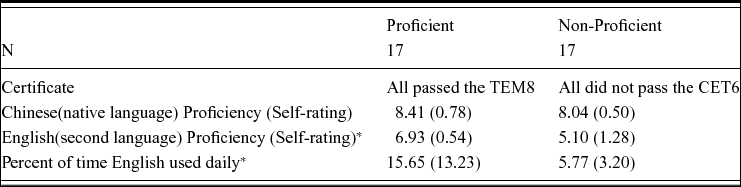
When all the experiment tasks were completed, participants were required to fill out a self-rating questionnaire about language proficiency, which included reading, speaking, writing and listening skills in their native language (i.e., Chinese) and second language (i.e., English). The answers to the self-rating questionnaire are listed in Table 1.
Self-Ratings on Language Proficiency

Self-ratings are on a scale from 1 (not at all) to 10 (perfect command) and are averaged across reading, speaking, writing and listening abilities.
*Groups significantly different, p < .05.
Design
The experiment used a 2 (Proficiency: proficient vs. non-proficient) × 2 (Congruency: congruent vs. incongruent) × 2 (Context: single culture vs. mixed culture) three factors mixed design, with the first factor varying between participants and the second and third factors varying within participants. The dependent variables were response time and error rates in the Eriksen Flanker task (Eriksen & Eriksen, Reference Eriksen and Eriksen1974).
Stimuli
We used the Eriksen Flanker task that Wu and Thierry (Reference Wu and Thierry2013) used in their experiments. Stimuli were displays featuring five horizontal arrows, with the arrow in the center either matching the direction of the flanking arrows or not. A single arrow consisted of 0.69° of visual angle. The contours of the adjacent arrows were separated by 0.28° of visual angle. The task requires participants to judge the direction of the center arrow while ignoring the direction of the flanking arrows. Thus there were two stimulus types: (1) congruent trials in which the center arrow pointed in the same direction as the flanking arrows, either all pointing to the right “→→→→→” or all to the left “←←←←←”; (2) incongruent trials in which the center arrow pointed in the opposite direction from the flanking arrows, that is, “→→←→→” or “←←→←←”.
Culture stimuli were 368 pictures depicting the heritage and culture of China, or the heritage and culture of the United States and the United Kingdom. Fifty-five college students evaluated the representativeness of these 368 pictures, and we selected 92 of them as most typical of Chinese heritage and culture and another 92 as most typical of American and British heritage and culture. All pictures selected had neutral affective valence, since they were all of landscapes. The blocks differed in terms of the culture(s) of the intervening pictures (i.e., Singled or Mixed). In the single culture block, all pictures were Chinese. In the mixed culture block, half of the pictures were Chinese and the other half were American or British. Picture order was randomized across participants.
Each of the two blocks contained 92 trials. Half of the trials were congruent trials and the other half were incongruent trials. In the single culture block, there were 46 Chinese culture pictures and each appeared two times in the block; in the mixed culture block, a different set of 46 Chinese culture pictures and 46 English culture pictures each appeared once in the block.
Procedure
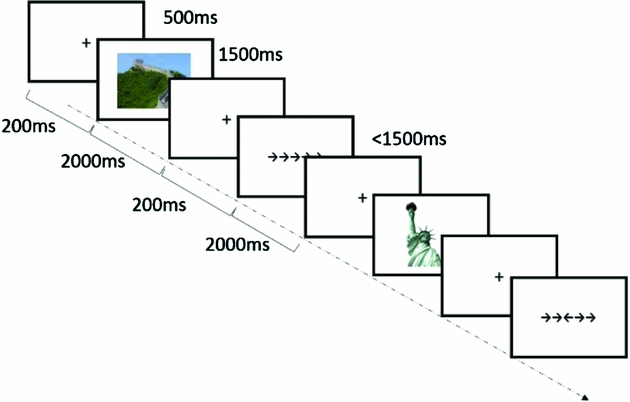
Participants sat on a chair 1m away from the screen in a quiet room. They signed a written consent form before taking part in the study. The flanker task was similar to the one in Wu and Thierry's (Reference Wu and Thierry2013) study: (1) flanker trials were intermixed with random presentation of single pictures; (2) all stimuli were presented at the center of the screen to avoid vertical eye movements. Each trial had the following sequence: (1) a fixation cross (+) appeared at the center of the screen for 500 ms; (2) a blank screen appeared for 200 ms; (3) the flanker stimulus was presented until the participants responded or for a maximum duration of 1500 ms; while the culture stimulus was presented for 1500 ms and no need for an response; and (4) a 2000 ms intertrial interval occurred. The experiment procedure and stimulus examples are shown in Figure 1. The relatively long intertrial interval reduced the eventuality of carryover effects (Wu & Thierry, Reference Wu and Thierry2013).
Experiment procedure and stimulus examples. Each trial began with a fixation cross which lasted for 500 ms. After a blank display lasted for 200 ms, the stimulus presented at the same location as the fixation cross, lasted until response implement and no longer than 1500 ms. The intertrial interval was 2000 ms.

Participants were instructed to indicate with the corresponding finger whether the central arrow among the flanker stimuli pointed to the left (left button press) or the right (right button press) and to ignore intervening picture presentations (i.e., not to make any response to them). Block order was fully counterbalanced across participants. Participants took a short break between the two experimental blocks. The cultural pictures represented in the filler trials were mentioned to the participants, who were also reminded that these pictures were irrelevant and should be ignored. After the experiment, participants were given a surprise questionnaire in which they had to identify pictures previously presented in the experiment intermixed with 184 new pictures. Participants were able to recognize > 70% of the pictures (false alarms were marked negatively, i.e., incorrect), and the error rate did not differ significantly between the two groups [t(32) = 0.086; p = 0.93].
Results
In accordance with the purpose of our study, we compared respectively the error rates and response times of proficient and non-proficient bilinguals in two cultural contexts. One participant in the proficient group and one participant in the non-proficient group did not complete the experiment, resulting in 34 participants, 17 in each group.
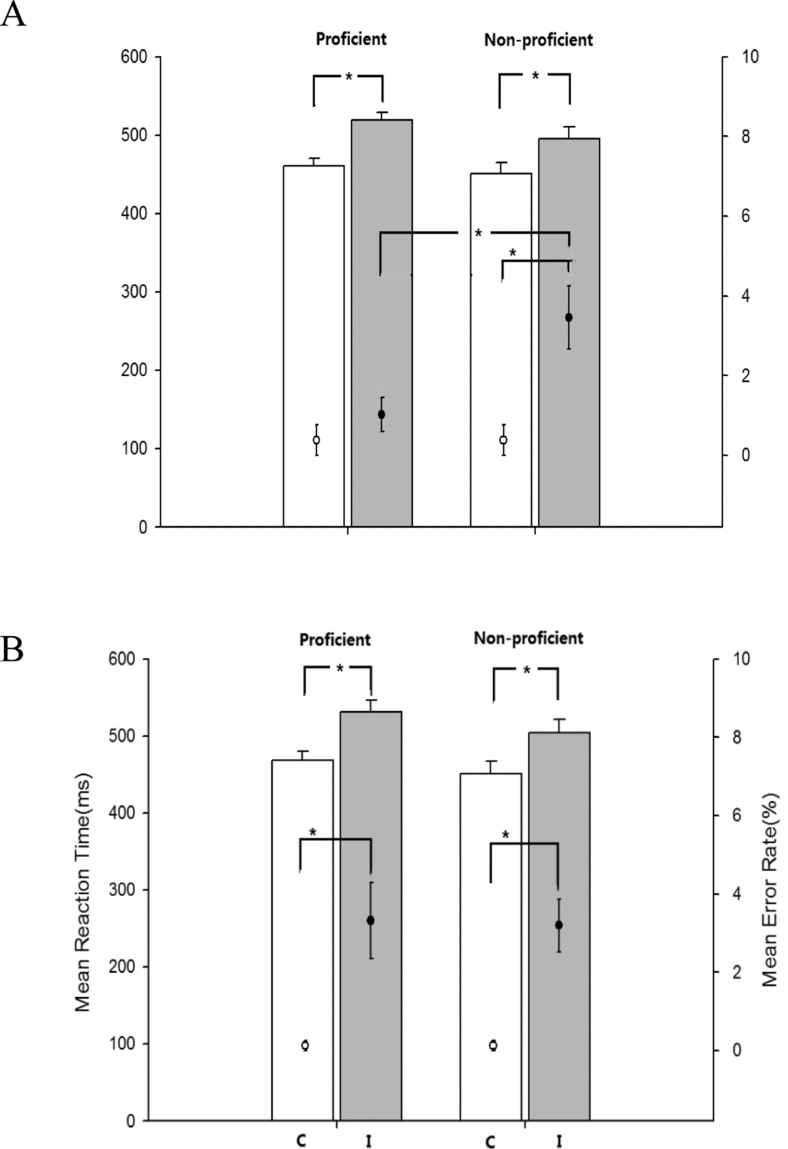
We used a three-way repeated measures ANOVA, with proficiency as a between-participant factor (high vs. low) and congruency (congruent vs. incongruent) and context (uni-culture vs. bi-cultural) as within-participant factors, to compare the error rates of the proficient and non-proficient bilinguals in completing the congruent and incongruent trials of the Flanker Task. As expected, there was an interaction effect of the three factors [F(1,32) = 4.798, p < .05; ηp 2= 0.130]. Further analysis showed that in the bi-culture context, proficiency (i.e., proficient and non-proficient) interacted with congruency (i.e., congruent and incongruent) [F(1,32) = 6.579, p < .05, ηp 2= 0.171]: error rates for incongruent trials in the proficient bilingual group were significantly lower than in the non-proficient group [F(1,32) = 7.330, p < .05, ηp 2 = 0.186], whereas in the congruent trials the error rates of the two groups did not differ [F(1,32) = 0.000, p =1.000, ηp 2= 0.000]. However, in the uni-culture context, no interaction between proficiency and congruency was found [F(1,32) = 0.11, p = 0.917, ηp 2= 0.000]. These results were in accordance with our hypothesis that only in a complicated cultural context should proficient bilinguals show an advantage over monolinguals in conflict resolution.
In addition, in order to look at the direct effect of cultural contexts on cognitive control, we compared directly the performance of the Flanker task between the bi-cultural and the uni-cultural conditions for proficient bilinguals. To do this, we used a two-way repeated measure ANOVA, with context and congruency as within-participant factors. Again, we found a significant interaction effect between context and congruency [F(1,16) = 8.864, p < .05; ηp 2= 0.357]. Post hoc analysis showed that error rates for the incongruent trials were smaller in the bi-cultural context compared with the uni-cultural context [F(1,32) = 4.730, p < .05; ηp 2= 0.129], giving direct evidence that bi-cultural context ‘enhances’ proficient bilinguals’ cognitive performance.
We also used a three-way repeated measure ANOVA, with proficiency as a between-participant factor (high vs. low) and congruency and context as within-participant factors, to compare the reaction times of proficient and non-proficient bilinguals in completing the congruent and incongruent trials of the Flanker Task. As expected, reaction times were shorter in congruent trials compared with incongruent trials [F(1,32) = 143.632, p < 0.001, ηp 2= 0.818], whereas proficiency [F(1,32) = 1.259, p = 0.270, ηp 2= 0.038] and cultural context [F(1,32) = 0.774, p = 0.385, ηp 2= 0.024] showed no main effects. In addition, no interactions were significant. These results showed that the error rate data we obtained were valid. That is, the fact that proficient bilinguals showed a lower error rate than non-proficient bilinguals in incongruent trials in the mixed cultural context was not due to proficient bilinguals having a longer reaction time. The mean reaction time and mean error rates for these data are shown in Figure 2A for the mixed culture context and Figure 2B for the single culture context.
Mean reaction time and mean error rates as functions of proficiency and congruency. Here, a C stands for congruent, while an I stands for incongruent. Panel A is for mixed culture context and Panel B is for single culture context. Error bars represent standard error.

Discussion
There has been mixed evidence regarding the presence of a bilingual advantage in executive functioning. The current study tested the hypothesis that an advantage would be seen on more complex tasks that recruited an enhanced level of executive function. The results showed that proficient bilinguals outperformed non-proficient bilinguals on incongruent trials in a flanker task when the task was presented in a more complex, mixed culture context compared with a single culture context. That is, only in the mixed culture context did proficient bilinguals show an executive advantage; in the single culture context and in congruent trials of the mixed context, proficient bilinguals did not show any advantage over non-proficient bilinguals. These findings cast important light on understanding the nature of bilingual advantage.
First, these data suggest that proficient bilinguals do have an advantage over non-proficient bilinguals but this advantage is only apparent under certain conditions, a finding consistent with previous studies (Costa et al., Reference Costa, Hernández, Costa-Faidella and Sebastián-Gallés2009; Wu & Thierry, Reference Wu and Thierry2013). This finding, along with the mixed evidence in earlier research, calls for new ways of thinking about whether there exists a bilingual advantage in executive function. Considering this, the present study, of young adults who are at the developmentally peak age for cognitive control, did not use a typical cognitive control task that might not distinguish between bilinguals and monolinguals, but rather a more complicated task requiring a higher level of inhibition control or monitoring. That is, mixed context produced an environment that is similar to what bilinguals often experience and in which they need a higher level of inhibition control or monitoring. It was assumed that in this more complicated context the bilinguals would show greater activities in cognitive control centers and show an advantage over monolinguals (Bialystok, Craik, Grady, Chau, Ishii, Gunji & Pantev, Reference Bialystok, Craik, Grady, Chau, Ishii, Gunji and Pantev2005). This account is consistent with neuroimaging studies investigating brain basis of the impact of bilingualism on cognitive control (Crinion et al., Reference Crinion, Turner, Grogan, Hanakawa, Noppeney, Devlin, Aso, Urayama, Fukuyama, Stockton, Usui, Green and Price2006; Garbin, Sanjuan, Forn, Bustamante, Rodríguez-Pujadas, Belloch, Hernández, Costa & Ávila, Reference Garbin, Sanjuan, Forn, Bustamante, Rodríguez-Pujadas, Belloch, Hernández, Costa and Ávila2010).
Second, our findings help validate the proposal that a non-language mixed context may shift the executive system to an enhanced level, making non-verbal conflict resolution more effective. This proposal is consistent with theories of reactive adjustment in executive control, as Wu and Thierry (Reference Wu and Thierry2013) argued. For example, studies have shown that conflict resolution is better when the previous task and the current task engage the same cognitive operation, compared to a condition in which the previous task and the current task engage different operations. That is, when the brain is primed to a state of higher cognitive control by a previous complicated task, the processing of conflict is enhanced and it is easier for conflict resolution to occur (Wu & Thierry, Reference Wu and Thierry2013; Gratton, Coles & Donchin, Reference Gratton, Coles and Donchin1992; Botvinick, Cohen & Carter, Reference Botvinick, Cohen and Carter2004; Kerns, Cohen, MacDonald, Cho, Stenger & Carter, Reference Kerns, Cohen, MacDonald, Cho, Stenger and Carter2004; Kerns, Reference Kerns2006).
Researchers are concerned about two important issues concerning bilingual cognitive advantages. The first is whether there is a bilingual cognitive advantage, and the second is how a bilingual advantage is expressed – for example, which aspects of executive function may be affected. In previous studies using a range of cognitive tasks, most researchers agreed that continuously shifting between different languages, which requires constant recruitment of cognitive control, enhances bilinguals’ executive function. According to these findings, several researchers proposed an inhibition control model, which assumed that bilingual advantage lay in the inhibition control component of executive function (Bialystok et al., Reference Bialystok, Craik, Klein and Viswanathan2004; Green, Reference Green1998).
However, several problems with this account have been identified. For example, in previous research the bilingual advantage appeared in congruent trials (in which there is no conflict) as well as incongruent trials (Bialystok et al., Reference Bialystok, Craik and Luk2012; Costa et al., Reference Costa, Hernández, Costa-Faidella and Sebastián-Gallés2009). Therefore, the monitoring model has been proposed as an alternative to the inhibition model. A monitoring view assumes that bilingual advantage appears mainly in the monitoring component of executive function. Because there is always some probability that the next display may be an incongruent trial, participants must monitor the situation even on congruent trials and the display must be evaluated before committing to a response. Individuals with superior executive control will be able to carry out such monitoring and evaluation more rapidly and effectively (Bialystok et al., Reference Bialystok, Craik and Luk2012). This would account for why bilingual advantage has appeared not just in incongruent trials but also in congruent trials.
Importantly, however, a recent review of the scope and the nature of the bilingual effect on executive function noted that conflict monitoring and inhibition are not mutually exclusive (Bialystok et al., Reference Bialystok, Craik and Luk2012). Bialystok et al. (Reference Bialystok, Craik and Luk2012) hold that although the monitoring model is consistent with evidence that pure blocks of congruent trials are performed equivalently by monolinguals and bilinguals (Bialystok et al., Reference Bialystok, Craik and Ryan2006; Bialystok, Reference Bialystok2010), an inhibition account is still required to explain evidence that pure blocks of incongruent trials are performed better by bilinguals, notably by older adults for whom the task is more effortful (Bialystok et al., Reference Bialystok, Craik and Ryan2006).
According to our results and previous findings, we propose that bilingualism may improve two aspects of executive function. The first is inhibition control. Bilingualism influences inhibition control by changing the timing of its development, that is, bilingualism may accelerate the development of inhibition control; besides, it delays its decline. Therefore, in children or older adults, a bilingual advantage can appear in common cognitive control tasks. However, in young adults, whose inhibitory control function is at the peak of development, no advantage would be seen on common cognitive tasks. The other aspect of executive functions that is improved by bilingualism is the monitoring function. In contrast to the effects of bilingualism on inhibitory control, the effects on the monitoring functioning can be described in terms of degree of development. Thus, in general, bilinguals develop a higher level of monitoring function than monolinguals. However, this superior monitoring function in bilinguals is only apparent in contexts requiring high monitoring.
Here, we found evidence of an enhanced level of executive function in proficient bilinguals in a non-language mixed cultural context. However, there are two concerns that should be noted. First, the setting of using 46 pictures in the single culture context condition that are presented to participants twice whereas 92 unique pictures presented once in the mixed culture context (46 for each culture) may raise a concern that it may be more cognitively demanding in the bi-culture context than in the uni-culture context simply because more novel items need to be processed. And it may be processing of more novel items that benefits bilinguals’ performance in bi-cultural condition (92 unique pictures compared to 46 pictures repeated twice in uni-culture condition), rather than ‘mixed culture’ itself. The most parsimonious explanation is that, since these pictures are task irrelevant, the incidental processing of pictures from two cultures did not directly compete for cognitive resources with the flanker task. Instead, the pictures only produced contexts of uni-culture or bi-culture (Wu & Thierry, Reference Wu and Thierry2013). Still, some may be concerned that a repeated picture may retrieve bound memories that occurred around the time of the first presentation of the picture (Hommel, Proctor & Vu, Reference Hommel, Proctor and Vu2004; Egner, Reference Egner2014), which could affect critical outcomes. In order to rule out this possibility, we compared the performance between trials around the first-presentation pictures and the second-presentation pictures. The results showed that there was no difference between these two parts of trials, no matter in error rates [F(1,32) = 0.032, p = 0.859, ηp 2= 0.001] or reaction times [F(1,32) = 0.277, p = 0.602, ηp 2= 0.009]. This result made our findings that mixed cultural context brings out bilingual advantage more convincing.
The second concern is that cultural context is somewhat related to language. Some researchers have asserted that culture and language are not distinctive concepts: language is a part of culture. And in the domain of cultural psychology, many studies have used language as a kind of culture priming (Hong, Morris, Chiu & Benet-Martínez, Reference Hong, Morris, Chiu and Benet-Martínez2000; Ji, Zhang & Nisbett, Reference Ji, Zhang and Nisbett2004), or cultural icons as language priming (Zhang, Morris, Chen & Yap, Reference Zhang, Morris, Cheng and Yap2013). Therefore, it is possible that only in a mixed context related to language will the bilingual advantage be fully apparent. The present study extends previous research demonstrating bilinguals performed better in mixed language context and contributes to our understanding of the processes involved in bilingual advantage on executive function. Bilinguals outperformed monolinguals only in mixed cultural context. On closer inspection, however, these cultural contexts may be related to language. Future studies can investigate this issue by contrasting bilingual executive function in mixed contexts that are related and fully unrelated to language. However, we assume that it is only in an activated enhanced level of executive function that a bilingual advantage will be fully expressed, and our study proved this hypothesis to some extent.
Conclusion
This study investigated how cultural context influenced bilingual executive function in the non-language domain, using an Eriksen Flanker Task. The results showed that proficient bilinguals exhibited a maximum advantage over non-proficient bilinguals in the more complex mixed cultural context, compared to the less demanding single cultural context. This finding offers evidence of a possible mechanism by which bilingualism affords an advantage in executive function.