Public health refers to all organized measures, whether public or private, to prevent disease, promote health, and prolong life among the population as a whole. 1 Throughout history, the public health sector has faced a wide range of challenges, such as infectious diseases, pandemics, and natural disasters. Over the past few decades, the potential role of space assets in public health has been recognized by relevant stakeholders. In 1999, 185 countries participated in the Third United Nations (UN) Conference on the Exploration and Peaceful Uses of Outer Space (UNISPACE III) in Vienna, Austria. The conference participants adopted the Vienna Declaration on Space and Human Development, which recommended that space assets be used to improve “public health services by expanding and coordinating space-based services…to manage natural disaster mitigation, relief and prevention efforts.” 2
Space applications have evolved to play a significant role in disaster relief by providing services including remote sensing imagery for mitigation and disaster damage assessments;Reference Kaushal and Johnson 3 satellite communication to provide access to medical services; positioning, navigation, and timing services;Reference Chopra 4 and data sharing. 5 Some terrestrial environments share the challenges associated with the low Earth orbit environment, such as isolation and limited or delayed access to medical services.Reference Kuyumjian 6 Experiences gained in telemedicine during missions to the International Space Station (ISS), along with the devices used for such missions, are now being applied in terrestrial telemedicine.Reference Dulchavsky 7 Additionally, spin-off technologies developed for space are being adapted by different sectors such as the Plasmair (AirInSpace, Beverly, MA), which eliminates microorganisms in the air.Reference Szalai, Detsis and Peeters 8 The unique environment in space provides a good opportunity to develop medical technologies for the benefit of humankind on earth. For instance, osteoporosis—a disease characterized by decreased bone densityReference Varacallo and Fox 9 —is a major health issue for astronauts on board the ISS. Studying aging and accelerated osteoporosis in space can help in the development of new treatments and preventive measures for patients on the ground.Reference Sibonga 10
Common issues identified in past disaster response and relief efforts include lack of communication,Reference Bannon, Andrade and Abai 11 , 12 delayed ordering of actions (eg, evacuations), 12 and low levels of preparedness by authorities during and after disasters. 13 Between 1980 and 2012, natural disasters caused approximately $3.8 trillion in damages worldwide. 14 Eighty-seven percent of reported disasters (18,200 events), 74% of losses ($2.8 trillion), and 61% of lost lives (1.4 million) were caused by weather-related natural disasters. 14 Given the financial and social costs of disasters, many organizations are focusing on disaster management, from disaster response and recovery to preparedness and mitigation strategies, despite their high short-term cost. Long-term cost-benefit predictions suggest that preparedness and mitigation will reduce expected economic losses due to natural disaster by 40% to 68% by 2030. 14
It is crucial to consider all aspects of disaster management regardless of how robust the mitigation and preparedness efforts may become. Therefore, a new system for relief efforts during and after disasters seems necessary. We briefly summarize the Space for Health (S4H) Team Project, which was prepared during the Space Studies Program 2014 at the International Space University held in Montreal, Canada. The S4H Project focused on a new system for relief efforts during natural disasters that will have a drastic impact on public health. The main objective of the S4H Project was to provide an overview of areas where public health and space impact each other. The team’s mission statement was “To identify challenges in the operation and coordination of natural disaster relief efforts among the disaster management, public health, and space sectors, and to recommend potential disruptive innovations to address existing technological, organizational, and regulatory approaches.”
The S4H Project studied 5 disaster cases: the Indian Ocean earthquake and tsunami of 2004, Hurricane Katrina of 2005, the West African floods of 2010, the Haiti earthquake of 2010, and the Tohoku earthquake and tsunami of 2011. The case studies were used to gain an understanding of current practices and areas of improvement in public health during relief efforts. Space assets were used to support disaster relief in all case studies; however, challenges existed in several aspects of disaster management. These challenges included resource availability, communication, and coordination of roles and responsibilities. In all cases, public health issues were also identified. Key issues included air and water quality monitoring, waste disposal, and disruption of access to medical services. Thus, the S4H Project aimed to improve the way space assets and experiences are used in support of public health during disaster relief efforts.
Suggested Disruptive Innovations for Disaster Relief
According to Christensen’s disruptive theory, disruptive innovations (DIs) refer to innovations that create a new market by applying a different set of values that ultimately and unexpectedly overtake an existing market.Reference Christensen and Raynor 15 - Reference Eggers, Baker, Gonzalez and Vaughn 17 These innovations are not limited to technological developments and may include business or operational models.Reference Dombrowski and Gholz 18 Christensen highlights the main criteria for an innovation to be considered disruptive as follows: (1) innovation should be introduced to the market by someone outside the established market or industry, (2) targets of DIs should be underserved or entirely new markets or groups of stakeholders that have initially inferior existing products or processes, (3) DIs should be less expensive than existing products or processes, and (4) DIs are usually advanced by an enabling technology.Reference Christensen and Raynor 15 - Reference Eggers, Baker, Gonzalez and Vaughn 17 Given that DIs can have a positive impact on public health,Reference Dombrowski and Gholz 18 the S4H Project proposed the use of DIs for disaster relief efforts. In this light, the S4H Project has recommended a new multi-tiered integrated system to provide public health services during a disaster using space assets, ground-to-space communication, and medical scanning devices. Nevertheless, it should be noted that some of the proposed systems and devices are still in the research and development stage.
On-Demand Nano-Satellite Constellation
Miniaturization of spacecraft subsystems has led to smaller satellites being launched with functionalities similar to their larger predecessors. A nano-satellite constellation (NC) can provide communication and remote sensing services with acceptable accuracy. The idea is to provide these services immediately to stakeholders by obtaining near real-time images of the disaster area, relief efforts, and search as well as rescue. The NC is potentially disruptive because it can replace traditional ways of providing communication and remote sensing services through the use of large satellites in low Earth orbit and geosynchronous orbit as previously described.Reference Kameche, Benzeniar and Benbouzid 19 Launching an NC immediately after a disaster is possible either from the ISS (which is now operationally in use through the Kibo module)Reference Gill, Sundaramoorthy and Bouwmeester 20 or through novel aerial launch systems, such as the system proposed by Swiss Space Systems. An NC may be much cheaper than maintaining large satellites. Indeed, the ISS was recently used as a space-based launch pad for a set of satellites that were delivered to the ISS by using a transport vehicle.Reference O’Dell 21 An NC may also be deorbited when its applications are no longer required. The actual parameters recommended to be considered for an NC are displayed in Table 1.
Suggested Parameters for a Nano-Satellite Constellation

Depending on the geographic location, the orbital parameters will vary. Thus, we propose 2 different launch methods: the ISS launch and the air launch of nano-satellites. The latter is feasible given that Orbital Sciences Corporation has completed 42 air launch missions. To date, they have successfully placed 86 satellites into low Earth orbit by using the Pegasus rocket carried by the Stargazer L-011 aircraft, which is released approximately 12 km from ground level and sets the satellites in orbit in approximately 10 minutes. 22 However, space flights are scheduled months to years in advance and the ISS imposes various safety restrictions regarding satellites, which may reduce the number of satellites that can be launched. Therefore, it would be useful to consider using and reconfiguring an already deployed system. In this light, the Planet Labs Flock 1, which is already in orbit, could alternatively be used to provide remote sensing and/or communication instead of launching new nano-satellites. 23 This may reduce the cost of the launch vehicle given also that space agencies are not pursuing a multi-spacecraft network owing to increased costs.Reference Thoemel 24
Micro-Unmanned Aerial Vehicles
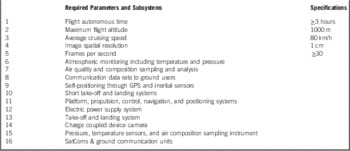
To enhance emergency response, micro-unmanned aerial vehicles (micro-UAVs) can be used to provide local remote sensing, situational awareness, and real-time images of the disaster site. Micro-UAVs are small, lightweight, portable, remote-controlled robotic aircrafts. They use commercial off-the-shelf components and can be land-launched and managed by a single operator.Reference Nebiker, Annen, Scherrer and Oesch 25 They are easy to deploy, simple to operate, and provide rapid data acquisition and processing.Reference Nebiker, Annen, Scherrer and Oesch 25 It should be noted that there are no officially established size or weight ranges for micro-UAVs. Generally speaking, a micro-UAV is considered to weigh up to a kilogram. Nevertheless, to achieve flight times of more than 3 hours, substantially larger UAVs do exist. In this light, our system may also include larger UAVs. Micro-UAVs have already been used for search and rescue, disaster monitoring, fire detection, and mapping.Reference Meier 26 To increase the efficiency of micro-UAVs in disaster mapping, the S4H Project recommends using a network of self-organizing micro-UAVs, namely a micro-UAV “swarm,” as previously described.Reference Werner 27 The swarm consists of an autonomous flock of approximately 10 to 20 micro-UAVs. The network uses bio-inspired algorithms that mimic the collective behaviors of animals and insects. The swarm flies autonomously or under remote control from the disaster site.Reference Werner 27
The micro-UAVs can be deployed to multiple locations in a disaster area to rapidly create communication networks for search and rescue operations. They can fly closer to the ground to capture high-resolution images of the disaster sites.Reference Hauert, Leven and Zufferey 28 , Reference Hauert, Leven and Zufferey 29 From a hardware perspective, the micro-UAVs are designed to be robust, safe, lightweight, and low-cost. The interface protocols are developed to allow nonexperts to easily and safely operate large groups of micro-UAVs.Reference Hauert, Leven and Zufferey 28 , Reference Hauert, Leven and Zufferey 29
Although micro-UAV technologies are still in early testing and prototyping phases, they are currently capable of collecting data from a disaster area.Reference Hauert, Leven and Zufferey 28 , Reference Hauert, Leven and Zufferey 29 We suggest transmitting the collected data to disaster relief teams by use of cell phones and mobile devices. We also recommend using micro-UAVs to track and identify victim position via NC telecommunication networks integrated with positioning, navigation, and timing systems. In this light, micro-UAVs can support decision-making for public health issues, preventing and reducing the risks of food and water contamination as well as the spread of diseases. Table 2 highlights some important parameters for designing a micro-UAV swarm. However, the actual values of the suggested parameters may vary from mission to mission and are dependent on the type of application in a specific disaster condition. One problem to be overcome is that disaster officials often place a “no fly” restriction over disaster areas, which includes micro-UAVs, but this is likely to change in the future as these systems proliferate.
Parameters for Designing a Micro-UAV “Swarm”Footnote a

a Abbreviation: UAV, unmanned aerial vehicle.
Medical Diagnostic Tools
Physicians rely on various medical examinations and laboratory results to determine a definitive diagnosis. This process takes time—a limiting factor in immediate disaster relief. The S4H Project suggests the integration of novel biomedical devices in disaster management such as portable medical scanning tools. These devices may decrease turnaround times for retrieving the results of medical examinations that are critical during disaster relief efforts. Some of the portable diagnostic tools that have shown promise in this area include the Tricorder by Peter JansenReference Jansen 30 and Scanadu by Yves Béhar.Reference Behar 31 Tricorder and Scanadu are considered to have the potential to revolutionize medicine both on Earth and in space as indicated in the National Research Park Post, a publication of the National Aeronautics and Space Administration.Reference Rowe and Cagle 32 However, these devices need further development.
Scanadu is a small, portable, self-scanning device that provides biomedical data, such as heart rate, blood pressure, body temperature, and oxygen content in the bloodstream.Reference Behar 31 Another useful tool is electronic triaging armbands (eTriage), which are used instead of paper tags. eTriage contains a GPS sensor, a radio-frequency identification chip, and a network component for communication with the data network. Uninjured people can receive an armband with a GPS receiver only, whereas unstable and severely injured victims can have sensors attached to their bodies that transmit vital signals to the emergency response control center. The data can be transmitted via a wireless local area network, or via mobile phone networks, and could be displayed on a tablet or smartphone. 33 A map view and augmented reality view could give first responders and response coordinators a quick overview of the situation.Reference Elmasllari 34 Nevertheless, the device is an early prototype still in research and development and is not yet available on the commercial market.
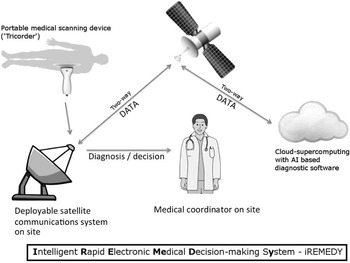
Personal medical devices and associated networks are systems utilizing radio-frequency identification, infrared sensors, and other information-sensing devices.Reference Takizawa 35 We propose a novel interlinked system in which portable medical scanning devices (also known as “Tricorders”) are coupled with a cloud-based high-performance computer system in which artificial intelligence–based diagnostic software can deliver rapid medical decisions and precise diagnoses to the on-site medical coordinators and responders. The information stream could be transmitted through an NC, which secures communication in remote areas and disaster zones where standard means of communication might be temporally unavailable. The proposed intelligent rapid electronic medical decision-making system (iREMEDY) is displayed in Figure 1.
The Intelligent Rapid Electronic Medical Decision-Making System (iREMEDY). AI, artificial intelligence.

Mobile Self-Contained Disaster Relief Units
Given previous experience with natural disasters, some of the main challenges are the effectiveness of communications between relief effort authorities and ground-based workers as well as power and water supplies in the affected area. In this light, mobile self-contained relief units can be used to set effective communications and to supply the affected area with electricity and clean water. New devices such as the PowerCube (Ecosphere Technologies, Inc, Stuart, FL) seem to be a potential solution.
The PowerCube is a large mobile generator that runs on high-power photovoltaic solar cells to harness energy from the sun. Its container is combined with a wind turbine, which stores energy in on-board batteries. Housed in a standard shipping container, the PowerCube can be transported via land, air, or sea. The setup of the device is quick and the unit provides a maximum of 15 kW of electricity, offers telecommunications, and acts as an emergency shelter and water treatment center. The integrated wind turbines can also deliver an additional source of water by extracting moisture from the atmosphere. 36 It can also act as a central coordination and operations hub and as an emergency hospital system for triaging and rapid access to injured victims. The system also supports quicker decision-making processes by collecting data and real-time synchronous images of current critical situations. It is also equipped with a pseudo-cell station to intercept signals and get their position data. 36
Mobile self-contained relief units could establish real-time communications with several units, including personal medical devices (directly or indirectly), a micro-UAV swarm, an NC, or traditional satellite communication systems. 37 The communication could be established via the satellite and ground communication network, and medical and imagery data could be transferred through the NC and the micro-UAV swarm. The processed data and images collected by the micro-UAV system and nano-satellites could be sent to the mobile self-contained relief units to further assist the medical coordination team for rapid decision-making. Additionally, a network of mobile self-contained relief units could provide synergy across the disaster area.
Policy and Law
The system proposed for relief efforts during natural disasters by the S4H Project requires addressing several policy and law issues. For instance, the launching states of the nano-satellites will be subject to relevant international (primarily UN) treaties, principles, regulations, and guidelines. Because the launches would be aerial based, the launching parties would also need to operate within international (eg, the International Civil Aviation Organization) and national regulatory frameworks for aviation standards. Use of the ISS as a space-based launching platform for nano-satellites would require multilateral agreements among all space agencies and states involved in the ISS. Issues related to state security and privacy will need to be addressed on a case-by-case basis, and policy and regulation established regarding the activation, operation, and liability of parties involved in an ISS deployment. However, considering the lifetime and orbit of the ISS, alternative arrangements may also be explored such as an international cooperation for a similar space-based deployment platform. Furthermore, the International Telecommunication Union should allocate special frequencies for nano-satellite communication in a disaster situation. These frequencies should be allocated and may be similar to Mobile Satellite Systems to ease the communication between various elements.
To integrate micro-UAVs into a space-based solution for disaster relief, legal and policy aspects must be considered for current and emerging aviation standards. The International Civil Aviation Organization recommends that member states help to develop policies on UAVs. 38 Both the United States and the European Union are developing comprehensive roadmaps to regulate the micro-UAVs and to recognize them as legitimate airspace users. 39 However, key concerns range from privacy and security on the use of UAVsReference Finn and Wright 40 to the establishment of “no fly” zones over disaster areas that would allow relief-based UAV operations.
The medical equipment industry is an innovative field that is evolving fast within a generally undefined international regulatory context. In 2003, the World Health Organization stated that “Governments need to put in place policies that will address all elements related to their safe and appropriate use and disposal.” This point is particularly relevant for developing countries, where the “health technology assessments are rare and where little regulatory controls exist to prevent the importation or use of substandard devices.”Reference Cheng 41 - Reference Thatte, Hussain and de Rosas-Valera 43
Developed countries already possess established institutions that regulate medical device production and commercialization. 44 The lack of international regulations for medical devices triggered the formation of the former Global Harmonization Task Force, now called the International Medical Device Regulators Forum (IMDRF). 45 IMDRF publications have become the gold standard of “good device regulation.”Reference Altenstetter 46 However, this organization has no binding authority, and each country has the freedom to decide on a national level whether to follow its directives.Reference Cheng 41 , Reference Altenstetter 46 Legal and policy challenges in the geographical type group are subdivided into international and national level challenges.Reference Cabrera-Alvarado, Langston and Antoniou 47
Estimated Cost
Nano-satellites have low construction costs compared to traditional large satellite platforms. On the basis of multiple online sources (eg, cubesatkit.com, gomspace.com) and consulting advice from numerous experts, an estimation of cost for the NC is displayed in Table 3. However, the estimated cost should be considered a rough approximation.
Estimated Cost of a Nano-Satellite Constellation

Individual device costs have not yet been released, because further research and development is necessary to reach the stage at which full implementation of the proposed systems is possible. It is estimated that the cost would be comparable to personal health and fitness tracking devices (nowadays $149-259) because the technical sophistication is similar. Specifically, the Scanadu is now available for $199,Reference Clendaniel 48 whereas the cost of a deployable satellite communication system onsite is estimated to be between $1500 and $7500. This is because the cost is heavily dependent on bandwidth requirements. Additionally, the estimated running cost for a cloud-based high-performance supercomputer (Figure 1) is approximately $1279 per hour.Reference Anthony 49
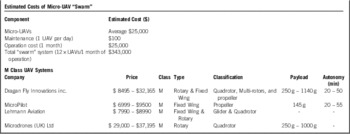
The operational cost of micro-UAVs has been reduced through the use of commercial off-the-shelf components.Reference Kumar and Michael 50 Given the interest and investment in this technology, it is likely that in the near future micro-UAVs will provide a multitude of cheaper services compared with what currently exists.Reference Sarris 51 The estimated operational cost of micro-UAVs and an overview of commercially available micro-UAV systems on the basis of previous dataReference Al-tahir, Arthur and Davis 52 are shown in Table 4. A micro-UAV system should be cost-effective; capital costs should be adopted by government and private agencies, whereas operation costs should allow for continued and constant use of the system.Reference Al-tahir, Arthur and Davis 52
Estimated Costs of a Micro-UAV “Swarm” and Overview of Commercially Available M Class UAV SystemsFootnote a

a Abbreviation: UAV, unmanned aerial vehicle.
The costs of micro-UAV systems presented in Table 4 refer to a single disaster relief operation, whereas the maintenance cost includes spare parts, system support, depot maintenance, and fuels.Reference Valerdi, Merrill and Maloney 53 , Reference Valerdi 54 Operation cost is mainly personnel cost, which was calculated by consulting with UAV operators.Reference Wezeman 55 Micro-UAVs are available as off-the-shelf systems and therefore are inexpensive compared with larger systems.Reference Wezeman 55 The S4H Project has identified the M-class (Micro and Mini) UAVs as having the highest potential for low-cost operations.
Finally, in an attempt to obtain a rough estimate of the cost to procure a PowerCube, a project team member e-mailed the developers of the application. Their response indicated no public announcements of the cost.
Conclusions and Recommendations
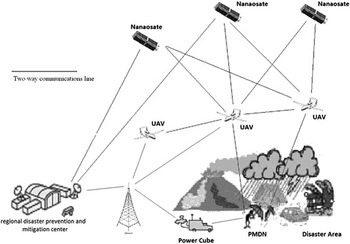
The present article is a brief summary of the S4H Project, which took an interdisciplinary, intercultural, and international approach toward the better use of space assets during and immediately after disasters to address public health issues related to those events both directly and indirectly. The project built upon the large body of knowledge currently available and assessed the use of a DI model to recommend changes to current technical, policy, and regulatory approaches. It is anticipated that the recommended coordination and communication system will improve the way space assets and experiences can support public health during disaster relief efforts. This system is displayed in Figure 2.
Proposed Operational System for Disaster Relief Efforts Using Space Assets. A nano-satellite constellation (NC) provides the necessary communication and remote-sensing (RS) services to the mobile self-contained relief units (ie, PowerCubes), individual scanning devices, and regional prevention center. The RS and NC components can provide the optimal deployment route for self-diagnostic tools and mobile self-contained relief units. The communication of the NC component could provide the platform for the monitoring of medical devices and the data transfer for the mobile self-contained relief units. The micro-unmanned aerial vehicles (micro-UAVs) and mobile self-contained relief units can be connected for efficient information transfer by using the NC. The information collected by the micro-UAVs can be directly transferred to any place on Earth by using the NC. The communication among the micro-UAVs may also be facilitated by using the NC. Diagnostic tools may benefit from data transmission through the NC or by using mobile self-contained relief units as intermediaries for receiving and sending data to the NC. Micro-UAVs can be used as data relays to help with tracking diagnostic results and providing additional information to further help the medical coordination team for rapid decision-making. Abbreviation: PMDN, personal medical device and its networks. (Figure by Jingbo Huang and Hooman Jazebizadeh.)

Despite the efforts of many international stakeholders to improve the use of space assets during disasters, in the past, lack of coordination and communication during disasters caused delays and many public health issues. 56 – Reference Vanderford, Nastoff and Telfer 58 In this regard, lack of clear understanding of roles and responsibilities between stakeholders, communication between the relief agencies, and processing as well as sharing important situational awareness information among all actors remains a challenge. Moreover, deployment confusion, uncertainty about mission assignments, and sharing details on medical history when data are collected via physical surveys are just a few examples of timely communication challenges. 56 - Reference Vanderford, Nastoff and Telfer 58 Therefore, developing an effective procedure for coordinating between relief agencies, with clear definitions and understanding of roles and responsibilities, is necessary.
Uses of novel space assets may improve the quality and maintenance of public health in regions affected by disasters. Indeed, new space innovations such as nano-satellites, along with innovations such as mobile self-contained relief units and self-scanning devices, have the potential to revolutionize public health during disaster relief efforts. However, one limitation of the nano-satellites is that the orbit altitude at which they are deployed results in them not remaining over a region, which may disrupt the communication between them and ground-based segments. In this regard, we alternatively propose the use of balloon communication systems. Indeed, this kind of technology has been extensively used in the past.Reference Kanoria and Pant 59 , Reference Smith, Perry and Lew 60 These balloons can remain stationary for a long time period under unstable weather conditions, and they can support communication with ground-based segments.Reference Kanoria and Pant 59 , Reference Smith, Perry and Lew 60 The latter system can also bridge the communication gap between nano-satellites and low-altitude micro-UAVs. Additionally, other alternatives such as the Planet Labs Flock 1 project could offer rapid deployment and reduced costs. 23
The main recommendations for the better use of space assets to support public health during natural disaster relief efforts are presented below:
-
1. An integrated solution based on nano-satellites or a balloon communication system, mobile self-contained relief units, portable medical scanning devices, and micro-UAVs could revolutionize disaster relief and disrupt different markets.
-
2. To ensure the successful implementation and use of the recommended solutions, stakeholders should be trained in 2 core areas: the technical design, operation, and maintenance of the innovations, and the medical, ethical, and humanitarian procedures and principles associated with disaster relief efforts.
-
3. Owing to the significant role that DIs from different sectors can play in support of public health during disaster relief, stakeholders should adopt methods to identify disruptive solutions and strengthen their capacity to integrate these solutions into the practices and procedures of their organizations.
-
4. Many of the mentioned technologies are designed and operated by private organizations. Public-private partnerships should be used to enhance disaster relief efforts. Governments can use the resources and expertise within the private sector to support disaster relief efforts. Additionally, coordination between civil and military organizations may be critical throughout the disaster relief process.
-
5. Research and development of the identified DIs is capital-intensive. Government-funded programs to support research and development of innovations that promise to aid in disaster relief efforts and public health, such as those mentioned here, is required to stimulate technology markets and allow the development of innovations that advance current disaster relief mechanisms.
-
6. Many challenges on the policy and legal side persist when new innovations are to be used for disaster relief efforts. Existing laws and policies should be adapted and new regulatory frameworks created to facilitate the legitimate use of the recommended solutions.
In conclusion, the recommended system of coordination and communication using space assets to support public health during disaster relief efforts is feasible. Nevertheless, further actions should be taken by governments and organizations in collaboration with the private sector to design, test, and implement this system.
Acknowledgments
The Space for Health Project would like to acknowledge the Human Exploration and Operation Missions Directorate of the National Aeronautics and Space Administration (NASA) and Boeing’s Space Exploration Division for their support. The Space for Health team would also like to thank the guest experts and key informants who provided valuable guidance throughout the project. The authors also thank the members of the Space for Health team who are not listed here as authors for their contribution to this project within the Space Studies Program 2014 of the International Space University. The present work was performed in (partial) fulfillment of the requirements for obtaining the degree “Dr. med” (Christian Mueller).