I. INTRODUCTION
Titania (TiO2) is a photoactive compound of great importance for photophysical and photochemical applications. In 1972, Fujishima and Honda showed that TiO2 can be used to photocatalytically split water to hydrogen and oxygen using solar light, a topic of great current societal interest and intense research.Reference Fujishima and Honda1 The strong photocatalytic oxidation capacity of TiO2 is also used for degradation of organic contaminants in water and air.Reference Hoffmann, Martin, Choi and Bahnemann2 In this area, self-cleaning coatings of titania are saving large amounts of energy.Reference Fujishima, Rao and Tryk3 More recently, titania has been increasingly studied for its great potential as an active component in solar cells as demonstrated by Oregan and Grätzel.Reference Oregan and Grätzel4 Titania occurs as a common compound in the earth’s crust where its three most common polymorphs are brookite, anatase, and rutile. Rutile is thermodynamically stable, whereas anatase and brookite are metastable. The polymorphs have somewhat different electronic and optical properties and hence different areas of application. Anatase has been reported to exhibit higher photocatalytic activity than rutile.Reference Hoffmann, Martin, Choi and Bahnemann2, Reference Li, Lee, Lee, Song and Kim5 However, there are studies that show that rutile nanoparticles synthesized at low temperatures show similar activity but may catalyze different reaction paths compared with anatase.Reference Kim, Lee, Kim, Lee and Lee6–Reference Andersson, Österlund, Ljungstrom and Palmqvist8
A way of further improving the effectiveness of crystalline titania for photocatalytic oxidation is to prepare it in a mesoporous form.Reference Andersson, Birkedal, Franklin, Ostomel, Boettcher, Palmqvist and Stucky9 A similar benefit has been shown for dye-sensitized solar cells.Reference Grätzel, Durrant, Archer and Nozik10 Mesoporous materials have pores in the range of 2 to 50 nm and large specific surface areas, the combination of which increases the amount of active sites and the accessibility to these sites for an electrolyte or reactant mixture. Ordered mesoporous metal oxides were first reported in the early 1990s.Reference Yanagisawa, Shimizu, Kuroda and Kato11, Reference Kresge, Leonowicz, Roth, Vartuli and Beck12 They are typically made by removal of the organic structure-directing molecules used in the formation of a mesostructured organic/inorganic composite. The mesostructured composite is prepared under wet chemical conditions using amphiphilic molecules, as structure-directing agents. A large number of ordered mesoporous materials have been prepared using this methodology.Reference Beck, Vartuli, Roth, Leonowicz, Kresge, Schmitt, Chu, Olson, Sheppard, Mccullen, Higgins and Schlenker13–Reference Brinker, Lu, Sellinger and Fan17 However, the walls of an as-prepared ordered mesoporous material are most often amorphous since crystallization usually requires temperatures that exceed those available under the aqueous conditions used. This is the case also for titania, and the as-prepared mesostructured composite is typically amorphous.Reference Alberius, Frindell, Hayward, Kramer, Stucky and Chmelka18 Crystallization of the titania may subsequently be affected through solid-state conversion of the amorphous composite into crystalline nanoparticles organized in a mesoporous structure. However, such heat treatment often induces loss of meso-order because of thermal instability as a result of the crystallization and the crystal growth, and rutile especially remains a challenge to prepare in an ordered mesoporous state. One attractive way to overcome these obstacles would be to prepare nanoparticles of crystalline titania and subsequently induce a co-assembly process of the nanocrystals with a liquid crystal-forming amphiphilic template. This requires a system that allows for crystallization of nanoparticulate titania at low temperatures and which is also able to form liquid crystalline phases.
A number of different synthesis technologies are being developed for preparation of nanoparticulate materials including high-temperature gas synthesis methods such as flame synthesis and plasma processes,Reference Nalwa19, Reference Klabunde20 supercritical methods,Reference Hald, Becker, Bremholm, Pedersen, Chevallier, Iversen and Iversen21 and low-temperature solution methods such as sol-gel, solvothermal, or microemulsion. In general, the solution-based methods are slower but compatible with softer chemical interactions present in surfactant self-assembly methodologies. Such methods have shown it possible to prepare high-temperature stable oxide phases at low temperatures. Exploiting the faster dynamics and the large interfacial area between oil and water in microemulsions allows for increased reaction rates and the use of hydrophobic molecular precursors under mild conditions. Hence, rutile was recently prepared with very high specific surface area at room temperature through a microemulsion-mediated route using a system with the nonionic surfactant Triton X-100.Reference Andersson, Kiselev, Österlund and Palmqvist22 The topic of this work is to develop a similar synthesis route for anatase and rutile using a microemulsion system based on the nonionic block copolymer Pluronic F127.Reference Holmqvist, Alexandridis and Lindman23 This system is especially interesting because Pluronic polymers display phase diagrams containing a plethora of liquid crystalline phases that have successfully been used for formation of meso-ordered hybrid materials and, upon subsequent removal of the polymer, of mesoporous metal oxides.Reference Zhao, Huo, Feng, Chmelka and Stucky16
II. EXPERIMENTAL METHODS
A series of syntheses was performed with synthesis mixture compositions positioned within the reversed microemulsion area (L2) of the ternary phase diagram between Pluronic F127, butanol and water.Reference Holmqvist, Alexandridis and Lindman23 The butanol that is formed upon hydrolysis of the titania precursor shifts the position of the composition in the phase diagram only to a minimal extent and only within the boundaries of the reversed microemulsion phase. The chemicals used in this study were Pluronic F127 (EO100PO70EO100, Sigma), titanium(IV)butoxide (97%, Aldrich), 1-butanol (≥99.4%, Sigma-Aldrich), hydrochloric acid (37%, Sigma-Aldrich), and nitric acid (69%, Sigma-Aldrich). The weight ratio of Ti(IV)butoxide/diluted acid was equal to 0.85 for all syntheses. Ti(IV)butoxide was added dropwise to the microemulsion under continuous stirring. The mixture was put in a polypropylene bottle or a teflon-lined stainless steel autoclave at specified temperature and time. The formed products were separated from the synthesis solution by centrifugation and washed in CH2Cl2 to remove the surfactant. Finally, the CH2Cl2 was separated from the product by centrifugation, and the samples were subsequently dried at room temperature in open air overnight. Powder x-ray diffraction measurements were performed on a Bruker D8 advance diffractometer using Cu Kα radiation (λ = 1.54 Å). The mean crystallite size was calculated according to the Scherrer equation based on the Bragg peak width at half maximum intensity.Reference Scherrer24, Reference Patterson25 Transmission electron microscopy (TEM) observation was performed on a JEOL JEM-2100F with C s = 0.5 mm operated at 200 kV. The samples were dispersed in ethanol and dropped onto a microgrid, and images were recorded with a Gatan Ultrascan CCD camera. For the SEM observation, the samples were dropped on graphite. SEM images were acquired with a JEOL JSM-7401F. The accelerating and retarding voltages used were 3 and 2 kV, respectively; therefore, the net electron impact voltage onto the sample was 1 kV using gentle-beam method. Nitrogen gas adsorption measurements were performed at 77 K on a Micromeretic TriStar instrument, where prior to measurement, the samples were exposed to vacuum for 3 h at 100 °C to remove moisture. The specific surface area was measured according to the Brunauer–Emmett–Teller (BET) method.Reference Brunauer, Emmett and Teller26
III. RESULTS AND DISCUSSION
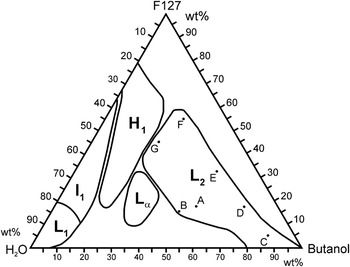
At first, the influence of the microemulsion composition on the formation of TiO2 nanoparticles was established by performing a series of syntheses at 50 °C at the different positions in the L2 phase region presented in Fig. 1. Composition A is centrally positioned within the L2 phase, whereas compositions B to G are positioned closer to the boundaries of the L2 phase to evaluate the extreme compositions of the microemulsion. Apparently the composition has a great impact on the crystallization of TiO2, and syntheses A, B, and G clearly show diffraction peaks corresponding to rutile (see supporting information). The crystallinity is very low or absent for syntheses made with low water content, i.e., compositions C to E. For syntheses made in compositions C and D, weak peaks at 2θ = 36° and 55° can be discerned indicating presence of some rutile. Clearly, composition A was most favorable for the formation of crystalline TiO2 of the compositions evaluated, and the study was henceforth focused on this point.
Phase diagram of H2O/butanol/F127 redrawn from Holmqvist et al.Reference Holmqvist, Alexandridis and Lindman23 with compositions of microemulsions used in the synthesis of TiO2 marked with letters A–G within the L2 phase region.

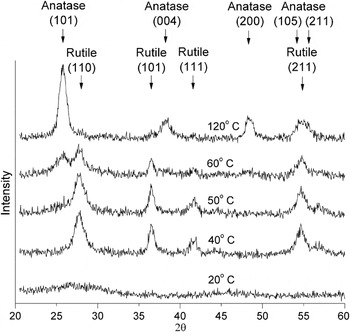
The three additional experimental parameters—temperature, synthesis time, and type of acid—were evaluated one at a time for syntheses performed with composition A. Figure 2 shows the x-ray diffractograms of the products obtained after 96 h in a series of runs performed at different temperatures and using 5 M HCl as acid solution. In contrast to results reported for the Triton X-100 system,Reference Andersson, Kiselev, Österlund and Palmqvist22 no crystallization occurred at room temperature where the material formed was amorphous even after 4 days of reaction. At synthesis temperatures of 40 and 50 °C rutile was formed, whereas if the synthesis solution was instead hydrothermally treated at 120 °C only anatase was formed in agreement with the Triton X-100 system. However, a prolonged synthesis at 120 °C did not result in a transition to rutile for the Pluronic system in contrast to the Triton X-100 system for which anatase was converted into rutile after roughly 12 h at 120 °C.Reference Andersson, Kiselev, Österlund and Palmqvist22 We note, however, that there seems to be a discrepancy between the kinetics of the conversion from anatase to rutile at 120 °C for the Triton X-100 system, apparently due to differences in autoclave type used.Reference Andersson, Österlund, Ljungstrom and Palmqvist8, Reference Andersson, Kiselev, Österlund and Palmqvist22
Powder x-ray diffractograms of products formed during 96 h of synthesis, as a function of synthesis temperature, using a microemulsion with composition A and 5 M HCl as acid solution.

The two amphiphiles Pluronic F127 and Triton X-100 are both nonionic. Pluronic F127 is a triblock copolymer built up by a central, 70 unit long, polypropyleneoxide chain and two, 100 unit long, polyethyleneoxide chains. In solution, F-127 will form a hydrophilic headgroup by coiling up its two polyethyleneoxide chains, while its hydrophobic chain is folded out in the oil matrix. The Triton X-100 surfactant is a much smaller molecule built up by a hydrophilic polyethyleneoxide chain of 10 units and a hydrophobic chain consisting of a 4-(1,1,3,3-tetramethylbutyl)-phenyl group. These large differences in both size and composition of the two amphiphiles are expected to affect the formation kinetics as well as the colloidal stability and propensity for aggregation of the formed nanoparticles as further discussed below.
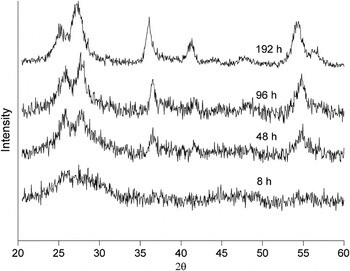
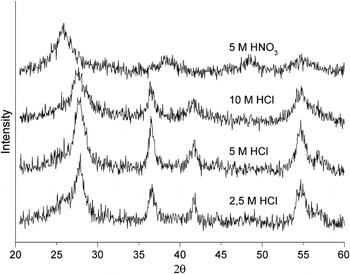
Using a synthesis temperature of 60 °C, both rutile and anatase were formed for the Pluronic F127 system. Figure 3 shows the x-ray diffractograms of products formed at 60 °C as a function of synthesis time. Clearly, the composition of the product gradually changes toward more rutile at this temperature. The corresponding x-ray diffractograms for syntheses made at 50 °C show that rutile exists already after 8 h of treatment of the synthesis solution, and as expected it is the only polymorph present also for the longer time periods studied (see supporting information). The influence of the hydrochloric acid concentration is shown in Fig. 4, and it was found not to affect the crystal structure of the formed TiO2 to a large extent, although a small shoulder for the anatase (101) reflection is discerned in the x-ray diffractogram when 2.5 M HCl was used. In contrast, when using 5 M HNO3 instead of HCl, anatase is the only polymorph formed. A similar dependence on acid type was reported also for the Triton X-100 system.Reference Andersson, Österlund, Ljungstrom and Palmqvist8
Powder x-ray diffractograms of materials formed at 60 °C of synthesis, as a function of synthesis time, using a microemulsion with composition A and 5 M HCl as acid solution.

Powder x-ray diffractograms of products obtained at 50 °C after 96 h for syntheses carried out in a microemulsion with composition A using different acid solutions.

In general, the formation of crystalline nanoparticles is governed by the interplay between thermodynamics and formation kinetics. Under the conditions present in microemulsion systems, the relative rates of nucleation and growth of the different polymorphs are what determines which polymorph forms and also what frequently facilitates less thermodynamically favored phases to form. It is the combination of reaction mixture molar composition and temperature used that governs the rates of formation, which may have different temperature dependencies due to differences in their rate-determining activation energies. This complexity is what facilitates the low-temperature synthesis of high-temperature phases such as rutile and also enables kinetic control over thermodynamic driving force, which allows for anatase to be formed before rutile.
Large differences between microemulsion systems such as types of amphiphile and acid anion used should be expected to induce large effects on the formation kinetics of the nanoparticles as well as on their thermodynamic properties because of their large surface-to-bulk ratio. The complexity of these syntheses may therefore lead to apparently contradictory results when comparing different microemulsion systems because they show different dependencies to a certain variable. In the present study, the rates of formation of the two polymorphs anatase and rutile are shown to be affected by a number of synthesis variables, such as, e.g., temperature and molar composition used in the reaction solution.
To rationalize the effect of the acid used, the polymorph-directing properties of the anion of the acid used is apparent. It affects the relative rates of formation of the two TiO2 polymorphs as evidenced by the fact that both polymorphs can be formed at the same temperature using different anions, and because one of the anions can induce formation of both polymorphs by proper choice of temperature. These observations are in accord with a formation mechanism in which the acid anion affects the relative rates of formation of the two polymorphs and where the polymorphs have different rate-determining activation energies and thus different temperature dependencies. The most likely molecular explanation for this is that the anions participate in the nucleation and growth of the TiO2 particles presumably through different modes of coordination at the growing surfaces of the particles. This is indeed to be expected as the two anions used (nitrate and chloride) exhibit largely different coordination characteristics in aqueous solutions. The differences in anion dependence between the two microemulsion systems compared here may be understood by realizing that it is the combination of amphiphile and anion that is decisive in the governing energies involved in the nucleation and growth of the nanoparticles rather than the individual components used.
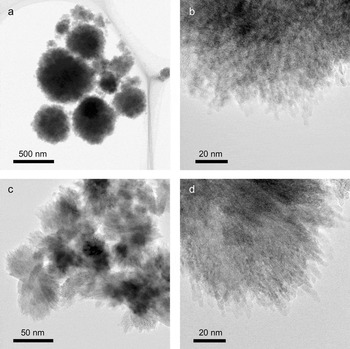
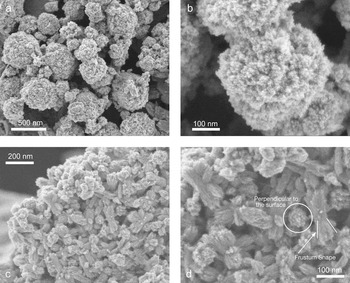
To compare the microscopic structure of the formed particles and their aggregation characteristics between samples prepared in the Pluronic F127 system with those prepared in the Triton X-100 system, a series of TEM and SEM images were collected for two samples. In Fig. 5, TEM micrographs of a sample formed during 8 h of synthesis at 40 °C using a microemulsion with composition A and 5 M HCl as acid solution are compared with micrographs of a sample prepared with a microemulsion based on Triton X-100, cyclohexane, n-hexanol and HNO3 as acid.Reference Andersson, Kiselev, Österlund and Palmqvist22 From these images it can be seen that both samples consist of nanocrystallites that are roughly 3 nm in diameter. The particles exhibit different surface properties manifested in differences in aggregate arrangements. The sample made in the Triton X-100 microemulsion system consists of spherical aggregates with variable diameter, whereas in the sample from the Pluronic F127 microemulsion system frustum-shaped aggregates with a diameter of 30 to 50 nm are formed. These aggregate shapes can also be seen in the SEM pictures presented in Fig. 6.
TEM micrographs of a rutile sample synthesized in the Triton X-100 systemReference Andersson, Kiselev, Österlund and Palmqvist22 (a) and (b) compared with a rutile sample synthesized during 8 h of synthesis at 40 °C using a microemulsion with composition A and 5 M HCl as acid solution (c) and (d). Spherical and frustum-shaped aggregates are found in images (a) and (c), respectively. At higher magnifications the rod-shaped crystals as well as the crystal fringes appear and differences in aggregate structures are apparent (b, d).

SEM images of a sample synthesized in the Triton X-100 system (a) and (b) compared with a sample formed after 8 h of synthesis at 40 °C using a microemulsion with composition A and 5 M HCl as acid solution (c) and (d).

While in solution, the properties of the two amphiphilic molecules compared differ in their ability to induce colloidal stabilization of the formed nanoparticles, which is why the subsequent particle aggregation appears different in the two microemulsion systems. In the case of Pluronic F127 its long polyethyleneoxide tails effectively adsorb to the hydrophilic TiO2 surface, while its more hydrophobic polypropyleneoxide chain extends far out in the oil matrix of the microemulsion, preventing the particles in neighboring droplets from coming in contact with each other. The much smaller polyethyleneoxide chain of the Triton X-100 suggests its adsorption to the TiO2 surface is lower. In addition, the short hydrophobic group of Triton X-100 extends a shorter distance in the oil matrix compared with the long hydrophobic chain of F127. The overall colloidal stabilization effect of Triton X-100 is thus expected and found to be lower than for F127.
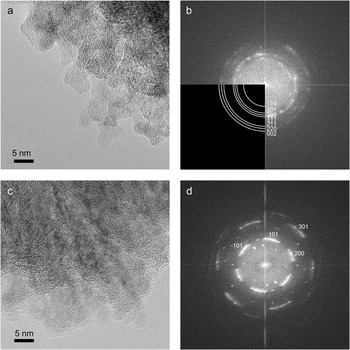
The structure of the nanocrystals and the manner of their aggregation were further characterized using high-resolution TEM images and the corresponding Fourier diffractograms presented in Fig. 7. Both samples show reflections corresponding to rutile. The Triton X-100 sample shows a typical polycrystalline ring pattern [Fig. 7(b)]. Also, several reflections that could be expected from a powder pattern do not appear due to the preferred orientation and the alignment of the crystallites along certain crystal facets. The pattern of the Pluronic F127 sample shows single-crystal-like diffraction pattern indicative of a sample with strong preferred orientation of the nanocrystals in the aggregate. The arcs are indexed with rutile structure of [010] incidence, and some other spots are also observed from small nanocrystallites.
High-resolution TEM images and corresponding Fourier diffractograms of samples made in the Triton X-100 microemulsion system (a) and (b) and in the Pluronic F-127 microemulsion system (c) and (d) clearly showing differences in nanoparticle sizes and their orientation relationships.

The reason for the differences in preferred orientation has not been investigated in detail and is thus not completely understood. In general, the resulting aggregate structure for a nanoparticle suspension will be that which is kinetically and/or energetically favored during the conditions used. Thus, it is the combination of all experimental conditions used and the surface properties of the formed particles that govern which specific aggregate structure that results. A number of key differences between the two studied microemulsion systems hold plausible explanations for the observations made including: (i) differences in adsorption strength of the amphiphile on different facets of the growing crystal leading to nonspherical particle morphologies, (ii) differences in induced surface characteristics of the nanoparticles by the adsorption of the amphiphiles, and (iii) the self-assembling properties of the amphiphile and differences in their sensitivity toward the presence of nanoparticles.
Interestingly, the crystallite size of the products formed with the Pluronic F127 microemulsion was found to be 8 to 9 nm for all samples prepared when determined with x-ray line broadening. Despite the small particle size, most of these samples had a surface area below 100 m2/g, except for those synthesized at 120 °C, which were close to 200 m2/g. The fact that the specific surface area is not correlated with a corresponding difference in crystallite size is consistent with the strong preferred orientation observed during particle aggregation, which limits the accessible surface-to-nitrogen sorption in varying degrees. The discrepancy between the XRD and TEM crystal size measurements may also be due to the strong preferred orientation of the aggregated nanocrystallites resulting in an apparent larger crystal domain size and narrower x-ray diffraction peaks.
The results obtained show that the type of surfactant used in microemulsion-based syntheses has a large impact on the crystallization kinetics of TiO2 as they differ in several aspects compared with earlier results obtained for the Triton X-100 system.Reference Andersson, Kiselev, Österlund and Palmqvist22 Especially noteworthy is that no crystallization is observed at room temperature even at longer time periods using Pluronic F127 in contrast with the Triton X-100 system. The plausible reason for these differences is the expected slower dynamics and reaction kinetics of the bulkier amphiphile system used here. In addition, the composition of the synthesis mixture within the reversed microemulsion region also has a large impact on the crystallization kinetics. At conditions with high viscosity and low water-phase content, the crystallization is very slow or absent, also expected from decreased dynamics and reaction kinetics. The influence of the anion of the acid used on the polymorph formed seems to be generic in nature. A synthesis made at hydrothermal conditions in a mixture of Triton X-100, cyclohexane and n-hexanol using HCl yields rutile while HNO3 gives anatase.Reference Andersson, Österlund, Ljungstrom and Palmqvist8, Reference Wu, Long, Huang, Luo, Feng and Xu27 Using the Pluronic F127 system, similar results were observed at lower temperatures, where rutile is formed at 50 °C using HCl and anatase is formed using HNO3. The small amount of anatase present in the sample prepared using 2.5 M HCl can be understood from earlier studies that show that for a given acid anatase is favored when the H+/Ti ratio decreases.Reference Yuan, Sheng, Zhang, Chen and Anpo28
Since rutile is the thermodynamically stable polymorph of TiO2 and in many cases formed from an intermediate state of anatase or brookite with increasing temperature or time,Reference Andersson, Kiselev, Österlund and Palmqvist22, Reference Yu, Yu, Leung, Ho, Cheng, Zhao and Zhao29, Reference Yu, Yu, Cheng, Hark and Iu30 one could expect that rutile is only formed at temperatures above 120 °C or perhaps after longer time periods. However, there is a temperature window around 50 °C where the formation of rutile is favored. The boundary of this temperature window within the Pluronic F127 microemulsion system seems to be at 60 °C where both polymorphs form. There have been reports showing that anatase is favored over rutile when the crystal size is smaller than 14 nm.Reference Zhang and Banfield31, Reference Zhang and Banfield32 This is not the case in the current study, which supports instead the theory that the crystal structure thermodynamics is highly dependent on the soft wet-chemical surrounding present and offering a high mobility of species during particle formation as well as the interaction with surrounding molecular species present in the solution.Reference Andersson, Kiselev, Österlund and Palmqvist22
IV. CONCLUSIONS
A low-temperature synthesis method to prepare crystalline TiO2 nanoparticles within the Pluronic F127 microemulsion system has been developed. The synthesis route of the nanoparticles is very flexible, and both anatase and rutile polymorphs can be prepared. The aggregation properties of the prepared particles differ from those prepared in the Triton X-100 microemulsion system and result in strong preferred orientation and frustum-shaped aggregates. The development of a synthesis of nanocrystalline TiO2 in the Pluronic F127 microemulsion system enables progress to be made in methods for direct synthesis of meso-ordered TiO2 at low temperatures due to the self-assembling properties of the block copolymer.
ACKNOWLEDGMENTS
E.N. thanks the National Graduate School in Material Science and the Foundation for Strategic Research for financial support. A.E.C.P. thanks the Swedish Research Council for financial support of a Senior Researcher position. O.T. thanks V.R. and the Knut & Alice Wallenberg Foundation for supports.
SUPPORTING INFORMATION
Powder x-ray diffractograms of materials formed at 50 °C during 96 h of synthesis at different positions in the L2 phase and powder x-ray diffractograms of products formed at 50 °C of synthesis as a function of synthesis time using a microemulsion with composition A and 5 M HCl as acid solution.