The documentary Miss Americana (2020) opens with a domestic musical moment as Taylor Swift plays the piano while one of her beloved cats, Benjamin Button, playfully crawls along the keyboard, crossing over Swift's hands, depressing keys with his small paws, and playing along with Swift. This multispeciesFootnote 1 musicking moment sparked the creation and sharing of GIFs, memes, reels, and other short-form internet audiovisual media of Benjamin Button and Swift's intimate musical moments on the set filming her latest music videos from Lover (2019), recording in the studio, and casually playing and listening to music in her home. In some instances, Swift and Benjamin Button co-created their musical soundworlds in the video excerpt, while in other examples their exchanges and interactions with each other are scored to recognizable excerpts of Swift's hit singles. Human listeners have responded in fascinating ways to non-human animal musicking through listening, sensing, and circulating on social media.Footnote 2 Online videos are unexpected spaces where users come to understand the importance of animals, their soundworlds, and our human relations with them.
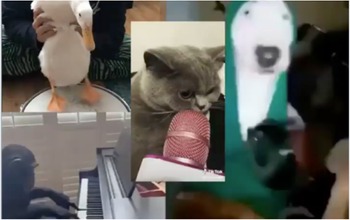
Non-human animal musicking takes a variety of forms across participatory media making by online user-creators on social media: the drumming duck also known as Ben Afquack who performs snare drumrolls with his webbed feet when held and suspended over a drumhead; the percussive clattering legs of a deer drum fill interpolated into Phil Collins's ‘In the Air Tonight’ for ‘In the Deer 2nite’; the visual rhythm of Beyoncé Bird's exaggerated struts that are mapped onto Beyoncé's ‘Crazy in Love’; YouTube videos of Bunny Momo, the pet bunny of Theremin player, vocalist, and composer Carolina Eyck, playing the Theremin by ear, and the virtuosic howling aria of Nico the Border Collie.Footnote 3 These online videos are unexpected, yet significant spaces where social media users develop their understanding of the importance of animals, their soundworlds, and our human relations with them (see Figure 1).
(Colour online) Screenshot of a video compilation collage of well-known pre-existing YouTube, Instagram, and TikTok videos in circulation of non-human animals interacting with instruments and music-making devices posted to a YouTube account that has since been deactivated.

Musicking animals have attained a centrality in our digital world. These participatory videos of non-human animal musicking reveal that when we listen, perform, make, and share with the diverse musicalities of our non-human kin by listening to our ubiquitous sonic interactions with animals across social media platforms, we can nuance our understanding of our complex and entwined interspecies relations. We listen to our sonic environments in order to understand them and how we sonically relate to others in these places, learning to attune ourselves to their large-scale and subtle changes. However, human aesthetic ideals and the ways we sense the world around us shape practices of representing environments and their living and non-living things. Practices of critically listening to sonic environments must extend into our digital environments of everyday life. It is not just a matter of how these animals are transmitted to human listeners, but a matter of content and attuning our listening bodies to the strategies used to format, replay, manipulate, edit, score, and remix the non-human animal for digital consumption.Footnote 4 This article contributes to the study of animal musicalities and the cultural meanings of sounds and movement of both human and non-human animals and the sonic relationships between humans and non-human animals, listening beyond the visual, discursive, symbolic, and tactile encounters between human and non-human animals.Footnote 5 I examine how our digital spaces and screens have become a shared interspecies environment for performance and sound making.
While animal visual culture on internet platforms has been examined as memes, advertisements, and genre and group construction, this scholarship does not address what they sound like and how users listen to them.Footnote 6 Sound and listening is central to the social practices and meaning-making strategies in musicking non-human memes, providing insight into how human listeners perceive, interpret, and respond to ubiquitous forms of non-human musicking that are recorded or staged for circulation on social media. Internet memes are an ever-expanding form of vernacular communication, participatory creativity, and an active space for ubiquitous listening and musicking. This article examines modes of listening to the soundworlds of non-human animals online and the pet sounds of digital culture. Animals and humans interact with each other in many different ways: as pets, livestock, food, costumes, clothing and fashion, and as sources of entertainment. However, humans consciously choose which characteristics are used, valued, changed, or edited out. When species meet online, to follow and extend Donna Haraway in When Species Meet,Footnote 7 I argue that human users and content creators use social media to explore creative opportunities to sound as, listen to, and perform with the music-making paws, hooves, and webbed feet of our non-human animal kin; however, these spaces participatory digital media production and circulation can also facilitate the exploitation and manipulation of the non-human animal.
In this article I frame musicking animal participatory media as a creative space for exploring different approaches to listening, performing with, and scoring sound and music to the behaviour, movement, and acoustic communication of the non-human animal. Memes, reels, and other forms of audiovisual social media posts are a form of cultural expression that reveals the varied ways humans relate to, connect with, and represent non-human animals – especially their pets – through sound, music, and the moving image. By listening to the plurality of musicking animals circulating on social media platforms and networks, I argue that user-creators conspicuously use music and performance to express alternative ideas of what it means to be musical, to feel closer to and connect with the important animals in their lives, and to explore the ways they can represent non-human animals using sound and music to explore musical concepts. I draw from three examples of participatory animal memes to address the relationship between music and non-human animal bodies that human user-creators make, share, watch, and listen to across social media on their devices: Nikolas the opera singing border collie, who inspired a series of participatory duet videos; Lauren the twerking duck, a single digital artefact in the constellation of videos participating in the ‘Vibe – If I Back It Up, Is It Fat Enough’ TikTok dance challenge; and the participatory remix viral remix meme ‘Javelina Running To’. These are all examples of what Paula Clare Harper refers to as ‘viral musicking’, a media theory of digital artefacts that we ubiquitously listen to in our daily lives that draws ‘media theory metaphors of voice and listening into dialogue with musicology, precisely at the intersection of audiovisual objects which are played, heard, listened to.’Footnote 8 In attuning to the musicality of mediated animals, I am asking listeners (listeners who might share or make their own video in response to listening) to go beyond the visual interactions that dominate the regime of cuteness that defines so much of the digital animal experience, to realize our sonic engagement and understanding through non-human living things.
There are a number of ways that human users listen to and represent non-human animal musicking across social media. While some user-creators frame non-human animals as musical by synching pre-existing music to their movements, others record, edit, and share footage of animal communication that sound uncannily similar to human music-making when evaluated by certain listeners using human musical aesthetics. There are also user-creators who stage an animal, most often their pet, in a musical situation, which might include interacting with an instrument or another music-making device typically used by humans to make music. Each of these animal musicking moments might bring us pleasure, but they are also examples of the myriad of ways we anthropomorphize non-human animal movements and sound-making. These videos, however, also reveal the adoption of an alternate way of thinking about musicality beyond the human in everyday life that articulates the complex connections between humans and animals through music and the human understanding of animals in music making.
As Jessica Maddox has argued, the internet's cute economy has produced complicated and increasingly exploitative relationships between people, their pets, and their followers on social media. This is widespread on platforms such as Instagram where the labour, representation, and exploitation of pets results in human gain.Footnote 9 In June 2021, for instance, I began to encounter videos of pet owners manipulating their dogs and cats like marionettes, moving their paws up and down in pantomime performance, air drumming along to the darbuka solo of Artem Uzunov's ‘Melody of a Heartbeat’ on toy drums, pots and pans, and other household items. In one video, a pug in a pink and white onesie with a bright pink bow around its neck stiffly drums along with a disapproving expression on her face. In another Instagram reel, a Nova Scotia Duck Tolling Retriever joyfully drums along on a coffee table, his paw pads softly striking its surface. As I watched and listened across this collection of Instagram reels, I observed cats and dogs that appeared relaxed while moved and held in the laps by their ‘paw parents’. In each video I watched there appeared to be no attempt made by its creator to hide the presence, labour, and intervention of the human puppeteer, who remains in full view in the video frame, staging the air drumming performance, and supporting their pet.Footnote 10
In contrast, there are other musicking animal meme trends that while trying to be funny to receive likes and shares, regularly portray animals that are visibly stressed as evidenced by the tension and rigidity of their legs and paws that resist the movement performed upon them by their owner in time with their music selection. This is the case in the viral animal musicking meme trend where dogs and cats dance to EDM tracks with flashing club lighting post-production effects that transform the owner's basement or living room into a nightclub dancefloor. Moving their paws, tails, and fluffy bellies in time to the beat of a range of original and remixed EDM tracks, their dance movements are synchronized and put into motion by their owners who hold them in place in front of the camera, moving their pets’ bodies and limbs in response to baseline rhythm. It is the intention of the pet owner and video creator of these EDM dancing cat and dog memes to make it appear as though their pet is dancing on its own. That means the human owners attempt to erase both their physical presence and their aural presence as listener-interpreters of the selected EDM track. Even the aforementioned Ben Afquack, the snare drum duck does not drum on his own. He is firmly held by his owner, Derek Johnson, who posted the video to Facebook that shows Johnson holding the duck in the air above a drum, causing the duck to tap its feet on the drum skim as it struggled to ground itself.
Animals have performed for humans as pets, fierce and spectacular sporting competitors, exotic entertainments, skilled companions in seeking and pursuing wildlife while hunting, novelty acts on the screen and stage, and endlessly shared YouTube amusements. In the words of Margo DeMello, ‘Americans love watching animals. We love watching them eat, play, interact with each other, and even sleep. We also love touching them and being as close as possible to them.’Footnote 11 Humans have created and encountered animals as performers in multiple domains for centuries: viewed in the zoo, marine park, and circus, choreographed by expert equestrians to complete a series of moves to music in dressage freestyle events that are built on technical training, rhythm and communication between horse and rider, and trained and bet on as racers and fighters. Fernandez et al. explain that in spite of zoos’ conservation goals, ‘the majority of zoo visitors come, at least in part, for entertainment’.Footnote 12 For example, even though it is necessary to provide a certain amount of idleness and periods of rest for the animals’ well-being, inactive animals are uninteresting to visitors, who report more positively on their visits after viewing animal training demonstrations and interactive feeding time performances.Footnote 13 This is why feeding times are widely advertised on zoo and aquarium maps and on the event announcement boards placed at the entrance and central gathering points (e.g., restaurants and rest stops) between animal exhibits and regional ecosystem pavilions. But what do the animals in these places sound like? We watch them, but do we listen to them? When you go to a zoo or an aquarium you might occasionally hear animal sounds, but they are fairly quiet, or their audibility is conditional on the design of the enclosure and the materials the exhibit is constructed from. The open-air penguin colony at the Boston's New England Aquarium, for instance, offers visitors a sensory overload of pungent scents and the clamorous vocalizations of diverse penguin species and their communication types. In contrast, a bird conservatory, such as the National Aviary in Pittsburgh, is a cacophony of diverse bird song and fluttering feathers. While internet users love to watch and listen to the soft purr of a sleeping cat on their mobile phone screen, they watch more intently and share more frequently when those animals are actively doing something cute, funny, tragic, or unexpected, such as singing, moving along to music, playing an instrument, and performing for us on the screens of our devices.
Sensing and listening to the non-human animal online
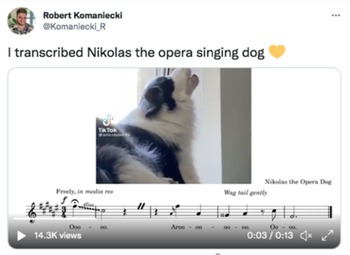
On TikTok in August 2021, I listened to Nikolas the ‘opera singing’ Border Collie's lyrical howls as he performed from the windowsill, in what was later titled ‘Doggo's Lament’ by online listeners.Footnote 14 In the video clip, the dog's impressive vocal range and distinctive singing style is there for all the world to see, with the pet pooch delivering a powerful rendition while curled up on a windowsill.Footnote 15 According to Nico's owners, who posted the original viral video, the adorable one-year-old Border Collie has always been very vocal, ‘singing’ since he was a small puppy first finding his voice. His family also observed that his singing is reactive, prompted by the wailing sirens of fire trucks and police sirens he hears from his favourite perch, the melismatic arias of opera singers on the records played in the house, and other dogs howling, including Nico's mom who also lives in the household. Nico's operatic howls initiated viral circulation, listening, and participatory practices, including an array of remixes. User-creators participated directly with the original video by adding instrumental accompaniment, performing a duet with Nikolas, and even interpreting and notating his performance into Western classical notation, transcribing his libretto (‘Ooo – oo’), adding articulation markings, and assigning musical symbols and terms that highlight his style (‘Freely, in media res’), extramusical performance gestures (‘wag tail gently’), and timbre of his vocal gestures (Figure 2). Reflecting on his transcription process, music theorist Robert Komaniecki shared that he was unable to transcribe the dog's vocalizations without first singing along to the passage himself. ‘So I had to listen to the recording a few times until I could sing along’, Komaniecki explains, ‘then I transcribed my own vocal performance at a keyboard. So I guess the animal transcription was kind of filtered through my own human voice, in a way.’Footnote 16 As one user-creator commented on their piano accompaniment remix arrangement of Nikolas, ‘Found this reddit post and figured it could use some accompaniment.’Footnote 17 When the Dallas Symphony encountered the viral operatic pup echoing across the internet, they heard both an opportunity to expand their audience by reaching new and younger TikTok audiences and a potential for a duet. The Dallas Symphony enlisted their co-concert master, Nathan Olson, to duet with Nico, which resulted in the composition of another version of ‘Doggo's Lament’.
(Colour online) Music theorist Robert Komaniecki's transcription of Nikolas the Opera Dog's TikTok performance shared on Komaniecki's Twitter account in reply to the account We Rate Dogs (@dog_rates) re-posting of the original TikTok video (used with permission).

What is fascinating about the reactions and comments to the original viral video of Nico's operatic howls and participatory remixes that followed, like that of the Dallas Symphony, are the ways users connected with Nico and their anthropocentric interpretations of why Nico is vocalizing in this style. The user Termusica noted that the dog ‘sang a whole octave phrase in minor key with a clear resolution at the end’, adding ‘your dog might be human’. One website that monitors the internet for the next viral video or internet trend introduced the video with ‘It's only a short performance, but it's one loaded with sorrow and turmoil, so much of which hangs on that woeful semitone drop.’ While listeners praised Nico for his inspiring performance, they also focused on their affective responses to Nico's vocalizations, commenting: ‘The pain, the drama, the tragedy’, ‘I'm in absolute tears’, ‘I want this dog to sing at my funeral’, ‘Sings so beautifully … I shed a tear’, and ‘What the sweet doggo must have gone through to bring forth such grief, will remain a mystery’.Footnote 18
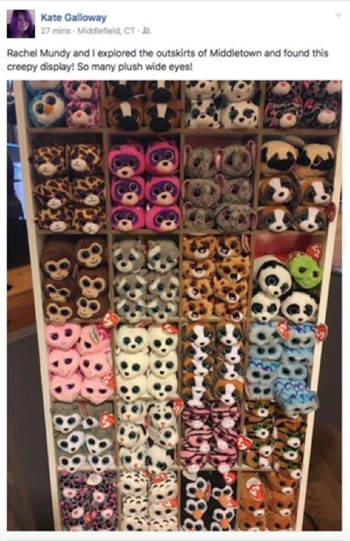
Mediated multisensory explorations and representations of the non-human animal did not originate with videos of dogs’ virtuosic howls – like those of Nico the Border Collie – posted and shared across social media platforms. As Maddox points out in her study of the cute economy of Pet Instagram where images of pets serve as communicative social media actions, the cultural compulsion to engage in the process of anthropomorphizing mediated versions of animals, specifically our pets, is not new. Importantly, these are audiovisual media that communicate through music, sound effects, and species-specific vocality, in addition to their moving images. Some of your own formative sensory experiences, or those of your children, may have been in the form of plush TY animal toys such as this creepy, yet inviting series of display cubicles featuring identical, silent plush toys and their endless eyes gazing right back at you (Figure 3). Or perhaps it was in the form of physical children's animal sound books, including the contemporary ‘Play-a-Sound’ or ‘Read Aloud’ edition of Polar Bear, Polar Bear What Do You Hear? written and illustrated by Bill Martin, Jr. and Eric Carle, that play back sound samples and simulations of the animals pictured on the page, or touch-and-feel books, such as Pat the Bunny.Footnote 19 Widely known, praised, and reprinted multiple times since its first publication in 1940, Pat the Bunny is credited as the first and most popular touch-and-feel book. This tactile reading practice and the memorable texture of the bunny inspired further experimentation across media formats devising new ways of experiencing and understanding animals using our senses. Whether we are reading, feeling, and listening to the sensory media embedded in a children's book or listening to a horse play a jazzy lick on an electric piano, these media provide humans with opportunities to touch, feel, hear, and listen to sonic and material approximations of animal fur, skin, acoustic communication, and even their musicality.
(Colour online) Facebook post of a photo taken of a display of plush TY Beanie Baby animal toys at Lyman Orchards Farm (CT) (photo by author). Personal Facebook account of the author.

Lauren the duck twerks for TikTok
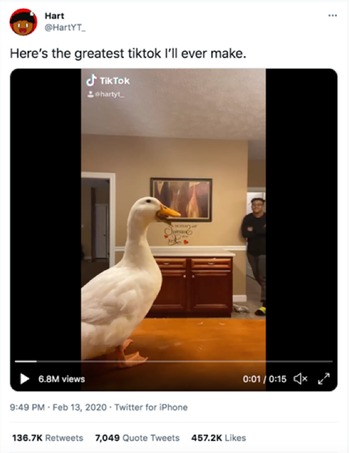
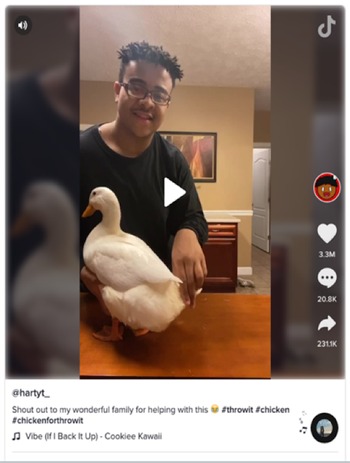
The loud, obnoxious goose of Untitled Goose Game (2019) was not the only viral noisy bird online. As Buzzfeed reported, ‘A Tennessee teen and his duck are bringing joy to the internet, one tail feather wiggle at a time.’Footnote 20 Hunter Clay and his beloved pet duck, Lauren, sparked joy for TikTok viewers as they twerked for Clay's phone camera as part of the ‘Vibe – If I Back It Up, Is It Fat Enough’ dance challenge. Clay described the origin story of his bond with Lauren: ‘My brother, when he was 16, he had just gotten his first pay check and he saw that Tractor Supply Co. was selling ducks, so he bought the duck.’Footnote 21 After his brother left for college, Lauren came into Clay's care. ‘Me and the duck just got like really close’, he said. ‘I'd say she likes me most.’Footnote 22 Clay and Lauren's multispecies intimacy is archived and performed in a number of videos shared to Clay's TikTok account, but it was the video of Lauren twerking with Clay and his family that went viral (Figure 4).Footnote 23 On 13 February 2020, Clay posted a TikTok video of himself dancing with Lauren and his family to Cookie Kawaii's ‘Vibe (If I Back It Up)’ in a versioning of the ‘Vibe – If I Back It Up, Is It Fat Enough’ TikTok dance challenge originated by 22-year-old Mikeila Jones,Footnote 24 sharing his original video across social media platforms.Footnote 25 Lauren is placed in the foreground as the star of their multispecies dance troupe.Footnote 26
(Colour online) Twitter screenshot of the opening of Clay and Lauren's ‘If I Back It Up, Is It Fat Enough’ dance challenge video.

The excerpt of ‘Vibe’ used in the ‘Vibe – If I Back It Up, Is It Fat Enough’ dance challenge that appears in Clay's TikTok post features crisp, playful sound effects, including a whip cracking and two different samples that resemble bird vocality: one resembling a duck and another that sounds similar to a crow. The 15-second video opens with Lauren waddling onscreen from the left-hand side of the camera frame while Clay looks on, arms crossed as he leans against a wall on the right-hand side of the camera frame. The video editing applied to the visual gesture of Lauren's beak opening and closing to produce a squawk is synchronized with the bird sound samples in the song well before her tail feathers wag and flutter along to the drum machine pattern once it enters the mix. Clay's video editing techniques recontextualize Lauren's bodily movements as musical when he lines up moments in his video footage with an excerpt of Kawaii's ‘Vibe’. Clay's editing choreographs Lauren's squawks, her feather flutters, and his own dance moves (as well as those of his family who join in at the end) to musical features of ‘Vibe’ that are audibly highlighted in the mix: the samples of bird calls and the drum machine pattern.
The process of musicalizing Lauren through digital video editing and the staging and manipulation of Lauren's body is also a calculated presence in the final video. Towards the end of the video when Lauren's tail feathers are synchronized to the track's drum machine gesture, there is an audiovisual disconnect between Lauren's beak and the bird sounds sampled in the song. We hear the squawks, but Lauren's beak does not open and close, revealing to the viewer-listener that these squawk samples are a part of the original track and Lauren was never squawking along to the song. The viral choreography and video editing creates moments of audiovisual synchronicity as the soft quack-like sounds sampled in Kawaii's track are aligned by Clay during the video editing process with the opening and closing of Lauren's beak. These samples become even more duck-like when heard alongside Lauren's movements and beak-syncing. Even though the fowl-like samples viewer-listeners hear are not performed by this duck on the track, these moments in Clay's TikTok editing recast Lauren as a featured performer on ‘Vibe’, redistributing musical agency to the non-human sample. The co-presence of synchronized and unsynchronized bodily and vocal choreography highlights the role of human aesthetic interpretation, filtering, and editing that takes place in representing the non-human animal, including the process of making a musicking animal TikTok video.
Clay recirculated the video on 6 April 2020 during the COVID-19 pandemic, proving digital pleasure for his followers as the video went viral for a second time. As Harper has noted in her talk ‘(Corona)Viral Musicking: Sounding Sanitation and Social Distance from Perotin to Cardi B’ for the series Music Scholarship at a Distance, the intersection of viral musicking and viral pandemic content was a productive site for amateur internet video making, circulation, and performance.Footnote 27 These media texts included hand washing memes, corona cover versions, Cardi B coronavirus musicalizations, and even autotuned remixes of Prime Minister Justin Trudeau ‘speaking moistly’ in footage from a COVID-19 press conference.Footnote 28 On 21 June 2020, Clay launched the Facebook page ‘Same video of guy dancing with his duck everyday’ @sameduckandguydancingeveryday where he continued to repost his TikTok video on a daily basis, ensuring his video remained in circulation. He made his first post on 23 June and as of writing, continues to repost. ‘More and more people have been retweeting it. I've seen messages like the world is going through a tough time right now so here's something positive’, said Clay.Footnote 29
It is Clay who stages Lauren, places her in a musical situation, and performs the duck, activating Lauren's duck twerking for the pleasure of his followers. ‘If you touch [Lauren's] tail feathers, she'll shake them, like twerking. And my brain just connected the dots’, he said.Footnote 30 He positions her as a natural performer on social media. ‘The duck was surprisingly photogenic with the video’, said Clay. ‘She was really well behaved throughout the whole thing.’ Viewer-listeners watch the flick of Lauren's tail feathers and their synchronized flutter with the urgent shaking rhythm track of ‘Vibe’. Clay heard a correlation between the line ‘If I back it up, is it fat enough’ and the noisy fluttering of Lauren's tail feathers and recorded a TikTok for the popular ‘Vibe’ challenge (Figure 5).Footnote 31 Unlike other popular TikTok songs such as ‘Renegade’, ‘Stay’, or ‘Stayin’ Alive Mashup’ set to a mash-up 50 Cent's ‘In Da Club’ and The Bee Gees’ ‘Stayin’ Alive’, there is no single prescribed dance or skit for ‘Vibe’ response videos.Footnote 32 At the time of writing, over half a million TikTok videos are posted to this soundtrack, many of which incorporate TikTokers twerking, throwing it back, and animals shaking their fur and feathers to ‘Vibe’.
(Colour online) Twitter screenshot of Lauren the duck “Twerking” from a TikTok video posted to Clay's @hartyt_ account.

Javelina ‘Running Up That Hill’ and across Twitter
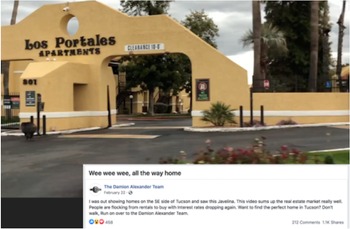
There is a blur of greyish-brown bristled fur, legs splayed out in full gallop, and visible air between the javelina's body and the ground that he barely touches as he bounds across the grass and pavement zooming along the side of the Los Portales apartment complex. We do not know why this javelina was running, shredding its way through Tucson, Arizona, but as we watched on Facebook, Twitter, and Instagram, we saw the javelina running with grace, joy, and pure abandon. On 24 February 2020, real estate agent Damion Alexander shared to Facebook personal mobile phone footage of a javelina running near East 22nd Street and Kolb Road in Tucson (Figure 6).Footnote 33 The video begins as a javelina runs alone across the pavement and grass in front of the entrance to the Los Portales Apartments, as a soft, encouraging voice in the background whispers, ‘keep going, keep going buddy’. The javelina sprints down the side of the road, unprovoked, but at a quick pace with a bounding gait. This javelina has somewhere to go, but no one is going to rush him.
(Colour online) Facebook Video from The Damon Alexander Team account that was also re-tweeted out featuring the original javelina running video.

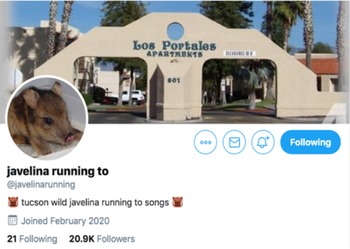
Following Alexander's Facebook post, the video of the javelina running went viral and it was reinterpreted as a musical remix video meme. This is a meme genre where user-creators remix the original video by re-scoring the moving image with a new soundtrack drawing on a range of pre-existing musics. Local news outlets quickly picked up this viral video event, including reporter Hannah Tide who shared the video on Twitter.Footnote 34 As the video continued to go viral over the course of the day, user-creators continued to share the video, but they also crafted new versions of Alexander's video, adding music to the video clip and synching the javelina running along to diverse selections of current and iconic popular songs, including ‘Running Up That Hill’ by Kate Bush.Footnote 35 During this time, the Twitter account ‘Javelina Running To’ @javelinarunning dedicated to this viral remix meme was created by 19-year-old New Orleans teen Teddy Duvall-Martin (Figure 7).Footnote 36 As one post to the ‘Javelina Running To’ Twitter account read, ‘The javelina runs fast and free, untethered to pedestrian notions of “fitness goals”. Perhaps the javelina runs in a way you wish you could? With pure abandon? The way you imagine you might, every time you lace up the ol’ sneakers?’Footnote 37
(Colour online) Twitter screenshot of the @javelinarunning'Javelina Running To’ account. The account has since been suspended.

From 25 February until roughly 1 March 2020 in the opening weeks of the COVID-19 pandemic in the United States, viewer-listeners swiped, shared, and listened to their screens as the javelina ran along to their favourite (and sometimes unexpected) bangers. As HuffPost reported, ‘Don't stop him now, he's having a such good time!’Footnote 38 Even when the account @javelinarunning took a hiatus from making and collecting videos, followers of the account continued the creative labour of re-scoring javelina running footage to popular music selections.Footnote 39 One viewer-listener even curated a Spotify playlist that contained all the songs the javelina had run to, adding new entries as the playlist creator discovered new versions of the remix meme. Listener-recommenders expressed their love for the account with sentiments such as ‘I didn't know I needed this’, ‘so graceful’, and ‘javelina is just being javelina’, and through participatory online performance of making music recommendations in the comments of new posts. These music recommendations and creative reworkings either synchronize effectively with the pace, energy, and spirit of the javelina's movements or create humorous mis-matched audiovisual mash-ups as human listeners interpret the javelina's actions and assign species-specific behaviour specific musical styles and genres.
The participatory remix meme ‘Javelina Running To’ ran along to clips of pre-existing music spanning a variety of genres. Twitter users were invited by the @javelinarunning account to make song requests to soundtrack the video clip to an array of musical requests. As you scroll through the account, the same video clip is re-scored to different styles of music that alter the perception of the video, specifically the movement of the javelina, the kinds of emotions Twitter users map onto the javelina, and our affective response to the video as human viewer-listeners. These requests ranged from the Queen's ‘Don't Stop Me Now’ to the Beastie Boys ‘Sabotage’, from Robyn's ‘Dancing on my Own’ to David Bowie's ‘Modern Love’ and from Tiffany's ‘I Think We're Alone Now’ to Rebecca Black's ‘Friday’ (which a user posted on a Friday). The javelina runs carefree, exuding an independent spirit with the wind in its hair; however, the momentum and pace of the javelina and the way we related to the animal shifts when set to the Beastie Boys’ ‘Sabotage’, as listeners cross-reference it against the frenetic camerawork and the renegade actions of the band members working undercover in the iconic music video.
User-creators only have to remove or mute the audio from the original video and replace it with an excerpt of new audio, most often a piece of pre-existing music, such as a song from their personal collection of MP3s or one that they downloaded online. When combined, the javelina's running, movement, and perceived attitude accumulates new meanings and associations that the song has gathered from the previous contexts in which the user-creator has heard the song. This audiovisual mash-up practice is ubiquitous on social media, but there are conflicting perspectives in the mash-up community concerning labour and creativity as new tools that make editing images and sound faster and less technically demanding are made widely available. For some user-creators, mash-up culture can be a low-effort, high-reward form of participation in digital remix culture that does not require the user-creator to learn and perfect an array of audiovisual editing skills and can be done using a variety of paid-for or freeware editing programs. Other mash-up practitioners view the mash-up process as an intricate, highly creative, and innovative method of working with the accumulated meanings embedded in pre-existing materials, which demands considerable effort on the part of the creator. Despite these contrasting views and approaches to the creative practice, both factions of mash-up culture place value on the user-creator's skill selecting pre-existing audiovisual materials and their ability to manipulate and recombine sounds and images containing pre-existing references to say something new.
‘Javelina Running To’ is not just a video remix meme, it is also a ‘Sound On’ or ‘Unmute This’ meme style that encourages circulation and active interaction with the meme by inviting the user to listen. A text prompt watermark on the video or notes from other users in the comments instruct users to turn the ‘Sound On’ and ‘Unmute This’ to hear what song the javelina is running along to. You follow the creator and other users’ advice and tap your screen to unmute the video. This bodily technique of tapping the screen to turn on the sound and access the sonic information of the video meme reveals the javelina running to a song that the user has probably heard before in another context and now those associations are mapped onto their audiovisual experience of the javelina. In the future, when they hear the song once more, they will likely picture the javelina bounding down the road outside the Los Portales apartment complex. If they scroll through their Twitter feed or start to follow the ‘Javelina Running To’ account, they will compare this remix to the music the javelina runs to in the remixes made before and after the first one they ever listened to. These processes of musical and memetic recall and remembrance through sharing and sensing, and listening to versioning of the javelina video are examples of what Braxton Shelley calls memetic practices of ‘digital antiphony’, an online audiovisual ecology of digital artefacts where each item provides its interpretation of the meme, recalls previous versions, and participates in ‘projecting its possible futurity’.Footnote 40 As I listened to these videos, watched the javelina run, and observed the songs suggested by users, I considered what made these videos so satisfying that they received participatory internet listening from fans of both the account and the original viral video. One user-creator leaned into the extramusical references afforded by their musical choice as they shared a version set to ‘Moon Theme’ from the DuckTales (Nintendo, 1989) video game. ‘Moon Theme’ is level music composed by Hiroshige Tonomura as the background extradiegetic scoring for the fifth stage of the game, which is set on the moon.Footnote 41 Only by turning the sound on and listening to this video post are the layers of the audiovisual palimpsest revealed.
The musical ecologies of participatory remix memes such as ‘Javelina Running To’ are not that different from compilation film scores, where unlike an original score the music is composed specifically for the film it is used in – a compilation film score re-purposes pre-existing music composed for other purposes. Thus, the music used in a compilation score brings to the film all the meanings and memories associated with a piece of music that a viewer has accumulated from previous listening contexts. As Anahid Kassabian argues, the compiled score can offer ‘affiliating identifications’ for viewers that ‘depend on histories forged outside the film scene’, presenting a collision between a song's existing sociocultural meanings and the meanings of the images and narratives with which it is joined.Footnote 42 Even though each video re-uses identical footage of the same javelina bounding down the side of the road, the nature of the javelina's movements and user-creators’ affective response to the javelina's motivation for running and their interpretation of the animal's choreomusicality shape the user-creator's remix response to the original video, previous versions of the meme, and how they choose to relate and represent the animal. Their remix video meme is individualized not only through the musical features and pre-existing uses of the music sample synched to the video, but also through the user-creator's pre-existing associations with the selected song and the indexes and meanings on the part of the viewer.Footnote 43
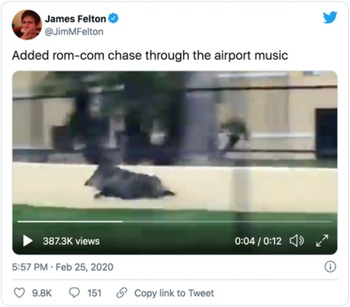
As Harper has examined, ‘Sound On’ or ‘Unmute This’ videos instigate viewer-listeners’ participation through the use of the ‘Sound On’ or ‘Unmute This’ directive, with the implied promise that this modest user labour will result in a sonic surprise and a satisfying listening experience that will encourage the user to re-listen and recirculate the meme.Footnote 44 As I scrolled down my Twitter feed I elected to turn the sound on, or unmute certain videos when I wanted to experience how the genre, instrumental arrangement, lyrics, or extramusical meaning of a song would shape my perception of the javelina, its gait, and its attitude. When I listened to the javelina running alone along to Robyn's ‘Dancing on My Own’, I interpreted and heard the javelina's movement as independent, carefree, and ready to take on the world. I scrolled down to the next video in my feed to a post where the user added an excerpt from the climax of the track ‘PM's Love Theme’ composed by Craig Armstrong from the soundtrack of the romantic comedy Love Actually (2003) during the infamous airport chase scene (Figure 8). I asked myself if the javelina was chasing after the love of his life just like young Sam chased after Joanna to her airport gate in order to declare his love before her flight departed. The text invitation in the post title or the comments to unmute, pause their social media scrolling, and listen, and the promise audiovisual satisfaction by other users on the platform stages affective intertextual encounters among human listeners, the non-human animal, and popular music to make the user-creator smile.
(Colour online) Twitter screenshot of the ‘Javelina Running To’ remix video meme using ‘PM's Love Theme’ (airport chase scene music) composed by Craig Armstrong from Love Actually (2003) in reply to a post of another remix to the @javelinarunning Twitter account by its owner.

Epilogue
Dogs howling in an operatic style, Lauren the duck twerking to ‘Vibe’ with her family, and a wild javelina running along the street to a catalogue of popular music hits are digital artefacts featuring musicking animals that circulate online and operate as virtual animal menageries.Footnote 45 Musicking animal memes are part of what Jody Berland calls the ‘virtual menageries’ of the internet, digital spaces and screens where human user-creators make, share, watch, listen to, and mediate the non-human animal, paying special attention to the representation of the domesticated animals in their family.Footnote 46 The history of the term ‘menagerie’, as Thomas Veltre explains, highlights its purpose for ‘not only containment, but, in a sense, domination and control as well’.Footnote 47 Similarly, as Eduardo J. Fernandez et al. observe, the modern zoo is multifunctional, participating in ‘animal welfare, conservation, education of the public, research, and entertainment’.Footnote 48 As Berger explains in About Looking, stuffed animal toys began production in the nineteenth century alongside the creation of public zoos, ‘and the most expensive were covered with real animal skin’.Footnote 49 Veltre also examines how animals functioned in printed books: ‘it might be said that scribal culture's menagerie animals were treated like stained glass windows in a cathedral, iconic reminders of stories to be contemplated’, entertaining us, ‘while print culture's menagerie animals were treated like books, to be studied, classified, and compared in minute detail’.Footnote 50 Regarding sonic culture, as musicologist Rachel Mundy has asserted, ‘When it comes to animals, natural history has traditionally been a practice of looking: looking in the field, in zoos, in museums, and in research collections’, rather than listening. Sound, however, ‘occupies a special place in our reception of the non-human animal’.Footnote 51 The internet and its dense network of audiovisual animal memes is a virtual menagerie where human/non-human relations are mediated, and ideas of musicality and the sonic representation of the non-human animal is explored through acts of listening, creating, and sharing animal musicking digital media.
The interdisciplinary field of animal studies has long struggled with the histories of living animal contexts and human/non-human relations in varied contexts, including zoos, circuses, menageries, petting zoos, sporting events, literary narratives, picture books, field recording, cross-species performance, and on screen in films, nature documentaries, video games, and internet viral videos and memes. As Nigel Rothfels writes, ‘an animal or species is as much a constellation of ideas (for example, vicious, noble, intelligent, cruel, caring, brave) as anything else. And, as with history itself, each generation seems to remake its animals.’Footnote 52 When children pet the fabric and faux fur glued to the cardboard pages of a touch-and-feel children's book, such as the classic Pat the Bunny, they do not feel the actual fur and hide of the animal on the page. Even if the faux bunny fur is replaced with the pelt of an actual bunny, the user still does not feel the warmth of the animal's body and haptic rhythmic pulses and pumps of blood through their bodies. Similarly, when users scroll through their social media feeds, unmute a video of a cute cat completing an ascending C major scale played on the piano by its owner with a perfectly placed and in tune meow, or listen to the sounds animals make in a musical context or the music juxtaposed against their moving image to represent their gestures and behaviour, there are obvious limitations to how human listeners can fully sense and know the non-human animal. However, by entering into these experiences, engaging with multispecies media, and reflexively critiquing the representational strategies used to frame animal musicking, online viewer-listeners can learn to sound, listen, share, scroll, and relate with increased understanding of their own complex relationships with non-human animals in their actual and virtual lives.